
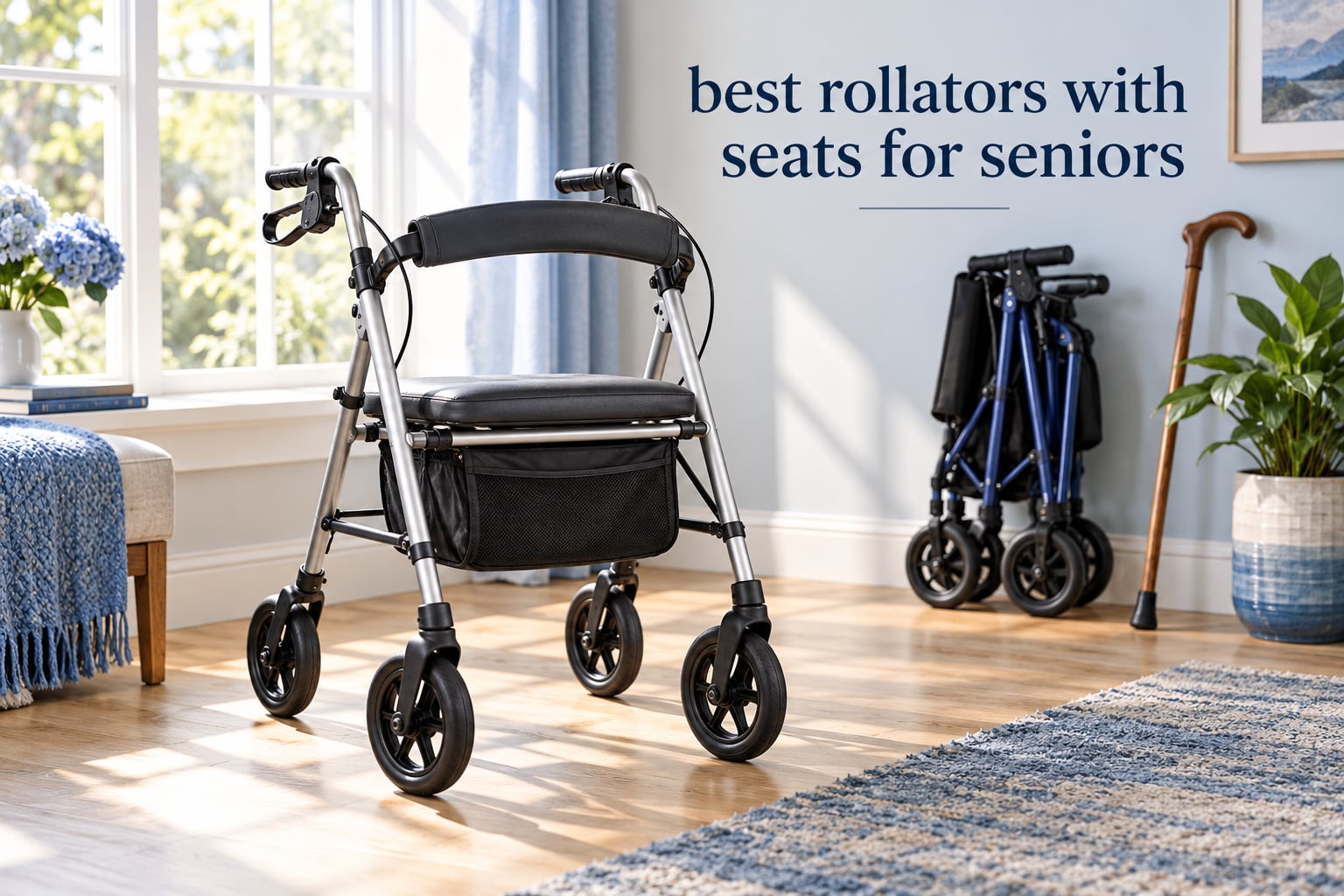
A rollator is a four-wheeled walking frame with hand brakes, a padded seat and a storage basket that you push rather than lift. It lets you walk with support, conserve energy, and sit down whenever you need to rest. For most seniors who can walk but tire quickly, that combination is the single most useful mobility upgrade available.
Picking the best rollators with seats for seniors is not a matter of finding the highest star rating. A rollator that suits a 5 foot 2 user who walks on carpet and smooth sidewalks can be a poor match for a 5 foot 11 user who crosses gravel every day. The type, the fit and the brake feel decide more than the badge on the box.
That is how we approached this guide. We read the published specifications for 10 of the most reviewed rollators in the category, then cross-checked those specs against tens of thousands of aggregated owner reviews to see which ones hold up in real homes, on real sidewalks and in real car trunks. We did not lab-test these units ourselves, so nothing here should be read as a hands-on performance claim. Every rating and review count below is copied from the live listing.
Start below with the fit check, because a rollator is the wrong tool for some people. If the check passes, the ten picks that follow are ordered so that the general-purpose choice comes first and the specialist choices follow.
Table of Contents
Is a rollator even the right device? Five cases where it is not
Not everyone should use a rollator walker with seat. A rollator works because you push it and control it with your hands, which means you need enough grip strength to work both brakes and enough balance to manage four rolling wheels. Several groups are safer with a different device or with a professional fitting.
You need to lean your full weight into the frame. A standard pickup walker with two front wheels and two rubber tips cannot roll away from under you, so it supports heavier loading. Most physical therapists recommend it for anyone who cannot keep the rollator moving.
Your hands are too weak to squeeze a brake lever. Stiff, high-effort brakes are the most commonly reported usability failure on rollators. If you cannot slow the device with a loose grip, a rollator becomes a hazard rather than a help, and an occupational therapist should test brake effort with you first.
You use stairs regularly. A rollator on stairs is a fall risk. Nothing in this roundup is designed for stair climbing, and no amount of careful handling changes that.
You want hands-free support. A cane leaves one hand free, and a forearm-supported upright rollator takes the load through your forearms instead of your wrists and shoulders. That is a better fit for anyone with back or shoulder pain from walking hunched over.
Most of your travel is long distances without rest breaks. A wheelchair or transport chair is far less tiring over a long outing. A rollator is built for the trip and the rest, not the marathon.
If none of those describe you, keep going. Falls are the leading cause of fatal and nonfatal injury in adults 65 and older, and a correctly fitted rollator adds stability, conserves energy and provides somewhere to sit, which keeps someone walking farther and more often.
Top 3 Rollator Picks for 2026
The three below cover the widest range of needs. The Drive Medical steel-frame model is the one we would put in front of most parents. The Medline steel rollator is the strongest value when capacity matters. The Drive Medical Nitro is the one to buy when wheel size and folding convenience beat price.

Drive Medical 7.5 Inch…
- Steel frame
- 300 lb class build
- 20 lb product weight
- Padded seat and fold-down backrest

Medline Steel Rollator 350 lb
- 350 lb capacity
- Push-up brake and push-down lock
- 12 x 12 inch padded seat
- 16.5 lb frame

Drive Medical Nitro Euro-St…
- 10 inch front casters
- One-hand fold with locking tab
- Tool-free handle and backrest adjust
All 10 Rollators Compared in 2026
Specifications below are taken from the manufacturer listings. Product weight matters more than most guides admit, because the caregiver is often the one lifting it into the car.
| Product | Specs | Action |
|---|---|---|
| Drive Medical Rollator Walker with Seat, 7.5 Inch Wheels |
|
Check Latest Price |
| Medline Steel Rollator Walker with Seat, 350 lb Capacity |
|
Check Latest Price |
| Drive Medical Nitro Euro-Style 4-Wheel Rollator |
|
Check Latest Price |
 VOCIC Z21 Rollator with 8 Inch All-Terrain Wheels VOCIC Z21 Rollator with 8 Inch All-Terrain Wheels |
|
Check Latest Price |
 Drive Medical Aluminum Rollator Walker, 6 Inch Wheels Drive Medical Aluminum Rollator Walker, 6 Inch Wheels |
|
Check Latest Price |
 HOMLAND Foldable Rollator with 16 Inch Extra-Wide Seat HOMLAND Foldable Rollator with 16 Inch Extra-Wide Seat |
|
Check Latest Price |
 Hugo Elite Rollator Walker with Seat and Basket Hugo Elite Rollator Walker with Seat and Basket |
|
Check Latest Price |
 Helavo Extra Wide Bariatric Rollator, 550 lb Capacity Helavo Extra Wide Bariatric Rollator, 550 lb Capacity |
|
Check Latest Price |
 Medline Superlight Folding Aluminum Rollator Medline Superlight Folding Aluminum Rollator |
|
Check Latest Price |
 Stander Space Saver Lightweight Folding Rollator Stander Space Saver Lightweight Folding Rollator |
|
Check Latest Price |
1. Drive Medical Rollator Walker with Seat, 7.5 Inch Wheels – Best Overall
Drive Medical Rollator Walker with Seat, 7.5 Inch Wheels, Blue
Steel frame
7.5 inch wheels
20 lb product weight
Padded seat with fold-down backrest
Pros
- Most established model in the roundup with over 51000 reviews
- Steel frame described as durable by owners
- Arrives nearly assembled and sets up in minutes
- Under-seat pouch for a purse or mail
- One person can lift 20 lb into a car
Cons
- Backrest is a basic foam-covered tube that is uncomfortable for long leans
- Folding can be awkward and the frame can open slightly when lifted
- Brake cable and clip hardware feel light-duty for the frame weight
When someone asks me for one rollator to recommend to a parent, this is the model I point them at first. It has been on the market since 2011, and with more than 51000 owner reviews behind it, patterns of failure are well documented and rare. That matters more than a newer model with a slicker feature list.
The steel frame is the reason. Owners consistently describe it as sturdy and well built, and the 7.5 inch casters roll smoothly across carpet, wood floors, grass and outdoor surfaces without feeling twitchy. Setup takes a few minutes because it arrives nearly fully assembled.
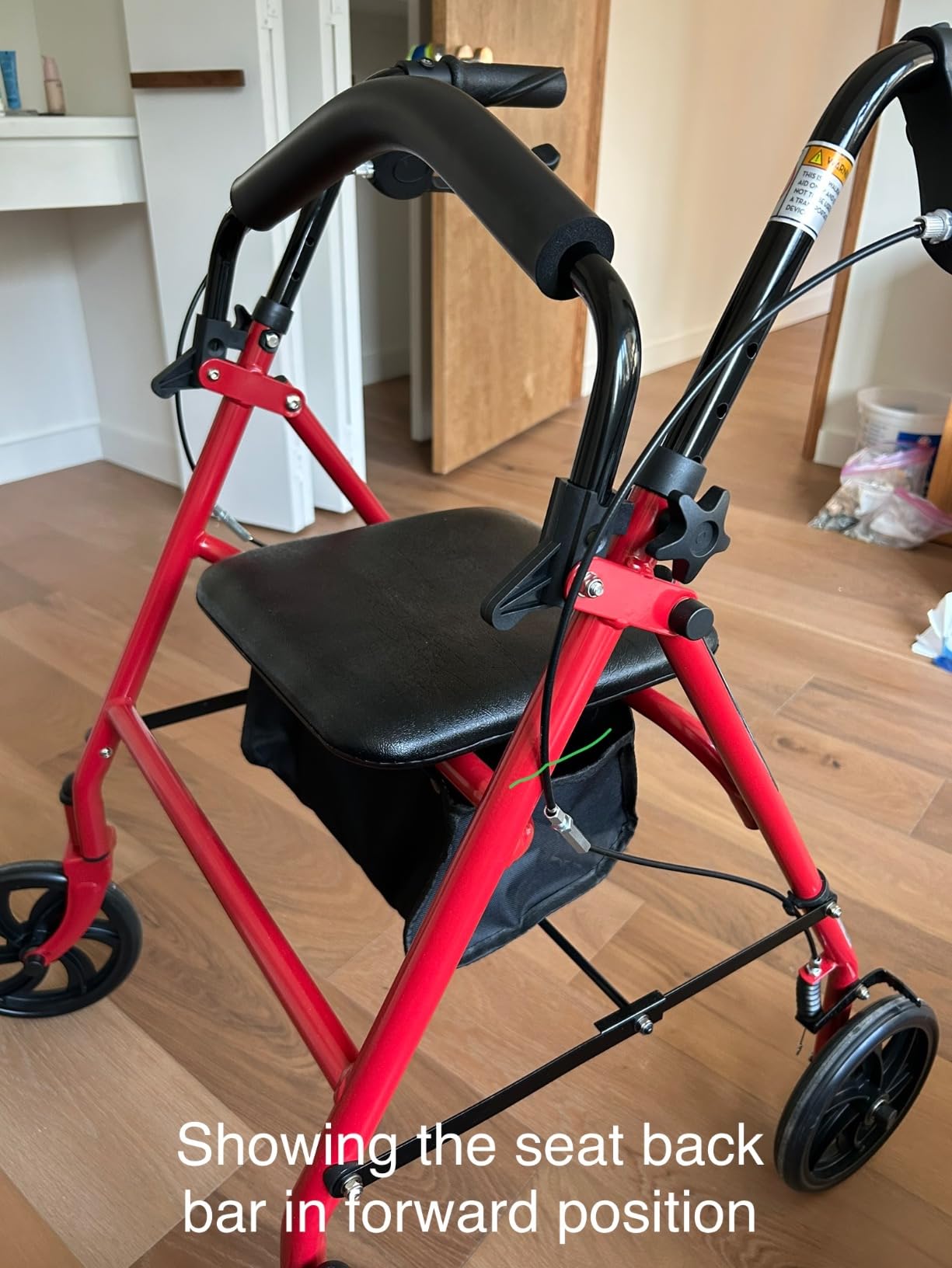
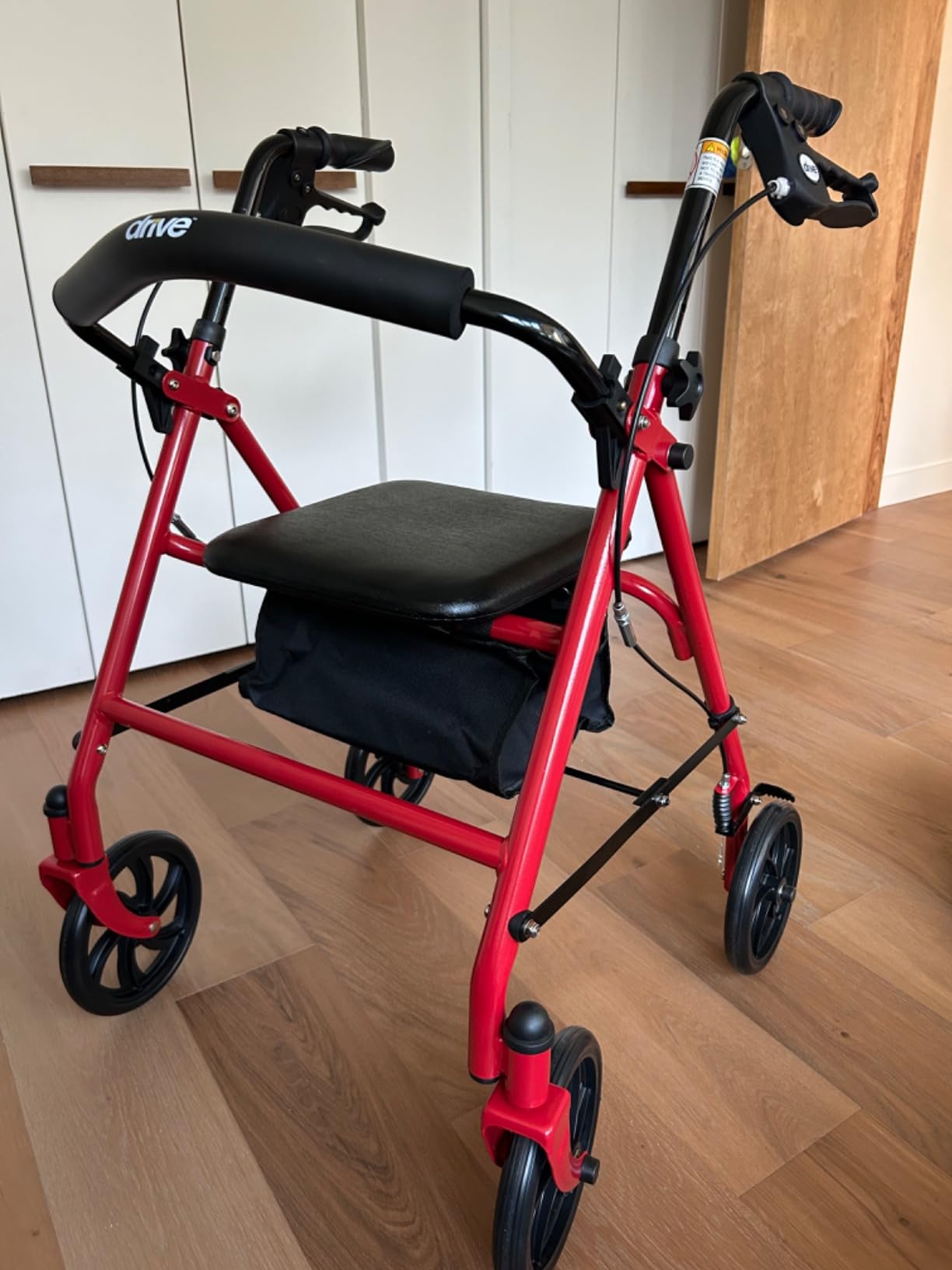
Two details do more for most buyers than any spec on the page. The padded seat and back support give a genuine place to rest mid-walk, and the under-seat pouch holds a purse or the mail so hands stay on the handles. Height adjustment on a lever lets you fine-tune grip position without tools.
The recurring criticism is the backrest. It is a foam-covered tube rather than a padded panel, and owners say leaning on it for a long rest is uncomfortable. Folding is functional but not elegant, and some buyers note the frame can spring open slightly when lifted by the seat.
Who the Drive Medical 7.5 Inch Wheel Rollator suits
This suits a general-purpose indoor and light-outdoor user who wants a device that has been proven over years rather than weeks. It is a good match for mixed surfaces, for households that keep one rollator by the door and one in the car, and for anyone who values a simple mechanism with few adjustment points.
It is also the safest default for a first purchase. When a family is unsure what type they need, this is the least risky bet.
Where the Drive Medical 7.5 Inch Wheel Rollator falls short
It is not the right pick for someone who wants a wide seat or whose handle range is above the standard 35 inch ceiling, because there are models here that go higher. It is also a poor match for a caregiver who cannot comfortably manage 20 lb, or for a user who sits down for long periods and needs real back support.
2. Medline Steel Rollator Walker with Seat, 350 lb – Best Value
Medline Steel Rollator Walker with Seat, Burgundy, 350 lb. Weight Capacity, 6” Wheels, Foldable, Adjustable Handles, Rolling Walker for Seniors, Walker for Mobility Impaired
Steel frame
350 lb capacity
6 inch wheels
16.5 lb frame
Handles 31-35 inches
Pros
- 350 lb steel rating is well above most aluminum rivals
- Push-up brake and push-down lock are easy for weaker hands
- 12 x 12 inch padded seat and matching backrest
- Under-seat storage compartment
- Frame folds down for storage
Cons
- 6 inch wheels are weaker over rough terrain and thresholds than 8 inch models
- Steel frame is heavier than comparable aluminum rollators
- Seat and backrest padding is basic rather than contoured
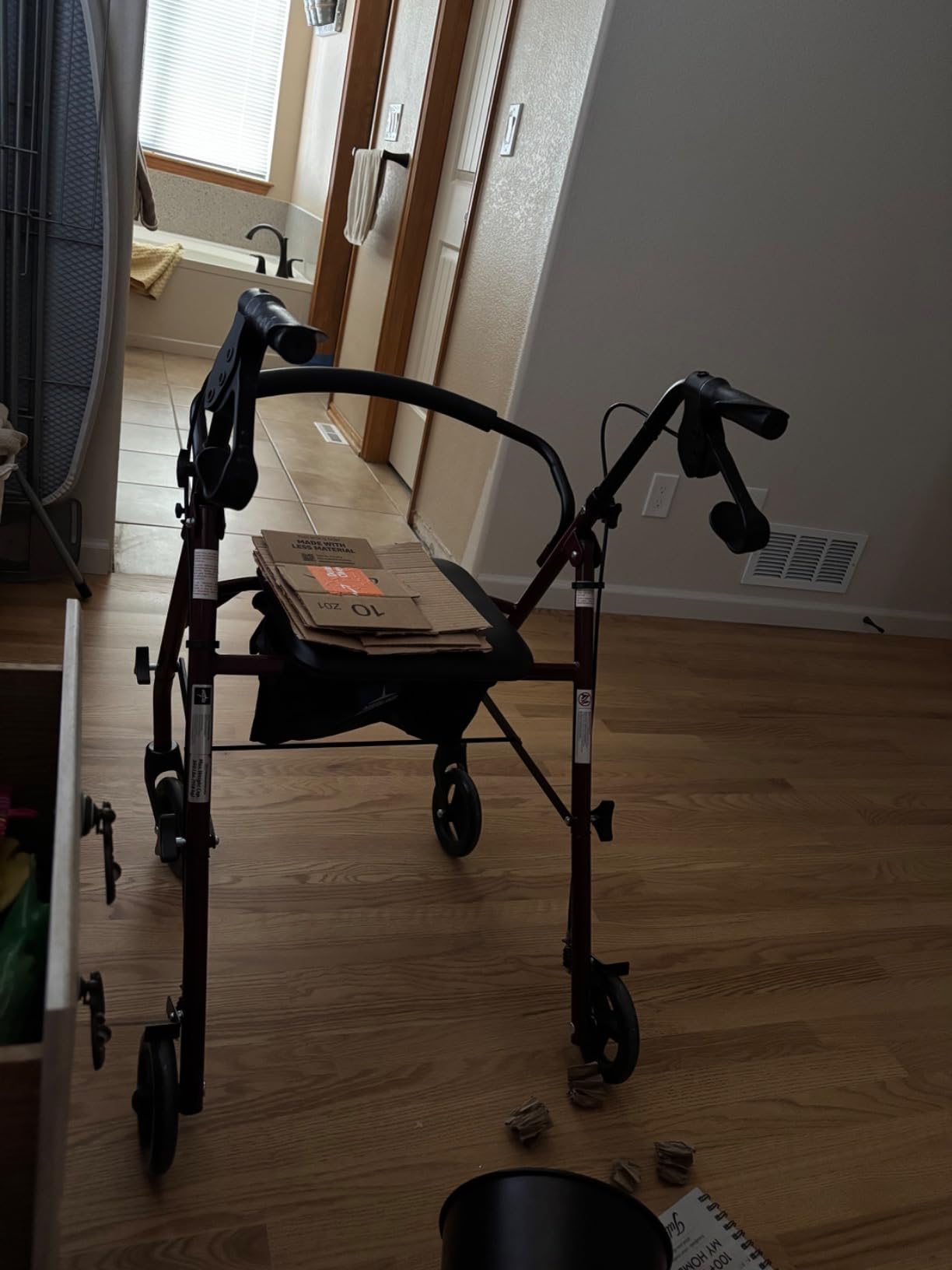
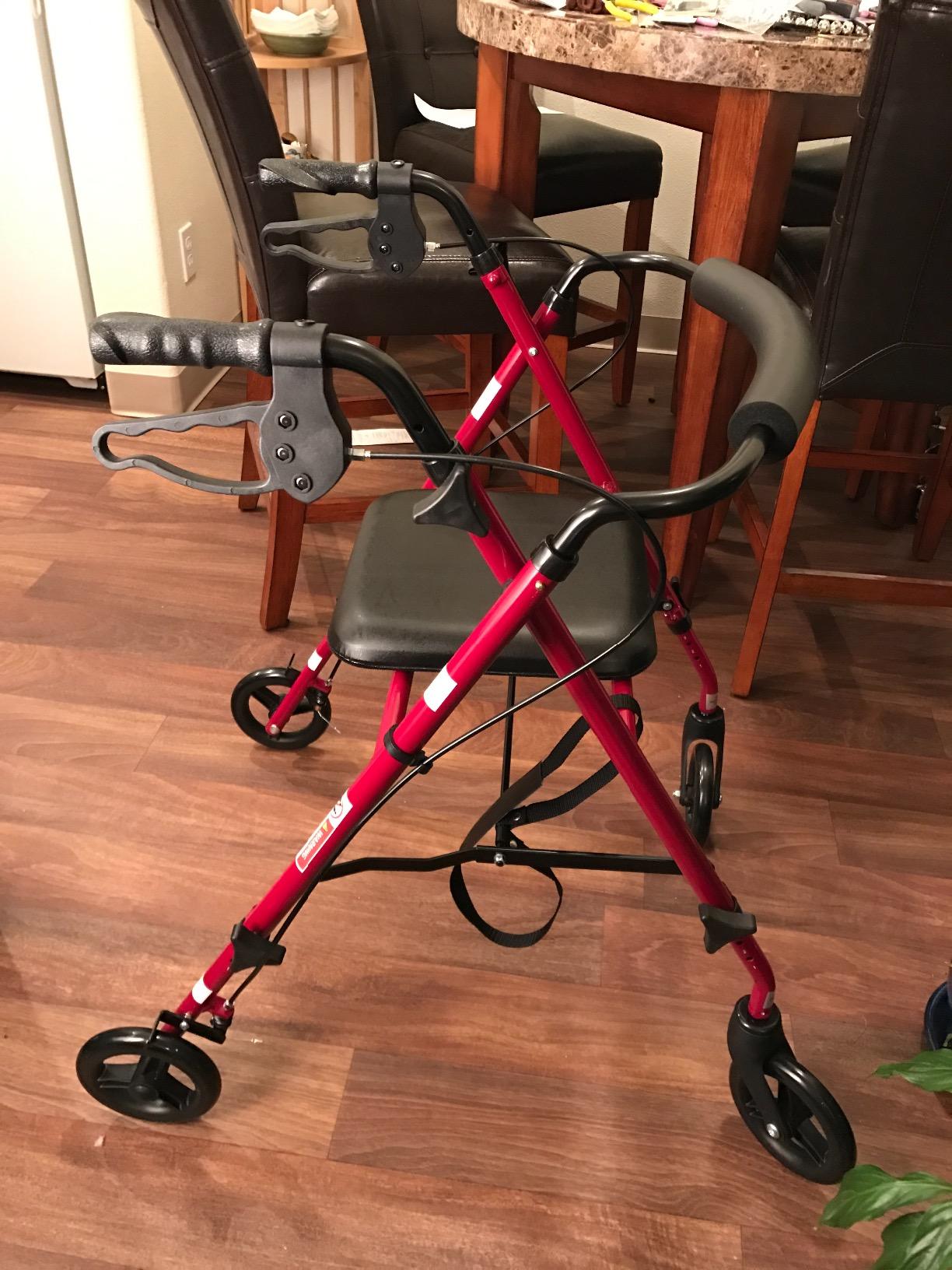
This is the rollator that owners describe as the durable, cheap workhorse, and the 350 lb steel rating is the reason it wins the value slot. Buy an aluminum model rated to 300 lb for a user who weighs 280 lb and you are running the frame near its limit from day one.
The brake design deserves specific attention. You push the handle up to brake and push it down to lock the wheels, and owners with arthritic hands single this out as easier to operate than small lever brakes. The 12 x 12 inch padded seat and matching backrest are unremarkable but adequate.
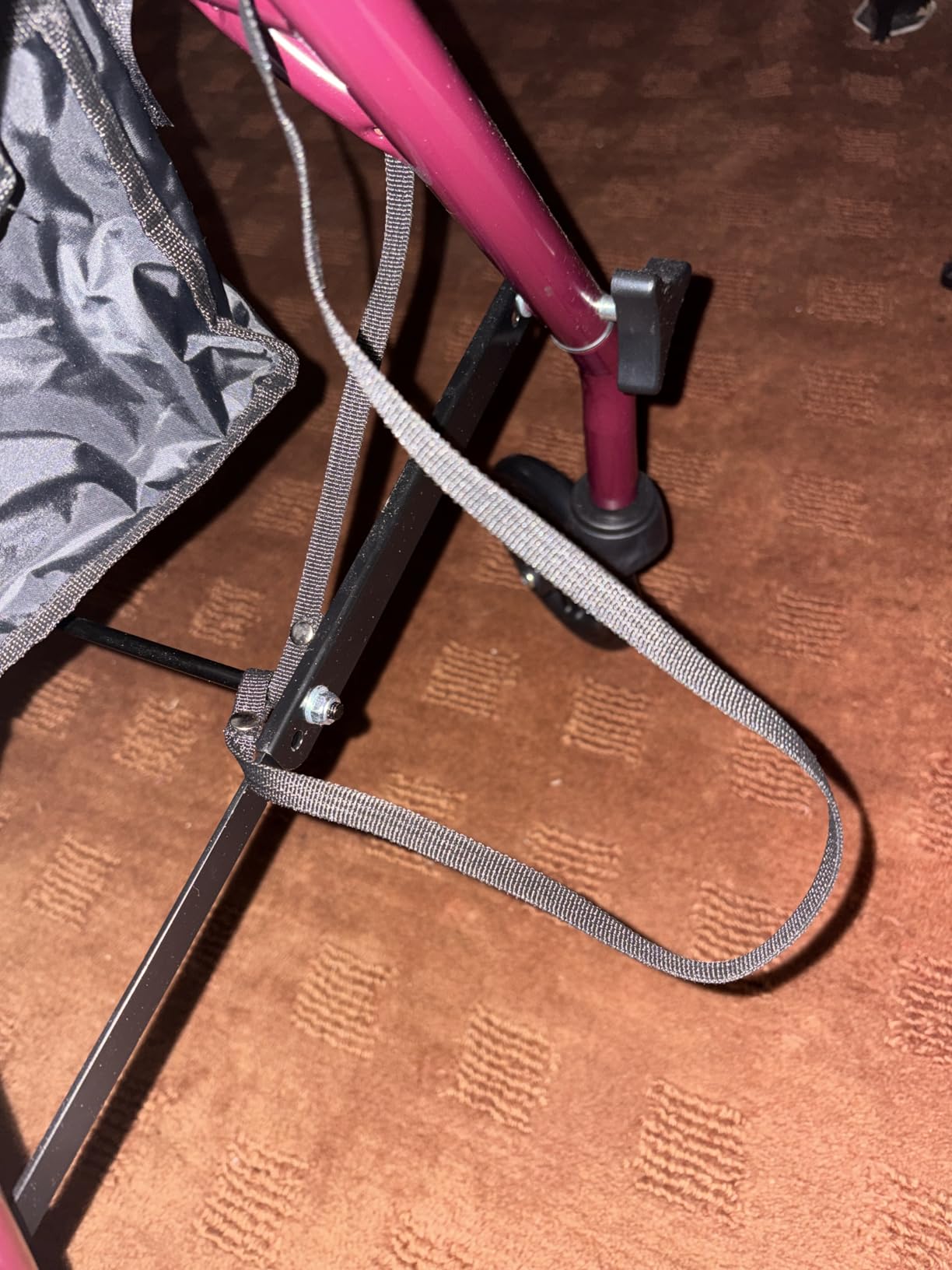
At 16.5 lb, the frame folds down for storage and is light enough for one person to manage. The handle adjustment runs from 31 to 35 inches, which fits most adults but tops out for anyone taller than roughly 5 foot 10.
The honest trade-offs are the 6 inch wheels and the steel weight. Reviewers consistently say the smaller wheels are less capable over thresholds and rough ground than newer 8 inch designs, and the seat padding is basic rather than contoured.
Who the Medline Steel Rollator suits
This suits anyone who needs a genuine margin above their body weight, or whose hands are the limiting factor. It is the strongest pick here for a user above 300 lb who does not want a full bariatric frame, and for grandparents and caregivers who need brakes that respond to a weak grip.
It works best on smooth indoor surfaces and paved sidewalks, which covers most daily use.
Where the Medline Steel Rollator falls short
It is the wrong choice for outdoor-heavy routines, unpaved paths or a large garden, where 6 inch wheels stop dead on cracks and gravel. It is also too short for very tall users and heavier to lift than an aluminum equivalent, which matters if a caregiver is loading it daily.
3. Drive Medical Nitro Euro-Style 4-Wheel Rollator – Best for Large Wheels
Drive Medical RTL10266 Nitro Euro-Style 4-Wheel Rollator with Seat, Red
10 inch front casters
17.5 lb frame
Padded seat with tool-free backrest
One-hand fold with lock
Pros
- Highest rating in the roundup at 4.8 stars
- 10 inch front casters glide over curbs and rough ground
- One-hand fold with an under-seat locking mechanism
- Push-button handle and tool-free backrest adjustment
- Removable zippered storage pouch
Cons
- Highest price point among the models reviewed
- Narrower seat and frame than wide-seat or bariatric options
- Smaller seat width for users who prefer a wider perch
The Nitro is the one I recommend when the rollator is going outside. The 10 inch front casters are the largest in this group and they glide over curbs, thresholds and rough ground in a way no 6 inch or 7.5 inch wheel here matches. It holds a 4.8 star average across nearly 6800 reviews, the highest rating in the roundup.
The folding design is the other reason it stands out. You fold it with one hand and an under-seat locking mechanism holds the frame closed, so it does not spring open in a car trunk. The handle height adjusts with a push button and the backrest adjusts with a tool-free thumb screw.

At 17.5 lb it is still a light frame for its wheel size, and the narrow euro-style profile turns tight corners and fits through narrower doorways than the wide-seat models. A removable zippered pouch handles small belongings.
The dominant complaint is cost relative to entry-level steel and aluminum rollators, and the seat is narrower than users who prefer a wide perch will like. If you want a broad seat more than you want big wheels, look at the wide-seat pick further down.

Who the Drive Medical Nitro suits
This suits an active user who walks outdoors regularly, crosses uneven pavement, deals with curbs, and wants a device that folds one-handed into a car. It is a strong choice for a tall-ish user who needs narrow indoor clearance and will spend real time outside.
It also suits anyone who travels to unfamiliar places where the surface is unknown, because the wheel size absorbs more of what it hits.
Where the Drive Medical Nitro falls short
It is not the pick for a user who wants a wide seat or a higher weight rating, and it costs more than the standard steel and aluminum options by a wide margin. For indoor-only use on carpet and hard floors, the large wheels and narrow frame add weight and price without buying much.
4. VOCIC Z21 Rollator with 8 Inch All-Terrain Wheels – Best for Outdoors
VOCIC Z21 Rollator Walker for Seniors with Seat, 8″ All Terrain, 350 LBS
350 lb capacity
8 inch puncture-proof tires
22.85 lb
Seat adjustable 20-22 inches
Handles 31.5-36.6 inches
Pros
- 8 inch puncture-proof tires handle bumps and slippery surfaces
- 1.6 inch thickened waterproof cushion relieves hip pressure
- Widened breathable backrest gives fuller support
- Three-second quick fold
- Reflective strips improve night visibility
Cons
- Heavier at roughly 22.85 lb than most aluminum competitors
- Brand has a shorter track record than established mobility brands
- Listed height figure reflects handle height rather than a compact profile
The VOCIC Z21 has the best outdoor spec sheet in the roundup for the money: 8 inch puncture-proof tires, 360 degree rotating front wheels and a 350 lb capacity on thickened tubes. It sits at the top of the Rolling Walkers best sellers ranking, which tells you how many people have landed on it.
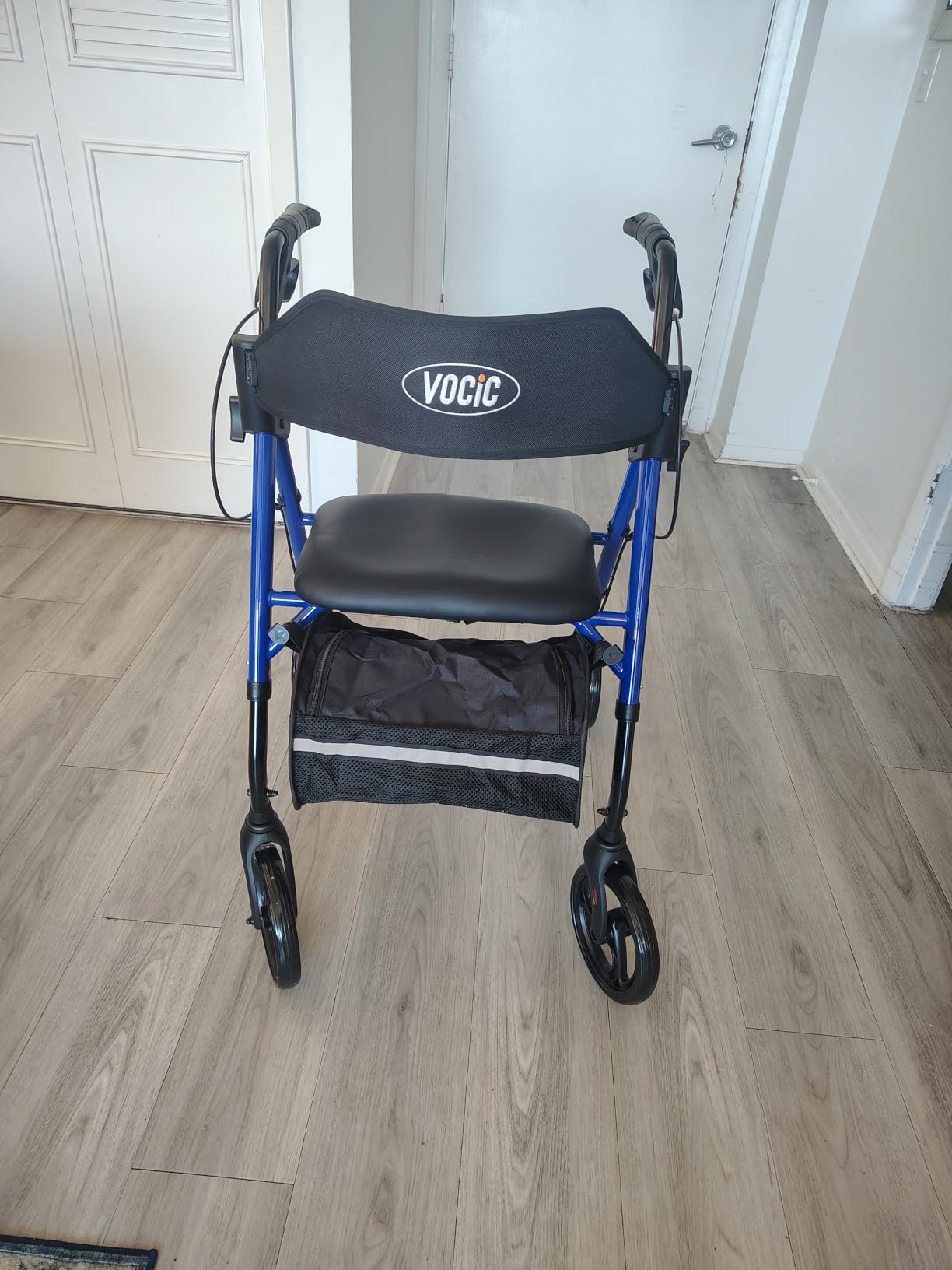
Where it genuinely beats the older models is the seat. The bionic ergonomic seat carries 1.6 inch of thickened waterproof cushioning with three height levels between 20 and 22 inches, and the widened breathable backrest is a real panel rather than the foam-covered tube used on budget models.
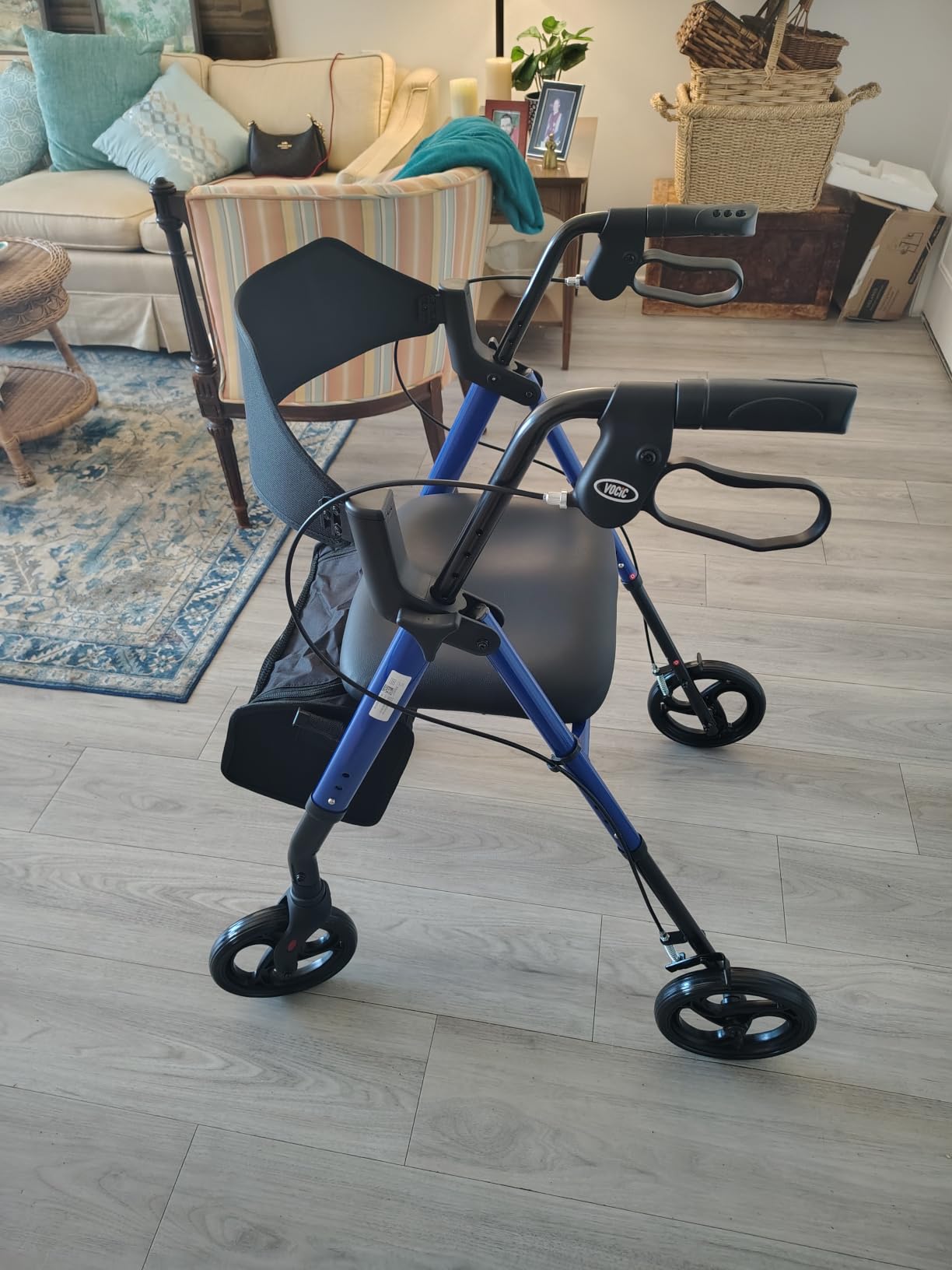
Handle adjustment runs from 31.5 to 36.6 inches across five levels, covering users from 4 foot 11 to 6 foot 3. The three-mode braking system gives free rolling, deceleration and a full stop, and reflective strips on the front wheels and storage bag help in low light. The three-second fold takes it to 31.5 by 23.6 by 13.8 inches.
The weight is the main complaint. At roughly 22.85 lb it is one of the heavier frames here, and reviewers who value lightweight loading should look elsewhere. The brand is also newer than Drive or Medline, so there is less long-term service history behind it.
Who the VOCIC Z21 suits
This suits an outdoor user on a budget, someone who walks on cracked pavement, grass or gravel, and anyone who wants a comfortable seat for long sits without paying for a premium frame. The fit range covers both short and tall users in one model, which is unusual.
It is also a strong option for evening walks given the reflective detailing.
Where the VOCIC Z21 falls short
It is a poor match for a caregiver who has to lift it into a car several times a day, because 22.85 lb is a lot to hoist into a trunk. Buyers who want established brand service and a long repair history should weigh that against the newer name.
5. Drive Medical Aluminum Rollator Walker, 6 Inch Wheels – Best for Lightweight Car Loading
Drive Medical Aluminum Rollator Walker, Padded Seat, 6-Inch Wheels, Blue
Aluminum frame
15.6 lb
300 lb capacity
6 inch wheels
14 inch padded seat
Pros
- Light enough for one person to load into a compact car
- Low profile 6 inch wheels pass through most doorways
- Side-to-side fold stands upright when folded
- Arrives almost assembled
- Under-seat pouch fits a purse
Cons
- No parking brake so the brakes must be held manually
- Brakes and fittings are light-duty plastic
- Rear wheels cannot move inside the frame to reduce width
This is the classic light aluminium rollator and the reason so many caregivers manage daily transport. At 15.6 lb it can be lifted into a compact car by one person without a struggle, and it has held a 4.7 star average across roughly 7600 reviews for two decades.
The fold is the other thing owners mention. It folds side to side with one hand and stands upright on its own once folded, which means it stores against a closet wall or sits in a trunk without lying flat and taking up the whole space.
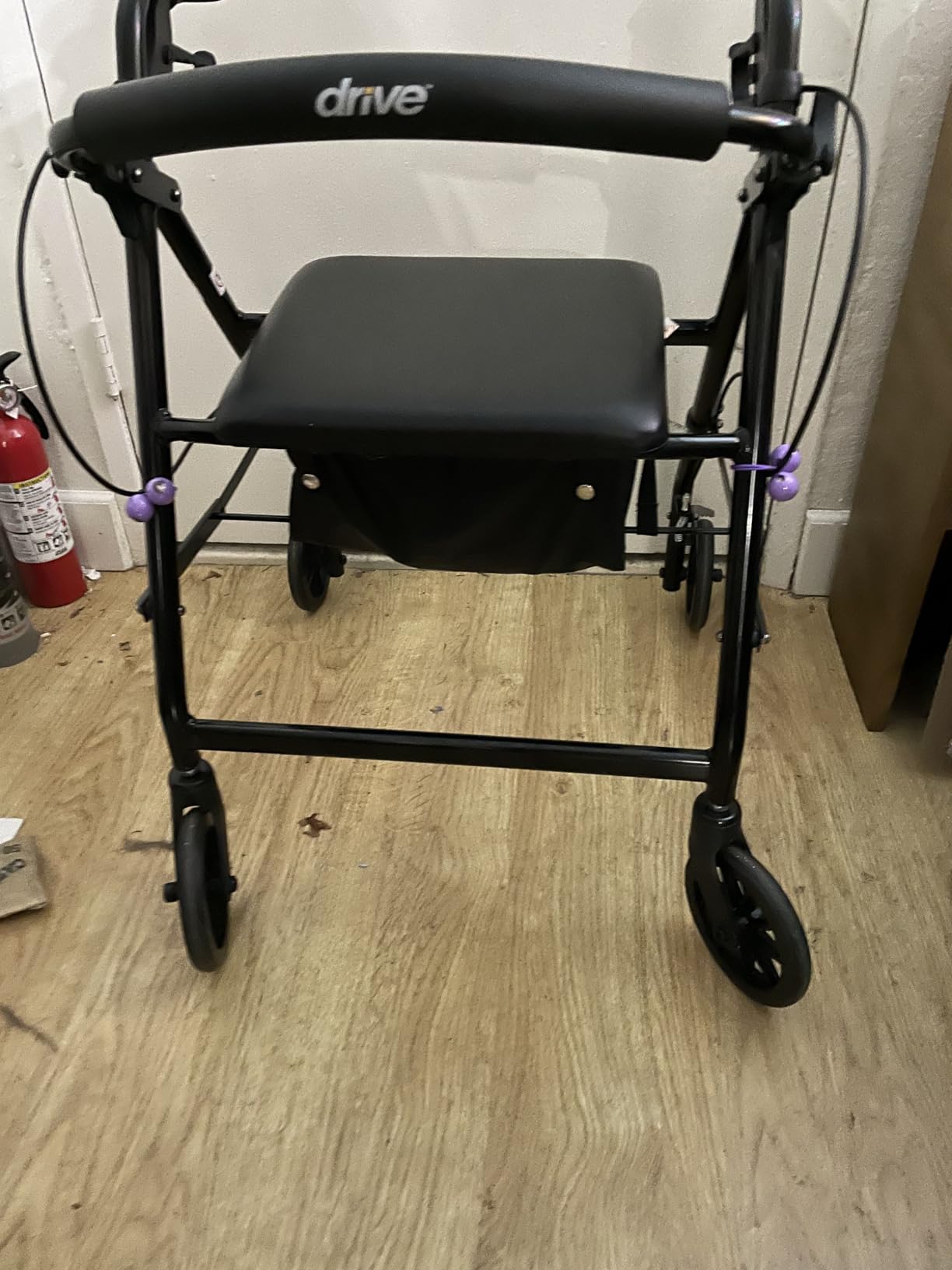
Levers adjust the ergonomic handles, the backrest hinges up and down, and the padded seat is a comfortable 14 inches wide. The low profile 6 inch wheels fit through most doorways, which matters in older housing.
Two complaints come up repeatedly. There is no parking brake on this model, so the brakes must be held manually to stay locked, and the brake fittings are light-duty plastic. Reviewers also report brake cable slack catching on walls when the handles are set low.

Who the Drive Medical Aluminum Rollator suits
This suits a user under about 250 to 300 lb who travels light, drives a small car, or has a caregiver doing frequent trunk loading. It is the strongest choice here for indoor use on hard floors and carpet where 6 inch wheels roll without resistance.
It is also a good fit for a small apartment where a wide frame will not turn corners.
Where the Drive Medical Aluminum Rollator falls short
The missing parking brake is the deal-breaker for anyone who plans to sit down on a slope or on uneven ground, since a rollator that rolls away while you are lowering yourself onto the seat is the most common serious complaint in this category. The plastic brake hardware also wears sooner than the steel and alloy fittings used on heavier models, and 6 inch wheels are a poor choice outdoors.
6. HOMLAND Foldable Rollator with 16 Inch Extra-Wide Seat – Best for Wide Seats
HOMLAND Foldable Rollator Walker for Seniors with Seat, 16″ Extra-Wide Seat
16 x 12 inch seat
22 inch frame width
Handles 33-40 inches
Fits 4 foot 7 to 6 foot 6
20.4 lb
Pros
- Extra-large 16 x 12 inch seat with 1.6 inch padding
- Widest height range in the group from 4 foot 7 to 6 foot 6
- Pinch-proof folding mechanism protects fingers
- Tri-angle geometry reduces wobble
- Tool-free assembly with lifetime metal frame coverage
Cons
- Wider 22 inch frame takes more space than standard rollators
- Heavier at 20.4 lb than most aluminum competitors
- Wide frame can be tight in narrow hallways and doorways
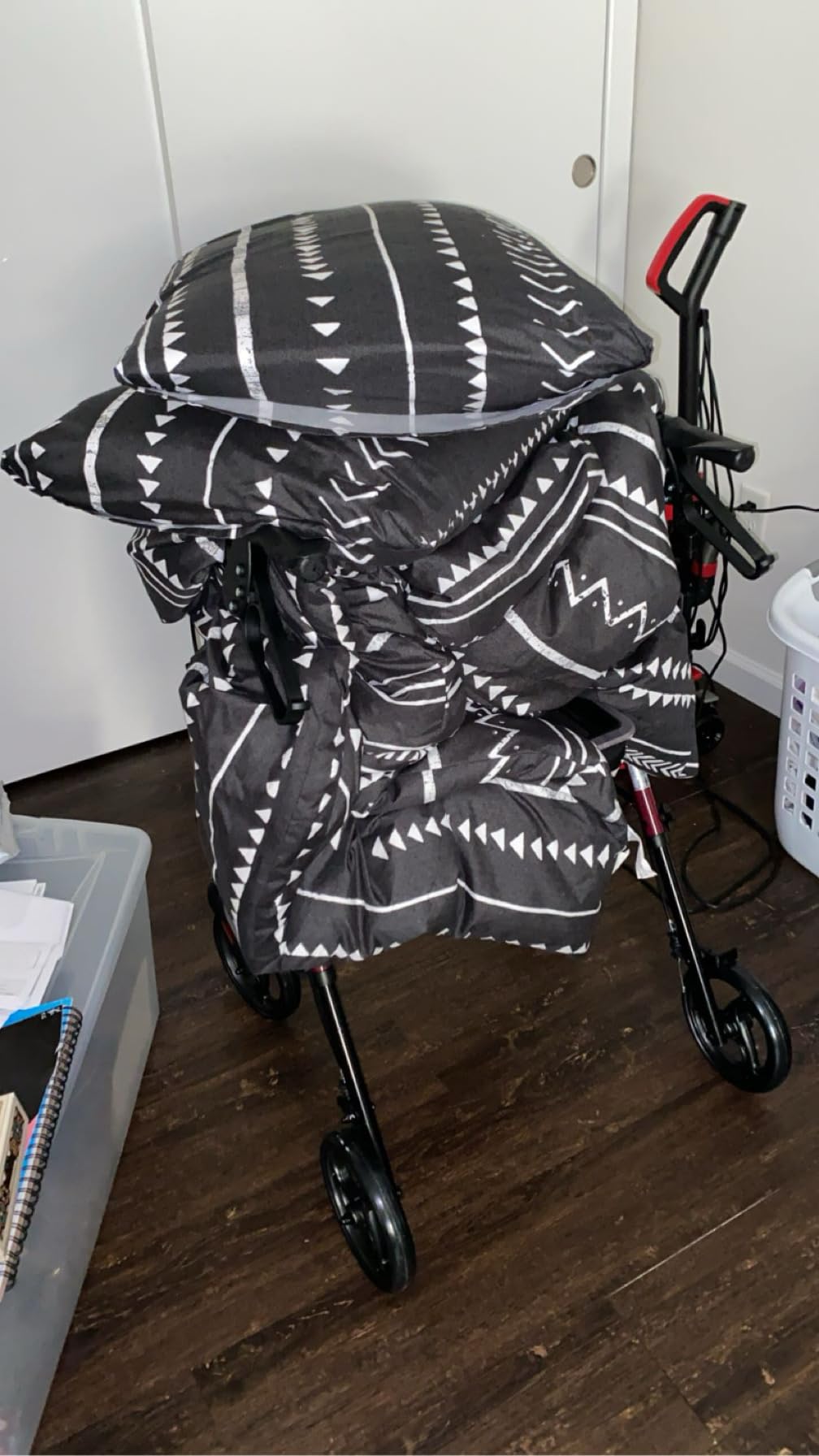
If a 14 inch or 12 inch seat feels cramped, this is the fix. The seat measures 16 by 12 inches with 1.6 inch of padding on a frame that is 22 inches wide, giving a spacious perch that smaller seats cannot match within the standard-width models here.
It also has the widest fit range we found. Seat height adjusts from 20 to 23 inches, handles run from 33 to 40 inches, and the manufacturer rates it for users from 4 foot 7 to 6 foot 6. Very tall users who strain their shoulders on a 35 inch ceiling elsewhere in this list will find room here.
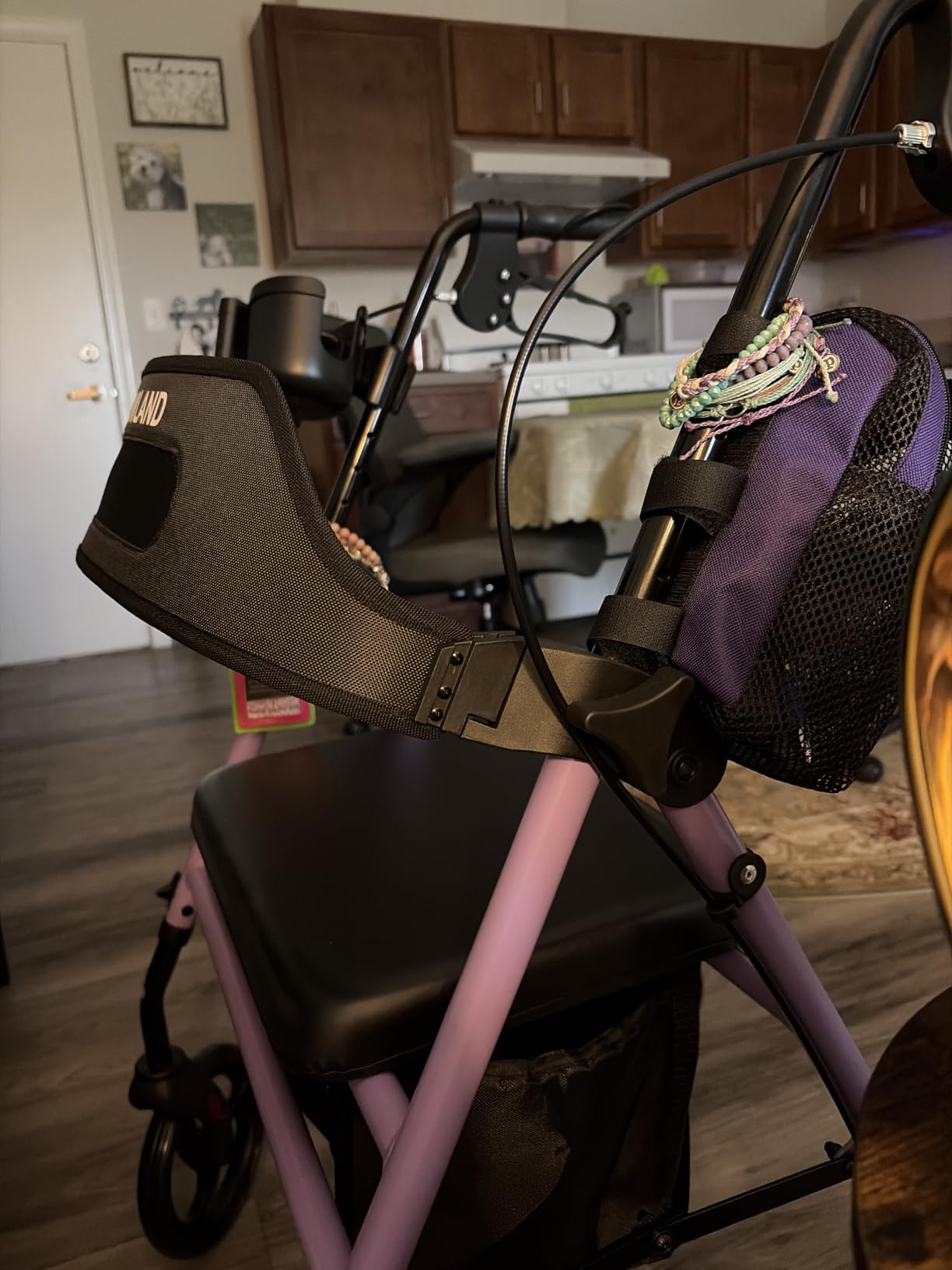
Construction details are unusually thoughtful for this tier. The tri-angle load-bearing geometry with dual-reinforced front supports reduces wobble and flex, the fold is pinch-proof to protect fingers, and the 8 inch puncture-proof wheels with 360 degree rotating front casters clear thresholds that stop 6 inch wheels.
The frame coverage is also worth noting: a lifetime warranty on the metal frame and one year on non-metal parts, with tool-free assembly. The trade-offs are width and weight. At 22 inches across and 20.4 lb, it takes more room and more effort than a standard rollator.
Who the HOMLAND Extra-Wide Seat Rollator suits
This suits a wider user, a tall user, or anyone who found the seat too small on a cheaper model. The 40 inch handle ceiling makes it the best fit in the group for someone around 6 foot or taller, and the broad seat is comfortable for a genuine rest rather than a quick pause.
It also works well for a user who walks frequently on uneven pavement and wants both the wheel size and the seating width in one model.
Where the HOMLAND Extra-Wide Seat Rollator falls short
In a narrow hallway, a small apartment or an old house with tight doorways, the 22 inch frame becomes a genuine problem. At 20.4 lb it is also heavy for a solo user who has to lift it, and the price sits above the basic aluminium models for the same indoor job.
7. Hugo Elite Rollator Walker with Seat and Basket – Best for Storage
Drive Medical Hugo Elite Rollator Walker with Seat and Basket, Blue
Aluminum frame
300 lb capacity
8 inch casters
18.02 lb
Handles 30-38 inches
Pros
- Large 8 inch swivel wheels glide over carpet and thresholds
- Dual storage with under-seat compartment and handlebar bag
- Automatic snap lock holds the frame folded
- Built-in brake cable routed through the frame
- Padded seat and cushioned backrest bar for long outings
Cons
- Heavier than lightweight aluminum competitors at 18.02 lb
- Folding strap is hard for shorter users to reach
- Brake cables run along the outside of the frame and can snag
- Seat height is no longer adjustable on the current version
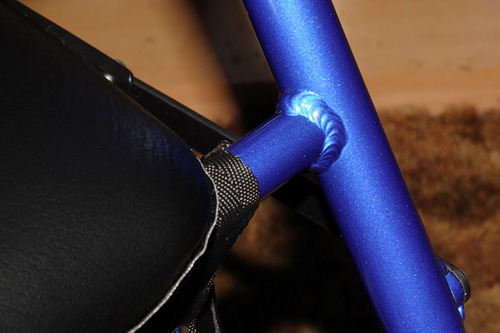
The Hugo Elite is the storage champion here. It carries two separate storage systems: a solid under-seat compartment and a removable handlebar bag with multiple pockets, plus a second wire basket tote. For someone who uses the rollator for shopping or pharmacy runs, that is a real advantage over a single under-seat pouch.
The 8 inch swivel casters handle carpet, grass and thresholds, and the frame is rated to 300 lb. Handles adjust from 30 to 38 inches and a snap-lock automatically holds the walker folded, so it stays closed in a trunk or closet.
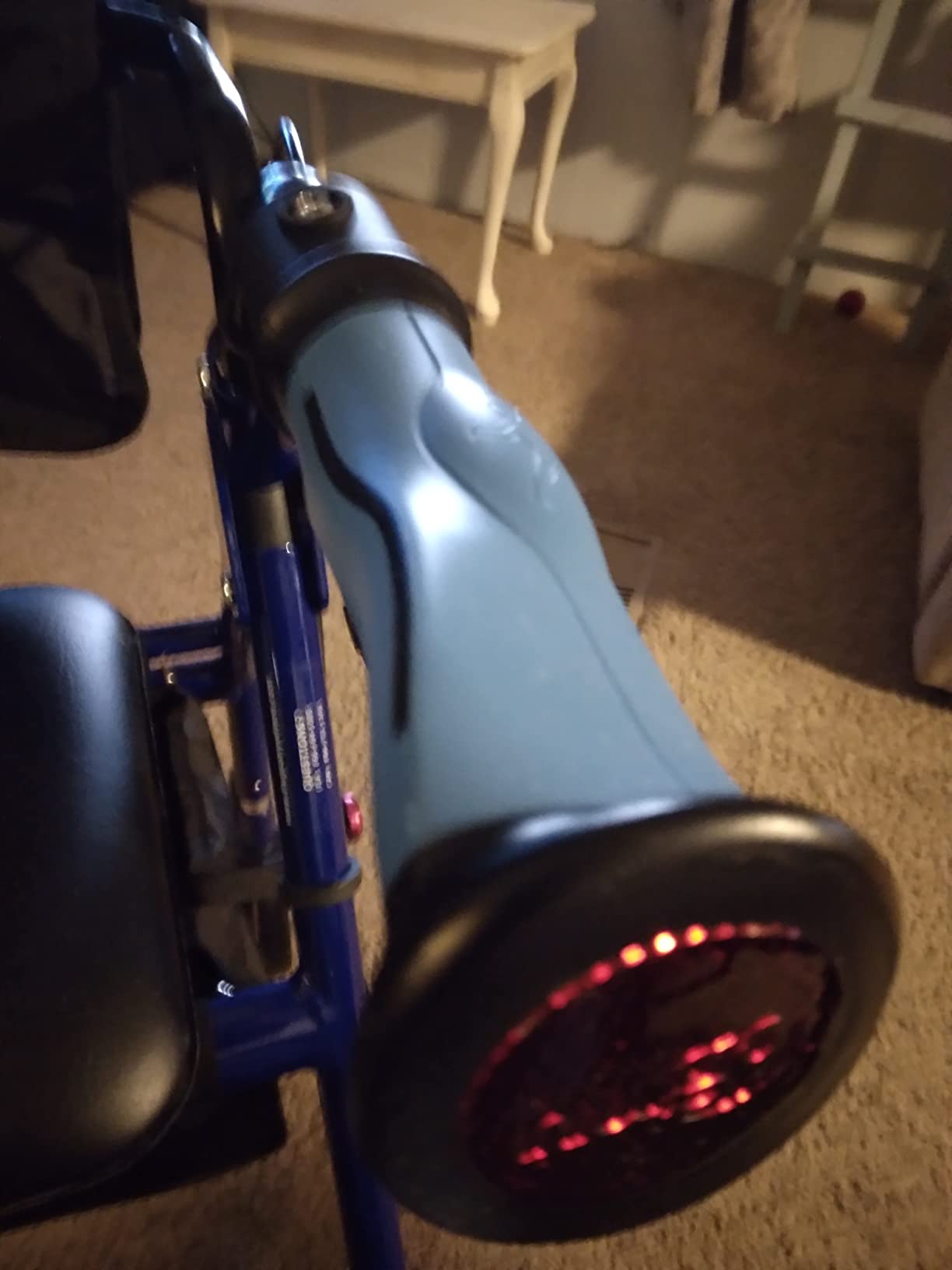
Assembly is tool-free with illustrated printed directions, and the brake cable is routed through the frame rather than clipped along the outside, which removes the snagging complaint that shows up on cheaper models. The cushioned backrest bar stays comfortable over long outings.
Reviewers do flag design changes across production years. On the current version, seat height is no longer adjusted through the wheel stems, some under-seat zippered pockets were removed, and the long folding strap is hard for shorter users to reach. Once folded it stands on two wheels and will fall if leaned against a wall.
Who the Hugo Elite Rollator suits
This suits an errand-focused user who carries a purse, shopping bags or a medication case and wants the load tucked away rather than hanging off the handles. It is a good pick for mixed indoor and light outdoor use where 8 inch wheels help at thresholds.
It also suits anyone who prefers a sturdier aluminium frame over a lightweight travel model and does not mind carrying 18.02 lb.
Where the Hugo Elite Rollator falls short
It is not the pick for a caregiver doing constant solo trunk loading, because at 18.02 lb it is on the heavy side. Verify the seat height on the specific production run before ordering if you need an unusually low seat, and expect the exterior brake cables to need attention in tight spaces.
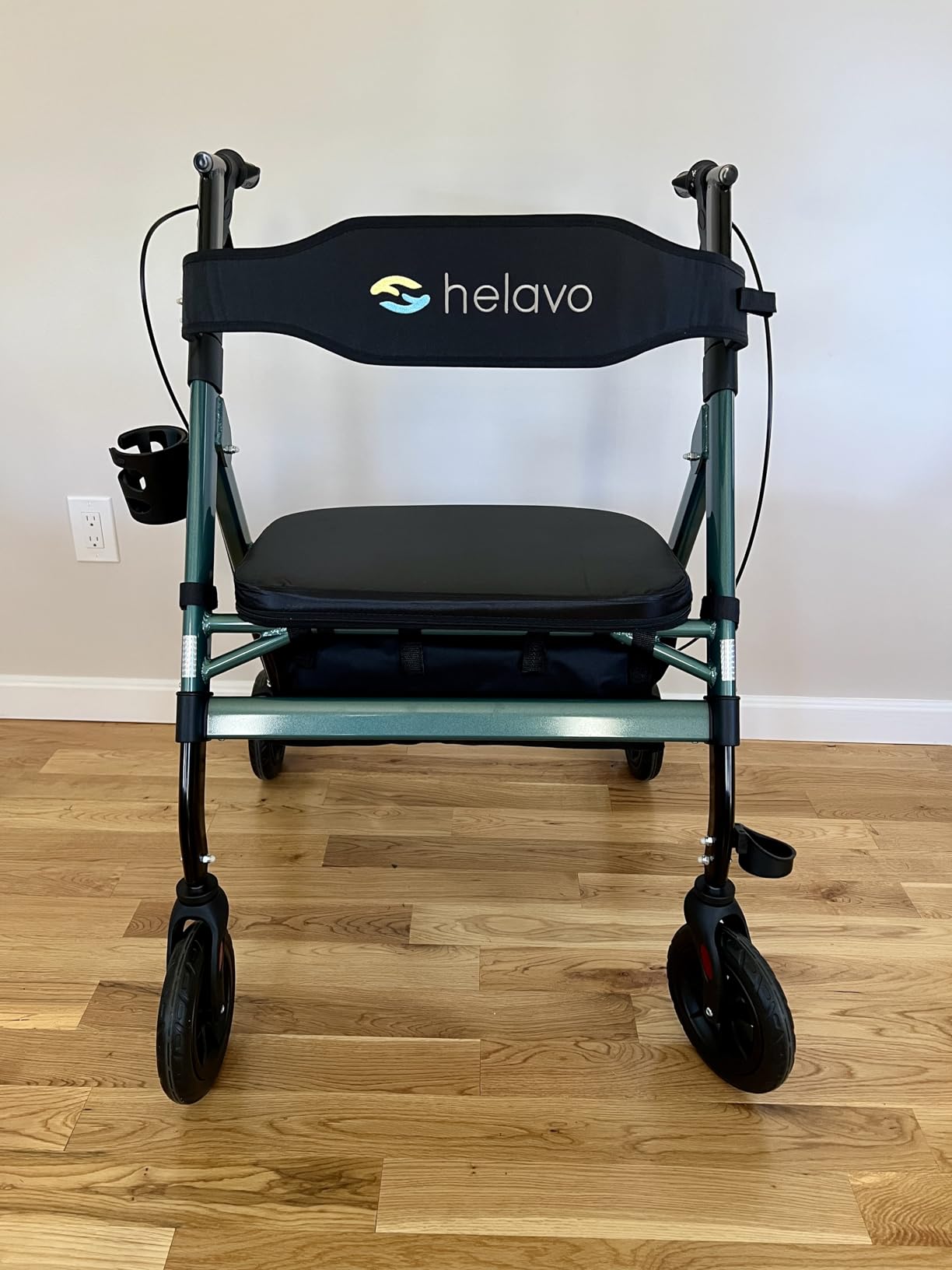
8. Helavo Extra Wide Bariatric Rollator, 550 lb – Best for Heavier Users
Helavo 28.3″ Extra Wide Bariatric Rollator Walker, 550 lbs Capacity
550 lb capacity
22.4 inch handle spacing
8 inch reinforced-spoke wheels
Parking brake
21.38 lb
Pros
- Highest weight capacity in the group at 550 lb
- 22.4 inch handle spacing creates a spacious seat
- Integrated parking brake holds the walker stationary
- Flip-up seat with a large transport basket underneath
- Handles
- seat and backrest all independently adjustable
Cons
- Heaviest and widest frame in the roundup at 28.3 inches across
- Largest folded footprint at 37.8 inches
- Premium price point relative to standard rollators
This is the bariatric answer and the highest capacity in the roundup by a wide margin. The reinforced aluminium frame is rated to 550 lb, and the 22.4 inch handle spacing creates a seat that genuinely fits a larger body rather than being a nominal width.
Unlike most rollators here, it has an integrated parking brake that holds the walker stationary while the user sits, which removes the single most reported safety problem in this category. Handles adjust from 33.1 to 39 inches, seat height from 20.9 to 22.8 inches, and the backrest adjusts vertically.

The flip-up seat lifts to expose a spacious transport basket, and an integrated cane holder removes the need for a separate attachment. The 8 inch wheels use reinforced spokes for stability across surfaces. Warranty runs one year standard and can be extended to three years with 24/7 support.
Size is the trade-off, and reviewers say so plainly. At 28.3 inches wide and 21.38 lb, this is the heaviest and widest frame in the roundup, and the 37.8 inch folded length needs real trunk or cargo space. It also costs more than a standard rollator.
Who the Helavo Bariatric Rollator suits
This suits a user whose body weight sits above what a 300 or 350 lb frame allows, including anyone above 400 lb. It is also the right pick for a wider user who wants a properly sized seat rather than a frame pushed past its rating, and it works well for anyone who will sit for extended periods.
The independent seat, handle and backrest adjustment makes it forgiving to fit, which matters when the user cannot easily change position.
Where the Helavo Bariatric Rollator falls short
Measure your doorways before ordering. A 28.3 inch wide frame will not fit through some standard interior doors or narrow hallways, and it will not go through a compact car trunk folded. For a user who only needs a bit more capacity, the 350 lb steel rollator is a much easier frame to live with.
9. Medline Superlight Folding Aluminum Rollator – Best for the Lightest Frame
Medline Superlight Folding Aluminum Mobility Rollator Walker, Smoky Blue, 250 lb. Weight Capacity, 6″ Wheels, Adjustable Arms and Seat, Foldable Rolling Walker for Seniors
12.6 lb aluminum frame
250 lb capacity
6 inch wheels
Seat adjustable 18-23 inches
Handles 29.5-36 inches
Pros
- Lightest frame in the comparison at 12.6 lb
- Handles and seat both adjust over a wide range
- Ergonomic non-slip brake handles suit weaker hands
- Under-seat storage compartment
- Aluminum frame folds down for transit
Cons
- 250 lb capacity is the lowest in the roundup
- Narrow frame may feel cramped for wider users
- 6 inch plastic wheels are less durable on rough terrain
- Back brace bar is fixed so it cannot be carried over the shoulder
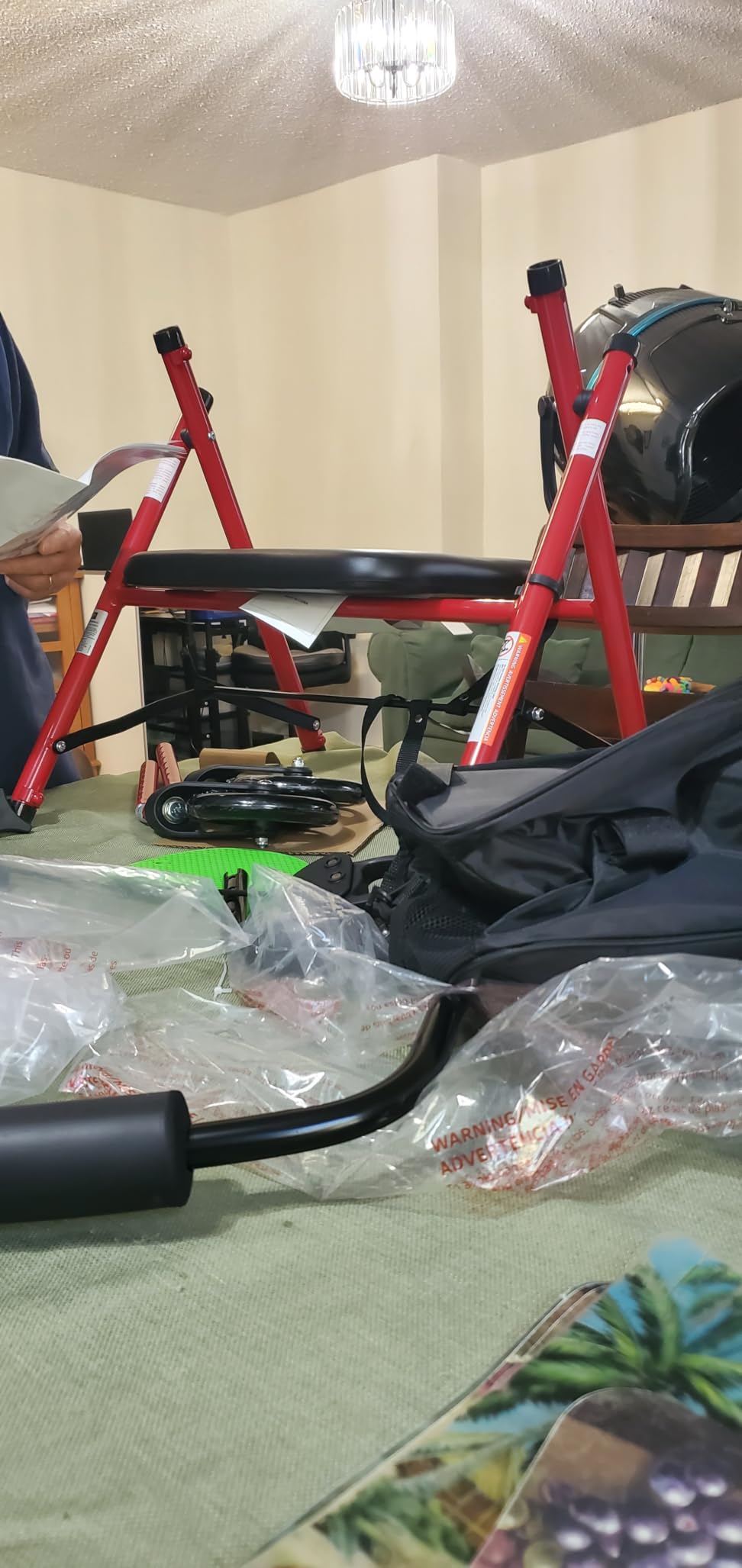
At 12.6 lb this is the lightest frame in the roundup, roughly 5 lb lighter than a typical 18 lb walker, and owners describe it as easy to load into an SUV by one person. If a caregiver is lifting the device several times a day, that difference decides the purchase.
Adjustment is unusually wide for such a light frame. The seat adjusts from 18 to 23 inches and the handles from 29.5 to 36 inches, so it covers both shorter and taller users in one model. The brake handles are non-slip and follow the same push-up to brake, push-down to lock pattern as the heavier steel Medline.
The lower star ratings cluster around predictable limits. The 250 lb capacity is the lowest here and rules it out for heavier users, the narrow frame can feel cramped for wider hips, and the 6 inch plastic wheels wear faster on rough ground than rubber or larger wheels.
Newer production runs also fold less flat and have no strap to hold the frame closed, and the fixed back brace bar means the walker cannot be carried over the shoulder, only lifted.
Who the Medline Superlight Rollator suits
This suits a user under about 250 lb who travels frequently, flies, or relies on a caregiver to load the device. It is the lightest option for a car trunk, a cruise cabin or a small apartment closet, and the wide seat adjustment makes it forgiving for a user whose height is difficult to estimate.
For indoor surfaces and short distances it is genuinely the easiest to handle in this list.
Where the Medline Superlight Rollator falls short
The 250 lb rating is the hard limit, and anything above that means stepping up to the steel or bariatric frame. The plastic 6 inch wheels, fixed back bar and less compact fold also make it a weaker choice for outdoor terrain or for anyone who wants to shoulder-carry the walker rather than lift it.
10. Stander Space Saver Lightweight Folding Rollator – Best for Travel and Small Spaces
Stander Space Saver Rollator, Lightweight Folding Rolling Walker with Seat for Seniors & Adults, 4-Wheel Mobility Aid with 6-inch Wheels, Locking Brakes & Padded Seat with Backrest, Cobalt Blue
Folds to a 10 x 11 inch footprint
14.5 lb aluminum frame
18.5 x 6 inch perch seat
Handles 33-36 inches
Pros
- Smallest folded footprint in the roundup at 10 x 11 inches
- Arrives fully pre-assembled with no setup
- Light 14.5 lb frame for travel and errands
- Rear locking brakes give the user direct control
- Compact back strap keeps the perch simple
Cons
- Perch seat is narrow at 18.5 x 6 inches and not meant for long sits
- 250 lb capacity is lower than heavier-duty models
- No under-seat storage bag
- Higher price per feature than standard models
The Stander Space Saver exists for one reason: storage and travel. Its patented fold collapses it to a 10 by 11 inch footprint, which owners describe as roughly three times smaller than a typical rollator, so it fits in a small closet, under a seat or in a compact car boot.
It also arrives fully pre-assembled, which removes the setup step that trips up some first-time users. The padded handles adjust from 33 to 36 inches and the rear locking brakes let the user control their own movement rather than relying on a separate brake.
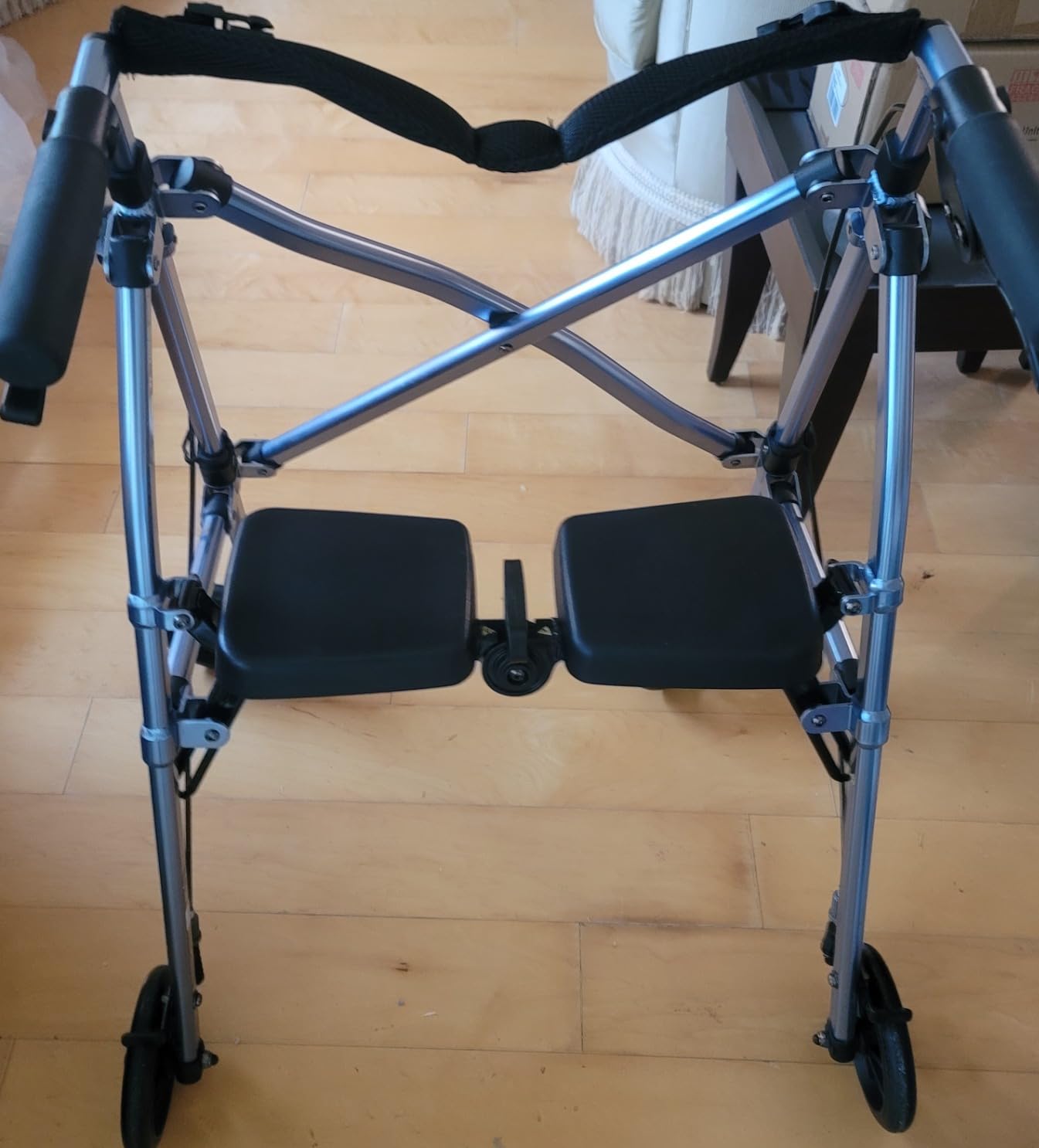
The seat is the compromise that matters most. It is a 18.5 by 6 inch perch seat rated to 250 lb with a compact back strap, and reviewers are clear that it works for quick rest stops while traveling but is not comfortable for sitting out a long afternoon.
At 250 lb it also sits at the lower end of the capacity range, and unlike almost every other model here it has no under-seat storage bag. You are paying a premium per feature for the folding design, so it makes sense only if the fold solves a problem you actually have.
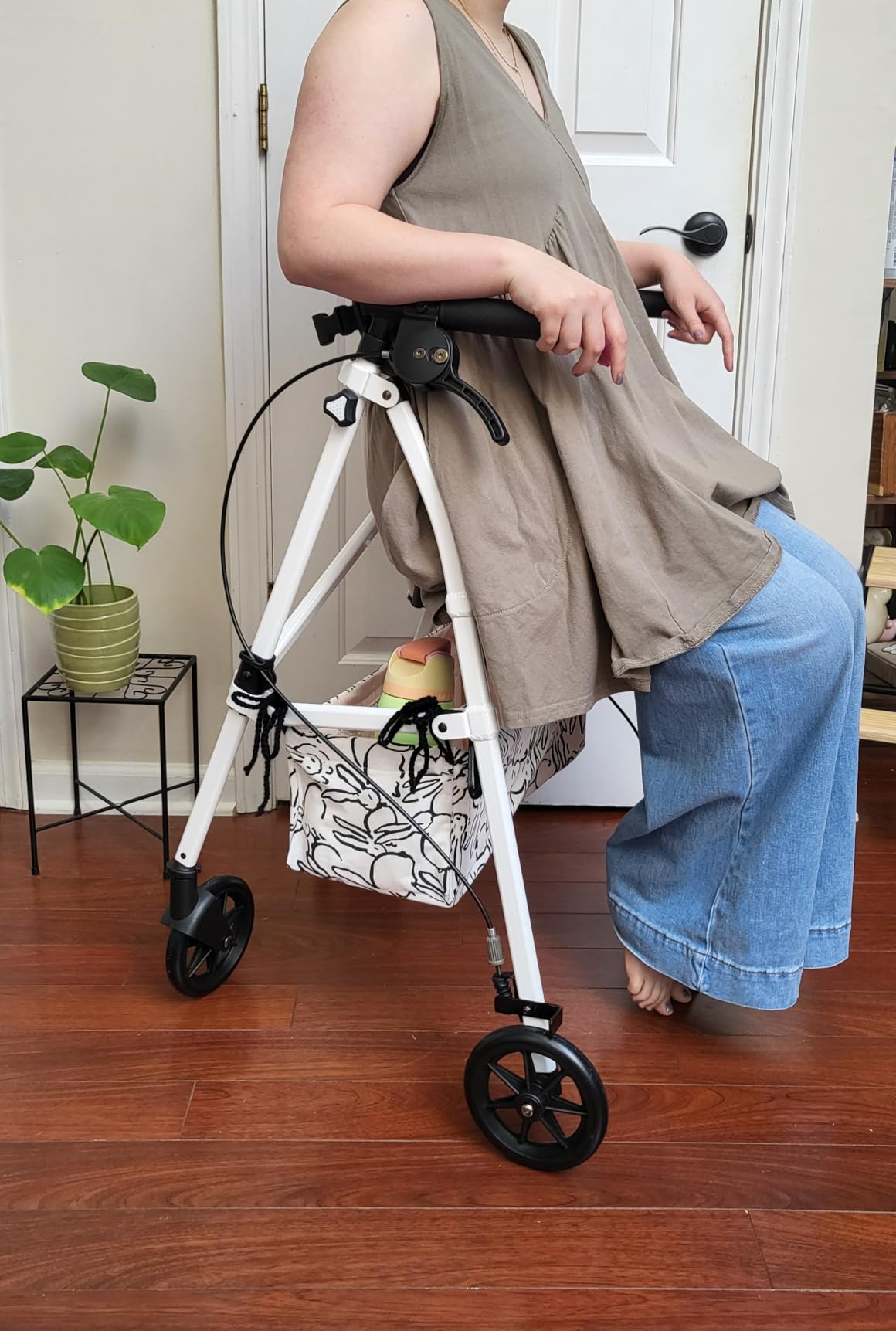
Who the Stander Space Saver Rollator suits
This suits a frequent traveller, a cruise passenger, or anyone living in a small apartment where a full-size rollator will not fit in a closet. It is a good match for short trips between home and appointments rather than all-day walking, and for a user who can manage a perch for brief pauses.
It also suits anyone who wants zero setup and will accept a lower weight rating in exchange.
Where the Stander Space Saver Rollator falls short
It is the wrong pick for a user who needs a supportive seat for long rests, since a 6 inch wide perch is not a comfortable chair. It is also unsuitable above 250 lb, and the lack of any under-seat storage means shopping trips require a separate bag that adds width at the handles.
Common problems with rollators and how to avoid them
These seven issues come up again and again in owner discussions, and each one has a fix you can check before buying.
Brakes that need real grip strength. The most commonly reported usability failure. Push up to brake, push down to lock, and test both with your weaker hand. If the lever moves more than a few inches before the brake bites, it is the wrong model.
Rolling away while you sit down. Users report this more than any other safety issue. Confirm both wheels lock before you lower yourself, and test the parking brake on a gentle slope. A rollator with no parking brake at all, like the light aluminium model here, carries this risk permanently.
Small wheels stopping dead. 6 inch wheels snag on sidewalk cracks, thresholds and gravel. Match wheel size to the surface: 6 inches for smooth indoor floors, 8 inches or larger for pavement, grass and gravel.
Too heavy to lift into a car. Product weight ranges from 12.6 lb to nearly 23 lb in this roundup. If a caregiver is doing the lifting several times a day, test the folded unit with one hand before ordering.
Seat sag or a seat that is too small. Budget models use a foam-covered tube backrest and thin padding. If the seat is the feature you will actually use, a 16 inch wide seat with real cushioning is worth the extra weight.
A loaded basket destabilising the frame. A hanging or swinging bag shifts the centre of gravity. Look for a basket that mounts close to the frame, or a rollator with under-seat storage instead.
Handle height too short for a tall user. Standard ranges top out around 35 to 36 inches, which causes shoulder and back strain above roughly 5 foot 10. Check the published handle range against the user’s height before ordering.
What to check before you buy a rollator walker with seat
Seven checks decide whether a rollator fits. Work through them in this order, because each one eliminates options faster than the last.
Weight capacity with real margin. Pick a rating comfortably above the user’s weight, not at it. Someone at 280 lb needs a 350 lb frame, not a 300 lb one.
Wheel diameter against the actual surface. 6 inches for indoor floors, 7.5 to 8 inches for sidewalks and thresholds, 10 inches for curbs and rough ground.
Handle height range. Measure the user standing. Grips should sit at the wrist crease with roughly a 15 degree elbow bend. If the published range does not cover that point, skip the model.
Seat height and seat width. A seat that is too low is hard to rise from; one that is too high causes slouching. Check both the range and the width against the user’s hips.
Brake effort. Ask the retailer to let you squeeze the brake with your weaker hand. This single test rules out more models than any spec on the page.
Folded size and who does the lifting. Compare the folded footprint with the actual trunk or closet, and decide whether the caregiver or the user will be lifting it.
Frame material. Aluminium keeps weight down for travel; reinforced steel carries a higher capacity for a heavier user.
That five-minute check is worth doing in a shop if you can. Squeeze each brake with your weaker hand and note how far the lever travels. Roll the unit on a slight incline and set the parking brake to see whether it holds. Measure grip height to your wrist. Then lift the folded frame with one hand. If any of those three fail, the model is out regardless of how it looks in a photograph.
One more thing that costs nothing. If your parent resists the idea of a rollator at all, let them choose the colour and let them try the seat height themselves before deciding. Owners in senior communities frequently describe the device as the change that kept them doing errands, but only when they felt they had picked it.
Does Medicare cover a rollator walker with a seat?
Yes. A rollator with a seat is durable medical equipment, and Medicare Part B covers it when a doctor documents that it is medically necessary and it is purchased from a Medicare-approved supplier. After the Part B deductible is met, the plan typically pays 80 percent of the approved amount and you owe the remaining share.
Two practical points. First, the doctor’s documentation has to exist before the purchase, not after, so raise it at an appointment rather than at the counter. Second, confirm that the supplier is Medicare-approved before you buy, because coverage follows the supplier’s status as well as the prescription. Confirm the current figures and any state-level rules with your own plan before relying on them.
Frequently Asked Questions
What is the best rollator walker for older people?
For most older people the Drive Medical rollator with 7.5 inch wheels is the safest general choice. It has a steel frame, a padded seat with a fold-down backrest, an under-seat pouch and more than 51000 owner reviews behind it. It suits mixed indoor and light outdoor surfaces and is light enough for one person to lift into a car. Users who walk outdoors every day should instead consider a model with 8 inch or larger wheels.
What is the best rollator walker for a heavy person?
For a heavier user, the Helavo extra wide bariatric rollator is the strongest option, rated to 550 lb on a reinforced aluminium frame with 22.4 inch handle spacing and an integrated parking brake. If the user is under about 400 lb, the Medline steel rollator rated to 350 lb is lighter, narrower and easier to move through doorways. Measure your doorways before ordering a wide bariatric frame, since some are over 28 inches across.
Who should not use a rollator?
A rollator is the wrong device for anyone who needs to lean their full weight into a frame, because its wheels can roll away. It is also unsuitable if you cannot squeeze the brakes hard enough to stop yourself, if you use stairs regularly, if you want hands-free support, or if most of your travel is over long distances. In those cases a standard pickup walker, an upright forearm-supported rollator, or a wheelchair is safer. Ask a physical therapist to assess you first.
What is better than a rollator?
A standard two-wheeled pickup walker is more stable and better for users who must lean into the frame, because its rear legs cannot roll. An upright rollator with forearm support is better for posture and for people with back or shoulder pain. A wheelchair or transport chair is better for long distances without rest breaks. A cane is better when only light support is needed and a free hand matters more than stability.
What are the disadvantages of a rollator walker?
A rollator requires enough grip strength to work both brakes, cannot be used on stairs, and is less stable than a fixed walker frame because all four wheels can move. It can roll away if the parking brake is not engaged before sitting, and it is bulkier and heavier than a cane. Wheels and brake cables need periodic checking, brake effort increases as cables stretch, and a loaded basket that swings can shift the centre of gravity and make the frame wobble.
The bottom line on the best rollators with seats for seniors
For most families, the Drive Medical steel-frame rollator with 7.5 inch wheels is the safest first purchase: the longest-established design here, the widest owner review base, and light enough for one person to load into a car. If body weight is the constraint, move up to the 350 lb steel frame, or the 550 lb bariatric model if you need more room and a real parking brake.
If the rollator will spend most of its life outside, buy wheels instead of saving money. The 10 inch front casters on the Nitro or the 8 inch all-terrain tires on the VOCIC handle curbs, cracks and gravel that stop 6 inch models dead. If the user travels or storage space is tight, the light aluminium models and the compact fold are where the frame weight and footprint actually drop.
Whatever you choose, fit it properly and check the brakes with the weaker hand before the first outing. And if you are still setting up the rest of the home for someone who is ageing in place, our guides to mattresses for older seniors, lightweight designs for seniors and easy-focus microscopes for seniors with large eyepieces cover the rest of the daily routine. This guide covers selection only and is not medical advice, so a fitting with a physical or occupational therapist remains the safest route.