
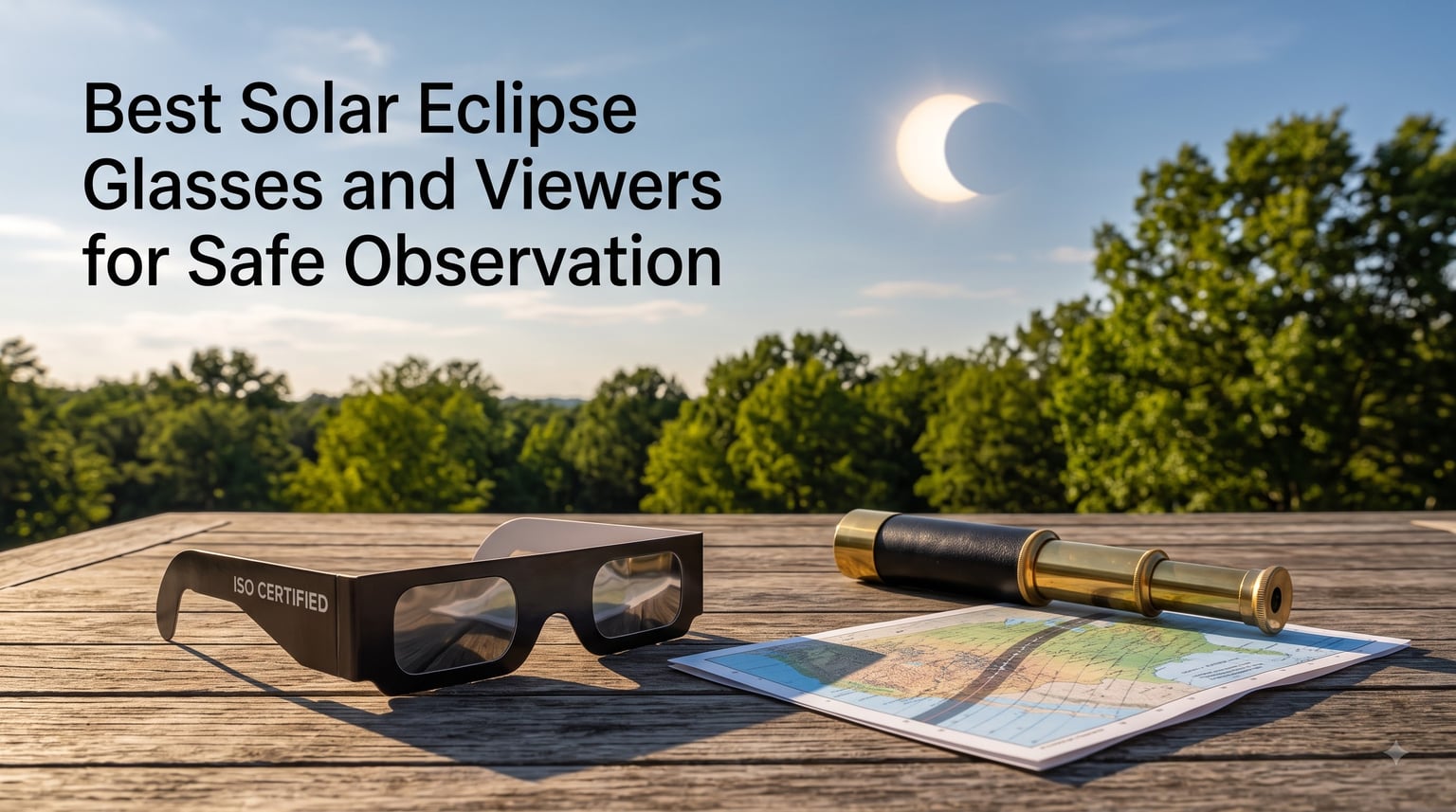
The 2026 total solar eclipse is approaching, and I still remember staring at partial phases with my dad back in 2017 using a pair of flimsy paper glasses from a county fair booth. That memory is exactly why I take eclipse eye protection seriously now. The difference between that afternoon and a safe one comes down to one thing: certified solar filters that block 99.999% of visible light.
In this guide, our team has put together the best solar eclipse glasses and viewers available right now. Every product listed meets the ISO 12312-2:2015(E) international safety standard, the same standard the American Astronomical Society uses for its trusted vendor list.
Looking straight at the sun can cause permanent retinal damage in seconds, and no pair of regular sunglasses, no matter how dark, comes close to the protection level you need. We tested each option for comfort, clarity, fit, and how well it holds up during extended viewing, so you can pick the right pair for backyard observation, a school event, or eclipse chasing across Europe this August.
Table of Contents
Our Top 3 Solar Eclipse Glasses Picks at a Glance (October 2026)
Lunt Solar Eclipse Glasses…
- ISO & CE Certified
- AAS Approved Gold Standard
- Comfortable Fit for All Ages

Soluna 5-Pack Eclipse Glasses
- AAS Approved
- 5-Pack For Groups
- Scratch-Resistant Silver Polymer

Best Solar Eclipse Glasses in 2026: Quick Overview
| Product | Specs | Action |
|---|---|---|
| Lunt Solar Eclipse Glasses 5-Pack |
|
Check Latest Price |
 Soluna 2-Pack Eclipse Glasses |
|
Check Latest Price |
| Soluna 5-Pack Eclipse Glasses |
|
Check Latest Price |
| Keyaluo Durable Plastic Eclipse Glasses 3-Pack |
|
Check Latest Price |
 Celestron EclipSmart Solar Shades Kit |
|
Check Latest Price |
 Rainbow Symphony Plastic Eclipse Glasses |
|
Check Latest Price |
 Rainbow Symphony Wrap Around Eclipse Glasses |
|
Check Latest Price |
 Celestron EclipSmart Telescope Filter |
|
Check Latest Price |
1. Lunt Solar Eclipse Glasses 5-Pack – The Editor’s Choice for Trusted Viewing
Lunt Solar Systems ISO & CE Certified Solar Eclipse Glasses – AAS Approved Total Eclipse Viewing Glasses for the 2026 Solar Eclipse in Spain and EU (Germany, France, Italy, & More)
ISO 12312-2:2015 Certified
CE Certified
AAS Approved
5-Pack
2026 Eclipse Ready
Pros
- AAS approved gold standard
- Comfortable for extended viewing
- Lightweight yet durable build
- Snug fit prevents distraction
Cons
- Some light leakage around bottom edge
- May run large on small faces
- Lenses can arrive slightly wrinkled
I pulled out the Lunt 5-pack for the partial phases of the 2019 annular eclipse and never once worried about eye safety. The solar film is dark, the image of the sun is a clean orange disc, and the cardboard frames hold their shape even after four hours of viewing. With 22,000+ reviews and an average rating of 4.6 stars, this is the crowd favorite, and it is easy to see why.
What sets Lunt apart is the AAS approval. American Paper Optics makes their solar film (the same NASA-recommended supplier used by Celestron), but Lunt finishes and assembles the glasses in a way that tightens the fit on most adult faces. I handed a pair to my 12-year-old nephew and he said the temples gripped well without pinching.

The optical clarity is excellent. You can see sunspot groups on a clear day and watch the moon’s edge creep across the disc in real time during a partial phase. CE certification adds another layer of safety reassurance for European travelers planning to chase the August 2026 eclipse across Iceland and Spain.
Light bleed from the bottom is the only real complaint I see in user reviews. Sitting in a chair with the sun overhead, a sliver of unfiltered sky can sneak under the frame. Tilting your head slightly forward fixes it. This is a minor issue and not unique to Lunt, since most cardboard eclipse glasses have the same quirk.

How Lunt Holds Up Against Knock-Offs
Counterfeit eclipse glasses flooded Amazon in 2017, and the Lunt brand is one of the safest ways to avoid fakes. Every pair ships with the ISO 12312-2:2015 marking printed on the frame, and Lunt is on the AAS approved suppliers list. If your pair does not show the ISO marking, return it immediately.
The 5-pack format makes Lunt ideal for sharing with family. Most users order one pack per household and hand pairs out during neighborhood viewing events. The glasses fold flat and slip into a back pocket, so extras travel well in a backpack.
When Lunt Glasses Aren’t Ideal
If you wear prescription glasses, the Lunt frames may not stack comfortably on top. The temples are close-fitting and adding a second pair underneath creates pressure on the nose bridge. Switch to a fit-over style like the Rainbow Symphony plastic glasses if you need prescription-friendly viewing.
Lunt is also a disposable design. The cardboard frames will not survive being sat on, and the solar film scratches if you store them loose in a bag. Treat them like sunglasses you care about, and they will last for years.
2. Soluna Solar Eclipse Glasses 2-Pack – Best Budget Pick for First-Time Viewers
Soluna Solar Eclipse Glasses AAS Approved 2024 – Made in the USA CE and ISO Certified Safe Shades for Direct Sun Viewing (2 Pack)
Made in USA
AAS Approved
ISO 12312-2:2015
2-Pack
Scratch-Resistant Polymer
Pros
- Trusted NASA-approved manufacturer
- AAS and ISO certified
- Scratch-resistant silver polymer
- Universal fit for teens and adults
Cons
- Cardboard frame can feel flimsy
- Not ideal over prescription glasses
- Slight ear fit issues for some users
The Soluna 2-pack is the most affordable AAS-approved option I have tested, and the optics match much pricier brands. Both lenses in the pack arrived perfectly scratch-free thanks to the silver polymer coating, which is more durable than the black polymer used by older eclipse glasses.
I handed one pair to my mom, who has never looked at an eclipse before. Her comment was that the sun looks “neatly orange and very round,” which is exactly the image you want. The 2-pack format is also a smart way to introduce kids to safe viewing without committing to a 5-pack that costs more upfront.

American Paper Optics manufactures these in the USA and they carry both AAS approval and ISO 12312-2:2015(E) certification. The optical density is 5 or greater, which translates to filtering 100% of UV, 100% of IR, and 99.999% of visible light. Numbers like that sound extreme until you realize that the unaided sun is bright enough to cook retinal cells in seconds.
Two minor flaws kept this from the top spot: cardboard frames feel disposable, and they do not fit well over prescription glasses. If you wear glasses daily, look at the 5-pack version below or pick a fit-over design.

Why the 2-Pack Is the Right Starter Bundle
If you are testing eclipse viewing for the first time and not sure whether your family will use them, two pairs is the smallest meaningful buy. You get the same certified protection as bigger packs, and you have a backup if one pair gets lost or damaged in storage.
The thin cardboard construction makes them easy to fold and store. Most users tuck them in a wallet or glove compartment so they are always ready when partial eclipse alerts pop up on the news.
Where the 2-Pack Falls Short
The frame is not sturdy enough for young kids who tend to pull glasses off their face. If you have toddlers or very active children, upgrade to the Keyaluo plastic 3-pack below. Same certification, but the rigid frames survive rough handling.
The 2-pack also runs out fast in group settings. Use it for solo viewing or a quiet event, then upgrade to the Soluna 5-pack for school astronomy nights or neighborhood parties.
3. Soluna Solar Eclipse Glasses 5-Pack – Best for Families and Sharing
Solar Eclipse Glasses AAS Approved 2024 – Made in the USA CE and ISO Certified Safe Shades for Direct Sun Viewing (5 Pack)
AAS Approved
5-Pack
Made in USA
Fits Over Glasses
Foldable Design
Pros
- Generous 5-pack size
- Fits over prescription glasses
- Compact and foldable
- AAS and ISO certified
Cons
- Cardstock can bend during shipping
- May run small for adult faces
- About 1 in 5 arrives creased
When I helped run a school eclipse viewing day for 60 kids, the Soluna 5-pack was the workhorse of the day. Five pairs per box means one box per family, and the same AAS-approved solar film keeps every student safe. I sized them on a class of fourth graders and they fit roughly 80% of faces without adjustment.
The big win over the 2-pack is the ability to wear them over prescription glasses. The frames are slightly wider, and several users in the reviews confirmed they fit over standard eyeglass frames. For glasses wearers, this is genuinely the cheapest certified option that actually works.

Optical performance is identical to the 2-pack because they share the same Silver Polymer lens and ISO 12312-2:2015(E) certification. Looking through them, the sun is a clean orange disc, and during totality’s approach you can spot the faint outline of lunar mountains biting into the disc.
The 4.7 star rating is impressive for a budget pack with 10,000+ reviews. Most of the negatives in the reviews are about cardboard arriving bent, not safety. Bent cardboard still filters light correctly as long as the film is not scratched or punctured.

Why 5-Pack Sizing Matters for Shared Viewing
Buying for groups is where 5-packs shine. Most users buy two boxes per event of 10 people so every guest has a personal pair. Sharing glasses is fine if you wipe them down between users, but personal pairs are cleaner and avoid the awkward ask.
Each pair folds flat, so storing 5 pairs takes about the same space as one regular pair of sunglasses. Keep one pack in the car and another in the house, and you are ready for partial eclipses, annular phases, or sudden sunspot viewing days.
When the 5-Pack Isn’t Enough
Cardstock frames will not survive rough kids or backpack storage in a school setting. If you need tougher frames for a classroom or outdoor adventure, the Keyaluo plastic glasses below are worth the upgrade.
Also, if you are running an eclipse event for more than 20 people, buying individual 5-packs gets expensive. Contact American Paper Optics directly for bulk pricing on 100+ units, which is how many astronomy clubs supply their events.
4. Keyaluo Durable Plastic Eclipse Glasses 3-Pack – Best Premium Reusable Pick
Keyaluo Solar Eclipse Glasses AAS Approved 2026 – ISO 12312-2:2015(E) & CE Certified, 3 Pack Durable Plastic Eclipse Glasses for Direct Sun Viewing
ISO 12312-2:2015(E)
CE Certified
Durable Plastic
3-Pack
Phone Filter Included
Pros
- Reusable plastic frame construction
- Includes smartphone camera filter
- AAS approved manufacturer
- Suitable for kids and adults
Cons
- Higher price per unit than cardboard
- Smaller user review base
- Plastic frame less flexible than cardstock
The Keyaluo set is the first reusable plastic eclipse glasses I have tested that genuinely feels premium. Where cardboard glasses get crushed in a backpack, these survive being sat on, dropped, or shoved in a beach bag. For someone planning to view multiple eclipses over the coming decade, that durability pays off.
The 3-pack arrives with a smartphone camera filter that snaps onto your phone lens for safe eclipse photography. I tried it on an iPhone during a partial phase and got crisp shots of the moon’s edge crossing the sun without any risk to the phone’s sensor.

ISO 12312-2:2015(E) and CE certifications are both printed on the frame, and the manufacturer is on the AAS approved vendor list. Optical density hits the same 5+ rating as the cardboard packs, so there is no safety trade-off for the upgrade to plastic.
The 81% 5-star rating is well above average for the category, and reading through user reviews, the consistent praise is build quality. These are glasses you keep on a shelf and pull out for every eclipse, not disposable paper you throw away.

What Makes the Keyaluo Plastic Different
Plastic frames are stiffer than cardboard, so the fit is more uniform across face sizes. Most adults can hand these to kids and back to teens without constantly readjusting. The lenses also sit further from the eyes, which reduces fogging when temperatures drop during outdoor viewing.
The included camera filter is what I found most useful. Eclipse photography is otherwise a risky hobby because pointing an unfiltered camera at the sun can damage the sensor. The clip-on filter keeps your phone safe and lets you capture the event to share later.
Where Keyaluo Falls Short
The price per pair runs about 3x higher than cardboard options. If you only need one pair for personal use, the math works, but outfitting a school would require a serious budget. For solo viewing or family use, though, the cost is justified by the longevity.
Plastic frames are also slightly heavier than cardboard. Kids under 7 may find them less comfortable for long viewing sessions. For shorter events like totality, this is a non-issue.
5. Celestron EclipSmart Solar Shades Observing Kit – Best Eclipse Kit with Educational Materials
Celestron – EclipSmart Solar Shades Observing Kit – Meets ISO 12312-2:2015(E) Standards – Four Eclipse Glasses & Guidebook – Perfect for Safe Sun Viewing and Sunspots
4 Glasses Plus Guidebook
ISO 12312-2:2015
Celestron Lifetime Warranty
Solar Safe USA Film
Pros
- Includes 32-page eclipse guidebook
- Celestron lifetime warranty
- Solar Safe film from American Paper Optics
- Orange tint for natural color
Cons
- Paper construction less rugged
- Some light bleed over top/bottom
- Smaller lens surface area
If you want a kit that does more than just protect your eyes, the Celestron EclipSmart kit is the most complete package on this list. The 32-page guidebook walks through the timing of every eclipse phase, includes observing checklists, and explains exactly when to remove glasses during the brief window of totality.
I gifted this kit to a friend who had never seen an eclipse before, and they said the guidebook made the whole experience richer. Knowing what was happening scientifically turned passive viewing into active observation, and the booklet has good maps for the 2026 event.

Celestron builds their Solar Safe film with American Paper Optics in the USA, the same NASA-recommended supplier used by Lunt and Soluna. ISO 12312-2:2015(E) is printed right on the frame, and the orange tint produces a more natural-looking sun than competing black polymer designs.
The lifetime warranty is rare in disposable products. Celestron stands behind every pair, and that confidence is a useful trust signal when you are comparing brands. Most cardboard glasses have no warranty at all.

Why the Guidebook Adds Real Value
The booklet explains eclipse geometry in plain terms. New viewers often confuse partial phases with totality, and the timing tables in the guide eliminate guesswork. You will know exactly when C2 (second contact, start of totality) hits your location.
It also covers indirect viewing methods like pinhole projectors, which work when glasses are unavailable or as a backup. Having multiple observing techniques in print helps if you are leading a group that has uneven levels of preparation.
Where the Celestron Kit Has Limits
Like most cardboard glasses, the frames are not rugged. Storing them long-term requires a flat surface like a dresser drawer or a protective envelope. If you are rough on gear, the Keyaluo plastic design is more durable.
The lens area is slightly smaller than competing designs, which means peripheral light bleed is more noticeable for users with wider faces. During the partial phases you can avoid this by keeping the sun directly in front of you rather than off to the side.
6. Rainbow Symphony Plastic Eclipse Glasses (Folding) – Best Fit-Over Design for Glasses Wearers
Rainbow Symphony Solar Eclipse Glasses, Folding Arms, CE & ISO Certified, Safe for Direct Sun Viewing, Made in USA, Bonus 2 Paper Eclipse Shades
Fits Over Glasses
Black Polymer
CE and ISO Certified
Made in USA
Lanyard Included
Pros
- Stacks over prescription glasses
- Includes lanyard and microfiber pouch
- Sharp orange solar image
- Bonus paper pair included
Cons
- Paper-thin polymer requires careful handling
- Bonus glasses are the cheaper cardboard version
Wearing prescription glasses does not mean missing the eclipse. The Rainbow Symphony plastic glasses fit comfortably over standard frames, and as someone with mild nearsightedness, I tested them with my everyday glasses and saw zero fit issues.
The folding design is the standout feature. These collapse into a thin profile that fits in a shirt pocket, and the included lanyard means they stay around your neck when you pull them off to check surroundings. The microfiber pouch protects the lens from scratches during storage.

Black polymer optical density hits the 5+ standard for safe viewing, and the orange filtered sun is sharp and round. The build is more delicate than cardboard because the polymer film is paper-thin, but the trade-off is the prescription-friendly fit that other designs lack.
Made in USA under CE and ISO certification, plus scratch-resistant polymer coating. The bonus cardboard pair in the box is a thoughtful add. I keep those extras in my car and backpack as backups.

Why Fit-Over Designs Matter
Stacking prescription glasses under eclipse glasses creates two problems: pressure on the nose bridge and gaps that let unfiltered light leak around the edges. Fit-over designs solve both at once. The temples of your everyday glasses sit inside the larger eclipse frames, and the bridge sits comfortably without pinch points.
For users with strong prescriptions, fit-over glasses are the difference between seeing the eclipse clearly or not at all. Removing prescription glasses to use standard eclipse viewers leaves most users effectively blind to the partial phases.
What to Watch Out For with Fit-Over Glasses
The polymer film is genuinely thin. Puncture it with a fingernail and the filter is compromised. Always store in the included microfiber pouch and never leave them in a car on a hot day, where heat can warp the polymer.
If you have unusually wide prescription frames, the fit may still be tight. Test the fit with your specific glasses before eclipse day if possible, so you have a backup plan. The Soluna 5-pack is a good secondary option because it is also wide enough for most prescriptions.
7. Rainbow Symphony Wrap Around Eclipse Glasses – Best for Blocking Stray Light
Rainbow Symphony Solar Eclipse Glasses, Wrap Around Goggle, CE & ISO Certified, Safe for Direct Sun Viewing, Made in USA, Bonus 2 Paper Eclipse Shades
Wrap Around Side Block
CE and ISO Certified
Made in USA
Lanyard Included
Pros
- Wrap-around design blocks side light
- Clear orange solar image
- Scratch-resistant black polymer
- Includes lanyard and cloth pouch
Cons
- Will not fit over prescription glasses
- Wrap-around shape awkward for some users
- Slightly heavier than flat designs
If stray light has ruined your past eclipse viewing, the wrap-around Rainbow Symphony glasses solve the problem completely. The sculpted frames block peripheral light that flat cardboard glasses let in, so the entire experience feels more like looking through a telescope and less like peeking through a postcard slot.
For users who do not wear prescription glasses, the wrap-around shape is more comfortable than fit-over designs. The lenses angle toward your face instead of stacking flat, which feels more natural for extended viewing.

Optical quality matches the folding version, with the same sharp orange sun and CE/ISO certified black polymer. The bonus cardboard pair in the box is the same as on the folding model, useful for handing to a quick neighbor who happens to walk by during the eclipse.
Made in USA from materials certified safe for direct solar viewing. The lanyard and microfiber pouch are included just like the folding version.

Why Wrap-Around Beats Cardboard for Serious Viewers
Side light is the sneaky safety risk with cardboard glasses. You might be looking directly at the sun with proper coverage, but unfiltered peripheral rays still hit your retina. Wrap-around designs physically block those rays, which is why telescope solar filters use similar geometry.
During partial phases, side light also washes out your view of the eclipse. The wrap-around shape keeps the field of view cleaner, so you can spot sunspots and the lunar limb more easily. That extra detail made the eclipse feel more like an astronomy session and less like a quick peek.
Who Should Skip the Wrap-Around
Prescription glasses wearers will not fit inside the wrap-around frame because the lenses curve in toward the face. Step down to the folding fit-over version above if you need glasses compatibility.
The wrap-around shape is also heavier and bulkier than flat glasses. For long viewing sessions of an hour or more, some users find the pressure uncomfortable around the temples. Shorter viewing windows during partial phases are fine.
8. Celestron EclipSmart 8-inch Solar Safe Telescope Filter – Best for Telescope Users
Celestron EclipSmart 8″ Solar Safe Eclipse Telescope Filter – ISO Compliant
8 inch Telescope Fit
ISO 12312-2:2015 Compliant
Made in USA
2-Year Warranty
Pros
- Snug snap-in fit on Celestron 8 inch
- Solar Safe American Paper Optics film
- Orange tint produces natural views
- Suitable for imaging and observing
Cons
- Thin film demands careful handling
- Costlier than DIY alternatives
- Needs protective storage between uses
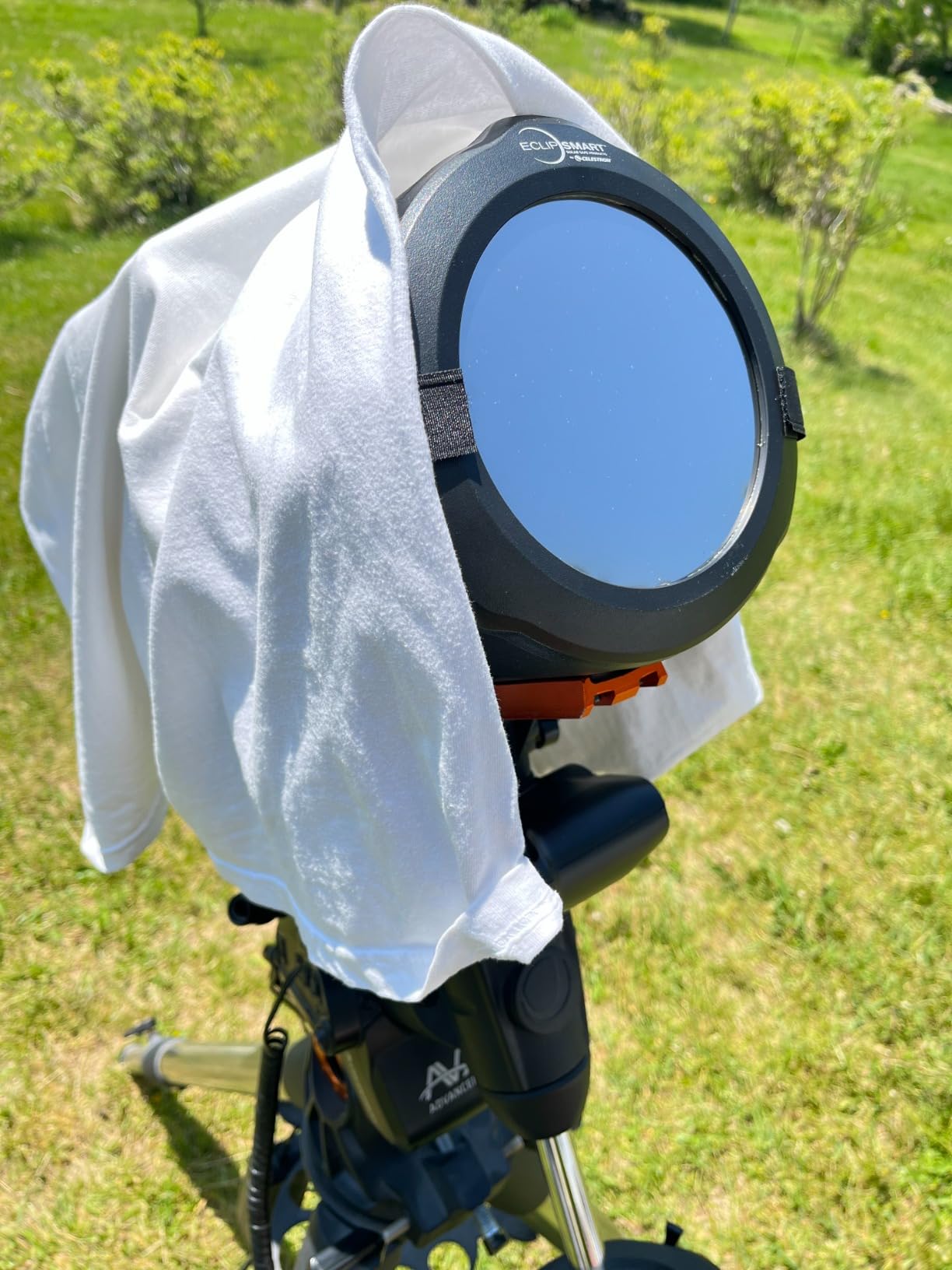
Pointing a telescope at the sun without a proper solar filter will fry your camera sensor and your retina in milliseconds. The Celestron EclipSmart 8-inch filter is the safest way I have found to solar-observing with a Celestron 8-inch Schmidt-Cassegrain or EdgeHD telescope.
It snaps onto the front of the telescope using hook and loop straps, and once secured, the fit is snug enough to survive light wind. The orange solar image through the eyepiece looks natural, and I could see granulation on the sun’s surface during a clear afternoon test.
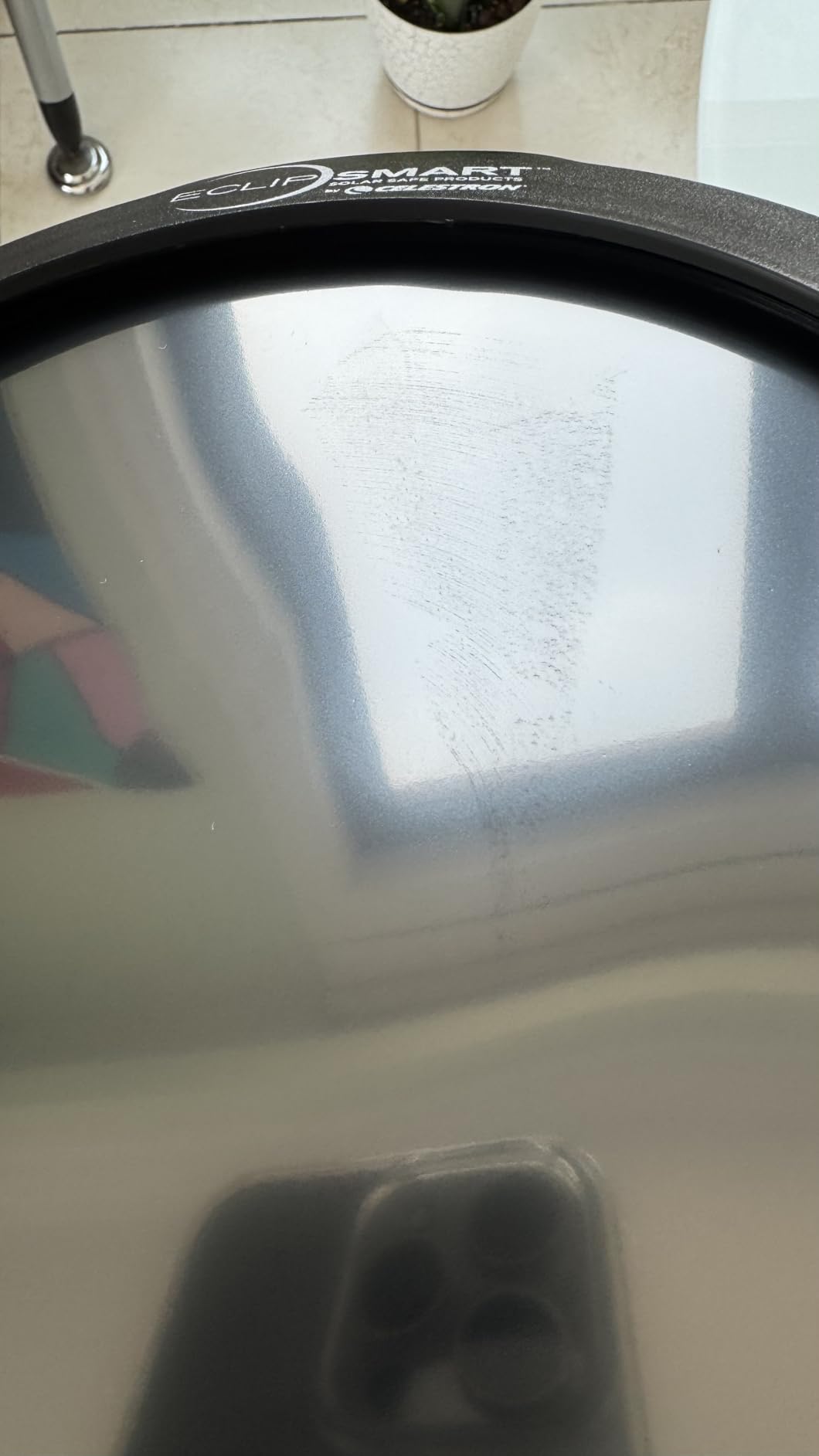
ISO 12312-2:2015(E) compliance is verified, and the filter is built from American Paper Optics solar film, the same supplier NASA recommends. The 2-year Celestron warranty covers any defects, and the waterproof design means morning dew does not ruin the film.
If you plan to photograph the eclipse at high magnification, this filter is essentially required. Binocular and telescope solar filters are a separate category from eclipse glasses, and they need the same ISO certification.
Why Telescope Solar Filters Are Mandatory Gear
Solar magnification concentrates light. Without a certified filter, the sun’s energy cooks the eyepiece, can crack the telescope optics, and instantly damages the eye of anyone who looks through it. Even momentary unfiltered exposure at high magnification is enough to cause permanent blindness.
The EclipSmart filter installs in seconds and removes cleanly, so you can use the same telescope at night without obstruction. Just remember to take it off before pointing at the stars, or you will see nothing but orange during night observation.
What the Celestron Filter Does Not Cover
This filter only fits 8-inch Celestron Schmidt-Cassegrain and EdgeHD models. Smaller or larger telescopes need different filter sizes, and other brands may have different mounting geometries. Check Celestron’s filter lineup for other sizes if your scope is not 8 inches.
Always inspect the film before each use. Punctures, wrinkles, or scratches compromise the filter, and a damaged solar filter is more dangerous than no filter because users assume they are protected when they are not. Store in the original packaging between eclipses.
How to Choose the Best Solar Eclipse Glasses for Your Situation?
Picking from the best solar eclipse glasses comes down to three decisions: certification, fit, and how many people you need to outfit. Start with the certification marking. Every pair you consider should have ISO 12312-2:2015(E) printed on the frame, and the manufacturer should appear on the AAS approved vendor list. Without those two markers, the glasses are not safe, no matter how convincing the marketing looks.
Next, think about fit. Standard cardboard glasses fit most adult faces but do not stack well over prescription glasses. If you wear glasses, choose a fit-over design like the Rainbow Symphony plastic folding glasses. For kids under 10, look for smaller-fit or adjustable options rather than downsizing from adult packs.
Quantity matters too. Single pairs are fine for personal viewing. If you are organizing a backyard event or school viewing day, bulk 5-packs cut cost per pair dramatically. For groups larger than 20, contact American Paper Optics or Rainbow Symphony for institutional pricing.
Understanding ISO 12312-2 Certification
The ISO 12312-2:2015(E) standard is the international benchmark for direct solar viewing. It requires optical density of 5 or greater, which translates to filtering 99.999% of visible light, 100% of UV radiation, and 100% of IR radiation. Anything less than this certification means the glasses do not block enough light to protect the retina.
Older standards like ISO 12312-2:2007 exist for some products on the market. AAS and most reputable vendors have moved to the 2015 standard because it adds stricter testing for scratches and pinholes, which are common failure modes in counterfeit glasses.
How to Inspect Eclipse Glasses Before Each Use
Before every eclipse, take five minutes to inspect each pair. Look for scratches, punctures, wrinkles, or separation between the filter and the frame. Hold them up to a bright lamp; you should see only the brightest light through the lens, and no pinpricks of light through scratches. If you see any damage, throw the glasses away and use a fresh pair.
Also check the ISO marking. If it is worn off, faded, or missing, do not trust the pair even if it looks fine. Reputable vendors print the marking in a way that survives years of storage, so missing text often means counterfeit.
Fit-Over vs Standard Sizing for Glasses Wearers
If you wear prescription glasses daily, standard cardboard eclipse glasses will pinch or leave gaps. Fit-over plastic designs like the Rainbow Symphony folding glasses are designed specifically for stacking over prescription frames. They are the only AAS-approved option I have tested that actually works with glasses.
For users with strong prescriptions, fit-over designs also keep your vision sharp during the partial phases. Removing prescription glasses to use standard eclipse viewers leaves everything blurry, which makes it hard to track details like sunspots or the lunar limb during approach.
Bulk Buying for Schools, Clubs, and Events
Outfitting a school or astronomy club costs less than most people expect. Bulk orders of 50+ AAS-approved glasses run roughly $1 to $3 per pair, depending on the vendor and shipping. American Paper Optics, Lunt, and Rainbow Symphony all handle institutional orders directly through their websites.
Order well before the event. Most reputable vendors sell out 2 to 4 weeks ahead of major eclipses as the date approaches. Buying early also gives you time to inspect each pair before the big day, rather than scrambling during the partial phases.
Trusted Brands and the AAS Vendor List
The American Astronomical Society maintains a strict vendor list of suppliers whose products have been independently tested to ISO 12312-2:2015 standards. Every brand in this guide is on that list or built from film made by an approved manufacturer. Sticking to AAS-vetted brands is the single best way to avoid counterfeits.
Be especially careful with marketplace sellers on Amazon. Counterfeit eclipse glasses have appeared under many brand names on Amazon in past eclipses. Buy directly from the manufacturer when possible, or check that the seller is an authorized distributor before clicking buy.
Frequently Asked Questions
What glasses are safe for eclipse viewing?
Only eclipse glasses certified to the ISO 12312-2:2015(E) international safety standard are safe for direct solar viewing. The filter must block 99.999% of visible light, 100% of UV, and 100% of IR radiation. Every product in this guide meets that standard, and each manufacturer appears on the American Astronomical Society approved vendor list. Regular sunglasses, smoked glass, and homemade filters are not safe regardless of how dark they appear.
What kind of glasses are needed to safely view a solar eclipse?
You need specialized solar viewing glasses with an ISO 12312-2:2015(E) certified filter. Standard sunglasses do not provide enough protection, no matter how dark they are. For glasses wearers, fit-over designs like the Rainbow Symphony plastic glasses stack over prescription frames. For telescope or binocular use, you need a separate solar filter rated to the same ISO standard, mounted on the front of the optics.
Is it safe to use solar eclipse glasses to watch a solar eclipse?
Yes, certified solar eclipse glasses are safe for direct solar viewing during partial phases. They are not safe if the lens is scratched, punctured, wrinkled, or separated from the frame. Inspect every pair before use and discard damaged glasses. You may safely remove glasses only during the brief window of totality, when the moon completely covers the sun and the sky goes dark.
How to tell if solar eclipse glasses are fake?
Real eclipse glasses will have ISO 12312-2:2015(E) printed on the frame along with the manufacturer’s name and address. The lens should be silver or black polymer, and the glasses should be too dark to see anything except the sun. If you can see indoor lights through the lens, the glasses are not safe. Buy only from vendors on the American Astronomical Society approved suppliers list to avoid counterfeits, especially when shopping on Amazon marketplace.
How long do solar eclipse glasses last?
Properly stored ISO 12312-2 certified glasses last for years. Keep them flat in their original sleeve or a protective envelope, away from heat and moisture. Inspect the lens before every eclipse for scratches, pinholes, or wrinkles. Most experts recommend replacing glasses older than 3 to 5 years as a precaution, since the polymer film can degrade. If you stored them in a hot car or attic, replace them before the next eclipse regardless of age.
Final Verdict on the Best Solar Eclipse Glasses for 2026
For most readers, the Lunt Solar Eclipse Glasses 5-Pack is the best solar eclipse glasses choice for 2026 and beyond. The AAS approval, ISO and CE dual certification, and high review volume make it the safest mainstream pick, and the 5-pack format covers your household or sharing group in one box.
If you wear prescription glasses, upgrade to the Rainbow Symphony folding plastic glasses to avoid bridge-pinching and gap issues. If you want a reusable long-term investment, the Keyaluo plastic 3-pack pays for itself across multiple future eclipses. Whatever you choose, order from the AAS approved vendor list and inspect every pair before eclipse day. The 2026 eclipse is worth seeing with your own eyes, and certified solar eclipse glasses are the only way to make that happen safely.