
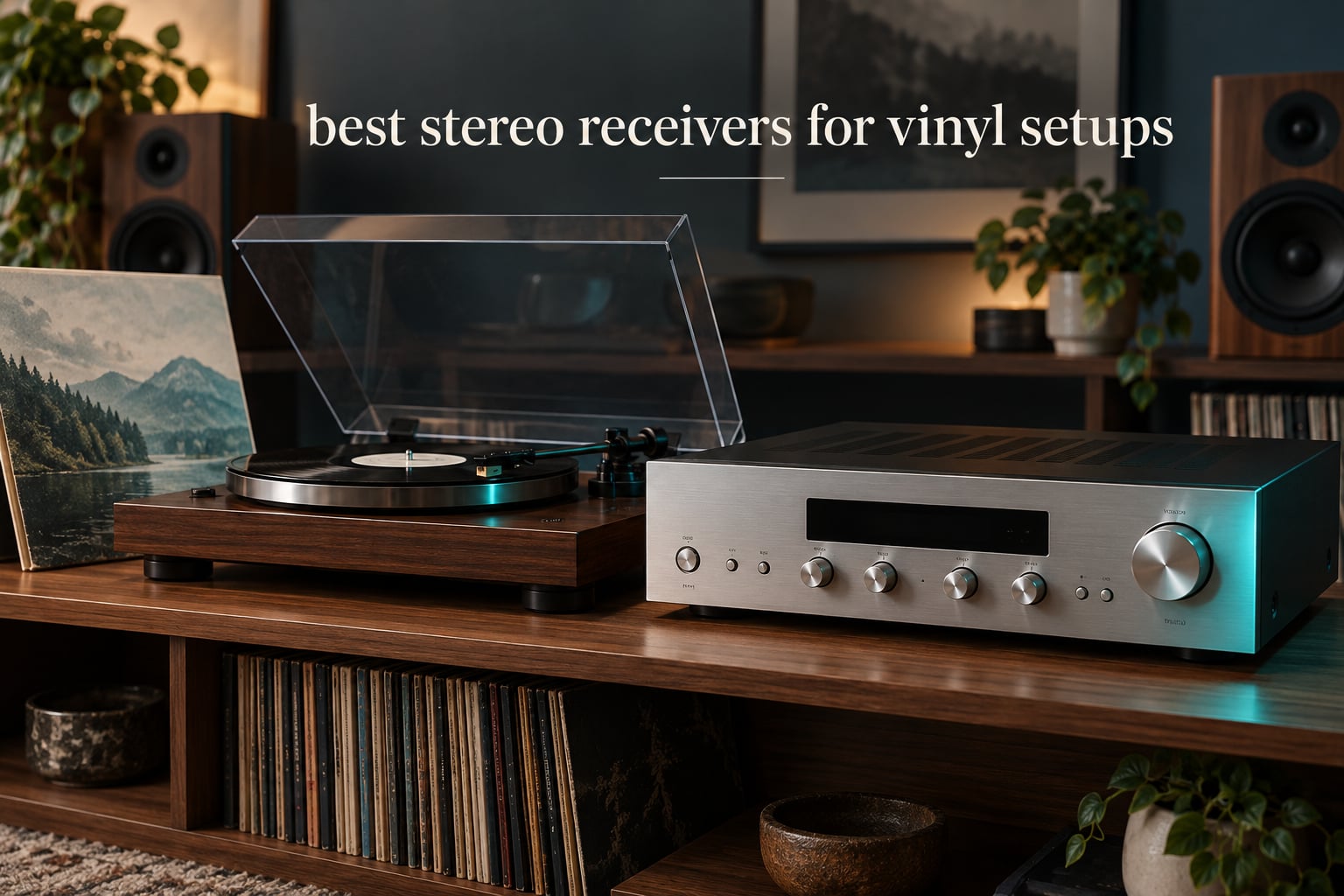
Your turntable does not send a normal audio signal. The stylus movement inside the cartridge produces a signal measured in millivolts, recorded with bass and treble reversed so the disc sounds right on playback. Until a circuit applies the reverse of that curve and multiplies the signal up to a normal line level, there is nothing you can usefully send to a speaker.
That circuit is the phono stage, and the box that houses it along with the power amplifier driving your passive speakers is a stereo receiver. So the best stereo receivers for vinyl setups are not really a lifestyle purchase: they are the missing link in the chain.
Get the phono stage wrong and records sound quiet, thin and lifeless, or harsh and over-amplified. Get it right and the rest of the system stops being the interesting part, which is exactly what you want.
Before you buy anything, check whether your turntable already has a preamp. Many entry-level turntables ship with a tiny switch that routes the phono signal through an on-board preamp so you can plug into a regular AUX or line input. If that switch is set to PREAMP, the receiver’s phono stage must stay unused, and you connect the turntable to a line input instead.
If the switch is set to PHONO, the on-board preamp is out of the circuit and the receiver’s phono input is the correct home for the signal. Running a preamp-equipped turntable into a receiver phono input is the single most common setup error in this hobby, and it produces thin, over-bright, distorted sound that owners usually blame on the cartridge.
We compared ten two-channel units with built-in phono stages, weighing rated watts per channel against the stated impedance, phono stage design, digital input options, and how owners describe the sound in their reviews. Data was refreshed in September 2026, and every spec quoted below comes from the manufacturer listing rather than from forum lore.
Table of Contents
Top 3 Picks for Vinyl Setups in 2026

Sony STR-DH190
- 100W x 2 into 8 ohms
- Built-in phono input
- 4 stereo RCA inputs
- Bluetooth and FM
Quick Overview: Best Stereo Receivers for Vinyl Setups in 2026
Every unit below is two-channel and has a built-in moving-magnet phono stage. Watts are rated per channel into 8 ohms unless the manufacturer states otherwise.
| Product | Specs | Action |
|---|---|---|
| Sony STR-DH190 |
|
Check Latest Price |
| Yamaha R-S202BL |
|
Check Latest Price |
 Denon PMA-600NE Denon PMA-600NE |
|
Check Latest Price |
 Donner MAMP2 Donner MAMP2 |
|
Check Latest Price |
 Marantz PM6007 Marantz PM6007 |
|
Check Latest Price |
 Douk Audio Tube Phono Amp X1 Douk Audio Tube Phono Amp X1 |
|
Check Latest Price |
 Cambridge Audio AXA35 Cambridge Audio AXA35 |
|
Check Latest Price |
 Onkyo TX-8470 Onkyo TX-8470 |
|
Check Latest Price |
 Yamaha R-N800A Yamaha R-N800A |
|
Check Latest Price |
 Nobsound NS-13G MAX Nobsound NS-13G MAX |
|
Check Latest Price |
1. Sony STR-DH190: The Most Complete Entry-Level Box
Sony STRDH190 2-ch Home Stereo Receiver with Phono Inputs & Bluetooth Black
100 watts x 2 at 8 ohms
Built-in phono input
4 stereo RCA inputs
Bluetooth and FM
Pros
- Quiet phono stage with no hum or distortion
- Generous four analog inputs for the tier
- A/B switching runs four speakers at once
- Bluetooth pairs fast and holds steady
Cons
- Phono sound is clean but lean rather than warm
- Small chassis will not take a turntable on top
- Spring-clip speaker terminals
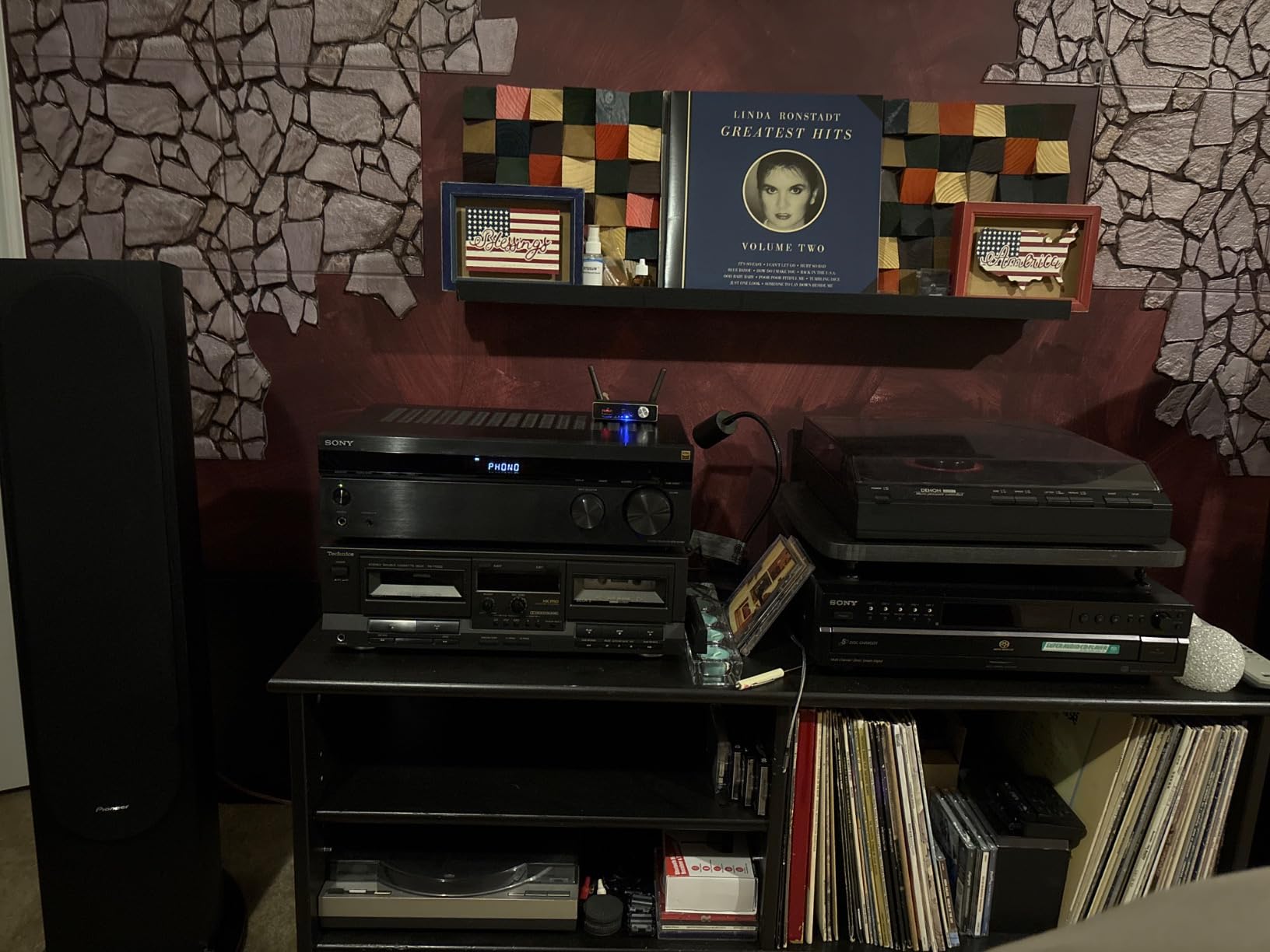
The Sony STR-DH190 is the unit we keep coming back to, because it removes almost every reason a first vinyl owner would need a second box. The phono input is present, quiet and free of the hum that plagues cheaper units, and it plays records at a healthy level with no external preamp in the chain. Owners consistently describe the result as clean rather than warm, and that is fair.
What separates it from its budget rivals is input count and speaker flexibility. There are four stereo RCA inputs plus the phono input and a front 3.5mm jack, and A/B switching lets you run two pairs of speakers together or in separate zones.
That makes it a good match if you are still deciding on speakers, or if you want music in another room as well. A/B switching gave our own bookshelf setup noticeably more flexibility than a single pair ever did.
At 100 watts per channel into 8 ohms with 6 to 16 ohm speaker support, it has more headroom than most competitors this size, thanks to a large-capacity power transformer in a chassis that stands only 5.25 inches tall. That low profile is also its main physical limitation: you will not stack a turntable on top, and the depth is shallow enough that cables behind it are tight.
Bluetooth pairing is instant and holds a strong connection across a room, and the full-size quarter-inch headphone jack is a good option for late listening.
Why the Sony STR-DH190 works for most first vinyl setups
Because it does the one job that matters without an external preamp, and it gives you four analog inputs plus A/B speaker switching, so you are not box-shopping later. A 4.5 average across 10091 reviews is the deepest owner base in this list by a wide margin, which means parts, tips and real-world fixes are easy to find. For anyone moving up from an all-in-one record player, this is the least complicated step forward.
Where it falls short for vinyl listening
The phono sound is described by owners as having a CD-like character, with bass that needs heavy boosting from the tone controls to sound full. If you like warm, weighty vinyl presentation, the Denon or Marantz below suit that taste better. The spring-clip speaker terminals are also a step down from screw posts once you start re-terminating cables.
2. Yamaha R-S202BL: The Best Value for a Music-Only Room
YAMAHA R-S202BL Stereo Receiver
85 watt rated output
Built-in phono input
Bluetooth 4.1
A/B speaker selector
Pros
- Warm musical voicing reviewers like
- Bluetooth pairs smoothly with phones and computers
- FM/AM tuner with 40 presets
- Useful bass and treble controls for room correction
Cons
- Low power means high volume settings
- No digital input so a TV needs a converter
- Vented chassis runs warm
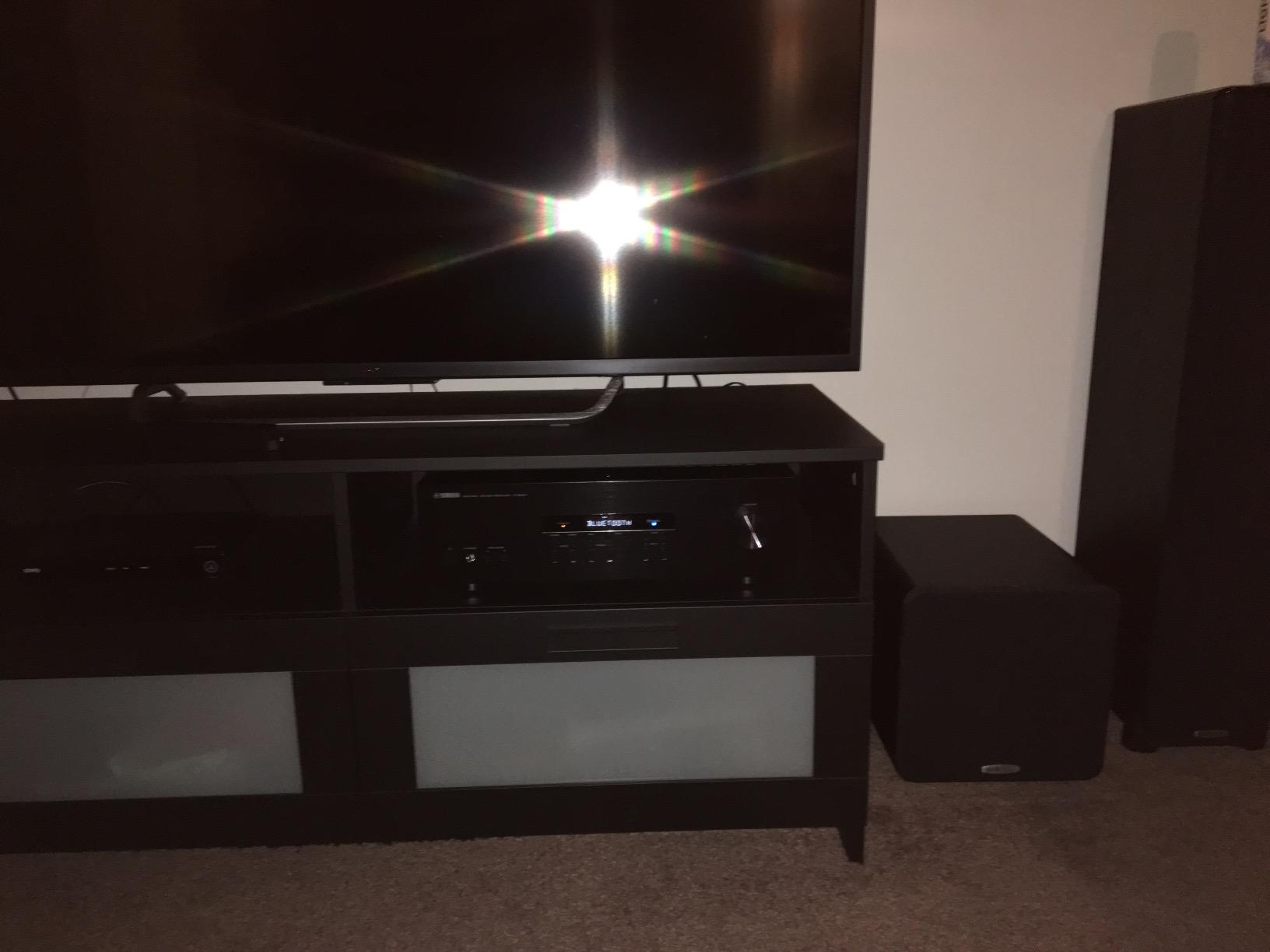
The Yamaha R-S202BL is the budget pick for a room where music is the only job. The phono input is a genuine moving-magnet stage rather than a shared line input, and owners generally find it clear and quiet. Yamaha’s voicing here is warmer than the Sony’s, which suits records that sound a little lean in the budget tier.
It is a simple box with no digital inputs at all. That is a real limitation the moment you want television audio, and it means a small external converter is needed for a TV. For a turntable, a tuner and a Bluetooth phone, it covers everything without complexity.
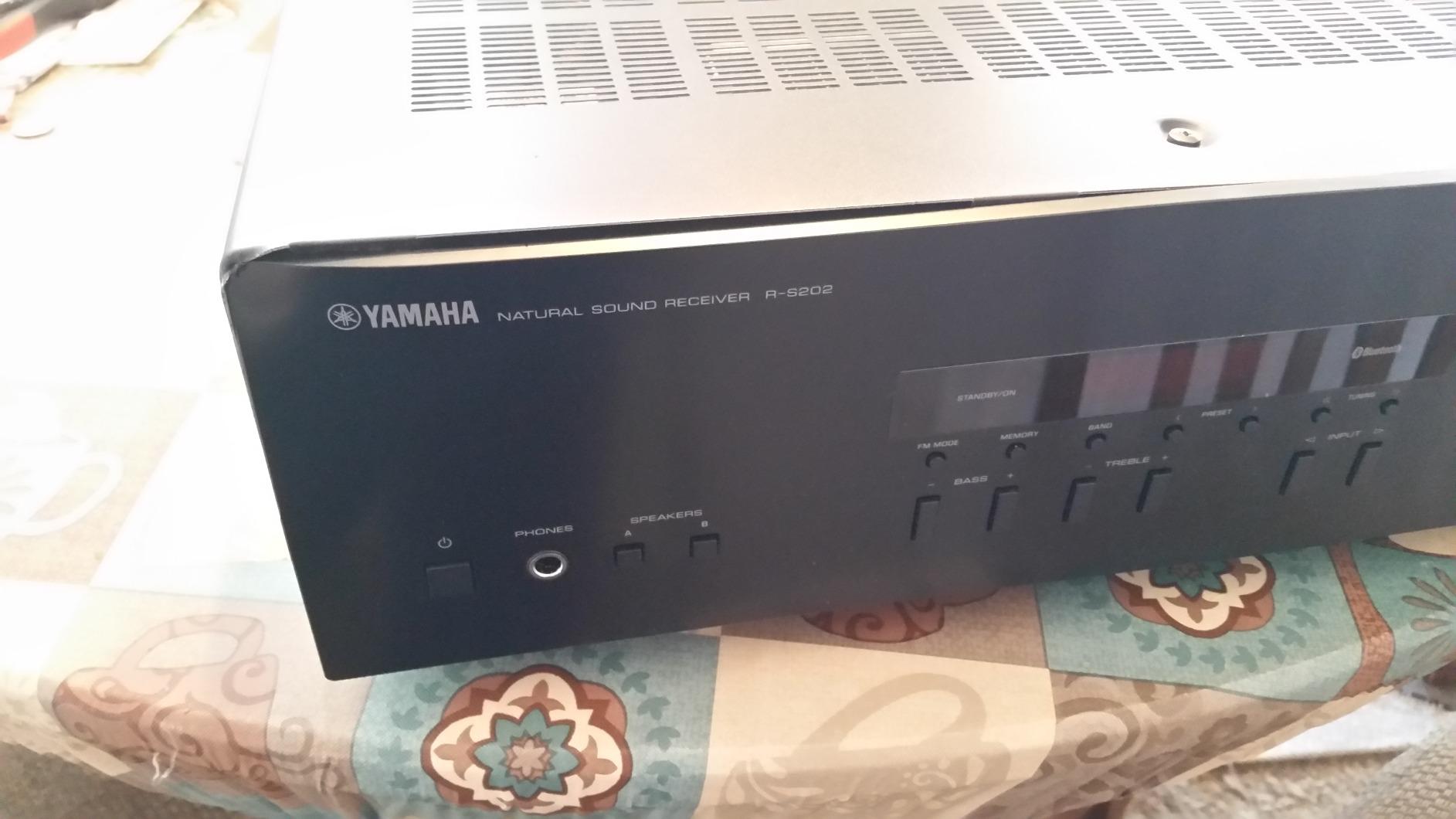
The tuner is a genuine strength: 40 FM/AM presets and strong sensitivity pull in weak and distant stations clearly, which matters more to many buyers than streaming features.
Where owners split is power and treble. At 85 watts rated, a larger room means pushing the volume further than you would like, and the treble control is reported as very soft, with cymbals and snare lacking presence.
Why the Yamaha R-S202BL earns its place
It does the phono-to-speaker job well for a modest outlay, adds a tuner most rivals at this level drop, and keeps the signal path analog and short. Two speaker systems can be switched from the front panel, so it grows with your setup. For a bedroom or a small apartment listening space, that is the whole requirement met.
Where it falls short for vinyl listening
The power rating is the honest limit. Owners of large floorstanding speakers will run out of headroom in a big room, and a small subwoofer output is not present to help. The absence of optical, coaxial and HDMI inputs also blocks the common vinyl-plus-TV arrangement. If either matters to you, the Denon is the better step up.
3. Denon PMA-600NE: The Best Built-In Phono Stage Here
Denon PMA-600NE Bluetooth Stereo Amplifier, 2 Channel Amplifier Home Audio
70W at 4 ohms
Built-in MM phono preamp
Analog Mode disengages digital circuits
2 optical and 1 coaxial input
Pros
- Phono stage is quiet with no hum
- Analog Mode fully shuts out digital circuitry
- Built-in DAC performs at or above external streaming DACs
- Subwoofer pre-out included
Cons
- Remote volume steps are coarse and laggy
- Dim recessed input indicators
- Binding posts can be tight
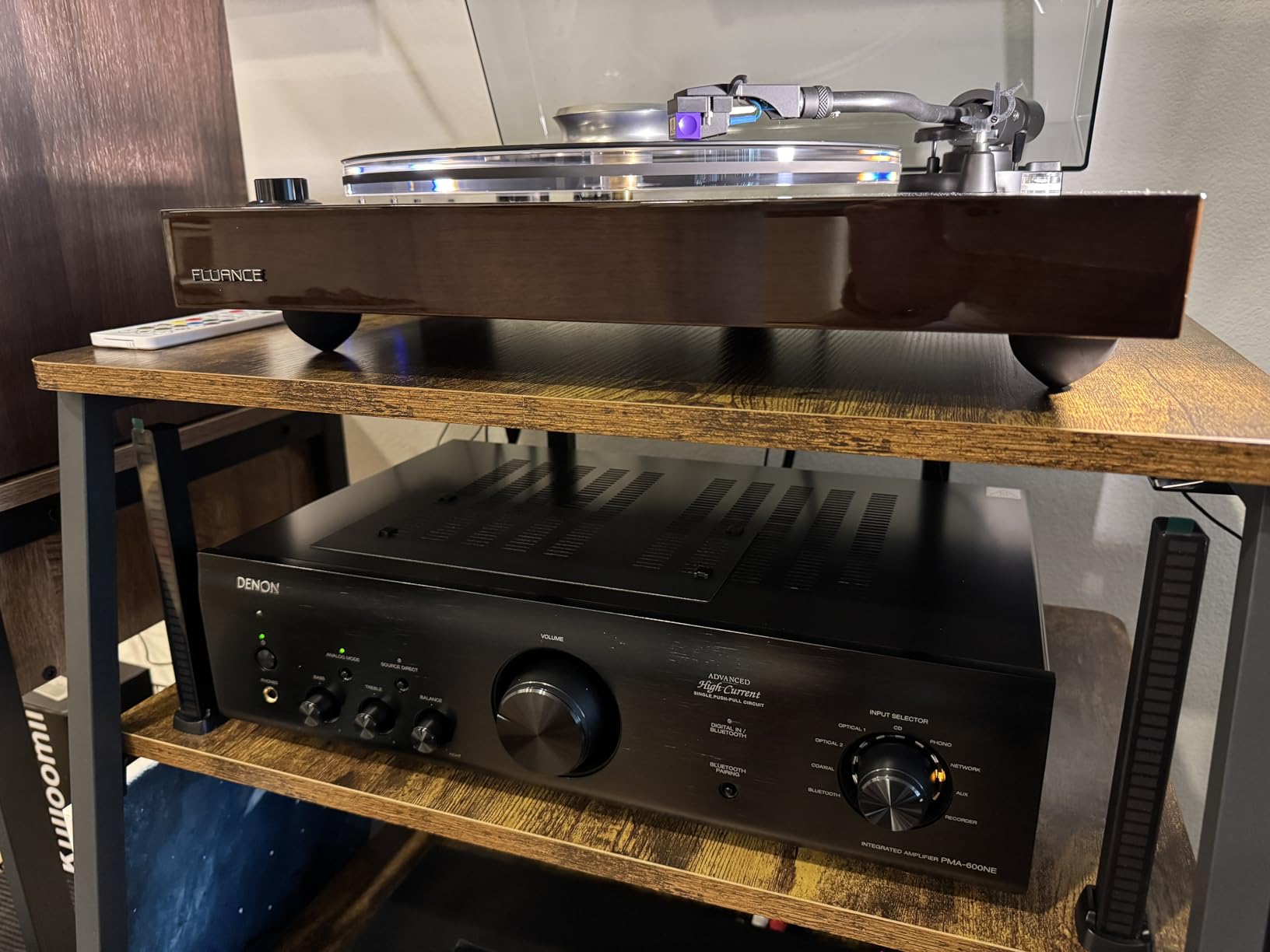
The Denon PMA-600NE is technically an integrated amplifier rather than a receiver, which in practice means the same job with a cleaner signal path. Its phono stage is among the strongest here: owners describe it as quiet and hum-free, and the 4.7 average across 582 reviews is the highest in the group.
Analog Mode physically disconnects the digital circuitry rather than just bypassing it in software. When you want nothing between the cartridge and the power stage except the phono preamp, that leaves the shortest path available on any of these units. There is also a Source Direct path that bypasses tone and balance controls.
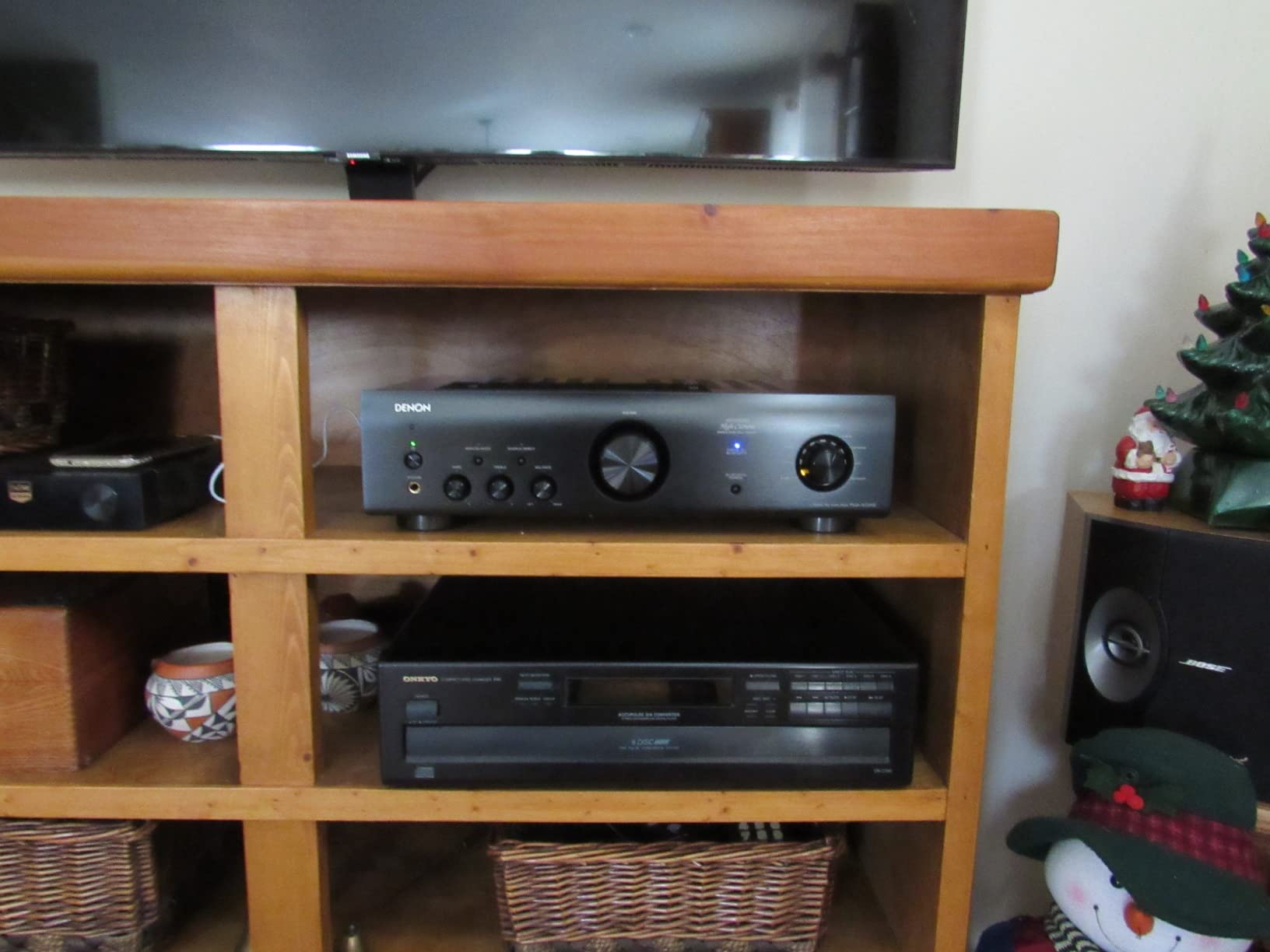
Two optical inputs and a coaxial input feed an internal DAC, and owners compare that DAC favorably against external streaming converters at several times the cost. An RCA subwoofer output covers the common small-speakers-plus-sub arrangement, and a quarter-inch headphone jack sits on the front. The shallow chassis is easy to place close to speakers, which matters more than it sounds: turntables need distance from speaker drivers to avoid acoustic feedback.
The Advanced High Current push-pull topology reaches loud levels at low volume settings, so volume positions behave sensibly next to a phono source. The three-year warranty is among the longest here.
Why the Denon PMA-600NE suits serious vinyl listening
Because the phono stage and the Analog Mode give you a genuinely pure path when you want it. Warm, tube-like voicing is the most common description, and owners compare it favorably to 1970s receivers. The subwoofer pre-out and internal DAC make it the easiest single box for vinyl plus TV plus streaming.
Where it falls short
At 70 watts into 4 ohms it is not a high-power amplifier, and without a subwoofer the bass extension is limited, which is why several owners add one. The dim, recessed LED indicators around the selector are genuinely hard to read in a dark room, and the plastic binding posts can be tight for banana plugs.
4. Donner MAMP2: The Most Inputs You Can Get in One Box
Donner Stereo Audio Amplifier, 600W Peak 2 Channel Receiver with Bluetooth 5.3, Phono, Optical, Coaxial, USB, FM, 2 Mic-in, Aux, RCA Input for Home, Karaoke, Theater Speakers, MAMP2
600W peak or 60W x 2 RMS
Phono, optical, coaxial, USB
Bluetooth 5.3
2.1 speaker support
Pros
- More input types than any other unit here
- Separate channel volume knobs plus midrange control
- Clean phono stage that works out of the box
- Full-function remote
Cons
- Cooling fan is loud during quiet passages
- Only one RCA line input on the back
- Peak wattage claim far exceeds real output
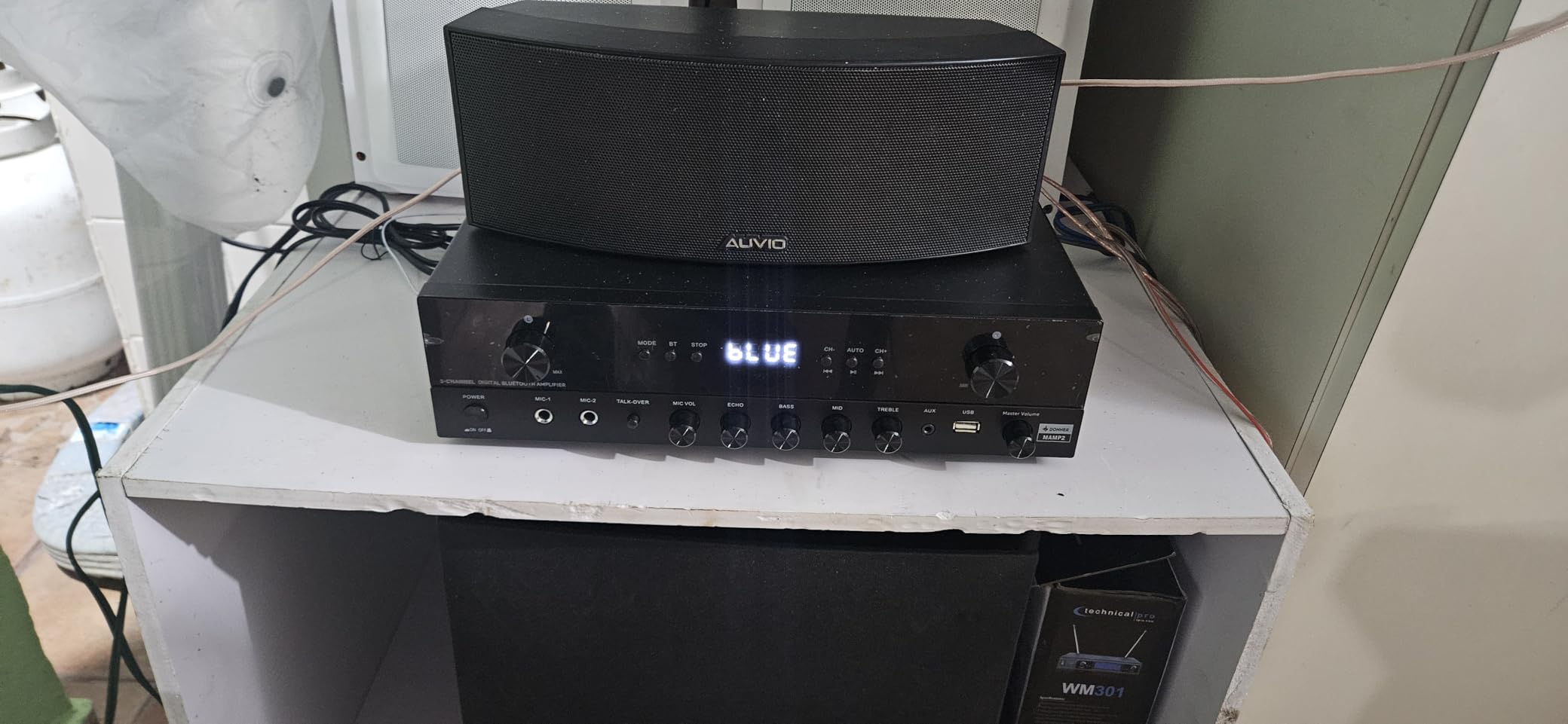
The Donner MAMP2 is the feature-dense option, and for a setup with several sources it is hard to argue with. The phono input is clean and works with a turntable straight out of the box, with no hum reported. Everything else is analog or digital convenience layered on top: optical, coaxial, USB, Bluetooth 5.3, AUX, FM radio and two microphone jacks with a talk-over function for karaoke or hosting.
Independent volume knobs for each channel and a midrange EQ control are unusual at this level, and a settings memory restores volume and EQ after power-up.
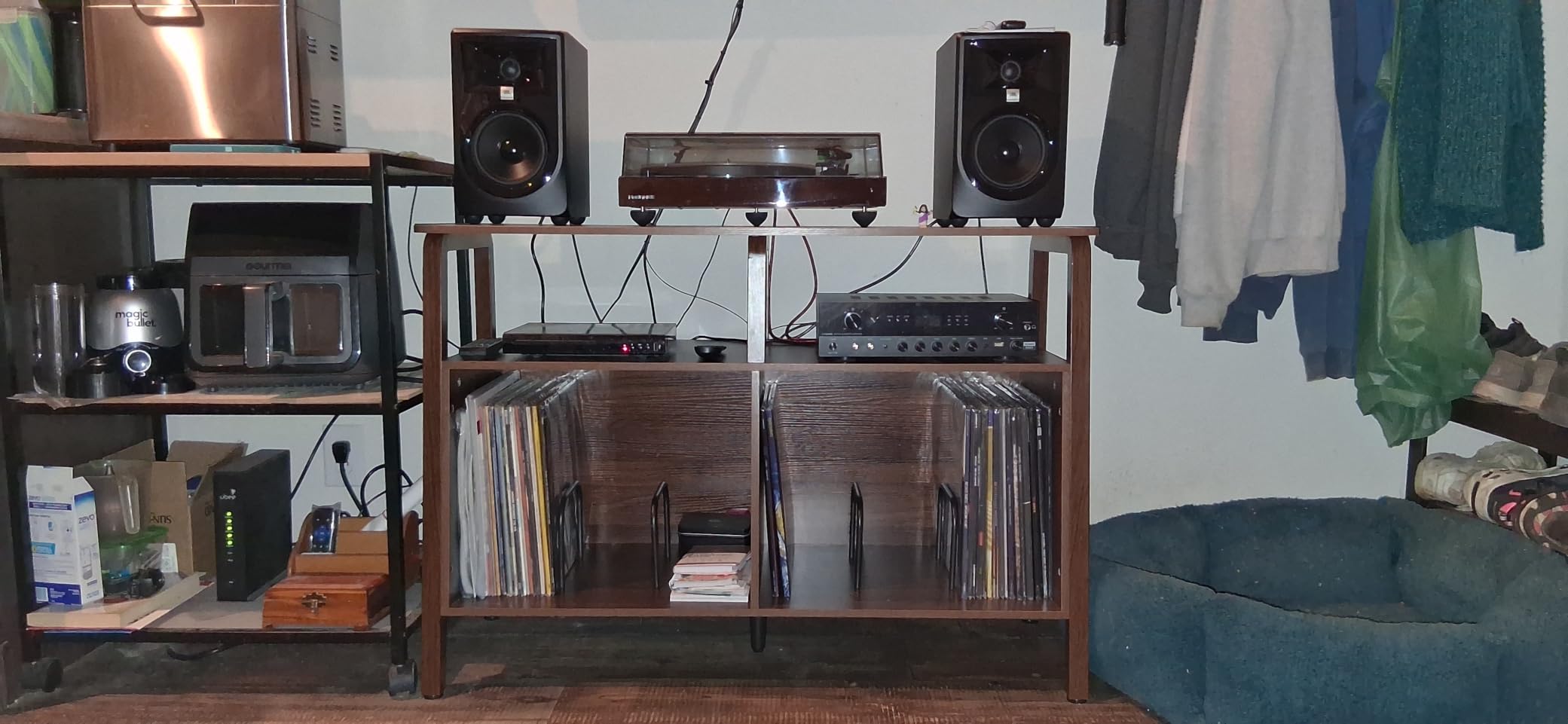
Speaker support runs from 4 to 16 ohms across two groups plus a subwoofer. Judge the power on the RMS figure: the listing advertises 600 watts peak while actual output is 60 watts RMS per channel, which is still enough for most bookshelf pairs.
The most repeated complaint is the cooling fan, which revs up audibly during quiet passages. That matters in a vinyl setup, where much of the listening is at low volume. There is also only one RCA line input on the back and no display dimmer.
Why the Donner MAMP2 fits a multi-source room
Because it accepts virtually any source without an adapter: a turntable, a TV over optical, a computer over USB, a phone over Bluetooth, and microphones for karaoke. If your listening room doubles as a rehearsal space or a small office, nothing else in this list covers that range. Settings memory means the volume does not jump back to a startling level each morning.
Where it falls short for vinyl listening
The fan noise is a real problem for quiet, close-listening vinyl, which is exactly the use case here. The single RCA line input limits how many analog components you can chain. And with a 4.0 average, the build and support record are a step behind the established Japanese and European brands.
5. Marantz PM6007: The Warm, Vintage-Sounding Choice
Marantz PM6007 Amplifier, Integrated Amplifier – Black
45W per channel at 8 ohms
MM phono preamp with FET input
5 analog plus 2 optical and 1 coaxial
A/B speaker switching
Pros
- Signature warm crisp Marantz voicing
- Plenty of power for a small dedicated room
- Bluetooth included
- Gold-plated inputs with digital options
Cons
- Some examples arrive with a European three-pin plug
- Phono stage can take time to settle in
- 45 watts is modest for large floorstanders
Marantz built its reputation on how records sound through its gear, and the PM6007 carries that character into a modern integrated amplifier. Owners consistently describe the voicing as warm and crisp, and compare it directly to 1970s Marantz receivers. If you find budget gear cold and lean, this is the tonal correction you are looking for, and forum regulars name Marantz as the benchmark vintage receiver for vinyl warmth.
The phono stage is a moving-magnet design with a FET input stage, which is the right architecture for the vast majority of turntables. The current feedback amplifier design and HDAM SA3 discrete modules in the output stage are Marantz house features aimed at dynamic range and lower distortion.
Five analog inputs are gold-plated, and there are two optical and one coaxial digital input feeding a fully shielded DAC with two selectable filters. Bluetooth is built in, which most Marantz integrated amplifiers of this generation lack. A/B speaker switching uses copper terminal screws, and steel feet handle vibration isolation. It also stacks visually with other Marantz components.
At 45 watts per channel into 8 ohms, that is ample in a small dedicated room and modest for large floorstanding speakers. A meaningful group of reviews concerns regional power plugs, since some examples arrive with a European three-pin plug needing 220V and a step-down transformer, so check the plug on arrival.
Why the Marantz PM6007 suits vinyl listeners chasing warmth
The tonal character is the reason, and it is consistent across the reviews rather than anecdotal. A 4.6 average reflects broad satisfaction. The shielded DAC with selectable filters lets you compare digital sources, and Bluetooth means it works as a modern central component rather than a period piece.
Where it falls short
The 45-watt rating limits headroom with efficient-but-large speakers, and there is no subwoofer pre-out listed. Verify the plug type on arrival. If you want more power and more connectivity in the same warm character, the Denon PMA-600NE covers more ground.
6. Douk Audio Tube Phono Amp X1: Tube Sound for a Desktop System
Douk Audio Tube Phono Amp: Bluetooth Receiver | 2-Channel Amplifier for MM Turntables | 160W×2 TDA7498E | Tone Control | for Desktop Vinyl HiFi Home Audio System (X1)
160W x 2 at 4 ohms
JAN5725 tubes on pluggable sockets
Dedicated low-noise MM phono stage
Bluetooth 5.0 with aptX
Pros
- Warm detailed tube voicing at a low cost
- Quiet MM phono stage with proper grounding
- Compact footprint for a full amplifier
- NOS GE tubes included
Cons
- Bluetooth module can fail after about a year
- Sensitive to a loose phono ground wire
- Sounds hollow until the tubes warm up
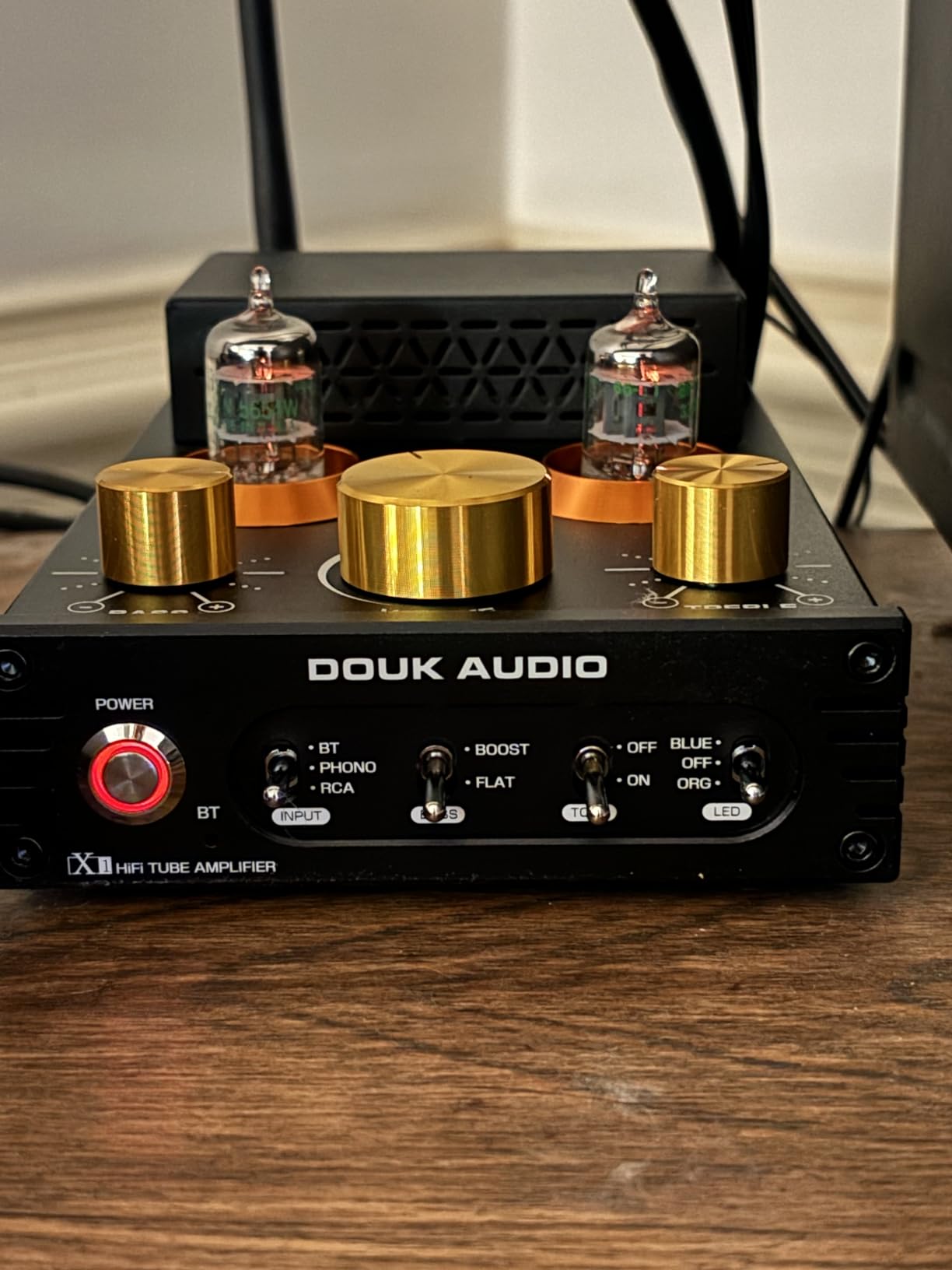
This is the odd one out in the roundup, and that is the point. The Douk Audio X1 puts a pair of JAN5725 vacuum tubes on pluggable sockets in the preamp section, and buyers consistently treat the included new-old-stock GE tubes as a standout bonus. The voicing is described as warm and detailed, and as a genuine step up from other budget amplifiers.
Here, the tube sound works because power is not the problem: a TDA7498E output stage rated 160 watts per channel into 4 ohms, with a 32V/5A supply included and upgradeable to 35V. Owners report it driving 1970s floorstanding speakers and 10-inch woofers convincingly, and a subwoofer output is included for active subs.
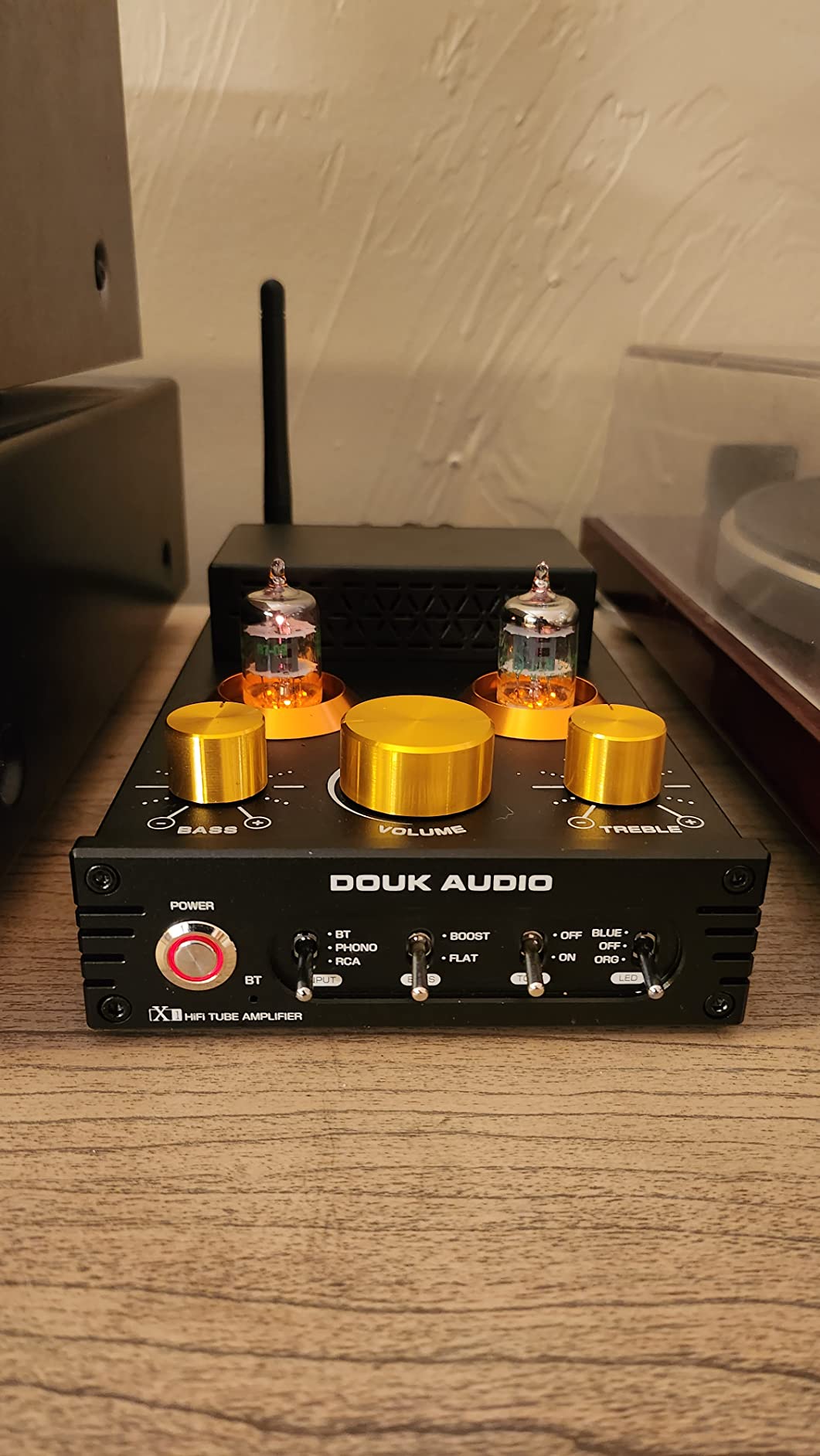
The phono stage is a dedicated low-noise MM design with an optimized board layout, and reviewers report no hum at high levels. That quietness depends on the ground connection being solid, which leads to the most important caveat on this page. Bluetooth 5.0 with the QCC3034 chipset supports aptX and aptX-HD, and it connects silently without confirmation beeps.
Reliability is the weak point: Bluetooth board failures are reported after roughly a year, sometimes outside the warranty. One owner reported the unit shorting out after a loose phono ground wire, so treat the ground post connection as essential.
Why the Douk Audio X1 fits a small warm system
Tubes in the signal path, plenty of clean power, and a phono stage reviewers call quiet. For a desk or shelf system with vintage recordings, the warm character suits the material. Tone control, bypass and bass boost are all present, so you can compare the tube path against a cleaner one through the bypass switch.
Where it falls short
The Bluetooth module’s reliability history is the concern for anyone planning to keep this for years. Grounding must be handled carefully. And the 4.1 average reflects that this is a value-first design rather than a serviceable one, with an 18-month warranty rather than multi-year coverage.
7. Cambridge Audio AXA35: Built for Small Rooms and Small Shelves
Cambridge Audio AXA35 Integrated Amplifier with Built in Phono Stage (Silver)
35 watts into 8 ohms
Built-in phono stage
4 RCA inputs and front aux
82dB signal to noise
Pros
- Built-in phono stage removes the external preamp need
- Compact 3.3 inch tall chassis fits small cabinets
- Wide 5Hz to 50kHz frequency response
- Four RCA inputs plus front aux jack
Cons
- 35 watts is limited for larger rooms
- No wireless or digital inputs at all
- No subwoofer output listed
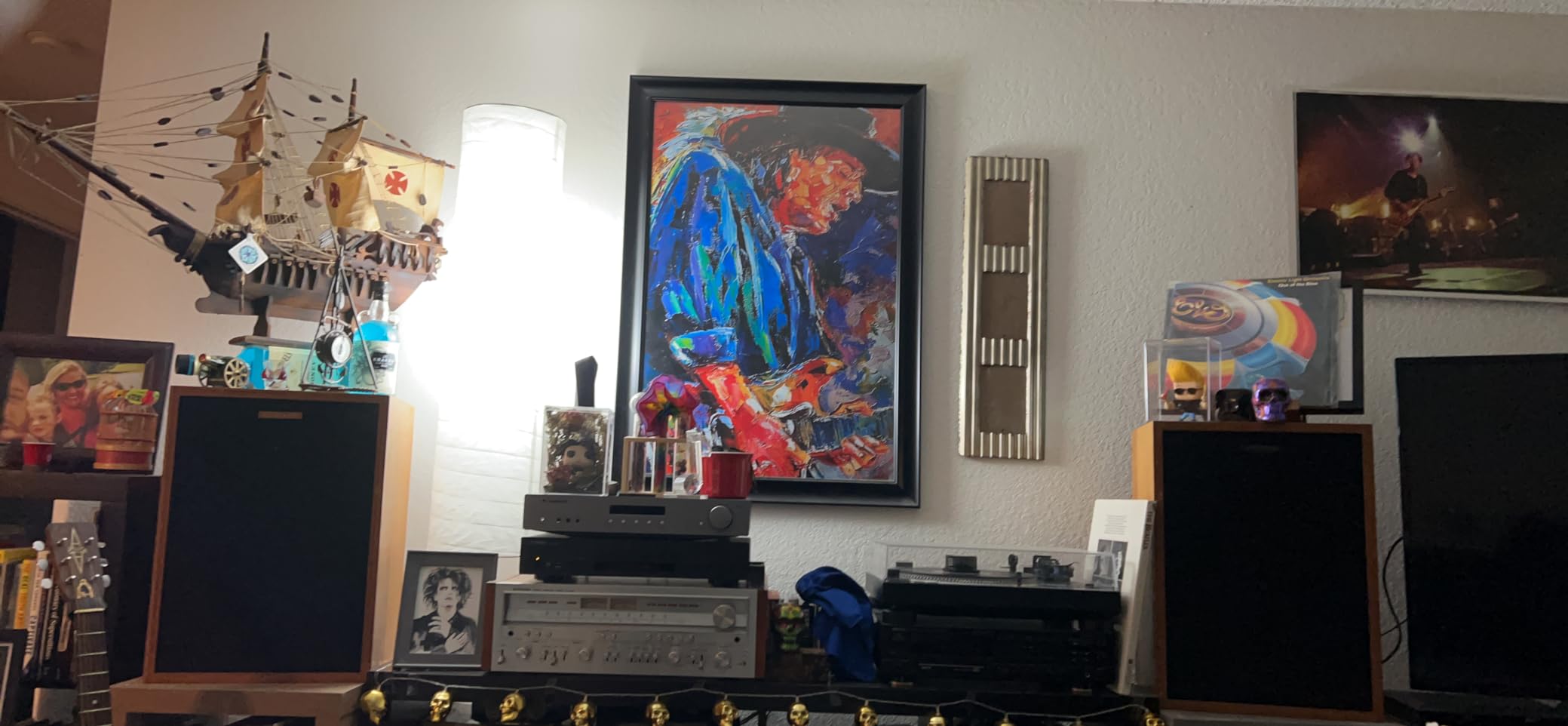
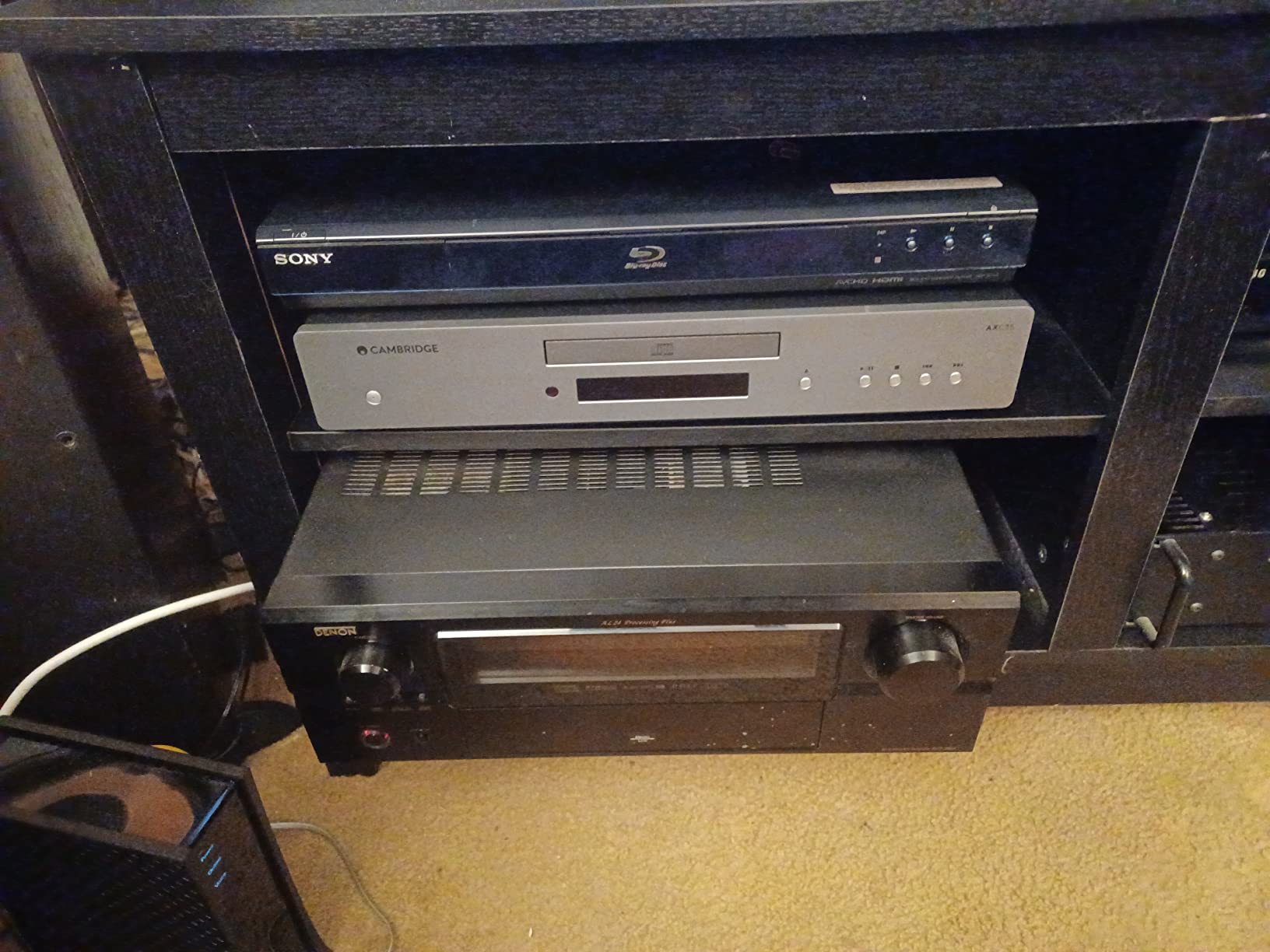
The Cambridge Audio AXA35 is the answer when shelf space is the constraint. At 3.3 inches tall it slides into a cabinet most other amplifiers in this roundup will not, and the low-profile aluminum chassis is easy to place near your speakers. Turntables need distance from speaker drivers to avoid acoustic feedback, so a small chassis that can sit close to the speakers is a genuine functional advantage.
The built-in phono stage is the most-cited reason owners buy it for vinyl, and it removes the external preamp from the equation. Four RCA line inputs and a front 3.5mm aux jack cover analog sources, and the measured frequency response runs from 5Hz to 50kHz with a signal-to-noise ratio above 82dB.
At 35 watts into 8 ohms this is the lowest output figure in the roundup, so match it to efficient near-field or bookshelf speakers rather than large floorstanders. In a small room at near-field distances it is enough.
Connectivity is where it gives ground. There is no Bluetooth, Wi-Fi, optical, coaxial or USB input, and no subwoofer pre-out is listed, so a TV needs an external converter.
The 4.6 average across 178 reviews points to broad satisfaction, though detailed per-feature commentary in the review data is limited, so specific limitations are less well documented here than for the other picks.
Why the Cambridge AXA35 suits a compact vinyl system
The footprint and the built-in phono stage solve two problems at once: where to put the box, and whether you need a second one. Four line inputs give room to grow as sources are added, and the front aux jack keeps a phone or tablet connection one plug away.
Where it falls short
Power is the honest ceiling. A larger room with less efficient speakers will exhaust it, and there is no subwoofer output to extend the bottom end. With no digital or wireless input, it is a music-only component by design rather than a central hub.
8. Onkyo TX-8470: The Best Phono Board, Weakest Software
Onkyo TX-8470 2 Channel Stereo Receiver with Wi-Fi, Bluetooth, Phono, Hi-Res Audio and Roon Ready
110 watts output
Isolated MM/MC phono board
Wi-Fi, Bluetooth, AirPlay, Roon Ready
4 HDMI ports with ARC
Pros
- Isolated MM/MC phono board is exceptional for the tier
- Expansive soundstage with strong microdetail
- Built-in DAC widely praised
- Two year parts and labor warranty
Cons
- App and Wi-Fi drop frequently requiring re-setup
- No built-in subwoofer crossover or bass management
- Fiddly setup menu and remote password entry
The Onkyo TX-8470 is a genuine two-channel receiver built for music rather than surround, and that framing explains the specification choices. Four HDMI ports with ARC, a USB input, optical and coaxial digital, and full network streaming with Tidal, Deezer, Spotify, AirPlay, Bluetooth and Roon Ready. Dirac Full Band room correction is included as well.
The phono board is isolated from the rest of the circuit and uses discrete op amp circuitry, and owners comparing it against far more expensive separates describe the soundstage and microdetail as excellent. The DAC is singled out as exceptional at this level.
At 110 watts rated output it has real headroom, enough to drive floorstanding speakers. Some owners found it insufficient for multiple towers plus a subwoofer, and there is no built-in subwoofer crossover or bass management.
The persistent problem is software, not sound. Owners report the app and Wi-Fi dropping connection frequently, forcing repeated setup and long troubleshooting sessions, and the unit cannot play an entire USB drive continuously, stopping at the end of each folder.
Why the Onkyo TX-8470 suits a streaming household with a turntable
It is the only pick here that can run vinyl and a television from one box with HDMI ARC, and the switchable MM/MC phono board means it will grow with a cartridge upgrade. Roon Ready and Dirac room correction are unusual at this level, and a two-year parts and labor warranty is among the longer ones.
Where it falls short
Network reliability is the flaw to plan around, and it is the first thing to check when setting it up. No bass management means sub integration is manual. If you only play records and a tuner, the simpler analog boxes above give you fewer ways to be let down.
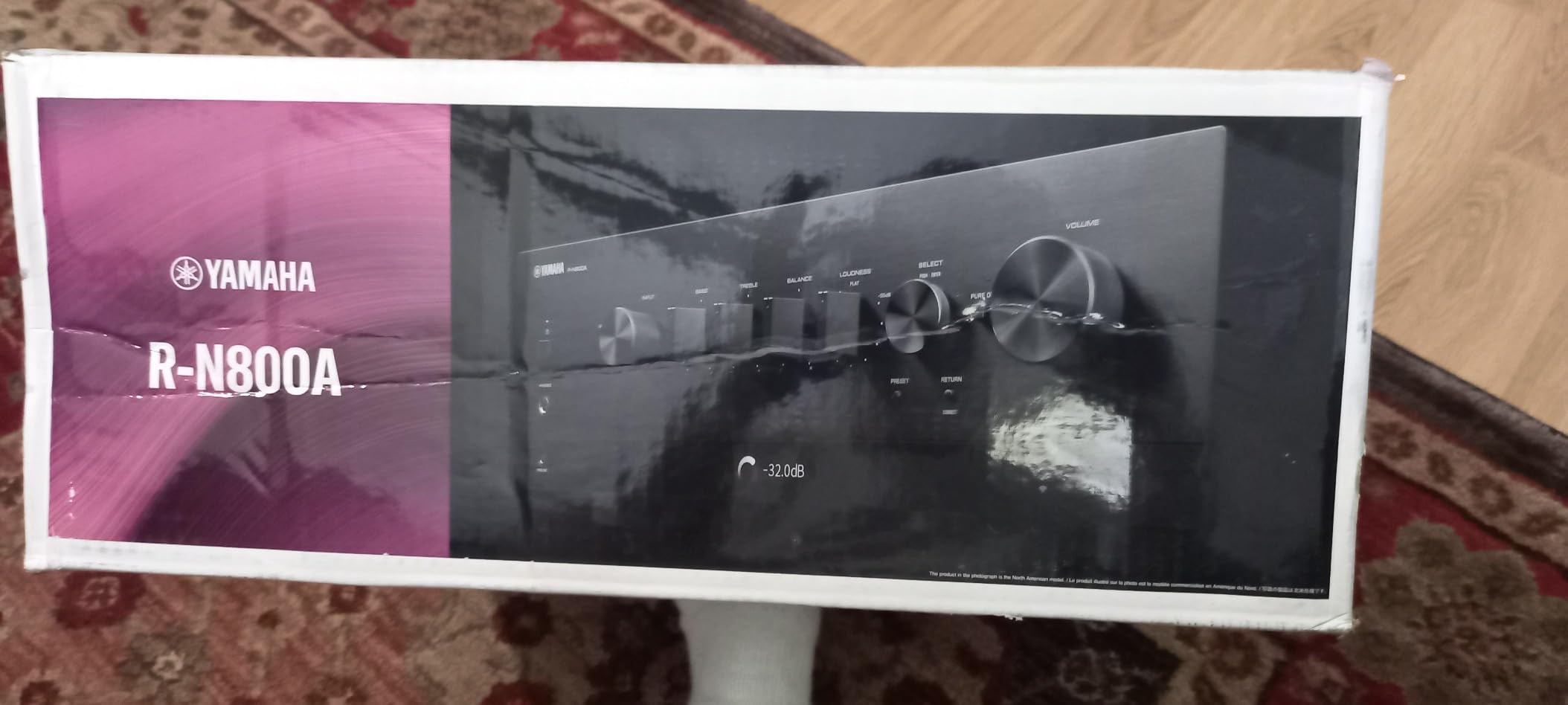
9. Yamaha R-N800A: The Most Capable Network Box, Weakest Phono Stage
Yamaha R-N800A Network Receiver with Phono and Built-in DAC, Black
100W per channel
MM phono input
ESS SABRE ES9080Q DAC
YPAO-R.S.C. room correction
Pros
- Clean detailed sound with wide soundstage
- ESS SABRE DAC plus USB for DSD and 384 kHz
- MusicCast app covers all streaming services
- YPAO measures distances accurately
Cons
- Built-in phono stage is considered weak
- Volume differs a lot between vinyl and line sources
- YPAO EQ is seen as muddying the sound
The Yamaha R-N800A is the most capable machine here on paper, and the caveat is specific and important for this roundup: the built-in phono stage is widely considered weak. One owner added a separate Cambridge Audio phono preamp. For a vinyl-focused list, that is a meaningful strike against a box that is otherwise exceptional.
What it does exceptionally well is everything after the phono stage. The ESS SABRE ES9080Q Ultra DAC drives the USB input for DSD at 11.2 MHz native and 384 kHz playback, and owners report a consistent sound character across optical, coaxial, AirPlay, Bluetooth and USB sources. MusicCast covers the streaming services in one app, and the sound is described as clean, detailed and fatigue-free with excellent instrument separation.
Power is 100 watts per channel in a 2.1 configuration, and YPAO-R.S.C. measures speaker distances, handles crossover settings and sub levels. Some owners prefer listening with YPAO off for critical playback, and one had the measurement microphone return an error. Volume differences between the phono source and line sources are a repeated complaint, which is normal for phono-level input but catches people out.
Construction is serious, with ToP-ART anti-resonance design and low impedance concepts, and the warranty runs five years, the longest here. Minor gripes include thin sheet metal on the rear speaker connectors, rectangular rather than round tone controls, and some owners losing network and Wi-Fi connectivity after a few months.
Why the Yamaha R-N800A suits a digital-heavy household
It is the only pick with a serious hi-res DAC, USB input, HDMI with ARC and full room correction for a 2.1 system. If you play records alongside a lot of streaming and files, the source switching and app are hard to match. The five-year warranty is also the strongest here.
Where it falls short for vinyl
The phono stage is the reason it is not higher. If the record is your main source, an external phono preamp plus this amplifier is a common enthusiast path, and that is an added box and an added cost. Disabling YPAO and managing level jumps between sources takes setup effort too.
10. Nobsound NS-13G MAX: The Smallest Useful Vinyl Amp
Nobsound 300Wx2 Stereo Amplifier with Phono Input – HiFi Class D Mini Power Amp for Home Theater, Turntables, Studio Monitor | TPA3255 Chip, RCA/MM Inputs, Bass/Treble Control (NS-13G MAX DC 48V)
300W x 2 at 4 ohms Class D
TPA3255 chip, 0.005 percent THD
MM phono input
5.1 x 4 x 1.5 inch chassis
Pros
- MM phono input works out of the box
- Compact CNC-milled aluminum chassis frees shelf space
- Accurate flat response with a wide soundstage
- 48V/5A power supply included
Cons
- Runs very warm to the touch
- No Bluetooth or wireless connectivity
- Some users needed to disconnect the phono ground wire
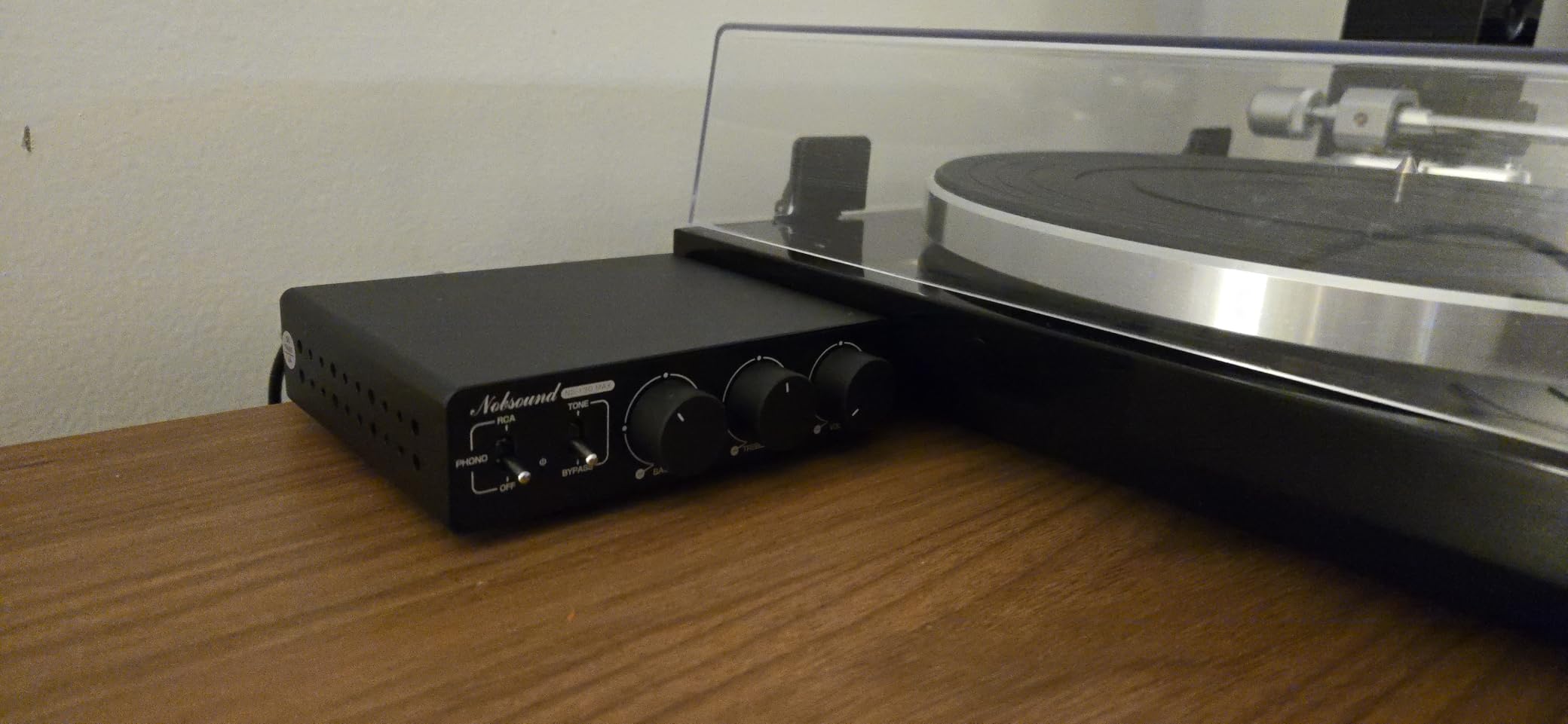
The Nobsound NS-13G MAX is the smallest complete vinyl system in this roundup, at 5.1 by 4 by 1.5 inches. The CNC-milled aluminum chassis is genuinely pocket-sized, and a 48V/5A supply is included, so it is plug-and-play with no separate brick to hide. Owners building simple turntable and bookshelf systems report it as a real step up from entry-level desktop amplifiers.
Power comes from a Texas Instruments TPA3255 Class D chip rated 300 watts per channel into 4 ohms, with 0.005 percent THD and 107dB signal-to-noise. NE5532P preamp chips, Japanese Rubycon capacitors and WIMA film capacitors in the signal path. The MM phono input works well out of the box, and 2.1 is supported through a volume-synced 3.5mm aux passthrough to a subwoofer.
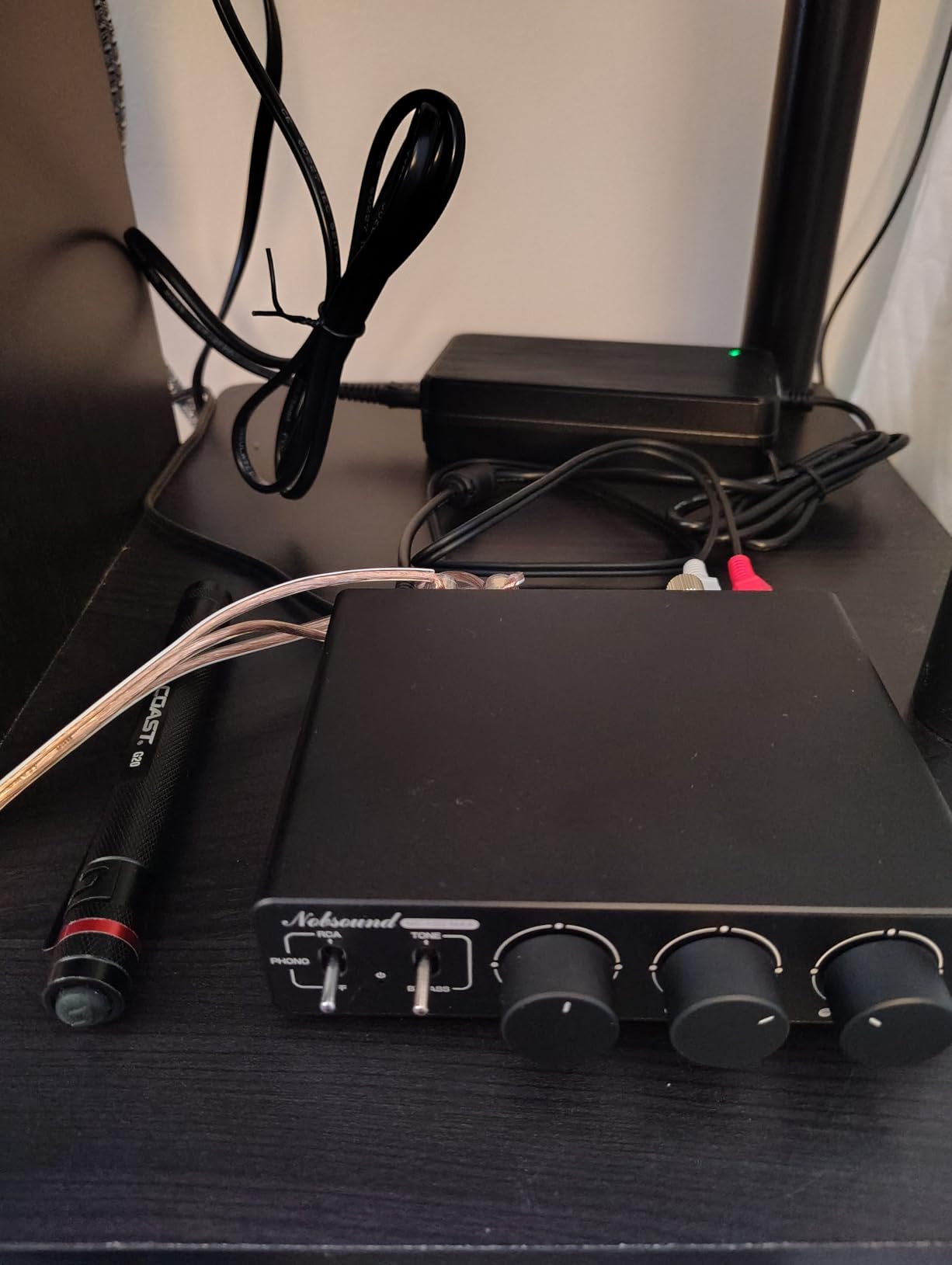
Bass and treble adjust plus or minus 6dB, and owners describe the controls as wide-ranging without harshness, with a tactile detent feel. Frequency response is described as accurate and flat with a noticeably wide soundstage, and banana speaker outputs are provided. The 18-month warranty is short next to the Denon and Onkyo coverage.
Heat is the consistent complaint. The unit runs very warm and can be hot to the touch even when idle or lightly loaded, so it needs airflow. There is no wireless connectivity of any kind, and sound can come across flat without an external equalizer.
Reliability reports are isolated but real: one unit failed after five months with a single channel at reduced power. Some users also needed to disconnect the phono ground wire to remove heavy distortion, which points to sensitivity in the grounding path.
Why the Nobsound NS-13G MAX suits a small vinyl system
It gives you a real MM phono stage, plenty of rated power and honest componentry in a box that disappears on a shelf. A 4.1 average across 75 reviews is the smallest owner base here, so treat it as a value pick. The included supply and banana outputs remove two common setup problems.
Where it falls short
Heat management, no wireless connectivity, and the shortest warranty in the group. With 75 reviews, real-world failure data is thinner than for the established models, so the two-year and three-year warranty options elsewhere carry more weight if you keep equipment for a long time.
Stereo Receiver vs AV Receiver for Vinyl: Do You Actually Need Surround Sound?
An AV receiver can play records well. The forum consensus in vinyl-focused discussions is that an AV receiver sounds fine for vinyl playback if it is set to two-channel stereo mode with all DSP and tone controls defeated. The problem is not sound quality, it is the rest of the box.
A stereo receiver or integrated amplifier has two channels of power, no HDMI switching, no room correction, no surround processing, and usually no subwoofer crossover. An AV receiver adds those things, which is useful if you watch films and useless if you do not. It also adds menus, calibration microphones and network setup, and typically costs more for the same two-channel power.
Shopping results for this query routinely surface AV receivers, which is why we have kept this list strictly two-channel. If you want one box for films as well as records, the Onkyo TX-8470 and the Yamaha R-N800A are the two picks here that can carry HDMI and room correction, and both need their tone and DSP behavior configured for vinyl listening. Our companion guide to AV receivers for home theater covers that category properly.
How to Connect a Turntable to a Stereo Receiver
Check the preamp switch on the turntable. If the turntable has a PREAMP/PHONO switch, decide which signal you want. Preamp mode means the turntable outputs line level, so it goes into an RCA line input. Phono mode means the turntable outputs cartridge level, so it goes into the receiver’s PHONO input.
Connect the RCA cables. Match the left channel to the left input and the right channel to the right input. In PHONO mode the plug goes into the phono input, usually labelled PHONO or with a small record icon. Do not use a phono input with a preamp-equipped turntable running in line mode.
Connect the ground wire. A thin bare wire from the turntable’s grounding post goes to the GND or ground post on the receiver. This is the step that removes hum, and it is the step most often skipped. The post is usually a small screw terminal near the phono input.
Connect the speakers. Use the A and B speaker terminals, observing polarity so the positive channel matches the positive terminal on both speakers. Turntables and speakers need physical separation, so a receiver you can place away from the speakers is useful.
Set the level correctly, then test. Start with the volume low. Select the phono input, put the needle down, and raise the volume gradually. Because the phono stage adds a lot of gain, the useful volume range is lower than for streaming, and the setting will differ between sources.
If you hear hum after all five steps, the ground wire is the first thing to re-seat, not the cartridge or the RCA cables.
The Phono Stage Question: MM, MC, and Why You Might Not Need the Receiver’s Own
Are built-in phono preamps good? Increasingly yes for moving-magnet cartridges, and a moving-magnet cartridge will work in essentially every built-in phono stage on this list, which is why beginners can safely choose a receiver on power, connectivity and size. Enthusiasts still prefer a dedicated external phono preamp, and the forum view is that a decent standalone stage usually sounds better than a budget receiver’s built-in circuit.
A moving-magnet cartridge outputs several millivolts. A moving-coil cartridge outputs a fraction of that and needs a much higher-gain, switchable MC stage. If your cartridge is MM and the stage is set to MC, the result is very quiet and thin. The Onkyo TX-8470 is the only pick here with a switchable MM/MC board; the rest are MM only, which is the right call for most turntables.
Two situations make an external preamp worth it. If your receiver’s phono stage is weak for your taste, the Yamaha R-N800A is the clearest example. If you want to audition cartridges later, a standalone stage gives you one box to change rather than a whole receiver. In both cases, the receiver’s phono stage goes unused rather than double-amplified.
Fixing the Most Common Vinyl Setup Problems
Hum is the first problem nearly everyone hits, and it is almost always solvable without replacing anything.
Hum that follows the volume control points to a ground loop. Re-seat the turntable ground wire, remove any unused RCA cables from the back of the receiver, and try the turntable on a different input. If the hum persists, a cheap isolation transformer or a hum eliminator on the phono path resolves it. Some owners on budget units report that disconnecting the phono ground wire removed distortion, but that is a workaround, not a fix, and it also removes your noise reference.
Sound that is too quiet, thin or lifeless almost always means the record is playing through a line input instead of the phono input, or the turntable’s preamp switch is in the wrong position. Double-check both. A moving-magnet cartridge into a line input needs roughly 500 to 1000 times more gain than it is getting, which is exactly the sound you describe.
Sound that is harsh, thin and over-bright usually means double amplification: a preamp-equipped turntable in line mode, plugged into the receiver’s phono input, so the signal is amplified twice and equalized once. Turn the turntable’s preamp switch to PHONO, or move the cable to a line input. This single fix accounts for more bad-sounding vinyl systems than any cable or cartridge change.
A sudden jump in loudness when you switch from streaming to vinyl is normal, because a line source is already amplified and a phono source is not. Set the level to match rather than assuming something is wrong.
How to Choose a Stereo Receiver for Vinyl
Power is the specification buyers guess at most and it is simpler than it looks. In a small room, 30 to 40 watts per channel into 8 ohms is enough for efficient bookshelf speakers. In a mid-size living room, 60 to 80 watts is comfortable. For large floorstanding speakers in an open-plan space, you want 100 watts or more, or you will run out of headroom before the volume knob stops. Check the impedance too: a unit rated for 6 to 16 ohms, such as the Sony STR-DH190, accepts a wider speaker range than one designed around a single figure.
All ten units here are built for passive bookshelf or small floorstanding speakers, so matching efficiency matters as much as wattage. A guide to bookshelf speakers for stereo listening is worth reading before you commit to a pairing.
Beyond power, seven criteria decide the choice.
Phono stage present and correct for your cartridge. MM is the requirement for most turntables. MC switchability is a bonus, and only the Onkyo offers it here.
Preamp-on-both-ends protection. Confirm where the turntable’s preamp switch needs to sit, and confirm the receiver has a line input if you want to use the turntable’s on-board preamp instead.
Pure analog path for vinyl. Analog Mode on the Denon, Direct or Source Direct bypassing tone controls, or an entirely analog signal path. Tone controls and DSP should be defeatable.
Input count and types. Count the analog sources you have now plus one you might add. Digital inputs matter only if a TV or streamer is part of the plan.
Power and speaker impedance. Match rated watts per channel against room size and speaker efficiency, and confirm the receiver accepts your speakers’ impedance.
Size and placement. A low-profile chassis lets you place the receiver away from speakers that need distance from the turntable.
Warranty and support. Ranges from one year to five years here, which reflects how serviceable each brand is over the long term.
Here the 45-watt Marantz and the 35-watt Cambridge suit the smaller-room, near-field end of that range, while the Sony at 100 watts and the Yamaha at 100 watts per channel cover a typical living room. The Donner and Nobsound amplifiers rate their output into 4 ohms, so read those figures carefully rather than comparing them directly against 8-ohm ratings.
One buying path worth naming: a serviced vintage receiver remains a legitimate option and Marantz is the name most often recommended for vinyl warmth. The tradeoff is condition, moving parts and no warranty, so the modern boxes above are the lower-risk choice for a first system.
Which One Should You Buy?
For most people, the Sony STR-DH190 is the answer: a quiet phono stage, four analog inputs, A/B speaker switching, Bluetooth and a tuner in one low-profile box, backed by 10091 owner reviews. If your turntable has a preamp switch and you want the simplest possible path, the Yamaha R-S202BL is the cheaper, warmer-sounding alternative for a music-only room.
If you care more about the record than the gadget, the Denon PMA-600NE pairs a quiet phono stage with Analog Mode, optical and coaxial inputs and a subwoofer pre-out. Choose the Marantz PM6007 instead if you specifically want warm, vintage-style voicing in a small room. Pick the Onkyo TX-8470 when a television and streaming share the system, and the Yamaha R-N800A when hi-res files and room correction matter more than phono quality.
Frequently Asked Questions
Do I need a stereo receiver for my turntable?
If your turntable has no built-in preamp, you do. The cartridge produces a signal of only a few millivolts, and a phono stage is required to apply RIAA equalization and raise it to a normal line level. If your turntable has a preamp switch, you can use a line input on any amplifier instead. Either way you still need a power amplifier to drive passive speakers.
What is the best receiver amplifier for a turntable?
The Sony STR-DH190 is the best all-round choice here, with a quiet built-in phono stage, 100 watts per channel into 8 ohms, four analog inputs, A/B speaker switching, Bluetooth and an FM tuner. Choose the Denon PMA-600NE instead if the phono stage quality matters most, or the Onkyo TX-8470 if you also want HDMI, Wi-Fi and a switchable MM/MC phono board.
Are built-in phono preamps good?
For moving-magnet cartridges, yes, and every unit in this roundup will play an MM cartridge directly. A dedicated external phono preamp generally sounds better than a budget receiver’s built-in circuit, and it is worth adding if your receiver’s phono stage disappoints. An MM cartridge into a stage set for MC sounds very quiet and thin, so check the switch position before blaming the cartridge.
What causes hum in a phono preamp, and how can I stop my turntable from humming?
Almost always a ground loop. Re-seat the turntable ground wire at the receiver’s ground post, remove any unused RCA cables, and try the turntable on a different input. A hum that rises and falls with the volume control is almost never the cartridge or the speakers. If it persists, an isolation transformer or hum eliminator on the phono path removes it.
What is considered the best stereo receiver of all time?
There is no permanent answer, because the category was defined largely by vintage Marantz, Technics and Pioneer receivers, which forum listeners still describe as the benchmark for vinyl warmth. Among current models, the Sony STR-DH190 is the best-supported all-round pick, while the Denon PMA-600NE has the strongest phono stage and the Marantz PM6007 the warmest voicing. The right answer depends on your speakers and room.
Conclusion
The best stereo receivers for vinyl setups all do the same essential job, and the differences are in power, phono stage design and the connections you will actually use. Our Editor’s Choice, the Sony STR-DH190, covers the widest set of needs for the money; the Denon PMA-600NE wins on phono stage quality; the Marantz PM6007 wins on warmth. Whatever you choose, check the preamp switch on your turntable first and connect the ground wire, because those two details decide whether the system sounds right. Data refreshed in September 2026.