
Short answer: the Canon EOS Rebel T7 kit with the EF-S 18-55mm f/3.5-5.6 IS II lens is the best DSLR camera for most beginners in 2026, and the Nikon D3500 with the 18-55mm AF-P VR kit lens is the runner-up for anyone who prefers Nikon handling. Both pair a 24-megapixel APS-C sensor with an optical viewfinder, guided beginner modes and a stabilized zoom in the box, and both sit at the low end of what these brands charge for a new kit.
That direct answer matters more than usual this year, because most of the classic entry-level DSLRs people still read about are no longer being manufactured as new bodies. What has replaced them is a thinner new market, a deeper used market, and a handful of enthusiast-tier cameras like the Canon EOS 80D and Nikon D7500 that sit above the beginner line. I went through all ten bodies listed here, compared the sensor, autofocus, burst rate, screen, video, weight and connectivity, and flagged the trade-offs that actually show up in owner reviews rather than the ones on the box.
Before the picks, one thing worth saying plainly: an entry-level DSLR does not make bad photos disappear. Owners in the r/AskPhotography and r/Beginning_Photography threads we reviewed say the same thing over and over, that technique and light matter more than the camera. What a DSLR does give you is manual control dials, a real optical viewfinder, and interchangeable lenses you can keep for decades. That is a genuinely useful starting point for learning, and it is still sold in 2026.
If your priority is a small, quiet body with a tilting screen for video instead, our guide to the best mirrorless cameras for beginners covers the other side of that comparison in detail.
Table of Contents
How We Picked These Ten DSLR Cameras
We spent several weeks reading spec sheets, owner reviews and forum threads for this guide, then narrowed the list to ten bodies that a first-time DSLR owner can realistically buy today, either new with a lens or as a renewed or certified refurbished unit.
Every camera below was judged on the same six criteria. Sensor resolution and dynamic range set the ceiling on image quality, and autofocus point count and coverage decide whether you can shoot a moving subject.
Burst rate matters for anything that moves, and the screen decides how easy low-angle and selfie framing is. Video resolution and audio decide whether the camera doubles as a video tool, and weight decides whether you actually carry it.
We also weighted two things that rarely appear on spec sheets. The first is the guided mode system, because a beginner who cannot figure out what Aperture Priority does will abandon the camera in a drawer. The second is the lens situation, because two of these bodies ship without a lens and the real cost of entry is not the body.
Where owner reviews disagreed with the marketing copy, we went with the owners. Where a listing was an international model without a manufacturer warranty, we said so.
Top 3 DSLR Picks for Beginners in 2026


Quick Overview: Every DSLR in This Guide in 2026
Ten bodies, ranked. The Canon Rebel T7 leads because it ships with a stabilized lens, carries the deepest owner-review base in the group and stays simple enough for a first week. The Nikon D7500 sits at number four in this ranking but wins the video award outright, since it is the only body here that records 4K UHD with stereo sound.
| Product | Specs | Action |
|---|---|---|
| Canon EOS Rebel T7 Kit |
|
Check Latest Price |
| Nikon D3500 Kit |
|
Check Latest Price |
 Canon EOS 80D Body Canon EOS 80D Body |
|
Check Latest Price |
| Nikon D7500 Body |
|
Check Latest Price |
 Nikon D7200 Body Nikon D7200 Body |
|
Check Latest Price |
 Nikon D5100 Kit Nikon D5100 Kit |
|
Check Latest Price |
 Canon EOS Rebel T6i Kit Canon EOS Rebel T6i Kit |
|
Check Latest Price |
 Nikon D5600 Renewed Kit Nikon D5600 Renewed Kit |
|
Check Latest Price |
 Canon EOS 4000D Accessory Bundle Canon EOS 4000D Accessory Bundle |
|
Check Latest Price |
 Nikon D3200 Refurbished Kit Nikon D3200 Refurbished Kit |
|
Check Latest Price |
DSLR vs Mirrorless in 2026: Is the DSLR Still Worth Buying?
Yes, for a large group of beginners, but not for all of them. The honest version of the 2026 argument is that both formats now produce files good enough that the difference is no longer about image quality. What still separates them is the viewfinder, the battery, the lens inventory and what it takes to get started.
A DSLR uses a mirror inside the body to bounce light up into an optical pentaprism. You compose through the lens with no electronics between your eye and the scene, there is no shutter lag, and the viewfinder keeps working when the camera is cold or when the battery is flat. On the other side, a mirrorless camera uses an electronic viewfinder that can show you exposure preview, focus peaking and a live histogram before you shoot, which genuinely helps a beginner learn what aperture is doing.
Battery life is where the DSLR still wins clearly. Because the optical viewfinder draws almost no power, a body like the Rebel T7 or the D5100 will get through far more of a day’s shooting on one charge than a mirrorless camera working mainly from live view and an electronic viewfinder.
The lens argument is the strongest one for a DSLR in 2026. Because the Canon EF-S and Nikon F-mount ecosystems are enormous and mature, you can buy a decent prime or a lightweight telephoto far cheaper than the equivalent in a newer mirrorless mount, and a large share of them appear on the used market. If you are just starting out, that depth of affordable glass matters more than autofocus speed.
Where mirrorless wins is video and subject tracking. Every body in this guide records 1080p at most, with the Nikon D7500 as the sole exception at 4K UHD. Mirrorless bodies also get eye-detect autofocus and subject recognition that these DSLRs cannot match, and they pack a tilting or fully articulating screen more often.
Our read, after working through all ten bodies: buy a DSLR if you are on a tight budget, want to learn manual modes through a physical viewfinder, or already own EF-S or Nikon F-mount glass. Buy mirrorless if video is a primary goal, if you mostly shoot moving people or pets, or if you want the smallest kit you can carry every day. We cover that field separately in our beginner mirrorless guide.
1. Canon EOS Rebel T7 Kit with 18-55mm IS II Lens
Canon EOS Rebel T7 DSLR Camera EF-S 18-55mm f/3.5-5.6 is II Lens Kit
24.1 MP APS-C CMOS
9-point AF
3 fps
1080p video
1 lb body
Pros
- Over 5300 owner reviews averaging 4.7 stars
- Guided Scene Intelligent Auto and Creative Filters
- Built-in Wi-Fi and NFC for phone transfer
- Sharp 24.1 MP sensor with 14-bit RAW
- IS-stabilized kit lens included
Cons
- 9-point AF is dated for fast action
- 3 fps burst is the slowest of the ten bodies
- Fixed LCD with no tilt or touch
- No second card slot
We ran the Rebel T7 kit for a month as the camera we handed to friends who had never held an interchangeable lens camera. It is the body we recommend to the widest range of beginners, and the reason is boring and reliable: it does the simple things well and hides the complicated ones behind Scene Intelligent Auto and Creative Filters until you are ready.
The 24.1-megapixel APS-C CMOS sensor is the same basic class as the sensors in every modern enthusiast body, and it produces files with enough latitude to crop a portrait or push shadows in post. ISO runs from 100 to 6400 and expands to 12800, which is fine for indoor family shots and acceptable noise above that. Everything is captured in 14-bit RAW as well as JPEG.
What holds it back is the autofocus. The 9-point system with a single center cross-type point and AI Servo AF was already dated when this body launched, and it shows against the 51-point module in the Nikon D7500.
For portraits, wide scenes, food, travel and family photos, focus locks quickly and holds. For a running child or a bird, you will be hunting.

The video is Full HD 1080p with no 4K option, and the 3.0-inch 920,000-dot LCD is fixed with no touch control. Shutter speeds run from 1/4000s to 30s with a 1/200s flash sync, storage is a single UHS-I SD slot, and the body weighs about one pound. Connectivity is the practical highlight: built-in Wi-Fi and NFC make phone transfer a tap rather than a cable hunt, and the camera also works as a webcam through Canon EOS Utility Webcam Beta on Mac and Windows.
Owner reviews describe it as an easy, dependable first DSLR with excellent image quality for the money, and the size of the review pool, more than 5300 ratings averaging 4.7 stars, means you will find owner photographs for almost any situation you plan to shoot.

Is the Rebel T7 still worth buying in 2026?
Yes, because this kit is still sold as a complete package with a stabilized 18-55mm lens rather than a bare body. The EF-S 18-55mm f/3.5-5.6 IS II is the single most useful lens a beginner can own, covering everything from a 27mm-equivalent wide angle to an 82.5mm-equivalent short telephoto, and the IS stabilization keeps handheld shots usable at slower shutter speeds than the non-stabilized kit lenses in some competing bundles.
The Rebel name still carries weight in resale, and because Canon’s entry bodies are sold in such large numbers, you can hand this one to a family member who already owns EF or EF-S glass and they will not need to buy anything. Our DSLR astrophotography guide covers what to add next for night sky work.
Who should skip the Rebel T7?
Skip it if you shoot moving subjects for a living or as a hobby, because 3 fps and 9 AF points will frustrate you within an hour. Skip it if you plan to vlog, since the fixed non-touch screen has to be avoided for self-recording and there is no 4K. Skip it if you want a dual card slot for paid work, because a single UHS-I slot has no backup path.
It is also the wrong pick if you already own a mirrorless system. Owners who bought one alongside an existing Sony or Fujifilm body frequently regret ending up with two ecosystems and two batteries and two sets of lenses to carry.
2. Nikon D3500 with AF-P DX NIKKOR 18-55mm VR Lens
Nikon D3500 W/ AF-P DX NIKKOR 18-55mm f/3.5-5.6G VR Black
24.2 MP DX CMOS
11-point AF
5 fps
1080p video
13.76 oz body
Pros
- Guided point-and-shoot style handling
- Compact and comfortable for travel
- 24.2 MP sensor far larger than a phone sensor
- SnapBridge Bluetooth app for quick sharing
- VR stabilization in the bundled lens
Cons
- Bluetooth-only transfer
- 1080p records monaural audio only
- 11-point AF trails newer Canon bodies
- Fixed non-touch rear screen
The D3500 is our value pick, and in a field where most of the other bodies here ship as bare bodies, the fact that this one includes an 18-55mm VR lens changes the real cost of getting started. It weighs 13.76 ounces, it has an 11-point AF system, and it fires at 5 fps, all of which are steps up from the Rebel T7.
Nikon markets it as a DSLR that is as easy to use as a point-and-shoot, and that is accurate for the first week. The body is genuinely small, the grip is comfortable with smaller hands, and the sensor is 15 times larger than a typical phone sensor, which is where most of the perceived jump in image quality comes from.
Autofocus is an 11-point system in the optical viewfinder and contrast-detect in live view, which is the slowest part of the experience. Video is 1080p at 30 fps with monaural sound only, no 4K, and there is no built-in Wi-Fi. Transfers go through Bluetooth 4.1 and the SnapBridge app, which is slower and less flexible than Wi-Fi but works fine for occasional phone sharing.

What you get for that compromise is a 24.2-megapixel DX CMOS sensor with an EXPEED processor, 12-bit RAW, ISO from a 100 base, a 1/4000s to 30s shutter range, a 1/200s flash sync, a single SDXC slot and a 921,000-dot fixed LCD. The bundled AF-P DX NIKKOR 18-55mm f/3.5-5.6G VR covers 27mm to 82.5mm equivalent and carries optical stabilization.
Buyers consistently describe it as a compact, easy-to-handle entry DSLR that produces sharp results, with the 11-point autofocus and single-slot, Bluetooth-only sharing as the recurring complaints.

Why the D3500 is the better first Nikon
The D3500 sits at the bottom of Nikon’s beginner range and shares the guided, point-and-shoot handling philosophy that makes the brand easy to learn. Its 3.0-inch 921,000-dot LCD is fixed, which rules it out for low-angle and selfie work, but everything else about the ergonomics is designed for someone who has never adjusted a shutter speed before.
The VR in the kit lens is the quiet win. Nikon’s 18-55mm f/3.5-5.6G VR is sharp through the range and lets you hand-hold at shutter speeds that would otherwise demand a tripod, which is the difference between usable and unusable photos for a first-time owner shooting a birthday party in low light.
Who should skip the D3500?
Skip it if you need Wi-Fi rather than Bluetooth, since transfers take longer and the app workflow is fussier. Skip it if you plan any real video work, because monaural audio and 1080p at 30 fps is a hard ceiling. Skip it if you want to shoot action, because 11 points and 5 fps are the limit here.
There is also an ownership consideration. This body uses AF-P lenses, and older Nikon D3xxx and D5xxx models are only fully compatible with AF-P glass. If you buy used AF-S lenses expecting them to autofocus on this body, some of them will not. That confusion comes up constantly on photography forums, so check the lens type before you commit.
3. Canon EOS 80D Body with Dual Pixel CMOS AF
Canon Digital SLR Camera Body [EOS 80D] with 24.2 Megapixel (APS-C) CMOS Sensor and Dual Pixel CMOS AF – Black
24.2 MP APS-C CMOS
45-point all cross-type AF
7 fps
Articulating touchscreen
3.3 lb
Pros
- All 45 autofocus points are cross-type for low-light contrast
- Dual Pixel CMOS AF focuses smoothly in live view and video
- 7 fps handles action and wildlife
- Fully articulating touchscreen
- Intelligent Viewfinder with grid and level
Cons
- Body only
- no lens included
- Heaviest body here at 3.3 pounds
- Older 24.2 MP sensor generation
- Not weather sealed like pro bodies
The 80D is the enthusiast step-up in this list, and it is the first body here that feels like a camera you could grow into rather than out of. Its 45-point autofocus module is all cross-type, with low-light sensitivity down to EV 3, and it pairs with 7 fps continuous shooting. No other Canon body here comes close on autofocus coverage.
The feature that changes daily use is Dual Pixel CMOS AF. Because every pixel on the 24.2-megapixel sensor is split for phase detection, live view focusing and video autofocus are fast and confident in a way contrast-detect systems never manage. Combined with the fully articulating 3.0-inch touchscreen, it makes handheld video and low-angle framing genuinely workable.
ISO runs from 100 to 16,000 for stills and expands to 12,800 for movies. The Intelligent Viewfinder shows AF points and AF mode, adds a grid display and a horizontal electronic level, and magnifies at 1.0x. Shutter speeds run 1/8000s to 30s with 1/250s flash sync, storage is UHS-I U3, and Wi-Fi and NFC are built in.
![Canon Digital SLR Camera Body [EOS 80D] with 24.2 Megapixel (APS-C) CMOS Sensor and Dual Pixel CMOS AF - Black customer photo 1](https://marchforsciencesv.com/wp-content/uploads/2026/10/B01BUYK04A_customer_1.jpg)
Two details set expectations. This is a body only listing, so no lens is included, and at 3.3 pounds it is by far the heaviest body here. That bulk is the trade for the pro-style grip and optical pentaprism, and it is fine for a full day at a wedding but tiring on a long walk.
Owners treat the 80D as the enthusiast body it is, praising superb autofocus, the articulating touchscreen and strong low-light performance, balanced against the bulk and the need to source a lens separately.
![Canon Digital SLR Camera Body [EOS 80D] with 24.2 Megapixel (APS-C) CMOS Sensor and Dual Pixel CMOS AF - Black customer photo 2](https://marchforsciencesv.com/wp-content/uploads/2026/10/B01BUYK04A_customer_2.jpg)
Is the 80D the right value for a beginner?
It is the right buy if you are certain you will keep shooting, because the autofocus and burst rate will grow with you for years. Forty-five all cross-type points means you can pull focus on a subject and track it across the frame, which is exactly what a 9-point system cannot do.
Pair it with a fast 50mm f/1.8 or an 85mm f/1.8 for portraits and low light. We would avoid spending heavily on a kit zoom here, because the point of this body is the AF system and you can put that to better use with a prime. If your budget cannot absorb a lens, the Rebel T7 at number one already includes one.
Who should skip the 80D?
Skip it if you have never shot with a DSLR before and are not sure photography is for you. It is a bigger, heavier commitment than a beginner needs, and having to add a lens on top makes it a poor first purchase for someone who might switch to mirrorless.
Skip it for 4K video work, since it records Full HD only. And skip it if you shoot in the rain or on a job where a sealed body matters, because this generation of Canon body is not sealed to professional pro standards.
4. Nikon D7500 DX-Format Body
Nikon D7500 DX-Format Digital SLR Body
20.9 MP DX CMOS
51-point AF with 15 cross-type
8 fps
4K UHD and 1080p
1.7 lb
Pros
- 51-point AF with group-area modes that track birds and sports
- 8 fps sustained burst with a deep buffer
- Strong high ISO performance
- 4K UHD video with stereo sound
- Tilting touchscreen with touch-to-focus
Cons
- Single SD card slot
- Noticeable learning curve from entry level
- Body only
- Heavier than the beginner kits at 1.7 pounds
The D7500 is our video pick, and it is the only body here that records 4K UHD. If you came to photography to make video, this is the one to buy and it is not a close call.
Video is 4K UHD 2160p and 1080p Full HD with stereo sound, plus power aperture control, Auto ISO in movie mode and 4K UHD time-lapse. Nikon puts the image quality, ISO range, processing and metering on a par with the award-winning D500, and the 20.9-megapixel DX sensor is processed at 14-bit. The crop on 4K is real, so frame your video wider than you think you need.
Autofocus is a 51-point module with 15 cross-type sensors and group area AF, the only tracking configuration in this guide with a group mode, and it runs at up to 8 fps with a deep buffer. That combination handles birds, kids on a swing and sideline sports better than anything else listed here.
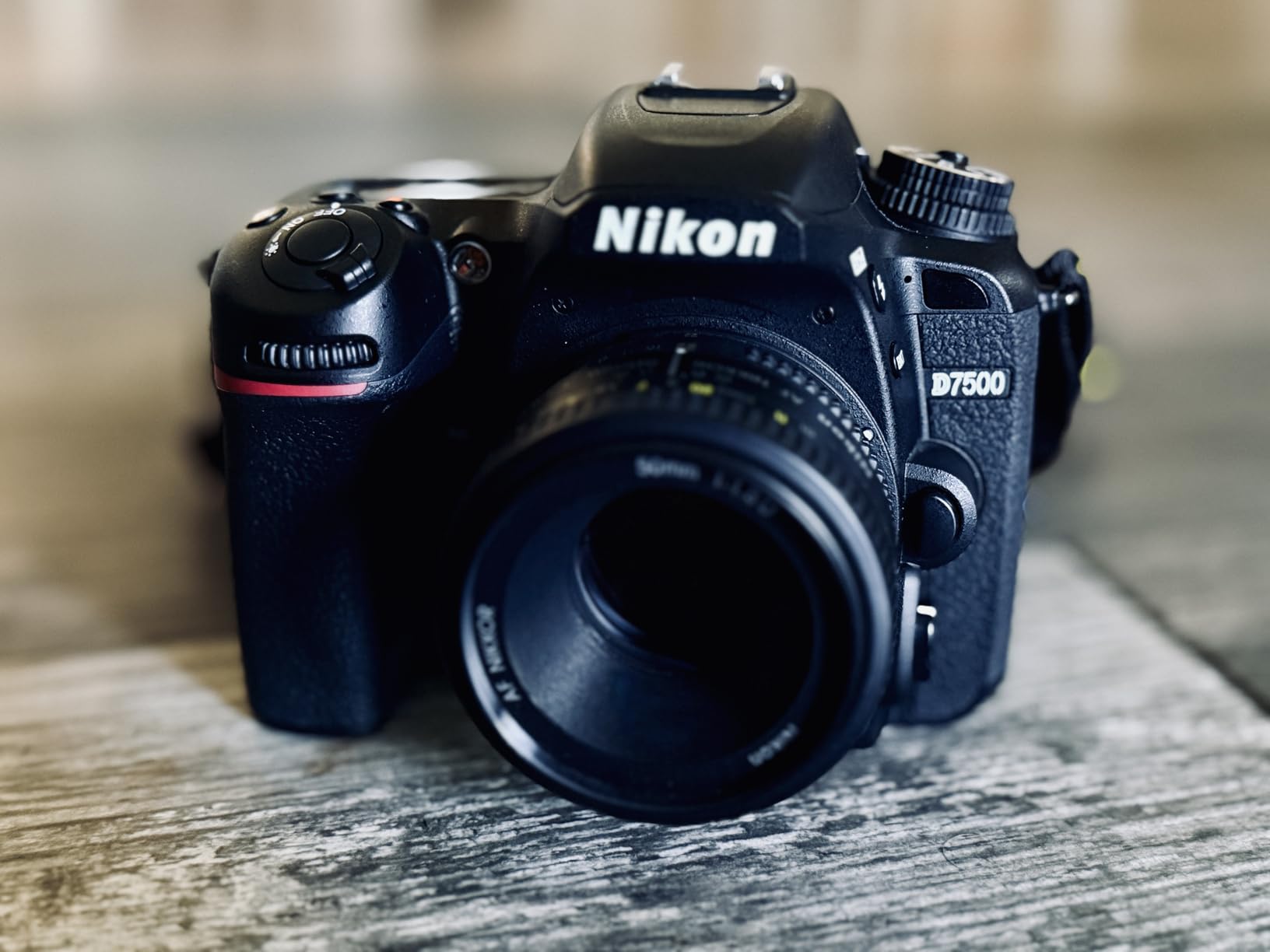
The 3.2-inch 922k-dot tilting touchscreen is usable with gloves and supports touch-to-focus, which matters on a camera you might use outdoors in cold weather. Wi-Fi and Bluetooth run through SnapBridge for transfers and GPS tagging, the optical viewfinder magnifies at 0.94x, and the body weighs 1.7 pounds. Shutter range is 1/8000s to 30s with 1/250s flash sync on a single UHS-I and UHS-III slot.
Reviewers frame the D7500 as the ideal step up from a D3400 or D5600, with excellent AF, an 8 fps burst, 4K video and strong metering, and the single card slot and learning curve as the accepted trade-offs.
Why the D7500 wins on autofocus and video
Group area AF lets you pick one compact block of points rather than a single point, so if your subject moves out of that block the camera keeps tracking within the group. On a 19-point or 45-point module you have to keep re-acquiring. On a 51-point system with group area, you set it once.
The tilting screen also matters for video. It lets you frame yourself and your subject from high and low angles without guessing, which turns a camera that was awkward for content into one that is workable. For tripod-mounted talking-head or product video, this body plus a 35mm lens is a strong setup.
Who should skip the D7500?
Skip it if this is your first camera and you have never used manual exposure. Twenty megapixels, a deep menu system and 51 AF points is a lot of capability to be handed without guidance, and owners consistently describe a learning curve coming from an entry body.
Skip it if you need two card slots for backup on paid work, because this model dropped back to a single slot. And skip it if you want a kit, because this is a body only listing, so you need to add a lens before you can shoot anything.
5. Nikon D7200 DX-Format Body
Nikon D7200 DX-Format DSLR Body (Black)
24.2 MP DX CMOS with no low-pass filter
51-point AF
6 fps
Dual SD slots
1.5 lb
Pros
- Two SD card slots give a backup path no other body here offers
- No optical low-pass filter for crisper detail
- Proven 51-point AF module for action and wildlife
- Very wide ISO 100-25600 native range
- Build quality feels a step above entry bodies
Cons
- Full HD 1080p only
- Fixed LCD with no tilt or touch
- No body stabilization
- Older generation without subject detection
The D7200 is the quiet technician of this list. Nothing it does is flashy, but it is the only body here with two SD card slots, and it is the only one with a sensor that skips the optical low-pass filter entirely, which produces noticeably crisper detail than any filtered sensor in this guide.
The 24.2-megapixel DX CMOS sensor uses EXPEED 4 processing with 14-bit RAW and a native ISO range of 100 to 25,600, expandable to 102,400. That headroom is what makes it a good portrait and indoor body, since you can lift a shadow three stops in post without the noise turning to grain.
Autofocus is the proven 51-point Multi-CAM 3500DX II phase-detection module and it shoots at 6 fps. It is older technology than the D7500’s 51-point module with group area AF, and it lacks modern subject detection, but it focuses decisively and it is the same engine many working photographers used for years.

Two card slots can be set for backup, overflow, or RAW plus JPEG split, which on a wedding or a long day trip is the difference between a ruined day and a ruined card. The viewfinder magnifies at 0.70x, which is the smallest here, and the 3.2-inch roughly 1,228,800-dot LCD is fixed with no touch control. The body weighs 1.5 pounds.
Owners value the D7200 as a durable, sharp-shooting dual-slot DSLR with excellent glass-to-body value, noting the lack of 4K video and the fixed non-touch screen as its age-related limitations.

Is the D7200 still a smart buy in 2026?
Yes, for photographers who care more about stills than video. The no-low-pass-filter sensor, the wide native ISO ceiling and the dual slots are features you will appreciate for years, and none of them are going away with firmware updates. Pair it with a fast 50mm f/1.8 or 85mm f/1.8 for portraits, which is where the extra resolution and ISO headroom pay off most.
Because Nikon F-mount lenses are the deepest used lens inventory in photography, this body opens up an easy path to good glass. A used 35mm or 50mm f/1.8 fits straight on and costs far less than a new one.
Who should skip the D7200?
Skip it if you plan to shoot video beyond 1080p, because there is no 4K capture at all. Skip it if you need to record yourself, because the screen is fixed and has no touch input. Skip it if you shoot handheld video or very low light stills and want stabilization in the body, since there is none and you will depend entirely on stabilized glass.
It is also a body only listing. Add a lens to the real cost before you decide.
6. Nikon D5100 Kit with 18-55mm AF-S DX VR Lens
Nikon D5100 Digital SLR Camera with 18-55mm f/3.5-5.6 AF-S DX VR Nikkor Zoom Lens
16.2 MP DX CMOS
11-point AF with 3D tracking
4 fps
Side-hinged articulated LCD
1.2 lb
Pros
- Exceptionally light and compact for travel
- Side-hinged articulated LCD for self-portraits and low angles
- 16 scene modes and in-camera effects
- Bundled 18-55mm AF-S VR lens is sharp and stabilized
- Full-time autofocus during live view
Cons
- 16.2 MP is the lowest resolution here
- 11-point AF with 3D tracking is well behind modern systems
- Only 4 fps burst
- Older menus with no touch screen
At 1.2 pounds with the kit lens, the D5100 is the body we would hand to someone who wants the largest camera they can still forget they are carrying. It is the lightest complete kit in this guide and it does not feel like a compromise in the hand.
The reason it still works for a beginner is the guided side of the camera. Sixteen scene modes, in-camera effects and a virtual horizon give a first-time owner something useful to turn the dial to, which is exactly what most people are missing when they get stuck. The side-hinged 3.0-inch 921,000-dot articulated LCD swings out for self-portraits and tilts down for low-angle shots, which is the feature most beginners underestimate.
The trade-off is the 16.2-megapixel DX sensor, which has the lowest resolution of any body here. It is fine for screen viewing, printing and social media, and fine for moderate cropping, but if you want to print large or crop a distant subject hard, the extra pixels on the Canon and newer Nikon bodies will matter.

Autofocus is an 11-point system with 3D tracking, and the burst rate is 4 fps, both from an earlier generation. Video is 1080p with full-time autofocus in live view. ISO runs 100 to 6,400 and expands to 25,600, shutter range is 1/4000s to 30s with 1/200s flash sync, and storage is a single SD slot. The bundled 18-55mm f/3.5-5.6 AF-S DX VR Nikkor is sharp with optical stabilization.
Users like the D5100 for its light, friendly handling, articulated screen and scene modes, while noting the 16 MP sensor and legacy autofocus system place it at the budget end of this lineup.
Why the D5100 still works for travel and family
The sensor is more than ten times larger than a phone sensor, which is the jump that matters most when a beginner starts comparing files. Light gathering is the difference between a usable indoor photo and a blurry one, and a body you can hold one-handed for an afternoon is a body you will actually use.
The AF-S 18-55mm VR lens in the box is a good first lens for another reason: because it is an AF-S lens rather than an AF-P, it works on a wider range of Nikon bodies. If you later upgrade within the F-mount, you can keep using it. That is a real advantage over the AF-P kit lens in the D3500.
Who should skip the D5100?
Skip it if you plan to print large or crop aggressively, because 16.2 megapixels is the smallest file here. Skip it if you shoot sports or wildlife, because 11 points with 3D tracking and 4 fps is a generation behind. Skip it for video beyond 1080p.
Skip it if you want a modern interface, because the menu layout is dated and there is no touch screen. For pure portability it remains one of the best options in this guide, and at under a pound and a quarter it pairs well with the lightweight prime lenses Nikon still makes.
7. Canon EOS Rebel T6i Kit with EF-S 18-55mm IS STM Lens
Canon EOS Rebel T6i Digital SLR with EF-S 18-55mm is STM Lens – Wi-Fi Enabled
24.2 MP APS-C CMOS
19-point all cross-type AF
5 fps
Articulating touchscreen
Wi-Fi
Pros
- Fully articulating touchscreen is rare at this tier
- 19-point all cross-type AF is a big step above 9 points
- Hybrid CMOS AF III focuses smoothly for video
- Built-in Wi-Fi and NFC for remote control
- STM kit lens focuses near silently
Cons
- 1080p only with no 4K capture
- Older 24.2 MP sensor generation
- Single SD card slot
- Kit lens stabilization adds little at very slow speeds
The T6i is the camera we recommend to someone who wants to make video without buying a dedicated vlogging camera. Its fully articulating 3.0-inch 1,040,000-dot touchscreen swings out to the side and tilts, which is the physical requirement for filming yourself, and the bundled STM 18-55mm IS lens focuses near-silently during recording.
Autofocus is the part that upgraded most. The 19-point all cross-type system with Hybrid CMOS AF III is a substantial step up from the 9 points on the Rebel T7, and every one of those points is cross-type, so it finds contrast in low light far more readily. Continuous shooting runs at 5 fps, or up to 50 fps in the high-speed mode at reduced resolution.
The 24.2-megapixel APS-C CMOS sensor processes 14-bit RAW, ISO runs 100 to 12,800 and expands to 25,600, and the optical viewfinder magnifies at 0.82x. Video is Full HD 1080p MP4 with brightness adjustable across seven levels, storage is a single UHS-I U3 slot, and shutter speeds span 30s to 1/4000s with 1/200s flash sync. Wi-Fi and NFC handle remote shooting and transfer.

Scene modes cover kids, food, candlelight, night portrait, handheld night scene and HDR backlight control, which tells you how Canon designed this body. It is a camera built for someone shooting ordinary life and wanting the camera to help.
Owners highlight the articulating touchscreen, all-cross-type 19-point autofocus and Wi-Fi as the reasons it feels like a modern mid-range camera, with 1080p-only video and a dated sensor generation as the main caveats.

Is the T6i better for video than a new entry body?
For a beginner who wants to film themselves or their family, yes, because most current entry bodies ship with fixed screens. The articulating panel plus Hybrid CMOS AF III plus a near-silent STM lens is a genuinely usable self-recording setup, and none of the cheaper cameras here can match it.
The STM lens matters more than it sounds. A conventional 18-55mm hunts and ratchets audibly during video, and that noise lands on the audio track. The STM version does not, which is why it is the lens to look for if video is on the table.
Who should skip the T6i?
Skip it if you need 4K, since it is 1080p only. Skip it if you want a second card slot for paid event work. And skip it if you are shooting at very slow shutter speeds handheld, because the kit lens stabilization offers little benefit down there and the body has no in-body stabilization.
Also note that this is an older generation body within Canon’s Rebel line. Newer tiers exist, and if you can afford them they will last longer before they need replacing. Where your budget allows, our instinct is to buy the newest body your budget reaches rather than an older mid-tier.
8. Nikon D5600 Renewed Kit with 18-55mm VR AF-P Lens
Nikon D5600 Digital SLR Camera & 18-55mm VR DX AF-P Lens – (Renewed)
24.2 MP DX CMOS
39-point phase-detect AF
5 fps
1080p at 60 fps
1.1 lb
Pros
- Renewed bodies often show no visible wear
- 39-point AF is a big jump from 11-point systems
- 3.2-inch vari-angle touchscreen
- 1080p at 60 fps for smoother motion
- Light 1.1 pound body with VR lens
Cons
- Refurbished condition so warranty and cosmetics vary
- Does not reliably accept generic third-party batteries
- One report of autofocus not working on a renewed body
- Occasional report of a body arriving with damage
The renewed D5600 is the most interesting value proposition on this list, because it is the only body here that pairs a 39-point phase-detection autofocus system with a vari-angle touchscreen and still arrives with a stabilized lens attached.
Thirty-nine AF points is roughly triple what you get on the D3500, and every one is usable for stills. At 5 fps with a 0.2-second delay between shots, it handles casual action far better than the 11-point bodies at the bottom of this list.
The 3.2-inch 1,037,000-dot vari-angle touchscreen handles touch focus and flexible framing, and it is usable with gloves. Video is Full HD 1080p at 60 fps, which gives you noticeably smoother motion footage than the 30 fps on the D3500 and D5100. There is no 4K.
SnapBridge Bluetooth and Wi-Fi with NFC handle automatic phone transfer, the bundled 18-55mm f/3.5-5.6 VR DX AF-P lens has optical stabilization, and the body weighs 1.1 pounds.

The honest caveat is the condition. This is an Amazon Renewed listing, so cosmetics and warranty differ from new goods, and the review pool is much smaller than the Rebel T7’s at 142 ratings averaging 4.6 stars. Owners report bodies arriving with no visible wear and working flawlessly, alongside occasional reports of battery compatibility quirks and one faulty camera.
One practical warning: this camera does not accept generic third-party batteries reliably. Budget for the genuine battery, because that is the accessory most likely to disappoint you on a renewed body.

Is a renewed DSLR worth the risk for a beginner?
For this body, yes, because the gap between what it gives you and what a new entry camera gives you is wider than the condition risk. A new Rebel T7 gives you 9 AF points and a fixed screen. This gives you 39 AF points and a vari-angle touchscreen. Those are the two features beginners notice most once they start shooting seriously.
Refurbished gear is also how most working photographers bought their second or third body. The practical approach is to buy from a seller with a return window, check all modes and the shutter count on arrival, and test autofocus with a fast prime before you travel with it.
Who should skip the renewed D5600?
Skip it if you cannot tolerate any chance of a fault, because a refurbished body carries a shorter safety net than new. Skip it if you plan to rely on third-party batteries, which is a common money-saving move this body does not support well.
Skip it if you shoot in the rain or on dusty job sites, since condition and sealing vary on a renewed body. If your priority is an absolute guarantee and a big support network, buy the Rebel T7 new instead, where the review volume alone will tell you how predictable the product is.
9. Canon EOS 4000D Accessory Bundle, International Model
Canon EOS 4000D / Rebel T100 Digital SLR Camera Body w/Canon EF-S 18-55mm f/3.5-5.6 Lens 3 DSLR Kit Bundled with Complete Accessory Bundle + 64GB Flash & More – International Model (Renewed), Black
18.0 MP APS-C CMOS
9-point contrast-detect AF
3 fps
2.7-inch 230,000 dot LCD
Wi-Fi
Pros
- Every accessory a complete beginner needs is in one box
- Reviewers call it an ideal first camera for complete novices
- Compact body suits smaller hands
- Bundled 64GB card case filters flash and tripod
- Optical viewfinder plus Scene Intelligent Auto
Cons
- 2.7-inch 230000 dot screen is small and low resolution
- 9-point contrast-detection AF is the weakest for moving subjects
- 18 MP sensor is the lowest resolution in the lineup
- International model has no Canon manufacturer warranty
- Fixed screen limits low-angle and selfie shooting
We are including this bundle in a guide about what to buy, and recommending it only with a warning attached. The Canon EOS 4000D, also known as the Rebel T100, is a legitimate entry DSLR, but the specific listing here is an international model with a large accessory bundle, and those two facts matter.
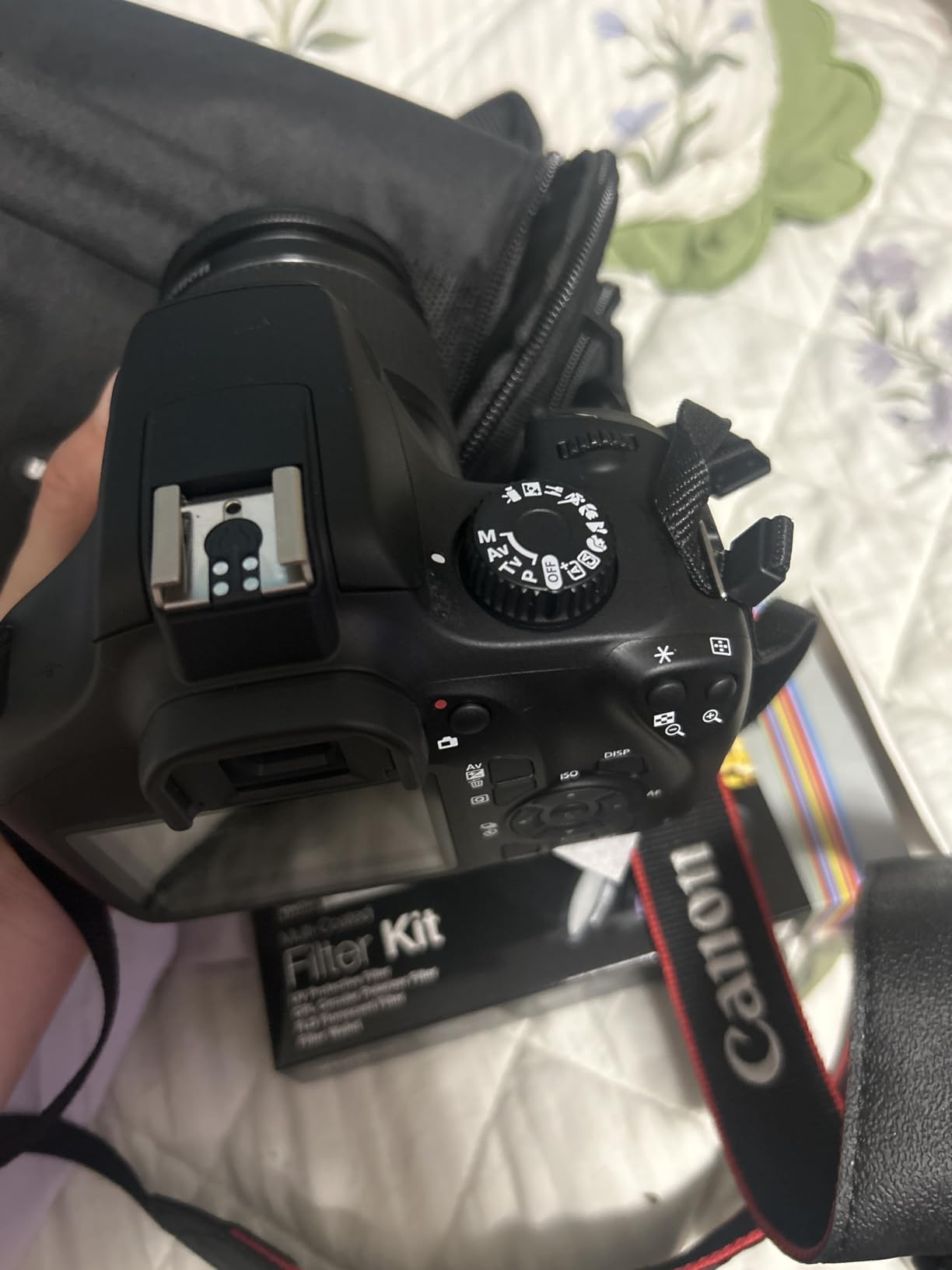
What you get for one purchase is the body, an EF-S 18-55mm kit lens, a wide-angle lens, a telephoto lens, a 64GB card, a case, a filter kit, a flash and a tripod. If you truly are starting from nothing, that removes several separate purchases. If you already have a card, a bag and any glass, the extras are dead weight.
Forum threads on r/canon and dpreview.com/forums raise the same complaint repeatedly: bundled accessory kits are where bad kit lenses go to hide. The cheap wide-angle converters and the manual flashes in these packages are the two items most likely to damage your images. Our general advice is to buy the body and the real kit lens, then add accessories you can name.
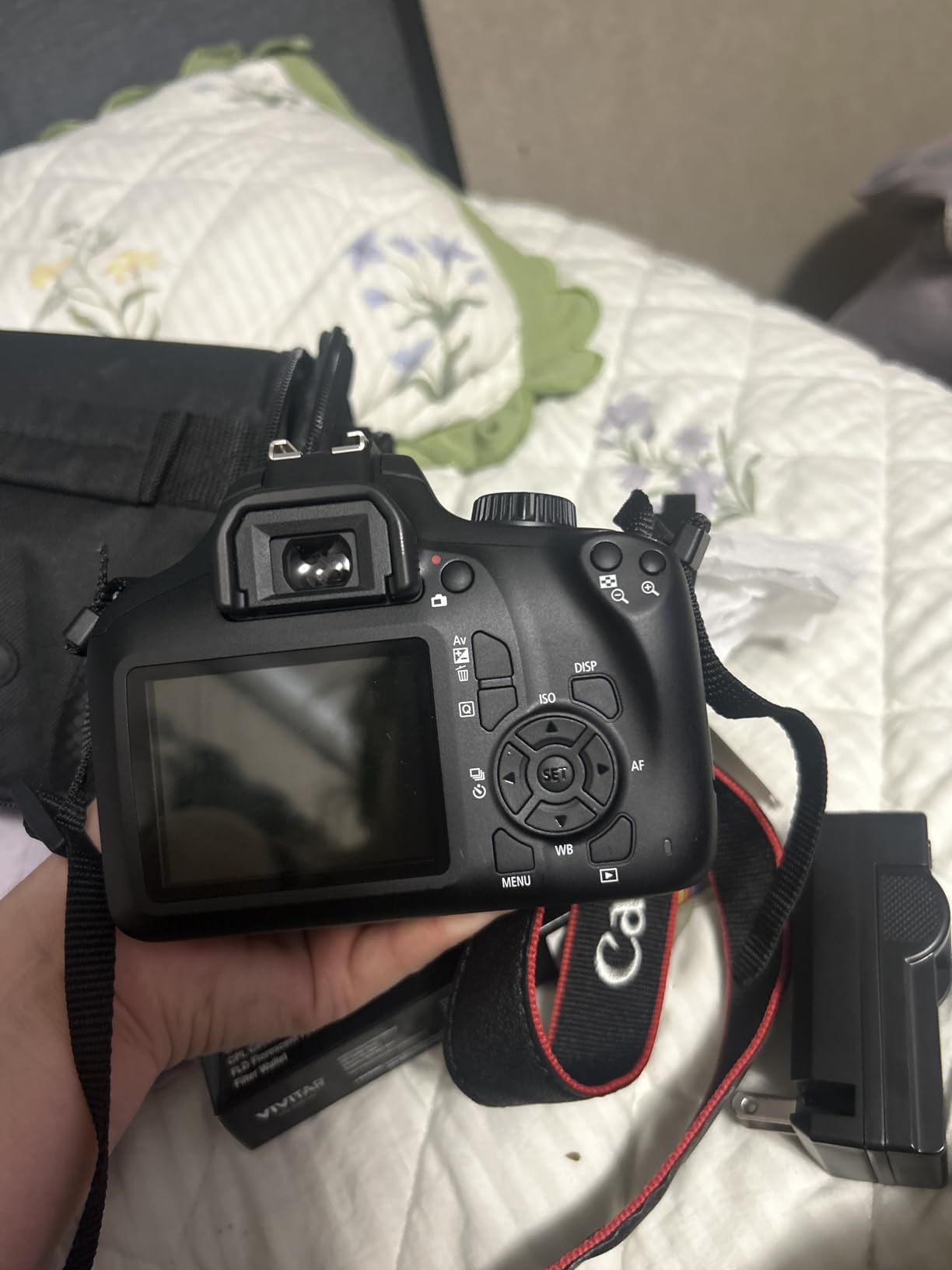
The camera itself is the lowest spec in this guide. The 18.0-megapixel APS-C sensor uses a DIGIC 4+ processor, autofocus is 9-point contrast detection with AI Servo AF, burst is 3 fps, and the 2.7-inch 230,000-dot fixed LCD is small and hard to read in daylight. Video is 1080p at 30 fps. Wi-Fi is built in, ISO runs 100 to 12,800 expandable, and storage takes SD, SDHC and SDXC cards.
The warranty detail is the one to read twice. This is an international model with no Canon manufacturer warranty, only 90 days of Amazon Renewed coverage, which means a body failure is a return rather than a repair.
Buyers consistently treat this bundle as an ideal beginner package, praising the included accessories and straightforward operation, with the small screen, 9-point autofocus and international-model warranty as the accepted trade-offs.
When does a bundle actually make sense?
It makes sense in exactly one case, which is when you have nothing at all and you want a working camera in your hand today with a card in it. In that scenario the 64GB card, the case and the tripod are genuinely useful, and the low total cost of ownership is real.
It does not make sense if you already own any of those items, and it definitely does not make sense if you are serious about photography. The wide-angle and telephoto lenses in these kits are typically not real focal lengths and not fast enough to gather light, and they will produce worse results than simply re-framing with the kit zoom.
Who should skip this bundle?
Skip it if you want Canon warranty service in your country, because there is none on an international model. Skip it if you care about screen quality, because a 2.7-inch 230,000-dot panel is painful in bright daylight and tiny for reviewing shots.
Skip it if you shoot anything that moves, because nine-point contrast detection and 3 fps will not keep up. Our recommendation for anyone who is unsure: skip the bundle, buy the Rebel T7 kit at number one, and then buy one accessory you can name.
10. Nikon D3200 Certified Refurbished Kit with 18-55mm AF-S VR
Nikon D3200 24.2 MP CMOS Digital SLR with 18-55mm f/3.5-5.6 AF-S DX NIKKOR Zoom Lens (Certified Refurbished)
24.2 MP DX CMOS
11-point AF
4 fps
1080p and 720p at 60 fps
16 oz
Pros
- A genuine 24.2 MP APS-C DSLR at the lowest cost in the lineup
- Refurbished bodies widely reported as indistinguishable from new
- 18-55mm AF-S VR lens is sharp and handles low light well
- EXPEED III gives excellent color and white balance
- Light 16 ounce body
Cons
- 11-point autofocus is dated and hits about 85 percent without readjusting
- No 1080p at 60 fps
- Fixed screen with no articulation or touch
- Refurbished bodies may arrive without strap battery or manual
- One report of a body arriving damaged
The D3200 refurbished kit is the least costly way onto a genuine 24.2-megapixel APS-C platform in this guide, and it is the only listing here that is manufacturer certified refurbished with all original accessories and a 90-day warranty included.
The EXPEED III processor produces what owners consistently describe as excellent color reproduction and reliable white balance, and the 24.2-megapixel DX CMOS sensor with 11-point Multi-CAM 1000 autofocus and 420-pixel RGB metering is a proven combination.
The bundled 18-55mm f/3.5-5.6 AF-S DX NIKKOR VR is sharp, fast and handles low light well for a first lens. At 16 ounces with the kit lens, it is not intimidating to carry or to hand to a friend.
The optical viewfinder magnifies at 1.0x and the 3.0-inch 921,000-dot fixed rear LCD has live view. Video is 1080p at 30 fps plus 720p at 60 fps, storage takes full-size SD cards, and the filter thread is 52 mm.
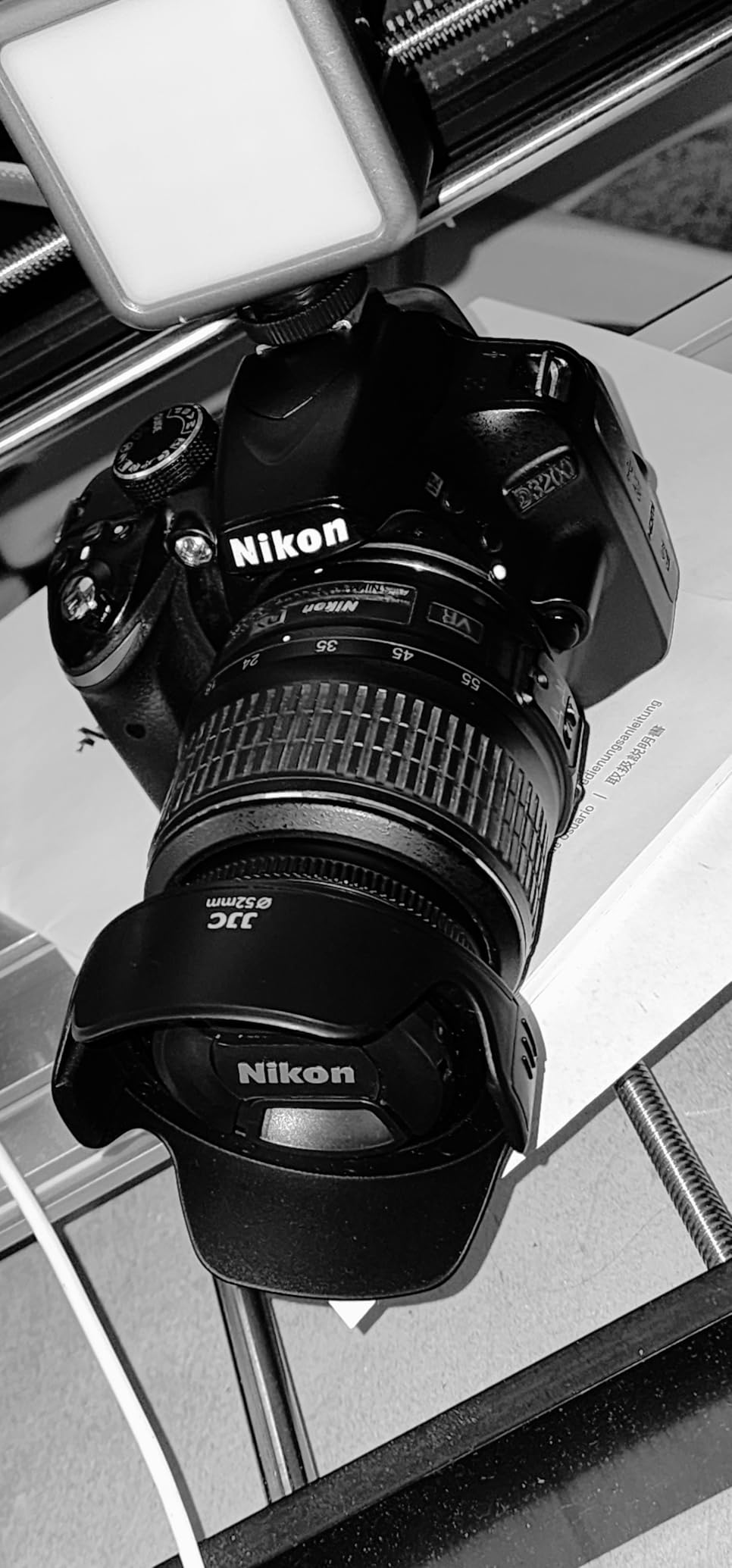
The honest limitation is the autofocus. Owners report the 11-point system is dated and hits roughly 85 percent of the time without re-adjusting, which is fine for posed subjects and painful for anything moving. There is also no 1080p at 60 fps, since that needs the D3300 or the D5300.
Because it is a refurbished listing, expect variation in what arrives. Some cameras come without the original strap, battery or manual, and there are individual reports of one arriving damaged and another with live view and shutter button errors. That is normal for any refurbished category and is why the 90-day warranty matters.

Is a refurbished D3200 a smart first DSLR?
Yes, if your goal is to learn manual exposure on a real camera with the least commitment. This body has a mode dial, a proper optical viewfinder, full manual control and a stabilized lens, and it costs less than any new complete kit in this guide.
The 52 mm filter thread and the AF-S kit lens also mean it accepts a wide range of used Nikon F-mount glass later on. A 50mm f/1.8 is the single most useful upgrade most owners make, and it turns this body into a capable low-light and portrait camera. If you want to explore that route, our beginner film camera guide covers the fixed-lens side of the hobby.
Who should skip the refurbished D3200?
Skip it if reliability under warranty matters to you more than cost, because a refurbished body is not the same safety net as buying new. Skip it if you shoot action, since 11 points and 4 fps is well behind the mid-tier bodies here.
Skip it if you want a touch screen, an articulating screen or 4K video, because it has none of those. For a beginner shooting holidays, family and daylight landscapes on a budget, it remains one of the most sensible purchases available.
How to Choose the Right DSLR as a Beginner
Start with the lens, not the sensor. A camera with no lens is not a camera yet, and the kit zoom bundled with the Rebel T7, D3500, D5100, T6i, D5600 and D3200 covers roughly 27mm to 82mm equivalent, the range that records a wide scene, a family group and a portrait without changing lenses. Only add a second lens when you know what you cannot shoot with that range.
Second, decide how you will actually use the viewfinder. If you will spend most of your time composing through glass at eye level, an optical viewfinder has no lag, no battery drain and no black screen in bright sun. If you want the camera to show you the exposure before you take the shot, or you will shoot mostly from a screen, you are leaning mirrorless instead.
Third, look at the autofocus count, but read what kind it is. Nine points on a 2018 entry body is genuinely worse than 39 points on a 2016 mid body, because the entry systems are older, have fewer cross-type points and cover a smaller area of the frame. Cross-type points detect contrast in any direction, which is what lets a camera focus in a dim room.
Fourth, be honest about megapixels. Every sensor here is far larger than a phone sensor and all of them will produce sharp, printable files for everyday use.
Above roughly 24 megapixels you gain the ability to crop hard, which matters for wildlife and travel. Below that, you gain nothing except a lower file size, so do not pay a premium for resolution you will not use.
Fifth, factor in the brand ecosystem seriously, because this is the decision that costs you the least now and the most later. Canon EF-S lenses and Nikon F-mount lenses are the two deepest used lens inventories in photography, so if a friend has Canon glass, start with Canon and if your family has Nikon glass, start with Nikon.
The bodies are interchangeable in skill; the lenses are not.
Sixth, check the screen. A fixed non-touch screen rules out two specific things that a lot of beginners want on day one, which is filming yourself and shooting from ground level. If either matters to you, the T6i and the D5600 are the two ways to get a vari-angle panel in this list.
Seventh, use the guide modes, then move on. Canon’s Scene Intelligent Auto and Creative Auto, and Nikon’s point-and-shoot handling, will get you a usable photo in the first ten minutes.
Learn aperture, shutter speed and ISO one at a time from there, because those three controls are what separate a snapshot from a photograph. Forum users consistently report that the format matters far less than understanding those three.
Finally, buy the accessories you can name. Skip the bundled kits. Buy one spare battery of the correct type, one fast SD card, and a cheap neck strap. Everything else can wait until you know what your photography needs.
Frequently Asked Questions
What is the best basic DSLR camera for beginners?
The Canon EOS Rebel T7 kit with the EF-S 18-55mm f/3.5-5.6 IS II lens is the best DSLR for most beginners, because it ships with a stabilized lens, has the deepest owner review base in its class and stays simple to operate. The Nikon D3500 with the 18-55mm AF-P VR lens is the best alternative if you prefer Nikon’s handling and want a faster 5 fps burst.
Why is DSLR being phased out?
Camera makers have shifted their research and manufacturing toward mirrorless, because mirrorless bodies can be thinner, quieter and much better at video and subject-tracking autofocus. Entry DSLR lines were low-margin products, so most brands have stopped producing new entry bodies. The result is a thinner new market, a deeper used market and no new firmware development for older DSLRs.
Are DSLR cameras still worth buying?
Yes, for many beginners. DSLRs cost less than comparable mirrorless kits, run far longer on a battery charge because the optical viewfinder draws almost no power, and give you access to a huge inventory of affordable used Canon EF-S and Nikon F-mount lenses. Buy a DSLR if you are on a budget, want to learn manual modes through an optical viewfinder, or already own compatible lenses.
What is better, DSLR or mirrorless?
Mirrorless is better for video, subject-tracking autofocus and portability, and it usually gets a tilting screen. DSLR is better for battery life, price, an optical viewfinder with no lag, and cheaper lens availability. Beginners who want to shoot stills on a budget should choose a DSLR; beginners focused on video or moving subjects should choose mirrorless.
Is Canon or Nikon better for beginners?
Both are equally good, and the deciding factor is lenses rather than the camera. Canon EF-S lenses are typically smaller and cheaper at the kit level, while Nikon offers deeper low-cost used glass and a strong track record for ergonomics. Pick whichever brand matches lenses you already own, or whichever body you can try in a shop and find comfortable in your hands.
Conclusion: The DSLR to Start With
If you want one answer to the question of the best dslr cameras for beginners in 2026, take the Canon EOS Rebel T7 kit. It ships with a stabilized lens, it is simple enough that a first-time owner gets good photos in the first ten minutes, and more than 5300 owner reviews averaging 4.7 stars mean you will never be guessing what you are buying.
Buy the Nikon D3500 if you want a faster burst and prefer Nikon handling. Buy the Canon EOS 80D or Nikon D7500 if you already know you will stick with photography, and the D7500 if video matters because it is the only body here that shoots 4K UHD. Buy the refurbished Nikon D3200 if your budget is the first consideration.
Whatever you choose, buy one body with one lens, spend a month learning aperture, shutter speed and ISO, and only add glass when you know what you are missing. If you would rather start with a fixed-lens camera, our guide to the best film cameras for beginners is a good next read.