
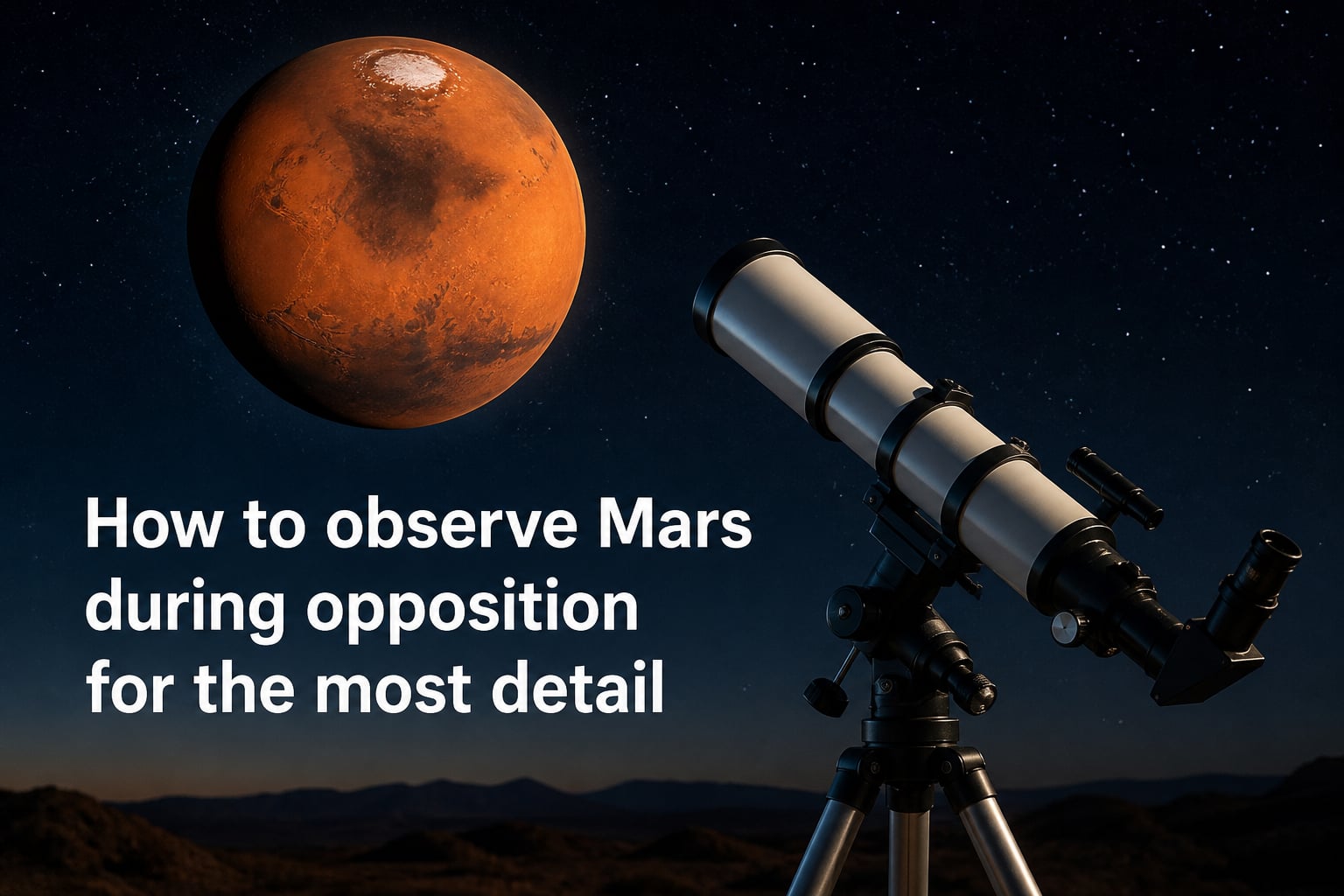
Mars opposition is the single best window of the year to observe the Red Planet, when Earth slips directly between Mars and the Sun and our two worlds make their closest approach. During opposition in 2026, Mars climbs high in the night sky, swells to its largest apparent size of the year, and reveals surface details that are simply impossible to see at other times. Our team has spent dozens of nights under the eyepiece tracking oppositions, and we wrote this guide to help you observe Mars during opposition with the most detail possible, whether you own a small refractor or a 12 inch Dobsonian.
If you have ever aimed a telescope at Mars and seen nothing but a fuzzy orange dot, the opposition window is your chance to fix that. We will cover what opposition actually is, which oppositions are worth chasing, the aperture and eyepiece combinations that bring out real detail, the filters that sharpen albedo markings, and the surface features you can expect to identify on a steady night.
Table of Contents
What is Mars Opposition and Why Does It Matter?
Mars opposition occurs when Earth passes directly between Mars and the Sun, aligning all three bodies in a straight line with Mars sitting opposite the Sun in our sky. Because the two planets are on the same side of the Sun at that moment, Mars rises at sunset, transits the meridian around midnight, and sets at sunrise, giving observers an entire night of viewing.
Opposition matters because it is when Mars is at its closest to Earth, so its angular diameter peaks and surface markings become visible in modest telescopes. At a favorable opposition Mars can reach about 25 arcseconds across, more than twice the size it shows at aphelic oppositions, which is the difference between seeing a blank orange disc and resolving the polar caps plus dark albedo features like Syrtis Major.
During opposition the planet is also fully illuminated by the Sun, just like a full Moon, so we see Mars’s entire Earth-facing hemisphere. Combined with its larger apparent size, that full illumination is what makes the opposition window the only time to push magnification and chase fine surface detail.
From a physics standpoint, opposition is essentially a syzygy where the Sun-Earth-Mars angle approaches 180 degrees. The exact distance varies from one opposition to the next because Mars has a noticeably elliptical orbit, which is why some oppositions are far better than others.
The Opposition Cycle: Perihelic vs Aphelic
Mars reaches opposition roughly every 26 months, which is how long Earth takes to lap Mars on its inside orbit. That 26 month cycle is why observers get a fresh opportunity every couple of years rather than every year.
Not all oppositions are equal. Mars swings between perihelion (closest to the Sun) and aphelion (farthest) during its 687 day orbit. When opposition coincides with Mars near perihelion, the planet can come within about 35 million miles of Earth and show an apparent diameter near 25 arcseconds. When opposition occurs near aphelion, the distance stretches past 60 million miles and the disc shrinks to around 14 arcseconds, which is noticeably smaller and harder to resolve.
Perihelic oppositions happen in a 15 to 17 year cycle. The last excellent one was 2018, and the next cluster of favorable oppositions runs from 2031 through 2035. The 2027 opposition, while not perihelic, is still a strong showing with Mars reaching roughly 13.8 arcseconds, which is plenty for a dedicated observer.
| Opposition Date | Distance (million miles) | Angular Diameter (arcseconds) | Type |
|---|---|---|---|
| January 16, 2027 | 59.4 | 13.8 | Aphelic |
| February 19, 2029 | 62.0 | 13.2 | Aphelic |
| May 4, 2031 | 48.6 | 16.9 | Moderate |
| April 11, 2033 | 42.9 | 19.1 | Perihelic |
| September 16, 2035 | 35.4 | 23.2 | Perihelic |
For context, Mars reaches a minimum distance of about 33.9 million miles during an ideal perihelic opposition, which is the theoretical best viewing geometry we ever get.
Choosing the Right Telescope Aperture for Mars
Aperture, not magnification, is what reveals fine surface detail on Mars because detail is limited by diffraction. A larger primary mirror or objective lens gathers more light and produces a sharper Airy disc, which is what lets your eye or camera resolve small albedo markings and the polar caps.
For Mars we recommend a minimum of 4 inches (100 mm) of aperture to make the opposition worth your time. With a 4 inch refractor or reflector you can identify the polar caps during good seeing and catch the largest dark features like Syrtis Major. A 6 inch scope opens up more subtle albedo markings. At 8 to 10 inches, Mars becomes a richly detailed world where you can track dust storms and cloud formations. A 12 inch or larger scope shows the planet almost like a spacecraft image, assuming the atmosphere cooperates.
Refractor, Newtonian reflector, and catadioptric (Schmidt-Cassegrain or Maksutov) designs all work for Mars, and each has trade-offs. Apochromatic refractors deliver the sharpest contrast and need almost no maintenance, but they cost more per inch of aperture. Newtonian reflectors give the most aperture for the money and excel at revealing fine detail when properly collimated. Catadioptric telescopes are compact and have long focal lengths, which produces high magnification naturally with common eyepieces.
| Telescope Type | Strength for Mars | Watch Out For |
|---|---|---|
| Apochromatic Refractor (4 to 6 inch) | Sharpest contrast, no central obstruction | Higher cost per inch |
| Newtonian Reflector (6 to 12 inch) | Best aperture value | Needs regular collimation, open tube |
| Schmidt-Cassegrain (8 to 14 inch) | Compact, long focal length for high power | Collimation drift, longer cooldown |
| Maksutov-Cassegrain (5 to 7 inch) | Excellent contrast, low maintenance | Long cooldown, heavy per inch |
If you already own a 3.5 inch scope, do not skip the opposition. You will still see Mars as a clear orange disc with a hint of the polar cap. The opportunity is worth using whatever optics you have, and a small scope is a great way to learn the planet’s rotation before upgrading.
Eyepieces, Magnification, and Barlow Lenses
Magnification on Mars is calculated by dividing telescope focal length by eyepiece focal length. A 1200 mm scope with a 10 mm eyepiece gives 120x. To observe Mars during opposition with the most detail, plan to use magnifications between about 200x and 350x on nights of steady seeing, with shorter focal length eyepieces (4 mm to 6 mm) doing the heavy lifting.
Push magnification too hard and the atmosphere will punish you. The practical limit is set by seeing conditions, not by your telescope, so a 6 mm eyepiece is the right starting point because it typically delivers around 200x to 250x on common Mars scopes and remains usable even when seeing is average.
A Barlow lens doubles or triples the magnification of any eyepiece, which is the cheapest way to reach high power without buying specialty short focal length eyepieces. A 2x Barlow behind a 6 mm eyepiece behaves like a 3 mm eyepiece and produces around 400x to 500x. Use that high magnification only on nights of excellent seeing, otherwise the image breaks down into a boiling blur.
For eyepiece design, prefer Plossl, orthoscopic, or quality wide-field designs with at least 50 degrees of apparent field. Avoid bargain eyepieces with short eye relief at high power because focus is hard enough to nail without a wobbly eye position.
Useful magnification benchmarks for Mars at opposition:
Low power (80x to 120x): Locate Mars, scan for the polar caps and major dark regions.
Medium power (150x to 200x): Resolve Syrtis Major, watch Mars rotate.
High power (250x to 350x): Pull out dust storm edges and limb hazes on steady nights.
Extreme power (400x and up): Reserve for the best 5 percent of nights and large apertures.
Filters for Enhancing Mars Surface Contrast
Colored planetary filters screw into the eyepiece barrel and selectively transmit or block wavelengths of light, which sharpens the contrast between different surface materials on Mars. They cost under $30 each and quietly improve most views.
A red filter (Wratten 25 or 29) darkens the bluish sky background and makes the polar caps stand out brilliantly against rust-colored terrain. An orange filter (Wratten 21) gives a balanced view that boosts contrast on dark albedo features like Syrtis Major without dimming the image too much. A yellow filter (Wratten 12) is the gentlest option and works well on smaller scopes. A blue filter (Wratten 80A) reveals white clouds and limb hazes rather than surface markings, and a green filter (Wratten 58) helps bring out frost along the polar cap edge.
| Filter Color | Wratten # | Best Use on Mars |
|---|---|---|
| Yellow | 12 | Subtle dark-region enhancement, beginner-friendly |
| Orange | 21 | Boost contrast on Syrtis Major and other albedo markings |
| Red | 23, 25, 29 | Polar caps pop, dust storm definition, larger apertures only |
| Blue | 80A, 82A | Clouds, limb hazes, atmospheric detail |
| Green | 58 | Frost boundaries, terminator detail |
Skip filters at low power because they mostly just dim the image. Start adding color around 150x and above, where contrast becomes more important than brightness. We have found orange filters to be the single most useful Mars accessory for amateur scopes.
Surface Features to Look For During Opposition
Mars rotates once every 24 hours and 37 minutes, which means the same surface features drift back into view roughly 40 minutes later each night. Tracking features across nights helps you confirm what you are seeing and reveals how the planet’s appearance changes as different longitudes face Earth.
The most accessible feature is the south or north polar cap, depending on which pole is tilted toward Earth during that opposition. The polar cap looks like a bright white spot and shrinks over weeks as the Martian spring advances. Even a 4 inch scope at 150x shows the cap clearly on a steady night.
Syrtis Major is the easiest dark feature to identify. It is a distinctive V-shaped or triangular dark patch near the Martian equator that resembles the Indian subcontinent. Once you recognize Syrtis Major, you have a reference point for everything else because most other albedo features rotate into the same hemisphere.
Hellas Basin appears as a bright oval and is actually a deep impact crater. It often looks pale or whitish when filled with frost or morning fog, which makes it easy to mistake for a polar cap until you have observed it a few times.
Other named features worth hunting once you have your eye in:
Sinus Meridiani: dark notch near Syrtis Major, easy to spot in 6 inch scopes.
Mare Tyrrhena and Mare Cimmeria: long dark bands on the eastern hemisphere.
Solis Lacus: a dark oval sometimes called the “Eye of Mars.”
Olympus Mons and Valles Marineris: rarely seen visually but worth trying in 10 inch and larger scopes near the terminator.
Phasis, Aurorae Sinus, and Trivium Charontis: small albedo patches for advanced visual observers.
Dust storms are the wild card. Global dust storms can hide almost every surface feature for weeks. Check sites like Mars Dust Storm Watch for updates before planning a long observing session.
Best Timing Windows for Mars Observation
The single best time to view Mars is when it transits the meridian, the highest point of its arc across the sky, because you are looking through the least amount of atmosphere. Aim to observe within two hours of transit whenever possible.
Plan to start observing about two weeks before opposition and continue for two weeks after, because Mars stays near maximum apparent size across that entire window. Waiting only for the exact opposition date is a mistake. The difference in apparent size between a week before and a week after is imperceptible, and any clear night in that stretch is fair game.
Mars should be at least 30 degrees above the horizon to reduce atmospheric distortion. Anything lower means you are peering through thick, turbulent air near the horizon and Mars will look like a wobbly blob no matter how good your scope is.
Late night to early morning hours tend to produce the steadiest seeing once the ground has cooled and convection dies down. In the hour or two after midnight we often see the sharpest Mars views, especially in suburban and urban locations where daytime heating destabilizes the lower atmosphere for hours.
Use free planetarium software to find Mars’s transit time on the night you plan to observe. Stellarium, Cartes du Ciel, and SkySafari all show altitude versus time so you can pick the best hour to set up.
Location and Seeing Conditions Optimization
Seeing conditions describe how steady the atmosphere is, and they matter more than aperture for fine planetary detail. A 6 inch scope under excellent seeing will show more Mars than a 12 inch scope under poor seeing, which is why experienced observers say patience beats equipment.
High pressure weather systems tend to deliver the steadiest skies, especially after a cold front has passed and the air has settled. Low pressure, jet stream overhead, and weather fronts all worsen seeing. Local topography matters too: cold air draining into valleys creates poor seeing, while ridges and hilltops often sit above the turbulent boundary layer.
Get away from urban heat islands when you can. Pavement, buildings, and parking lots radiate stored heat overnight, which keeps the air boiling for hours after sunset. Grass, fields, and water-side locations cool down faster and stabilize sooner.
Let your telescope acclimate to outdoor temperature for at least 30 to 45 minutes before chasing high magnification. A warm tube full of rising air inside the optical path ruins the view. Set up early, point the scope away from Mars during cooldown, and revisit the planet once everything has equalized.
If your first impression of Mars is a fuzzy ball, do not blame your scope. Wait ten minutes, look at a brighter star to check focus and steadiness, and try again. Seeing often improves as the night progresses.
Step-by-Step: Your Mars Observation Plan
Here is the procedure we use at every opposition to consistently pull out detail, regardless of telescope size.
Check the weather and seeing forecast 24 hours in advance, and pick the clearest, steadiest night in the opposition window.
Set up your scope at least 30 minutes before Mars transits so the optics can cool to ambient temperature.
Collimation check. Confirm the optics are aligned by defocusing a bright star and checking the diffraction rings are concentric.
Find Mars at low power (around 80x) and center it in the field of view.
Switch to medium power (around 150x) and let your eye adapt for 30 seconds before judging the view.
Insert an orange or yellow filter and watch the dark albedo features sharpen.
Step up to high power (200x to 300x) only if the image remains crisp. Drop back down immediately if Mars starts to boil.
Sketch what you see, noting the position of the polar cap and the largest dark feature. Compare to a Mars map the next day.
Repeat across multiple nights to track rotation and watch for dust storms or cloud changes.
Sketching is the single best way to train your eye. The act of drawing forces you to look longer and notice subtle contrasts that you would otherwise miss.
Astrophotography Tips for Mars During Opposition
If you want to capture Mars rather than just look at it, the technique that works best is called lucky imaging. You record a short video of Mars at high magnification, then stack the sharpest individual frames into a single image. The result on a 6 inch scope during good seeing can rival what the eye sees, and on a 10 inch or larger scope you can beat the eye.
Use a planetary camera that records at least 60 frames per second at low resolution. Free software like FireCapture, SharpCap, and AstroDMx capture runs the camera, while Autostakkert, Registax, and planetary stacking tools combine the best frames into a final image.
Choose nights when seeing is stable and Mars is at high altitude. Take multiple short videos of 60 to 90 seconds rather than long exposures, because longer runs often capture a sudden seeing drop. Keep the gain low and the histogram well-separated so you can pull out subtle albedo contrast in post-processing.
For wide-field Mars photography with a smartphone, hold the phone steady against the eyepiece and shoot video rather than stills. Stacking a short video in apps like NASA’s image stacker or PIPP dramatically improves the result compared to a single exposure.
Frequently Asked Questions
What does it mean when Mars is in opposition?
Mars is in opposition when Earth passes directly between Mars and the Sun, aligning the three bodies in a straight line. Mars rises at sunset, is visible all night, and sits at its closest approach to Earth, which is why it looks largest and brightest at opposition.
How to observe Mars?
To observe Mars, use a telescope with at least 4 inches of aperture, let the optics cool outside for 30 minutes, and wait for Mars to rise above 30 degrees altitude. Start at around 150x magnification with an orange filter to boost contrast on dark surface features, then push magnification higher on nights of steady seeing.
How far away is Mars during the most favourable opposition?
During the most favorable opposition, Mars comes within about 33.9 to 35.4 million miles of Earth and can show an apparent diameter near 25 arcseconds. These perihelic oppositions occur in clusters roughly 15 to 17 years apart, with the next strong window arriving in the early 2030s.
What is the opposition mission to Mars?
Opposition is not a mission but an astronomical event. Several robotic missions to Mars have been launched during oppositions because the closer distance shortens travel time, but the term itself simply describes the Sun-Earth-Mars alignment that brings the planet nearest to Earth.
How often does Mars reach opposition?
Mars reaches opposition approximately every 26 months because that is how long it takes Earth to lap Mars on its inside orbit. Some oppositions are more favorable than others depending on where Mars sits in its elliptical orbit.
What is the best time to view Mars?
The best time to view Mars is within two hours of when it transits the meridian (its highest point in the sky), ideally 30 degrees or more above the horizon, and within about two weeks before or after the opposition date for maximum apparent size.
Final Thoughts
Learning how to observe Mars during opposition for the most detail is really about three things: choosing the right window, picking gear that matches the planet, and reading the sky on the night you observe. Mars does not wait for perfect conditions, but it rewards observers who plan around opposition dates, cool their optics properly, and respect the atmosphere.
Pick an upcoming opposition, mark your calendar for the two weeks on either side of the date, and commit to at least three clear nights of observing. Sketch what you see, compare notes, and keep an eye on dust storm reports. By the end of the window you will have watched a full Martian hemisphere rotate past, identified Syrtis Major and the polar cap with confidence, and built the foundation for sharper views at the next opposition in 2026 and beyond.