
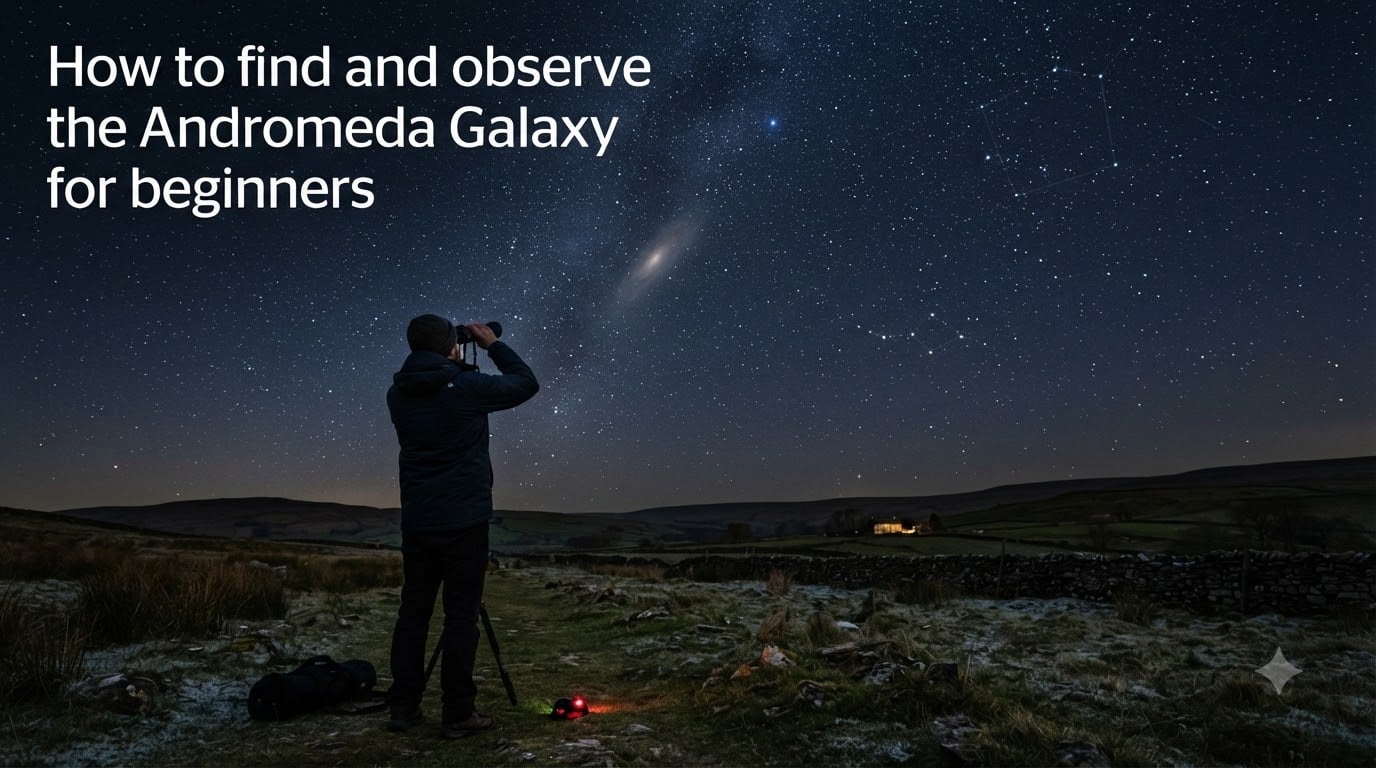
Learning how to find and observe the Andromeda Galaxy for beginners is one of the most rewarding first steps into deep-sky astronomy. The Andromeda Galaxy, also known as M31, sits 2.5 million light-years from Earth and is the farthest object most people can see with their own eyes. I still remember the night I first spotted that faint, ghostly smudge in the sky, and I want to help you do the same.
This guide walks you through every step I use on clear nights, from picking the right season to star-hopping with Cassiopeia and the Great Square of Pegasus. You will not need expensive gear or technical knowledge, just patience and a dark sky.
Table of Contents
What Is the Andromeda Galaxy and Why Should You See It?
The Andromeda Galaxy is a spiral galaxy roughly the same size as our own Milky Way. It contains about a trillion stars and lies 2.5 million light-years from us. That means the light entering your eyes tonight left Andromeda before humans even existed on Earth.
For beginners, Andromeda is the ideal first galaxy target because it is bright enough to see without a telescope under dark skies. It also rewards small binoculars more than almost any other deep-sky object. When you find it, you are looking across intergalactic space at something almost incomprehensibly large.
It is also moving toward us. In about 4.5 billion years, Andromeda will collide with the Milky Way. That makes tonight’s quiet view feel a little more meaningful.
When Is the Best Time to Find Andromeda?
The best window to observe Andromeda runs from late August through early March in the Northern Hemisphere. During those months, Andromeda rises high in the eastern sky and climbs overhead by late evening.
My favorite time to look is between 10 p.m. and midnight in autumn, when Andromeda is high enough above the horizon to clear away the worst of the light pollution near the ground. In the Southern Hemisphere, you can still see Andromeda, but it stays very low on the northern horizon, so I recommend looking during October and November for your best chance.
Pick a night when the Moon is new or a thin crescent. A bright Moon washes out faint objects like Andromeda almost completely.
Finding Andromeda by Star-Hopping from Cassiopeia
Star-hopping means using bright, easy-to-find stars as stepping stones to reach your target. It is the same technique I teach every beginner because it works without any equipment.
Cassiopeia is one of the easiest constellations to spot. Look north and find the five bright stars that form a big W or M shape. This constellation circles the North Star and is visible year-round in most of the Northern Hemisphere.
Follow these steps to find Andromeda from Cassiopeia:
Identify the W shape of Cassiopeia on its side, with the open side facing the Andromeda direction.
Pick the two stars at the narrow point of the W, called Schedar and Caph.
Draw an imaginary line from Schedar through Caph and extend it about three times that distance into the sky.
Look for two moderately bright stars along that line, then a fainter fuzzy patch just past them.
That faint, oval smudge is the core of the Andromeda Galaxy.
Your first time, this might take 20 minutes of sweeping with binoculars. That is normal. Take your time and let your eyes adjust.
Finding Andromeda from the Great Square of Pegasus
If Cassiopeia is not clearly visible, try the Great Square of Pegasus instead. This is a large, boxy pattern of four bright stars that looks like a giant baseball diamond in the autumn sky.
Find the Great Square by looking high in the south or southeast on autumn evenings. The four stars are roughly equal in brightness, which makes the square stand out.
Use these steps to star-hop from Pegasus to Andromeda:
Locate the top-left corner of the Great Square, the star Alpheratz.
Move two fist-widths to the left of Alpheratz (measured at arm’s length).
Find two dim stars in a row, then a third slightly brighter star above them.
Just past that third star, you should see a faint fuzzy patch that looks like a small cloud.
That cloud is the Andromeda Galaxy. Binoculars will confirm it immediately.
I find this method slightly easier for total beginners because the Great Square is harder to mistake for anything else in the sky.
Dark Sky Requirements and Why Light Pollution Matters
Andromeda has a magnitude of about 3.4, which sounds bright on paper but is spread across a huge area. That makes light pollution its biggest enemy. Under a city sky, Andromeda is invisible. Under a truly dark sky, it is obvious.
If you live in or near a city, you will need to travel at least 30 to 60 minutes away from the urban core to find a dark enough sky. Look for a Bortle Class 4 or darker location. Free light-pollution maps online can show you the closest dark zone.
Even your backyard can work if you block direct streetlights, shut off porch lights, and let your eyes adapt. I have successfully spotted Andromeda from suburban driveways by simply waiting in the dark for 30 minutes.
How to Dark-Adapt Your Eyes for Better Viewing
Dark adaptation is the process of your eyes becoming sensitive to faint light. It takes about 30 minutes for full effect and can be ruined by a single bright phone screen in seconds.
Here is my dark-adaptation routine before every observing session:
Avoid bright white lights for at least 30 minutes before viewing.
Use only red light for any necessary illumination. Cover a flashlight with red film or use a dedicated red astronomy flashlight.
Set your phone to night-shift mode or use a red filter app before looking at star charts.
Avoid looking at car headlights or other bright lights during the session.
Give your eyes time to settle between glances at the sky.
Once your eyes are fully adapted, you will notice several more stars and your target will look noticeably brighter. This single step improves almost every beginner’s results.
What Andromeda Looks Like Through Binoculars and Telescopes
Set your expectations honestly. Andromeda will not look like the colorful Hubble images you have seen. Through any optics, it appears as a gray, oval, fuzzy patch, brighter in the middle and fading at the edges. The first time I saw it, I genuinely thought I had found a smudge on my lens.
With naked eyes under dark skies, Andromeda looks like a small, dim cloud. With 10×50 binoculars, the core becomes obvious and you may glimpse the faint outer disk. With a small telescope, you can see the bright nucleus and possibly a hint of the galaxy’s dust lanes.
Binoculars are the best beginner choice because they give a wide, bright view that makes finding the galaxy much easier. A telescope narrows your view and can actually make Andromeda harder to locate the first time.
Helpful Tools and Apps for Beginners
A good free smartphone app makes Andromeda dramatically easier to find. Apps like Stellarium, Sky Tonight, and Star Walk overlay constellation lines on your phone’s camera view, so you simply point your phone at the sky and follow the arrows to M31.
To use them effectively, switch your phone to red mode before going outside so the screen does not destroy your dark adaptation. Hold the phone above your head, find Cassiopeia or Pegasus on the screen, then look up with your eyes and find the same pattern. Your phone becomes a real-time star chart.
A printed star chart also works well if you prefer to stay disconnected. Many astronomy clubs offer free monthly charts that show exactly where Andromeda sits on any given night.
Frequently Asked Questions
What direction should I look to see the Andromeda Galaxy?
Look north if you are in the Northern Hemisphere and find the W-shape of Cassiopeia or the Great Square of Pegasus high in the east or south. Andromeda sits between these two patterns in the autumn sky. From the Southern Hemisphere, look low on the northern horizon during October and November.
How can I observe the Andromeda Galaxy as a beginner?
Find a dark sky location away from city lights, let your eyes adapt for 30 minutes, then star-hop from Cassiopeia or the Great Square of Pegasus. Use 10×50 binoculars for the easiest first view, and follow a smartphone app to confirm your target.
Can you see Andromeda with a beginner telescope?
Yes. A small beginner telescope shows Andromeda as a bright fuzzy oval with a concentrated core. Binoculars are usually easier for finding it the first time, but a telescope gives more detail once you know exactly where to point.
How do I locate the Andromeda Galaxy tonight?
Check the Moon phase first, then pick a clear night between late August and early March. Go outside after 10 p.m., face northeast or east, and look for Cassiopeia or the Great Square of Pegasus. Use the star-hopping steps above to navigate from either pattern to the faint oval smudge that marks M31.
Final Tips for Your First Andromeda Night
Learning how to find and observe the Andromeda Galaxy for beginners really comes down to three habits: pick a dark sky, give your eyes time to adapt, and star-hop patiently from a bright pattern you already know. Do those three things and Andromeda will reveal itself.
On your next clear night, dress warmly, grab a pair of binoculars if you have them, and follow the steps above. The first time you see that faint, glowing smudge, you will be looking at a galaxy older than human civilization. Welcome to deep-sky astronomy in 2026.