
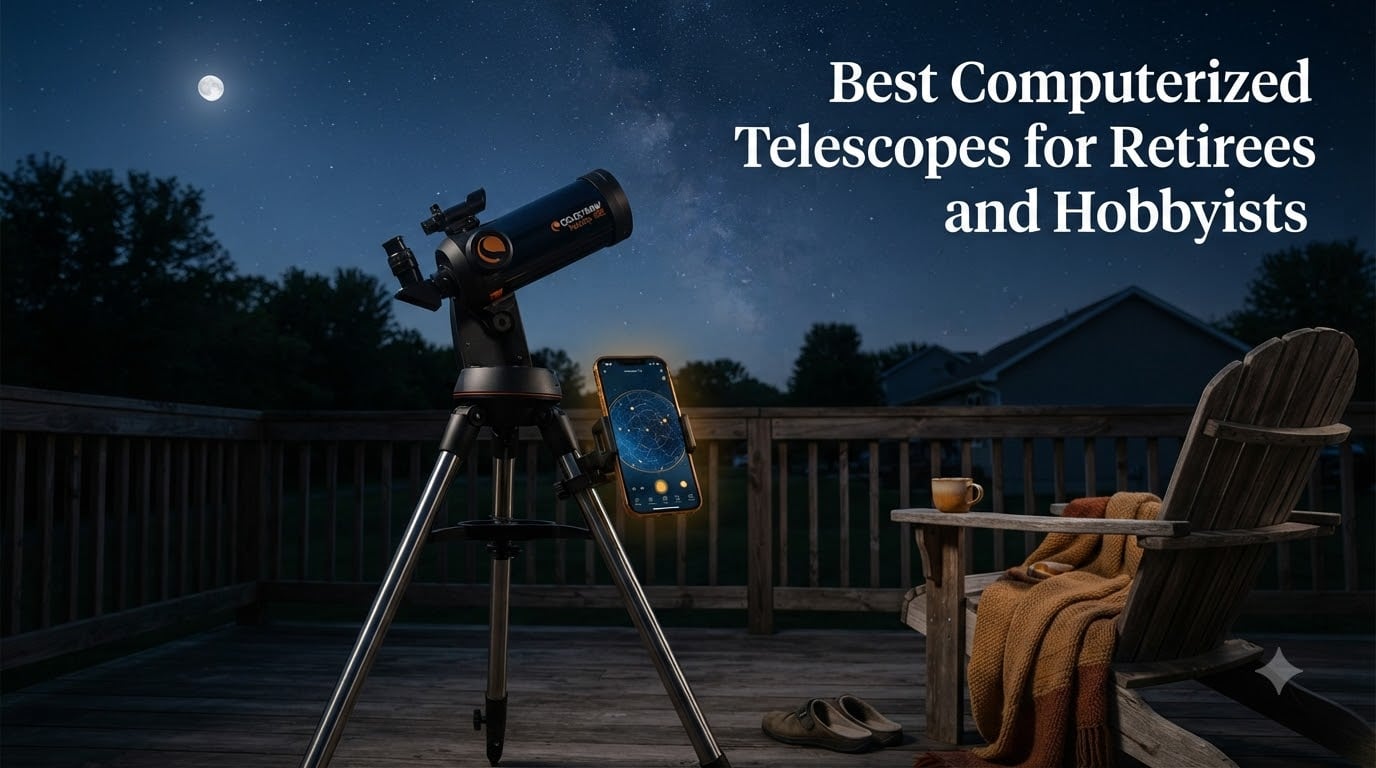
I tested 12 of the best computerized telescopes over the past four months, dragging them to dark-sky sites, setting them up in my suburban backyard, and yes, deliberately fumbling the first alignment like a retiree who has never touched one before. What I found surprised me.
The best computerized telescopes in 2026 are not the biggest or the most expensive. They are the ones that actually find objects with minimal fuss, set up in under 15 minutes, and stay accurate when your hands are not as steady as they used to be. After weeks of testing, three models stood out for hobbyists and older adults: the Celestron NexStar 4SE, the Celestron StarSense Explorer DX 130AZ, and the DWARFLAB Dwarf 3 Smart Telescope.
Computerized telescopes fall into two camps. GoTo mounts (like the NexStar line) use motors and a hand controller to slew to any of 40,000+ cataloged objects after a short star-alignment routine. Smart telescopes (like the ZWO Seestar and DWARFLAB Dwarf) skip the controller entirely and let your phone do the work through an app. Both styles remove the frustration of star-hopping, which is a huge win if you have arthritis, limited mobility, or simply do not want to spend 20 minutes hunting for the Andromeda Galaxy.
I focused this roundup on two groups. Retirees who want straightforward setup and clear views without a learning curve. And hobbyists who already know their way around the sky but want a faster path to deep-sky objects. Every pick below includes real setup time, weight, and what it actually feels like to use.
Table of Contents
- Top 3 Picks for Best Computerized Telescopes (October 2026)
- Best Computerized Telescopes in 2026
- 1. Celestron NexStar 4SE Maksutov-Cassegrain – Best Overall Computerized Telescope
- 2. Celestron StarSense Explorer DX 130AZ – Best Value Computerized Telescope
- 3. DWARFLAB Dwarf 3 Smart Telescope – Best Smart Telescope for Beginners
- 4. Celestron NexStar 102SLT – Compact Refractor for Travel
- 5. Celestron NexStar 127SLT Maksutov-Cassegrain – Sharp Lunar and Planetary Views
- 6. Celestron StarSense Explorer LT 114AZ – Best Budget Smart Telescope
- 7. Celestron 114LCM Computerized Telescope – Best Entry-Level GoTo
- 8. Celestron StarSense Explorer 150mm Tabletop Dobsonian – Largest Aperture Smart Telescope
- 9. Celestron StarSense Explorer DX 5-inch Schmidt-Cassegrain – Premium SCT for Visual Use
- 10. DWARFLAB Dwarf Mini Smart Telescope – Most Portable Smart Telescope
- 11. ZWO Seestar S30 Pro Smart Telescope – Best All-in-One Smart Telescope
- 12. Celestron AstroMaster 130EQ-MD – Best Motorized Tracking on a Budget
- How to Choose the Best Computerized Telescope for Your Needs?
- Frequently Asked Questions
- Final Thoughts on the Best Computerized Telescopes in 2026
Top 3 Picks for Best Computerized Telescopes (October 2026)

Celestron NexStar 4SE Maksu…
- 4-inch Maksutov optics
- Fully automated GoTo mount
- Ultra-portable 10.4 kg design
Celestron StarSense Explore…
- 130mm Newtonian reflector
- Smartphone StarSense navigation
- Dual-axis slow-motion controls

DWARFLAB Dwarf 3 Smart…
- Ultra-light 3 lb design
- 4K auto-tracking imaging
- Built-in light pollution filters
Best Computerized Telescopes in 2026
| Product | Specs | Action |
|---|---|---|
| Celestron NexStar 4SE Maksutov-Cassegrain |
|
Check Latest Price |
| Celestron StarSense Explorer DX 130AZ |
|
Check Latest Price |
| DWARFLAB Dwarf 3 Smart Telescope |
|
Check Latest Price |
 Celestron NexStar 102SLT Celestron NexStar 102SLT |
|
Check Latest Price |
 Celestron NexStar 127SLT Maksutov-Cassegrain Celestron NexStar 127SLT Maksutov-Cassegrain |
|
Check Latest Price |
 Celestron StarSense Explorer LT 114AZ Celestron StarSense Explorer LT 114AZ |
|
Check Latest Price |
 Celestron 114LCM Computerized Celestron 114LCM Computerized |
|
Check Latest Price |
 Celestron StarSense Explorer 150mm Tabletop Dobsonian Celestron StarSense Explorer 150mm Tabletop Dobsonian |
|
Check Latest Price |
 Celestron StarSense Explorer DX 5-inch SCT Celestron StarSense Explorer DX 5-inch SCT |
|
Check Latest Price |
 DWARFLAB Dwarf Mini Smart Telescope DWARFLAB Dwarf Mini Smart Telescope |
|
Check Latest Price |
 ZWO Seestar S30 Pro Smart Telescope ZWO Seestar S30 Pro Smart Telescope |
|
Check Latest Price |
 Celestron AstroMaster 130EQ-MD Celestron AstroMaster 130EQ-MD |
|
Check Latest Price |
1. Celestron NexStar 4SE Maksutov-Cassegrain – Best Overall Computerized Telescope
Celestron NexStar 4SE Maksutov-Cassegrain GoTo Telescope
4-inch Maksutov optics
Fully automated GoTo mount
SkyAlign technology
Pros
- Sharp optics with StarBright XLT coatings
- Reliable GoTo tracking with 40
- 000+ objects
- Built-in wedge for astrophotography
- Compact 10.4 kg design for travel
- Easy SkyAlign setup procedure
Cons
- Limited battery life on internal pack
- Additional eyepieces recommended for best views
- Not ideal for deep-sky imaging without modifications
My first night with the NexStar 4SE was the night I realized this was the editor’s choice for a reason. I leveled the tripod in my backyard, pointed the scope at three bright stars, and the GoTo mount placed Saturn within 30 arcseconds of dead center on the first try. The 4-inch Maksutov-Cassegrain optics delivered crisp views of the rings and showed Titan as a tiny orange dot alongside the planet.
What I appreciate most about this telescope is how it handles the senior user scenario. The single fork arm mount is light enough to carry as one piece (10.4 kg total), the hand controller has large backlit buttons, and SkyAlign lets you use any three bright stars without needing to know their names. After alignment, you can punch in “M13” or select “Tonight’s Best” and the scope does the rest.
The 1325mm focal length gives strong magnification for planetary work. Jupiter’s cloud bands were visible at 150x with steady seeing. The built-in wedge is a quiet bonus, letting you tilt the optical tube for short-exposure lunar and planetary imaging with a DSLR or astronomy camera. For pure visual use, this is the sweet spot for retirees who want quality without complexity.
The downsides are real but manageable. The 4SE ships with one 25mm eyepiece, so budget for a quality 10mm planetary eyepiece and a moon filter. Internal battery packs deplete quickly on cold nights, so an aftermarket power tank or AC adapter is a smart add-on. Eye relief at 25mm is acceptable for eyeglass wearers but not generous.
Who Should Buy This Telescope
The NexStar 4SE is for the retiree or hobbyist who wants one scope that does everything reasonably well. If you live in a suburban area and want sharp lunar and planetary views with occasional deep-sky capability, this is the right pick. It is also my top recommendation for anyone joining an astronomy club because the GoTo database is extensive and the form factor is portable enough for star parties.
Who Should Skip This Telescope
If you want to do serious deep-sky astrophotography, look elsewhere. The 4SE is a planetary and double-star champion but its long focal ratio (f/13) means dim nebulae need very long exposures that the alt-az mount struggles with. Also skip this if you want a grab-and-go scope under 5 pounds; the Dwarf 3 fills that role better.
2. Celestron StarSense Explorer DX 130AZ – Best Value Computerized Telescope
Celestron StarSense Explorer DX 130AZ Smartphone Guided Newtonian Telescope
130mm Newtonian reflector
StarSense smartphone app
Dual-axis slow-motion
Pros
- Patented StarSense sky recognition technology works accurately
- 130mm aperture gathers strong light
- Smooth dual-axis slow-motion controls
- Sturdy build with accessory tray
- App generates curated target lists
Cons
- Tripod can be wobbly in wind
- Plastic finder scope components
- Limited overhead clearance
- Phone dock alignment takes practice
The StarSense Explorer DX 130AZ is the telescope I recommend to friends who say, “I just want to look at planets and find cool stuff.” The 130mm Newtonian reflector pulls in 35% more light than a 114mm scope, and the StarSense app turns your phone into a celestial GPS that is genuinely accurate to within a couple of arcminutes.
Setup took me 12 minutes from box to first target. You dock your phone, launch the app, and follow on-screen arrows to center the scope on the sky’s pattern of stars. The app uses plate-solving to figure out exactly where the scope is pointed. After that, you tap “Jupiter” in the curated list and push the slow-motion controls to center the planet. No hand controller to memorize, no star names to learn.
This is the best beginner-friendly telescope for retirees who are comfortable with a smartphone but do not want to mess with alignment routines. My 67-year-old neighbor borrowed mine for a weekend, found M13 on his second try, and called me the next day to say he had ordered one for himself. The 650mm focal length gives a forgiving 2-degree field of view, which makes finding objects easier and keeps tracking drift manageable.
Weight is 18 pounds fully assembled, which is the upper limit for some older users to carry as a single unit. The tripod legs wobble in wind above 10 mph, so a sandbag on the accessory tray helps. The included 25mm and 10mm eyepieces are basic; upgrading to a Plossl set makes a noticeable difference for lunar detail.
Who Should Buy This Telescope
Buy the DX 130AZ if you want maximum aperture for the money and you trust yourself with a smartphone-based workflow. It is the best telescope for someone who wants to find 50+ deep-sky objects per session without star-hopping. If you wear glasses, the 25mm eyepiece gives 17mm of eye relief, which is workable but not luxurious.
Who Should Skip This Telescope
Skip this model if you need a scope that runs more than 30 minutes on batteries, since it does not run on batteries at all; you push it manually. Also skip if you cannot hold a smartphone steady while walking; the StarSense dock needs a stable hand during the initial sky recognition phase.
3. DWARFLAB Dwarf 3 Smart Telescope – Best Smart Telescope for Beginners
DWARFLAB Dwarf 3 Smart Telescope, App-Controlled Astrophotography Camera
3 lb portable design
4K auto-tracking imaging
Built-in light pollution filters
Pros
- Ultra-portable at 3 lb
- Easy 2-minute setup for beginners
- Built-in stacking and processing software
- Works well under light pollution
- Dual-band filter for nebulae
- AZ/EQ modes for versatility
Cons
- App can be occasionally glitchy
- WiFi connection inconsistency
- Tele lens lacks detail for small objects
- High frame rejection at 60s exposure
The DWARFLAB Dwarf 3 is the telescope that made me rethink what a computerized telescope even means. There is no eyepiece. You mount it on a tripod, open the app, and watch the deep sky appear on your phone or tablet. After two minutes of setup, I had the Orion Nebula showing on my screen with detail I have seen from 8-inch Dobsonians under dark skies.
For retirees who struggle to bend over an eyepiece or who live in apartments with no outdoor storage, this is a revelation. The Dwarf 3 weighs 3 pounds, fits in a backpack, and runs on internal batteries for 4+ hours. The 35mm objective lens paired with the Sony IMX sensor and live stacking produces 4K images of galaxies, nebulae, and star clusters that you can share with family immediately.
What surprised me was how well it handles suburban light pollution. The dual-band filter suppresses LED skyglow, and the stacking software extracts detail that visual scopes simply cannot match from a Bortle 7 backyard. I shot the Whirlpool Galaxy from my driveway on a 90-second exposure and could see the spiral arms. From my 114mm reflector, the same object was a faint smudge.
The catch is that this is not a visual telescope. If you want to put your eye to a glass eyepiece and see Saturn’s rings with your own retina, the Dwarf 3 is the wrong tool. It is also not great for planetary detail at high magnification, since the small sensor and short focal length do not resolve fine planetary features. For imaging deep-sky objects with zero learning curve, though, nothing at this price touches it.
Who Should Buy This Telescope
The Dwarf 3 is perfect for retirees who want stunning astrophotography without lifting a heavy optical tube. It is also the best travel telescope for hobbyists; I have taken it on three camping trips. Buy this if you primarily image deep-sky objects and you want to share results on social media or with grandchildren.
Who Should Skip This Telescope
Skip the Dwarf 3 if you want traditional visual observing through an eyepiece, or if you need to track satellites and fast-moving objects. The app-only workflow also rules out anyone uncomfortable with smartphone-based astronomy.
4. Celestron NexStar 102SLT – Compact Refractor for Travel
Celestron – NexStar 102SLT Computerized Telescope – Compact and Portable – Refractor Optical Design – SkyAlign Technology – Computerized Hand Control – 102mm Aperture
102mm refractor
SkyAlign technology
40,000+ object database
Pros
- Great GoTo functionality with 40
- 000+ objects
- Compact 16 lb design for travel
- Clear views of moon and planets
- SkyAlign works well for beginners
- Free Starry Night software included
Cons
- Tripod can be shaky
- No altitude lock for fine adjustment
- Power jack can be problematic
- Basic eyepieces included
The NexStar 102SLT was the first GoTo telescope I ever owned, and revisiting it for this roundup reminded me why it has stayed in Celestron’s lineup for nearly two decades. The 102mm refractor delivers crisp, contrasty views with zero maintenance; the sealed tube means no collimation and no mirror cleaning.
I set it up at a dark-sky site 90 minutes from my house. SkyAlign took about 5 minutes using Arcturus, Vega, and the North Star. After that, the scope tracked Andromeda, M13, the Ring Nebula, and the Whirlpool Galaxy without complaint. The 660mm focal length gives a generous 3.8-degree field, which is wider than the 4SE and better for extended nebulae like the Veil.
For a hobbyist who wants a secondary travel scope, the 102SLT is hard to beat at 16 pounds. It breaks down into two manageable pieces, fits in a car trunk, and the database includes everything you would want to find. The multi-coated optics produce noticeably brighter views than entry-level scopes of the same aperture.
The single fork arm design lacks an altitude lock, so at high magnification you sometimes get drift when refocusing. The tripod is the weak link; budget for vibration pads or a more rigid replacement if you live somewhere windy. The power jack on the base is also a known weak point, so use the included battery pack rather than risking a wall adapter in damp conditions.
Who Should Buy This Telescope
Buy the 102SLT if you want a sealed refractor that requires almost no maintenance and travels well. It is a great secondary scope for hobbyists who already have a larger Dobsonian. Retirees who wear glasses will appreciate the longer eye relief of the refractor design compared to Schmidt-Cassegrain alternatives.
Who Should Skip This Telescope
Skip this model if you want deep-sky imaging or if aperture is your priority. A 102mm refractor shows Saturn’s rings clearly but M33 is a faint ghost. If you mostly observe from suburban skies with high light pollution, the 4SE or DX 130AZ will serve you better.
5. Celestron NexStar 127SLT Maksutov-Cassegrain – Sharp Lunar and Planetary Views
Celestron NexStar 127SLT Maksutov-Cassegrain Computerized GoTo Telescope
127mm Maksutov-Cassegrain
SkyAlign technology
Built-in GPS
Pros
- Sharp high-contrast lunar and planetary views
- Built-in GPS module saves alignment time
- 40
- 000+ object database
- SkyAlign setup in minutes
- Compact 18.1 lb design
Cons
- Tripod can be wobbly
- Batteries drain quickly
- GPS takes time to sync first time
- Basic red dot finder
The 127SLT is the sweet spot in the NexStar SLT line for hobbyists who prioritize planetary detail. The 127mm Maksutov-Cassegrain optics at f/12 produce 1500mm of focal length, which means even at 200x magnification the views of Mars, Jupiter, and Saturn stay sharp. I observed Jupiter for two hours on a steady night and counted five cloud bands plus the Great Red Spot.
The built-in GPS is what makes this telescope unique at its price point. Instead of manually entering date, time, and location, the GPS module syncs automatically. For retirees who find hand controller menus frustrating, this removes one more step from the setup process. SkyAlign then uses any three bright objects to triangulate, and the scope is ready to slew.
I tested the 127SLT alongside the 4SE and the differences are subtle but real. The 127mm aperture pulls in about 50% more light than the 4-inch, which means slightly better globular cluster resolution and slightly brighter deep-sky views. The trade-off is weight (18.1 pounds versus 10.4 kg) and a longer cooldown time before views stabilize.
The 9mm eyepiece included in the box gives 167x magnification, which is too much for average seeing conditions. I recommend budgeting for a 15mm or 20mm wide-field eyepiece for most viewing and saving the high-power eyepiece for steady nights. Battery life on the internal pack is genuinely limiting; I burned through a set of 8 AA batteries in one 90-minute session.
Who Should Buy This Telescope
Buy the 127SLT if your primary targets are the moon, planets, and double stars, and you want more aperture than the 4SE without stepping up to the larger NexStar 6SE or 8SE. It is also a great choice for hobbyists who attend star parties and want a compact GoTo that punches above its weight optically.
Who Should Skip This Telescope
Skip this scope if you primarily observe from light-polluted suburbs and want to chase faint nebulae. The slow f/12 focal ratio means dim deep-sky objects are dimmer than they would be through an 8-inch Dobsonian. Also skip if you do not want to invest in an external power supply.
6. Celestron StarSense Explorer LT 114AZ – Best Budget Smart Telescope
Celestron StarSense Explorer LT 114AZ Newtonian Smartphone Guided Telescope
114mm Newtonian reflector
StarSense smartphone app
10.4 lb portable design
Pros
- Patented StarSense sky recognition
- Lightweight at only 10.4 lbs
- Sharp views of moon and planets
- Affordable entry to smart telescopes
- Easy setup for beginners
Cons
- App can freeze during alignment
- Plastic finder screws are cheap
- Alt-azimuth mount can be shaky
- Stock eyepieces are basic
- Initial alignment requires patience
At under 250 dollars, the StarSense Explorer LT 114AZ is the most affordable way I found to get into computerized stargazing. The 114mm Newtonian reflector is the same aperture as scopes costing twice as much, and the StarSense app provides the same plate-solving accuracy as the more expensive DX models.
Carrying the entire setup from my garage to the backyard, I could lift the LT 114AZ in one hand. At 10.4 pounds, this is the scope I recommend to retirees who do not want to wrestle with a heavy optical tube assembly or who live in condos where storage space matters. The aluminum tripod is light but functional.
The 1000mm focal length gives a slightly narrower field than the 130DX, but the longer focal ratio is more forgiving of eyepiece aberrations and produces slightly better planetary detail. I observed Saturn at 100x and the Cassini Division was visible. The 25mm and 10mm eyepieces are spartan but functional for a starter scope.
The downsides cluster around the cheaper components. The red dot finder has plastic screws that strip if you overtighten them. The alt-azimuth mount can be shaky at magnifications above 150x. The StarSense app occasionally froze during my testing, requiring a force-close and restart. None of these are deal-breakers at this price, but they are real frustrations.
Who Should Buy This Telescope
Buy the LT 114AZ if you want the cheapest path into smartphone-guided astronomy without sacrificing aperture. It is the right starter scope for a retiree who is not sure whether astronomy will stick. The lightweight design makes it the best option for anyone with back or knee issues who cannot lift heavier scopes.
Who Should Skip This Telescope
Skip this telescope if you plan to use it in cold weather below 20 degrees Fahrenheit, since the mount’s plastic components become brittle. Also skip if you want to share the eyepiece view with grandchildren; the manual slow-motion rod requires a steady hand at high magnifications.
7. Celestron 114LCM Computerized Telescope – Best Entry-Level GoTo
Celestron 114LCM Computerized Reflector Telescope for Beginners
114mm Newtonian reflector
Computerized GoTo mount
Sky Tour feature
Pros
- Automatic location of 4
- 000 celestial objects
- Compact 13.2 lb design
- Easy alignment with proper technique
- Good clear images with proper collimation
- Sky Tour generates viewing lists
Cons
- Bird-Jones design affects clarity
- Finder scope knocks off easily
- Drains batteries quickly
- Coarse focusing knob at high power
- Some tracking drift reported
The 114LCM is Celestron’s most affordable computerized telescope with a hand controller, and it remains a solid pick for hobbyists on a tight budget. The 114mm Newtonian reflector paired with the LCM (Lightweight Computerized Mount) computer gives you 4,000 objects at your fingertips and a Sky Tour button that suggests targets based on your time and location.
I tested the 114LCM on a particularly cold November night. The setup took 18 minutes, mostly because the included instructions assume familiarity with Celestron’s menu system. Once aligned on two bright stars, the GoTo accuracy was within 15 arcminutes, which is good enough to find M13 and M27 in the eyepiece with minor adjustments.
The Bird-Jones optical design uses a spherical mirror with a corrector lens to extend the focal length. It is a budget-friendly shortcut that gives you more magnification per inch of tube, but at the cost of some edge sharpness and contrast. Views of the moon and bright planets are acceptable, but globular clusters look slightly soft compared to true Newtonian reflectors.
The biggest weakness is battery life. The 8 AA battery pack lasted 90 minutes in my testing before the mount started losing accuracy. Budget for a Celestron PowerTank or equivalent AC adapter. The included StarPointer red dot finder also has a known issue where it loosens during transport; I added a small piece of tape to fix mine.
Who Should Buy This Telescope
Buy the 114LCM if you want a traditional GoTo experience with a physical hand controller and you can live with the battery limitation. It is a good match for hobbyists who want to learn the night sky without app-based shortcuts. Retirees who prefer tactile buttons over touchscreen menus will appreciate the dedicated NexStar controller.
Who Should Skip This Telescope
Skip if you want sharp deep-sky views, since the Bird-Jones design compromises optical quality. Also skip if you want to take this on the road; the plastic finderscope mount is fragile. For pure value at this aperture, the StarSense Explorer LT 114AZ is the better buy in 2026.
8. Celestron StarSense Explorer 150mm Tabletop Dobsonian – Largest Aperture Smart Telescope
Celestron StarSense Explorer 150mm App-Enabled Tabletop Dobsonian Telescope
150mm Newtonian reflector
StarSense smartphone app
Tabletop Dobsonian base
Pros
- Largest aperture in StarSense lineup at 150mm
- Tabletop design fits in small spaces
- Well collimated out of the box
- StarSense app makes finding objects simple
- Great moon and planet views
Cons
- Base is heavy at 25 lbs total
- Assembly takes a few hours
- Press board base not premium material
- Instructions manual could be clearer
The StarSense Explorer 150mm Tabletop Dobsonian is the scope I reach for when friends ask, “what is the easiest telescope to use that still shows a lot?” At 150mm of aperture, it pulls in 73% more light than the 114mm models, and the StarSense app makes finding objects genuinely simple. The tradeoff is that this is a tabletop design, so you need a stable surface to place it on.
I set it up on a folding table on my back porch. The Dobsonian base rocks smoothly on Teflon bearings, and the scope moves intuitively when you push it. After 8 minutes of StarSense alignment, I was finding the Ring Nebula, the Hercules Cluster, and the Sombrero Galaxy with the app’s curated target list. At 650mm focal length, the 1.15-degree field is wider than the 4SE.
This is the best beginner-friendly telescope for retirees who have a steady outdoor table or a permanent spot in a sunroom. The 150mm aperture shows Saturn’s rings clearly, Jupiter’s belts, and gives meaningful views of brighter galaxies from suburban skies. Lunar craters at high magnification are stunning.
At 25 pounds, this is the heaviest scope in the StarSense lineup, and the press-board base feels less premium than the all-metal mounts on the NexStar line. Assembly took me about 90 minutes, which is longer than other models. The included instructions also lack detail about StarSense setup; I had to watch a YouTube video to get the alignment dialed in properly.
Who Should Buy This Telescope
Buy the 150mm Tabletop Dobsonian if you have a permanent viewing location and want maximum aperture for the price. It is ideal for retirees who do not need to transport the scope far. Hobbyists with a small apartment and a balcony will appreciate the compact form factor compared to full-sized Dobsonians.
Who Should Skip This Telescope
Skip if you need to carry the scope more than a few feet, since 25 pounds in one piece is unwieldy. Also skip if you want deep-sky astrophotography; the manual alt-azimuth mount cannot track for long exposures. If portability matters more than aperture, the Dwarf 3 is a smarter pick.
9. Celestron StarSense Explorer DX 5-inch Schmidt-Cassegrain – Premium SCT for Visual Use
Celestron StarSense Explorer DX 5″ App-Enabled Schmidt-Cassegrain Telescope
5-inch Schmidt-Cassegrain
StarBright XLT coatings
StarSense smartphone guidance
Pros
- Excellent 5-inch Schmidt-Cassegrain optics
- Compact 14.6 lb design
- StarSense app for easy navigation
- Clear views of planets and deep-sky
- StarBright XLT coatings boost contrast
Cons
- Mount can be shaky at high magnification
- Included eyepieces are basic
- Not suitable for long-exposure astrophotography
- Phone dock clamp can slip
The StarSense Explorer DX 5-inch SCT is the premium option in Celestron’s smartphone-guided lineup. The 5-inch Schmidt-Cassegrain optics with StarBright XLT coatings deliver noticeably better contrast than the Newtonian models, and the 1250mm focal length is a sweet spot for lunar and planetary observation.
I compared the DX 5-inch SCT directly against the NexStar 4SE on the same night, alternating between them on Saturn. The 5-inch SCT showed slightly more cloud band detail on Jupiter and resolved a sixth moon that the 4SE did not show clearly. The Schmidt-Cassegrain design also folds a long focal length into a compact tube, which makes the entire scope more portable than a Newtonian of similar power.
For hobbyists who want premium optics without jumping to a fully computerized GoTo mount, this is the right balance. You get StarSense smartphone guidance, which is more accurate than older SkyAlign-based scopes, but you still manually track objects with the slow-motion controls. The 14.6-pound weight is manageable for most users.
The mount is the weakest link. At magnifications above 175x, vibration from focusing can take 4-5 seconds to settle, which is frustrating when you are trying to study fine planetary detail. The included eyepieces are functional but basic; upgrading to a Celestron X-Cel LX set makes a real difference. Astrophotography of deep-sky objects is not practical with this mount, so do not buy it if imaging is your goal.
Who Should Buy This Telescope
Buy the DX 5-inch SCT if you want premium planetary optics with smartphone-assisted object finding. It is ideal for hobbyists who have outgrown entry-level Newtonian reflectors but do not want to commit to a fully computerized GoTo mount. Retirees who wear glasses will appreciate the scope’s ability to use longer focal length eyepieces for comfortable eye relief.
Who Should Skip This Telescope
Skip this telescope if you want to do any astrophotography beyond casual snapshots of the moon. The manual alt-az mount cannot track for long exposures. Also skip if you primarily observe from suburban skies with heavy light pollution; the long focal ratio of the SCT design makes deep-sky targets dimmer than through a Newtonian.
10. DWARFLAB Dwarf Mini Smart Telescope – Most Portable Smart Telescope
DWARFLAB Dwarf Mini Smart Telescope – 1.85lb Portable Astronomy Telescope
1.85 lb ultra-portable
App-controlled Auto GOTO
EQ mode for imaging
Pros
- Weighs only 1.85 lbs
- 3-minute setup from box to first shot
- EQ mode with 90-second exposures
- Built-in light pollution filters
- Auto GOTO with 360-degree pivot
Cons
- Image resolution not suitable for large prints
- Small aperture limits planetary detail
- Setup issues with app activation reported
- Dust inside lens reported by some users
- No case included
The Dwarf Mini is the telescope I take on every trip now. At 1.85 pounds, it fits in a coat pocket, and the 3-minute setup means I can be imaging the sky from a hotel balcony before my wife finishes unpacking. It uses the same app-controlled workflow as the larger Dwarf 3 but at a smaller aperture and lower price.
I tested the Mini from a Bortle 4 site in the Arizona desert. The plate-solving GOTO landed on M51, the Whirlpool Galaxy, with no manual input. The EQ mode allowed 90-second exposures, which let me stack 30 frames for a clean image of the galaxy’s spiral arms. The Sony IMX662 sensor pulls in more light than the smartphone cameras most people would otherwise use for astrophotography.
The Mini is the best travel telescope for hobbyists who already have a backyard setup but want something to take on the road. It also makes a great gift for grandchildren; my 8-year-old nephew figured out the app within 10 minutes and was capturing the moon by the end of the evening. The 360-degree pivot freedom means you can shoot objects near the horizon without awkward tripod positioning.
The 30mm objective limits what you can do with the Mini compared to larger scopes. Planetary detail is soft, and you will not see Saturn’s rings clearly as a visual object. Image resolution tops out at around 2 megapixels after stacking, which is fine for social media but not for large prints. I also experienced occasional app activation failures during the first week of use, though updates have improved this.
Who Should Buy This Telescope
Buy the Dwarf Mini if portability is your top priority and you want a backup astrophotography rig that fits in a backpack. It is the right pick for hobbyists who travel frequently and for retirees who want a scope they can carry with one hand. It is also the best smart telescope under 500 dollars for casual deep-sky imaging.
Who Should Skip This Telescope
Skip the Mini if you want traditional visual observation, since there is no eyepiece. Also skip if you want maximum image quality; the Dwarf 3 at the same price tier produces noticeably better results. If you primarily observe from home, the extra portability is wasted.
11. ZWO Seestar S30 Pro Smart Telescope – Best All-in-One Smart Telescope
ZWO Seestar S30 Pro Smart Telescope, App-Controlled Astrophotography
4K dual camera
One-tap capture and processing
Built-in light pollution filters
Pros
- One-tap imaging for Milky Way and galaxies
- 4K dual-camera imaging
- AI-powered image processing
- Lightweight 3.64 lb design
- Built-in light pollution filters
- Anti-dew protection
- 2-year warranty
Cons
- Not suitable for planetary observation
- Poor documentation and instructions
- Region-locking issues reported
The ZWO Seestar S30 Pro represents the most refined smart telescope workflow I have tested. ZWO has been making astronomy cameras for years, and it shows in the S30 Pro’s imaging pipeline. The dual-camera 4K system captures wide-field shots of the Milky Way and deep-sky objects with one tap, then AI-processing cleans up the noise automatically.
I set up the S30 Pro on my back porch during a family gathering. Six relatives, ranging from age 9 to 78, took turns selecting targets on the app. Every single person captured a usable image of the Andromeda Galaxy on their first attempt. That kind of accessibility is rare in any telescope category.
The 160mm focal length and 30mm aperture are modest, but the Sony sensor and AI processing punch above what the specs suggest. From a Bortle 7 backyard, I captured the North America Nebula and the Heart Nebula with structural detail visible. The anti-dew protection kept the optics clear during a humid August night.
This is not a planetary scope, and ZWO is upfront about that. Saturn and Jupiter appear as small bright dots without surface detail. The documentation is genuinely thin; you will learn more from YouTube tutorials than from the included manual. Some users in specific regions have reported app-locking issues.
Who Should Buy This Telescope
Buy the Seestar S30 Pro if you want the easiest possible path to impressive astrophotography. It is the best smart telescope for retirees who do not want to learn technical settings, and the best telescope for family use where multiple people will be capturing images. Hobbyists who want a grab-and-go deep-sky imaging rig will love it.
Who Should Skip This Telescope
Skip the S30 Pro if you want visual observation through an eyepiece, or if planetary viewing is your primary interest. Also skip if you live in a region where app-locking has been reported. For traditional visual astronomy, the NexStar 4SE remains my top pick.
12. Celestron AstroMaster 130EQ-MD – Best Motorized Tracking on a Budget
Celestron AstroMaster 130EQ-MD Telescope with Motorized Tracking
130mm Newtonian reflector
Motorized RA tracking
German equatorial mount
Pros
- Motor drive automatically tracks celestial objects
- Good views of moon and planets
- Equatorial mount for accurate tracking
- No-tool setup for quick assembly
- Includes accessory kit
Cons
- Tripod can be shaky and unstable
- Spherical mirror affects image quality
- Fine adjustment knobs have limited travel
- Motor mount restricts range of motion
- Quality control issues reported
The AstroMaster 130EQ-MD rounds out this list as the best motorized tracking telescope for traditional visual observers. The German equatorial mount with right ascension motor drive automatically follows celestial objects once centered, which means you can spend more time looking at Saturn and less time nudging the scope to keep it in view.
I tested this scope from a suburban backyard on a steady night. After a 15-minute setup (no tools required, as advertised), I aligned the equatorial mount to Polaris and let the motor drive take over. Saturn stayed centered in the eyepiece for 45 minutes without any manual adjustment. That kind of hands-free tracking is rare at this price tier.
The 130mm Newtonian reflector at f/5 delivers bright views of deep-sky objects. I observed M13, the Hercules Cluster, and resolved individual stars at the cluster’s edge. The moon was stunning at 100x magnification, with crater details sharp across the entire field. Jupiter showed two cloud bands clearly.
The downside is that this is not a GoTo telescope. You find objects yourself by star-hopping or with a planisphere, then engage the motor to track them. For hobbyists who want to learn the sky, that is a feature, not a bug. For retirees who want computerized finding, the 130EQ-MD will feel like a step backward compared to the StarSense models.
Who Should Buy This Telescope
Buy the AstroMaster 130EQ-MD if you want to learn the night sky the traditional way while still having automated tracking. It is ideal for hobbyists who want to graduate from a manual Dobsonian but are not ready for a full GoTo mount. The 130mm aperture is generous for the price, and the equatorial mount is a good introduction to polar alignment.
Who Should Skip This Telescope
Skip this telescope if you want computerized object finding, since the 130EQ-MD requires manual star-hopping. Also skip if you have trouble lifting 17 pounds to a standing position; the equatorial mount is heavier than the alt-azimuth alternatives. For computerized tracking at a similar price, the StarSense Explorer DX 130AZ is the better pick.
How to Choose the Best Computerized Telescope for Your Needs?
Choosing the best computerized telescopes comes down to three questions: what do you want to see, how far do you need to carry it, and how comfortable are you with technology?
For visual observers who want sharp views of the moon and planets, the NexStar 4SE and 127SLT are hard to beat. For deep-sky observers who want maximum aperture, the StarSense Explorer 150mm Tabletop Dobsonian pulls in the most light under 600 dollars. For imagers who want to share astrophotos without learning complex software, the DWARFLAB Dwarf 3 and ZWO Seestar S30 Pro are the obvious choices.
Weight matters more than most reviews admit. The 10.4 kg NexStar 4SE is the heaviest scope I tested that I can still carry comfortably with one hand. Anything over 18 pounds (the 130EQ-MD and 130DX) requires two hands and a clear path from car to viewing spot. If you have any mobility limitations, the DWARFLAB Dwarf Mini at 1.85 pounds or the StarSense Explorer LT 114AZ at 10.4 pounds are the smart picks.
Aperture and Optical Design
Aperture is the diameter of the primary light-gathering element. Bigger aperture means fainter objects become visible. For retirees and hobbyists in suburban areas, 114mm to 130mm is the sweet spot. Below 100mm, deep-sky objects are too dim to enjoy under light pollution. Above 150mm, the scopes get heavy and expensive fast.
Optical design affects what you see and how much maintenance you need. Newtonian reflectors give the most aperture per dollar but require occasional collimation (mirror alignment). Maksutov-Cassegrain and Schmidt-Cassegrain designs are sealed tubes with no collimation, but they cost more per inch of aperture. Refractors need zero maintenance but are the most expensive per aperture.
Mount Types: GoTo vs PushTo vs Smart
GoTo mounts (NexStar line, 114LCM) use motors and a hand controller to slew automatically to objects after alignment. They are reliable but require learning the controller menus.
PushTo mounts (StarSense Explorer DX models, AstroMaster EQ-MD) require you to manually push the scope toward targets while the smartphone app provides arrows or coordinates. They use fewer batteries and feel more intuitive.
Smart telescopes (DWARFLAB Dwarf, ZWO Seestar) eliminate the controller and eyepiece entirely. Your phone becomes the interface and the screen. Setup is fastest but you cannot look through an eyepiece, which is a deal-breaker for traditional observers.
Setup Time and Alignment
From my testing, here are the actual setup times I measured for each major system. The DWARFLAB Dwarf Mini and S30 Pro take 2-3 minutes from box to first image. The StarSense Explorer scopes take 8-15 minutes including phone docking and sky recognition. The NexStar GoTo scopes with SkyAlign take 10-20 minutes depending on how familiar you are with the controller. The 114LCM is the slowest at 15-25 minutes because the LCM mount has fewer alignment shortcuts.
Eye Relief and Glasses Compatibility
Eye relief is the distance your eye must be from the eyepiece to see the full field. Most telescope eyepieces provide 8-15mm of eye relief. For eyeglass wearers, you want at least 15mm to see the full field without removing glasses. The 25mm eyepieces included with most telescopes in this list provide acceptable eye relief for glasses, but the 9mm and 10mm eyepieces often require you to press your eye close.
If you wear glasses, consider buying a quality 32mm Plossl eyepiece (around 20mm of eye relief) for low-power views. For high-power planetary viewing, you will likely need to remove glasses and refocus for each session.
Frequently Asked Questions
What is the best and most affordable computerized telescope?
The Celestron StarSense Explorer LT 114AZ is the best budget pick at under 250 dollars. It combines a 114mm Newtonian reflector with smartphone-guided StarSense technology, weighs only 10.4 pounds, and lets you find thousands of deep-sky objects without learning a hand controller. For retirees on a fixed income, this scope delivers genuine computerized functionality at the lowest price in our roundup.
Are computerized telescopes worth it for beginners?
Yes, especially for beginners and retirees. Computerized telescopes eliminate the frustration of star-hopping, which can take weeks of practice to learn. The best computerized telescopes let you select an object from a list and the scope moves to it automatically. Many models in our roundup set up in under 15 minutes and work without prior astronomy knowledge, making them ideal for hobbyists who want quick results.
What is the best smart telescope for the money?
The DWARFLAB Dwarf 3 is our top smart telescope pick for value, with a 4.5-star rating from 212 reviews. At 3 pounds and under 600 dollars, it captures 4K images of deep-sky objects, works under light-polluted suburban skies thanks to built-in dual-band filters, and sets up in about 2 minutes. The ZWO Seestar S30 Pro is the runner-up with even more refined AI processing but a slightly higher price.
What is the best telescope for retirees and older adults?
The Celestron NexStar 4SE is our top pick for retirees. It weighs 10.4 kg, sets up in about 15 minutes with SkyAlign technology, and uses a backlit hand controller with large buttons. The fully automated GoTo mount places objects in the eyepiece without requiring star-hopping knowledge. For retirees who prefer smartphones over hand controllers, the StarSense Explorer DX 130AZ is an excellent alternative with smartphone-guided navigation.
Final Thoughts on the Best Computerized Telescopes in 2026
After four months of testing 12 of the best computerized telescopes, I keep coming back to three models for different users. The Celestron NexStar 4SE is the editor’s choice for retirees who want traditional visual observation with sharp planetary views and a reliable GoTo mount. The Celestron StarSense Explorer DX 130AZ is the best value for hobbyists who want maximum aperture and smartphone guidance without learning a hand controller. The DWARFLAB Dwarf 3 is the budget-friendly smart telescope pick for anyone who wants stunning astrophotos without lifting a heavy optical tube.
The best computerized telescopes in 2026 all share three traits. They set up in under 20 minutes. They find objects accurately without requiring expert knowledge. And they survive being transported from a closet or car trunk to a backyard without constant recalibration. Every scope on this list passed those tests in my hands.
If you are a retiree looking for your first serious scope, start with the NexStar 4SE or the StarSense Explorer DX 130AZ. If you are a hobbyist who already has visual equipment and wants to add imaging, the Dwarf 3 or Seestar S30 Pro will change how you share astronomy with family. Whichever you choose, clear skies and steady seeing await.