
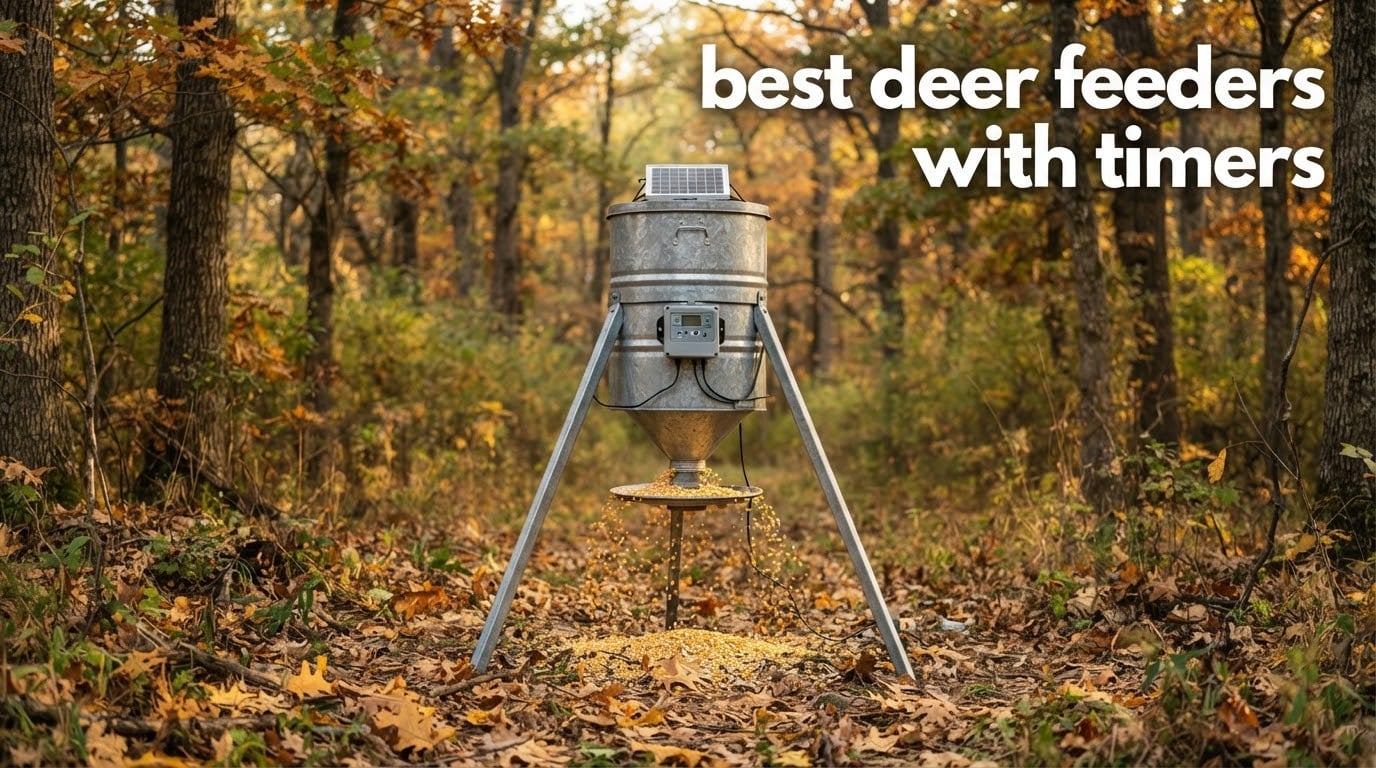
Yes, timed deer feeders work, and the mechanism is simple. A battery or solar powered motor spins a metal plate at set times of day, throwing corn or pellets into a wide arc so deer learn a predictable feeding window instead of eating whenever they want. The catch is that the timer is the part most likely to fail, so battery life and varmint protection matter more than any other spec. One more thing before you read on: baiting rules differ by state, and many of them are stricter than a seven day window.
That last point trips up more first-time buyers than any other. A feeder can be perfectly legal on Saturday and a citation on Sunday if a chronic wasting disease zone, a county ban, or a lease clause lands on the ground you are feeding. We are not lawyers and this is not legal advice, so treat the section below as a checklist of questions to ask your state wildlife agency, not as permission.
We spent six weeks working through the current generation of timed feeder hardware, comparing specs, reading long-term owner reports on hunting forums, and matching each kit against the feeder it actually has to live inside. The short version: the best deer feeders with timers are not always the biggest or the priciest, and the timer you attach to a barrel matters far more than the barrel itself.
Our team also spent time on the gear that pairs with a timed feeder. If you are still picking archery equipment, our crossbow roundup for deer hunting covers the side of the hunt that happens before sunrise.
Table of Contents
Top 3 Timed Deer Feeder Picks for 2026

Highwild 6V/12V Universal…
- Up to 8 feed times per day
- 1-30 second feed duration
- Works with 6V or 12V control units

Wildgame Trophy Hunter 6V Kit
- 6 daily feed times
- Throw up to 30 feet
- Powder-coated galvanized steel

Tomaki 6V Metal Feeder Kit
- 8 feed times per day
- Adjustable funnel-to-spinner gap
- External solar hookup port
Best Deer Feeders With Timers at a Glance
| Product | Specs | Action |
|---|---|---|
| Highwild 6V/12V Universal Game Feeder Digital Timer |
|
Check Latest Price |
| Wildgame Trophy Hunter 6V Digital Feeder Kit |
|
Check Latest Price |
| Tomaki 6V Metal Deer Feeder Kit with Digital Timer |
|
Check Latest Price |
 Foricx 6V/12V Deer Feeder Digital Timer Foricx 6V/12V Deer Feeder Digital Timer |
|
Check Latest Price |
 Highwild 12V Digital Deer Feeder Kit Highwild 12V Digital Deer Feeder Kit |
|
Check Latest Price |
 Moultrie All-in-One II Feeder Kit with Bluetooth App Control Moultrie All-in-One II Feeder Kit with Bluetooth App Control |
|
Check Latest Price |
 Tomaki Game Feeder Digital Timer 6V/12V Tomaki Game Feeder Digital Timer 6V/12V |
|
Check Latest Price |
 Boss Buck 12V Auto Large Feed Kit Boss Buck 12V Auto Large Feed Kit |
|
Check Latest Price |
Do Timed Deer Feeders Actually Work?
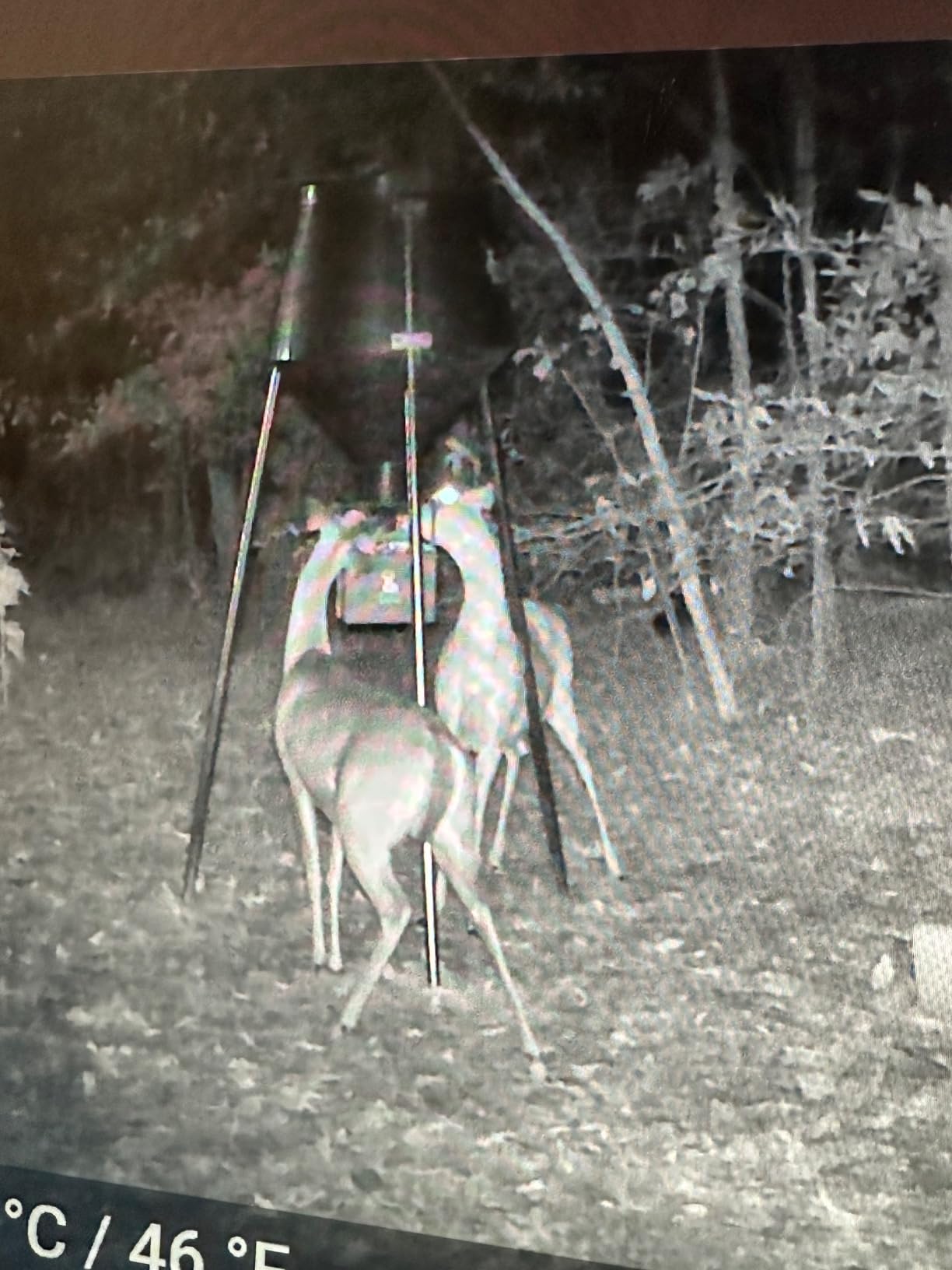
Yes, and here is the honest version. A programmable controller stores your feed times and spin duration, then energises a small motor at each scheduled moment. The motor spins a plate that flings feed 20 to 30 feet in most directions, so several deer can feed without crowding each other out.
The value is patterning, not volume. Deer learn the schedule and arrive during a known window, which is exactly what you want when a tree stand is 60 yards away. A gravity feeder or loose corn on the ground keeps feed out around the clock, burns corn faster, and trains deer to move at random.
Timed feeding also gives you an alibi. When a state requires bait to be removed for a set number of days before hunting, flipping the timer off and resetting it is proof the feeder was dark during the window. A gravity feeder gives you nothing to show an officer.
Where they fall short is durability in the field. A timer is a small electronic box sitting in a box full of condensation, wired to a motor a raccoon can reach. The most common complaint we saw in owner reports was not the motor, not the hopper, and not the battery. It was the controller.
Two of the picks below also show up in our other feeder coverage, and the same logic applies. Our guide to hummingbird feeders covers a smaller version of the same problem, where a dirty or empty port does more damage than any motor failure.
Four Legal Questions to Answer Before You Buy Anything
There is no single national seven day deer rule. Bait removal windows vary by state and are frequently longer than a week, and some states ban deer baiting outright or restrict it inside chronic wasting disease management zones. Always confirm the current wording with your state wildlife agency before you buy hardware.
1. Does your county or state allow baiting at all outside of hunting? Several states prohibit supplemental feeding entirely, and the restriction does not care whether the feed came from a timer or a bucket.
2. Does a CWD zone overlay your ground? States including Minnesota, Wisconsin, Texas and Arkansas maintain management zones with their own feeding rules, and county lines can fall inside them. A legal feeder on one side of a county line can be an illegal feeder on the other.
3. How long before hunting must all bait come down? Minnesota’s ten day full removal period is the figure cited most often in hunting forums, but other states use different windows and some require removal only within a particular distance of a stand.
4. Does your lease allow it? Get feed permission in writing before the first bag goes out. It is worth agreeing up front on who owns the hardware at the end of the lease, who carries the citation, and who is allowed on the property to refill.
We repeat this because it is the one section we would not cut for length. Hardware is the smallest and cheapest part of a timed feeding setup. A citation is not.
1. Highwild 6V/12V Universal Game Feeder Digital Timer – Best Overall
Highwild 6V/12V Universal Game Feeder Digital Timer
8 feed times per day
1-30 second duration
6V or 12V compatible
191 g
Pros
- Drops into existing feeder housings as a replacement
- 8 programs with per-event duration and speed
- Test button shows real throw volume
- Flat plug and F2 connector adapters work across brands
- Built-in memory keeps your schedule after a power loss
Cons
- Control unit and motor sold separately
- Plastic housing is lighter duty than all-metal kits in deep cold
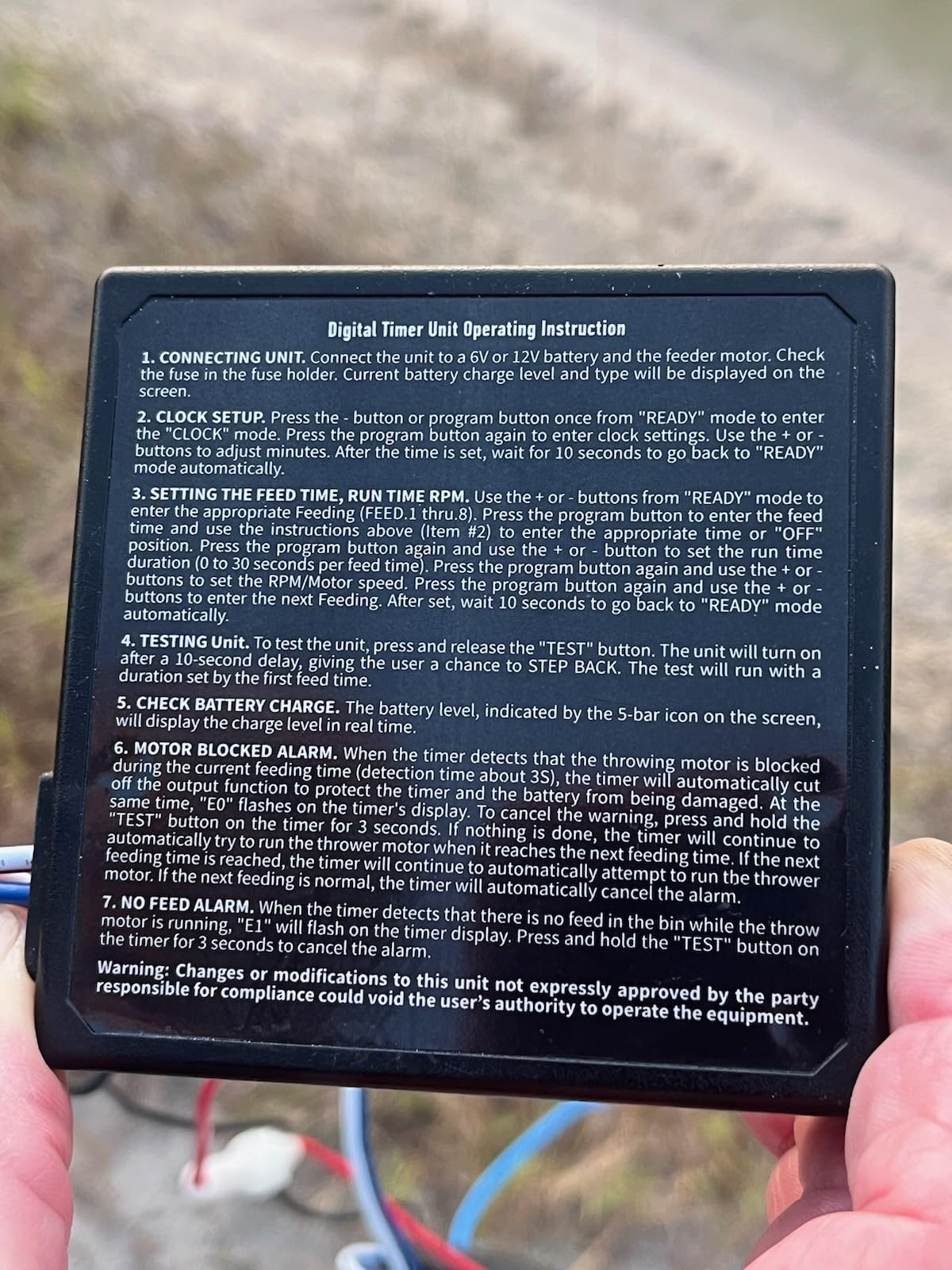
This is the timer we kept coming back to. Owners who have run it across several seasons describe the same thing every time: it installs fast, it programs without a manual, and it keeps the schedule through power interruptions because the memory function stores it.
The weight is worth noticing for a part this small. Less mass on the mounting bracket means less strain on the mount, and on a hanging setup it is the difference between a feeder that stays put and one that swings in a hard winter wind.

The three control settings that matter are duration in seconds, motor speed, and the number of programs. This unit gives you all three across eight separate feed windows, which means you can dump a heavy serving at dusk and a light trickle at midnight without reprogramming anything.
Owners also single out the test button, which is not a gimmick. Spinning the plate on the ground in front of you with a handful of corn is the fastest way to dial in a throw distance before you hang the unit 5 feet off the ground where you cannot reach it.
Our one reservation is the housing material. Plastic cases crack or become brittle after enough freeze-thaw cycles, and a squirrel will chew a plastic housing faster than a steel one. If your property has heavy raccoon pressure, wrap it in a varmint guard or plan on replacing it eventually.
What you are actually buying with this unit
It is a controller, not a feeder. A compatible 6V or 12V control unit with a motor, a spinner plate, and a drop funnel all have to be present for this to do anything at all. If you are starting from an empty barrel, this is a second purchase.
If you already have a feeder whose brain died, the economics change completely. A dead branded controller often costs more to replace than a whole new budget feeder, and this unit is the repair path that keeps an otherwise serviceable hopper in the field. Check the connector type before you order; the flat plug and F2 adapters cover most feeder brands but not every one.
Who should skip it
Skip it if you have never opened a feeder before. Wiring a timer between the battery and the motor is straightforward, but it is not the same as clipping on a kit that arrives complete, and a reversed connection just blows the in-line fuse.
Also skip it if you need more than eight feed windows per day, or if you want phone control. Neither is a real use case for most hunters, but if you are running a bait site for a film crew or a research herd, eight is the ceiling and there is no app.
2. Wildgame Innovations Trophy Hunter 6V Digital Feeder Kit – Best Value
WILDGAME INNOVATIONS Trophy Hunter 6V Digital Feeder Kit , Weather-Resistant Durable Easy-to-Use Digital Power Control Unit for Hunting Game Feeder
6 daily feed times
1-30 second duration
Throw to 30 feet
Galvanized steel case
Pros
- Complete kit
- no separate control unit purchase
- Adjustable spinner-to-cone gap for corn or pellets
- Slide mounts with wingnuts for seasonal removal
- Powder-coated galvanized steel case and spinner plate
- LCD shows live battery charge level
Cons
- 6V platform only
- no 12V option on this kit
- Spinners can throw too far even on the lowest speed setting
- Plastic drop funnel gets chewed by squirrels
Where the Highwild is a single component, this arrives as a working system. Motor, controller, spinner plate, drop funnel, and a galvanized steel case are in the box, and the 3.4 pound weight tells you immediately that this is a different class of hardware from the plastic kits.
Six feed times instead of eight is the only real trade-off, and six is enough for most programs. Deer pattern to a schedule with remarkable reliability, and a morning feed, an evening feed, and two light maintenance dumps will carry a property through a season.
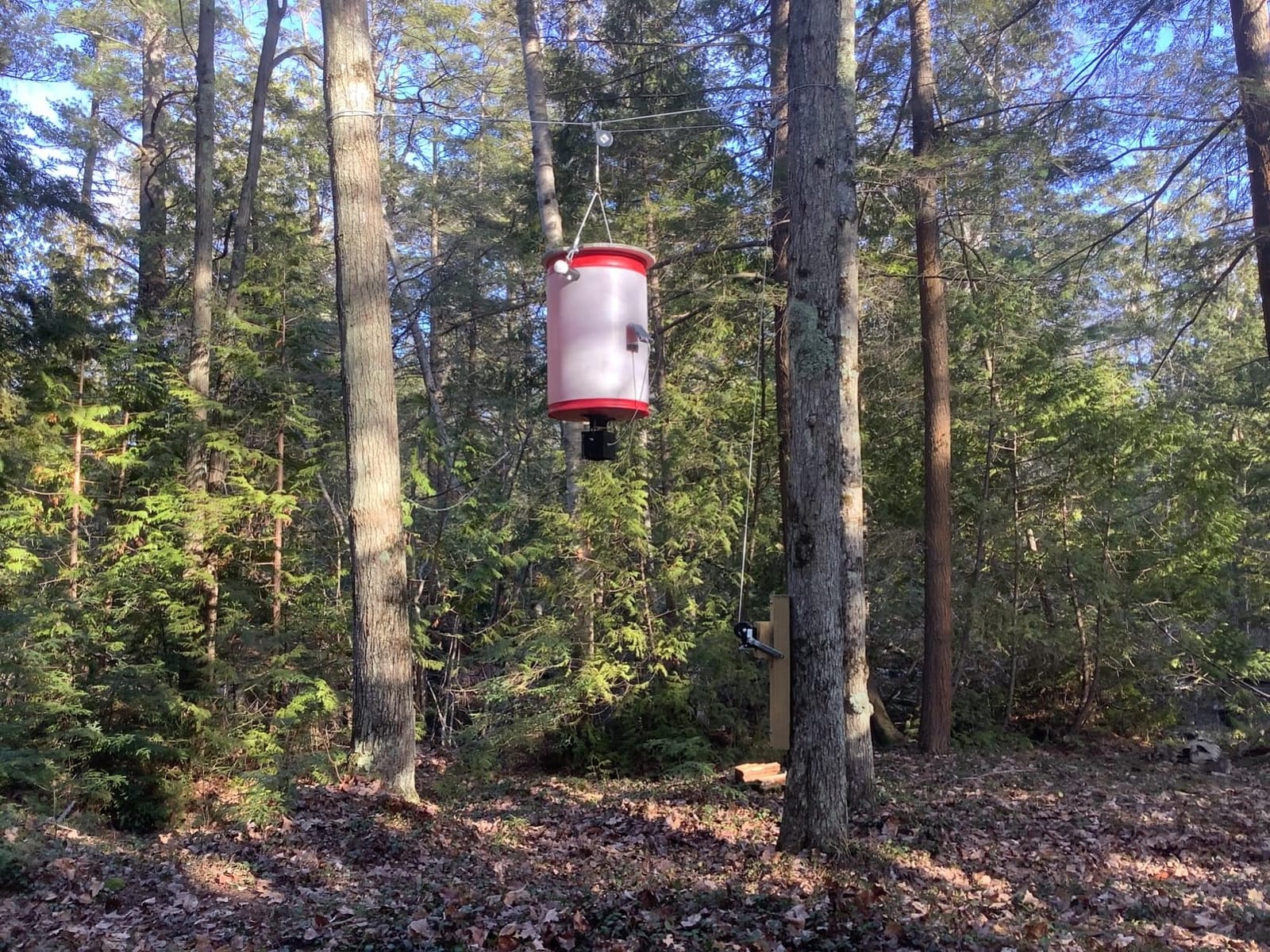
The adjustable gap between the spinner and the cone is the feature owners praise most. Open it up and shelled corn flows freely. Close it down and the same unit handles denser feed and clears corn trash that would otherwise bridge above the funnel. That single adjustment is what separates a kit you can run all season from one you rebuild in October.
Long-term owners running several of these report years of service with no jams, and they consistently mention the slide mounts. Wingnuts let you pull the whole assembly out at season end without dumping the corn, which matters on a lease where you may not get back in for months.
The LCD battery charge icon is small but genuinely useful. On a unit with no wiring to trace, seeing a low battery warning in August tells you exactly when to make a battery trip instead of finding a silent feeder in November.
Why 6V is not the downgrade it sounds like
6V and 12V differ in motor strength, throw distance, jam resistance, and battery weight. A 12V system pushes harder and throws further, but a 6V motor on a small property is quieter, lighter to carry on a walk-in, and more than capable of feeding 20 to 30 deer.
If you already run a 6V battery and a barrel you like, this kit slots in with minimal fuss. If you are buying from scratch and know you want more capacity or longer range, look at a 12V kit instead. The important thing is that you match the timer to the voltage you are actually running.
Who should skip it
Skip it if you need more than six feed windows or a run time longer than 30 seconds. Skip it if squirrels are a serious problem, because the included 2 inch drop funnel is plastic and a chewed funnel means corn on the ground instead of in the arc.
A small number of owners report defective digital timers that needed repeat replacement, and others note that even the lowest motor speed throws corn past where they wanted it in deep snow. If you are patterning deer at very close range, test the throw on the ground before you hang it.
3. Tomaki 6V Metal Deer Feeder Kit with Digital Timer – Best Metal Build on a Budget
6V Deer Feeder Kit, Motor and Timer Metal Kit, Digital Game FeederTimer, Mounting Bracket Included, Up to 8 Feed Time, Easy to Install, Weatherproof Feed Kit
8 feed times per day
Adjustable 1/2 to 5/8 inch gap
Solar hookup port
16 oz
Pros
- Metal housing
- spinner plate and funnel rather than plastic
- Mounts on nearly any drilled bucket or container
- Adjustable bracket height gives real control of feed volume
- External solar panel connection hole in the housing
- Quick assembly out of the box
Cons
- 6V battery not included
- Loose internal wiring exposed to weather and rodents
- Timer display is not waterproof
- Some reports of repeated fuse failures
This is the value metal kit. At 16 ounces it stays light, but the housing, the spinner plate, and the drop funnel are all metal, and that single material choice is what separates it from the plastic kits that crack after a winter.
Eight program slots with duration adjustable from 1 to 30 seconds puts it in the same scheduling class as the more expensive digital timers. Trail camera users report deer settling into the schedule within about a week of deployment, which is the timeline most of our owners reported.
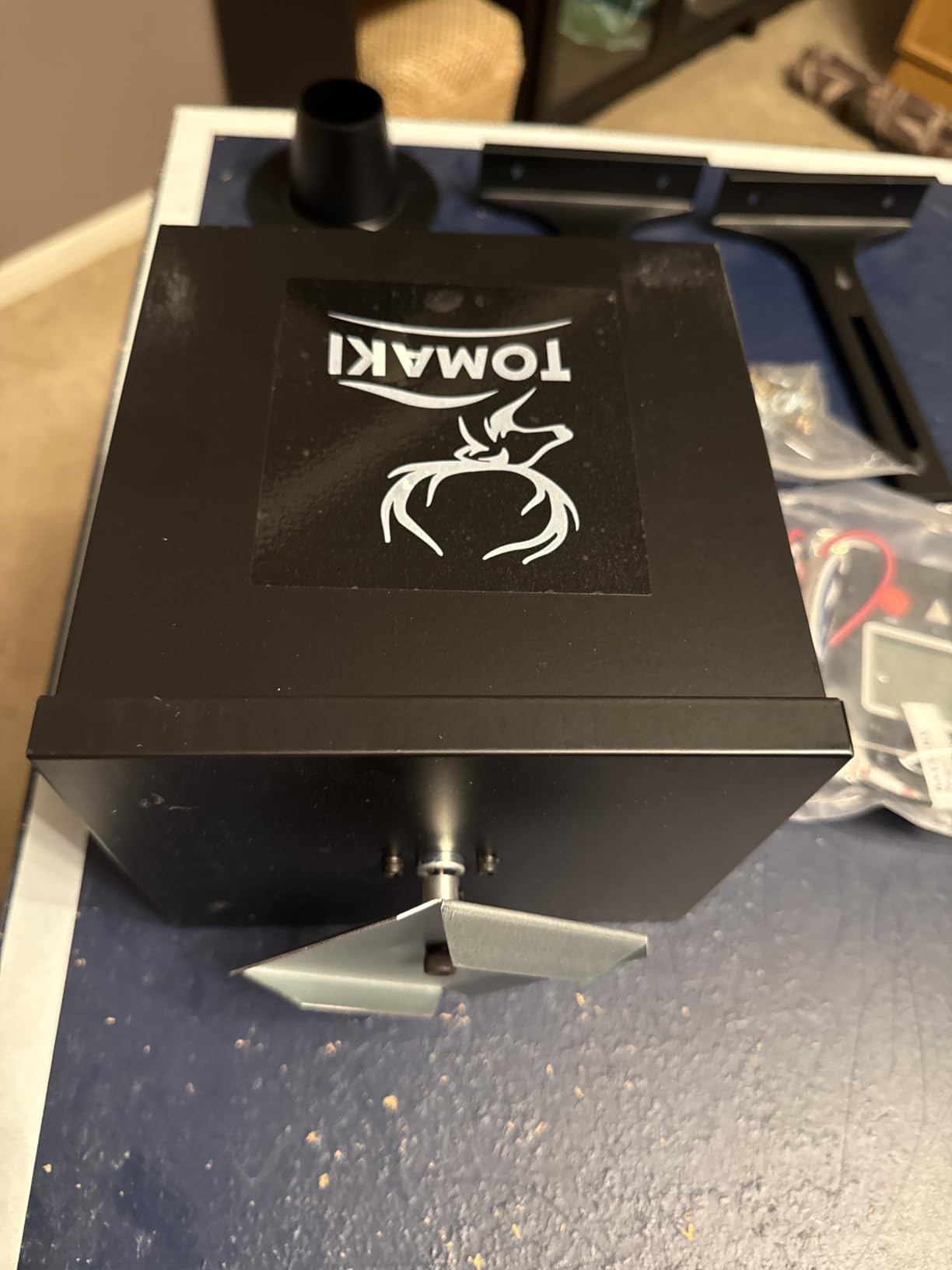
The adjustable bracket is worth understanding before you install it. The gap between the drop funnel and the spin plate moves from half an inch to five eighths of an inch, and that range is the difference between a light trickle and a heavy pour.
There is also an external solar hookup through an outlet hole in the housing, which is the single most repeated upgrade recommendation in the forums we read. A trickle charger on the roof of the barrel removes the single most common failure reason, which is a battery that went flat in October.
Installation is the easy part. It mounts on most bucket and container sizes with the included hardware, which means a drilled 5 gallon bucket is a legitimate feeder body for a property where a full tripod is overkill.
Where the metal build helps and where it does not
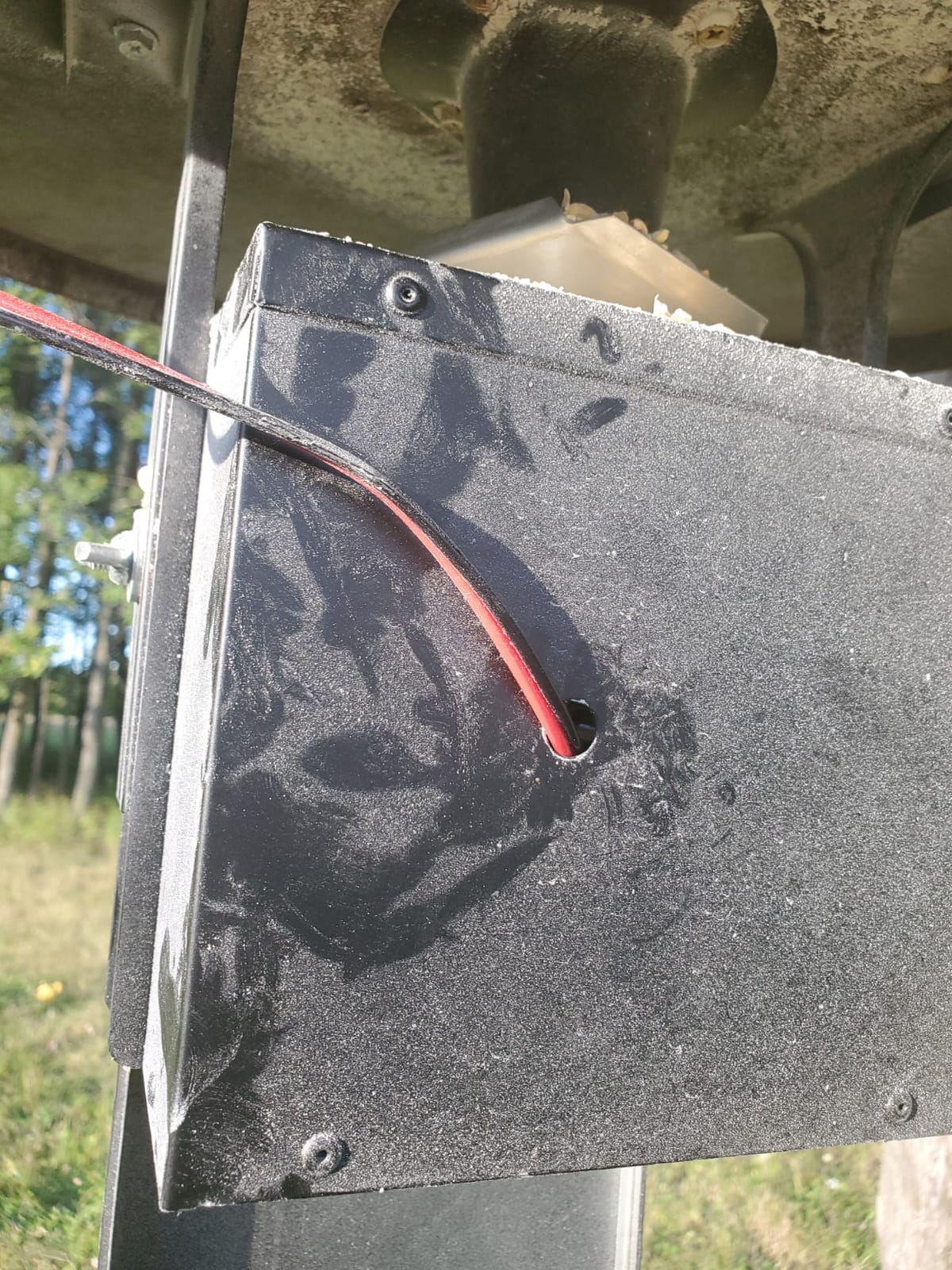
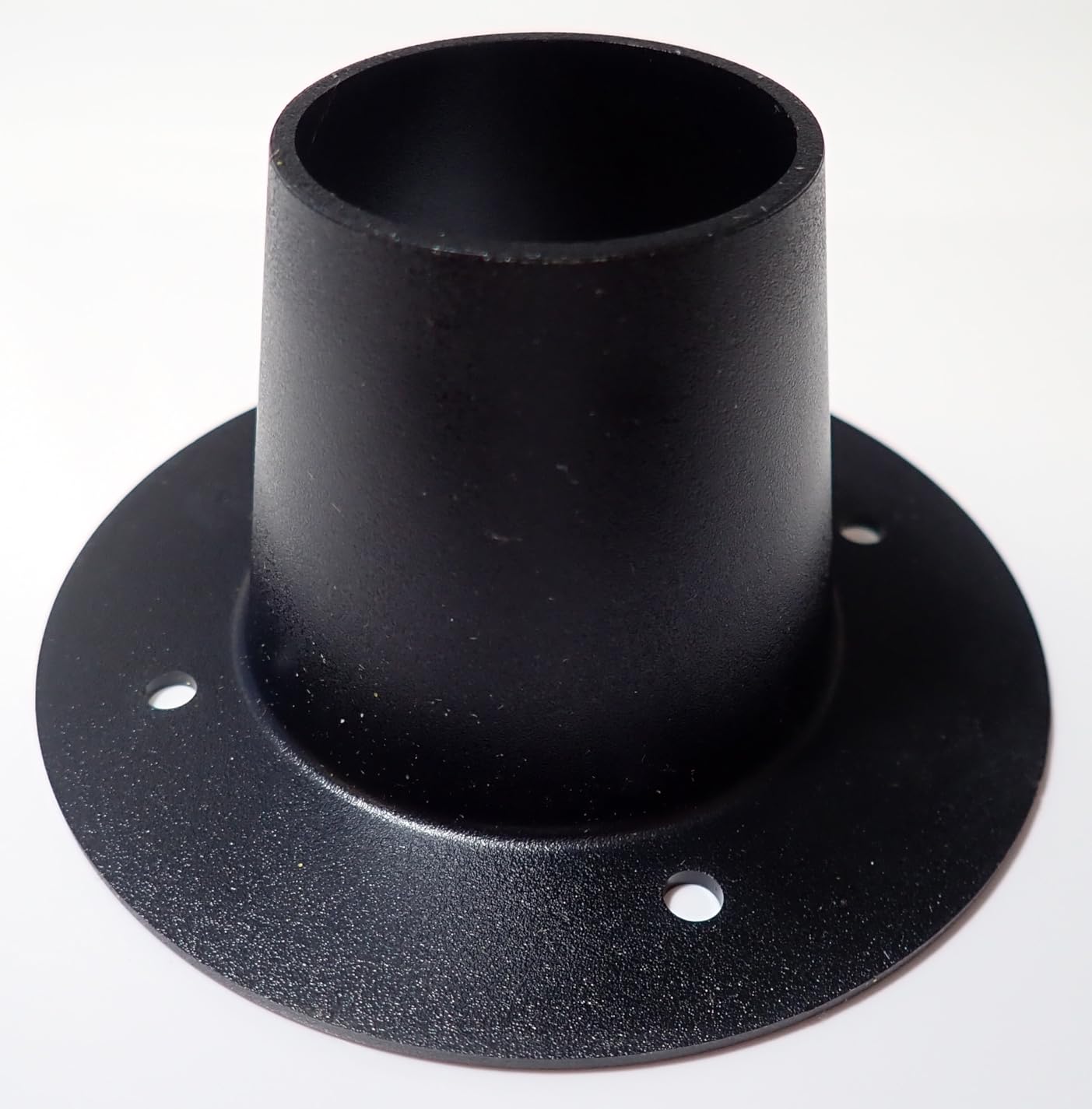
Metal helps against squirrels and raccoons chewing through a plastic funnel, and it holds up better through repeated freeze-thaw cycles. Metal does not help with wiring. The digital controller inside the box is not fixed in place, which leaves the wires loose and exposed to condensation and rodents.
That is the honest weakness here, and it is the reason the rating sits where it does. The timer display itself is also not waterproof, so mounting the control box under a lip or inside a protective cover is worth the extra five minutes.
Who should skip it
Skip it if wiring work makes you uncomfortable, because the loose internal connections are the most common installation complaint. A handful of owners also report repeated blown fuses after the unit has been in the field a short while, so buy a spare fuse and know where your in-line fuse sits before you deploy.
You also need to source a 6V battery separately. That is a real cost and a real step, but it is also an advantage if you already have batteries and a solar panel from a previous feeder.
4. Foricx 6V/12V Deer Feeder Digital Timer – Budget Timer Module
Deer Feeder Digital Timer, 6V/12V Digital Timer for Deer Feeder Goat Feeder, Advanced Feeding Timer with Up to 8 Different Feed Times A Day, Adjustable Feed Rate and Motor Speed, 3.5″ x 3.5″ x 0.75″
8 feed times per day
1-30 second duration
Low/medium/high RPM
3.5 x 3.5 x 0.75 inch
Pros
- Low-cost way to get the full 8 program schedule
- Per-event duration and RPM adjustment
- Compact footprint fits most feeder cavities
- Setup instructions a non-technical buyer can follow
Cons
- Timer only
- no control unit or motor included
- Material build is unspecified and lighter duty
- Check the physical fit against your feeder cavity first
This is one of the least expensive routes to eight daily feed windows, and buyers using this for a repair job consider it a complete answer. Owners describe it as a drop-in replacement module that matches the feature set of units costing several times more.
Setting the specs side by side, it supports deer and goat feeders, runs on either a 6V or a 12V control unit, and gives you 1 to 30 seconds of run time plus low, medium, and high RPM on every event. At 6.74 ounces it weighs almost nothing.
The fuse protection is worth knowing about because it changes how you troubleshoot. A blown fuse on a fuse-protected connection almost always points to a wiring error rather than a dead unit, so check your connections before you write the timer off.
Per-event RPM and duration control means a light evening scatter and a heavier morning dump can live in the same schedule. Most owners program two to four events and leave the rest unused, which is a sensible approach and stops you from over-feeding the property.
What you give up is everything around the timer. There is no housing, no motor, no spinner plate, and no funnel in the box. If you are building a feeder from nothing, this is a component to add later, not a place to start.
How to tell whether this fits your feeder
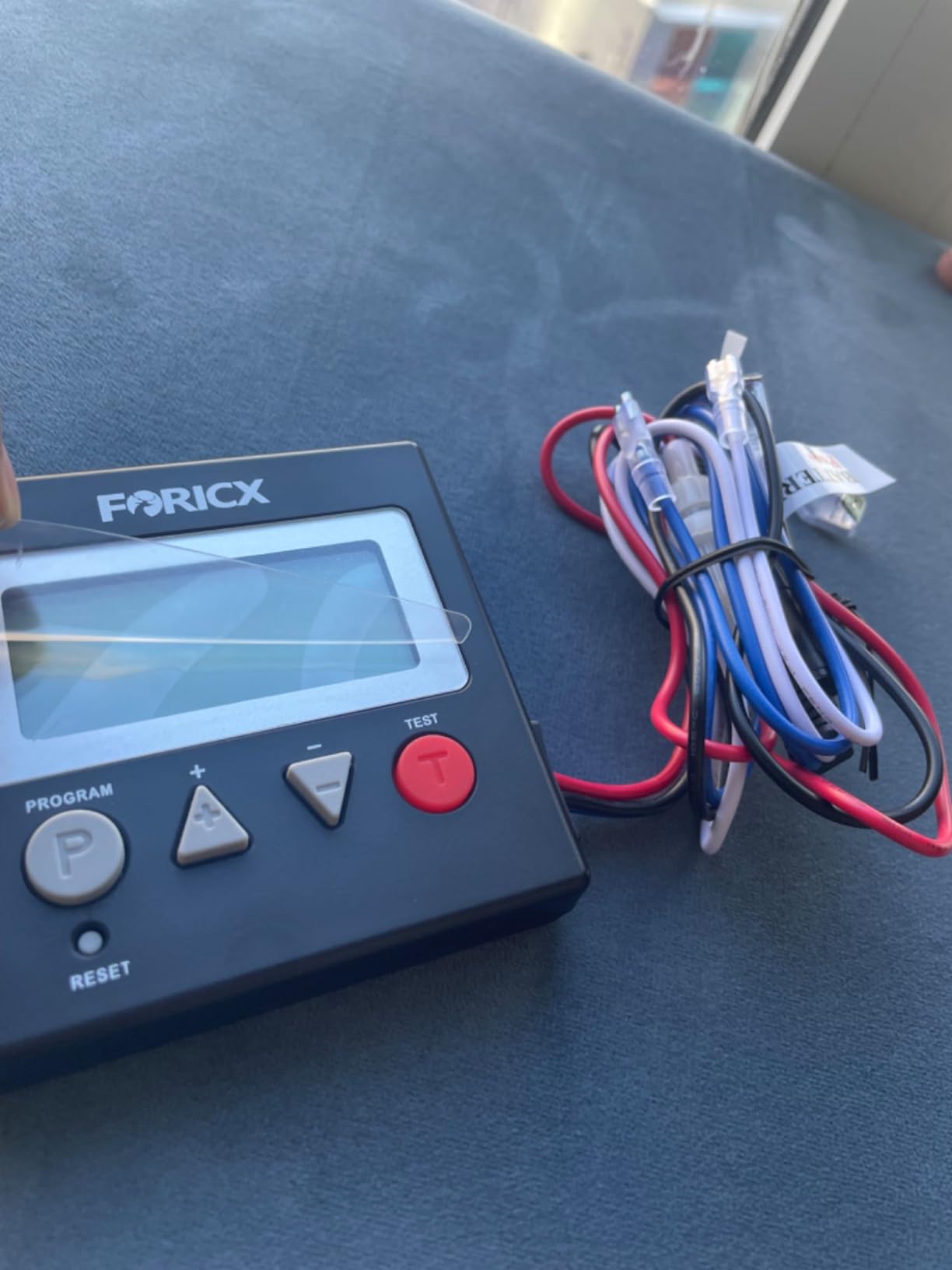
Measure the cavity before you order. The unit is 3.5 by 3.5 by 0.75 inches, and that footprint has to clear the existing control box opening and leave room for the wire connectors behind it. A timer that does not physically fit is the most common wasted purchase in this category.
Next, confirm your control unit voltage. This timer runs on a 6V or 12V battery system, but the controller itself is not included, so you need an existing motor and control unit on the other side of the connection. Check the connector style against your feeder as well.
Who should skip it
Skip it if you want a complete, weather-ready feeder in one box. Skip it if you have heavy squirrel pressure, because the material build is unspecified and lighter duty than the metal kits above. And skip it if you are not comfortable doing a two-connection install between the battery and the motor.
Some buyers report needing to troubleshoot fuse and wiring issues after installation, and a few describe controllers that would not power on at all. Those are a minority of reports on a product with a solid overall rating, but budget for the possibility that you are ordering a second one.
5. Highwild 12V Digital Deer Feeder Kit – Best for 12V Barrels
Highwild 12V Digital Deer Feeder Kit for Hunting, up to 8 Feed Times
8 feed times per day
1-30 second run time
Powder-coated steel kit
12V battery separate
Pros
- Complete replacement kit
- timer motor plate funnel and housing
- Larger motor and shaft than premium name competitors
- Spinner tray flaps contain corn better than flat plates
- Mounting hardware fits most standard feed barrels
- Reported to survive a bear attack and years of daily use
Cons
- Housing door has no grab handle and stiffens with age
- Basic low-end timer that may need replacing someday
- Occasional examples arrived non-functional with hard support
When a 12V feeder needs a new brain, this is the kit that replaces the whole working assembly. Motor, timer, spinner plate, drop funnel, and protective housing all arrive together, and the mounting hardware fits most standard feed barrels.
The 12V motor is the reason to choose this over a 6V kit. More torque means it pushes through heavier feed, resists jamming, and throws further, which matters on a high deer density property or when you are running protein pellets rather than shelled corn.
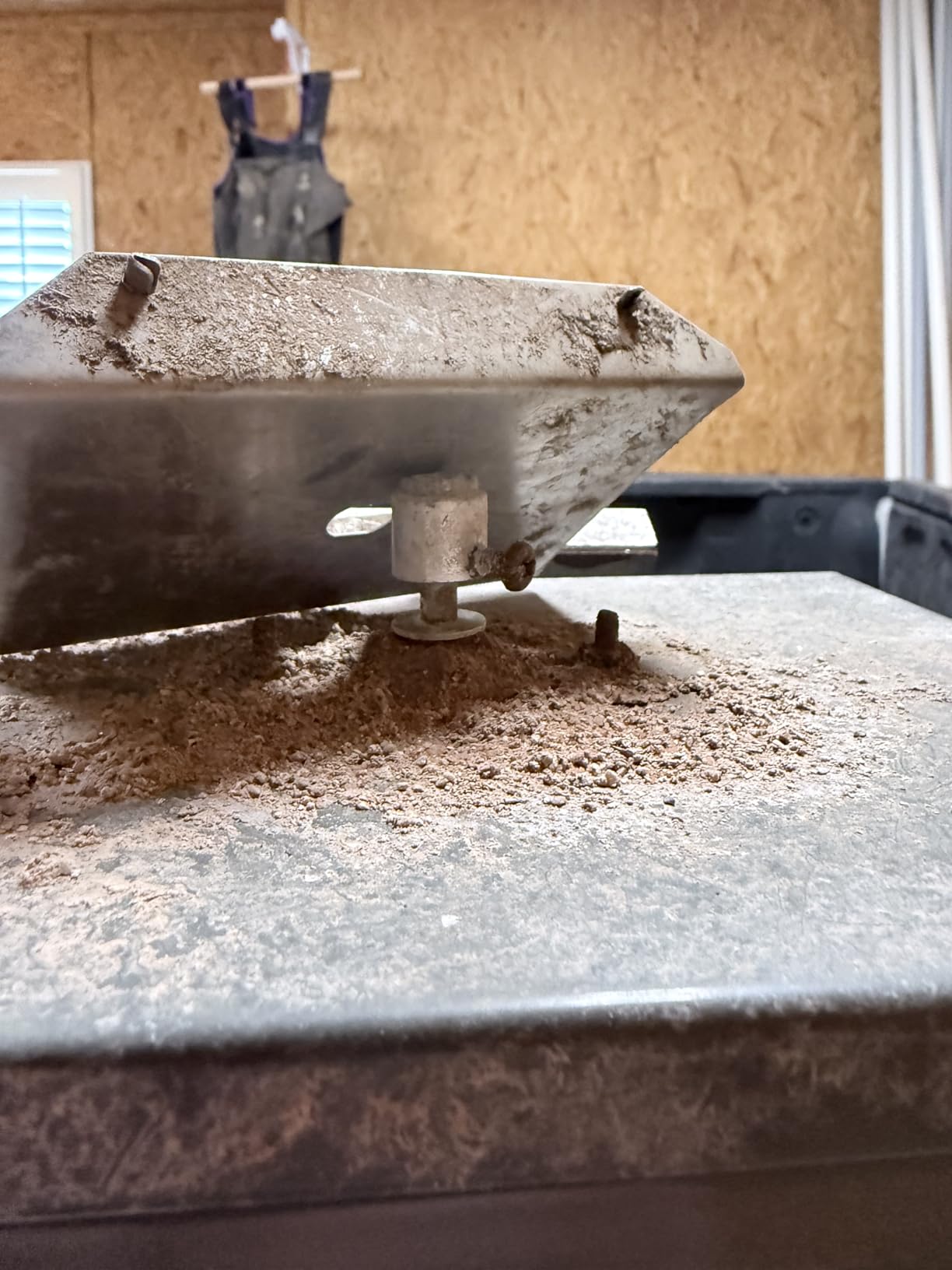
Owners comparing this against premium name brands generally land on the same conclusion. The motor is bigger, the shaft is heavier, and the spinner plate uses tray flaps that contain corn better than a flat plate, which means less feed landing under the feeder and fewer wasted bags.
One long-term owner reports that the unit survived a bear attack and years of daily service, and others describe it as a straightforward upgrade on an aging feeder. That is the kind of durability report you cannot get from a spec sheet.
Capacity planning is the other half of the picture. A single deer eats roughly 5 to 8 pounds of corn a day, so a 200 pound feeder on two 1 pound events empties in about 10 days on a 10 deer site. Work that number before you buy, not after.
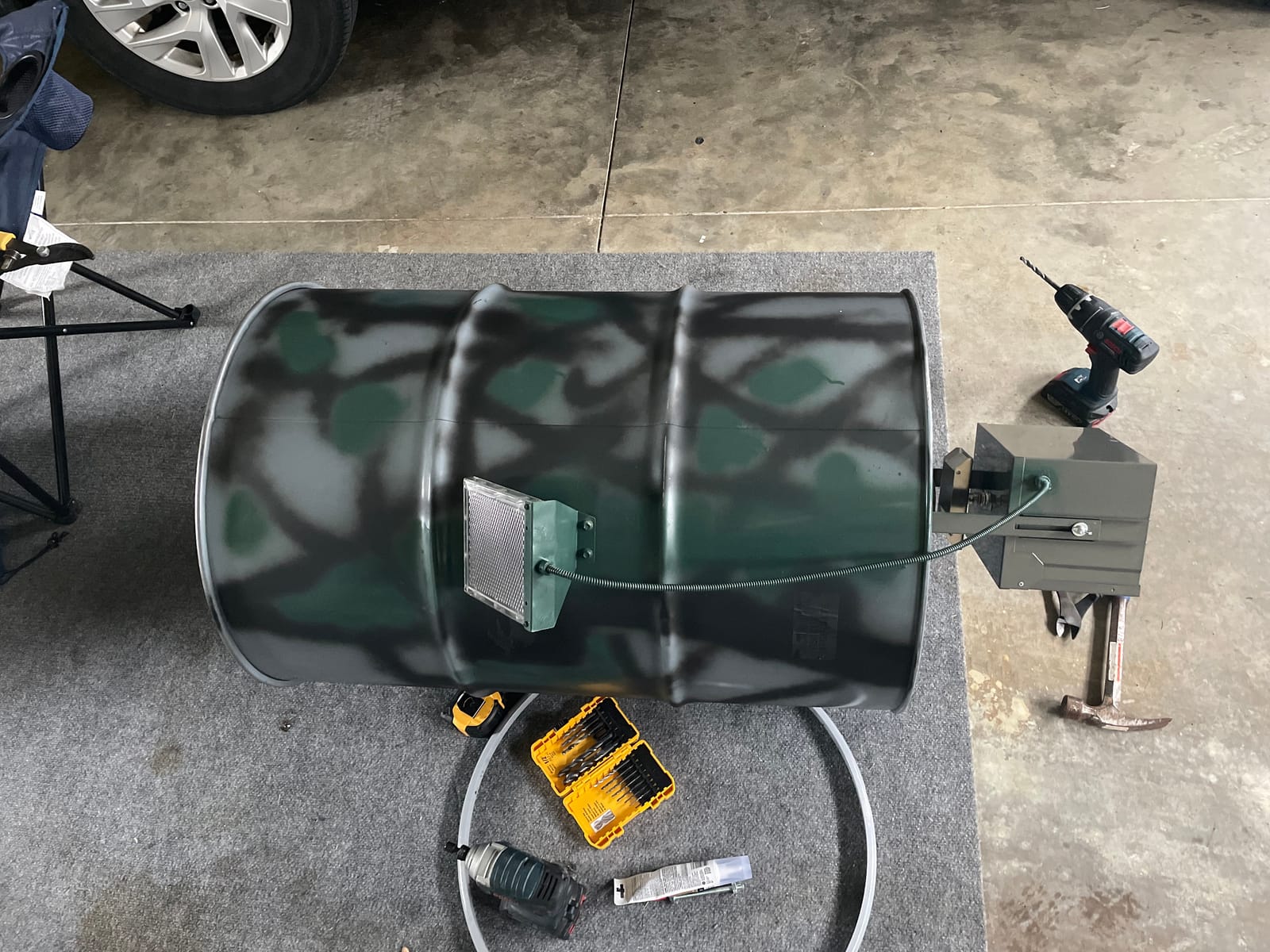
What a complete 12V kit does and does not include
It includes everything from the timer to the housing except the battery. A 12V battery is sold separately, and it is the single heaviest thing you carry to the feeder. Add a solar panel with a small trickle charger if you want to stop thinking about battery swaps entirely.
Also note the physical scale. This is a barrel-mounted unit, not a hanging kit, and it is built for a stationary setup. If you want something that collapses and moves between trees, this is the wrong category entirely.
Who should skip it
Skip it if your property runs on 6V. This kit is 12V only, and pairing it with a 6V battery system will not work no matter how good the deal looks.
Skip it if you carry everything on your back. A 12V battery is heavy, and walk-in hunters who already haul a bow, a stand, and a pack will feel that weight every trip. Two specific complaints to know about: the housing door has no grab handle and stiffens in cold weather, and the included timer is a basic unit that a small number of owners have had to replace later.
6. Moultrie All-in-One II Feeder Kit with Bluetooth App Control – Best for App Control
Moultrie All-in-One II Feeder Kit – Bluetooth App Control
Bluetooth control to 300 feet
4 feed events, 1-20 seconds
Quick-Lock adapter
AA powered
Pros
- The only kit here with app-based remote scheduling
- Quick-Lock adapter fits 35 or 55 gallon drums buckets and custom builds
- Runs on standard AA batteries with no 6V or solar needed
- Slide-out battery tray makes swaps fast
- Pairs with Edge 3 cameras for cellular control with no subscription
Cons
- Only 4 feed events per day and a 20 second maximum
- Plastic build is lighter duty than metal kits
- Bluetooth range stops at 300 feet without the optional camera
This is the one to buy if you want to change your schedule from your phone. The kit pairs over Bluetooth through the Moultrie Connect app, and the 300 foot range covers most of the walk between your truck and the feeder, so you reprogram on arrival instead of climbing in.
The Quick-Lock adapter is the quiet hero. It is a twist-lock mount that fits 35 or 55 gallon drums, buckets, and custom builds, which means you can convert the same hopper to gravity, spincast, or a hanging setup without tools.
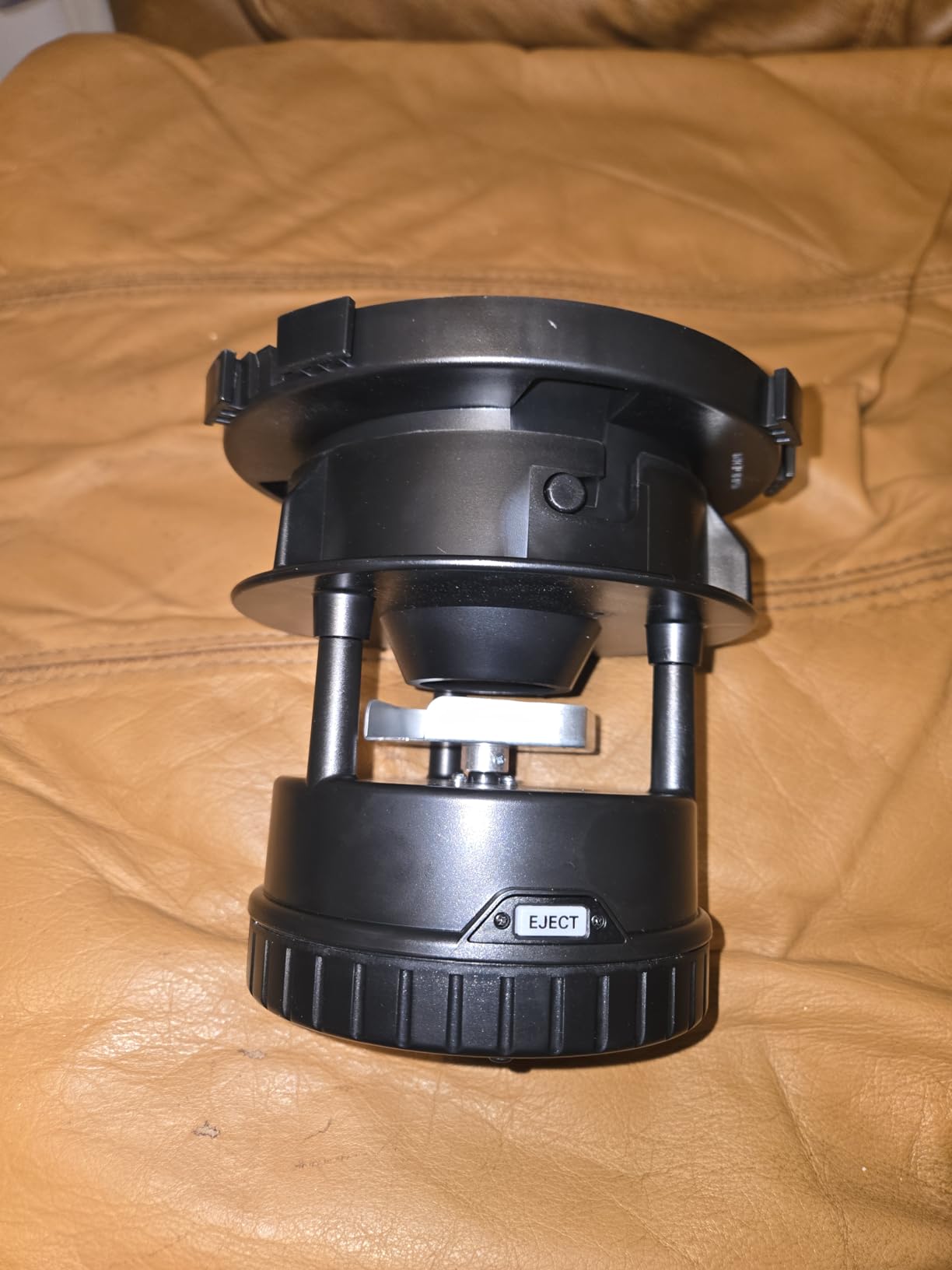
It runs on four or eight AA batteries, and the tray slides out for fast swaps. No 6V battery, no solar panel, no alligator clips. For a hunter who visits a property occasionally, that simplicity is worth more than any spec on the list.
There is a path to real remote control too. Pair the kit with an Edge 3 series camera and you get cellular control with no subscription fee, which is a different product category from a subscription cellular feeder. Our smart feeder roundup covers the same subscription question in more detail for backyard setups.
Bluetooth versus cellular, in plain language
Bluetooth means you must physically walk to the feeder, within about 300 feet, to change anything. Cellular means you can change it from your kitchen. That is the whole difference, and readers constantly conflate the two because both are called remote control.
A cellular feeder usually carries a monthly plan, and the plan cost over a season can exceed the hardware cost several times over. Bluetooth with a camera bridge costs nothing extra, which is why we would rather see you buy a solar panel and a second battery.
Who should skip it
Skip it if you need more than four feed events a day or run times longer than 20 seconds. Several competing digital timers give you eight programs and 30 seconds, and that ceiling is real when you are running a heavy feed program in a high density area.
Skip it if you have a large property. Once you are past roughly 300 feet the app connection stops, and a walk of that length defeats the purpose of programming remotely in the first place. And skip it if raccoons are heavy on your property, because this is a plastic build competing against all-metal kits.
7. Tomaki Game Feeder Digital Timer 6V/12V – Best 8 Program Repair Module
Game Feeder Digital Timer 6V/12V Kit for 8 Feed Time
8 feed times per day
1-30 second duration
6V and 12V kits
2.5 x 2.5 x 3.5 inch
Pros
- Full 8 program schedule without a premium-brand markup
- Per-event duration and motor speed cut feed waste
- Two-connection install between battery and motor
- Works with both 6V and 12V kits so it fits many existing setups
- Test button for verifying the install before deployment
Cons
- Timer only
- no battery motor or housing
- Plastic housing is light duty for exposed mounting
- A few examples reported dead on arrival or blowing fuses
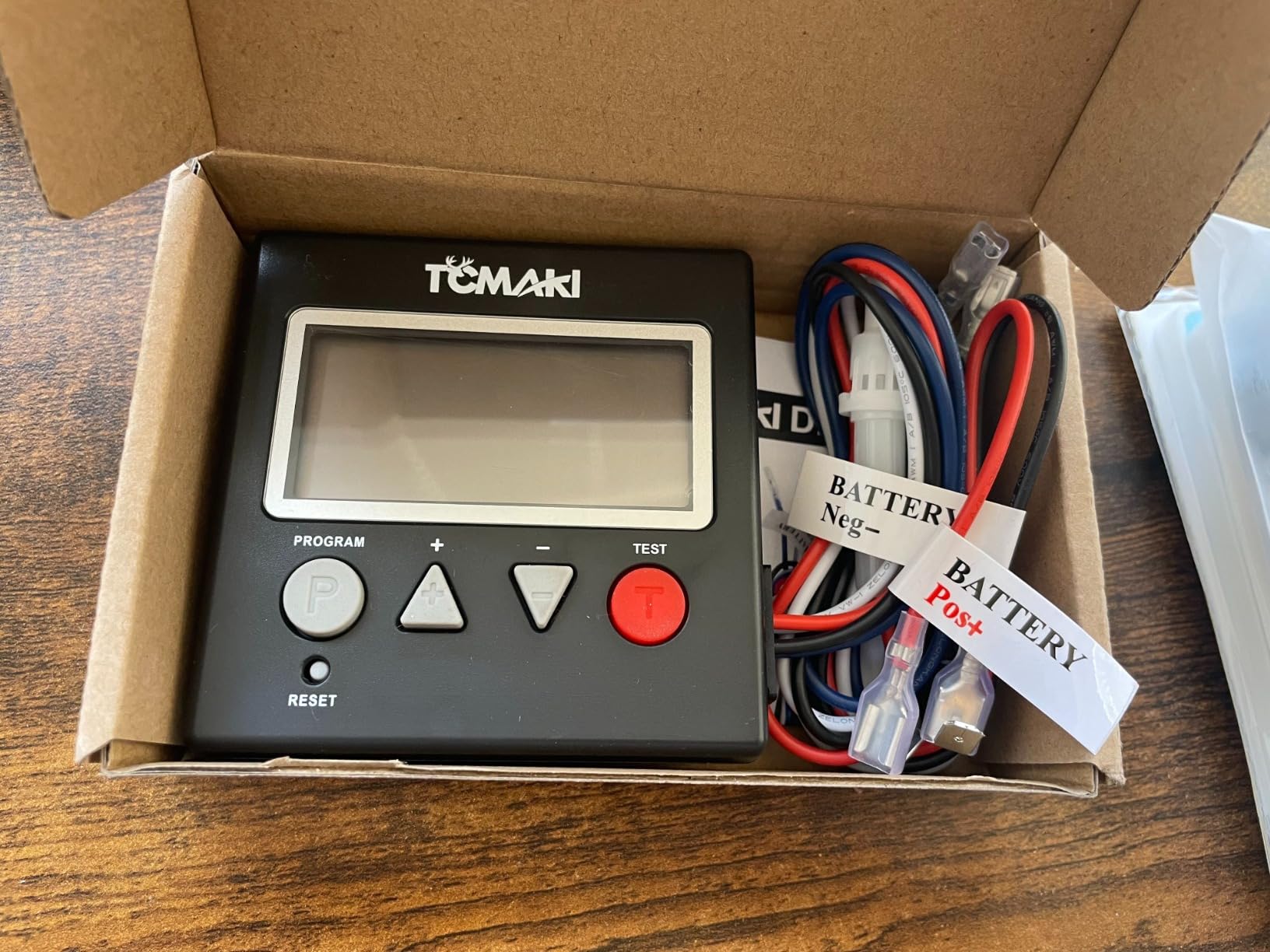
This is the other route to a full eight program schedule, in a more compact 2.5 by 2.5 by 3.5 inch body. Owners using it as a do-it-yourself replacement module describe the install as two connections between the battery and the motor.
Each of the eight programs, labelled FEED1 through FEED8, carries its own duration and motor speed setting. That per-event control is what stops you from dumping 10 pounds of corn at midnight because you set one event and let the rest run on the machine default.
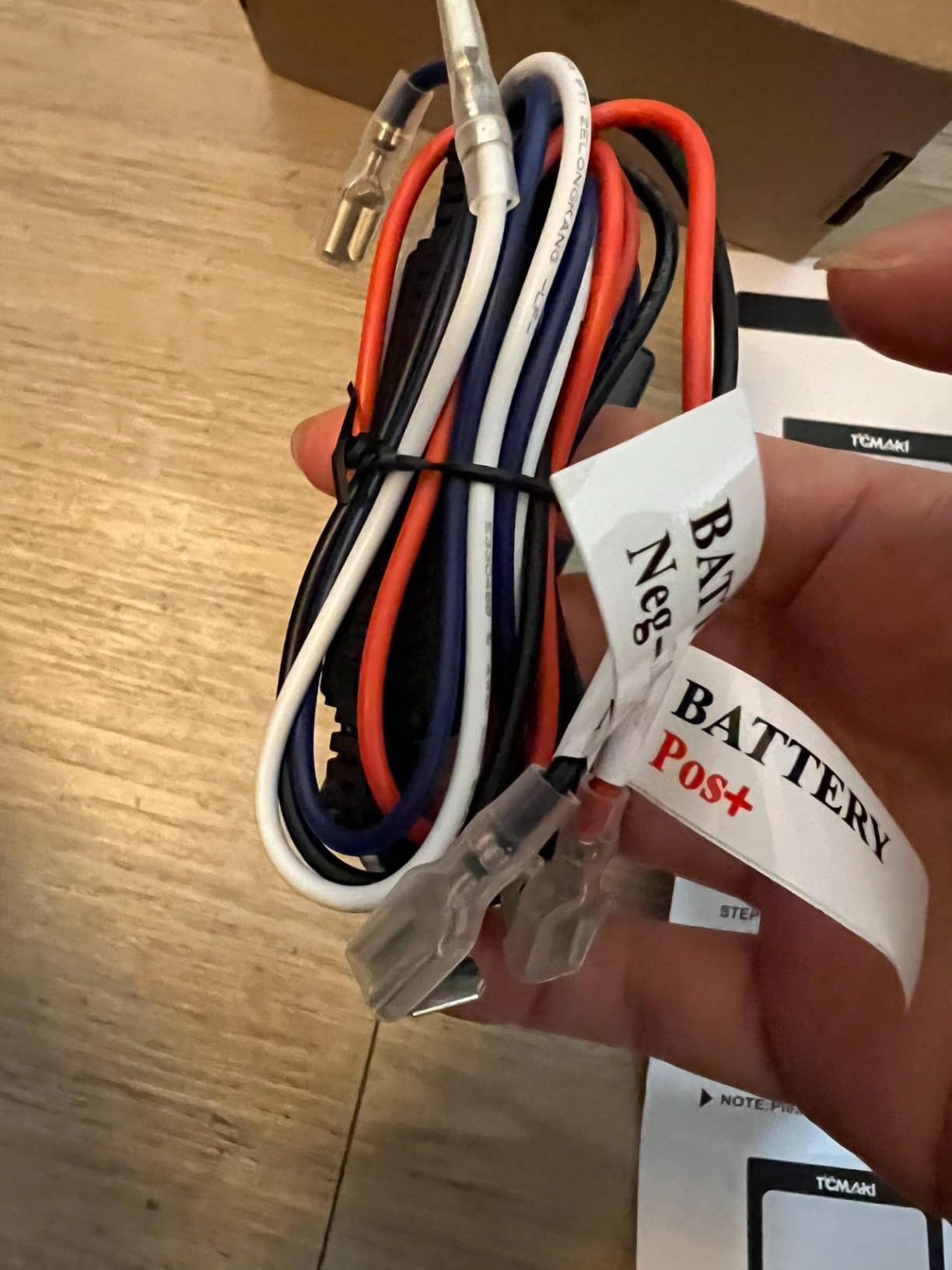
Because it works with both 6V and 12V feeder kits, the same timer revives a 6V barrel and a 12V barrel. That matters if you are running more than one feeder on the property and want a single spare on the shelf.
Review sentiment is positive on cost and ease of programming, and tempered by what is not in the box. There is no battery, no motor, no housing, no spinner plate, and no funnel. This is a brain, not a feeder.
On a unit this small, the test button matters more than it would on a full kit. Spin the motor with a handful of corn in the funnel before you close the housing, or you are commissioning a feeder you cannot easily reach.
When a standalone timer beats buying a new feeder
Consider it when the hopper, legs, and barrel are all fine and only the controller died. That is a common end-of-season failure, and it happens right when you least want to troubleshoot electronics in bad weather.
A dead branded controller can cost more than a complete budget feeder with a new timer already inside it, which makes replacement arithmetic genuinely worth doing before you buy. Add up the motor, the housing, and the battery against this module and a working controller, and compare.
The one thing a standalone timer cannot fix is a dead motor. If the motor is silent and the plate is not spinning on the test cycle, you are looking at a full kit instead.
Who should skip it
Skip it if you are starting from nothing, because there is no motor or housing to drive. Skip it if the timer will be mounted exposed, because the plastic housing is light duty for outdoor service. And skip it if a blown fuse is your problem, since wiring errors will blow the fuse again regardless of which timer you fit.
There are a small number of reports of controllers that would not power on, so keep the original timer until the new one has completed a full successful test cycle in the field.
8. Boss Buck 12V Auto Large Feed Kit – Best for Converting an Existing Gravity Feeder
BOSS BUCK 12V Auto Large Feed Kit | Hunting Versatile Automatic Durable Steel Control Box with Digital Timer & Motor for Deer Game Feeder
Converts Boss Buck gravity feeders
12V high-torque blower motor
5 inch steel slinger
6 lb all-steel box
Pros
- Converts a gravity feeder into a programmable automatic feeder
- Automotive-grade 12V blower motor with a 5 inch steel slinger
- All-steel control box mounting plate and conversion funnel
- Solar knockouts for both box mount and drum mount panels
- Wingbolt quick-attach for fast seasonal install and removal
Cons
- Only fits Boss Buck Non-Typical 350 600 and 1200 series feeders
- Digital timer often has to be bought separately
- Reported motor life of one to two years with unit-to-unit speed variation
- Hopper design channels rainwater toward the control box
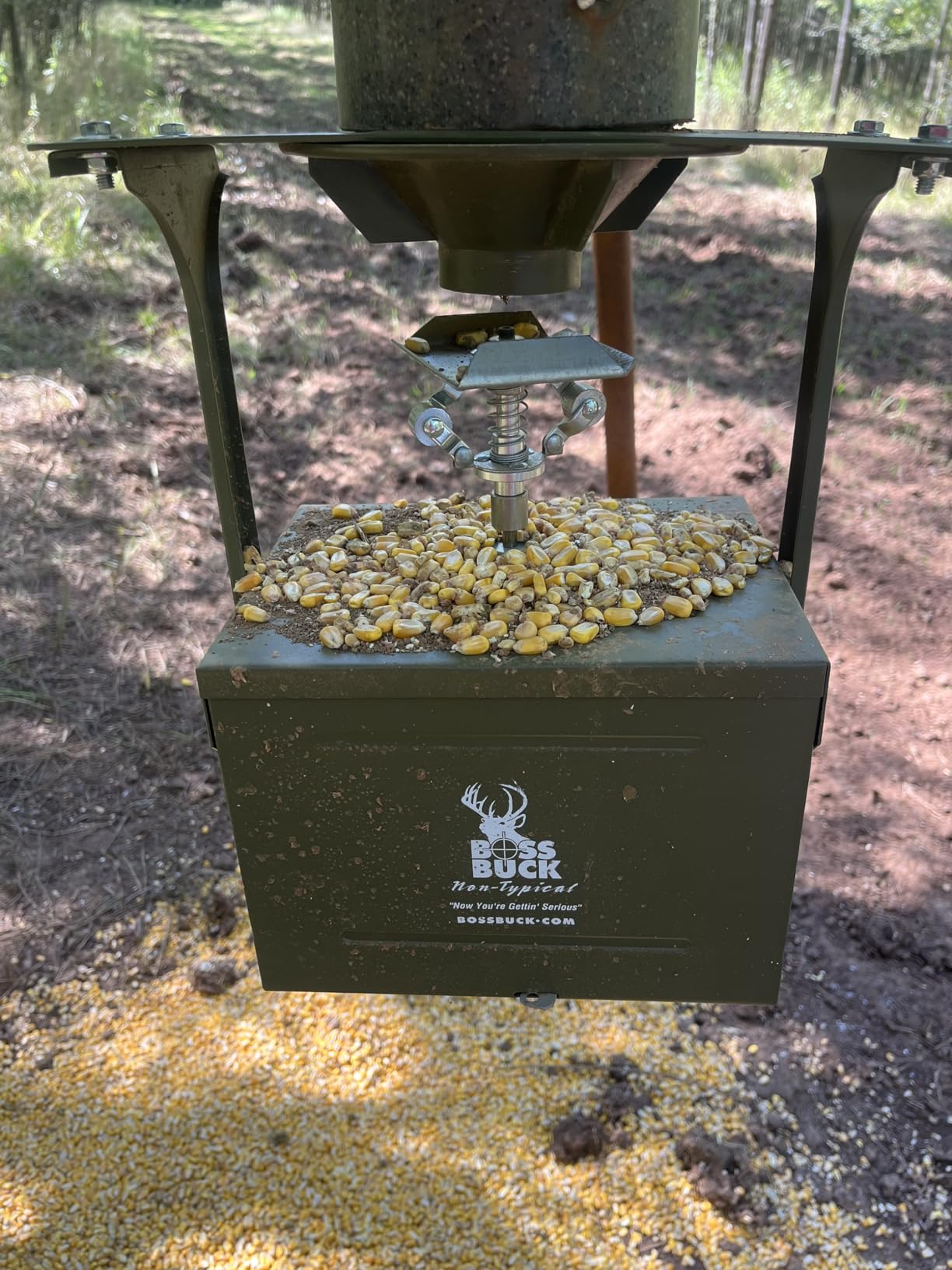
This kit does something none of the others do. It converts a gravity feeder into a programmable automatic feeder rather than replacing the whole unit, so if you already own a Boss Buck Non-Typical 350, 600, or 1200 series hopper, this converts that investment instead of replacing it.
At 6 pounds of alloy steel, the control box, mounting plate, and conversion funnel are built for a fixed installation. The motor is an automotive-grade 12V blower, and it drives a 5 inch steel swing door slinger that throws corn into a 20 to 30 foot circle with adjustable flow and throw distance.
Owners with several Boss Buck feeders on one property point to the metal build and the slinger pattern first, and multiple reports describe reliable running with solar charging through Canadian winters. The solar knockouts for both box mount and drum mount are a detail most kits leave out, and the panel rotates after filling so it is not shaded by the hopper.
Three motor speeds and six feed schedules cover most programs, and the wingbolt quick-attach makes seasonal removal fast enough that you can pull the whole assembly at season end without draining the hopper.
Two things catch people out. The hopper on converted gravity designs channels rainwater toward the top of the control box, and the motor is reported by some owners to last only one to two years. Neither is a dealbreaker, but both belong in your maintenance plan.
What compatibility means for this kit specifically
Compatibility here is narrow and worth reading twice. This kit fits Boss Buck Non-Typical 350, 600, and 1200 series feeders only. It is not a universal conversion, and it will not retrofit a Wildgame, Moultrie, or generic gravity barrel without fabricating a mount.
Before you order, confirm the series number on your existing feeder. If your hopper is from another brand, this kit is the wrong answer and one of the universal 6V or 12V kits above is the right one, paired with a barrel that suits your capacity.
Who should skip it
Skip it unless you already own a compatible Boss Buck feeder, because otherwise you are buying a premium control box with nothing to drive it. Also skip it if you want a simple install, since this is a conversion rather than a kit that arrives ready to bolt to any barrel.
Budget for the timer separately, because the digital timer is frequently not included and has to be sourced on its own. Add the reported one to two year motor life to your replacement planning, and on exposed ground make sure the tripod legs are guyed out, because a full hopper on a slinger this size is a sail.
Timer Failure Modes and How to Fix Them
1. Dead or flat batteries. The single most common cause, and the most avoidable. A timer with no power gives you no error message, it just stops feeding. Fix it with a scheduled swap, or eliminate the trip entirely with a small solar panel and trickle charger on the barrel roof.
2. Motor failure in wet weather. Condensation collects in the housing, corrodes the terminals, and the motor seizes. Fix it by keeping the control box under a lip, sealing the wire entry points, and choosing a metal housing over a plastic one.
3. Raccoon and squirrel damage. These animals chew plastic lids, the spinner plate, and the wiring, and a chewed wire can short the motor. Fix it with a steel varmint guard cage around the spinner and motor. Owners treat surviving raccoon pressure as the acid test of any feeder.
4. Wet corn jamming the funnel. This is the most common mechanical complaint and it is a feed problem, not a timer problem. Fix it by keeping the funnel and spinner gap clean, avoiding partially full bags that sit damp, and checking for bridging in the hopper when you refill.
5. Timer clock drift. Cheap controllers lose time, and a feeder that fired at 2:40 in the morning instead of 4:00 will move your whole pattern. Fix it by re-checking the clock every time you visit, and favouring units with memory so a power blip does not wipe your schedule.
6. LCD failure in freezing conditions. Displays go dark and appear dead in deep cold even when the unit is fine. Fix it by not concluding the timer is broken in January, and by warming the housing with your hands before you swap the unit.
For numbers one, five, and six, the fix is usually a standalone universal timer. A controller that has lost its clock or its display is not a feeder failure, it is a single part. Two of the picks in this roundup are exactly that part.
If you want a second opinion on the hardware side, our window bird feeder guide covers the small-scale version of the same maintenance routine, and the discipline transfers directly.
How to Choose a Deer Feeder Timer
1. Match the timer to the voltage you already run. A 6V timer and a 12V timer are not interchangeable, and this is the most common mismatched purchase. Check the label on your existing control unit before you order anything.
2. Count your feed events, then halve it. Most hunters use two to four windows a day. If you only need four, a Bluetooth-controlled kit is a better experience than an eight program unit you never max out. If you are running a heavy program, pay for eight.
3. Do the capacity math before you buy the hopper. A single deer eats roughly 5 to 8 pounds of corn per day. Ten deer on two 1 pound events consumes about 100 pounds a week, so a 200 pound feeder on a busy site needs refilling every ten days. A refill trip is the real ongoing cost of any timed feeder.
4. Plan power before you plan everything else. AA batteries and a slide-out tray are the simplest option. A 6V or 12V battery with a solar trickle charger is the set-and-forget option. A rechargeable battery pair on a rotation schedule sits in between. All three work, and mixing them up is how feeders end up silent in November.
5. Assess varmint pressure honestly. Raccoons and squirrels destroy plastic funnels, lids, and wiring. Heavy pressure means metal construction and a steel guard cage, no matter how good the timer is. Light pressure on a 5 acre place does not.
6. Check physical fit and connector type last. Measure the cavity in your control box, confirm whether you need a flat plug or an F2 connector, and confirm the mounting bracket style. Most returns in this category are dimension problems rather than quality problems.
What we deliberately excluded
Cellular feeders with subscription plans are excluded from this list. The hardware works, but the recurring plan cost over a season can exceed the cost of the feeder, and the timed kits on this list cover the same scheduling need with no ongoing charge. We also passed over 600 pound and larger stand-and-fill systems, which need a vehicle at the fill point and solve a different problem than pattern a buck for a morning.
Frequently Asked Questions
Do timed deer feeders work?
Yes. A programmable controller energises a small motor at set times, spinning a plate that throws corn or pellets 20 to 30 feet so several deer feed without crowding. The real benefit is patterning, because deer learn the schedule and arrive in a predictable window. The main weakness is that the timer is the part most likely to fail, so battery life and varmint protection deserve more attention than any other spec.
What is the best automatic feeder for deer?
For most hunters, the Highwild 6V/12V Universal Game Feeder Digital Timer is the best automatic feeder controller because it offers eight feed times, 1 to 30 second duration control, and a memory function, and it drops into existing housings. The Wildgame Trophy Hunter 6V kit is the better choice if you want everything in one box, and the Moultrie All-in-One II is best if you want app control.
What are some common problems with the timer on a deer feeder?
The most common problems are dead or flat batteries, motor failure caused by condensation inside the housing, raccoon and squirrel damage to the spinner plate and wiring, and wet corn jamming the drop funnel. Cheap controllers also suffer clock drift and LCD failure in freezing temperatures. Most of these are fixed with a scheduled battery swap, a solar trickle charger, and a steel varmint guard.
What is the best deer feed for an automatic feeder?
Shelled corn is the safest default because it flows cleanly through both spincast plates and gravity ports without bridging. Protein pellets are denser and bridge easily, so they need a feeder with adjustable flow control and a gap between the funnel and spinner plate you can narrow. A timed feeder set to pellets at full speed will jam faster than most owners expect.
What is the 7 day deer rule for deer baiting?
There is no single national 7 day rule. Bait removal windows vary by state and are often longer, with Minnesota’s ten day full removal period cited most often, and some states restrict or ban supplemental feeding entirely. Chronic wasting disease management zones add county level restrictions. Always confirm the current regulation with your state wildlife agency, and remember that a lease can impose its own rules.
Final Verdict
Our editor’s choice is the Highwild 6V/12V Universal Game Feeder Digital Timer. It carries the largest review count in this group, it gives you eight feed windows with per-event duration and speed control, and it is the unit we would reach for whether you are building a new feeder or reviving an old one.
Buy the Wildgame Trophy Hunter 6V kit if you want a complete metal system in one box and you do not want to hunt for a controller. Buy the Moultrie All-in-One II if phone control matters more than feed window count. Buy the Highwild 12V kit if you run 12V barrels and want a full replacement assembly with a stronger motor.
Everything else on this list is a specialist choice: metal durability, a budget eight program repair, or converting a gravity feeder you already own. Whichever one you pick, confirm the voltage, confirm the connector, confirm the physical fit, and check your state’s baiting rules before the first bag goes out.
That last check takes one phone call, and it is the difference between the best deer feeders with timers being the right decision and the most expensive mistake of your hunting season. Updated for 2026.