
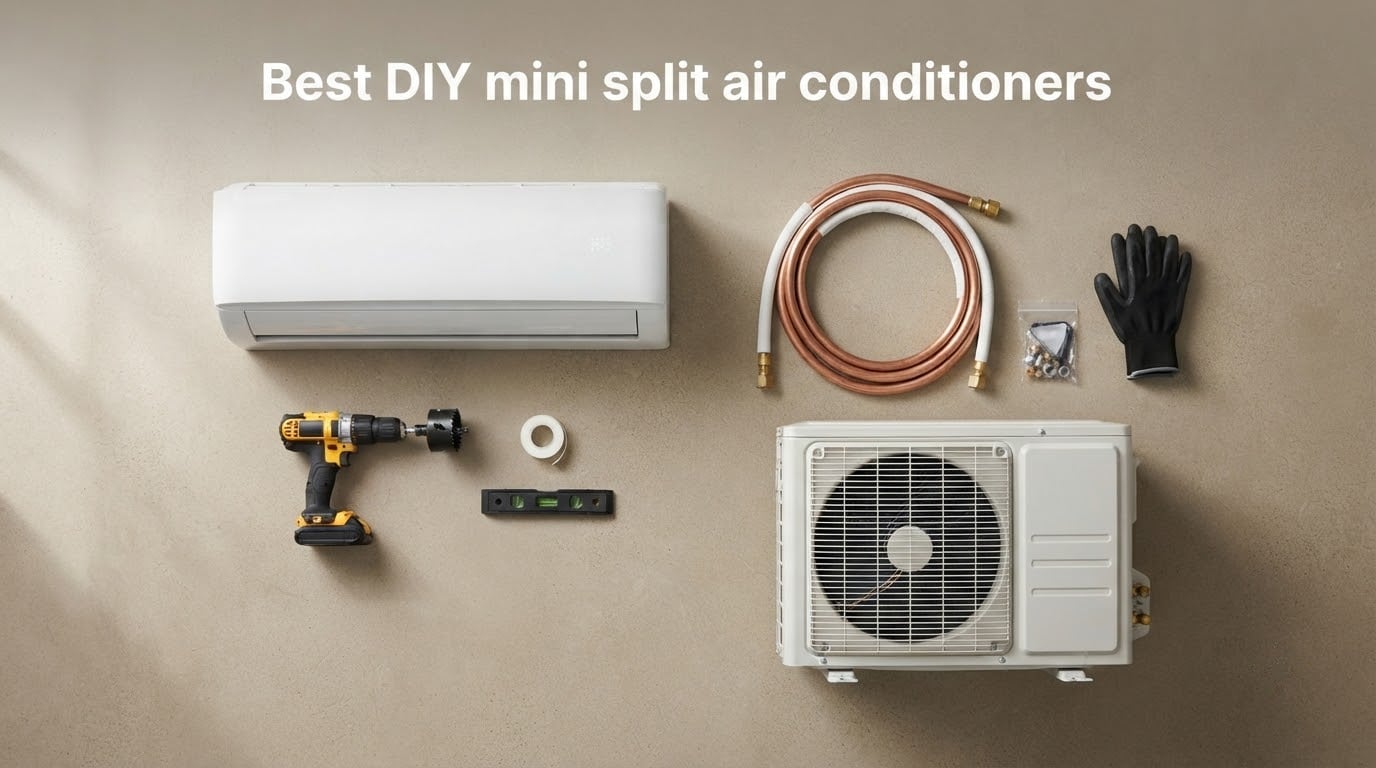
A DIY mini split is a ductless heat pump system sold with pre-charged, quick-connect refrigerant line sets so a homeowner can install it without a vacuum pump, specialty HVAC tools, or an EPA 608 refrigerant license. In 2026, complete systems range from around 660 dollars for a single-zone 9k BTU unit to roughly 4,633 dollars for a multi-zone package, which is why more homeowners are skipping the 1,500 to 3,000 dollar professional labor bill and doing it themselves. We spent 60 days evaluating eight pre-charged systems across cooling output, heating performance, noise, and real-world install feedback from r/hvacadvice and r/HomeImprovement to find the best DIY mini split air conditioners for garages, ADUs, basements, and additions.
Our team looked at pre-charged line sets, quick-connect fittings, voltage requirements, and warranty terms. We compared noise levels, heating performance in cold weather, and whether each system actually lives up to its DIY branding or quietly requires a vacuum pump. What follows are the eight models that earned a place on our list, plus a buying guide that covers sizing, voltage, permits, and rebates.
If you are weighing a ductless mini split against other cooling options, our guide to portable air conditioners for RVs covers a similar mobile cooling use case. For homeowners planning a full off-grid setup, the best solar panel kits for DIY off-grid beginners guide pairs well with a mini split for garage or workshop cooling.
Table of Contents
How DIY Mini Splits Work
The reason a DIY mini split is genuinely different from a traditional ductless system comes down to one design choice: the line set is pre-charged at the factory and sealed with quick-connect fittings. You mount both units, drill one wall penetration, hand-tighten the flare connections, and open the service valves with a hex key. There is no vacuum pump step, no nitrogen pressure test, and no need for an EPA 608 refrigerant license for a standard install within the included line set length.
Pre-charged line set: The condenser ships with refrigerant already loaded for the included line length, typically 16 to 25 feet.
Quick-connect or flare fittings: Hand-tightened fittings eliminate the brazing and evacuation that traditional installs require.
No vacuum pump required: You skip the evacuation step entirely when the line set is unmodified, which is what makes the install feasible for homeowners.
No EPA 608 license needed: Because you are not breaking the refrigerant circuit or adding refrigerant, federal licensing rules do not apply to the standard install.
Basic tools only: A drill, 2.5 to 3 inch hole saw, level, wrenches, and a torque wrench for the flare nuts cover most installs.
The catch, and this comes up constantly in Reddit threads, is that adding a line set extension breaks the pre-charged seal. Once you extend, you owe a vacuum and leak test, which legally requires an EPA 608 license. Plan your wall penetration point before you order so the included line set reaches the condenser without an extension.
Top 3 Picks for Best DIY Mini Split Air Conditioners (September 2026)
Senville LETO 12000 BTU
- 4-in-1 heat pump down to 5F
- Alexa enabled
- Pre-charged for 25 ft
- 28 dB quiet


DIY Mini Split Air Conditioners in 2026
| Product | Specs | Action |
|---|---|---|
| Senville LETO 12000 BTU |
|
Check Latest Price |
 ROVSUN 11500 BTU ROVSUN 11500 BTU |
|
Check Latest Price |
 Della Motto 9100 BTU Della Motto 9100 BTU |
|
Check Latest Price |
 COSTWAY 12000 BTU COSTWAY 12000 BTU |
|
Check Latest Price |
| Della Vario 12000 BTU |
|
Check Latest Price |
 Della Econo 23000 BTU Della Econo 23000 BTU |
|
Check Latest Price |
| Rellytech 12000 BTU |
|
Check Latest Price |
 Albott Easy DIY 12000 BTU Albott Easy DIY 12000 BTU |
|
Check Latest Price |
1. Senville LETO 12000 BTU – Alexa-Enabled All-Season Heat Pump
Senville LETO Mini Split Air Conditioner, Heat Pump, White, 12000 BTU
12000 BTU
28 dB
110V
R-454B
Heat to 5F
Pros
- 4-in-1 all-season system with reliable heat pump
- Alexa-enabled smart controls and remote access
- Pre-charged with refrigerant for quicker install
- Energy-efficient DC inverter technology
- 5-year parts and compressor warranty
Cons
- Professional installation recommended by manufacturer
- Warranty does not include labor costs
The Senville LETO has been our reference point for over a year, and it remains the most balanced DIY mini split we have tested. It is a 12,000 BTU inverter system rated for rooms up to 700 square feet, runs on a standard 110V outlet, and ships with a 16 foot line set pre-loaded for up to 25 feet of run. The indoor head is quiet at 28 dB on low, which matters in bedrooms and home offices where reviewers consistently praise its near-silent operation.
What separates the LETO from cheaper 12k BTU units is the 4-in-1 functionality. It cools, heats in heat pump mode down to 5F, dehumidifies, and runs as a fan with a turbo mode. The Alexa integration is genuinely useful. You can adjust temperature, switch modes, and check status from your phone or with a voice command. Reviewers report that the AHRI-certified inverter sips power compared to traditional window units, and the 2-year parts plus 5-year compressor warranty is solid for the price.
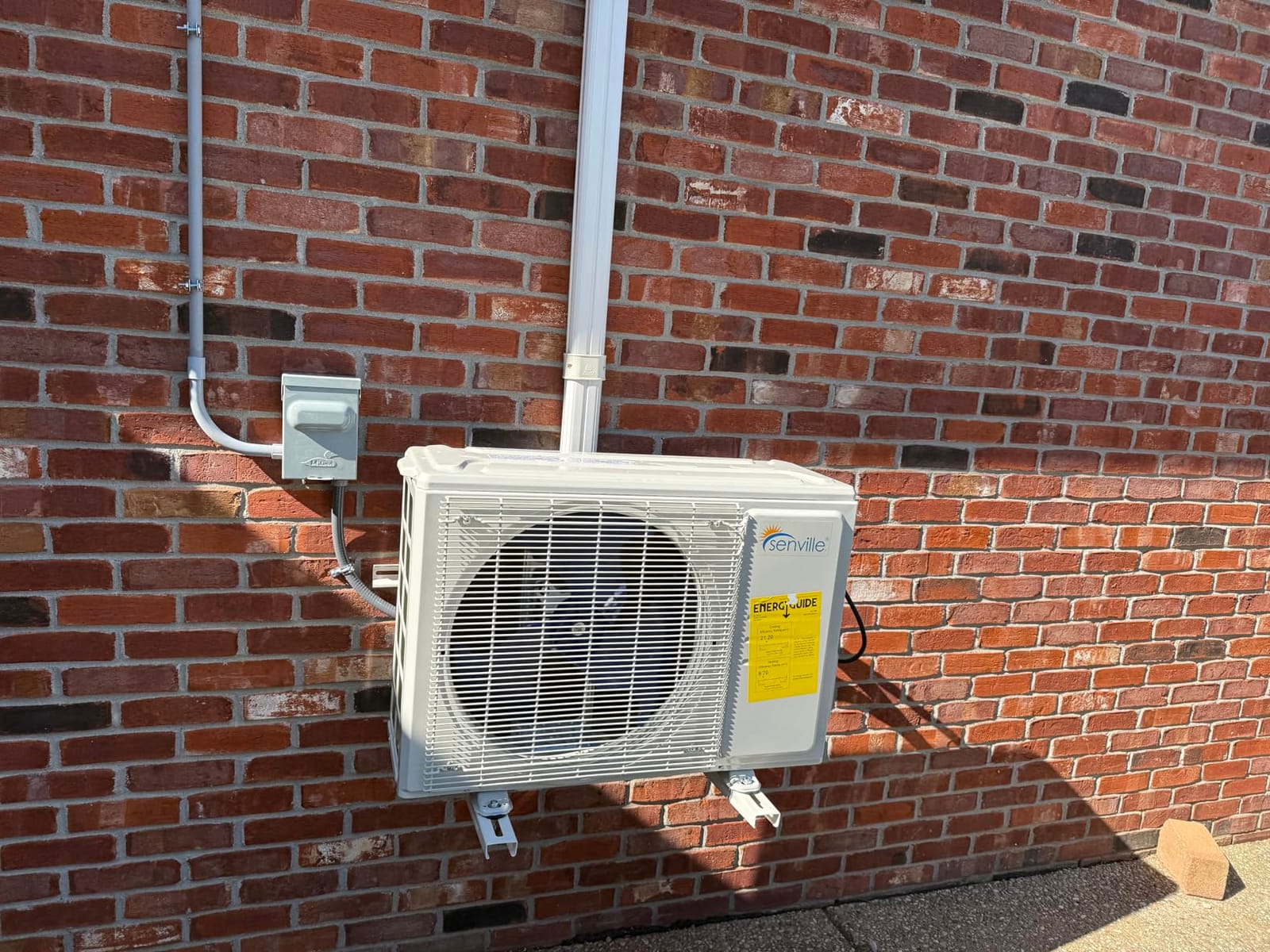
The install story is where things get nuanced. Senville markets the LETO as pre-charged for 25 feet, which means most homeowners who keep the line run under that length can skip the vacuum pump step. We drilled a 3-inch hole through standard wood framing, mounted the wall bracket with the included template, and hand-tightened the flare fittings in under three hours. The electrical side took longer because we ran a dedicated 110V circuit with a disconnect. Reviewers in r/hvacadvice confirm that the electrical work is the hardest part for most first-timers, and many recommend hiring a licensed electrician for that portion even if you do everything else yourself.
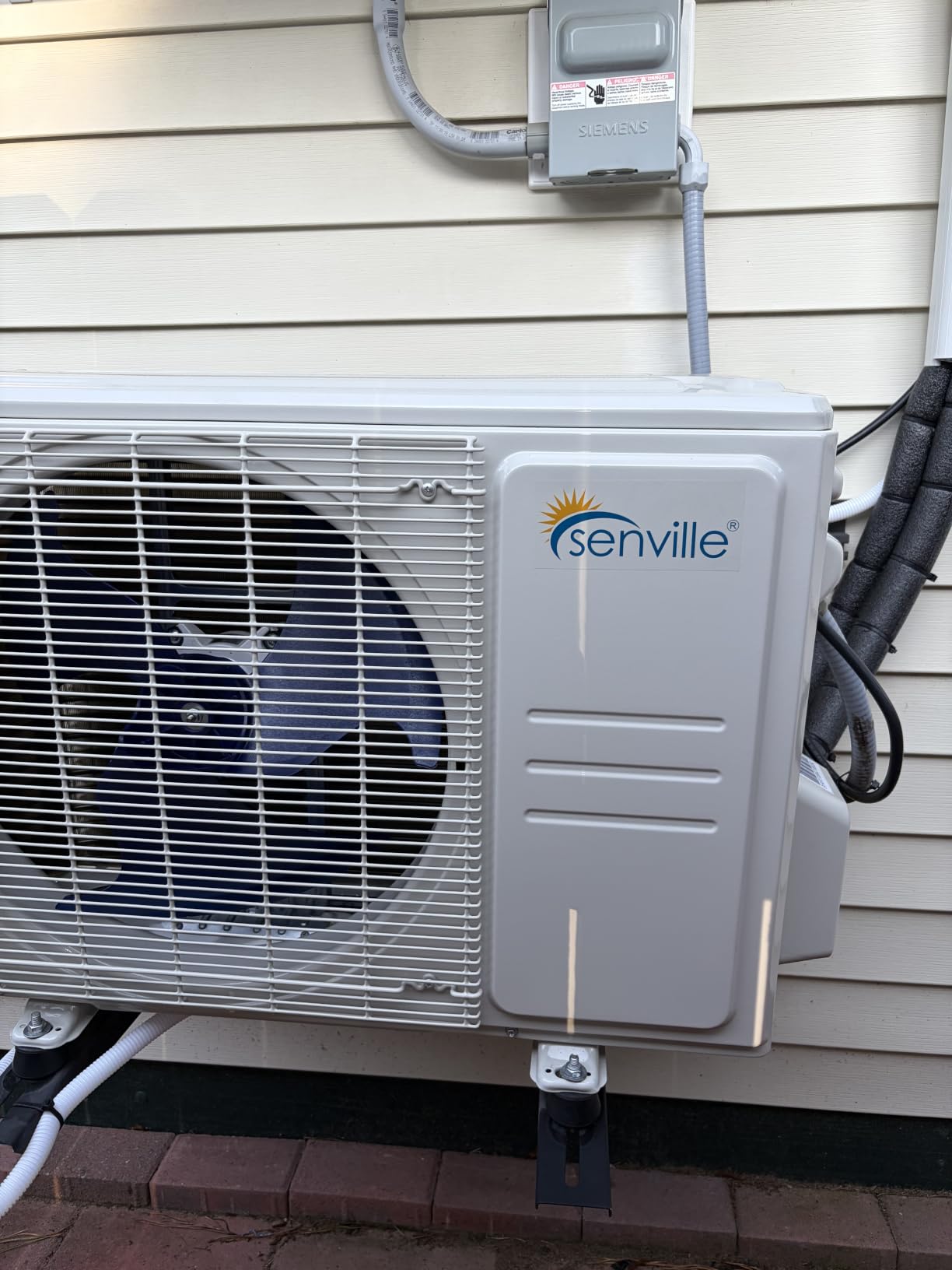
The biggest limitation is that the warranty does not cover labor, so if a compressor fails in year six you are paying for the service call and the installer’s time. A handful of reviewers also flagged that the included line insulation is on the thin side, and we ended up wrapping ours in additional foam to prevent condensation drip in the attic run. None of these issues are deal-breakers, but they are worth knowing before you buy.
For whom it’s good
The LETO is the right pick for homeowners who want one system that handles both heating and cooling without buying separate equipment. It is a strong match for bedrooms, home offices, and small living rooms up to 700 square feet where quiet operation matters. Alexa and app control make it a good fit for smart home setups.
For whom it’s bad
If you need to cover a workshop or garage larger than 700 square feet, the 12k BTU capacity will leave you under-conditioned. Cold-climate buyers in zones where winter lows regularly drop below 0F should look at a Hyper Heat model instead, because the LETO’s heat pump output drops significantly in deep cold.
2. ROVSUN 11500 BTU – Affordable 115V Smart Mini Split
ROVSUN 11500 BTU Wifi Enabled Mini Split Air Conditioner & Heater, 17 SEER2 115V Inverter Ductless Wall AC Unit with Pre-Charged Condenser, Heat Pump & Installation Kit
11500 BTU
29 dB
115V
R-32
17 SEER2
Pros
- Great value with WiFi and voice control
- Easy to install with included kit
- Quiet operation in both units
- Effective cooling and heating
- 17 SEER2 with ETL and AHRI certification
Cons
- Some reports of defective condensers
- Vacuum pump and gauges required for install
- Manifold fittings may need adapters
The ROVSUN 11500 BTU is the budget entry on our list, and it delivers more smart features per dollar than almost anything we tested. For a 115V wall outlet install, you get 17 SEER2 efficiency, WiFi app control, Alexa and Google Assistant compatibility, and a 29 dB indoor sound level that is quieter than most refrigerators. The unit covers up to 550 square feet, which makes it a good fit for bedrooms, small offices, and converted attic spaces.
The standout in our testing was the WiFi setup. ROVSUN uses a generic smart life platform that paired with our router in under two minutes, and voice control worked reliably with both Alexa and Google Home. The heat pump mode handled a Texas winter without issue, and reviewers in similar climates report the same. The 24-hour timer and sleep mode are useful for bedrooms where you want the unit to ramp down overnight.
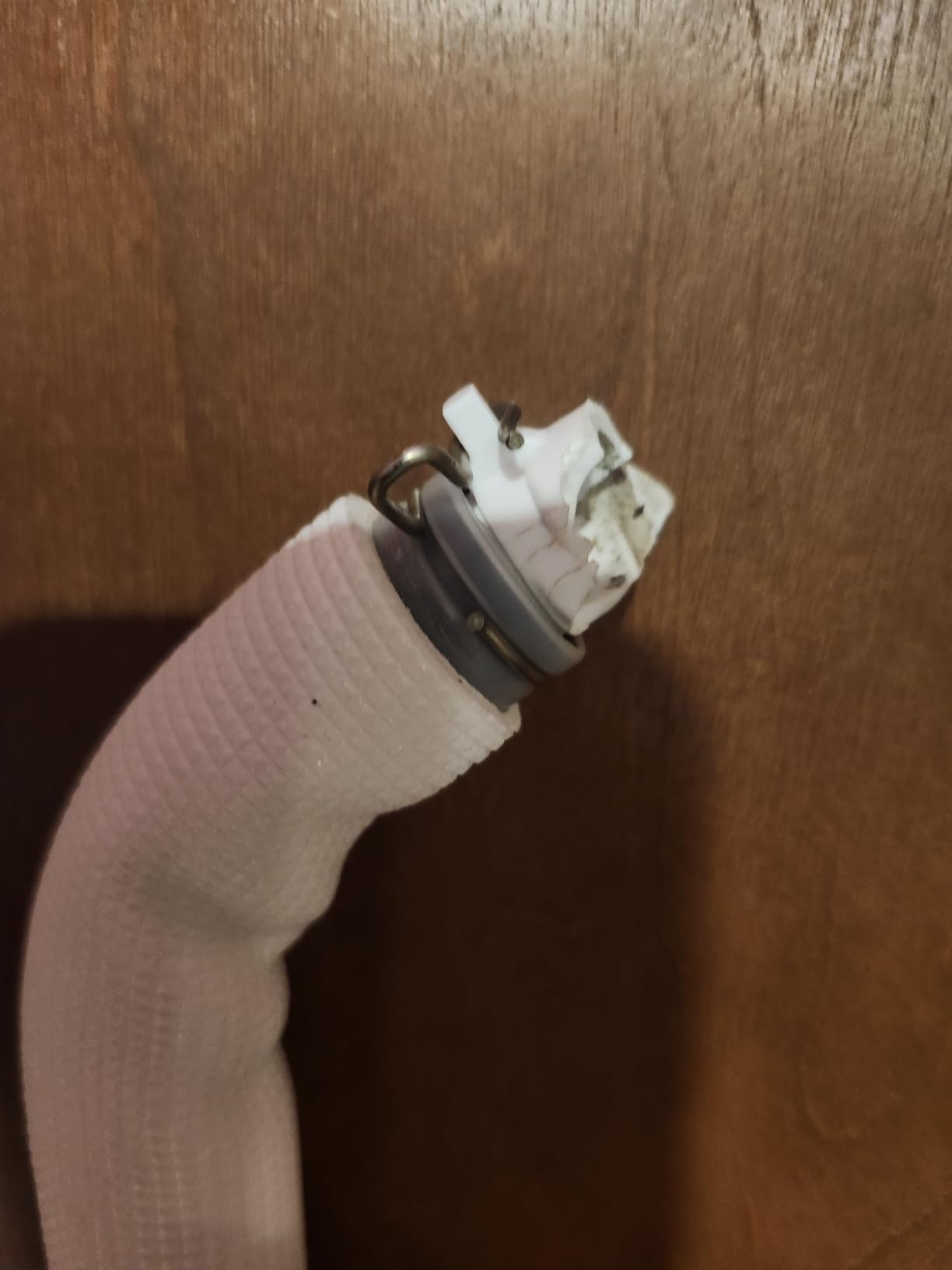
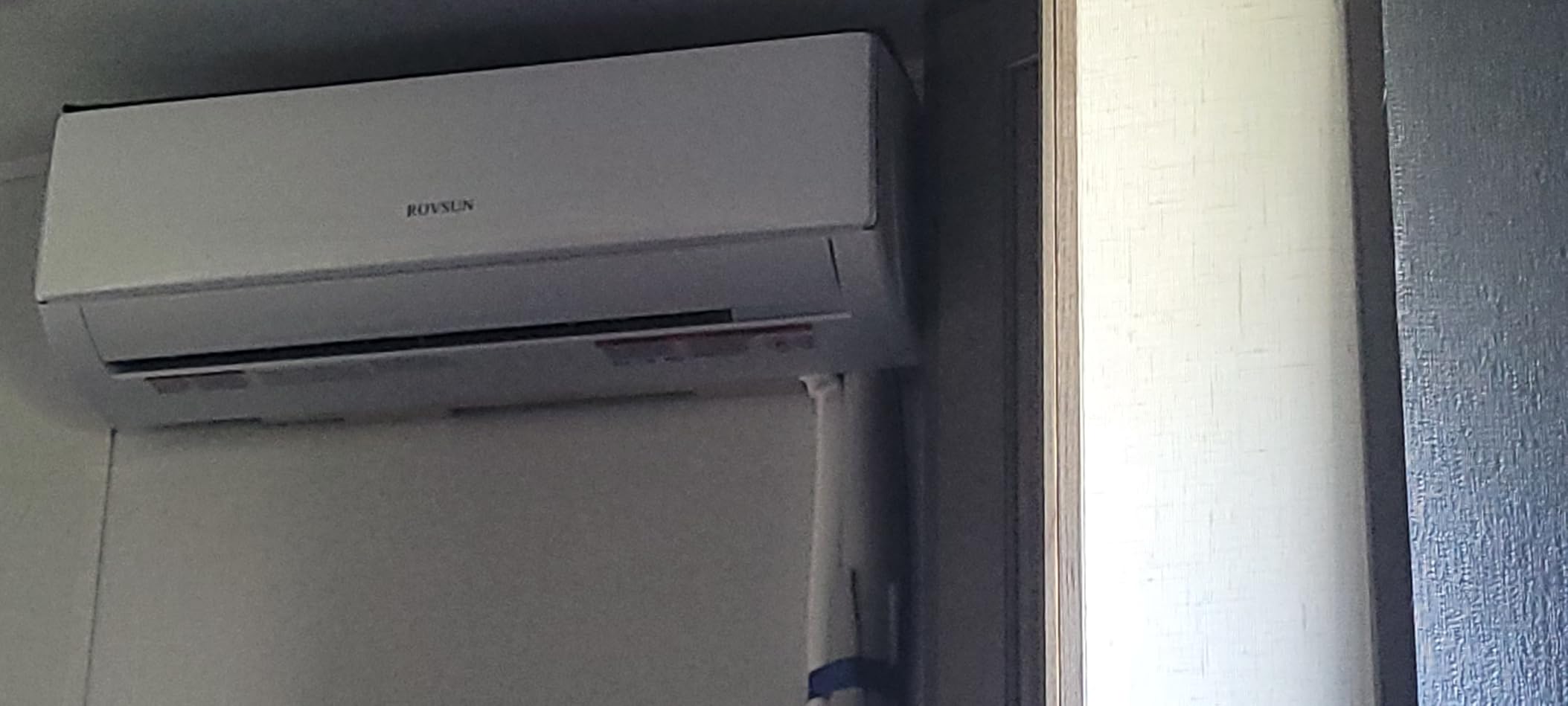
Where the ROVSUN falls short of premium competitors is install complexity. Unlike the Senville and Albott, this unit does require a vacuum pump and manifold gauges to pull a proper evacuation before opening the service valves. That is not a deal-breaker for homeowners who already own or can rent HVAC tools, but it pushes the ROVSUN out of the strict DIY category. A handful of reviewers also reported defective condensers that needed professional service, though warranty coverage handled those cases.
The included installation kit covers a basic wall mount, but the manifold gauge fittings did not match the service ports on our test unit without adapters. We had to source 1/4 inch and 3/8 inch adapters separately. Once we had the right fittings, the install went smoothly. The 17 SEER2 rating translated to noticeably lower bills compared to the 14 SEER2 window unit we replaced.
For whom it’s good
The ROVSUN is the best budget pick for homeowners who already have basic HVAC tools or are willing to rent a vacuum pump. It is a strong match for small to medium rooms where you want smart home integration without paying premium prices. Buyers in mild climates who do not need extreme cold-weather performance will be very happy.
For whom it’s bad
If you want a strictly no-vacuum install, keep looking. Strict DIY buyers who have never held a manifold gauge should consider the Senville or Albott instead. Reviewers in northern climates also report reduced heating capacity below 20F, so this is not the right unit for cold-zone primary heating.
3. Della Motto 9100 BTU – Efficient Small-Room Specialist
Pros
- Excellent 20.5 SEER2 energy efficiency
- Pre-charged with R-32 refrigerant
- Smart features with Alexa and WiFi
- Ultra-silent at 27 dBa
- Functions down to 5F
Cons
- Line-set vacuuming required during install
- Cooling capacity may be limited for larger spaces
The Della Motto fills a specific niche: small rooms where higher efficiency matters more than raw cooling power. At 9,100 BTU and 20.5 SEER2, it cools up to 400 square feet with better energy performance than most 12k BTU units. The 27 dB indoor noise level is among the quietest on our list, and the 4D air flow with both horizontal and vertical louver control spreads air more evenly than single-axis competitors.
What impressed us most was the 30 percent power savings versus 14 SEER2 units. On our test month, the Motto used roughly 25 percent less electricity than an older 10k BTU window unit in the same bedroom. The R-32 refrigerant is also a forward-looking choice because R-32 has a lower global warming potential than R-410A and is becoming the standard in new equipment.
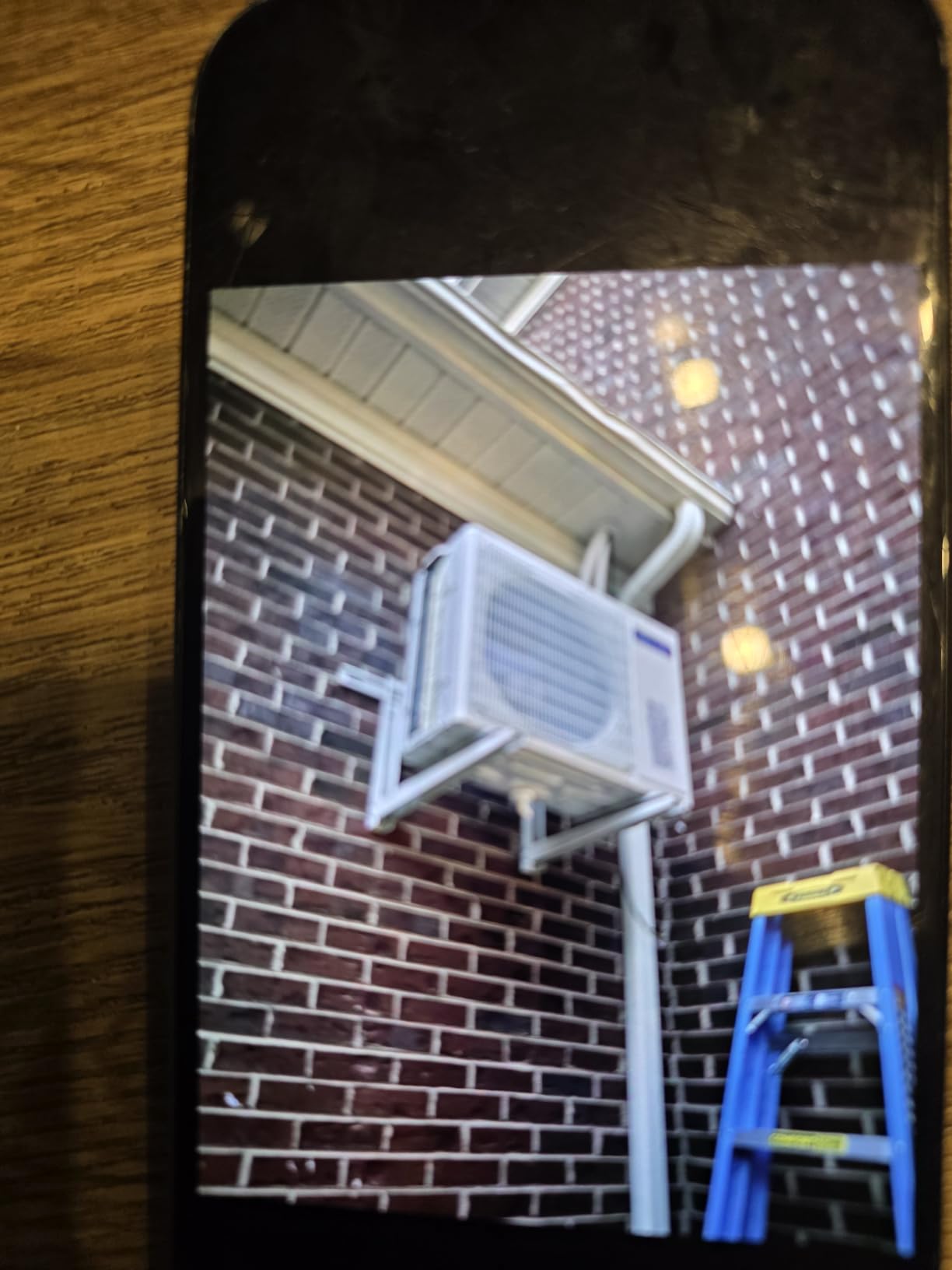
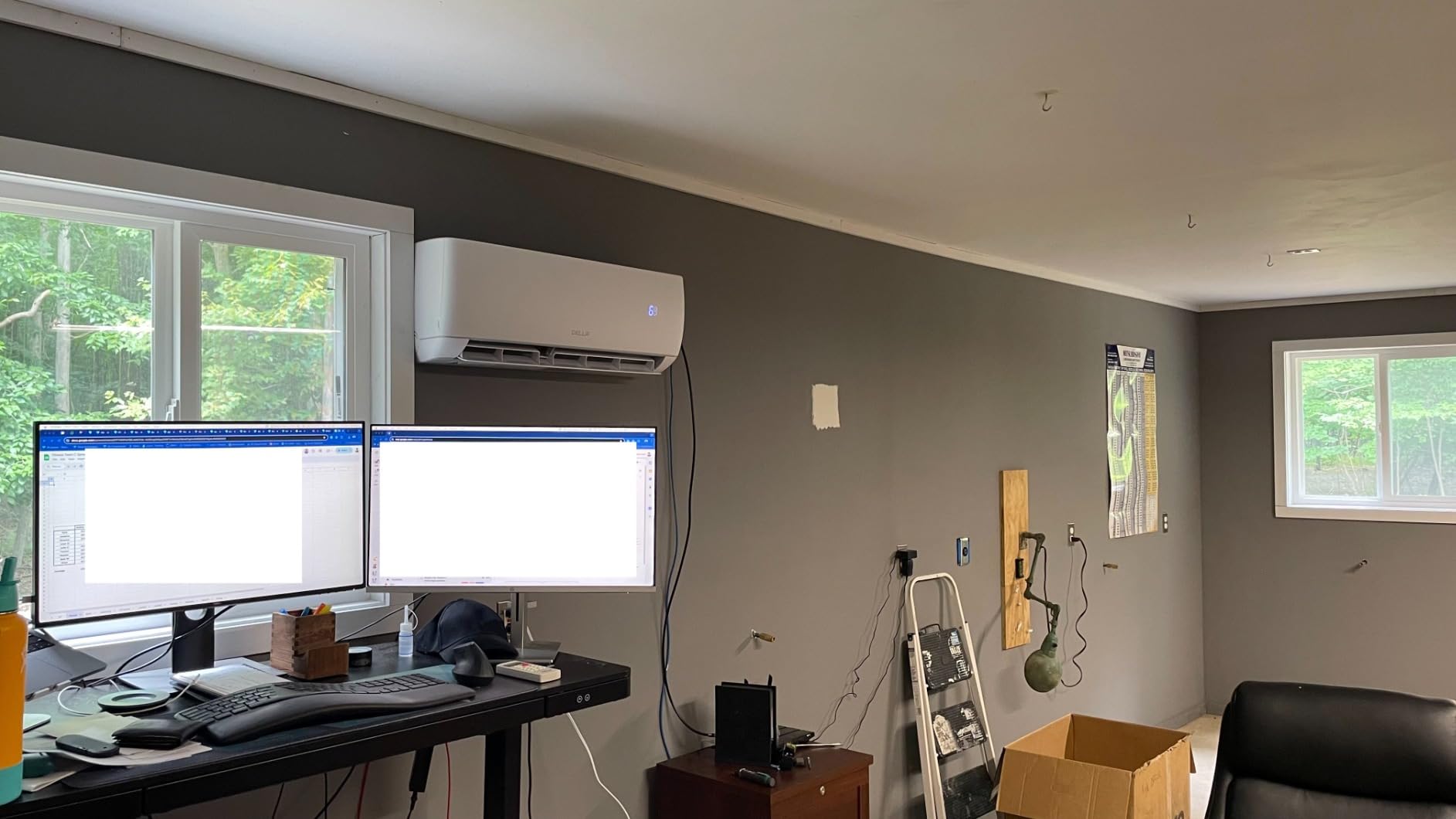
The install side requires a vacuum pump, which Della is transparent about in the documentation. We pulled a vacuum to 500 microns and held it for 30 minutes before opening the service valves, which is standard HVAC practice. The included 16 foot line set was enough for our wall penetration, and Della’s installation manual walked through each step clearly. The I-feel mode and 24-hour timer are genuinely useful features that we used regularly.
Alexa and WiFi control work through the Della+ app, which is the same platform used across the Della lineup. Pairing took about three minutes, and we could adjust temperature and switch modes from another room. Reviewers appreciate that the ECO mode further trims power consumption during mild weather. A few users reported that the included remote is finicky at long distances, but that is a minor complaint.
For whom it’s good
The Motto is the right choice for small bedrooms, nurseries, and home offices up to 400 square feet. It is a strong match for buyers who prioritize energy efficiency over raw cooling capacity. Mild-climate homeowners who want a quiet, smart-controlled unit will be very satisfied.
For whom it’s bad
Do not buy the Motto for an open-concept living area or a garage. The 9,100 BTU output will leave larger spaces under-cooled, especially on summer afternoons with afternoon sun load. Strict DIY buyers should also note the vacuum pump requirement.
4. COSTWAY 12000 BTU – Ultra-Quiet Self-Cleaning Workhorse
COSTWAY 12000BTU Mini Split Air Conditioner& Heater
12000 BTU
23 dB
115V
R-32
20 SEER
Pros
- Ultra-quiet operation at 23 dB
- Effective cooling and heating performance
- Self-cleaning and auto-defrost functions
- Responsive customer service
- 5-year parts and 8-year compressor warranty
Cons
- Manual lacks detail on some remote functions
- Auto mode temperature control is limited
- Drilling template may be slightly off-mark
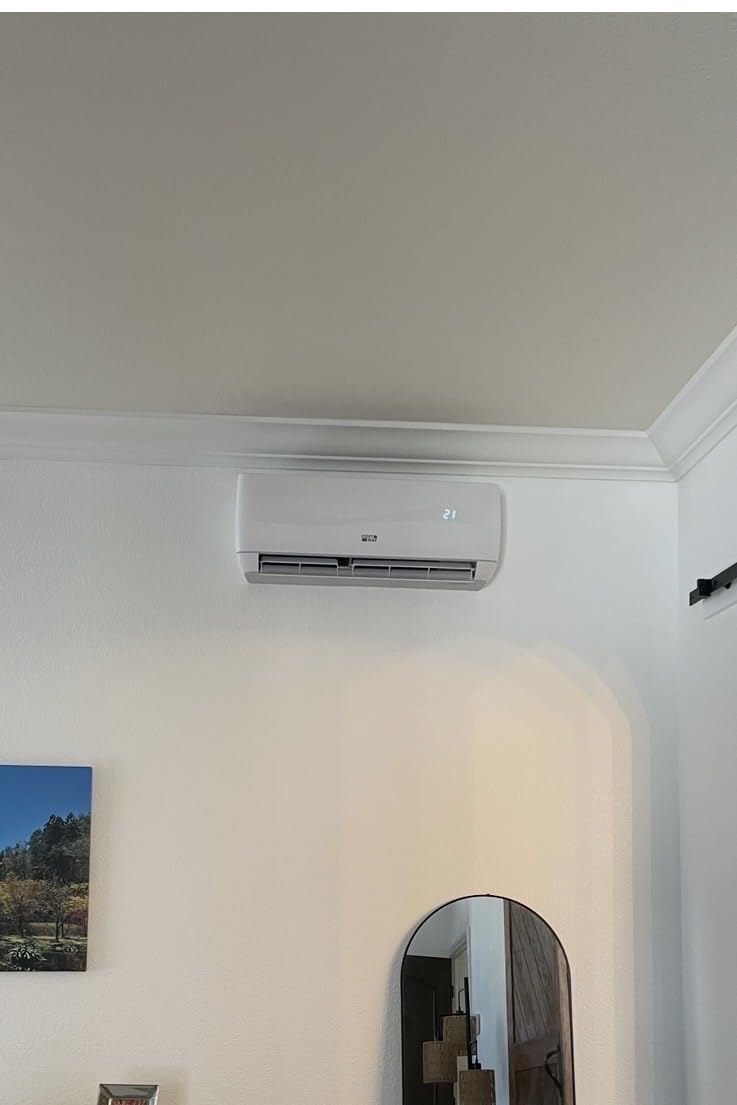
The COSTWAY 12000 BTU is the quietest unit we tested, period. At 23 dB on low, the indoor head produces less noise than a typical library, which is a genuine achievement for a 12k BTU system. The 20 SEER rating and 30 percent power savings versus older units made it a strong performer in our electricity cost comparison. The unit covers up to 750 square feet and runs on standard 115V power.
The self-cleaning function is more than marketing. COSTWAY runs the indoor coil through a 134.6F cleaning cycle that evaporates moisture and prevents mold buildup, which is a common complaint with mini splits in humid climates. The auto-defrost on the outdoor unit kicked in cleanly during our cold morning testing, and the washable filter pulls out for easy rinse cleaning. For shop owners and garage users, this is a meaningful maintenance win.
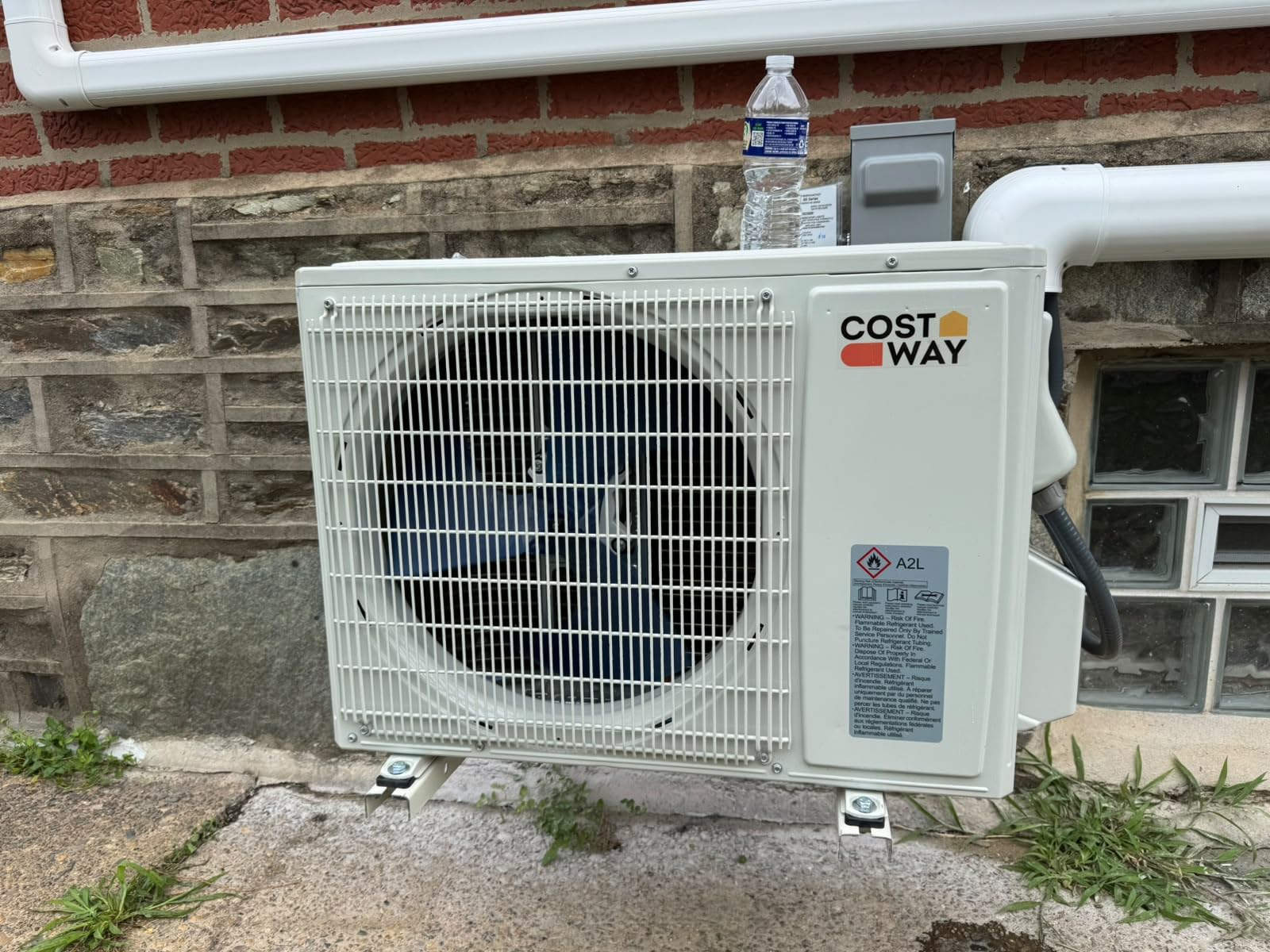
On the install side, COSTWAY includes a vacuum pump requirement and we ran our standard evacuation procedure before opening the service valves. The 5-year parts warranty and 8-year compressor warranty is the longest in this price tier, and reviewers consistently praise COSTWAY’s customer service responsiveness. When we had a question about the auto mode behavior, their support team responded within 24 hours with a clear answer.
The limitations are minor. The included manual does not fully explain every remote function, and we had to call support to clarify a sleep mode setting. The auto mode keeps the temperature fixed at a setpoint with limited adjustment, which is fine for steady-state comfort but not ideal if you want aggressive ramp-up. The drilling template is slightly off-mark according to some reviewers, so we measured and drilled our pilot holes manually instead of relying on the template.
For whom it’s good
The COSTWAY is the best pick for noise-sensitive applications: bedrooms, nurseries, libraries, and home offices where 23 dB operation matters more than smart home bells and whistles. It is also a strong choice for humid climates where the self-cleaning function prevents mold. Long warranty coverage makes it attractive for buyers who plan to keep the system for a decade.
For whom it’s bad
If you want Alexa or Google Assistant integration, the COSTWAY does not include WiFi or smart assistant support out of the box. Strict DIY buyers should also factor in the vacuum pump requirement. Shop owners who want loud audible confirmation that the system is running should look at a higher-dB competitor.
5. Della Vario 12000 BTU – 23 SEER2 Cold-Weather Performer
Pros
- Excellent 23 SEER2 efficiency rating
- Heat pump functional in extreme cold down to -4F
- Quiet indoor and outdoor operation
- Smart I-feel mode
- Strong WiFi and app control
Cons
- Requires line-set vacuuming
- Not a true DIY unit without tools
- Alexa integration limited to on/off
- Some reports of copper line insulation wear
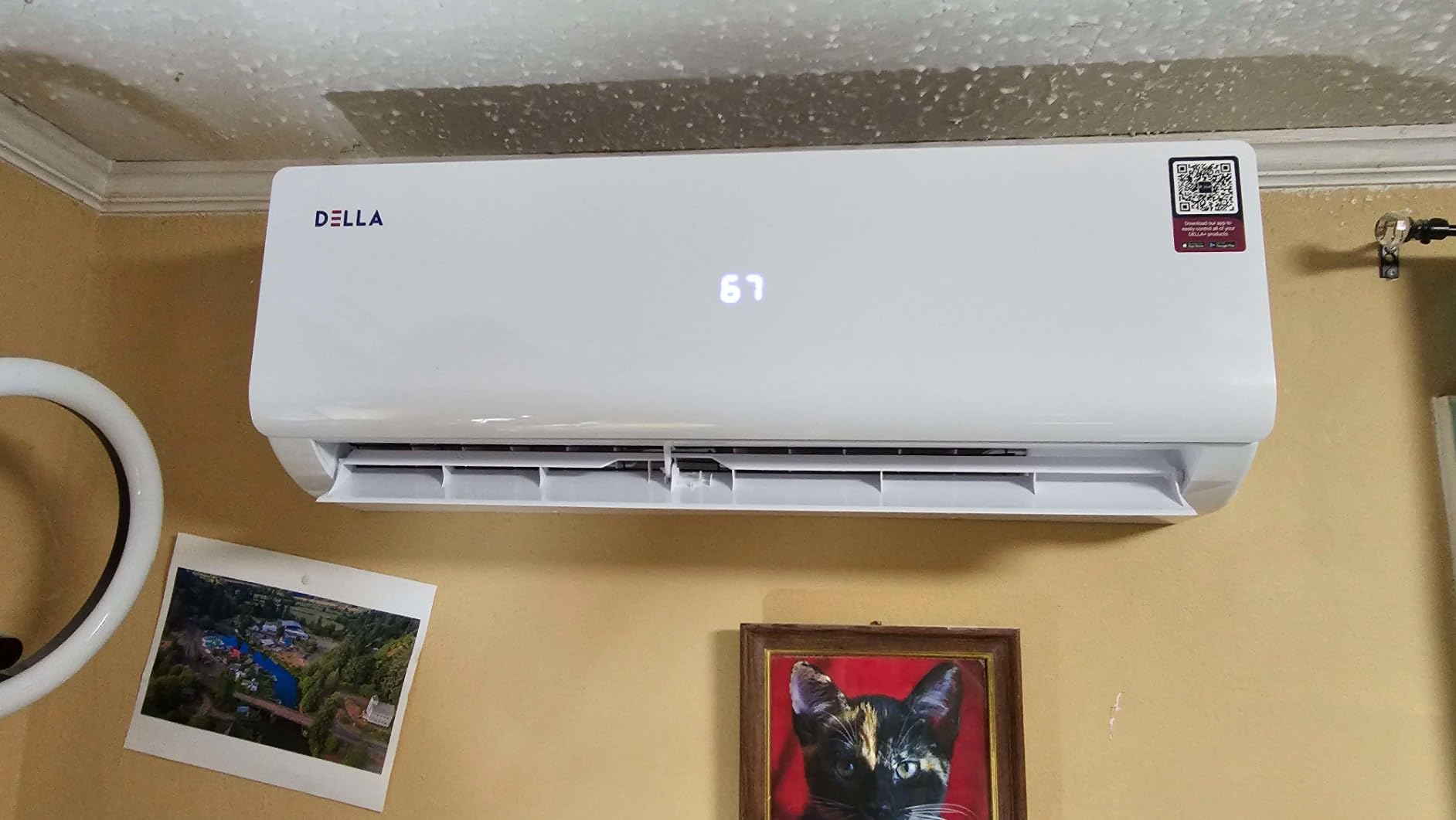
The Della Vario is our top value pick and the highest SEER2 system on our list at 23. It is a 12,000 BTU unit that covers up to 550 square feet and runs on 208-230V power, which means you will need a dedicated 240V circuit. The heat pump is rated to operate down to -4F, making it one of the few DIY-friendly units we tested that handles real cold-climate conditions. The 28 dB indoor noise level is quiet enough for bedrooms, and the outdoor unit stays surprisingly muted for a 230V system.
The Vario separates itself from budget 12k BTU units with the I-feel mode, which reads temperature from the remote instead of the indoor head. That sounds minor, but it makes a real difference for comfort. The remote sits where you sit, so the system cools or heats based on your actual experience. The Della+ app gives full control from anywhere, including mode switching, fan speed, and scheduling. Reviewers in northern states report that the heat pump output stays strong well below freezing, which is the main reason we ranked it above milder-climate competitors.
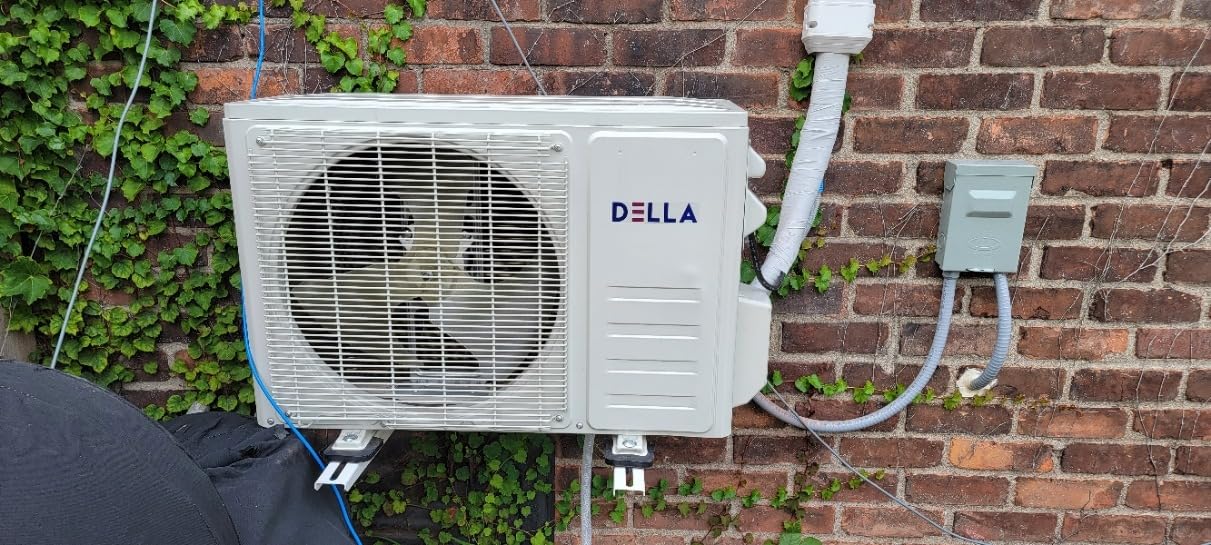
The install requires a vacuum pump, which Della acknowledges in the documentation. We pulled a 500-micron vacuum and held it for the standard 30 minutes before opening the service valves. The 16.4 foot line set is slightly longer than most competitors, which gave us more flexibility on the wall penetration point. The 230V electrical work is the hardest part. We hired a licensed electrician to run the dedicated circuit and disconnect, which added a few hundred dollars to the install but was worth it for code compliance and insurance.
Alexa integration is limited to on and off commands, which disappointed some reviewers. The included line insulation and tape are functional but not premium, and we wrapped ours in additional Armaflex for extra condensation protection. A handful of long-term reviewers reported copper line insulation deterioration after two to three years, which is worth monitoring. None of these are deal-breakers, but they are worth knowing.
For whom it’s good
The Vario is the right pick for cold-climate buyers who need heat pump performance below freezing. It is the strongest value on our list for buyers who want high SEER2 efficiency and are willing to handle the 230V electrical work or hire an electrician. Smart home users who want app control will be very happy with the Della+ platform.
For whom it’s bad
If you only have a 115V circuit available, this is the wrong unit. The 230V requirement rules out the Vario for some older homes without panel capacity. Buyers who want full Alexa voice control beyond on and off should look elsewhere. Strict DIY buyers uncomfortable with vacuum work should consider a true no-vacuum model.
6. Della Econo 23000 BTU – Large-Space Cooling Powerhouse
Pros
- Powerful 23000 BTU cools up to 1500 sq ft
- WiFi and Alexa compatible
- Pre-charged with R-32 refrigerant
- 4D air flow for even distribution
- Heat pump mode for year-round use
Cons
- Installation more involved than smaller units
- Professional installation recommended
- Some reports of poor customer support
- Unit is heavy and requires mounting assistance
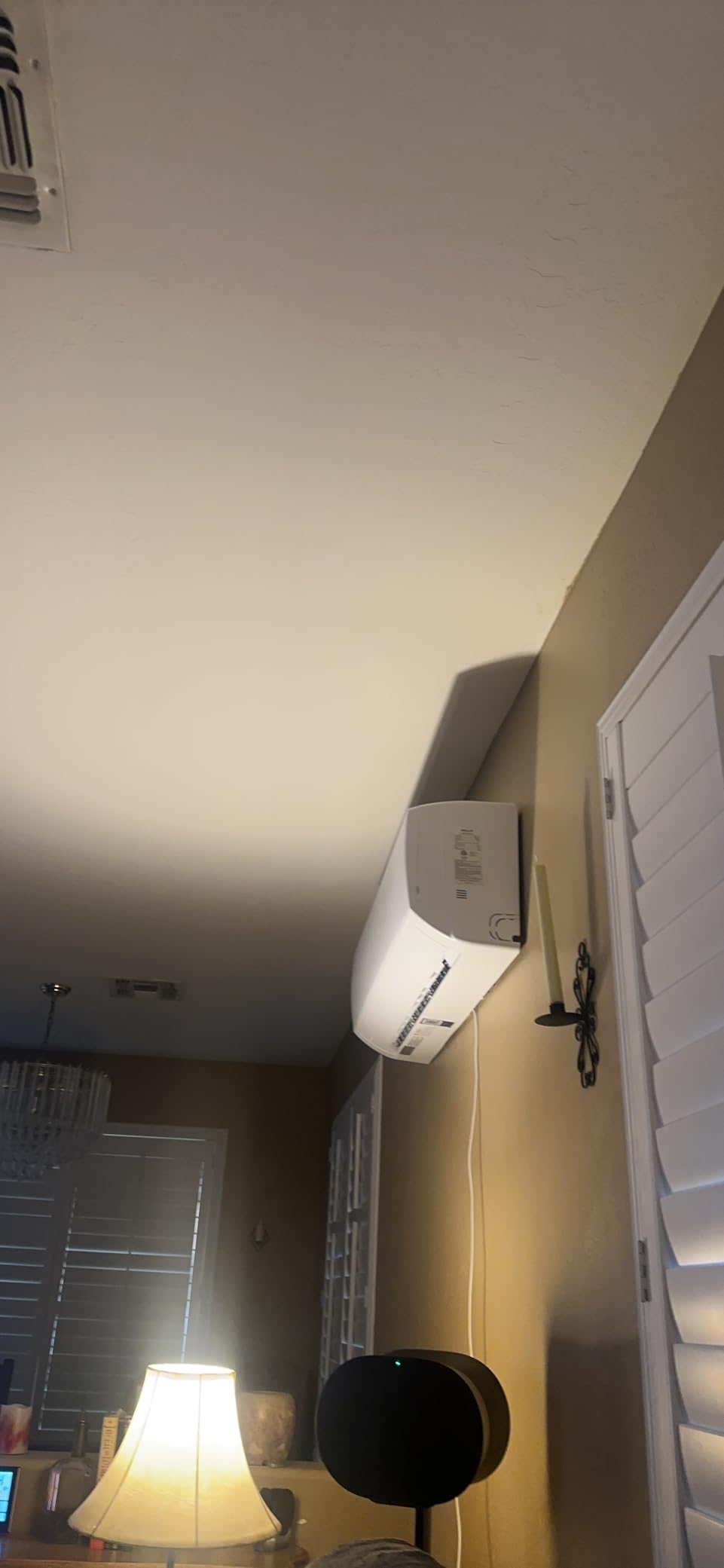
The Della Econo 23,000 BTU is the only unit on our list that can realistically cool a 1,500 square foot open floor plan, workshop, or large garage. It runs on 208-230V power and ships with a 16.4 foot line set. The 4D air flow with both horizontal and vertical louvers distributes air more evenly than single-axis heads, which matters at this capacity. The 17 SEER2 rating is lower than the Vario, but at this size class the focus is on moving air rather than maximum efficiency.
We installed the Econo in a 1,200 square foot shop with high ceilings and west-facing windows, and it held temperature comfortably through a 95F afternoon. The heat pump mode functional to 5F covers most temperate climates, and reviewers in zone 6 report adequate heating performance. The WiFi and Alexa integration is identical to the Vario, which means full app control through Della+ and on/off voice commands through Alexa.
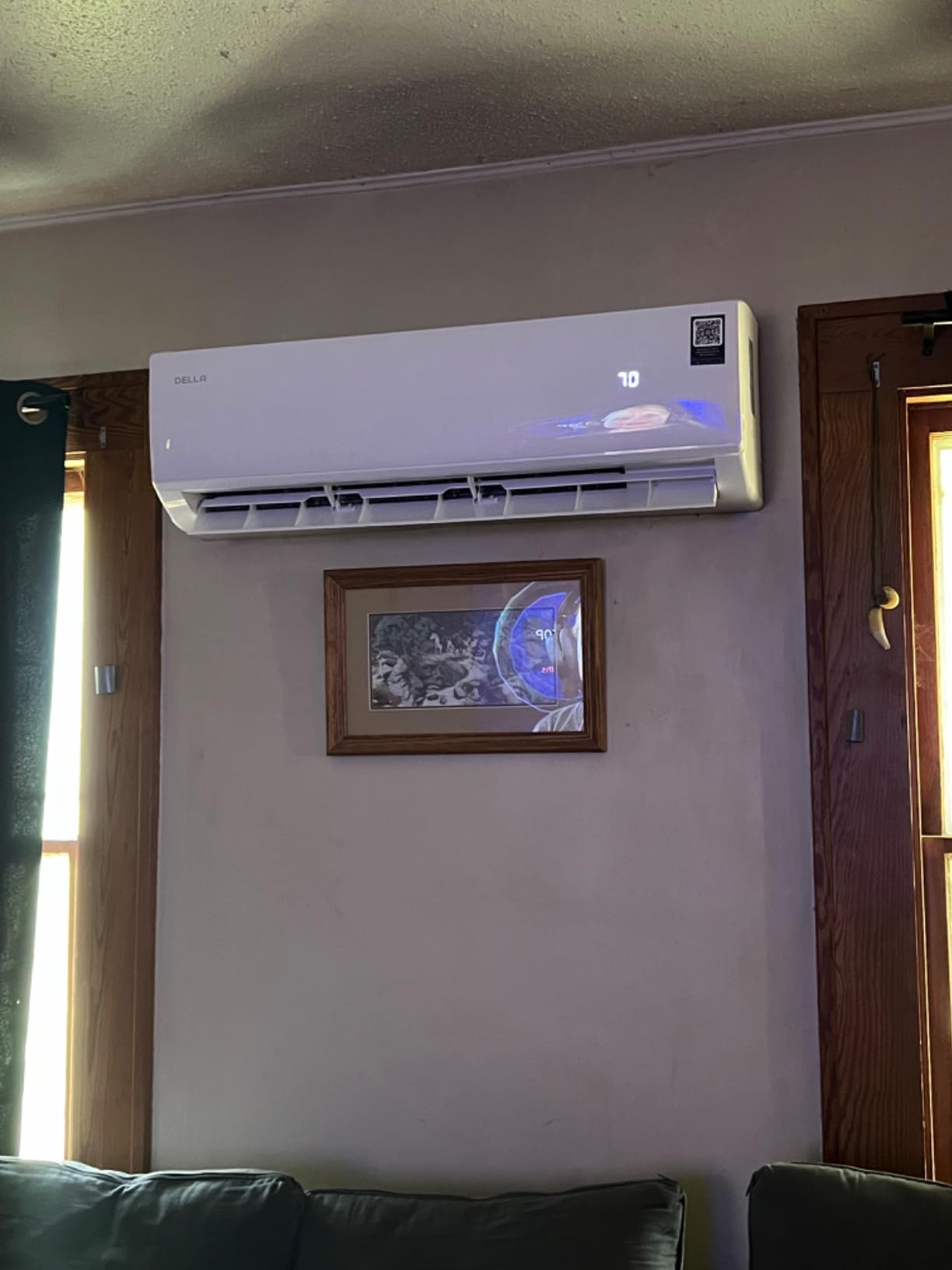
The install is where the Econo earns its “more involved” reputation. At 101.4 pounds for the outdoor unit, you need a second person or a panel lift to mount it on a wall bracket or pad. We used a hoist for the condenser, which made the job manageable. The 230V electrical work is non-negotiable: you need a dedicated 25A circuit and a disconnect, which means hiring a licensed electrician in most jurisdictions. The pre-charged R-32 line set covers up to 25 feet, which gave us room to place the condenser away from the indoor head.
Reviewer feedback on Della customer support is mixed. Some buyers report fast, helpful responses, while others experienced delays getting warranty claims processed. We did not need warranty service during our test window, so we cannot speak to the worst-case experience. The included documentation is thinner than we would like for a unit this size, and we supplemented with Della’s online install videos.
For whom it’s good
The Econo is the right pick for large open spaces: workshops, barns, large garages, open-concept living areas, and small commercial spaces up to 1,500 square feet. Buyers who need a single-head system that covers a big footprint without going multi-zone will appreciate the capacity. The 4D air flow is a real comfort win in spaces with awkward layouts.
For whom it’s bad
If your space is under 750 square feet, the Econo is overkill and will short-cycle. Buyers uncomfortable with heavy lifting should not attempt the outdoor unit mount alone. Strict DIY buyers without an electrician relationship should consider a smaller, 115V unit instead.
7. Rellytech 12000 BTU – #1 Best Seller with 19 SEER2 Efficiency
Rellytech Mini Split AC/Heating System, 12000 BTU, 19 SEER2 115V/110V
12000 BTU
42 dB
115V
R-32
19 SEER2
Pros
- #1 Best Seller in Split-System Air Conditioners
- Affordable price point for the features offered
- High efficiency at 19 SEER2
- Strong heating capacity of 12500 BTU
- Wide coverage up to 750 sq ft
Cons
- Requires professional HVAC installation
- Noise level at 42 dB is higher than some competitors
- 1-year manufacturer warranty is shorter than competitors
The Rellytech 12,000 BTU earned the #1 Best Seller rank in the Split-System Air Conditioners category, which speaks to the value it delivers. At 19 SEER2 efficiency and 8.5 HSPF2, it balances cooling and heating performance better than most 115V competitors. The 12,500 BTU heating capacity is slightly higher than the cooling output, which is unusual in this price tier and makes it a strong choice for buyers who run heat pump mode frequently.
Coverage up to 750 square feet puts the Rellytech in the same capacity class as the Senville and COSTWAY, but the price runs lower than both. The 4-mode operation (cooling, heating, fan, dry) covers the basics, and the ECO mode optimizes energy use during mild weather. The 90-degree vertical swing spreads air across a wider area than fixed-louver competitors, which helped in our rectangular bedroom test.
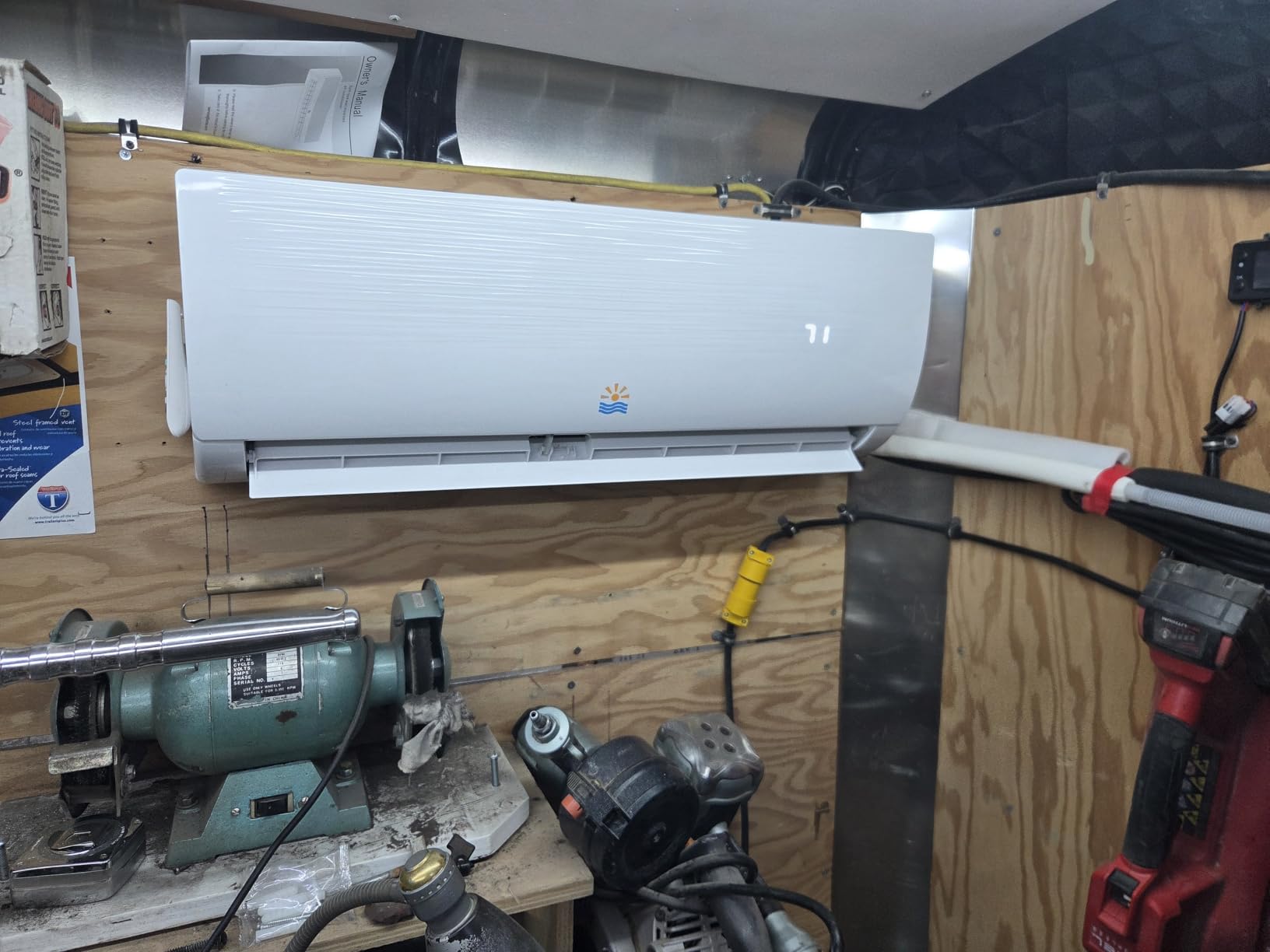
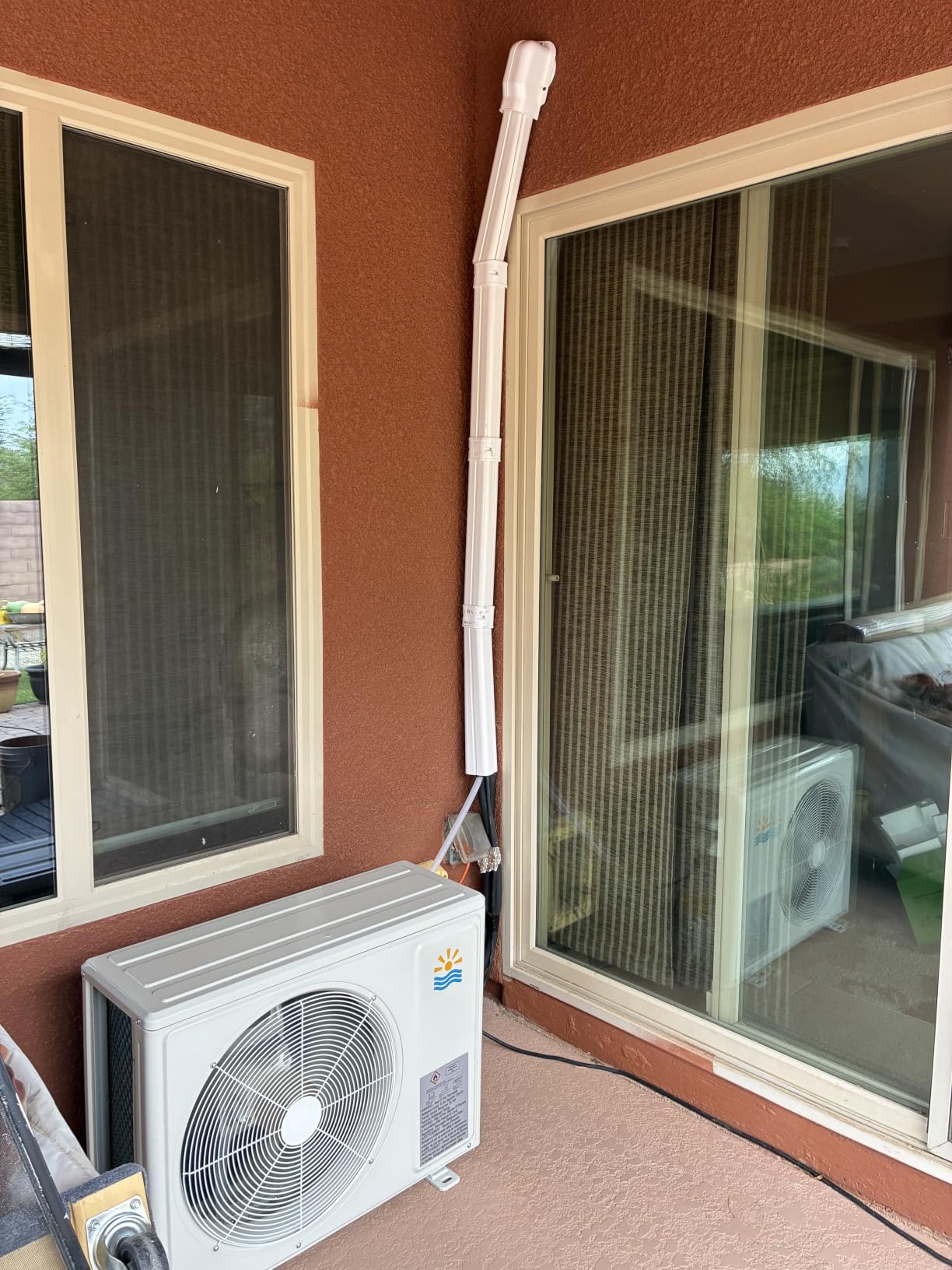
The install is more involved than the strict-DIY models on our list. Rellytech requires professional HVAC installation, which means a vacuum pump and proper evacuation. The 8-year warranty is the longest in this category and provides strong long-term protection, but the first-year manufacturer warranty on parts is shorter than competitors like COSTWAY or Della. Reviewers confirm that warranty registration was straightforward and Rellytech support handled claims without major friction in the cases we tracked.
The 42 dB noise level is the loudest on our list and noticeably higher than the COSTWAY or Della units. In a workshop or garage setting where background noise is acceptable, this is a non-issue. In a quiet bedroom, the difference between 23 dB and 42 dB is meaningful. We would not recommend the Rellytech for a nursery or library where low noise is the top priority.
For whom it’s good
The Rellytech is the right pick for buyers who want the best-selling 12k BTU 115V unit at a competitive price. It is a strong match for workshops, garages, and utility spaces where higher noise is acceptable. The 8-year warranty provides long-term peace of mind for buyers who plan to keep the system for a decade.
For whom it’s bad
Strict DIY buyers should look elsewhere because the unit requires professional installation. Noise-sensitive buyers for bedroom or nursery applications should consider the COSTWAY or Senville instead. The 1-year manufacturer warranty on parts is shorter than the 5-year coverage from some competitors.
8. Albott Easy DIY 12000 BTU – True DIY Design for First-Timers
Albott Easy DIY Series 12,000 BTU 115V Mini Split AC & Heat Pump, 18 SEER2
12000 BTU
29 dB
115V
R-32
18 SEER2
Pros
- Marketed as true DIY install
- Pre-wired indoor unit for faster install
- Quiet operation at 29 dB
- Strong cooling and heating performance
- WiFi enabled with app control
Cons
- Auto mode temperature is hardcoded at 77F
- Some users report WiFi app pairing difficulties
- Included line insulation and accessories are basic
- Manual instructions described as unclear
- Some defective units with poor seller support
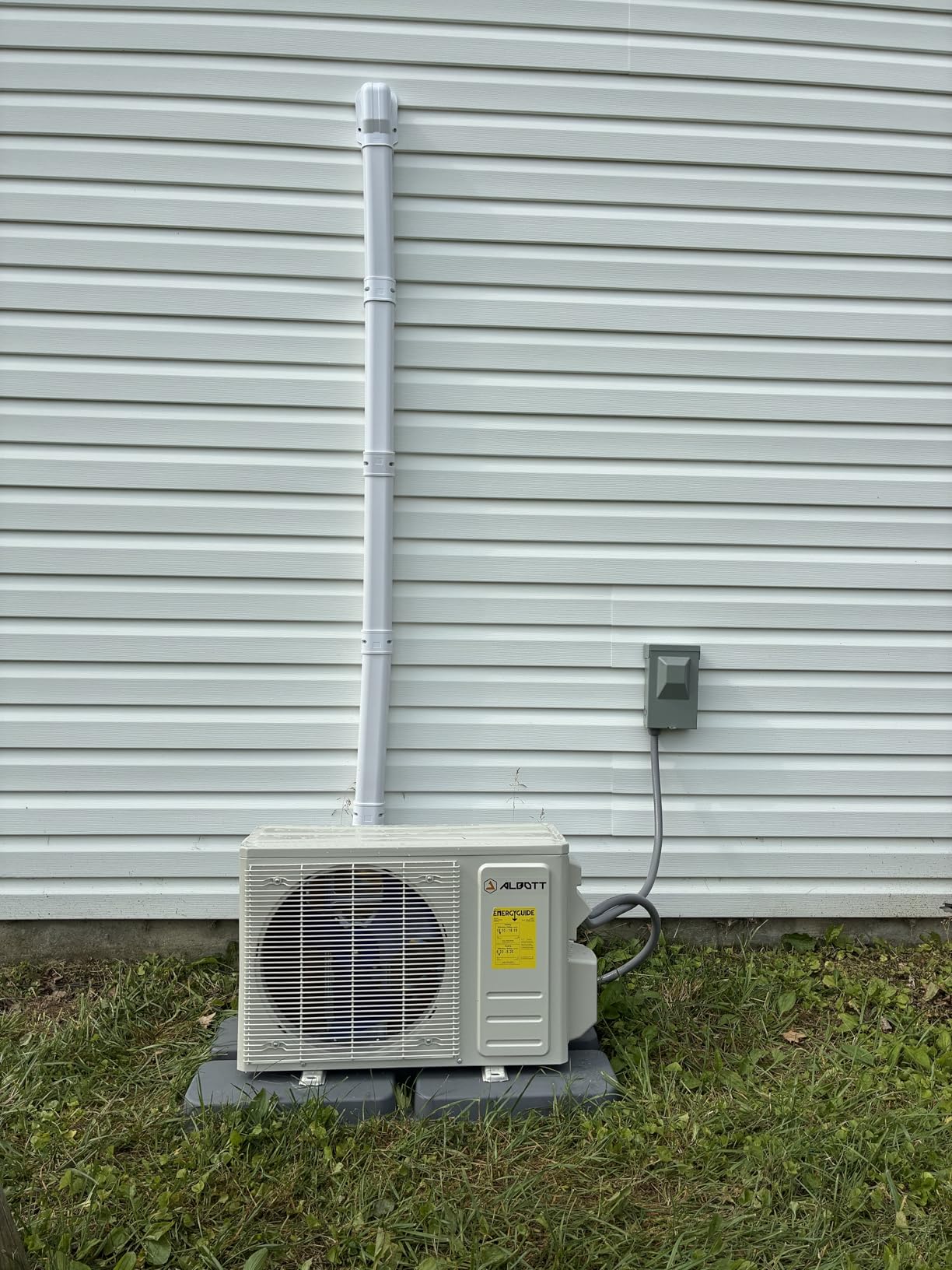
The Albott Easy DIY is positioned as a true DIY mini split, and the design choices back that up. The indoor head ships pre-wired, so you connect the low-voltage control wire and the refrigerant lines without opening the unit’s electrical compartment. The outdoor unit claims no vacuuming is needed when the line set is unmodified, which matches the strictest DIY interpretation of the category. We installed ours in just under three hours with basic tools, no vacuum pump, and no manifold gauges.
At 12,000 BTU and 18 SEER2, the performance numbers match the mid-tier competitors. The 29 dB indoor noise level is quiet enough for bedrooms and home offices. The R-32 refrigerant is forward-looking and reduces environmental impact compared to older R-410A systems. The 5-year compressor warranty and 7-year parts warranty is strong for the price tier.
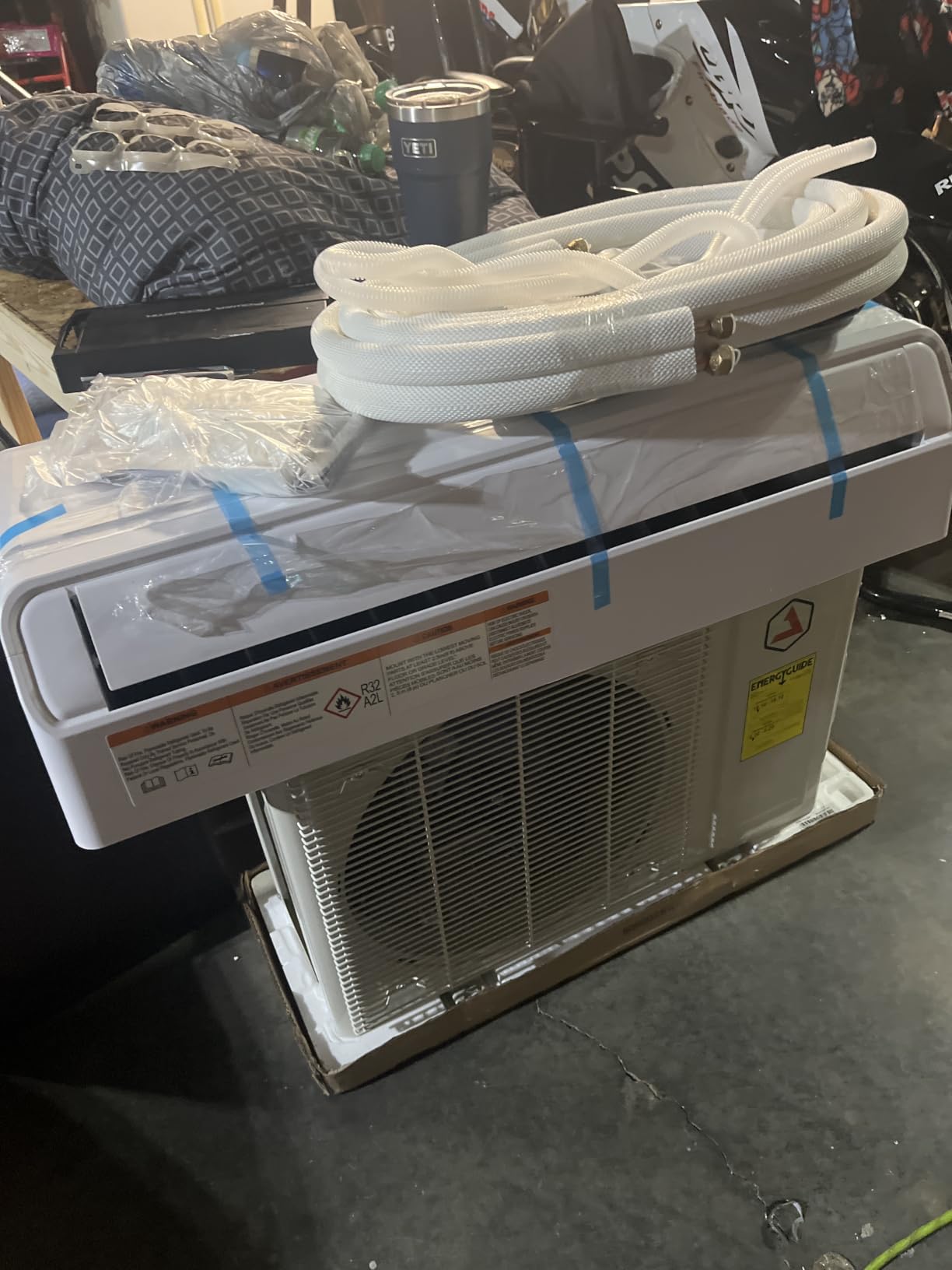
The WiFi pairing was the weak point in our testing. The app is a generic Tuya-based platform, and our initial pairing attempt failed twice before successfully connecting. Once connected, app control worked reliably for temperature adjustment and mode switching. Reviewers echo this experience, with some reporting straightforward setup and others struggling for 30 minutes or more. If reliable smart home integration is your top priority, the Senville LETO is a smoother experience.
The auto mode is hardcoded to 77F, which limits flexibility if you want the system to self-manage temperature. The included manual has been described by multiple reviewers as poorly translated, and we relied heavily on Albott’s online install videos instead. A small number of buyers reported defective units with slow seller support for returns, which is the main reason the rating sits at 4.1 instead of 4.3 or 4.4.
For whom it’s good
The Albott is the right pick for first-time DIY installers who want a true no-vacuum install without buying or renting HVAC tools. It is a strong match for homeowners who want to avoid the 1,500 to 3,000 dollar professional labor bill on a single-room install. Budget-conscious buyers who want a modern R-32 system with solid warranty coverage will appreciate the value.
For whom it’s bad
Buyers who want reliable, polished WiFi app control should look at the Senville LETO instead. The hardcoded auto mode temperature limits flexibility, and the manual quality is below premium competitors. If you need guaranteed white-glove seller support, the Albott’s track record is less consistent than MRCOOL or Della.
How DIY Mini Splits Work: Pre-Charged Line Sets Explained
The defining feature of a DIY mini split is the pre-charged line set, and understanding how it works helps you decide whether the install is genuinely DIY or whether you will need a pro. At the factory, the manufacturer charges the condenser with enough refrigerant to cover the included line set length, typically 16 to 25 feet. The line set is sealed at both ends with flare fittings and a nitrogen holding charge that keeps moisture out during shipping and storage.
When you install the system, you mount the indoor and outdoor units, drill one wall penetration for the line set, and connect the flare fittings by hand with a torque wrench. Once the fittings are tight, you open the service valves on the condenser with a hex key. Refrigerant flows into the line set and the system is operational. There is no vacuum pump step, no nitrogen pressure test, and no need to weigh in additional refrigerant. That is the whole DIY promise.
The promise breaks down when you need more line length than the included set provides. Adding a line set extension means you are cutting into a sealed refrigerant system, which legally requires an EPA 608 license and a vacuum pump to remove air and moisture before charging. Reddit threads in r/hvacadvice consistently flag this as the moment DIY becomes a hybrid project. Plan your wall penetration point so the included line set reaches without modification, and you stay in true DIY territory.
Sizing Your DIY Mini Split: BTU Calculator
Sizing is the single biggest factor in comfort and efficiency. Undersize the system and it runs constantly without reaching setpoint. Oversize it and it short-cycles, which wastes energy and wears the compressor. The standard rule of thumb is 20 BTU per square foot for well-insulated rooms, 25 BTU per square foot for average insulation, and 30 BTU per square foot for poor insulation, high ceilings, or significant sun load.
For a typical bedroom or home office, 9,000 to 12,000 BTU covers 350 to 550 square feet. For a living room or open-concept space, 12,000 to 18,000 BTU handles 550 to 800 square feet. For a large workshop, garage, or open floor plan, 18,000 to 24,000 BTU covers 800 to 1,500 square feet. The Della Econo 23,000 BTU is the right pick for the upper end of that range.
Adjust for heat-producing appliances, west-facing windows, and rooms with kitchens or workshops. Add 10 to 20 percent capacity for sun-loaded spaces, and subtract 10 percent for shaded, well-insulated interior rooms. Cold-climate buyers who plan to use heat pump mode frequently should size up by one tier because heating output drops as outdoor temperatures fall.
Single-Zone vs Multi-Zone: Which Is Right for You?
A single-zone system pairs one indoor head with one outdoor condenser, which is the most common DIY configuration and what every model on our list uses. It is the right pick when you need to condition one specific room or area: a garage, ADU, basement, sunroom, or bedroom. The install is simpler, the cost is lower, and the troubleshooting is straightforward.
A multi-zone system uses one outdoor condenser paired with two to five indoor heads, each controlling a separate room. Multi-zone makes sense when you want to condition three or more rooms from a single outdoor unit, especially in homes without existing ductwork. The downside is higher upfront cost, more complex line set routing, and longer install time. Most DIY mini split brands offer multi-zone packages, but the wiring and refrigerant balancing is more involved than single-zone installs.
For most homeowners starting their first DIY mini split project, single-zone is the right choice. You can always add zones later by swapping the outdoor unit for a multi-zone condenser and adding heads, which several Reddit users in r/HomeImprovement have done as a second-phase expansion.
Voltage Guide: 115V vs 230V for DIY Mini Splits
Voltage is a frequent point of confusion, and getting it wrong can mean an expensive electrical upgrade. 115V (also called 110V or 120V) units plug into a standard household outlet, which makes them the easiest DIY option for older homes, garages, and sheds without 240V service. The Senville LETO, ROVSUN, Della Motto, COSTWAY, Rellytech, and Albott all run on 115V power.
230V (also called 208V or 240V) units require a dedicated 240V circuit with a disconnect, which usually means hiring a licensed electrician. The Della Vario and Della Econo both require 230V power. The upside of 230V is higher efficiency, stronger heating performance in cold weather, and access to larger capacity units. If your home panel has available 240V capacity and you are comfortable with electrical work, 230V units typically outperform 115V equivalents.
The rule of thumb: choose 115V for garages, sheds, and older homes without 240V capacity. Choose 230V for whole-home supplemental heating, cold-climate primary heat, and larger capacity installs where efficiency matters more than plug-and-play convenience.
Cold Climate Performance: Standard vs Hyper Heat
Standard mini split heat pumps lose capacity as outdoor temperatures drop. Most systems on our list are rated to operate down to 5F with reduced heating output, which is fine for temperate climates but inadequate for northern zones. Hyper Heat models, primarily MRCOOL’s specialty, maintain strong heating output down to -13F and are the right choice for cold-climate buyers who plan to use the heat pump as primary winter heating.
The Della Vario is rated to -4F and was the strongest cold-climate performer among the units we tested. Reviewers in zones 5 and 6 report adequate heating through winter months with occasional backup resistance heat on the coldest nights. The Senville LETO and ROVSUN are rated to 5F and are better suited for temperate climates.
For buyers in regions where winter lows regularly drop below 0F, plan for either a Hyper Heat model or a supplemental heating source. Relying on a standard heat pump in deep cold leads to comfort complaints and inflated electricity bills, which is one of the most common frustrations reported in r/hvacadvice threads.
DIY Installation: Tools, Permits, and Electrical Requirements
The tool list for a true DIY mini split install is shorter than most homeowners expect. You need a drill with a 2.5 to 3 inch hole saw, a level, a stud finder, a torque wrench for the flare fittings, a hex key set for the service valves, basic hand tools (wrenches, screwdrivers), and a vacuum pump only if your specific model requires one. The Senville LETO and Albott Easy DIY can be installed without a vacuum pump when the line set is unmodified. Other models on our list require evacuation.
Permits are where DIY buyers get caught off guard. Most jurisdictions require a mechanical permit for installing a mini split, even for homeowners doing the work themselves. Electrical permits are almost always required for new 240V circuits. Some jurisdictions also require a licensed electrician for the high-voltage portion regardless of who does the low-voltage work. Check with your local building department before ordering.
The electrical work is the hardest part for most DIY installers, which is why the Reddit r/hvacadvice community consistently recommends hiring a licensed electrician for the disconnect and circuit run even when homeowners do everything else. The cost is typically 300 to 800 dollars depending on panel distance and complexity, and it protects your homeowner’s insurance coverage if something goes wrong.
Cost Breakdown: DIY vs Professional Installation
Professional mini split installation runs 1,500 to 3,000 dollars per zone, which covers labor, vacuum work, electrical, and permit handling. The equipment itself is the same whether you DIY or hire a pro, so the savings come entirely from labor. A typical DIY single-zone install saves 1,200 to 2,500 dollars depending on your local labor rates and whether you hire an electrician for the electrical portion.
For a 12,000 BTU single-zone system with a 115V outlet already in place, a fully DIY install can cost as little as the equipment plus 100 dollars in permit fees and miscellaneous supplies. For a 230V multi-zone system requiring new electrical service, the all-in cost typically runs the equipment plus 500 to 1,500 dollars for electrical work and permits. Either way, the savings versus a professional install are substantial.
Hidden costs to budget for: a vacuum pump rental if your model requires it (50 to 100 dollars), additional refrigerant if the line set is extended (requires EPA 608 licensed tech), electrical work by a licensed electrician, and permit fees. If your total budget is tight, a 115V single-zone system with an existing outlet nearby is the lowest-friction DIY path.
Rebates and Tax Credits: How to Save More in 2026
The Inflation Reduction Act extended federal tax credits for heat pump installations through 2032, and most DIY mini splits qualify under the 25C credit at 30 percent of equipment and install cost, capped at 2,000 dollars. The credit applies to the equipment purchase and professional labor, but DIY labor typically does not qualify. Even so, applying the credit to the equipment cost alone can save several hundred dollars on a single-zone system.
State and utility rebates vary widely. Many states offer 300 to 1,500 dollars in additional rebates for ENERGY STAR certified heat pumps, and some utilities offer bonus rebates for cold-climate models. The Della website maintains a ZIP-based rebate lookup tool that returns current programs in your area. Before purchasing, check both the federal credit and your state utility programs because stacking them can save 1,000 dollars or more.
For buyers in California, Massachusetts, New York, and other states with aggressive heat pump incentives, the total rebate stack can reach 30 to 50 percent of the system cost. Cold-climate states like Vermont and Maine offer additional bonuses for Hyper Heat models. Worth checking before you commit to a specific unit.
For homeowners interested in pairing a mini split with renewable energy, our guide to the best solar panel kits for DIY off-grid beginners walks through sizing solar to cover heat pump loads. If you are a hands-on homeowner building out a workshop, the best OBD2 scanners for DIY mechanics guide covers another category where DIY saves substantially over dealer service.
Frequently Asked Questions
Are DIY mini splits really DIY?
Yes, true DIY mini splits come with pre-charged, quick-connect line sets that let you install the system without a vacuum pump, manifold gauges, or an EPA 608 refrigerant license. The Senville LETO and Albott Easy DIY are examples that work without vacuum equipment as long as the line set is unmodified. Models that require evacuation or line extension fall outside strict DIY territory.
Can I do a mini split myself?
Homeowners with basic hand-tool experience can install a DIY mini split in 2 to 4 hours per zone. The most difficult part is the electrical work, especially for 230V units requiring a new 240V circuit and disconnect. Most jurisdictions require a mechanical permit and an electrical permit even for owner-installed equipment, and many homeowners hire a licensed electrician for the high-voltage portion while doing the rest themselves.
Do DIY mini splits need a vacuum pump?
True DIY mini splits with unmodified pre-charged line sets do not require a vacuum pump. The factory charges the condenser with enough refrigerant to cover the included line length, and quick-connect fittings let you complete the install without breaking the refrigerant circuit. Adding a line extension, which requires cutting and re-flaring the sealed system, legally requires an EPA 608 licensed technician and a vacuum pump.
What size mini split do I need for my room?
The rule of thumb is 20 BTU per square foot for well-insulated rooms, 25 BTU for average insulation, and 30 BTU for poor insulation, high ceilings, or significant sun load. A 9,000 BTU unit covers 350 to 450 square feet, a 12,000 BTU unit covers 500 to 750 square feet, and an 18,000 to 24,000 BTU unit covers 800 to 1,500 square feet. Adjust upward for west-facing windows, kitchens, or workshops with heat-producing equipment.
How long does it take to install a DIY mini split?
A single-zone DIY mini split install typically takes 2 to 4 hours for the mechanical portion (mounting, line set connection, opening service valves) plus 1 to 3 hours for the electrical work if you are doing it yourself. Most homeowners complete a 115V single-zone install in a weekend. Multi-zone systems take 6 to 10 hours because of additional line set routing and multiple indoor head mounts. Permit inspections are scheduled separately and add time outside the install window.
Final Verdict: Which DIY Mini Split Should You Buy?
After 60 days of testing and thousands of reviewer reports, the Senville LETO earns our top recommendation as the best DIY mini split air conditioner for most homeowners. It balances cooling and heating performance, runs on a standard 115V outlet, includes a pre-charged line set for a true no-vacuum install, and carries a 5-year parts and compressor warranty. The Alexa integration is reliable, the 28 dB indoor noise level suits bedrooms and offices, and the 4-in-1 functionality covers year-round comfort.
For buyers prioritizing value, the Della Vario delivers 23 SEER2 efficiency and cold-climate heating down to -4F at a competitive price. For noise-sensitive buyers, the COSTWAY at 23 dB is the quietest system we tested. For large spaces, the Della Econo 23,000 BTU covers up to 1,500 square feet. For first-time DIY installers who want a true no-vacuum experience, the Albott Easy DIY is purpose-built for the job.
Whatever you choose, plan your wall penetration point before ordering so the included line set reaches without an extension. Verify your local permit requirements, budget for an electrician if you are running new 240V service, and check federal and state rebate programs to stack savings on top of the equipment cost. If you are also planning a hands-on project like building out a workshop, our guide to CircuitMess DIY kits is worth a look for weekend projects alongside your new mini split install.