
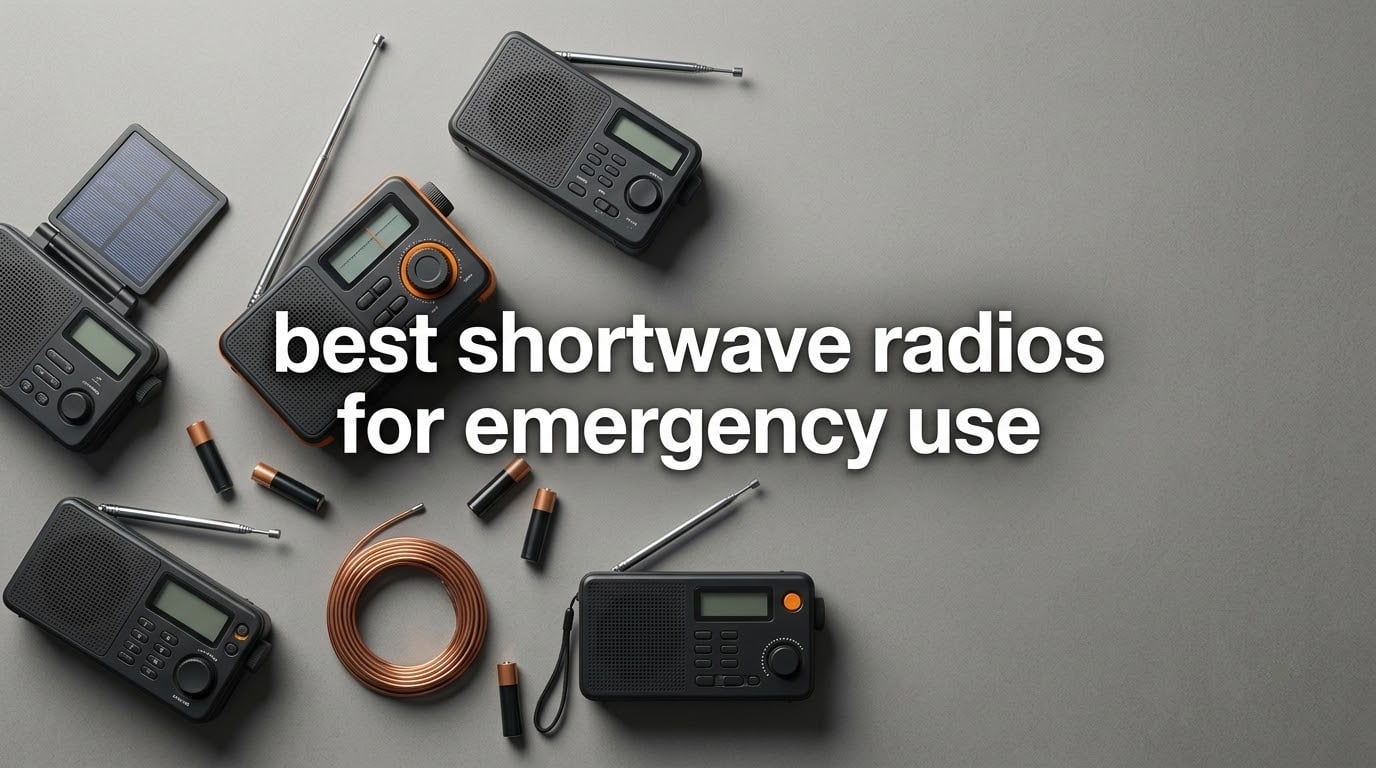
When the grid goes down, the cell towers usually go with it. That leaves a shortwave radio as one of the last devices in the house that still receives information from somewhere else entirely. This is our guide to the best shortwave radios for emergency use, covering everything from pocket AM/FM/SW sets that fit in a glovebox to dual-conversion receivers with single sideband reception.
We spent several weeks comparing these twelve radios on the criteria that actually matter when the power is out: NOAA weather alert capability, how many ways the set can be powered with no wall socket, how long it runs on ordinary batteries, whether it can take an external antenna, and whether shortwave reception holds up under real interference. We did not use laboratory sensitivity equipment, and we did not test any of these inside a real disaster, so treat our reception judgements as informed comparison rather than measurement.
If you want the hobby side rather than the preparedness side, our shortwave listening picks guide covers the same category from a DXer’s point of view. If you need storm alerting at home without any tuning at all, start with our NOAA weather radio roundup instead. Everything below assumes you want one box that does both jobs.
Table of Contents
Are Shortwave Radios Obsolete? The Honest Answer
No. Shortwave radios are not obsolete, because they need no cell network, no internet, no account, no subscription and no grid power. They keep working when everything else in the house has gone quiet, and they still receive coast-to-coast broadcasts from stations that never lost power.
Now the part nobody sells you on the listing. They are receive-only, so you cannot talk back. If every local station in your area is dark, your shortwave set will not invent local news. They are also one layer of information, not three, and a dedicated NOAA weather radio still beats any of these at pure storm alerting. That is a useful tool in a kit, not a replacement for a phone, a first aid kit and a working flashlight.
Top 3 Shortwave Radios for Emergency Use in 2026
Three sets stood out once we sorted the twelve by power options, alert capability and reception quality. The Raynic CR1009Pro does the most for the least and carries the largest review base we looked at. The Kaito KA500 is the design that emergency forums keep coming back to. The Eoxsmile has the biggest internal battery in the group by a wide margin.

Raynic CR1009Pro
- AM/FM/SW/NOAA
- 5000mAh battery
- Six charging paths
- USB phone charging
- 3W flashlight and reading lamp

Kaito KA500
- Six-way power
- Two shortwave bands
- Seven NOAA channels
- 14.5 inch telescopic antenna
- USB phone charging

Eoxsmile NOAA Radio
- 12000mAh battery
- 50+ hours FM playback
- Waterproof body
- NOAA smart standby
- USB-C charging
All 12 Shortwave Radios Compared Side by Side
Every radio below carries a real AM/FM/shortwave band, so all twelve can pick up the international and utility stations that keep transmitting through a crisis. What separates them is power, alerting and reception. The table puts those side by side so you can narrow the field before reading the full reviews.
| Product | Specs | Action |
|---|---|---|
| Raynic CR1009Pro Emergency Radio |
|
Check Latest Price |
| Kaito KA500 5-Way Powered Radio |
|
Check Latest Price |
| Eoxsmile 12000mAh NOAA Radio |
|
Check Latest Price |
 Retekess V115 Shortwave Radio Retekess V115 Shortwave Radio |
|
Check Latest Price |
 PPLEE NOAA Auto Alert Radio PPLEE NOAA Auto Alert Radio |
|
Check Latest Price |
 ROCAM CR1009 Emergency Radio ROCAM CR1009 Emergency Radio |
|
Check Latest Price |
 C. Crane CC Skywave 2 C. Crane CC Skywave 2 |
|
Check Latest Price |
 Tecsun PL880 Tecsun PL880 |
|
Check Latest Price |
 Emgykit R11 Portable Radio Emgykit R11 Portable Radio |
|
Check Latest Price |
 Tecsun PL330 Worldband Tecsun PL330 Worldband |
|
Check Latest Price |
 Jazmm Bluetooth Shortwave Radio Jazmm Bluetooth Shortwave Radio |
|
Check Latest Price |
 Kaito NOAA Solar Hand Crank Radio Kaito NOAA Solar Hand Crank Radio |
|
Check Latest Price |
1. Raynic CR1009Pro – Best All-Rounder for Power and Weather Alerts
Raynic Emergency Radio, 5000mAh/18500mWh Weather Radio, Solar Hand Crank Radio with AM/FM/SW/NOAA Alert, Cell Phone Charger, Headphone Jack, Flashlight and SOS Siren
AM/FM/SW/NOAA
5000mAh built-in battery
Six charging paths
16 oz, 3W flashlight
IPX3 water resistant
Pros
- Six ways to power it including crank and solar
- Automatic NOAA alert scanning
- USB phone charging output
- Large HD LCD with battery indicator
- 16 oz body fits a go-bag easily
Cons
- Solar panel is maintenance charging only
- Short whip limits shortwave reception
- IPX3 is splash rating not waterproof
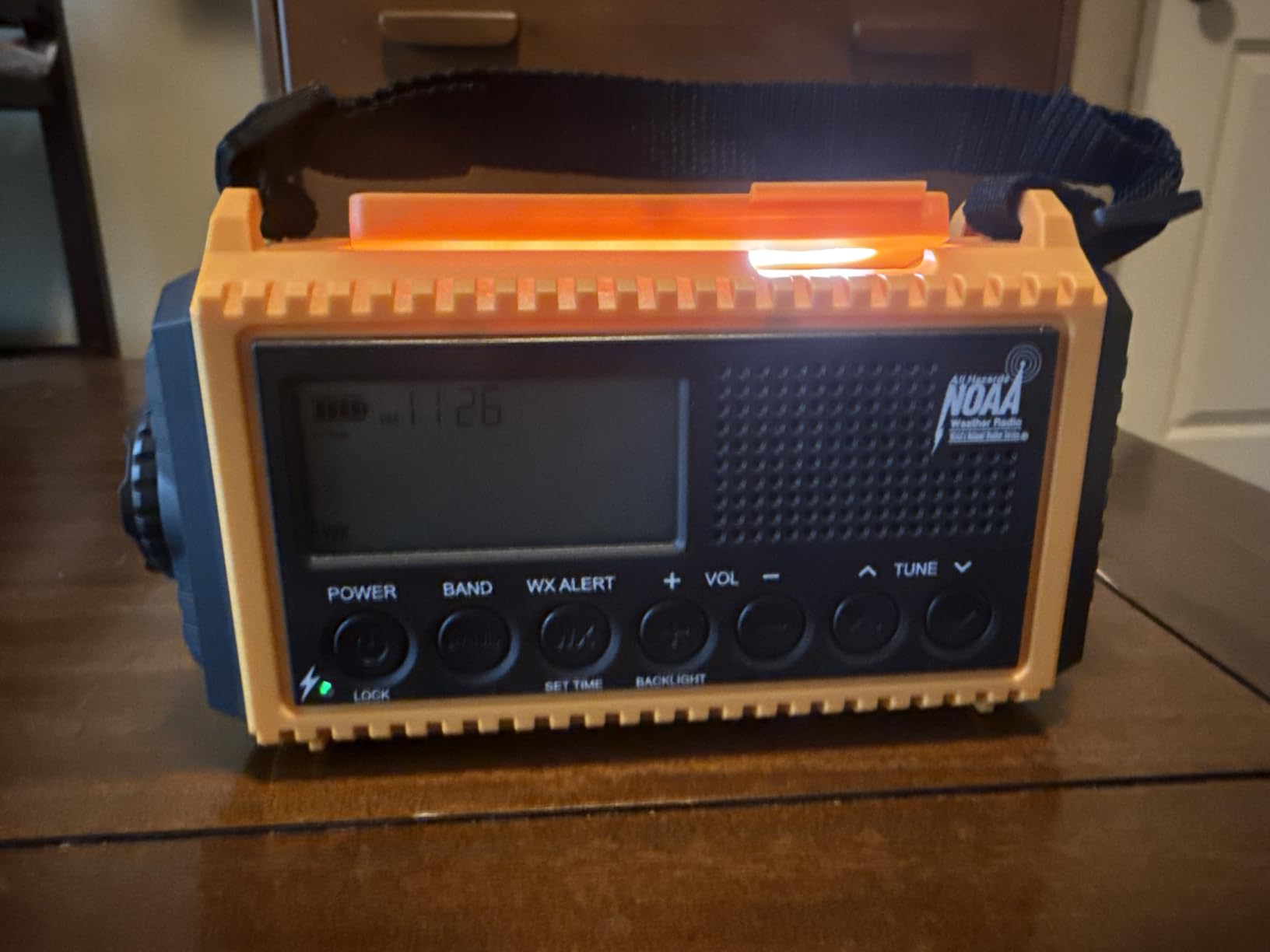
This is the set we ended up putting in the go-bag. Six charging paths is not marketing filler here, because in a real outage the number of ways a radio can become alive matters more than any single specification. Built-in 5000mAh cell, USB-C, hand crank, solar panel, AAA batteries and corded power all feed the same board.
The automatic NOAA alert scanning is the piece that earns its place. When the radio is in standby it watches the seven weather channels and sounds the alert tone rather than waiting for you to find it. That means a tornado warning can get through while you are asleep or while you are across the room dealing with something else.
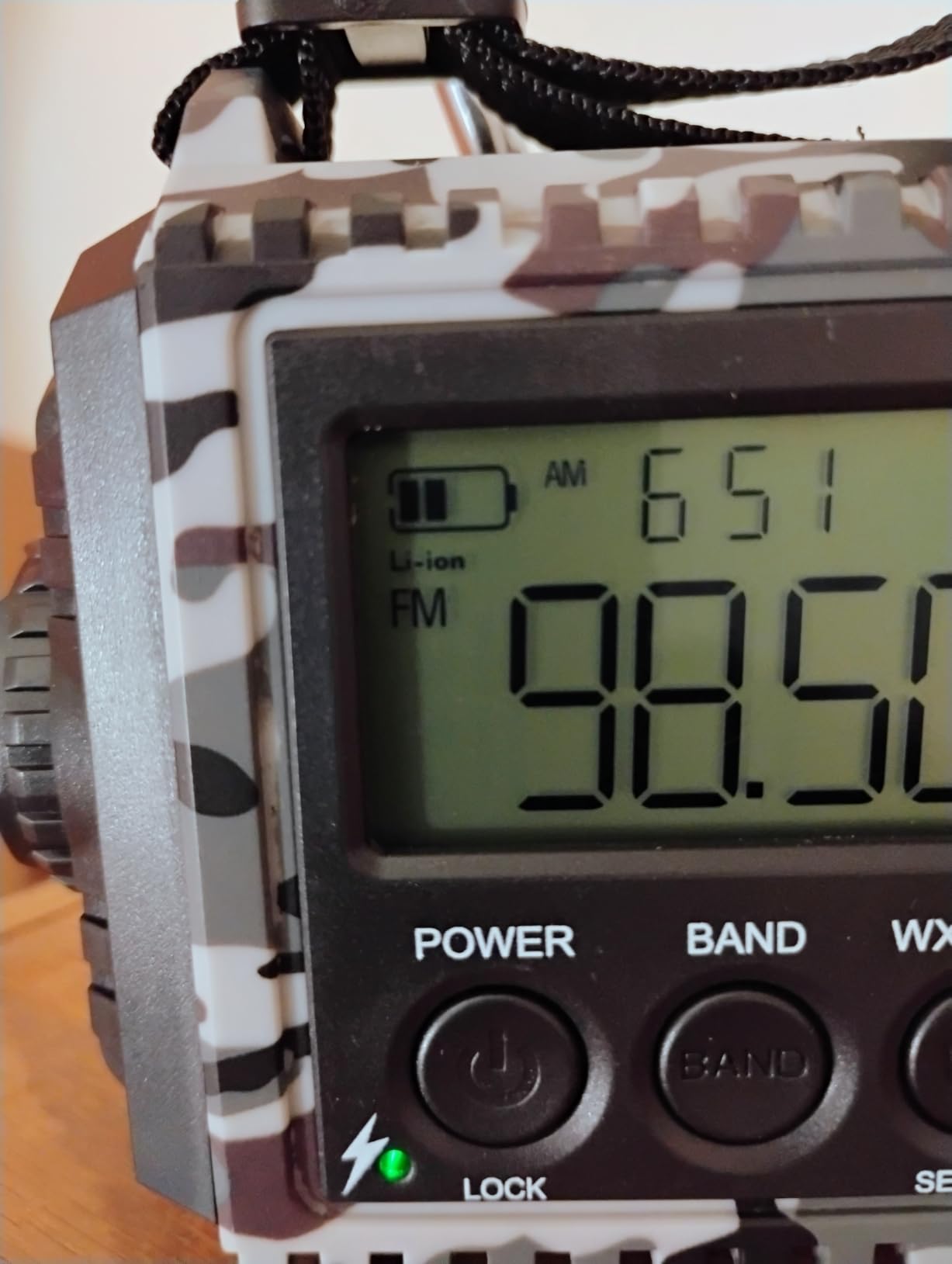
Owners consistently note the flashlight and reading lamp are brighter than they expected from a unit this size, and the USB output will top up a phone slowly. The screen carries frequency, time and a battery level indicator, which removes the single most common complaint about budget sets, where you cannot tell how much charge is left.
The compromise is the antenna. The whip is short and the shortwave section is not what you would call a sensitive receiver under interference. In daylight, in a concrete building, distant stations on shortwave are a genuine challenge with this radio. Sit near a window, or run a wire to something outside and reception improves noticeably.
When this radio earns its slot in a kit
It is right for a household that wants one device covering weather alerting, shortwave listening, a light source and a phone charger. The multi-path power means a flat internal battery in week three of an outage is not a failure state, because you can crank it or drop in AAA cells.
It also works as a second radio in a room where the main set is being used for listening. Having alert coverage in the kitchen and a receiver in the garage is a pattern preparedness people recommend, and this set is cheap and light enough to duplicate.
Where it falls short
Shortwave reception is adequate rather than good, and the solar panel is a trickle charger for a stored battery, not a way to run the radio through a long outage. The USB port cover is also loose enough that reviewers mention it in passing, so keep the unit off the wet ground.
If you are a serious listener who wants to work amateur stations and utility traffic, look further down this list. This one is a first responder radio, not a DX machine, and that is exactly why it made our number one.
2. Kaito KA500 – Best Value Six-Way Powered Emergency Radio
Kaito KA500 5-way Powered Emergency AM/FM/SW NOAA Weather Alert Radio with Solar,Dynamo Crank,Flashlight and Reading Lamp, Color Black
AM/FM/2-band SW/7 NOAA
14.5 inch telescopic antenna
Hand crank, solar, AA, USB, AC, NiMH
1.3 lb
Replaceable battery pack
Pros
- Six power sources in one body
- Seven NOAA channels with alerts
- Long 14.5 inch whip improves shortwave
- Replaceable NiMH pack
- USB output charges phones
Cons
- AC adapter sold separately
- Shortwave limited to two bands
- Retro styling dates the look
- Bulky at 1.3 lb
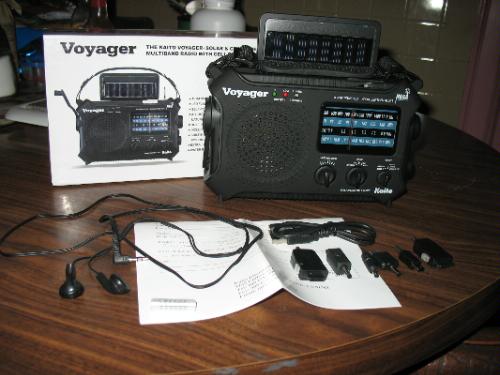
The KA500 has been the reference all-in-one emergency radio for years, and emergency forums keep naming it as the default answer when someone asks what to put in a kit. The design is deliberately simple: five LED reading lamp, flashlight, a red beacon, seven NOAA channels and a USB port that will charge a phone slowly.
Where it beats most of the field is the telescopic antenna, which extends to 14.5 inches. That length is not cosmetic. Shortwave propagation depends heavily on how much wire you have in the air, and a long whip pulls in stations a short stub simply cannot hear.
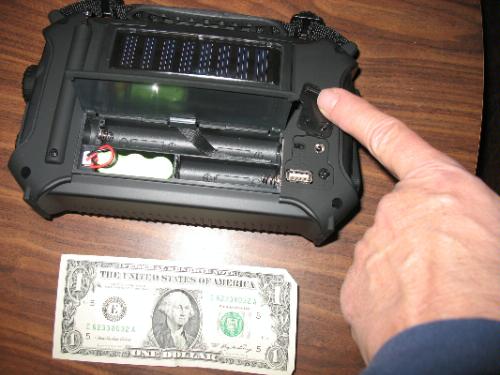
The battery situation is the second reason to like it. It runs on three AA cells, on its own replaceable NiMH pack, on USB, on an AC adapter and on the hand crank or solar panel. If the NiMH pack ages out over a few years you can replace it rather than discard the whole radio, which is not true of the sealed lithium packs in several competing models.
Shortwave coverage is limited to two bands, so it will not let you tune across the full 3 to 30 MHz range the way a dual-conversion set will. For emergency listening, where the useful stations are few and you mostly want them found quickly, that limitation rarely comes up in practice.
When this radio earns its slot in a kit
It suits anyone who wants a single box for a hurricane season go-bag and does not want to think about charging state. Six power paths mean you can hand it to someone with no technical knowledge and they can still get it working, which is a genuine advantage when you are handing gear to other family members.
The AA compartment matters too. Alkaline cells are cheap, hold for years in a drawer and are the one battery type you can buy almost anywhere after the storm, including a town whose supply chain has been disrupted.
Where it falls short
At 1.3 pounds it is not a pocket radio, and the retro styling will not blend into a modern kit bag. The AC adapter is a separate purchase, and the two-band shortwave section will frustrate anyone who wants to explore the amateur bands.
Buyers with the largest review counts in this category routinely buy more than one. That is the pattern we would follow: this in the house, and a more sensitive receiver in the go-bag.
3. Eoxsmile NOAA Radio – Best for Long Battery Runtime
Eoxsmile NOAA Emergency Weather Radio Hand Crank Solar 12000mAh Battery
12000mAh battery
50+ hours FM
AM 520-1710 kHz and SW 2.3-23 MHz
Waterproof
18-month warranty
Pros
- Largest internal battery we tested
- Waterproof construction
- AC adapter and USB-C cable included
- Flashlight reaches 70m
- 18-month warranty with fast response
Cons
- NOAA alerts only fire in standby mode
- Internal battery is not user replaceable
- AM reception weaker than FM and NOAA
- AAA backup drains alongside the lithium cell
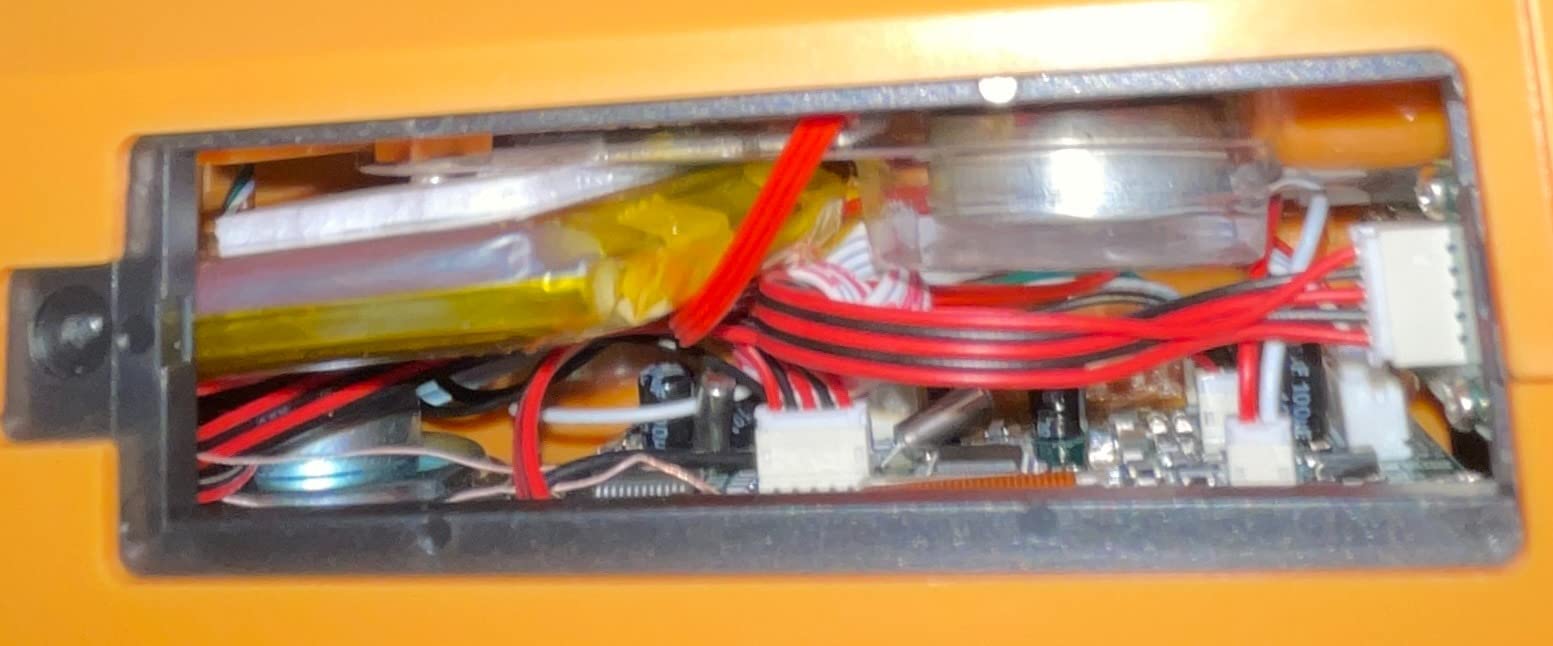
If the question is how long does the radio last before anyone has to think about power, this one wins on capacity alone. The 12000mAh pack is more than double what most competitors carry, and the manufacturer quotes 50 hours or more of FM playback from a full charge.
It is also the only set here rated waterproof rather than merely water resistant, which matters if it ends up on a porch during a storm. The flashlight is rated to 70 meters and the reading lamp covers a small room, so it functions as a lamp as well as a receiver.
One behaviour catches people out. The automatic NOAA alert wakes the set only in standby or alert mode, so if you leave it tuned to shortwave all night and never switch back, a warning can pass unheard. Set it to standby before you sleep, and check the display, which shows time, frequency, battery level and alert status.
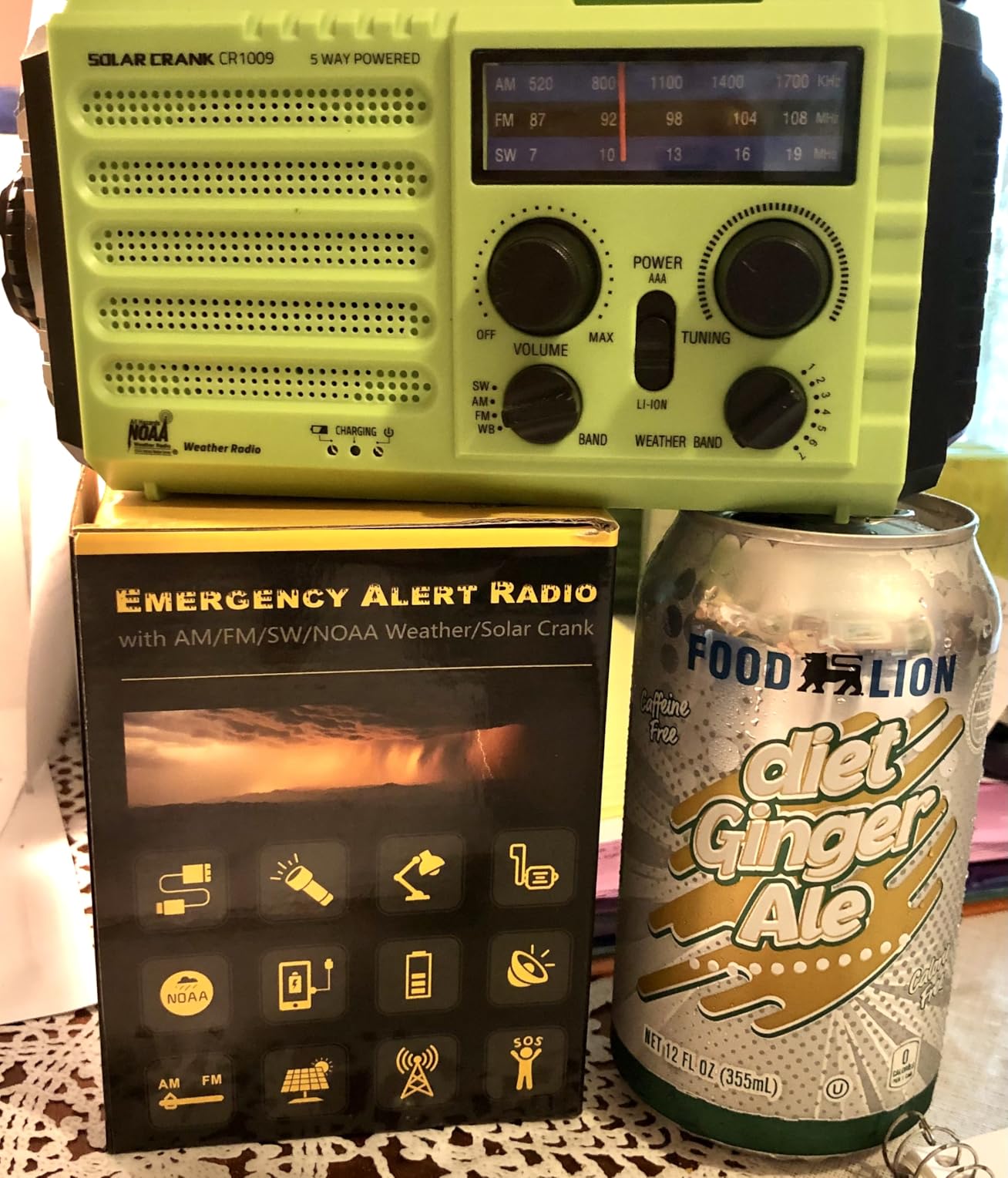
Coverage is genuinely wide, from 520 to 1710 kHz on AM and 2.3 to 23 MHz on shortwave, which is a broader span than most of the crank radios here. The catch is that AM sensitivity is weaker than the FM and NOAA sections, so medium wave stations at night will be harder to pull in than the specifications suggest.
When this radio earns its slot in a kit
It suits multi-day scenarios where nobody is going to a shop for batteries. A household facing a long outage, or a couple going into a storm shelter, gets the longest run time of anything in this roundup from a single charge.
The included AC adapter and USB-C cable remove the classic emergency-radio failure of arriving with no cable. The 18-month warranty is also the longest we saw, which matters when the seller of a white-label radio may not be around next year.
Where it falls short
The internal lithium pack is not user replaceable, so once it ages the set becomes an expensive paperweight as far as power goes. Reviewers also report that AAA backup cells drain alongside the lithium pack rather than stepping in when it is flat, which undermines the main reason to carry them.
Charging a phone from this radio is slow, and reviewers note that using it as a charger degrades reception at the same time. Plan on the radio being a receiver first and a power bank second.
4. Retekess V115 – Best Budget Pocket Shortwave Set
Retekess V115 Shortwave Radio, Digital Radio AM FM
AM/FM/SW digital tuning
1000mAh BL-5C battery
6 to 8 hours per charge
0.16 kg
TF card MP3 playback
Pros
- Lightest and smallest set in the roundup
- AM/FM/SW with adjustable 9 and 10 kHz step
- MP3 playback and radio recording
- Auto search plus manual frequency entry
- Back clip sized for a pocket or pack lid
Cons
- No NOAA weather band at all
- No hand crank solar or AAA backup
- Two watt speaker is quiet
- No flashlight or SOS beacon
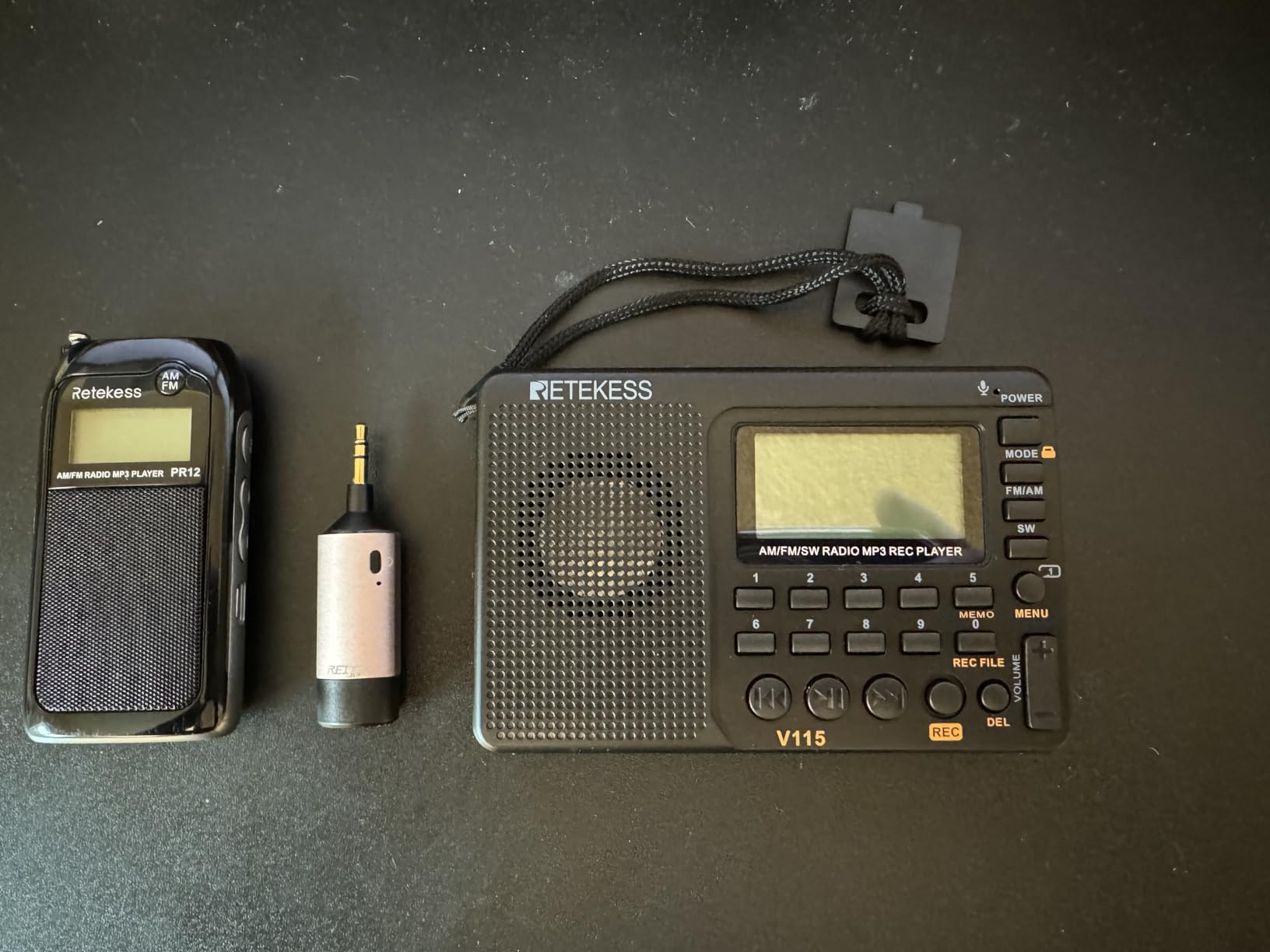
The V115 is here as a listening backup, not as an emergency radio, and we want to be straight about that. It covers AM, FM and a single shortwave band with digital tuning, which is enough to hear international broadcasters, but it has no NOAA weather channel capability at all.
What it does have is a genuinely useful set of extras for a radio this small. A TF card slot plays MP3 files, the same slot records radio audio, and there is a sleep timer plus preset stations. For a long drive or a night in a shelter with no signal, having pre-loaded audio on the same box is not a gimmick.
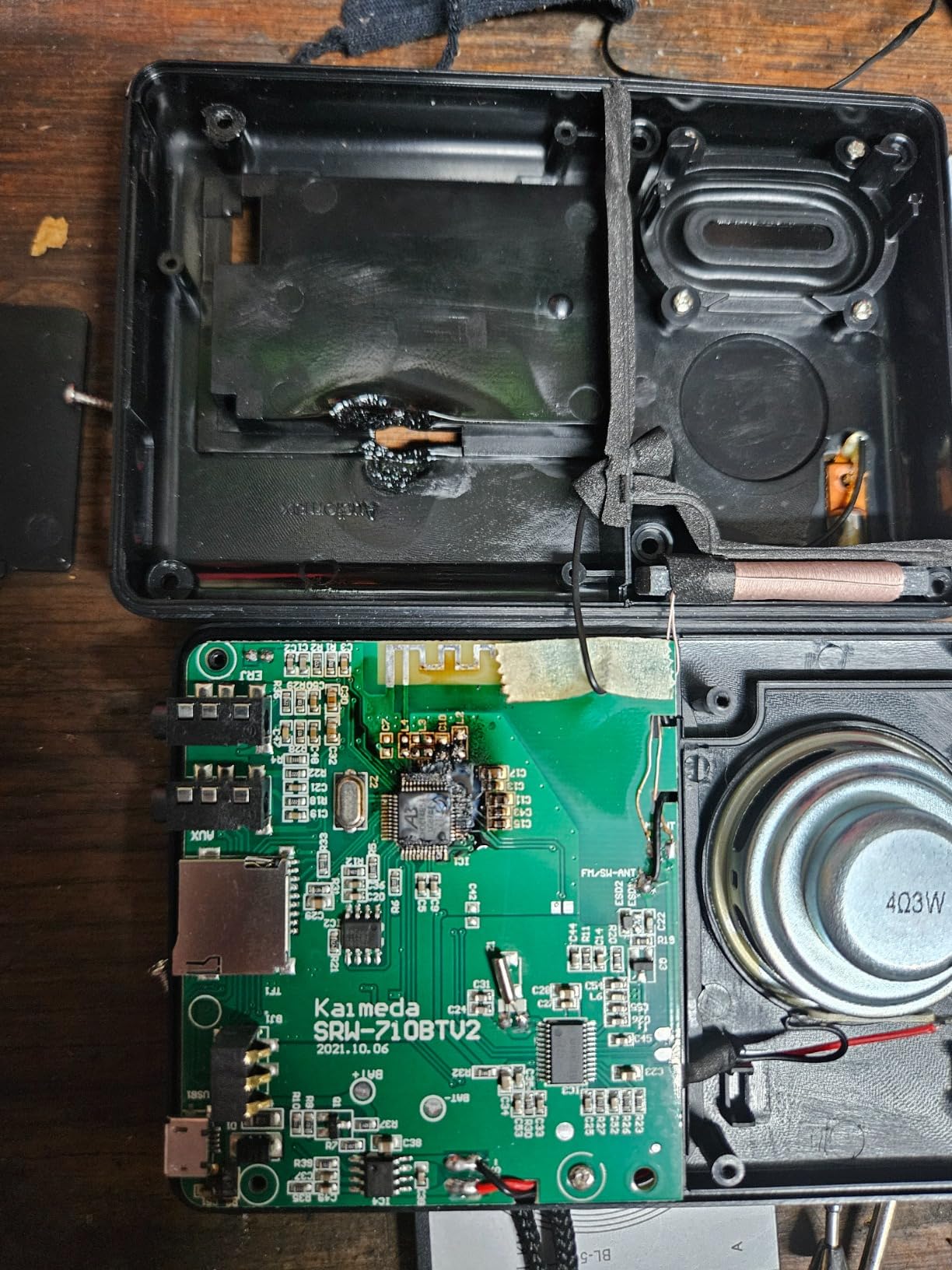
At 0.16 kg it disappears into a jacket pocket, which makes it the easiest of these twelve to keep on your person rather than in a bag at home. The BL-5C cell gives roughly 6 to 8 hours of playback, so it is a same-evening device rather than a multi-day one.
Tuning uses auto search or direct manual entry, and the AM step is switchable between 9 and 10 kHz, which matters for anyone who listens to stations on the wider continental spacing. Reception on the shortwave band is serviceable for nearby stations and thin for distant ones.
When this radio earns its slot in a kit
It suits a car glovebox or a jacket pocket as a third layer of information that costs almost nothing to carry. If the main receiver in your kit breaks, this will still let you hear an AM time signal station or a local station that is still broadcasting.
It also works as a personal audio player during an evacuation, which is a real use case that dedicated weather radios do not cover.
Where it falls short
There is no NOAA alerting, no hand crank, no solar panel and no AA fallback. None of the emergency power paths exist, so in a genuine grid-down event this radio depends entirely on its internal lithium cell being charged in advance.
The two watt speaker is quiet in a noisy shelter, and the plastic shell is not built for drops. If your plan depends on catching an automatic weather warning, buy a different radio and keep this one as the spare.
5. PPLEE NOAA Auto Alert Radio – Best for Go-Bag Backup Power
Emergency Crank Weather Radio with NOAA Auto Alerts and Shortwave, 5000mAh
AM/FM/SW/NOAA
5000mAh plus 3 AAA fallback
Five power sources
16 oz
3W flashlight, 2.5W lamp
Pros
- Five power paths including AAA fallback
- Automatic NOAA alerts with clock display
- Digital AM/FM/SW tuning with auto scan
- USB phone charging
- Carry strap and carabiner included
Cons
- Solar and crank are maintenance only
- Frequency buttons step one at a time
- Some units arrived with defective solar or crank
- Shortwave reception varies by location
The reason this set stands out in a go-bag context is the AAA battery compartment. Three AAAs sit alongside the internal 5000mAh cell, so if the built-in battery has flattened after weeks of storage you are not stuck. Most sealed lithium designs leave you with nothing at that point.
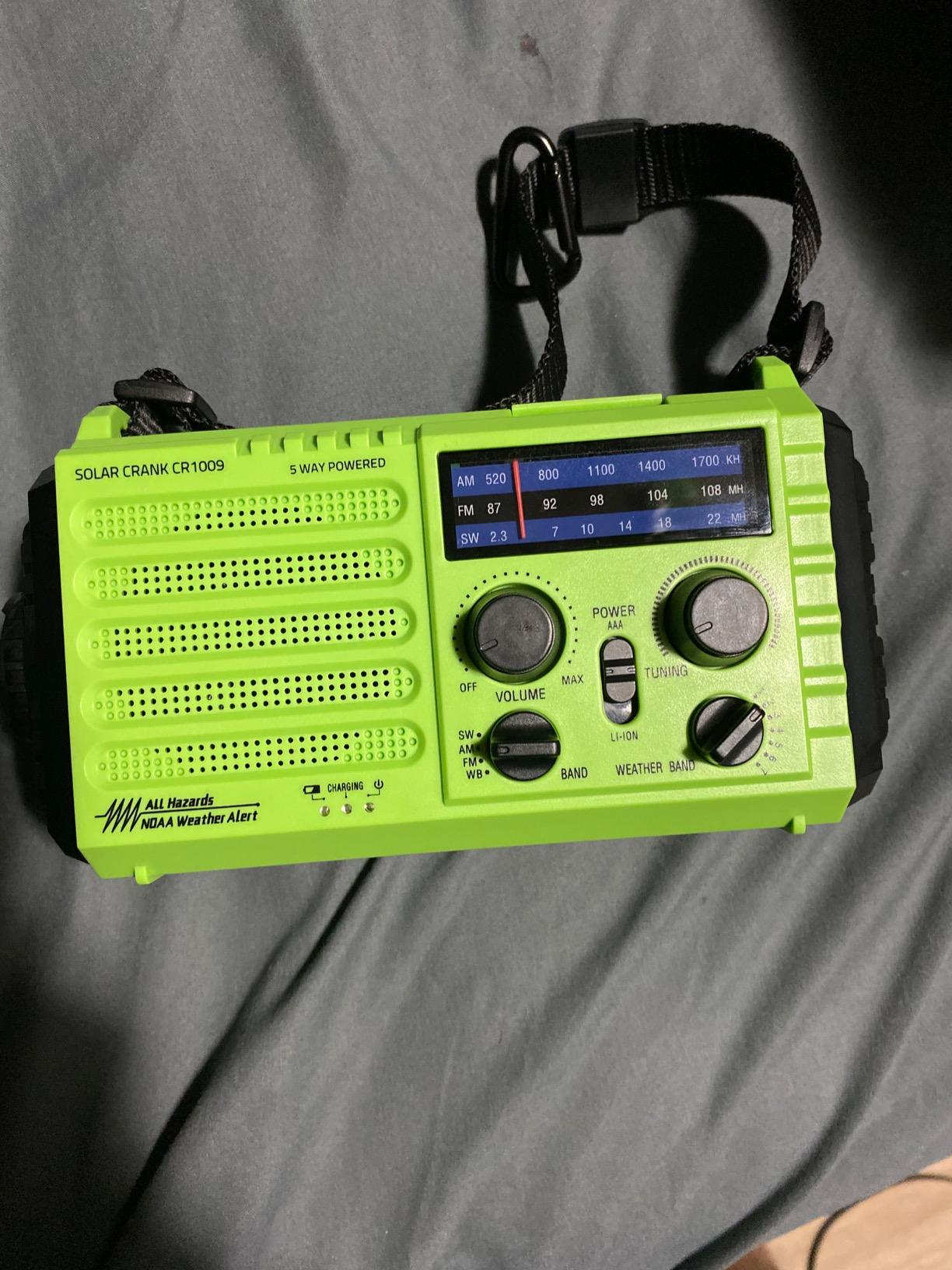
Alerts are automatic in standby mode, and the display carries a clock, so you can see at a glance when the unit last received or when it is in alert state. Digital tuning across AM, FM and shortwave with auto scan means you are not hunting a dial by feel in the dark.
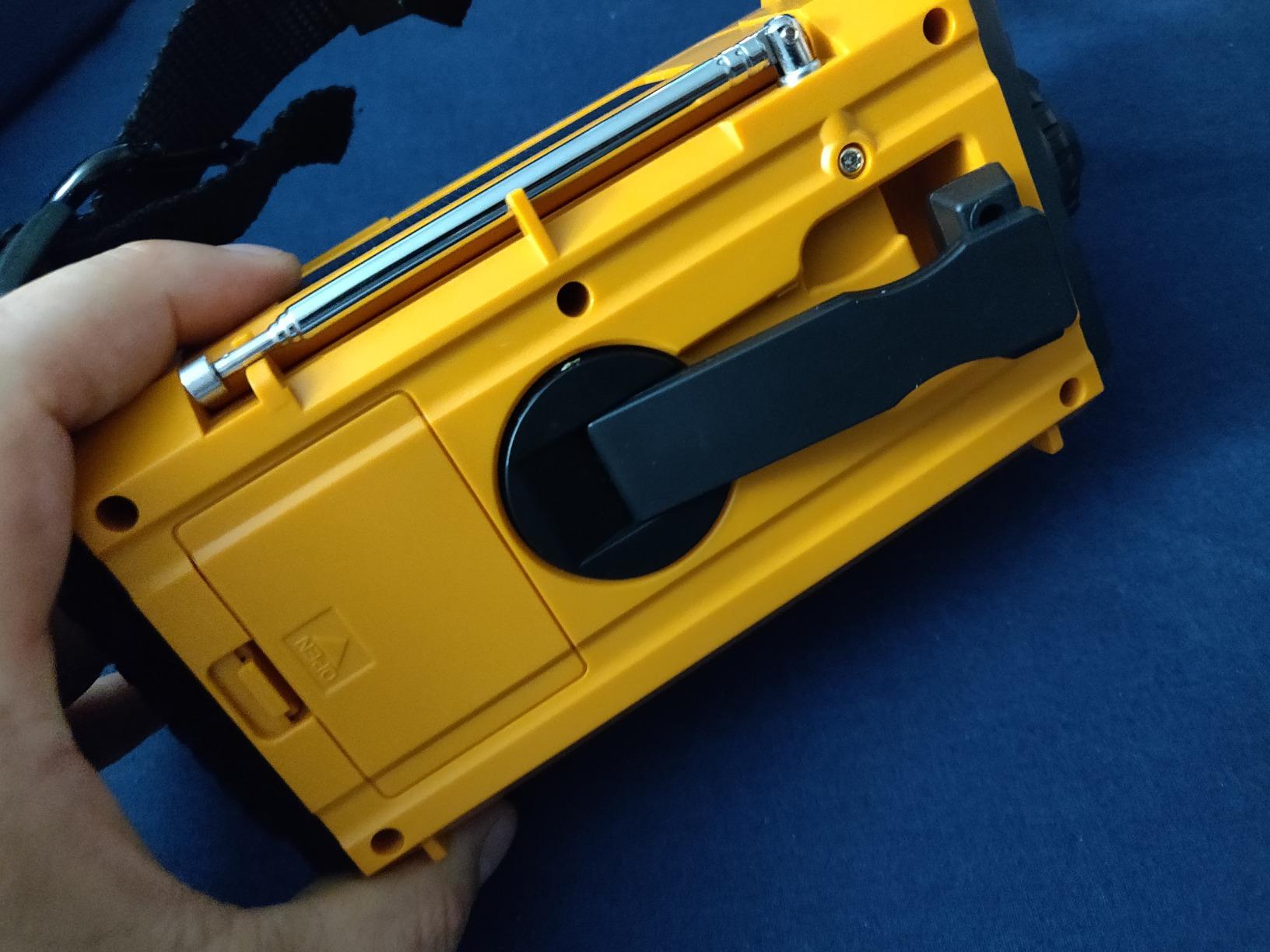
The 3 watt flashlight and 2.5 watt reading lamp are both genuinely bright for the category, and the SOS alarm sounds loud enough to be heard through a wall. A lock button stops a bag being crushed or a button being pressed in transit, which is a small feature that matters more than it sounds when the set lives in a rucksack.
Tuning ergonomics are the weak point. The frequency buttons step one position at a time rather than accelerating, so finding a specific station by scrolling is slow. Use the auto scan to find it once and note the frequency on paper, which is a good habit in a kit anyway.
When this radio earns its slot in a kit
It is built for a bag that gets opened rarely. The combination of a sealed rechargeable cell, AAA fallback and five charging paths means the radio is unlikely to be dead on the one day you need it, even if it has been sitting for months.
The included braid strap and carabiner mean it can hang from a tree branch, a tent loop or a fence rail, which gets the antenna away from your body and improves reception more than any internal change.
Where it falls short
The solar panel is too small for meaningful charging and the hand crank stores very little energy, so treat both as keeping a stored battery topped up rather than as a power source. Reviewers also report a small share of units arriving with defective solar or crank mechanisms, which the seller has replaced on request.
The bundled compass is unreliable in mountainous terrain, and shortwave reception still depends heavily on where you are standing. It is a fine backup radio, not a primary receiver for a serious listener.
6. ROCAM CR1009 – Best for Wet Weather and Storm Season
Emergency Radio with NOAA Weather Alert – Solar Hand Crank Portable AM/FM Shortwave Radio, Rechargeable Battery 5000mAh, USB Charger, Flashlight, SOS Alarm for Home Outdoor Hurricane Survival
AM/FM/SW/NOAA
IPX6 water resistance
Five power sources
5000mAh battery
16 oz with 3W flashlight
Pros
- IPX6 water resistance outranks most rivals
- AM/FM/SW plus 7 NOAA channels
- 3W flashlight and 6 LED reading lamp
- Loud SOS alarm with flashing light
- 12-month warranty
Cons
- Analog pointer display instead of digital
- Micro USB rather than USB-C
- Solar and crank are maintenance charging only
- Compass accuracy is questionable
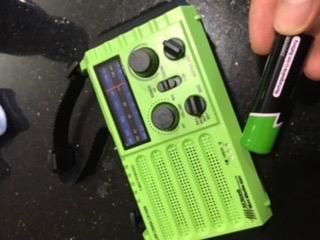
Storm season is where water resistance becomes a real specification rather than a checkbox, and this is the set here that takes rain most seriously. IPX6 means it survives heavy spray and pouring rain, which is a step above the splash rating most of the crank radios carry.
The light output is unusually good. A 3 watt flashlight plus a 6 LED reading lamp gives you a usable room light and a beam you can aim across a yard, and both run from the same battery that is powering the receiver. For most households the lighting half of this radio gets used far more than the shortwave half.
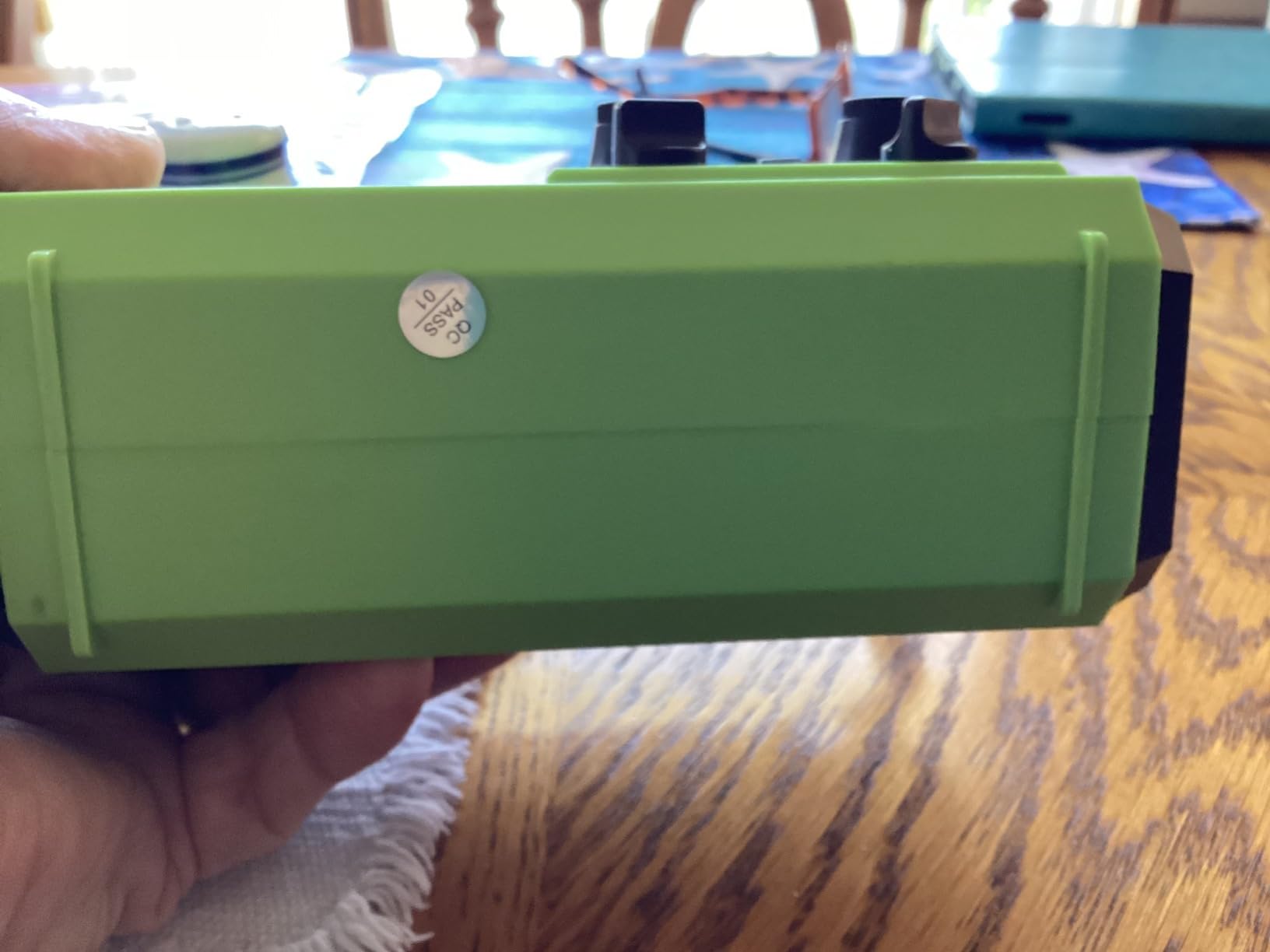
Power comes from solar, hand crank, the built-in 5000mAh rechargeable cell, AAA cells and micro USB. As with the others, the first two are topping-up options. The practical sequence is to charge it fully, carry it charged, and treat the panel as insurance.
The analog pointer dial is the most dated part of the design. Tuning is by knob rather than digital entry, which some people find easier in the dark and others find frustrating when they know the frequency they want. There are 12-month warranty terms, which is reasonable for this tier.
When this radio earns its slot in a kit
It suits a coastal home, a boat, a garage or a porch setup where the radio will live in damp conditions. A set rated IPX6 lets you leave it where you need it rather than pulling it inside every time rain starts.
It also makes sense as a hurricane kit radio for a family that is not technical. Turn to FM for local stations, NOAA for alerts, and the lamp and flashlight cover the two things everyone actually reaches for first.
Where it falls short
No digital display means no station memory beyond what you tune manually, and no clock to tell you when the unit last received. That matters in a shelter where you want alerts without hunting for them.
Micro USB is the older connector, so an old cable you already own will work but a modern USB-C cable will not. The larger battery variants with an LCD cost more, and the compass is worth ignoring.
7. C. Crane CC Skywave 2 – Best for Serious Listeners Who Want Air Band
C. Crane CC Skywave 2 AM, FM, Shortwave, NOAA Weather + Alert, VHF Aviation Band, Small Battery-Operated Portable Travel Radio with Clock and Alarm
AM/FM/SW/NOAA plus VHF air band
2300-26100 kHz SW
400 memories
70 hours on 2 AA
6 oz with antenna jack
Pros
- Reception and selectivity across every band
- Shortwave antenna jack for an external wire
- VHF aviation band with scan memories
- About 70 hours on 2 AA batteries
- US-based support and a one-year warranty
Cons
- No hand crank solar or rechargeable battery
- Not water resistant
- Backlight times out after 10 seconds on battery
- Faux leather case gives little drop protection
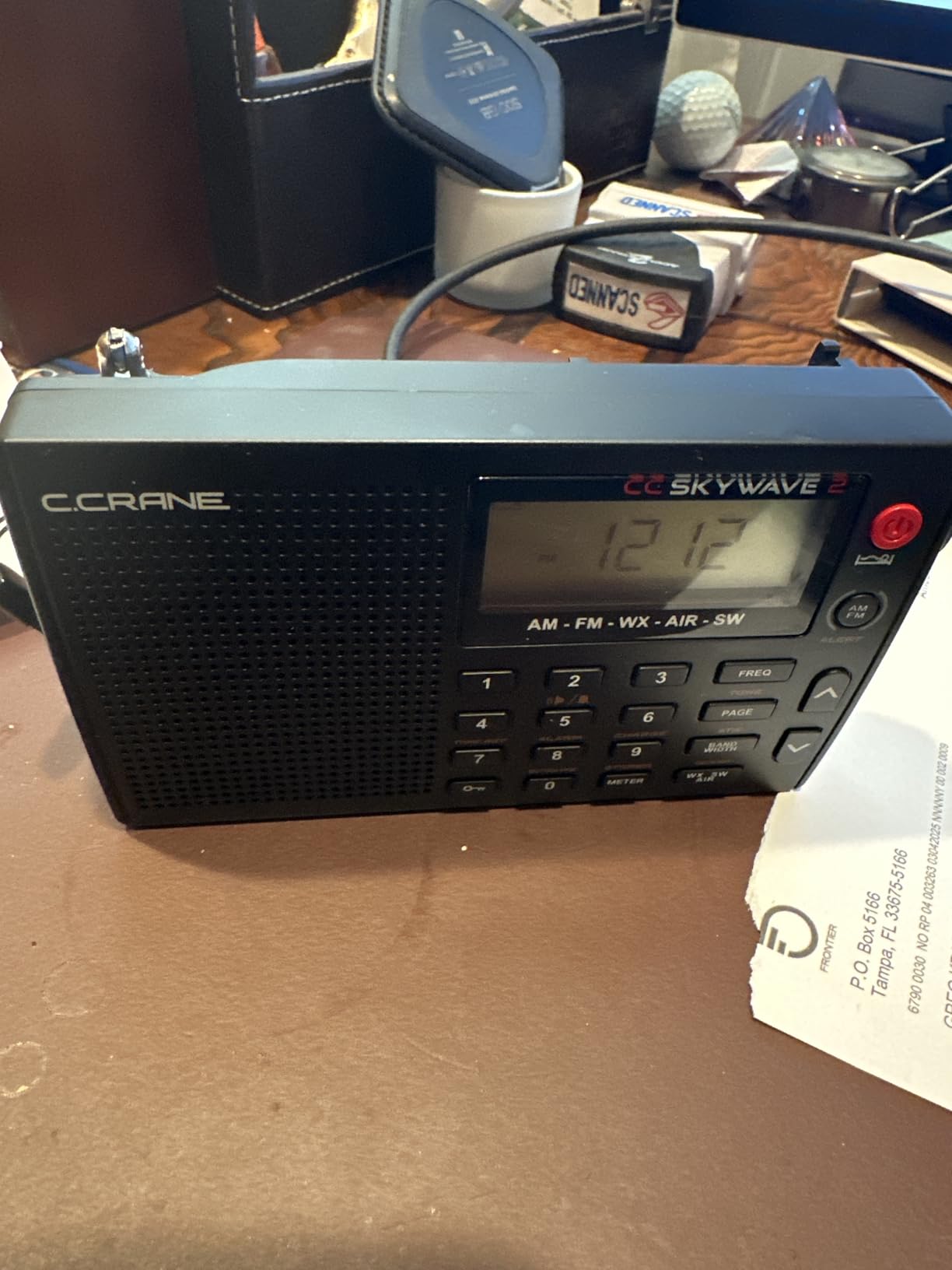
This is the first set in the roundup that behaves like a real communications receiver rather than an emergency novelty, and it changes the calculation for anyone who listens as well as prepares. Sensitivity and selectivity across AM, FM, shortwave, NOAA and the VHF aviation band are the strongest in this group by a clear margin.
The aviation band is the feature enthusiasts notice first. You can park outside on the approach path and listen to tower and ground frequencies, which turns an emergency kit into something you will actually use on an ordinary afternoon. Ten of the 400 memories are dedicated to aviation scanning.
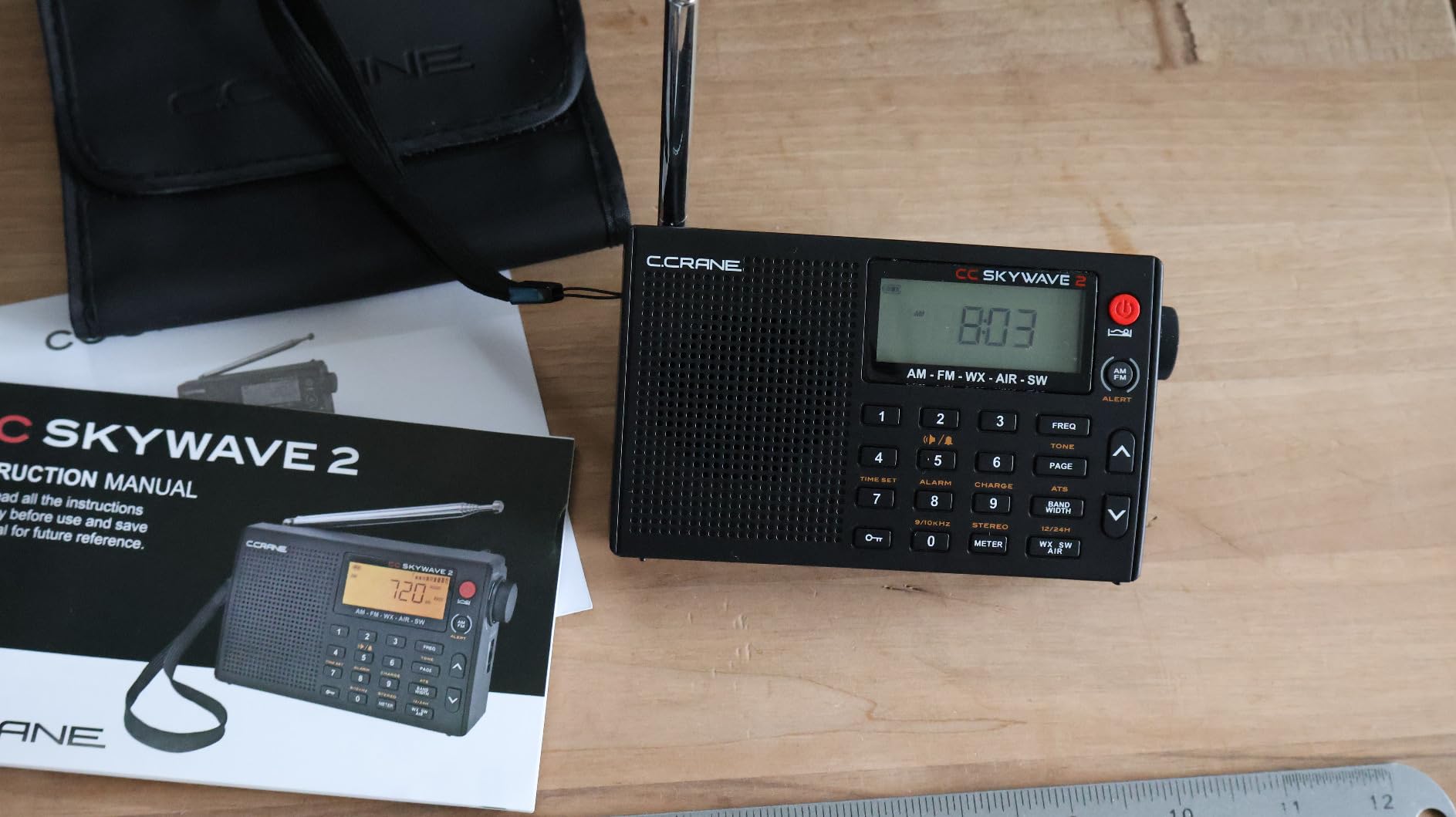
There is a shortwave antenna jack, and that single socket is what makes this set a serious emergency receiver. With a short piece of wire running to a fence or a tree, reception on distant stations changes dramatically compared with the internal whip.
Power is two AA batteries only, with about 70 hours of runtime on earbuds and roughly 60 on the speaker. That is excellent endurance and AA cells are the easiest thing to replace in a crisis. There is no crank and no solar panel, which is the honest trade you make for the reception quality.
When this radio earns its slot in a kit
It suits a household that wants one receiver at home, powered by an external wire antenna, covering NOAA alerts, local AM and FM, international shortwave and air band. At 6 ounces it also travels well and fits in a day pack without thought.
The 400 memory slots let you build a printed station list in advance. Spending twenty minutes storing your local channels and your national shortwave stations means that in a crisis you are pressing one number rather than sweeping a dial.
Where it falls short
It is not weather resistant, so keep it indoors. The display backlight shuts off after about 10 seconds on battery power to save cells, which is sensible but annoying when you are reading a frequency list by light.
There is no flashlight, no SOS beacon and no phone charging, so it cannot serve as a lamp. The included faux leather case is thin, and a drop onto concrete is a realistic way to lose a set at this level.
8. Tecsun PL880 – Best for SSB Reception on a Budget
Tecsun PL880 Portable Digital PLL Dual Conversion AM/FM Longwave Shortwave Radio with SSB (Single Side Band) Reception
PLL dual conversion
AM/FM/LW/SW/SSB
4 and 5 bandwidth filters
10 Hz SSB step
520 g with external antenna
Pros
- Dual conversion PLL with excellent sensitivity
- AM/FM/longwave/shortwave plus SSB
- Selectable bandwidth filters on AM and SSB
- 10 Hz tuning step for utility stations
- External antenna input
Cons
- No NOAA weather band or alerts
- No crank solar or rechargeable battery
- AA powered only
- No flashlight and no phone charging
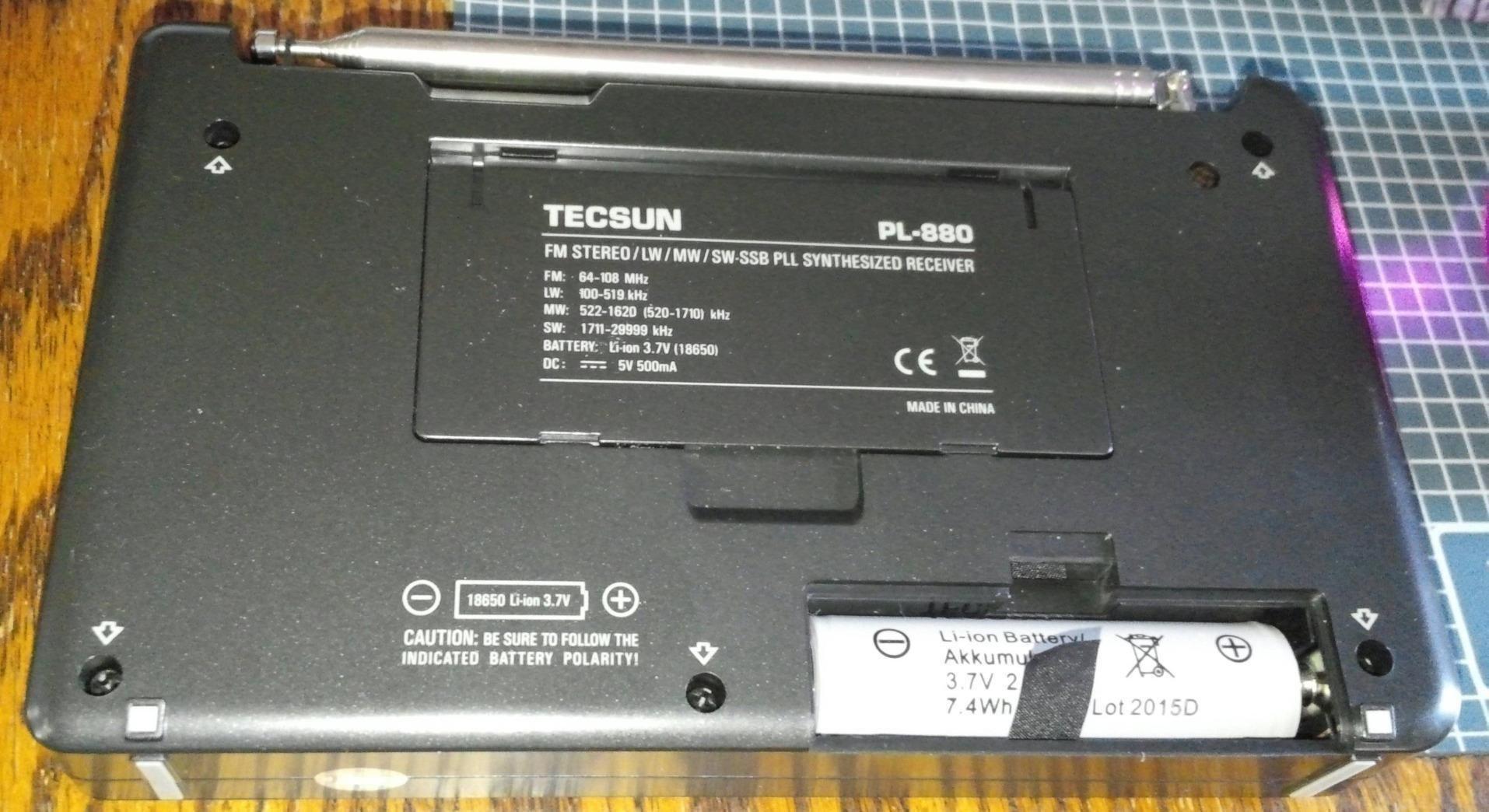
The PL880 is the point where single sideband reception becomes affordable, and that matters more in an emergency than most buyers realise. AM shortwave carries the international broadcasters, but utility stations, maritime traffic and amateur operators are on SSB, and an AM-only receiver cannot hear any of it.
Dual conversion is the technical reason this set performs. Using two frequency conversion stages sharply improves rejection of interference, which is what lets you sit on a weak station next to a strong one. The 4 and 5 kilohertz bandwidth filters on AM and the narrower SSB filters let you trade audio quality for selectivity as conditions change.
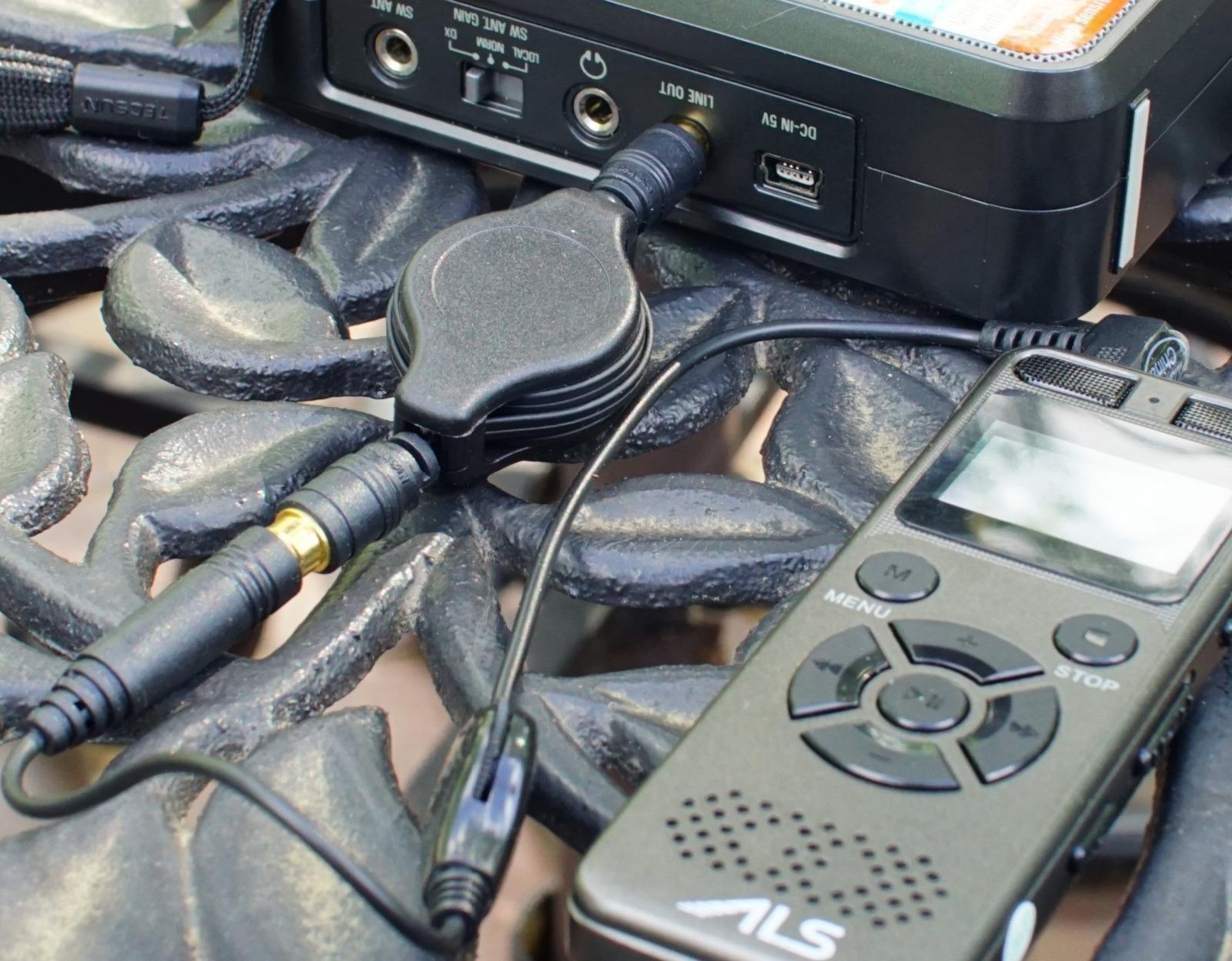
Frequency coverage spans AM, FM, longwave, shortwave and SSB, so longwave stations, often running maritime and utility traffic, are available too. Direct frequency entry with a 10 Hz step in SSB means you can land exactly on a utility channel rather than hunting near it.
The catch for emergency use is real. There is no NOAA weather band, so this radio will not give you official weather alerts, and it runs on AA cells with no crank, no solar panel and no internal rechargeable cell. You supply the antenna and the batteries, and it does the listening.
When this radio earns its slot in a kit
It suits someone who wants to hear what utility and amateur stations are saying during a regional disruption, which is often where the earliest situational information appears. Add it to a home setup with a long wire antenna and it becomes a genuinely capable information source.
It also suits travel. At 520 g it is a substantial but portable set, and the longwave and air-adjacent coverage means it picks up stations a domestic-only radio would miss entirely.
Where it falls short
No NOAA alerts is the biggest gap, and it is a hard gap for US buyers in hurricane or tornado country. You would need a separate weather radio alongside it, which is fine as long as you plan for two devices.
The control layout is dense for a first-time listener, with bandwidth, RF gain and mode buttons that mean nothing on day one. At 520 g it is not a pocket radio, and there is no flashlight for the dark.
9. Emgykit R11 – Best for Bluetooth and Media Playback
Portable Shortwave Radios with NOAA/SW/AM/FM, for Camping & Home
NOAA/SW/AM/FM
Bluetooth 5.0 streaming
4000mAh battery, 32 hours
TF, SD and USB playback
120LM flashlight
Pros
- Bluetooth 5.0 lets it act as a speaker
- Plays MP3 from TF
- SD or USB
- 4000mAh gives about 32 hours
- 120LM flashlight plus compass and SOS
- Auto-scan stores up to 210 channels
Cons
- Only three charging methods with no AAA backup
- Newer brand with a shorter review history
- Shortwave reception depends on location
- Small 5 watt speaker
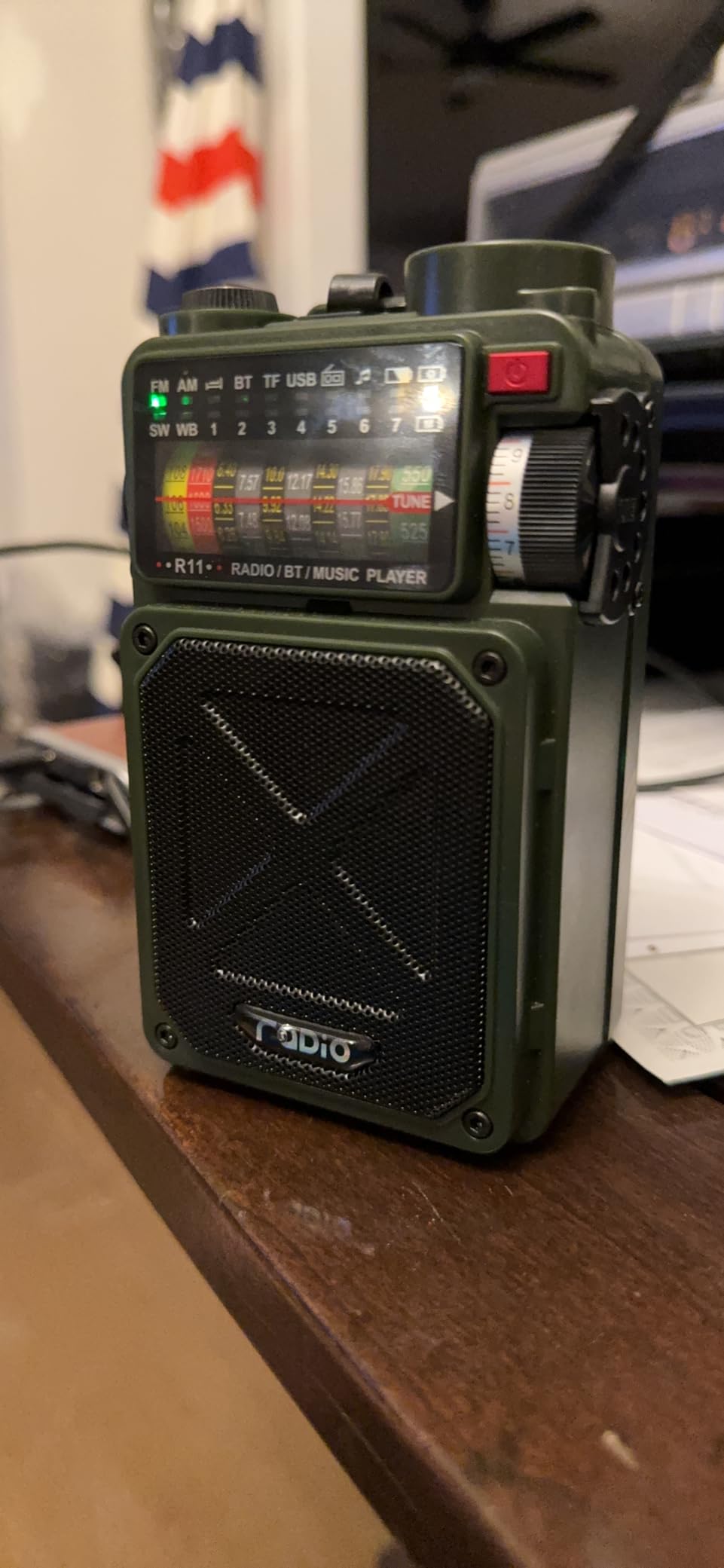
Most emergency radios in this category are cut-down versions of a normal receiver. This one runs the other way: it is a modern media and Bluetooth device with NOAA and shortwave added, and for a shelter with no internet that combination has real value.
Bluetooth 5.0 means a family member with a phone can push audio to it, and the TF, micro SD and USB playback covers files without any network at all. Seven white noise tracks and a 10 to 70 minute auto shut-off are small touches that make it usable as a bedside unit.
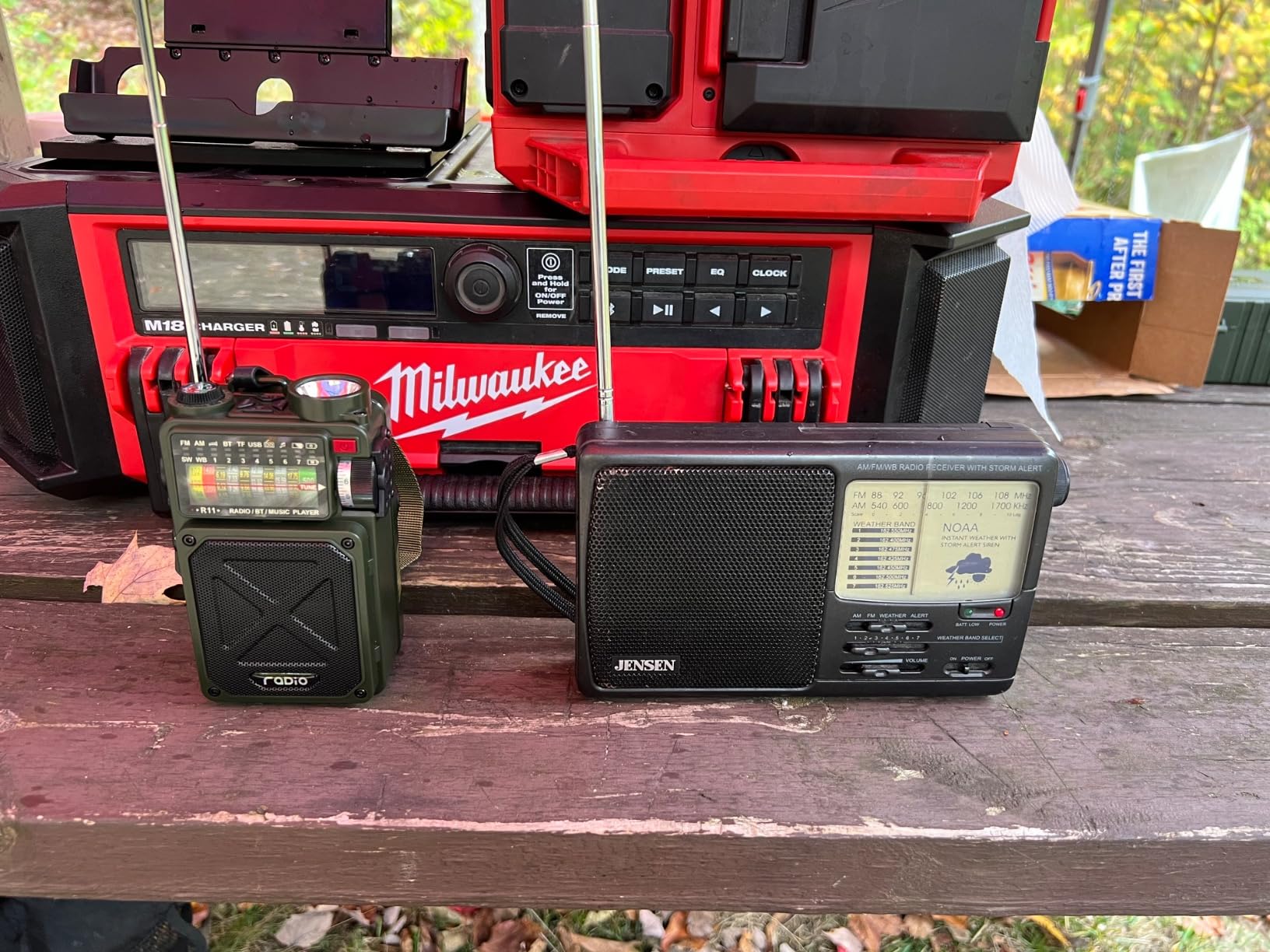
Charging is by USB-C, solar panel or hand crank, and the 4000mAh cell gives roughly 32 hours of playback. The gap here is that there is no AAA compartment, so if the internal cell is flat and the solar or crank has nothing to give, this radio is finished until it reaches a socket.
Digital auto-scan stores up to 210 channels, 70 per band, which is more than you will ever use but means the useful stations are found quickly. Shortwave reception is dependent on local conditions and on the internal antenna, so treat it as a convenience band rather than a long-range receiver.
When this radio earns its slot in a kit
It suits a family shelter where the adults have phones with downloaded material and the children need entertainment through a long night. A radio that plays local files and accepts Bluetooth covers that in a way a pure broadcast set cannot.
The included military-style case and carry strap make it easy to move between rooms, and the 120 lumen flashlight is adequate for finding a switch in the dark.
Where it falls short
Three power sources is thin for an emergency device, and there is no battery fallback. The brand is newer than most in this roundup with a shorter history of long-term reliability reports, so we would test it every few months rather than trusting it on faith.
The 5 watt speaker is small for a group, and shortwave reception will disappoint anyone expecting the selectivity of a dual-conversion set.
10. Tecsun PL330 – Best Pocket Worldband Receiver with SSB
Tecsun Digital PL330 AM/FM/LW/SW Worldband Radio with Single Side Band Receiver
AM/FM/LW/SW/SSB
DSP with synchronised detection
850 memory presets
7.4 oz
Rechargeable, about 22 hours
Pros
- DSP and synchronised detection pull weak stations in
- SSB coverage alongside AM/FM/longwave/shortwave
- 850 memory presets for stored stations
- External antenna input
- 22 hours per charge at 7.4 oz
Cons
- No NOAA weather band or alerts
- No hand crank solar or AA backup
- 0.2 watt speaker needs earphones
- No kickstand so it tips with an external antenna
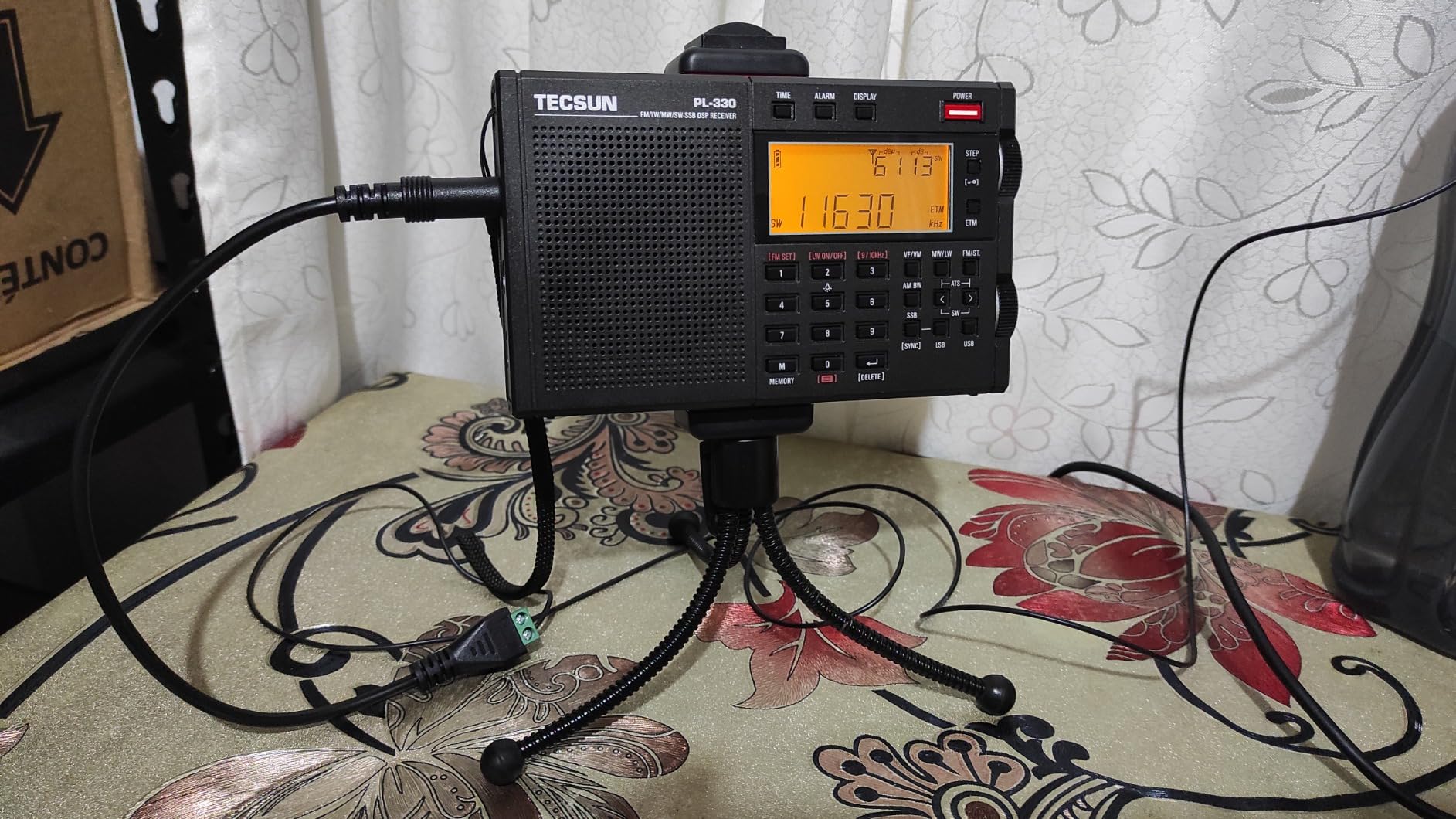
The PL330 does something no other set at this weight does, which is full SSB and longwave reception in a body you can put in a coat pocket. Seven and a half ounces with a rechargeable cell giving about 22 hours means it is a radio you will carry rather than one you will leave on a shelf.
The DSP chip with synchronised detection is what does the work at night on medium wave, where a conventional detector loses weak stations under fading. Synchronised detection re-times the received signal so the audio survives conditions that would turn an ordinary AM set into noise.
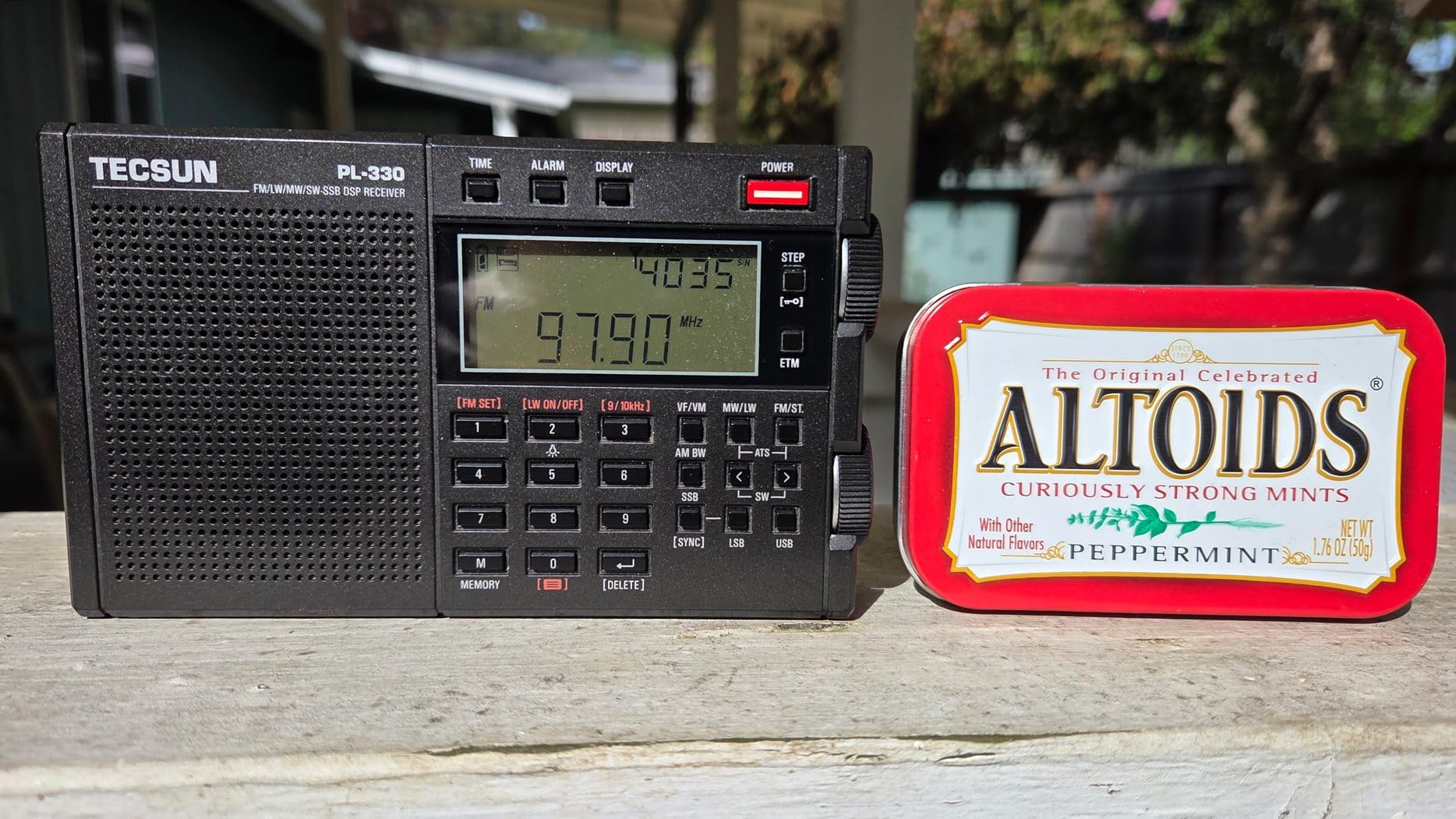
There is an external antenna input, 850 memory presets, a keylock and firmware that can be updated. All of that makes it easy to build and then correct a station list: write your frequencies on paper, key them into memory, and use the lock so a bag does not change them.
Two honest problems. There is no NOAA weather band, so it is not an alert receiver at all. And the 0.2 watt speaker is effectively decorative, meaning earphones are close to mandatory for anything except checking a frequency.
When this radio earns its slot in a kit
It suits a go-bag that is carried on foot or a jacket pocket during an evacuation, where 520 g receivers are unwelcome. Earphones solve the volume problem, and a private listening post in a shared shelter is often the more considerate option anyway.
It also doubles as a travel receiver for anyone who moves between countries, since the longwave and shortwave coverage picks up stations a domestic-only AM/FM set would miss entirely.
Where it falls short
No NOAA alerting is a decisive gap for US emergency use, and the rechargeable-only power means no AA fallback if the cell ages or drains. The tuning and volume knobs are light in the hand and there is no kickstand, so it will not sit still with a wire antenna attached.
The full feature set has a genuine learning curve. Budget an evening with it before you need it, and write down what you learned.
11. Jazmm Bluetooth Shortwave Radio – Best for Loud Speaker Audio
Bluetooth AM FM Shortwave Radio with NOAA Weather Alert,1250mAh Rechargeable Portable Pocket Radio with Best Reception,5W Big Speaker, Digital Tuner and Earphone,Support SD Card and USB MP3 Player
FM/AM/SW/WB four band
1250mAh USB-C battery
10 to 12 hours
5W stereo speaker
352 g with back clip
Pros
- Loudest speaker in the roundup at 5 watts
- Four band coverage including NOAA weather
- Back clip and wrist strap for hands-free carry
- Bluetooth 5.4 and TF card playback
- DSP chip and simple labelled controls
Cons
- 1250mAh gives only 10 to 12 hours
- Shortwave sensitivity is adequate rather than strong
- No hand crank solar or AAA backup
- Dense button layout takes practice
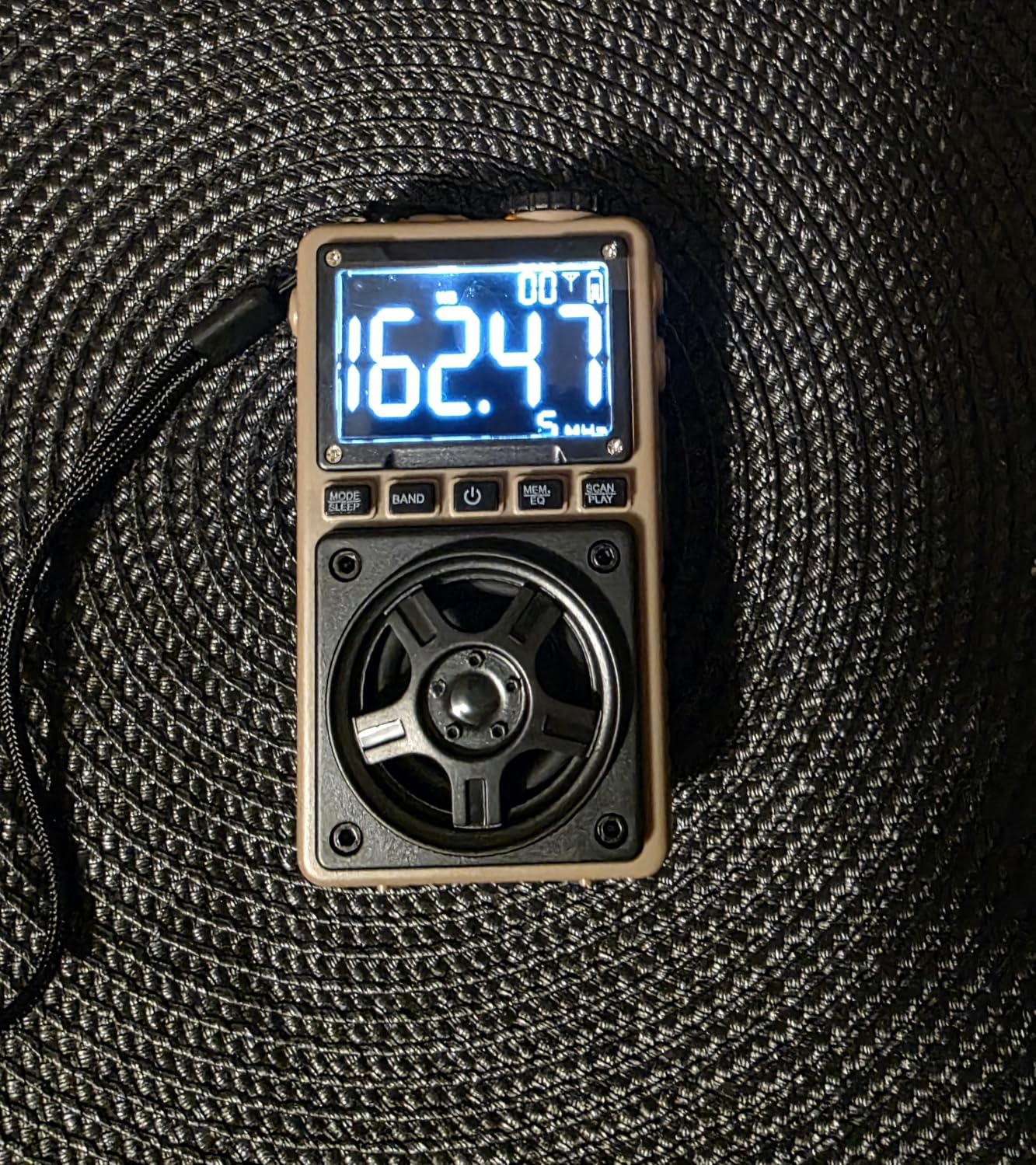
If your go-bag is going somewhere noisy, speaker volume becomes an emergency specification. This is the loudest set here at 5 watts with six EQ settings, and buyers consistently single out the sound quality as the reason they kept it.
Coverage runs FM 87 to 108 MHz, AM 520 to 1710 kHz, shortwave 4.75 to 21.85 MHz and a weather band from 162.400 to 162.550 MHz. A DSP chip handles the decoding, and reviewers describe the controls as simple and well labelled once you have found them.
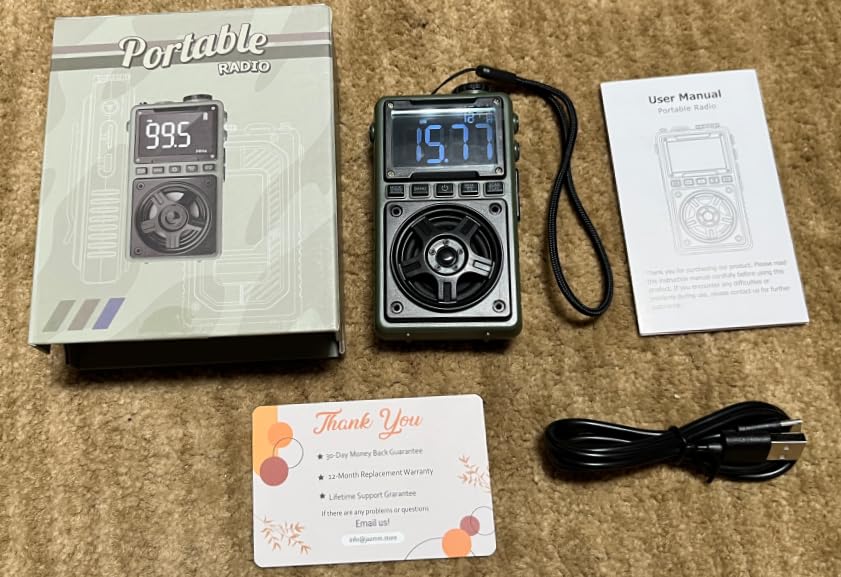
Bluetooth 5.4 and a TF card slot let it double as a speaker and an MP3 player, and there is a built-in flashlight plus a 3.5 mm headphone jack for when you do not want company. The back clip and wrist strap make it easy to wear on a belt or a pack strap.
The 1250mAh cell gives roughly 10 to 12 hours per USB-C charge, which is the shortest useful runtime among the rechargeable sets here. Shortwave sensitivity is described by some owners as adequate rather than strong, so treat the weather band and local AM as the reliable parts.
When this radio earns its slot in a kit
It suits a group shelter, a vehicle or a job site where you need everyone to hear a warning without crowding around one small speaker. Being able to hand it to a family member and have them clip it to a harness also reduces the chance of it being left behind.
The four-band spread covers the amateur-adjacent and utility part of shortwave, so listeners get a range of stations without needing a dedicated communications receiver.
Where it falls short
Ten to 12 hours of runtime is short for a multi-day event, and there is no crank, no solar panel and no AA compartment to extend it. Plan to recharge it whenever a vehicle or a mains supply is available.
Shortwave reception is the least impressive part, and a small share of owners note that weather alert coverage depends on signal strength in their area. The button layout is dense, so label the ones you actually need with tape.
12. Kaito NOAA Solar Hand Crank Radio – Best for Phone Charging on a Budget
Best NOAA Portable Solar/Hand Crank AM/FM, Shortwave & NOAA Weather Emergency Radio with USB Cell Phone Charger & LED Flashlight (Green)
Five-way powered
AM/FM/SW plus 7 NOAA channels
USB phone charging output
14 inch telescopic antenna
Palm-size ABS body
Pros
- Five power paths including crank and solar
- DC 5V USB output charges a phone
- 14 inch telescopic antenna for shortwave
- Siren and SOS beacon light
- Water and impact resistant ABS body
Cons
- Earphones not included
- AAA batteries not included
- NOAA coverage limited to the USA and Canada
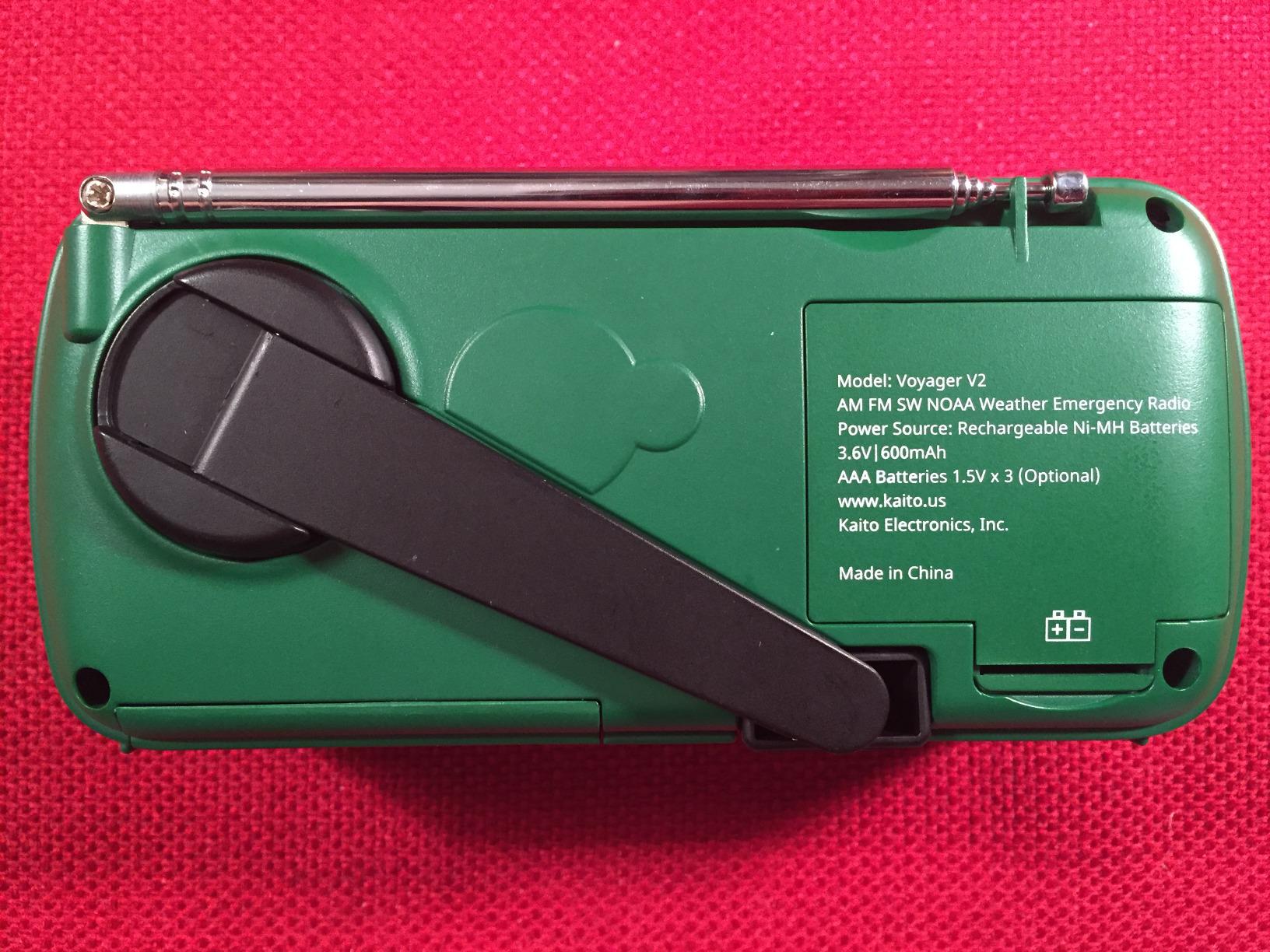
This set closes the list because it does something the others mostly do not at this tier: give you a USB output capable of putting charge into a phone. In a long outage a phone that can still make emergency calls is arguably the most valuable device in the room, and this radio will top one up.
Power comes from a hand crank generator, a solar panel, a three AAA compartment, a 5V mini USB input and a built-in rechargeable NiMH pack. That is five paths, and the replaceable NiMH design means an ageing battery is a low-cost repair rather than a write-off.
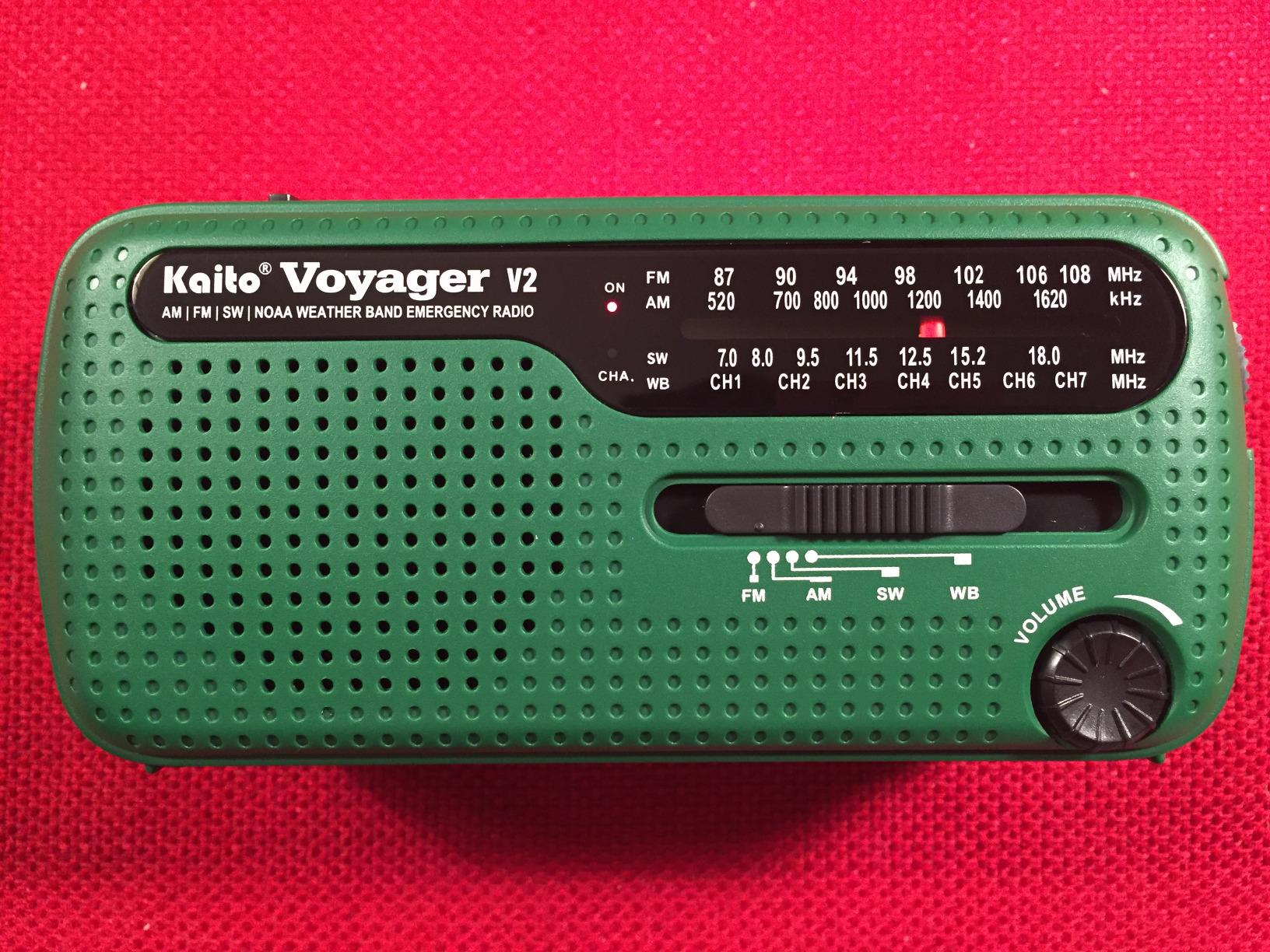
The 14 inch telescopic antenna is longer than most at this level and does help shortwave reception. A loud speaker, an earphone jack, a siren, an LED flashlight and a red SOS beacon round out the emergency functions, all in a palm-size impact and water resistant body.
Two practical gaps to know about before you buy. Earphones and AAA batteries are not in the box, so add those to your kit list. And NOAA transmissions only cover the USA and Canada, which makes this a poor choice if your emergency planning extends abroad.
When this radio earns its slot in a kit
It suits a go-bag for someone who wants one device that can power a phone, light a room, sound an alarm and still receive weather alerts. That combination at this level is unusual, and it is the reason we would not leave it out of the roundup.
It also works as a backup unit in a second building or a vehicle, where a palm-size set with five power paths is more practical than a larger receiver.
Where it falls short
The phone charging output is modest, so think of it as keeping a phone marginally alive rather than recharging it. Earphones and AAA cells cost extra, and NOAA coverage stops at the US and Canadian border.
The report history is shorter than most in this roundup, so test the crank and the USB output yourself before you rely on them. It is a capable backup radio, not a primary one.
What Can You Actually Listen To? Stations That Matter in an Emergency
Shortwave sounds like a strange hobby until you realise what is transmitting on it. These are the station categories worth pre-loading, with the frequencies you will hear most often.
NOAA Weather Radio, channels 1 to 7. 162.400 to 162.550 MHz. Continuous 24 hour official forecasts and warnings for the United States, and the single most useful thing any radio on this list can do. Program your county if the set supports SAME alerts.
Time and frequency signals. WWV at 2.5, 5, 10, 15 and 20 MHz, and WWVH on 5, 10 and 15 MHz. These broadcast an accuracy announcement every second, which lets you check a receiver is actually tuned correctly and gives you the time without a phone.
International broadcasters. The BBC World Service around 9410, 11640 and 15340 kHz, VOA and Radio Netherlands Worldwide across the tropical bands. They rarely carry local emergency detail but they carry national and international news that domestic stations will not.
Amateur radio bands. 3.5 to 4 MHz, 7 to 8 MHz, 14 to 15 MHz and 21 to 22 MHz on SSB. Licensed operators run nets for storm and emergency traffic, and you need an SSB capable receiver to hear them.
Aviation air band. 118 to 137 MHz on AM. Tower, ground and approach frequencies. In a regional emergency, flight traffic is often the first sign of how bad a situation is, and the C. Crane Skywave 2 covers this band.
Utility and maritime traffic. Longwave around 230 to 300 kHz, and higher shortwave bands. Coastal stations, weather bulletins and shipping traffic, often on SSB. Longwave coverage is the reason some sets still include it.
Local and regional shortwave. Some areas still have shortwave relay stations that survive when AM and FM transmitters are off the air. There is no fixed list, which is exactly why you should sweep the band during daylight hours and write down what you hear.
Digital shortwave, or DRM. A small number of DRM transmissions carry better audio than AM, but the technology is thin on the air and most of the sets here cannot decode it. Do not buy on the promise of DRM.
Two hours spent scanning these bands on a normal weekend is worth more than any feature on a spec sheet. Write the frequencies down on paper, store them in the radio’s memory, and put the paper in the bag.
What a Shortwave Radio Cannot Do
Set expectations honestly and you will be happier with whatever you buy. A shortwave receiver is one category of information, and it has hard limits.
It cannot create local news. If every station in your area is dark, there is nothing to hear. Shortwave broadcasts from far away travel further precisely because they do not depend on your local infrastructure.
It cannot talk back. Every radio here is receive-only. Transmitting on amateur bands needs a licence, and an unlicensed handheld is a different product with a different legal status.
It does not replace a dedicated NOAA radio. A set that only handles the seven weather channels will sound a warning faster and more reliably than a general receiver you have to be listening to.
It is not a GPS, a map or a radio licence. Positioning and calling for help remain the job of a phone, a beacon or a satellite messenger.
It will not fix a weak location. In a basement, a steel-framed building or a deep canyon, shortwave reception collapses no matter which model you buy. Propagation is the limit, not the hardware.
A hand crank is not a power station. On every set here, cranking maintains a stored battery rather than replacing a wall supply. Solar panels do the same, more slowly.
How to Improve Shortwave Reception When the Power Is Out
Most reception complaints trace back to antenna and placement rather than to the radio. Six steps fix the majority of them.
Run a wire outside. If your set has an antenna jack, attach 5 to 15 metres of wire to a fence, a tree or a metal gutter. The counterpoise is the wire itself, so it needs a good ground connection as well as a high connection.
Get the radio away from electronics. Chargers, LED lamps, switch-mode power supplies and even a phone on the same table will raise the noise floor. Move ten metres away from suspect sources if you can.
Use the hour that suits the band. The lowest shortwave bands work best at night, when the ionosphere carries them furthest. Higher bands open up in late afternoon. Tune when you have daylight, not at 3 am.
Extend the whip all the way. A telescopic antenna half extended is worse than useless, because it becomes a poor aerial with a good one in reach.
Turn bandwidth down on AM. On the radios with selectable bandwidth, the narrow setting rejects neighbouring stations and lets weak signals rise above the noise.
Move away from metal. Vehicles, chain link fences, water tanks and lift shafts reflect shortwave. Outdoors, away from structures, reception is typically better by a wide margin.
What to Look for in an Emergency Shortwave Radio
Seven criteria, in the order we would weight them.
NOAA weather alert in standby. For US buyers this is the first filter. A set that only sounds warnings while you are already listening to another band is much less useful than one that watches the weather channels for you.
Number of ways it can be powered. Count real options, not marketing. A sealed rechargeable cell alone is one path. A sealed cell plus crank, solar, USB and AA batteries is five.
Battery access. If the internal lithium pack cannot be replaced or supplemented, the radio is disposable once that cell ages. AA fallback is the most resilient choice.
Band coverage. AM, FM and shortwave are the minimum for emergency listening. NOAA adds alerts. Longwave and air band are worthwhile if you will use them.
SSB capability. Needed for utility, maritime and amateur traffic. Without it you are limited to AM and FM shortwave broadcasting.
External antenna connection. A jack for a wire antenna is what turns a portable into a capable receiver. It is the single upgrade with the biggest effect on what you can hear.
Lighting and alarm. A flashlight and reading lamp are used more often than the radio in a real outage, and an SOS beacon is worth having.
Size and weight. A radio you leave in a cupboard is not part of your kit. If it will not fit in the bag you actually carry, it will not be there when you need it.
Shortwave Radio vs NOAA Radio vs Walkie-Talkie vs Satellite Messenger
A lot of people buy the wrong category entirely, and for a fairly understandable reason: all four are sold as emergency communications. They solve different problems.
A dedicated NOAA weather radio is cheaper, simpler and more reliable for storm alerts. It watches the weather channels continuously and does nothing else. If you already own a good one, our weather radio reviews cover the current options.
A shortwave receiver adds international, amateur and utility listening. It is the only one of the four that reaches broadcasters outside your own country without any infrastructure of your own.
A walkie-talkie gives you two-way talk with people nearby and nothing else. Range is measured in miles, not states, and the channel is useless once you are more than a few kilometres apart. If you want to talk, this is the tool, and shortwave radios will not do it.
A satellite messenger sends text and location and reaches rescuers. It needs a clear view of the sky, it costs a subscription, and the device itself is a liability if it is the only plan you have. Shortwave is the cheap, no-subscription fallback when the sky and the network are both unreliable.
Most households that plan properly own at least two of these. The pairing that covers the most ground is a NOAA radio for alerts plus a shortwave receiver for everything the radio waves carry.
How to Store Batteries in a Go-Bag Without Ruining Your Radio
Preparedness forums keep returning to one unglamorous problem, which is that a radio stored for a year in a damp container may be destroyed by its own spare battery. Lithium cells that sit in a partially discharged state for months can leak electrolyte into whatever they sit next to.
Remove the spare lithium cells from the radio. Store them separately in an airtight bag, and do not leave loose cells loose in a bag.
Prefer alkaline AA cells for stored spares. They do not leak the way lithium cells can, and they hold for years. NiMH is fine but loses charge slowly in storage.
Charge the internal cell to full right before you seal the bag. A lithium cell stored at partial charge is the exact condition that causes leakage.
Test every three months. Switch the radio on, check the charge indicator, listen for one station, and top it back up. Ten minutes a quarter catches a dead cell long before you need it.
Carry two radios from different brands. This is the most repeated recommendation across preparedness forums, and the reasoning is simple. Manufacturing batches fail together, and the same design flaw affects every unit of a model at once.
Write the station list on paper and put it in the bag. If the radio is dead or the presets are wiped, frequencies on paper are the only thing that gets you back on air.
Add spare AA cells, a USB cable and a length of wire. A fifty metre coil of thin wire costs nothing and turns any set with an antenna jack into a better receiver.
One more piece of advice we agree with from listener forums: keep one of these radios permanently at home rather than everything in a bag that stays in a vehicle. Bags get thrown away, radios get lent out, and a household that has lost its radio has nothing to receive on.
Frequently Asked Questions
Are shortwave radios obsolete?
No. They need no cell network, no internet, no account and no grid power, so they keep receiving when everything else has failed. They are receive-only, local stations may be dark during a disaster, and they do not replace a dedicated NOAA weather radio for storm alerts.
What can you listen to with a shortwave radio?
NOAA Weather Radio on channels 1 to 7 (162.400 to 162.550 MHz), WWV and WWVH time signals on 2.5 to 20 MHz, international broadcasters such as the BBC World Service around 9410 and 11640 kHz, amateur bands on SSB, the aviation air band on 118 to 137 MHz, and maritime and utility traffic on longwave and higher shortwave.
What is the best budget shortwave radio for emergencies?
The Kaito KA500 covers AM, FM, two shortwave bands and all seven NOAA channels, and runs from crank, solar, USB, an AC adapter, three AA cells or its own replaceable NiMH pack. Most cheaper emergency radios under about forty dollars either lack a real shortwave band or cannot alert on NOAA while in standby.
What is the best portable shortwave radio?
For pure reception in a pocket-sized body, the Tecsun PL330 gives you AM, FM, longwave, shortwave and SSB with DSP and synchronised detection at 7.4 ounces, with about 22 hours per charge. For an alert-capable portable with hand crank and solar, the Raynic CR1009Pro is the better emergency choice.
Does a shortwave radio work when cell service is down?
Yes. Shortwave does not pass through cell networks, so tower failures do not affect it. It depends only on its own battery and on ionospheric propagation, which is why a set with AA or crank backup keeps working after mobile networks have failed.
What is the best emergency radio according to Consumer Reports?
Consumer Reports focuses mainly on dedicated NOAA weather radios rather than shortwave receivers, so we are not going to claim an endorsement we cannot verify. Apply the same criteria instead: automatic NOAA alerting in standby, multiple real power sources, replaceable batteries, and an external antenna connection.
What is the best weather radio for home use?
For pure home storm alerting, a dedicated NOAA radio with SAME county programming is cheaper and more reliable than any shortwave set, because it does nothing else but watch the weather channels. For home shortwave listening, a desk receiver with a long wire antenna beats any portable.
What is the 3-3-3 rule for radio?
The 3-3-3 rule is a general emergency preparedness guideline about keeping three days of water, three days of food and three days of other supplies, including a radio and spare batteries. It is a kit rule rather than a radio feature, and it is a reasonable minimum for a grid-down event.
Our Final Verdict on the Best Shortwave Radios for Emergency Use
The Raynic CR1009Pro is our pick for most households, because six power paths and automatic NOAA alerting in standby solve the two problems that actually stop people. If your kit is a bag rather than a house, add the Kaito KA500 for its AA fallback and replaceable NiMH pack, and put the Eoxsmile in charge of long-run situations where nobody will see a wall socket for days.
Then buy a second one from a different brand. That advice is the single most consistent thing we read across preparedness forums, and the reasoning is technical rather than superstitious. Manufacturing batches fail together, and a design flaw affects every unit of a model at once.
For pure listening rather than alerting, our shortwave listening guide goes deeper on reception quality, and our CB radio roundup covers the other end of the HF range. Whichever route you take, spend the saved afternoon writing down the frequencies you can hear. In 2026, knowing the numbers is worth more than the hardware.