
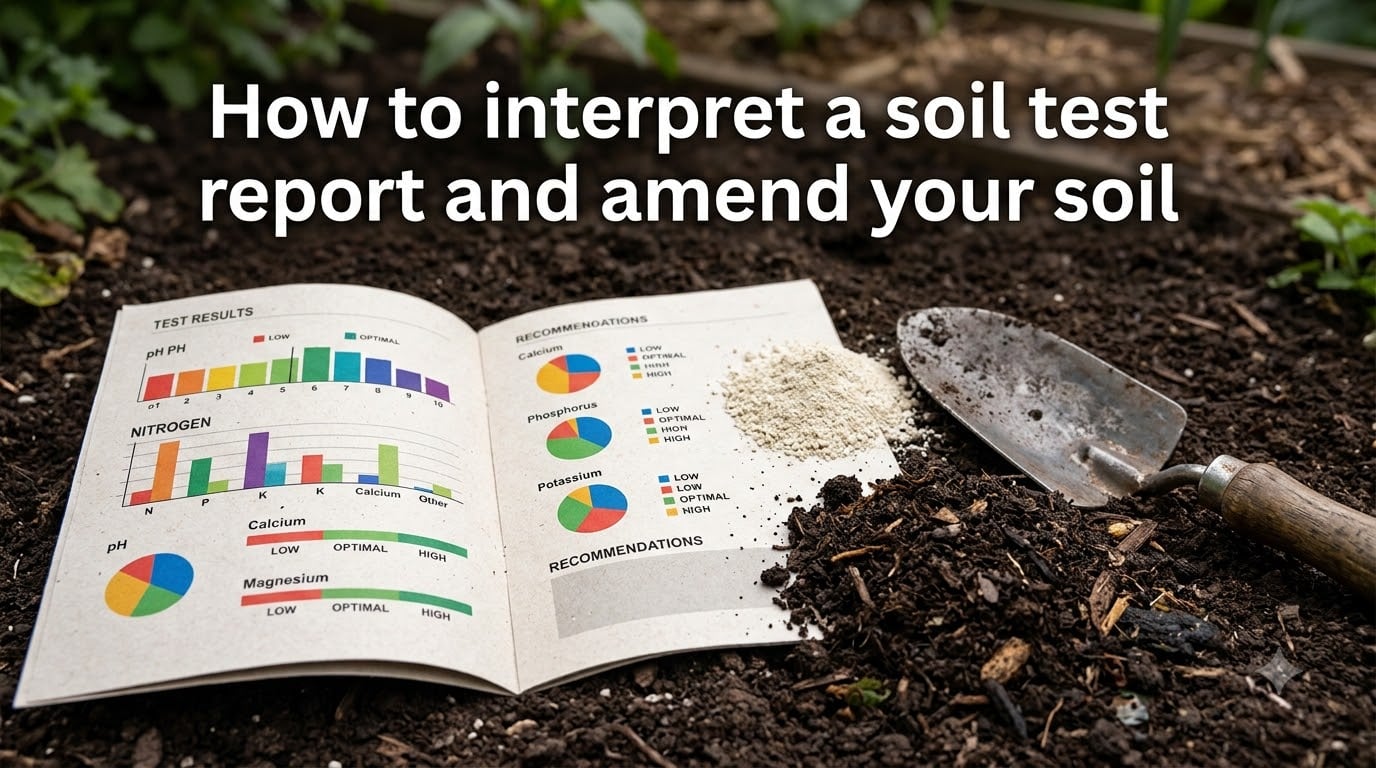
Learning how to interpret a soil test report is the single most useful skill a gardener can develop. I have walked dozens of clients through their lab results, and the moment those numbers finally make sense, the whole process of soil amendment stops feeling like guesswork. This guide breaks down every section of a typical report and shows you exactly how to act on it.
A standard soil test report gives you a snapshot of nutrient availability, pH, organic matter, and a few supporting measurements. Each value comes with a rating and a recommendation. By the end of this article, you will know what each number means, why the lab uses the thresholds it does, and how to convert those recommendations into real amendments for your lawn, vegetable garden, or flower beds.
Table of Contents
What a Soil Test Actually Measures?
A soil test report is a measurement of what your soil can currently supply to plants. The lab does not count every nutrient in your yard. It uses chemical extractions to estimate the portion of each nutrient that plant roots can actually access during the growing season.
Most reports from university extension labs and private services cover four categories of information. First, you get macronutrients, which are the nutrients plants need in the largest amounts: nitrogen (N), phosphorus (P), and potassium (K). Second, you get secondary nutrients like calcium (Ca), magnesium (Mg), and sulfur (S). Third, the report lists micronutrients such as zinc (Zn), iron (Fe), manganese (Mn), and boron (B). Fourth, the report includes soil characteristics that affect how nutrients behave, including pH, organic matter, cation exchange capacity (CEC), and sometimes soluble salts.
When you receive a paper report or a PDF, you will usually see each nutrient listed in parts per million (ppm) or pounds per acre, paired with a rating of Low, Medium, or High, and a recommended fertilizer rate. The rating is the most important piece because it tells you whether the nutrient is already adequate or needs supplementation.
Understanding pH and Why It Controls Everything
If you only remember one number from your soil test report, make it the pH. pH measures how acidic or alkaline your soil is on a scale from 0 to 14, with 7.0 as neutral. Most garden plants thrive between 6.0 and 7.0, where the widest range of nutrients stays available to roots.
pH is logarithmic, which means a soil at pH 5.0 is ten times more acidic than soil at pH 6.0. A small change on paper is a big change in chemistry. That is why even half a point can shift n?utrient availability dramatically.
How pH Works in Soil
pH controls whether nutrients stay dissolved in soil moisture or get locked up in compounds that roots cannot absorb. In acidic soils below pH 6.0, phosphorus binds with iron and aluminum, and calcium and magnesium become less available. In alkaline soils above pH 7.5, iron, manganese, and zinc become hard for plants to access, which is why you often see yellowing leaves on blueberries, azaleas, or pin oaks planted in alkaline ground.
Experienced gardeners on forums consistently call pH the single most important metric on the report. I agree, because no amount of fertilizer fixes a nutrient lockout caused by the wrong pH.
Target pH Ranges for Different Plants
Different plants prefer different pH ranges. Match your target to what you are growing.
Lawns and most vegetables: 6.0 to 7.0
Flowering perennials and shrubs: 6.0 to 7.0
Blueberries, azaleas, rhododendrons, camellias: 4.5 to 5.5
Potatoes and sweet potatoes: 5.0 to 6.0
Hydrangeas (for blue flowers): 5.0 to 5.5
If your report shows pH outside the range your plants need, correct the pH before chasing other nutrient targets. The other amendments will work far better once pH is right.
How to Read the N-P-K Macronutrients on Your Report
The N-P-K section is the headline of the report. These three nutrients drive most plant growth, and they are the ones any fertilizer bag will list on its label.
Nitrogen (N) drives leafy green growth. On most homeowner reports, nitrogen is reported as nitrate-nitrogen in ppm or as a Low/Medium/High rating rather than a precise number, because nitrogen levels fluctuate week to week. If your rating is Low, plan to sidedress with a nitrogen source like compost, blood meal, or a synthetic fertilizer such as urea during the growing season.
Phosphorus (P) supports root development, flowering, and fruit set. Phosphorus is reported in ppm using an extraction method such as Bray-1, Mehlich-3, or Olsen, depending on your region. The lab picks the method that matches your soil type. A High rating means you should not add phosphorus. Adding more to a soil that already tests High contributes to runoff and water pollution without helping your plants.
Potassium (K) supports overall plant vigor, disease resistance, and cold hardiness. Potassium is reported in ppm. Low and Medium ratings usually call for a fertilizer like muriate of potash or sulfate of potash, applied according to the rate on your report.
Forum users often ask whether a balanced 12-12-12 fertilizer works for any test result. The short answer is no. A balanced fertilizer applies phosphorus whether your soil needs it or not. Always follow the report ratios rather than guessing.
Secondary Nutrients and Micronutrients Explained
Below the N-P-K section, the report lists secondary and micronutrients. These are needed in smaller quantities, but deficiencies show up as visible problems like yellow leaves, blossom end rot, or stunted growth.
Calcium (Ca) and magnesium (Mg) work together. Calcium builds cell walls and prevents disorders like blossom end rot in tomatoes. Magnesium sits at the center of every chlorophyll molecule. If your report shows Low magnesium, dolomitic lime can correct both pH and magnesium in one application. If only calcium is low, calcitic lime is the better choice.
Sulfur (S) has become a more common deficiency in recent decades as atmospheric deposition has dropped. Sulfur is reported in ppm, and Low ratings call for gypsum or elemental sulfur.
Micronutrients include zinc, iron, manganese, copper, and boron. These are reported in ppm and often only matter if your pH is off. In alkaline soils, iron and manganese become unavailable even when present, which is why fixing pH often clears up micronutrient deficiencies on its own. Boron is one to watch because the gap between deficient and toxic is narrow. Never exceed the lab recommendation.
Reading the L, M, H Rating System
Most labs translate raw ppm numbers into a Low, Medium, or High rating. This rating compares your soil to agronomic research on what plants actually need, so it is more useful than the raw number on its own.
Here is a typical phosphorus rating scale for vegetable gardens using the Bray-1 extraction method:
Low: 0 to 15 ppm, recommended phosphorus application required
Medium: 16 to 30 ppm, lighter application recommended
High: 31 to 50 ppm, no phosphorus needed for one to two years
Very High: above 50 ppm, no phosphorus needed, monitor for runoff
A good soil test result is one where most ratings sit in the Medium to High range, pH is in the right zone for your plants, and organic matter is at least 3 percent. Anything rated Low is what your amendments need to fix.
Cation Exchange Capacity (CEC), Buffer Index, and Organic Matter
These three metrics appear further down the report and often confuse readers. They describe the soil itself, not the nutrient levels, and they tell you how well your soil can hold and release nutrients over time.
Cation Exchange Capacity (CEC) measures how many positively charged ions your soil can hold. Sandy soils have a low CEC, often under 5. Clay soils and soils rich in organic matter have a high CEC, often above 15. A higher CEC means your soil can store more nutrients and release them slowly, which reduces leaching. If your CEC is low, you will need to apply smaller fertilizer doses more often.
The Buffer Index (or Buffer pH) tells the lab how much lime it takes to raise your soil pH. Soils with high CEC need more lime to shift pH than sandy soils with low CEC. The lab uses the buffer index to write a precise lime recommendation rather than a one-size-fits-all rate.
Organic matter is reported as a percentage. Anything above 3 percent is considered good, and 5 percent or higher is exceptional. Organic matter is the single best thing you can add to any soil because it improves CEC, water retention, and microbial life all at once.
Step-by-Step Soil Test Interpretation Walkthrough
To pull this all together, let us walk through a fictional but realistic soil test report from a homeowner who wants to grow vegetables. The report shows: pH 5.4, phosphorus 18 ppm (Medium), potassium 95 ppm (Low), calcium 1200 ppm (Medium), magnesium 80 ppm (Low), organic matter 2.5 percent, CEC 7.2, buffer index 6.8.
Step 1: Check pH first. The pH of 5.4 is too acidic for a vegetable garden, which prefers 6.0 to 7.0. The pH needs to come up before any other amendment will work efficiently.
Step 2: Read the buffer index. A buffer index of 6.8 means the soil has moderate buffering capacity. The lab recommends 50 pounds of dolomitic lime per 1,000 square feet to raise pH to about 6.5.
Step 3: Apply the lime recommendation. Because magnesium is also Low, dolomitic lime is the right choice. It raises pH and adds magnesium in one pass.
Step 4: Address the Low potassium. The report recommends 2 pounds of muriate of potash per 1,000 square feet, worked into the top 4 to 6 inches of soil before planting.
Step 5: Leave phosphorus alone. Phosphorus is Medium, so no phosphorus fertilizer is needed. Adding phosphorus here would only push it into the High range and contribute to runoff.
Step 6: Build organic matter. At 2.5 percent, organic matter is below ideal. Plan to add 2 to 3 inches of compost annually and retest in two to three years.
How to Amend Your Soil Based on the Results?
Once you know what your report says, the next step is acting on it. The right amendment depends on what your soil needs and what you plan to grow.
Raising pH With Lime
Lime is the standard amendment for raising pH. The two most common types are calcitic lime (mostly calcium carbonate) and dolomitic lime (calcium and magnesium carbonate). Use dolomitic lime when magnesium is also Low, as in the example above.
Apply lime in fall or early winter, because it takes two to three months to fully react with the soil. Spread it evenly with a broadcast spreader, water it in lightly, and let it work over winter. Do not apply lime within six weeks of a manure application, as the two react and release ammonia.
Lowering pH With Sulfur or Organic Matter
To lower pH, elemental sulfur is the most common amendment. Soil bacteria convert sulfur to sulfuric acid over several months, so the effect is slow but lasting. For acid-loving plants like blueberries, pine needle mulch and peat moss also help maintain a low pH over time.
Ammonium sulfate is another option that acidifies the soil while supplying nitrogen, but it is more expensive per pound of pH change than elemental sulfur. Avoid aluminum sulfate, which can damage roots at high rates.
Converting Lab Recommendations to Garden Quantities
Most lab recommendations are written in pounds per acre, which is confusing for home gardeners. To convert to a smaller area, divide by 43.56 (the number of square feet in an acre times 1,000). For example, a recommendation of 2,000 pounds per acre equals about 46 pounds per 1,000 square feet.
For a 200-square-foot raised bed, take 46 pounds, multiply by 0.2, and you get about 9 pounds. Always round down rather than up when applying fertilizer, because over-application burns roots and wastes money.
Seasonal Timing and Environmental Considerations
Timing matters as much as the amendment itself. Lime and elemental sulfur need months to react, so fall application gives them all winter to work. Nitrogen and potassium are more mobile and can be applied closer to planting time, with nitrogen split into two or three sidedressings during the growing season.
Phosphorus deserves special caution. Because phosphorus binds tightly to soil particles, excess phosphorus does not leach downward the way nitrogen does. Instead, it runs off into streams and lakes, where it feeds algal blooms. In areas with phosphorus regulations, such as Maryland and other Chesapeake Bay watershed states, lawn fertilizers containing phosphorus are restricted unless a soil test shows a need.
Retest your soil every two to three years after a major amendment cycle. Most soil tests cost between $15 and $50 through a university extension lab, and the report pays for itself many times over in reduced fertilizer waste and healthier plants.
Frequently Asked Questions About Soil Test Reports
How do I interpret my soil test results?
Start with the pH, because it controls whether other nutrients are available to plants. Then check the N-P-K ratings, where Low means you need to add that nutrient, Medium means a light application is fine, and High means no amendment is needed. Finally, look at organic matter, CEC, and any micronutrients flagged as Low. Correct pH first, then address Low nutrients in the order the lab recommends.
What is a good soil test result?
A good soil test result has pH between 6.0 and 7.0 for most plants, organic matter at or above 3 percent, and most nutrients rated Medium or High. CEC above 10 indicates good nutrient-holding capacity. Anything rated Low should be addressed before the next growing season, and High ratings should be left alone to avoid over-application.
How to read a soil investigation report?
A soil investigation report follows the same structure as a homeowner soil test: pH, macronutrients (N-P-K), secondary nutrients (Ca, Mg, S), micronutrients, organic matter, CEC, and recommendations. Read pH first, then check each nutrient against its Low/Medium/High rating. The recommendations section at the end gives you specific application rates in pounds per acre or per 1,000 square feet.
How to read a soil tester?
A handheld soil tester typically gives you pH, moisture, and sometimes light readings. For accurate nutrient levels, send a sample to a professional lab. Home test strips can give a rough pH reading but are not reliable for nitrogen, phosphorus, or potassium. Lab results use standardized extraction methods and are calibrated against plant response data, which is what makes their recommendations trustworthy.
How much lime should I add based on my soil test?
The lab recommendation on your report is the most reliable guide. Sandy soils typically need 20 to 40 pounds of lime per 1,000 square feet to raise pH by one unit, while clay soils often need 50 to 100 pounds per 1,000 square feet. The buffer index on your report refines this further. Apply lime in fall and retest in six months to a year.
How often should I retest my soil after amending?
Retest two to three years after a major amendment cycle. Lime and sulfur take months to fully react, so a follow-up test in fall of the year after application shows how much the pH actually moved. For phosphorus and potassium, retest every two to three years, or before establishing a new lawn or garden bed.
Final Thoughts on Reading and Acting on Your Soil Test
Knowing how to interpret a soil test report turns a confusing page of numbers into a clear plan of action. Start with pH, address Low ratings in the order the lab recommends, leave High ratings alone, and build organic matter every year. Retest every two to three years to confirm your amendments worked and to catch any new issues before they limit your plants.
Once you have run through this process a couple of times, soil tests stop feeling like homework and start feeling like the most reliable tool in your gardening kit.