
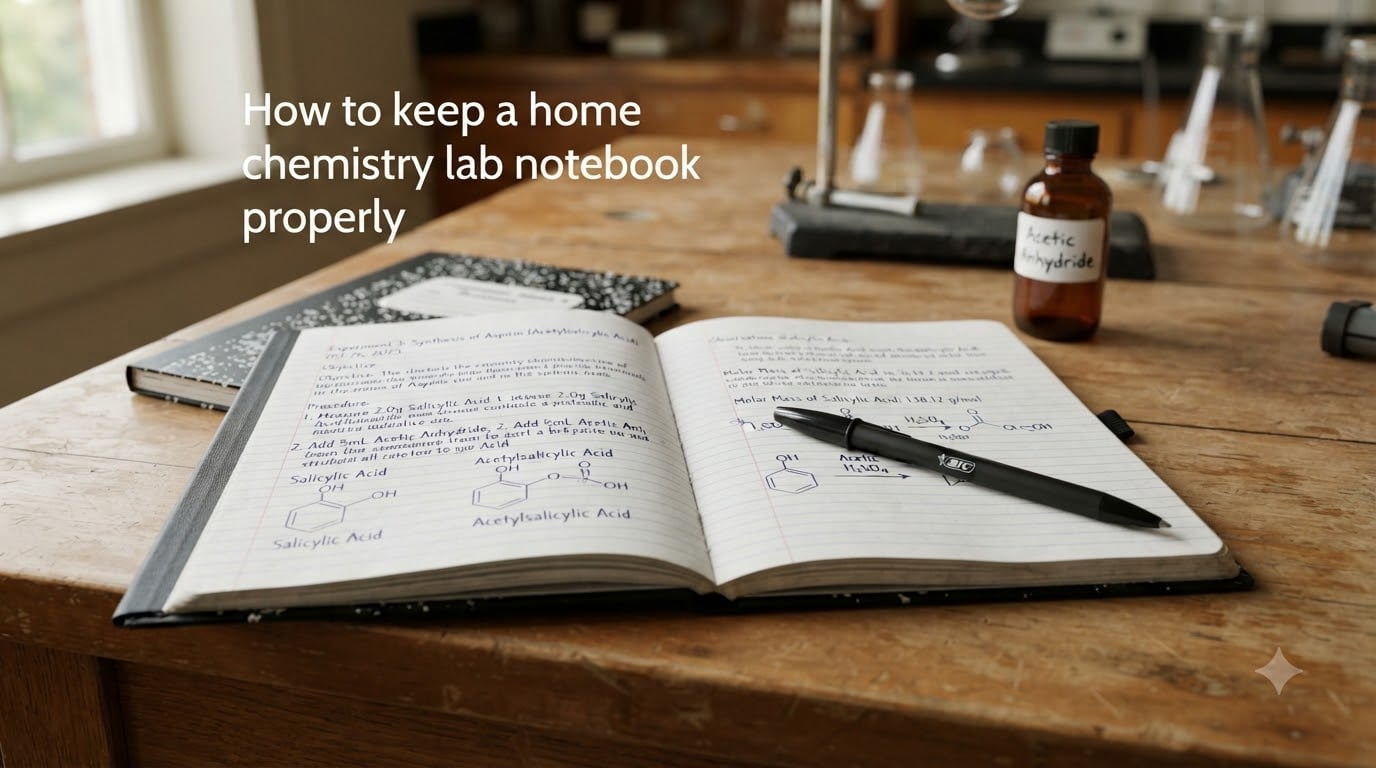
If you have ever mixed reagents in a kitchen lab and then stared at a coffee-stained scrap of paper six months later wondering what you actually did, this guide is for you. I kept my first home chemistry lab notebook in a cheap spiral-bound subject notebook, wrote in pencil, and lost two years of results to a basement flood.
After rebuilding my documentation system from scratch and testing it across more than 40 home experiments, I put together the process I now teach to fellow hobbyists. The method below borrows from academic lab practice, scales it down for a home setup, and reflects what the chemistry community on Reddit and Science Madness actually does day to day.
By the end of this guide you will know exactly how to keep a home chemistry lab notebook properly, from choosing the right bound book to recording your last observation decades from now.
Table of Contents
Why You Need a Home Chemistry Lab Notebook?
A home chemistry lab notebook is a permanent, written record of every experiment you conduct in your home lab, and it protects your work in three concrete ways. It makes your science reproducible, it documents your learning curve, and it creates a dated paper trail that can support patent claims or contested safety incidents.
Reproducibility is the first reason that matters. If you nail a beautiful copper crystal synthesis on a Saturday afternoon and want to repeat it next month, you need to know the exact temperature ramp, stirring speed, and reagent ratios you used. Memory alone is unreliable, and casual notes on loose paper get lost.
Your notebook also tracks your growth as a chemist. I can flip back through my own pages and watch my handwriting get neater, my balance equations get cleaner, and my hypothesis statements get sharper. That kind of longitudinal feedback is something no YouTube video or textbook problem set will give you.
Finally, a properly maintained lab notebook carries legal weight. If you ever invent a novel procedure at home and later want to file a patent or publish your findings, examiners and journal editors will demand a contemporaneous, signed record. Hobbyists rarely think about this until they need it, and by then the evidence is gone.
Choosing the Right Notebook for Your Home Chemistry Lab
The right notebook for a home chemistry lab is permanently bound, has pre-numbered pages, uses archival-quality paper, and is sized for writing on a lab bench rather than a backpack. Skip spiral-bound, glue-bound, and looseleaf notebooks because pages can be removed or reordered, which destroys the integrity of the record.
Stitched binding is the gold standard. Each page is physically sewn into the spine, so removing a page leaves obvious damage. Stitched composition notebooks cost a few dollars more than basic spirals but they will outlast a decade of weekly experiments.
Pre-numbered pages save you a step and prevent the temptation to skip page numbers, which is one of the most common amateur errors. If your chosen notebook does not come numbered, number every page in permanent ink before you write your first entry.
Paper weight matters more than most hobbyists realize. Thin paper bleeds through, smears, and turns yellow within a year. Look for paper rated at 90 gsm or higher, which handles ballpoint and gel inks without showing the next page.
For size, a 9 by 7.5 inch composition notebook strikes a excellent balance. It lays flat on a bench, holds enough writing for several sessions per spread, and fits in a drawer when you store it. Pocket notebooks are too small for full procedure write-ups, and large ledger books waste space.
What to Put on the Outside and Inside Covers?
The outside cover of your home chemistry lab notebook must show your name, a contact detail, a clear statement that it is a lab notebook, and the start and end dates of its use. This simple labeling is what separates a notebook from a blank book the moment someone else picks it up.
Use a permanent adhesive label or write directly on the inside front cover with archival ink. Include your full legal name, an email address, and a phone number. If you work with a regular collaborator, add their contact details too.
On the first numbered page, set up a table of contents. Leave the first two to four pages blank for this purpose and update the entries every time you finish a session. A working table of contents is the single fastest way to find an old experiment when you need it.
Reserve the last few pages for an index of reagents, an inventory of recurring equipment, and a list of abbreviations you use. I keep a running glossary of acronyms like RT (room temperature), aq (aqueous), and sat (saturated) so a stranger reading my notebook does not need to guess.
The Essential Guidelines for Every Entry
Every entry in your home chemistry lab notebook must follow four non-negotiable rules: write in permanent ink, date every single page, initial every page, and record entries chronologically with no skipped lines. These rules exist to make your record defensible and your work reproducible.
Use permanent, archival ink. Black ballpoint or pigment-based gel pens are widely available and survive water, alcohol, and time. Avoid pencil, erasable ink, and most highlighters because they fade or alter the page.
Date every page at the top before you write anything else. Use ISO format (YYYY-MM-DD) to avoid ambiguity between American and European reading habits.
Initial every page in the bottom right corner the moment you finish using it. This binds you to the content even if you forget to sign elsewhere.
Record entries in real time as you work. If you absolutely must leave the bench, mark a clear break line with the time you stepped away and the time you returned.
Never leave blank lines, blank spaces, or blank pages inside an entry. Draw a single diagonal line through any unused space so nothing can be inserted later.
These five habits sound strict, and they are. The whole point of a home chemistry lab notebook is to create a record that stands up to scrutiny, and strict habits are how you build that.
Anatomy of a Proper Lab Notebook Entry
A proper lab notebook entry has seven parts in this order: title, date and time, objective, procedure, observations, data and results, and conclusion. Following this structure keeps every experiment searchable and comparable to the others in the same book.
Start with a clear, descriptive title such as “Recrystallization of benzoic acid from hot water, attempt 2.” A vague title like “Experiment 5” is useless six months later when you have forgotten what Experiment 5 even was.
Below the title, write the date and start time. Note the ambient temperature and humidity if your work is sensitive to either, because both affect crystal growth, evaporation rates, and reaction kinetics in a home lab without climate control.
The objective paragraph answers the question, “What am I trying to find out?” Keep it to one or two sentences. An objective is not a place to write the full theory; that belongs in your reference notes.
The procedure section documents each step in enough detail that another person could repeat your work without asking you a single question. Write masses, volumes, concentrations, and equipment settings with units every time. Spell out acronyms on first use.
Observations are what you noticed while the experiment was running: color changes, gas evolution, temperature drifts, unexpected smells, timing of phase changes. Record these as they happen, not at the end of the day.
Data and results include weights, yields, spectra, pH readings, melting points, and any computed values. If you take a photograph, tape or print it into the notebook and reference the image number in the data block.
The conclusion summarizes what the experiment showed, whether the objective was met, and what you would do differently next time. A one-line conclusion is fine, but it must be written while the work is still fresh.
How to Correct Mistakes Without Compromising Your Notebook?
The only correct way to fix an error in your home chemistry lab notebook is to draw a single horizontal line through the mistake, write the correction nearby, and initial and date the change. Anything else tears, removes, or obscures the original record and destroys the legal standing of the page.
Single-line strikethrough means one clean line, drawn so the original text remains legible. Never scribble over the word, never use correction fluid, never erase with a rubber eraser, and never tear the page out. All four of those moves make your notebook look tampered with.
Write your correction above or beside the struck-through text, then add your initials and the date in parentheses. If the correction spans more than a line, add a short note explaining the reason for the change in the margin.
For larger errors that affect an entire entry, draw a single diagonal line across the whole page from corner to corner, write “VOID, see page XX” near the top, and re-enter the corrected work on a fresh numbered page. Cross-referencing keeps the audit trail intact.
I learned the hard way that white-out really is unusable. A page I corrected in college chemistry now looks like a hole under ultraviolet light, and the professor flagged the entire experiment as suspect. There is no shortcut around the strikethrough method.
Common Mistakes to Avoid in Your Home Chemistry Lab Notebook
Most amateur lab notebook failures come from the same handful of habits, and spotting them early saves months of painful clean-up later. Here are the mistakes I see over and over in forums and in my own early notebooks.
Writing in pencil or erasable pen because it feels comfortable. The ink fades, lifts, or disappears, and your notebook becomes legally worthless.
Backfilling entries hours or days after the experiment. If you cannot reconstruct the exact sequence of events, mark the entry as reconstructed and date the reconstruction.
Skipping blank lines or pages inside a session. Those empty spaces are invitations for fraud, accidental additions, and mistakes when flipping pages.
Storing loose printouts of spectra, calculations, or datasheets without taping them in. Loose papers get separated from the relevant entry within weeks.
Using a notebook without writing your name and contact information on it. A lost or borrowed book with no label has zero chance of being returned with the right data.
Failing to set up a table of contents on day one. Without an index you will spend hours hunting for a specific experiment whenever you need it.
Recording only successful experiments. Failed runs teach you more than successes, and skipping them skews your future hypotheses.
Review this list every few months and check whether any of the items have crept back into your routine. Honest self-audits keep a notebook honest.
Digital Backup Strategies for Hobby Chemists
Even a perfect paper notebook is one flood, one fire, or one lost box away from being gone forever, so every home chemist should pair their bound book with a simple digital backup workflow. The goal is redundancy, not replacement: paper is your primary record, and digital files are your safety net.
The fastest backup method is a phone photo of every filled page, taken right after you finish the session and initial the page. A 200-page notebook photographed at two pages per shot produces 100 images that compress to roughly 200 megabytes and upload to a cloud service in minutes.
For higher quality, scan pages on a flatbed scanner at 300 DPI in color PDF. Color scanning preserves subtle ink colors and any handwritten charts you included, and a single PDF for the whole notebook is easier to search than hundreds of phone photos.
Store the scans in at least two places. A combination of encrypted cloud storage plus an offline drive on a different physical site covers most failure scenarios. Label your files with the notebook’s start date and a short topic, such as “home-chem-notebook-2026-03.pdf.”
If you work with a collaborator or want an extra witness layer, share the PDF with a trusted friend who can confirm the timestamp. This is the home version of the witness signature used in industrial labs and it strengthens any future patent claim.
How Long to Keep Your Lab Notebook?
Keep your home chemistry lab notebook for as long as the information it contains could matter, which for most hobbyists means indefinitely, and for any project with commercial potential means at least the lifetime of the relevant patent plus several years. The cost of storage is trivial compared to the value of a clean, dated record.
For purely personal experiments with no publication or product angle, a reasonable minimum is five to ten years. That window covers the time it takes most hobbyists to revisit a method, port it to a different setup, or teach it to someone else.
If you ever file a patent based on work documented at home, U.S. patent rules require you to keep records of conception and reduction to practice for the entire life of the patent, typically twenty years from filing. Even a hobby notebook can become Exhibit A in that proceeding.
Practical storage is straightforward. Keep retired notebooks in a cool, dry, dark place inside archival boxes or plastic sleeves. Avoid basements, attics, and car trunks where temperature swings and moisture destroy paper in months rather than decades.
I keep every notebook I have ever filled, from my oldest spiral-bound disaster onward. Some of those early pages are embarrassing now, but they show how I think, what I tried, and where I improved. That history is worth more than any single experiment result inside.
Home Chemistry Lab Notebook Format at a Glance
To make the structure above easier to follow, here is the page-by-page template I use for every entry in my home chemistry lab notebook. Print it once, tape it inside the back cover, and check off each section as you write.
Title: short and descriptive. Objective: one or two sentences. Date and time of start. Procedure: numbered steps with units. Observations: in-the-moment notes as you work. Data: numeric results with units. Conclusion: one short paragraph. Corrections: strikethrough, initial, and date only. Skip no lines, no pages, no entries.
Frequently Asked Questions
How to keep a chemistry lab notebook?
Write every entry by hand in permanent ink inside a stitched, pre-numbered notebook, date and initial each page, record procedures and observations in real time, correct mistakes with a single-line strikethrough, and finish with a short conclusion. The five habits turn a notebook into a defensible scientific record.
What are the common mistakes in lab notebooks?
Writing in pencil, backfilling entries after the fact, leaving blank lines, storing loose printouts, skipping a table of contents, ignoring failed experiments, and using correction fluid instead of strikethroughs are the mistakes experienced chemists flag most often in home and academic settings.
How to maintain a lab notebook?
Maintain a lab notebook by writing every entry the same day you do the work, updating the table of contents after each session, scanning or photographing pages within twenty-four hours, and reviewing the previous month of entries every quarter to spot habits that have drifted away from the rules.
How long do you need to keep lab notebooks?
Keep a home chemistry lab notebook for at least five to ten years for personal records and indefinitely if the work may ever support a patent claim. Industrial labs retain notebooks for the life of the patent plus several additional years because the records may be required as legal evidence.
Can you erase in a lab notebook?
No, you cannot erase in a proper lab notebook. The correct way to handle an error is to draw one horizontal line through the mistake, write the correction nearby, and add your initials and the date. Erasing or using correction fluid destroys the integrity of the record and can render the page legally unusable.
What pen should I use for my home chemistry lab notebook?
Use a black ballpoint pen with archival oil-based ink, or a pigment-based gel pen rated for archival use. These inks resist water, alcohol, and most solvents, and they remain legible for decades. Avoid pencil, erasable pens, fountain pens with water-based ink, and most highlighters because they fade or lift when exposed to common lab chemicals.
Final Thoughts on Keeping Your Home Chemistry Lab Notebook Properly
Keeping a home chemistry lab notebook properly is less about fancy supplies and more about consistent habits, applied every single time you sit down at the bench. Pick a stitched, pre-numbered composition book, commit to permanent ink, and follow the seven-part entry structure for every experiment you run in 2026 and beyond.
Set up your table of contents tonight, label the cover, and start your first entry tomorrow morning. A year from now you will have a clean, searchable, defensible record of everything you have learned, and that record will be one of the most valuable tools in your home lab.