
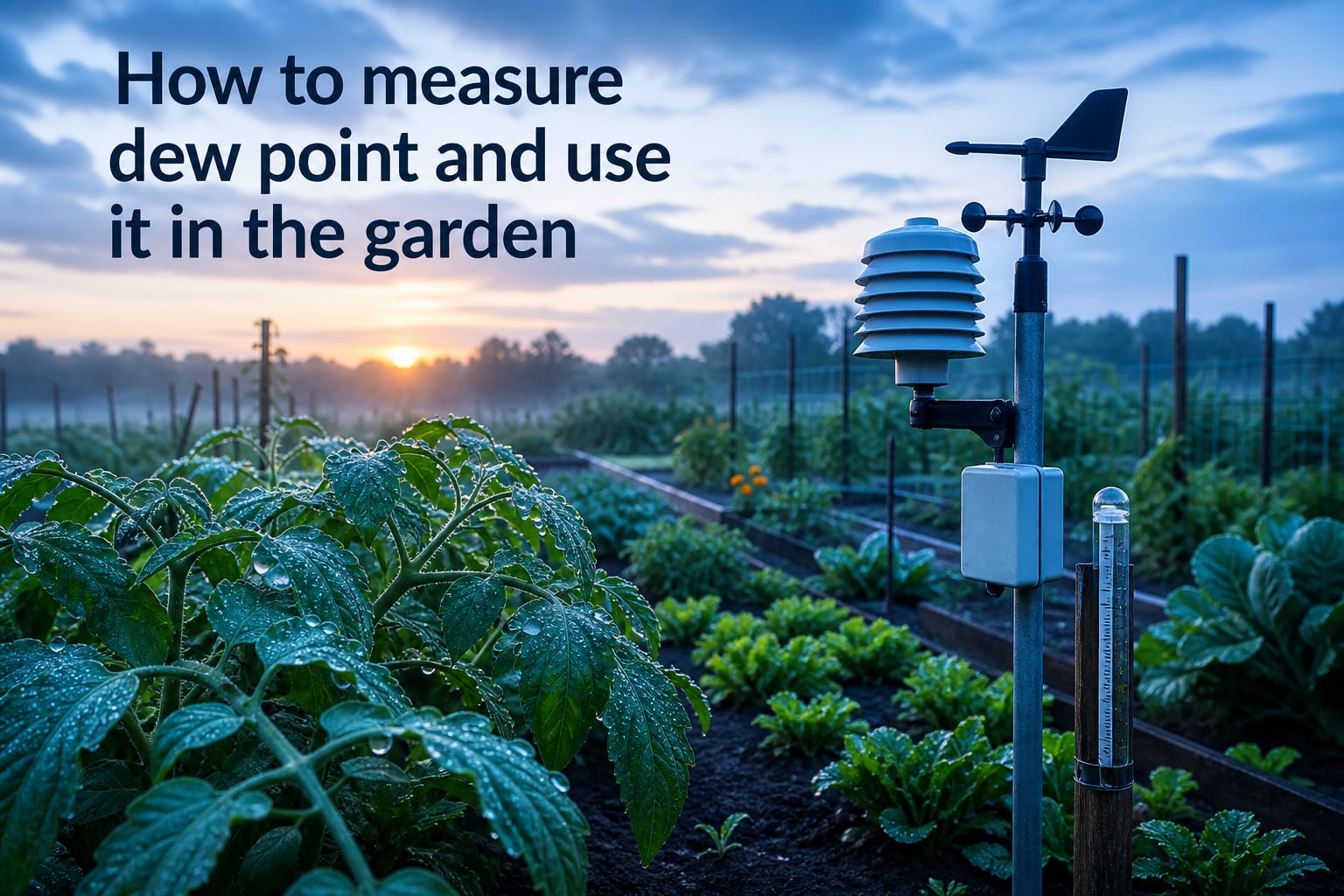
If you have ever lost tomatoes to an unexpected frost or battled powdery mildew all summer, learning how to measure dew point and use it in the garden can change the way you plan your season. Dew point is the single best number on a weather report for predicting frost, fungal disease, and how quickly your garden soil dries out. I started tracking it in my own beds six years ago, and I have not lost a pepper plant to cold damage since.
In this guide, I will walk you through the exact dew point formula with a worked example, show you four ways to measure dew point at home, and give you the specific thresholds I use for vegetables, flowers, and frost protection. By the end, you will know how to read a dew point number and turn it into a garden decision.
Table of Contents
What Is Dew Point?
Dew point is the temperature at which air becomes fully saturated and can no longer hold all of its water vapor. When the air cools to the dew point, the excess moisture condenses into liquid water (dew) or, if temperatures are below freezing, into ice (frost). Think of it as the exact temperature your lawn reaches just before you see water droplets on the grass in the early morning.
Here is a concrete example. If the afternoon air is 78 degrees F with 60 percent relative humidity, the dew point is around 62 degrees F. Once that grass and soil radiate heat overnight and cool to 62 degrees, dew forms. If the dew point is below 32 degrees F, you will see frost instead of dew, because the moisture freezes on contact with surfaces that are already at or below freezing.
This is why dew point matters more than relative humidity for gardeners. Relative humidity tells you how close the air is to saturation at the current temperature. Dew point tells you the actual temperature at which water will appear on your plants. That single number drives irrigation timing, disease pressure, and frost risk.
How to Measure Dew Point and Use It in the Garden?
The most accurate way to find dew point is to use the Magnus formula with your current air temperature and relative humidity. The formula looks like this:
Td = (b × γ) / (a − γ)
Where γ = (a × T) / (b + T) + ln(RH/100), T is air temperature in Celsius, RH is relative humidity as a percentage, and the constants are a = 17.27 and b = 237.7 degrees C.
Worked example with air at 25 degrees C and 70 percent relative humidity:
Step 1: Calculate γ. γ = (17.27 × 25) / (237.7 + 25) + ln(70/100) = 431.75 / 262.7 + ln(0.7) = 1.644 + (−0.357) = 1.287.
Step 2: Calculate Td. Td = (237.7 × 1.287) / (17.27 − 1.287) = 305.92 / 15.983 = 19.14 degrees C.
Step 3: Convert back to Fahrenheit if needed. (19.14 × 9/5) + 32 = about 66.5 degrees F.
So at 77 degrees F and 70 percent humidity, the dew point is roughly 66 degrees F. That is high enough to keep plant leaves wet for hours overnight, which is a major red flag for fungal disease.
If math is not your thing, you can skip the formula entirely and use one of these four practical methods:
Method 1: Use a weather app. Most apps including NOAA, Weather Underground, and AccuWeather now show dew point directly in the hourly forecast. Look at the 5 a.m. reading on the day you plan to water or spray.
Method 2: Use a home weather station. Stations from Davis, Ambient Weather, and AcuRite calculate and display dew point on the console. Place the sensor in an open area at plant canopy height, not under a tree.
Method 3: Use a sling psychrometer. This is the classic instrument. You swing a wet-bulb and dry-bulb thermometer together, then read the difference on a chart to find dew point. It is cheap, reliable, and unaffected by electronics.
Method 4: Use a metal can, ice, and a thermometer. Fill a shiny metal can with water, add ice, and stir with a thermometer. The temperature at which condensation first forms on the outside of the can is your dew point. This DIY method gets you within a degree or two.
Dew Point vs Relative Humidity
Relative humidity is a ratio that changes throughout the day as temperature swings. Dew point is an absolute measure of moisture in the air and stays much more stable. Two gardens can both show 80 percent relative humidity at dawn, but the one with a 70 degree F dew point will stay damp for hours, while the one with a 55 degree F dew point will dry quickly.
For gardeners, dew point is the better planning number because it tells you exactly how much moisture the air holds and how easily plants will dry. The USDA and most university extension services use dew point, not relative humidity, when they issue fungal disease forecasts.
A simple comfort and gardening scale I use:
Below 50 degrees F: Air feels dry. Powdery mildew pressure is low, but transpiration stress can climb on warm afternoons.
50 to 60 degrees F: Comfortable range. Most gardens stay healthy. This is the sweet spot for tomatoes, squash, and roses.
60 to 65 degrees F: Humid. Leaves stay wet longer. Begin scouting for black spot, late blight, and botrytis.
65 to 70 degrees F: Muggy. Disease pressure is high. Water at the base of plants only, and water in the morning.
Above 70 degrees F: Tropical. Expect aggressive fungal growth and slow drying soils. Avoid overhead watering entirely.
Dew Point Thresholds for Garden Plants
Different plants respond to dew point in predictable ways. Here are the thresholds I rely on after tracking three growing seasons of data in my 1,200 square foot vegetable and cut flower garden.
Vegetables. Tomatoes, peppers, and cucurbits thrive when the overnight dew point stays between 55 and 65 degrees F. Above 65, you will see early blight and powdery mildew within 7 to 10 days. Leafy greens tolerate higher dew points but bolt faster when nights stay above 70.
Fruit and berries. Strawberries and grapes are extremely sensitive to fungal disease above a 60 degree F dew point during bloom and fruit set. Apply preventive sprays before the dew point climbs into that band for three consecutive days.
Flowers and ornamentals. Roses and phlox show black spot and powdery mildew when dew points hold above 62 degrees F for a week. Cut back on overhead irrigation and increase airflow through pruning.
Watering decisions. If the morning dew point is above 65, skip watering for the day and let the soil surface dry. If the dew point is below 55 and your soil is dry, water deeply because evapotranspiration will pull moisture fast.
Using Dew Point for Frost Protection
Frost damage happens when plant tissues drop below 32 degrees F. The dew point tells you whether that cold air is dry or moist, which changes how frost forms and how aggressively you need to protect your plants.
Step 1: Check the forecast low and the dew point. If the forecast low is 35 and the dew point is 32, you have a 3 degree buffer. Frost is unlikely unless wind dies down and skies clear.
Step 2: Watch for the 32 degree F dew point threshold. When the dew point is at or below freezing, any further cooling will deposit frost on cold surfaces. This is your signal to cover tomatoes, peppers, and tender annuals the evening before.
Step 3: Cover before sunset. Use fabric row cover, frost cloth, or old bedsheets. Plastic touching leaves transfers cold directly and causes more damage, so always use a breathable layer.
Step 4: Remove covers when dew point rises above 35. Once the morning dew point climbs back into the upper 30s, condensation inside covers can actually burn leaves if you leave them on past mid-morning.
In our garden, this simple four-step routine saved an entire planting of dahlias and basil last October when an early frost hit with a dew point of 28 degrees F.
How to Measure Dew Point Without Tools?
If you have no instruments, you can still estimate dew point by observation. Walk outside an hour before sunrise on a clear morning. If grass, cars, and roofs are dripping wet, the overnight dew point is at or above the surface temperature. If everything is bone dry despite cold air, the dew point is well below the surface temperature and the air is unusually dry.
You can also pull free dew point data from the NOAA hourly forecast for your zip code, then layer it with the app method described above. This combination gets you within a degree of the actual reading and costs nothing.
Common Mistakes When Using Dew Point in the Garden
New gardeners often treat dew point as just a fancier humidity number. It is more than that. Three mistakes I see most often:
Mistake 1: Watering in the evening during high dew point periods. This extends leaf wetness and feeds fungal spores that are already active.
Mistake 2: Ignoring morning dew point in summer. Many gardeners only check the afternoon forecast, but the 5 a.m. dew point is what drives disease and dew formation on leaves.
Mistake 3: Assuming dew always comes from the air. On heavy clay or compacted soils, much of the moisture you see on plants is soil moisture rising overnight. Improving drainage and adding organic matter reduces this effect.
Track dew point alongside your watering journal for two weeks and you will start to see how plant health responds. The connection becomes obvious fast.
Frequently Asked Questions
Which is worse, high humidity or dew point?
Dew point is the better indicator of how uncomfortable or disease-prone the air will be. High relative humidity on a cool morning can mean very little moisture in the air, while a high dew point always signals real moisture load. For gardening, focus on dew point because it predicts leaf wetness duration and fungal disease pressure far more accurately.
How do you measure dew point at home?
You can measure dew point at home in four ways. Use the Magnus formula with temperature and humidity from a home weather station. Read the dew point directly from a weather app like NOAA or Weather Underground. Use a sling psychrometer for a manual reading. Or do a DIY test by cooling water in a metal can and watching for condensation to form on the outside.
How to know if dew will be on the ground?
Dew will form on the ground whenever surfaces cool to or below the current dew point temperature. On clear, calm nights with low wind, ground temperatures drop quickly and reach the dew point within a few hours after sunset. If your weather app shows a morning low that matches the dew point, expect visible dew on grass and plants.
Does dew point mean 100% humidity?
Yes, by definition, dew point is the temperature at which relative humidity reaches 100 percent and condensation begins. Below the dew point temperature, water vapor condenses out of the air. Above the dew point, the air is unsaturated and can still accept more moisture.
What dew point is uncomfortable?
A dew point above 65 degrees F feels muggy to most people and uncomfortable above 70. For gardeners, anything above 60 starts to drive fungal disease pressure, and above 65 you should expect active disease spread on susceptible plants like tomatoes, roses, and grapes.
How does dew point affect plants?
Dew point affects plants by controlling how long leaves stay wet, how easily they lose water through transpiration, and how likely frost or fungal disease becomes. High dew points keep leaves wet for hours and encourage disease. Low dew points speed transpiration and drying but also raise frost risk on cold nights.
Putting It All Together
Learning how to measure dew point and use it in the garden turns weather data into daily garden decisions. Check the 5 a.m. dew point on your weather app, compare it to the plant thresholds above, and act accordingly. Water in the morning when dew points are low. Skip watering and scout for disease when dew points climb above 65. Cover tender plants when the dew point is at or below 32.
Start tracking dew point this week, even if it is just by glancing at your phone each morning. Within two weeks you will see patterns between dew point, disease outbreaks, and how fast your soil dries. That single number will pay for itself the first time it saves a crop from frost or fungal damage.