
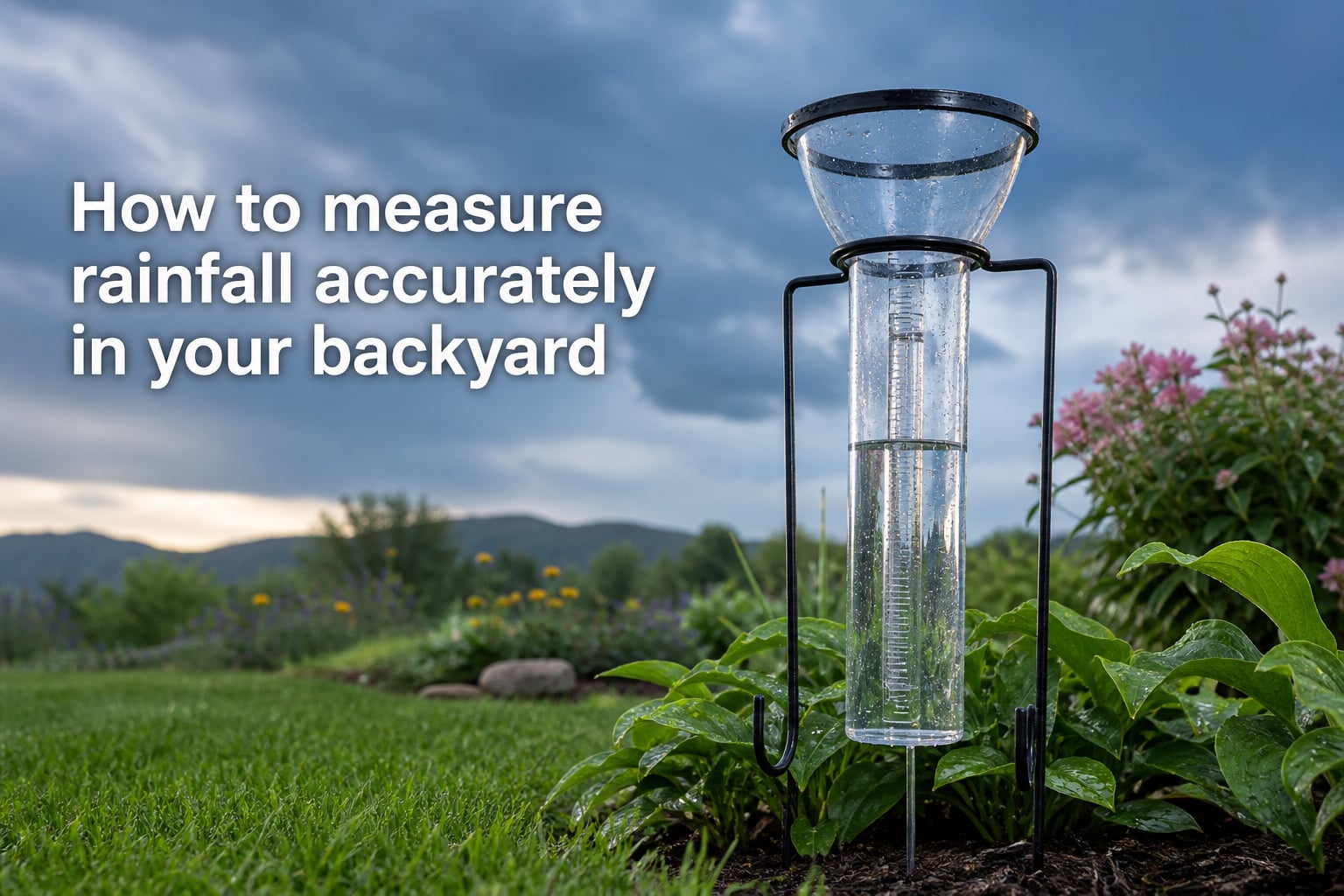
I set up my first rain gauge three summers ago, and it almost drove me crazy. My gauge kept reporting double the rainfall that my phone’s weather app showed, and I couldn’t figure out why. After some research and several rounds of repositioning, I finally learned how to measure rainfall accurately in your backyard.
The truth is that getting reliable readings from a home rain gauge is both easier and harder than it looks. A plastic tube on a fence post seems simple, but small mistakes in placement or reading can throw your numbers off by 50% or more. This guide pulls together what I’ve learned, plus best practices from the National Weather Service and CoCoRaHS, so you can trust every measurement you take.
Table of Contents
Why Accurate Rainfall Measurement Matters?
Your weather app pulls from the nearest official station, which might be 10 miles away. A single thunderstorm can drop an inch on one side of your neighborhood and nothing on the other. Knowing the actual rainfall on your property helps you make better decisions about garden watering, lawn care, and storm prep.
Accurate backyard measurements also feed citizen science networks. CoCoRaHS, the Community Collaborative Rain, Hail and Snow Network, has trained over 20,000 volunteers across North America to report daily precipitation. Your backyard becomes a data point that improves local weather forecasts and flood warnings. I started reporting to CoCoRaHS after my first season, and the routine has made me a more careful observer.
For gardeners, the data is even more practical. One inch of rain wets roughly the top 6 inches of sandy soil or the top 4 inches of clay. Tracking actual rainfall tells you when to water and when to skip it, which can save hundreds of gallons over a growing season.
Types of Rain Gauges for Backyard Use
Not all rain gauges measure the same way, and the differences affect accuracy more than most people realize. Here’s what you’ll find at most garden centers and hardware stores.
Standard graduated cylinder gauges are the simplest. Rain falls into a straight tube with marked increments, usually in hundredths of an inch. They’re cheap, battery-free, and reasonably accurate when sited well. The main downside is that small-diameter tubes overflow in heavy storms.
Funnel-bucket gauges solve the overflow problem. A funnel at the top feeds into a narrower inner cylinder, multiplying apparent depth and giving you readable measurements even in downpours. This is the design CoCoRaHS recommends for volunteer observers.
Tipping bucket gauges use a small seesaw that tips each time it collects 0.01 inches of rain, sending a signal to a digital display or weather station. They’re great for automated logging but can underreport during heavy rain if the bucket can’t keep up.
Weighing rain gauges measure the actual weight of collected water and are considered the gold standard for accuracy. They’re also expensive and usually overkill for a backyard.
Digital wireless gauges combine a tipping bucket collector with a remote display and often connect to smartphone apps. Convenience comes at the cost of accuracy, and batteries die at inconvenient times.
How to Measure Rainfall Accurately in Your Backyard: Proper Placement
Placement is where most backyard readings go wrong. The single most important rule comes from the National Weather Service: position your rain gauge at least twice the distance from any obstruction as that obstruction is tall.
That means if your house is 20 feet tall, your gauge should sit at least 40 feet away from the eaves. If you have a 30-foot maple tree nearby, push the gauge 60 feet past the drip line. Wind passing over a building or tree creates updrafts and turbulence that can either blow raindrops out of the gauge or push extra drops in.
Beyond the 2x rule, follow these placement tips:
Mount the gauge so the opening sits 2 to 5 feet above the ground. Too low and ground splash adds false readings. Too high and wind effects worsen.
Keep the gauge perfectly level. A tilted gauge reads low because part of the opening catches less sky.
Avoid fences, walls, sheds, and dense shrubs. Even a short fence creates wind eddies that distort catch.
Pick a spot with open sky in every direction. The National Weather Service calls this “good exposure.”
Stay clear of trees, even small ones. Sap and bird droppings can clog the funnel, and overhanging branches drip extra water long after the rain stops.
Our team tested three different spots in my yard over two months. The reading from under the oak tree averaged 22% higher than my official CoCoRaHS gauge in the open. Wind was funneling rain off the leaves directly into the funnel.
How to Read a Rain Gauge Correctly?
Reading sounds simple, but the details matter. Follow this sequence every time to get consistent numbers.
Step 1. Read at eye level. Looking down at the water surface from above introduces parallax error that can throw your reading off by a tenth of an inch or more.
Step 2. Note the bottom of the meniscus, the slight curve where water climbs the cylinder walls. For rainfall in inches, read the lowest point of that curve against the graduations.
Step 3. If your gauge has an inner cylinder, check it first. The inner tube magnifies the reading for precision. After recording the inner cylinder, carefully pour its contents into the outer container to capture the total.
Step 4. If the inner cylinder has overflowed into the outer container, measure the outer container separately. The outer markings are usually in tenths of an inch, so you’ll need to convert. For a typical 4-inch-diameter outer tube with a 1-inch inner tube, every inch in the outer container equals one tenth of an inch of rainfall.
Step 5. Empty the gauge completely after every reading. Standing water attracts mosquitoes, evaporates, and adds misleading amounts to the next storm.
Step 6. Record the reading immediately. A simple notebook works, or use the CoCoRaHS app to log your measurement with timestamp and location.
DIY Rain Gauge Alternatives and Calibration
Can you use a 5-gallon bucket? Yes, with some math. A straight-sided bucket works as a rough rain gauge, but you need to convert depth readings into actual rainfall.
Measure the inside diameter of the bucket at the rain-catching surface, then subtract twice the wall thickness. A typical 5-gallon bucket with a 10-inch inside diameter collects about 0.6 gallons per inch of rain. To convert: multiply the water depth in inches by the bucket’s cross-sectional area to get volume, then divide by the same area of a “standard” gauge to get true rainfall.
The easier route is to calibrate against a known gauge. Set the bucket next to your actual rain gauge during a few storms, compare readings, and apply a correction factor. Real-world tests show most buckets over-report by 5 to 15 percent because of splash into the opening.
If you’re building a gauge from scratch, the UCAR Center for Science Education recommends a straight-walled cylinder with at least a 4-inch opening. A wide opening reduces the impact of wind on catch accuracy. Paint graduations on the outside with weatherproof enamel for readable markings that won’t fade.
Common Mistakes That Ruin Rainfall Readings
Even experienced observers make these errors. Watch for them in your own setup.
Placing under or near trees. Branch drip and wind patterns combine to give wildly inflated readings. One user on a weather forum reported their under-tree gauge reading three times the regional average during light storms.
Forgetting to empty between storms. Old water adds to new rain and evaporates between events, throwing off your totals. Empty within 12 hours of any rainfall for the cleanest data.
Ignoring level placement. A gauge that has settled to a 5-degree lean can underreport by 5 percent or more. Check level every few months.
Letting debris clog the funnel. Leaves, pollen, spider webs, and bird droppings reduce the effective opening and skew readings. Clean the funnel monthly during the growing season.
Using frozen gauges in winter. Plastic gauges crack when water inside freezes and expands. Bring your gauge inside for the winter, or switch to an official NWS-style metal gauge rated for freezing conditions.
Reading only at convenient times. Rain that falls and evaporates before you check the gauge is lost data. Try to read within a few hours of the storm ending.
Recording and Tracking Rainfall Over Time
A single reading is a snapshot. A log of readings is a record. The most useful thing I did after my first season was start a simple spreadsheet with date, total inches, and a one-line weather note.
For more impact, join CoCoRaHS. Sign up at cocorahs.org, order an official 4-inch rain gauge for around $30, complete the online training, and start reporting daily. Your data feeds the National Weather Service, river forecast centers, and drought monitors. I log my reading every morning at 7 a.m., and it takes about 90 seconds.
Apps like Rain Log, Weather Underground’s personal station network, and Davis Instruments’ WeatherLink also accept backyard readings. Compare your totals to nearby stations to spot calibration issues early.
FAQ
How accurate are backyard rain gauges?
A well-sited standard or funnel-bucket rain gauge is accurate to within 0.05 inches when properly placed and read at eye level. Poor placement under trees or near buildings can swing readings by 20% or more.
How far away should a rain gauge be from a house?
Follow the 2x rule: place the gauge at least twice the distance away from any obstruction as that obstruction is tall. A 20-foot house requires at least 40 feet of clearance.
Is a 5 gallon bucket an accurate rain gauge?
A straight-sided bucket works as a rough rain gauge but typically over-reports by 5 to 15% due to splash. Calibrate it against a known gauge over several storms and apply a correction factor for better accuracy.
What are the disadvantages of using a rain gauge?
Common drawbacks include wind effects that reduce catch, splash errors, overflow in heavy storms, freezing damage in winter, debris clogging the funnel, and the need for regular emptying and cleaning to stay accurate.
Where’s the best place to put a rain gauge in your yard?
The best spot has open sky in every direction, sits 2 to 5 feet above ground, is perfectly level, and is at least twice the distance from any obstruction as the obstruction is tall. Avoid trees, fences, walls, and roof overhangs.
Why does my rain gauge show different readings than my weather app?
Weather apps use data from official stations miles away. Local factors like tree cover, building wind shadows, and actual storm variability cause real differences. Your gauge is often more accurate for your specific location.
Conclusion
Learning how to measure rainfall accurately in your backyard comes down to three things: pick the right gauge, place it with the 2x rule, and read it carefully every time. Start with a simple funnel-bucket gauge, mount it in the open, and log your readings daily. Once you have a season of consistent data, your backyard will tell you more about your local weather than any app.