
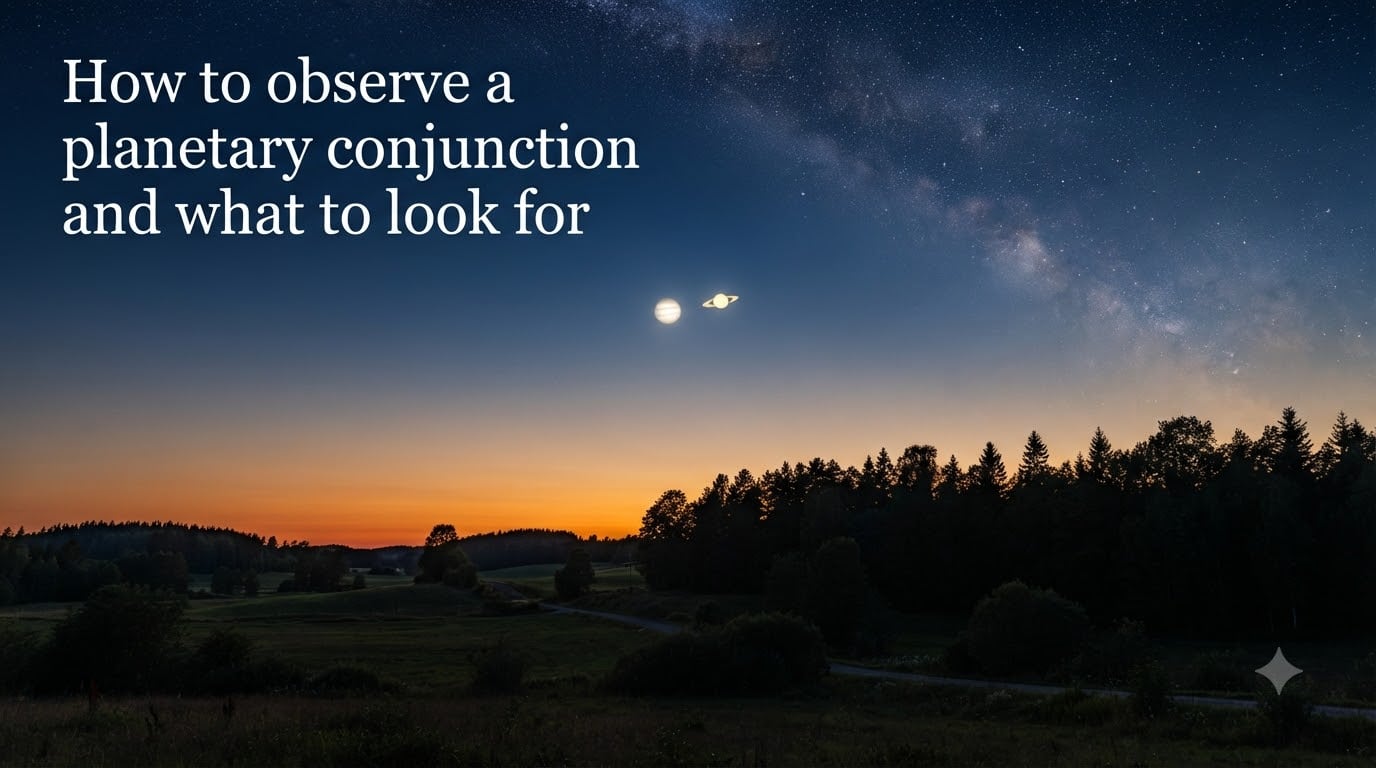
If you have ever glanced up at twilight and noticed two unusually bright “stars” hanging close to each other, you have probably witnessed a planetary conjunction. These alignments are some of the easiest and most rewarding sights in amateur astronomy, and I think they are the best possible on-ramp for anyone curious about the night sky.
In this guide I will walk you through how to observe a planetary conjunction from start to finish. We will cover what a conjunction actually is, why planets only appear close together, what to look for once you are outside, and how to time your viewing for 2026 and beyond. I have personally watched several of these events over the past few years, and I will share what worked, what flopped, and what I wish someone had told me before my first attempt.
Table of Contents
What Is a Planetary Conjunction?
A planetary conjunction is when two or more planets appear close together in the night sky from Earth’s perspective. The planets themselves are still millions of kilometers apart in space, but from our line of sight they look like neighbors.
Astronomers split conjunctions into two main types. An inferior conjunction happens when Mercury or Venus lines up directly between Earth and the Sun. A superior conjunction is when a planet sits on the far side of the Sun from us. For casual stargazing, “conjunction” usually means the first kind of event: two visible planets grouped together in the evening or morning sky.
You will also hear about the Great Conjunction, which is a once-every-20-years meetup between Jupiter and Saturn. The most recent Great Conjunction was on December 21, 2020, and the next one arrives in late 2026. That one is worth circling on your calendar if you have never watched these two gas giants share a single field of view.
Why Planets Appear Close Together in the Sky
Planets look close during a conjunction because we are seeing them along nearly the same line of sight, not because they are physically close. All the major planets orbit the Sun in roughly the same flat plane, called the ecliptic. From our viewpoint on Earth, the Sun, Moon, and planets all travel along a similar path through the sky.
Because each planet moves at a different speed, they occasionally lap one another. When two planets end up on the same side of the Sun and aligned with Earth, they appear to crowd together. The closer their orbits are to each other, the more often they pair up, which is why Venus and Jupiter conjunctions are common while a Saturn-Uranus conjunction is rare.
Even when two planets appear to almost touch, they can still be hundreds of millions of kilometers apart in real distance. I find this trick of perspective one of the most mind-bending parts of stargazing, and it is a great hook when you show a conjunction to friends or kids for the first time.
Conjunction vs Opposition vs Occultation
Beginners often mix up three terms that sound similar. A conjunction is when a planet appears near the Sun in our sky, which is why we usually see these pairings at sunrise or sunset.
An opposition is the opposite: a planet sits on the opposite side of Earth from the Sun, meaning it rises at sunset and stays visible all night. Opposition planets are at their closest and brightest, but they are not paired with another world.
An occultation is rarer and more dramatic. It happens when the Moon, or occasionally a planet, passes directly in front of another and briefly hides it. Lunar occultations of Venus or Jupiter can be spectacular, and they are worth chasing once you have mastered regular conjunctions.
What to Look For During a Planetary Conjunction
Once you know where to look, here is what to actually notice. First, watch the colors. Venus usually looks creamy white, Jupiter is pale yellow, Mars glows rusty orange, and Saturn has a soft golden hue. Seeing two of those colors side by side is part of the magic.
Next, pay attention to relative brightness. Venus is almost always the brighter of any pair because its cloudy atmosphere reflects sunlight so well. Jupiter is usually second. If you spot a “star” that does not twinkle, you have likely found a planet.
On consecutive nights, watch how the two worlds drift relative to each other. Their orbital speeds differ, so over a few days you can actually see the geometry change with your own eyes. That motion, slow and steady across the stars, is what I love most about conjunction watching.
Finally, with even modest binoculars you can sometimes catch Jupiter’s moons as tiny pinpricks near the planet. During a close conjunction, you can fit both planets and four Jovian moons into the same field of view, which feels like getting a front-row seat to the solar system.
How to Observe a Planetary Conjunction Step by Step
Here is the exact routine I use every time a promising conjunction rolls around. I have shared this with several local astronomy clubs and it has worked for total beginners and seasoned observers alike.
Pick your date. Use a stargazing app like Stellarium, Sky Tonight, or the American Astronomical Society’s event list to confirm the closest approach time and direction.
Check the weather. Clear skies matter more than perfect darkness. Even a partly cloudy evening works if you can find breaks near the horizon.
Arrive 30 minutes early. Give your eyes time to adapt to the dark. Avoid looking at your phone screen on full brightness, and turn off porch lights if you are in a backyard.
Find the planets first. Look west after sunset or east before sunrise, depending on the event. Bright planets are usually visible even before the sky fully darkens.
Confirm with binoculars. A quick scan through 10×50 binoculars will reveal Jupiter’s moons, Saturn’s rings, or the crescent shape of Venus if it is in the picture.
Switch to a telescope if you have one. Use a low-power eyepiece first to frame both planets, then zoom in on each individually for detail.
Log what you saw. Jot down the date, time, equipment, and sky conditions. After a year of notes you will have a great personal observing diary.
I follow this same checklist whether I am stepping outside my back door in a suburban neighborhood or driving two hours to a dark sky park. The structure keeps me from panicking when the moment arrives.
Naked Eye vs Binoculars vs Telescope
You do not need any equipment to enjoy a planetary conjunction. The brightest pairings, like Venus and Jupiter, are obvious to the naked eye, and that is how most people have experienced them for thousands of years.
Binoculars add a lot without much cost. A pair of 10×50 binoculars will show Jupiter’s four Galilean moons, the rings of Saturn as little handles, and the phase of Venus. They are also forgiving of shaky hands, which makes them ideal for beginners.
A telescope gives you the most detail but demands more setup. You will see cloud bands on Jupiter, the Cassini Division in Saturn’s rings, and craters near the terminator on the Moon. The downside is a narrow field of view, so wide conjunctions can be hard to frame.
My honest recommendation for first-timers: start with your eyes, then add binoculars, and only break out the telescope once you have the lay of the sky. You will appreciate the magnified view far more once you know what you are looking at.
Finding Dark Sky Locations and Timing
Light pollution is the biggest enemy of a great conjunction view. From a bright city, you might see Venus and Jupiter but lose the fainter planets or the Milky Way background. Escaping even 30 minutes outside an urban core makes a noticeable difference.
Search for certified Dark Sky Places through the International Dark-Sky Association, or simply use a light pollution map like lightpollutionmap.info to find the nearest darker patch of sky. State parks, lakeshores, and rural farmland are usually good bets.
Timing matters just as much as location. The “sweet spot” for most conjunctions is 30 to 60 minutes after sunset or before sunrise, when the planets are high enough to clear buildings and trees but the sky is dark enough for contrast. Use the free Time and Date website or your stargazing app to get exact rise and set times for your latitude.
One trick I lean on heavily: set a phone alert for one hour before the optimal viewing window. That way I am never rushing out the door with gear half-packed.
Smartphone Photography Tips for Conjunctions
You can absolutely capture a planetary conjunction with your phone, and the results are often better than people expect. The trick is treating your phone like a small telescope and giving it a few seconds to gather light.
Use Night Mode if your phone has one, and brace the phone against a stable surface or a small tripod. Tap to focus on the brightest planet, then drop the exposure slightly so the sky stays dark and the planets pop as bright points. A 3-second exposure on a steady surface usually beats a hand-held shot every time.
For close pairings, an inexpensive smartphone adapter like the Celestron NexYZ turns your phone into an afocal camera through a telescope eyepiece. I bought one in early 2026 and have used it for every close conjunction since. The learning curve is about 15 minutes, and the photos are surprisingly sharp.
Do not chase perfection on your first try. Get a clean, sharp image of the two planets, then experiment. Wide landscape shots with the conjunction over a tree line or skyline often look better than a tight close-up because they give the viewer scale.
Upcoming Planetary Conjunctions to Watch
If you want to plan ahead, here are several pairings worth marking on your calendar. These are based on standard almanac predictions and should be checked against your local conditions as dates approach.
August 2026: Venus and Jupiter pair up in the predawn eastern sky, separated by less than one degree at peak.
October 2026: A close approach of Mercury and Mars low in the western twilight shortly after sunset.
November 2026: Jupiter and the Moon share the same binocular field, with Venus nearby for a three-object grouping.
Late 2026: The next Great Conjunction of Jupiter and Saturn, the first close pairing since the 2020 event.
Dates can shift slightly based on your location, so cross-check with a current almanac closer to the event. Astronomy apps also send alerts when notable conjunctions are within two weeks, which I have found more reliable than relying on memory.
Common Mistakes to Avoid
After talking with hundreds of beginners at star parties and on forums, I have noticed the same handful of mistakes trip people up. Avoiding them will save you frustration and probably a wasted trip outside.
First, do not stare at your phone screen right before looking up. Even a quick glance at a bright display can ruin your dark adaptation for 20 minutes. Use a red flashlight or a night-mode app setting instead.
Second, do not show up at the wrong time. Many beautiful conjunctions happen in bright twilight, not full darkness. If an app says the event peaks at 6:15 a.m., be outside by 5:45 a.m., not 6:45 a.m.
Third, do not expect a telescope to “fix” light pollution. From a downtown backyard, even a large scope will show washed-out planets. Move to darker skies before upgrading equipment.
Finally, do not skip the binoculars step. People who jump straight to a telescope often miss the wide-field beauty of a conjunction because the magnification is too high. Binoculars first, telescope second is the order I recommend to every beginner.
Frequently Asked Questions
How rare is a planetary conjunction?
A basic two-planet conjunction happens a few times each year and is fairly common. Truly close pairings, especially of bright planets like Venus and Jupiter, occur roughly every one to three years. The Great Conjunction of Jupiter and Saturn is much rarer, happening only about every 20 years, and the very closest Great Conjunctions occur once per several centuries.
What to look for with planetary alignment?
Watch for steady, non-twinkling points of light, distinct colors like creamy white, pale yellow, or rusty orange, and changes in position from night to night. Even modest binoculars reveal Jupiter’s moons and the rings of Saturn. A telescope adds cloud bands on Jupiter and the Cassini Division in Saturn’s rings.
How to check planet conjunction?
Use a stargazing app such as Stellarium, Sky Tonight, or Stellarium Mobile to see live positions of planets from your location. Astronomy almanacs, planetarium websites, and the American Astronomical Society event calendar also list upcoming conjunctions with exact dates and times for your time zone.
How can I observe the Moon’s conjunction with planets?
Lunar-planet conjunctions are among the easiest events to watch. Look in the direction of the Moon in the hours after sunset or before sunrise, then identify the nearby bright planets. The Moon moves about 13 degrees per day, so the geometry changes visibly from one evening to the next.
Do I need a telescope to see a planetary conjunction?
No. The brightest conjunctions are easy to see with the naked eye, and binoculars add significant detail at low cost. A telescope is helpful for seeing planetary features like Jupiter’s cloud bands or Saturn’s rings, but it is not required to enjoy a conjunction.
Final Thoughts
Learning how to observe a planetary conjunction is one of the most satisfying projects in amateur astronomy, and it costs essentially nothing to start. Pick a date from the upcoming list, give your eyes 30 minutes to adapt, and step outside at twilight.
I think you will be surprised how much you can see with just your eyes, and how quickly the night sky starts to feel like familiar territory once you have watched a few of these alignments. Whether you chase the next Great Conjunction of Jupiter and Saturn or simply enjoy a quiet evening pairing of Venus and the Moon, the night sky has something ready whenever you are.