
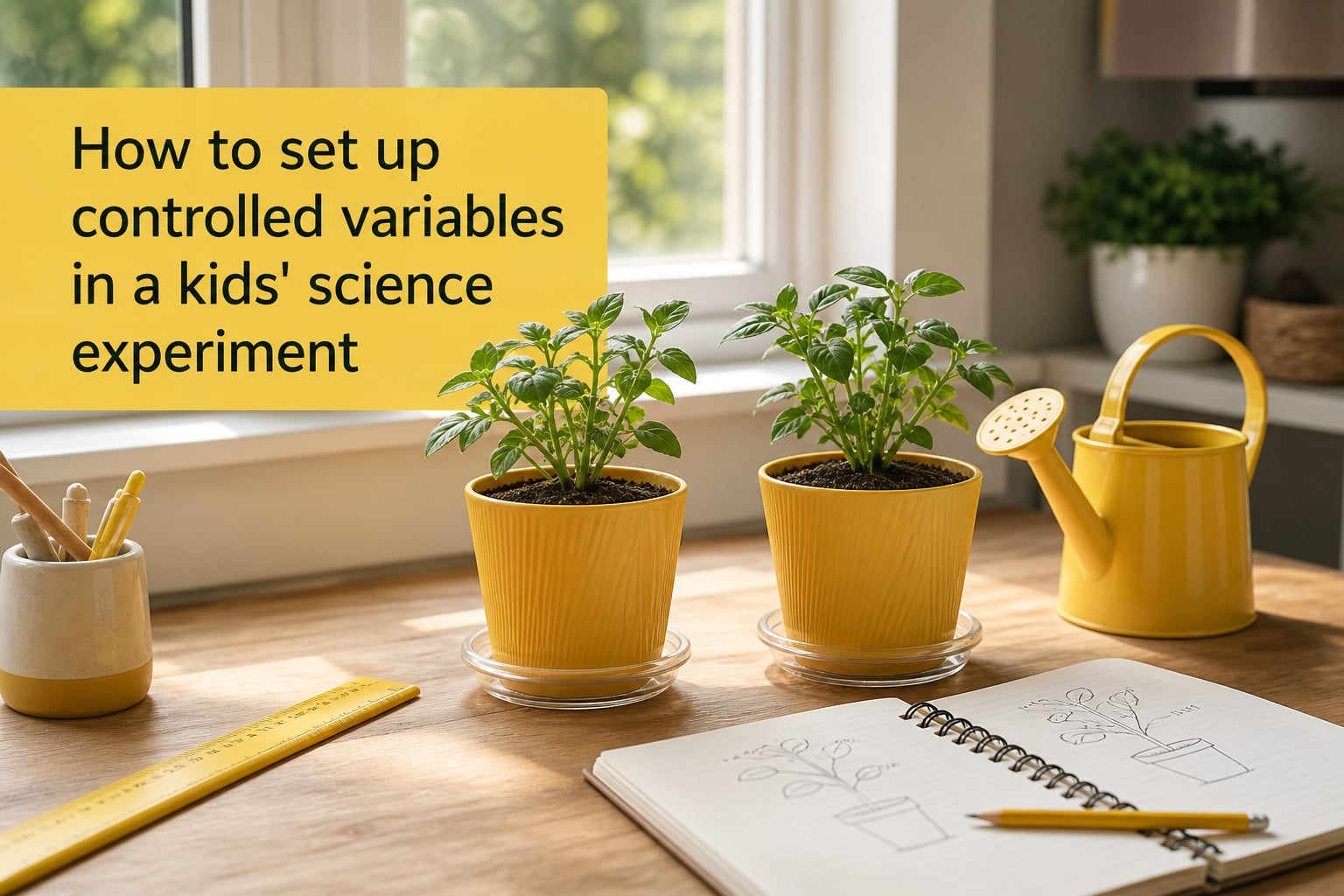
When my daughter came home with a science fair project last spring, she was confused about one word on her worksheet: controlled variable. She kept switching it with the thing she was supposed to change. I sat down with her and we worked through three plant pots on the kitchen windowsill to figure it out together. By the end of the week, she could point at any ingredient in any experiment and say, “That one stays the same.”
In this guide, I will walk you through exactly how to set up controlled variables in a kids science experiment so the results actually mean something. You will get a kid-friendly definition, the three variable types side by side, a step-by-step process to find controlled variables in any experiment, real examples you can run at home, and the common mistakes I have seen trip up young scientists. If you are a parent, teacher, or curious kid, this is for you.
Table of Contents
What Are Variables in a Science Experiment?
A variable is anything in an experiment that can change. The word sounds like “varies,” which is a helpful way to remember it. Variables are the building blocks of the scientific method because they let you test one thing at a time and watch what happens.
Think about baking cookies. The amount of sugar, the oven temperature, the baking time, and the size of the cookie scoop can all change. Each one of those is a variable. If you want to know which one makes the cookie chewy, you have to keep the others the same.
Every real experiment you do with kids will have variables everywhere. The trick is knowing which ones you are changing on purpose, which ones you are measuring, and which ones you are holding steady. That last group is what this guide is all about.
The Three Types of Variables You Need to Know
Every science experiment for kids uses three types of variables: independent, dependent, and controlled. They work together like a little team. Once your child understands the role of each one, they can read any experiment and figure out what is going on.
Here is a quick comparison you can save and refer back to when planning a project.
Variable Types Comparison Table
| Variable Type | What It Does | How Kids Can Spot It | Example in a Plant Experiment |
|---|---|---|---|
| Independent | The one thing you change on purpose | Ask: what am I testing? | Amount of water (1 cup vs. 2 cups) |
| Dependent | The thing you measure to see what changed | Ask: what am I watching or measuring? | Plant height in centimeters |
| Controlled | The things you keep exactly the same | Ask: what must stay constant? | Same soil, same pot size, same sunlight, same plant type |
The independent variable is the cause. The dependent variable is the effect. The controlled variables are everything else you freeze in place so the cause and effect are clear. When all three are set up right, your child has a fair test.
How to Set Up Controlled Variables in a Kids Science Experiment
Setting up controlled variables is a five-step process I have used with my own kids and the elementary classrooms I have worked with. Follow these steps before you run the experiment, not during, or you will scramble to fix things mid-test.
Step 1: Write Down Your Question
Start by writing the question your experiment is trying to answer. For example, “Do plants grow taller when they get more sunlight?” That question points straight at your independent variable: sunlight.
Step 2: List Everything That Could Possibly Change
Brainstorm every single thing that might vary in your setup. With the plant example, that includes water, soil type, pot size, plant species, temperature, fertilizer, sunlight, and the age of the plant. Do not skip anything yet. Just dump the list on paper.
Step 3: Pick One Thing to Change (Independent)
Choose exactly one variable to change. Two changes at once and you will not know which one caused the result. Circle that one variable. In our plant example, it is sunlight.
Step 4: Pick One Thing to Measure (Dependent)
Decide what you will measure to see the effect. It should be something you can count, weigh, time, or measure with a ruler. For our plant experiment, height in centimeters every three days works well.
Step 5: Mark Everything Else as Controlled
Every variable on your list that is not the independent or dependent variable becomes a controlled variable. Here is the rule I tell kids: if it is not changing and you are not measuring it, it must stay exactly the same in every trial. Same pot, same soil scoop, same water amount, same plant species, same starting height. Identical, not just close.
That last word matters. From talking to teachers on forums like r/ScienceTeachers, I have learned that students often forget controlled variables need to be identical, not similar. Two tablespoons versus a “rounded” two tablespoons is not a controlled variable. Two level tablespoons is.
Controlled Variable Examples for Popular Kids Experiments
Examples stick in memory better than definitions. Here are three classic kids science experiments with their controlled variables clearly listed. Try one with your child this week.
Plant Growth Experiment
Question: Does the amount of sunlight change how tall a plant grows?
Independent variable: Hours of sunlight (4 hours vs. 8 hours)
Dependent variable: Plant height measured in cm every 3 days
Controlled variables: Same plant species, same pot size, same amount of water, same soil type, same starting plant height, same room temperature
Ball Bounce Height Experiment
Question: Does the height of the drop change how high a ball bounces?
Independent variable: Drop height (1 meter vs. 2 meters)
Dependent variable: Bounce height in cm
Controlled variables: Same ball, same floor surface, same air pressure in the ball, same temperature, same person dropping it, same measuring tool
Baking Soda Volcano Experiment
Question: Does the amount of vinegar change how tall the eruption gets?
Independent variable: Amount of vinegar (50 mL vs. 100 mL)
Dependent variable: Eruption height in cm
Controlled variables: Same amount of baking soda, same water temperature, same volcano shape, same dish size, same brand of vinegar
Notice how the controlled variables are always the longest list. That is normal. Most of your setup work goes into keeping things steady so one change can speak for itself.
Why Controlled Variables Matter for a Fair Test
A fair test is an experiment where only one thing changes at a time. Controlled variables are what make a test fair. Without them, you cannot tell whether the result came from the thing you changed or from something else that drifted.
Imagine testing two plant pots. One gets more sunlight, but you also accidentally gave it more water because you forgot. If that plant grows taller, was it the sunlight or the water? You have no way to know. The controlled variables were not set up, so the test was not fair, and the results are not reliable.
This matters for science fair projects too. Judges look for fair tests because they show the student understands the scientific method. A neat board with messy variables will not score as high as a simple project with perfectly controlled variables.
Common Mistakes Kids Make With Controlled Variables
After watching dozens of elementary projects, I see the same five mistakes over and over. Sharing them with your child before they start can save hours of redoing.
Mistake 1: Calling the Independent Variable “Controlled”
Many kids hear “controlled” and assume it means the part they control, like the thing they are testing. It does not. Controlled variables are the ones you hold constant.
Mistake 2: Letting Controlled Variables Drift “Just a Little”
Slightly more water, slightly bigger pot, slightly warmer room. The word “slightly” is the enemy of a fair test. The variable must be identical across every trial.
Mistake 3: Forgetting to Control the Tester
If a human is measuring, timing, or dropping the ball, that person is part of the setup. Different people measuring will get different numbers. Use the same person, or better, write down a clear procedure so anyone could repeat it the same way.
Mistake 4: Skipping the Control Group
A control group is the trial where the independent variable is set to its normal or zero value. In the plant experiment, that means a plant with normal sunlight. Without it, kids cannot compare against a baseline and often miss this until judging day.
Mistake 5: Changing More Than One Thing on Accident
This is the classic trap. The plant experiment starts as a sunlight test, then the kid decides to also try a new fertilizer. Now there are two independent variables, and the results cannot be trusted. Pick one change, finish the experiment, then run a second experiment with the other change.
How Controlled Variables Connect to Your Hypothesis
The hypothesis is the prediction you write before the experiment. Controlled variables make the hypothesis possible. If you are not holding the other factors constant, your prediction about the independent variable has no meaning because too many other things are also affecting the result.
Here is a simple formula I teach kids: “If I change [independent variable] while keeping [controlled variables] the same, then [dependent variable] will [prediction].” That sentence makes every part of the experiment show up in writing. It also forces kids to name their controlled variables out loud before they start, which is a habit that prevents the common mistakes above.
For the plant example, the hypothesis becomes: “If I change the hours of sunlight while keeping the water, soil, pot, and plant type the same, then the plant with more sunlight will grow taller in 14 days.” Short, testable, and the controlled variables are right there in the sentence.
Quick Tips for Setting Up a Fair Science Experiment
Before you start any project, run through this short checklist with your child.
Write the question first, then the hypothesis, then the variable list.
Pick one independent variable and stick with it. Resist the urge to test two things.
Use the same brand and size for every material across trials.
Measure with the same tool, in the same units, every time.
Run at least three trials. One trial is not a fair test.
Have a control group with the normal or zero value of the independent variable.
Take photos of the setup so you can prove the controlled variables stayed the same.
Those seven habits will make any kids science experiment feel like real lab work. They will also save you from the most common fairness problems that show up at science fair judging.
Frequently Asked Questions
What is an example of a controlled variable in a science experiment?
A controlled variable is anything you keep exactly the same so your test is fair. In a plant growth experiment testing sunlight, controlled variables include the same amount of water, same soil type, same pot size, same plant species, and same starting height. Without these held constant, you cannot tell if sunlight caused the result.
What is an example of a controlled variable for kids?
For kids, a simple example is the baking soda volcano. If you change how much vinegar you use, the controlled variables are the amount of baking soda, the water temperature, the volcano shape, and the size of the dish. Everything except the vinegar stays identical so the eruption height comparison is fair.
What variables can be controlled in an experiment?
Almost anything that is not your independent or dependent variable can be controlled. Common categories include materials and supplies, amounts of ingredients, equipment size, environmental conditions like temperature and light, the person taking measurements, timing, and the location where the experiment happens. Make a list and freeze every item that is not being changed or measured.
What is a controlled experiment for kids?
A controlled experiment for kids is a fair test where only one thing changes at a time and everything else stays the same. The one change is the independent variable, what you measure is the dependent variable, and what stays the same are the controlled variables. Running the experiment with a control group that has zero change helps kids see the effect clearly.
Wrapping Up Your Controlled Variables Setup
Learning how to set up controlled variables in a kids science experiment is one of the most useful science skills you can teach. Once your child can spot independent, dependent, and controlled variables in any project, the whole scientific method starts to make sense.
Pick one of the three experiments above, sit down with your child, and walk through the five-step setup together. Make the controlled variable list out loud. Freeze those factors. Run the experiment. You will be surprised how confident kids become when they see a clean result come out of a fair test.
If you want more help planning a science fair project around controlled variables, our team has put together step-by-step guides for plant, chemistry, and physics experiments that work great at home or in class.