
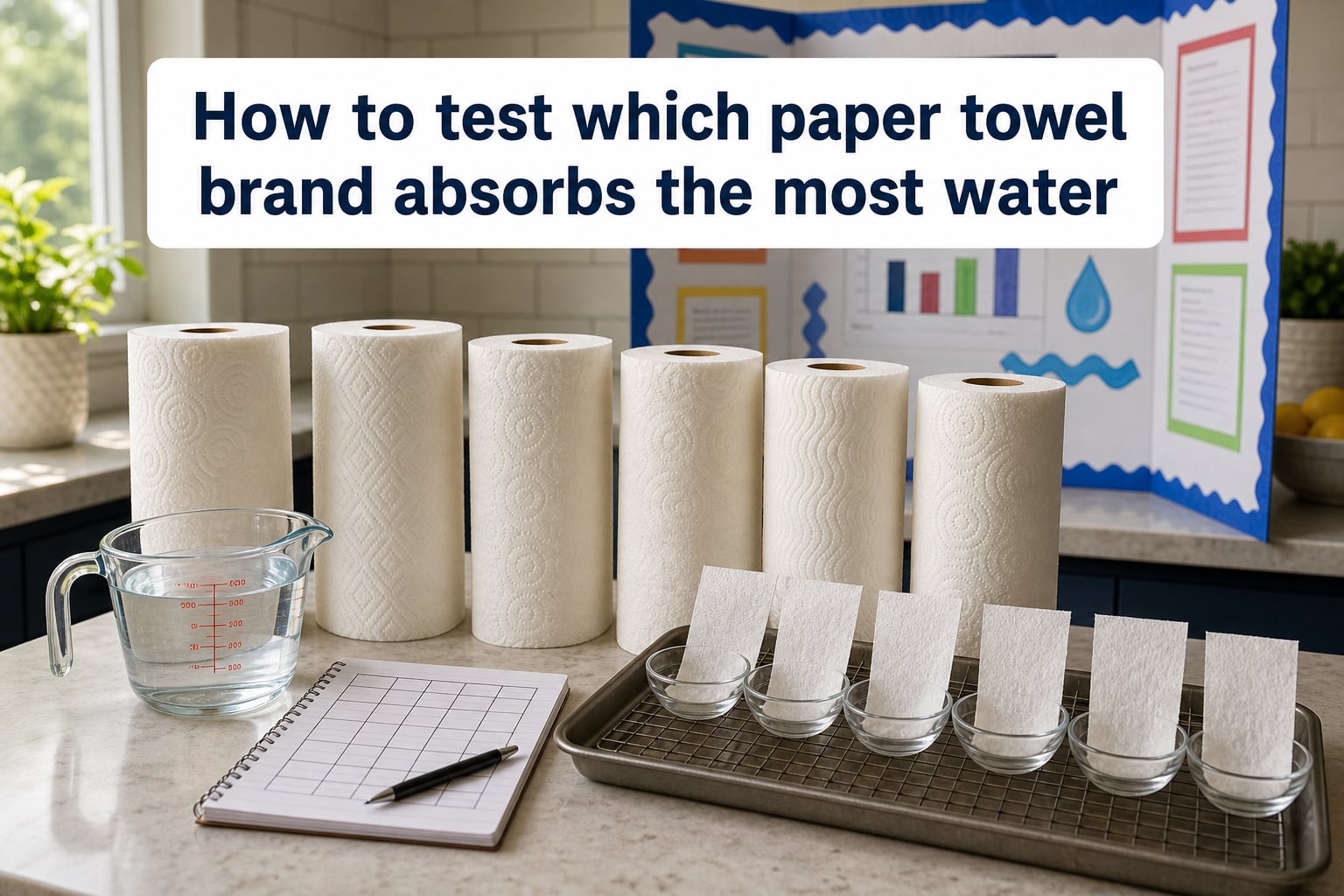
When my daughter came home with a science fair assignment sheet last fall, I knew exactly which experiment we were doing together. Learning how to test which paper towel brand absorbs the most water is one of the most popular classroom projects for a reason: it teaches real science, uses supplies you already have, and produces results that genuinely surprise people.
Our team has walked dozens of families through this experiment, and the same pattern repeats every time. Kids who follow a controlled procedure, record clean data, and explain the underlying science end up with stronger projects and higher scores. This guide gives you everything you need to run the experiment at home, in a classroom, or for a science fair in 2026.
Table of Contents
What You’ll Need: Materials and Supplies
One of the best parts of this project is that most of the supplies are already in your kitchen. Gather these items before you start, and the whole experiment takes under an hour.
- 4 to 6 different paper towel brands (full sheets, same size)
- A large measuring cup with milliliter markings (or a kitchen scale)
- A pitcher of room-temperature water
- A flat dish or baking sheet to catch drips
- A plastic ruler or measuring tape
- A notebook or printed data table for recording results
- A stopwatch or phone timer
- Paper towels for cleanup (one brand’s leftovers work great here)
Choose brands that span the price range. Pick up a premium brand, a store brand, and a budget option so your comparison actually tells a story. We also recommend including a basic school paper towel for a true baseline.
How to Test Which Paper Towel Brand Absorbs the Most Water: Step-by-Step Procedure
Follow these seven steps in order, and you will have clean, comparable data by the end. The whole process takes about 45 minutes once you have your supplies ready.
Step 1: Prepare Your Workspace
Lay down a flat surface with your dish or baking sheet to catch any spills. Set your measuring cup, water pitcher, and stopwatch within arm’s reach. We find that a kitchen counter works better than a dining table because cleanup is faster.
Step 2: Set Up Your Data Table
Draw or print a table with columns for brand name, starting water amount, ending water amount, and water absorbed. You will also want columns for trial 1, trial 2, and trial 3 so you can average your results. We’ll provide a ready-to-copy template later in this guide.
Step 3: Measure the Starting Water
Pour exactly 100 milliliters of water into your measuring cup for each trial. Write that number down in your data table. Using the same starting amount for every brand is what makes this a fair test.
Step 4: Submerge the Paper Towel
Place one full sheet of the first paper towel brand into the water. Press it down gently with a spoon so the entire sheet gets wet. Start your stopwatch and let it soak for exactly 60 seconds.
Step 5: Lift and Drain the Towel
Using tongs or your fingers, lift the paper towel out of the water. Hold it over the cup for 30 seconds and let the excess water drip back into the measuring cup. Do not squeeze the towel because squeezing changes what you are trying to measure.
Step 6: Measure the Remaining Water
Read the new water level in your measuring cup and subtract it from your starting amount. The difference is how much water that brand absorbed. Write the number down immediately.
Step 7: Repeat for Each Brand
Run three trials per brand to confirm your results. Average the three numbers to get the most reliable answer. If one trial seems wildly different from the others, run a fourth trial to see which two numbers match.
The Science Behind Paper Towel Absorbency
Paper towels soak up water because of a process called capillary action. Tiny spaces between the cellulose fibers in the paper act like straws, pulling water upward and holding it inside the sheet. The thinner and more tightly packed the fibers, the more spaces there are for water to fill.
Capillary Action Explained
Capillary action happens when the pull of water molecules toward a surface is stronger than the pull between water molecules themselves. In paper towels, water creeps into the narrow gaps between fibers and climbs upward, defying gravity for a few seconds. This is the same force that lets plants pull water up from their roots.
Adhesion and Cohesion in Paper Towels
Two related forces drive capillary action. Adhesion is the attraction between water molecules and the cellulose fibers in the paper. Cohesion is the attraction between water molecules themselves. When adhesion is stronger than gravity and cohesion keeps the water connected, liquid flows into the towel and stays there. Premium brands engineer their fibers to maximize both forces, which is why they often absorb more.
Applying the Scientific Method to Your Experiment
A paper towel absorbency test is one of the cleanest ways to teach the scientific method. Each step below maps directly to a section of your science fair board.
Forming Your Hypothesis
Your hypothesis is a guess you can test. A good hypothesis for this experiment sounds like this: “If the paper towel has a higher ply count, then it will absorb more water because more layers create more fiber space.” Make sure your guess includes both an “if” and a “then” statement so you can clearly prove or disprove it.
Identifying Variables (Independent, Dependent, Controlled)
The independent variable is what you change. In this experiment, that is the paper towel brand. The dependent variable is what you measure, which is the amount of water absorbed in milliliters. Controlled variables are everything you keep the same: water amount, soak time, drain time, water temperature, and paper towel sheet size. Holding these steady is what makes your test fair.
Drawing Your Conclusion
Compare your average results to your hypothesis. If your hypothesis predicted that premium brands absorb more and your data shows they did, you can confirm your guess. If a budget brand won, that is an even better story because it shows that price does not always predict performance. Real testing we have seen confirms this: a basic school paper towel absorbed only 5 to 10 milliliters out of 30 in one trial, while a premium brand absorbed around 20 milliliters on average.
Recording Results: Data Table Template
Copy this template into your notebook, print it, or recreate it on your science fair board. Filling in every cell as you go prevents lost data and makes your project look professional.
Brand name | Trial 1 (ml) | Trial 2 (ml) | Trial 3 (ml) | Average (ml)
Add a second table for observations. Note the texture, thickness, number of plies, and whether the towel fell apart when wet. These qualitative details often matter as much as the numbers when you present your findings.
Tips for Science Fair Success
I have judged enough science fairs to know that judges look for three things above all else. First, a clear hypothesis written before the experiment begins. Second, evidence that the student actually ran multiple trials. Third, a thoughtful conclusion that connects the data back to the original question.
Photograph every step. A photo of your setup, your data table, and your final soaked towels turns a flat report into a visual story. Judges love seeing real evidence of the work.
Graph your results. A simple bar chart with brand names on the bottom axis and milliliters absorbed on the vertical axis makes your data pop. You can create one by hand or use a free tool like Google Sheets.
Common Mistakes to Avoid
The biggest mistake we see is squeezing the paper towel during the drain step. Squeezing tests wet strength, not absorbency, and it skews every brand in unpredictable ways. Lift and let drip instead.
Another common error is changing brands mid-trial. Pick your lineup, label each sheet, and stick to the plan. Switching brands partway through destroys your ability to compare fairly.
Finally, do not skip the third trial. One soak can fool you because a single dry pocket inside the towel can absorb much more water than usual. Three trials give you a trustworthy average.
Extension Activities and Variations
Once you have mastered the basic test, try adding a variable. Test the same brands with saltwater instead of fresh water to see if dissolved minerals change absorption. Or run the experiment with cold water versus warm water to explore how temperature affects capillary action.
You can also test strength alongside absorbency. After soaking each towel, place standard weights on it one at a time until it tears. This creates a second project on the same board and often impresses judges more than a single test.
Frequently Asked Questions
Which paper towel is the most absorbent in an experiment?
Based on multiple consumer and classroom tests, Bounty and other premium 2-ply brands consistently absorb the most water, often around 20 milliliters per sheet, while budget and school-grade paper towels absorb far less.
What is the science behind paper towel absorbency?
Paper towels absorb water through capillary action, where water molecules adhere to cellulose fibers and cohesion between water molecules pulls more liquid into the tiny spaces between fibers.
Do all brands of paper towels absorb water at the same rate?
No. Brand absorbency varies widely because of differences in fiber quality, ply count, embossing patterns, and wet strength, which is why running a controlled test produces different results for each brand.
How do you write a hypothesis for a paper towel experiment?
Use an if-then statement that names your independent variable (brand or ply count) and predicts the dependent variable (water absorbed). For example: If the paper towel has a higher ply count, then it will absorb more water.
What variables should be controlled in a paper towel test?
Control the starting water amount, soak time, drain time, water temperature, sheet size, and the surface you dry on. Keeping these constant is what makes your comparison fair.
Do paper towel layers affect absorption?
Yes. Higher ply counts create more fiber layers, which means more capillary channels for water to enter, so 2-ply and 3-ply towels generally absorb more than single-ply sheets of the same brand.
Conclusion
Now you have a complete roadmap for how to test which paper towel brand absorbs the most water. Gather your materials, set up your data table, and run all seven steps for each brand. Take photos, average your trials, and explain capillary action in your conclusion.
The experiment works because it is simple enough for a 6-year-old to perform and rich enough to teach high schoolers about controlled variables. Run it this week, record your data honestly, and you will have a science fair project that stands out in 2026.