
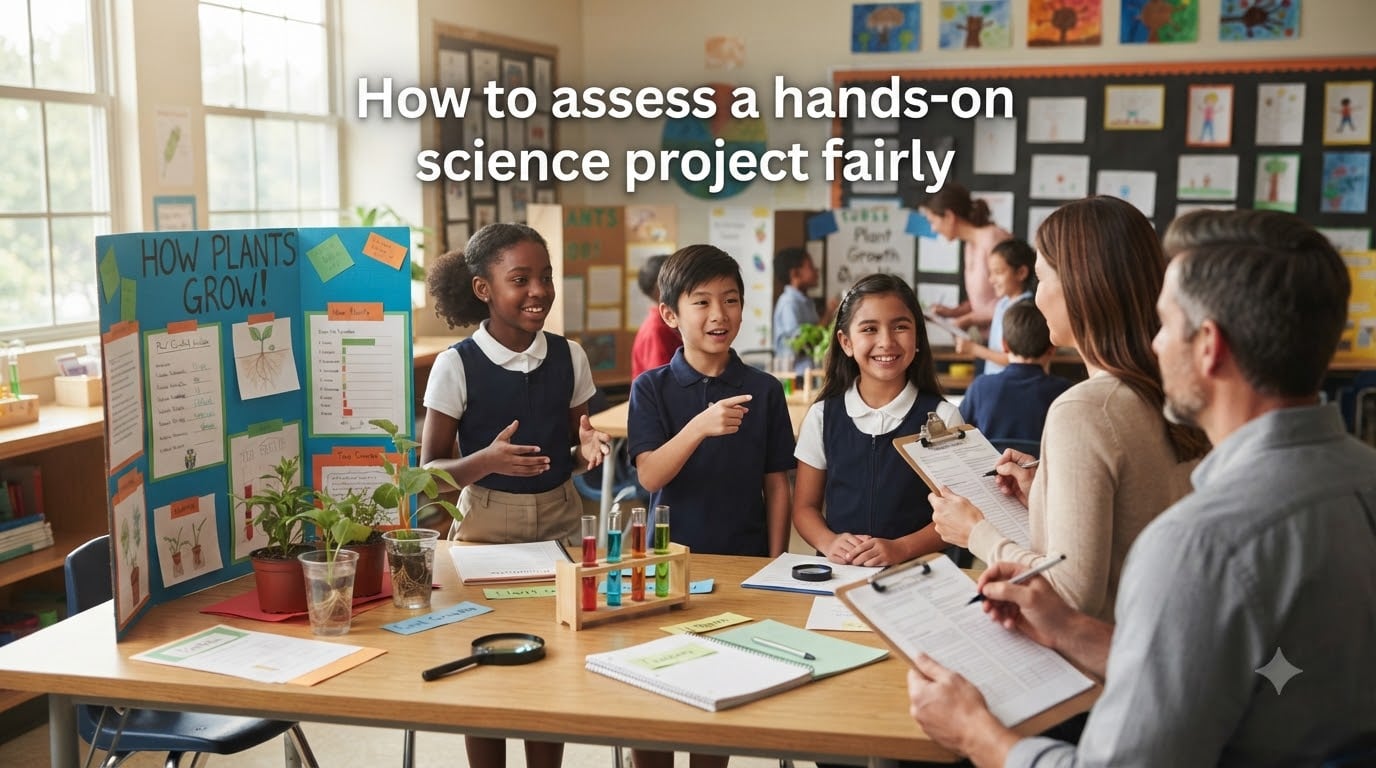
Learning how to assess a hands-on science project fairly is one of the most important skills a science educator or judge can develop. When students pour weeks of effort into experiments, the way we evaluate their work shapes whether they walk away inspired or discouraged. I have sat at judging tables, watched parents quietly help kindergartners build displays, and graded hundreds of middle school projects. The lessons I learned changed how I think about fair science project evaluation.
Fair assessment is not about lowering the bar. It is about applying consistent criteria so every student gets measured against the same standard. This guide walks through the science fair judging rubric, age-appropriate expectations, bias pitfalls, and interview questions that will help you evaluate hands-on science projects with confidence.
Table of Contents
What Is Fair Assessment of a Hands-On Science Project?
Fair assessment of a hands-on science project uses standardized criteria to evaluate all participants objectively, regardless of background, resources, or parental involvement. It applies the same rubric to every student, weighs the same factors, and judges work on its scientific merit rather than its visual polish.
Why does fair assessment matter? When students know they will be judged on clear, consistent standards, they focus on learning the scientific method instead of trying to game the system. Fair assessment also protects students who lack home resources or whose families cannot help with elaborate displays.
Hands-on projects specifically test something written tests cannot. They reveal whether a student can design an experiment, control variables, collect real data, and draw logical conclusions. A good assessment framework honors that process.
Key Criteria for Evaluating Hands-On Science Projects
The strongest science fair judging rubrics score projects across five core dimensions. I have used this framework with hundreds of students and found it produces consistent results across judges.
- Scientific Thought (25-30%) – Did the student identify a testable question, form a hypothesis, and design a controlled experiment?
- Creativity and Originality (15-20%) – Is the question novel, or did the student put a fresh spin on a known experiment?
- Thoroughness (20-25%) – Were enough trials run? Was the data complete? Did the student test multiple variables where appropriate?
- Skill and Technique (15-20%) – How well did the student execute the experiment? Was equipment used safely and properly?
- Clarity of Communication (15-20%) – Can the student explain the project clearly? Does the display support the explanation without doing the talking for them?
A common mistake is weighting visual presentation too heavily. A flashy trifold board does not make a science fair project fair or scientifically sound. Reserve most of your points for the thinking and the evidence.
How the Scientific Method Guides Fair Assessment
Every fair assessment of a hands-on science project should map back to the scientific method. When you anchor your rubric to these steps, bias has nowhere to hide.
Step 1: Question Formation
A strong project starts with a clear, testable question. Look for questions that can be answered with measurable data, not opinions. “Which paper towel absorbs the most water?” is testable. “Which paper towel is best?” is vague.
Step 2: Hypothesis Quality
A good hypothesis predicts an outcome and explains why. Award higher scores when students explain their reasoning, not just their guess. A hypothesis like “Brand X will absorb more water because its fibers are tighter” shows deeper thinking than “Brand X will win.”
Step 3: Variable Control
This is where most student projects fall apart. Fair assessment means rewarding students who identified independent, dependent, and controlled variables. Did they keep everything constant except the one thing they were testing? If not, the experiment has a flaw worth noting.
Step 4: Data Collection
Look for organized data in tables, charts, or graphs. Multiple trials beat a single run. Students who collected five trials of each condition demonstrate rigor that deserves recognition.
Step 5: Conclusion Drawing
A strong conclusion revisits the hypothesis and asks whether the data supports or refutes it. Bonus points go to students who acknowledge unexpected results or sources of error. That kind of honesty reflects real scientific thinking.
How to Create a Fair Science Fair Rubric
A well-designed rubric is the single most powerful tool for fair assessment. Without one, judges drift toward personal preference. Here is the process I use to build rubrics that produce consistent scores.
Define Clear Performance Levels
Each criterion should have 3-5 performance levels with specific descriptors. Avoid vague language like “good” or “excellent.” Instead, describe what work at each level actually looks like.
Assign Point Values by Weight
Scientific thought and thoroughness should carry the most weight because they reflect real learning. A typical 100-point rubric looks like this:
- Scientific Thought: 30 points
- Thoroughness: 25 points
- Creativity: 15 points
- Skill: 15 points
- Communication: 15 points
Sample Rubric Framework
For each criterion, write descriptors that match your grade level expectations. A middle school rubric for “Data Collection” might read: 4 points for 5+ trials with organized tables, 3 points for 3-4 trials with basic tables, 2 points for 1-2 trials with partial records, and 1 point for incomplete or missing data.
When you write descriptors this way, two judges looking at the same project almost always land on the same score.
Age-Appropriate Assessment Considerations
Fair assessment is impossible without matching expectations to the student’s developmental stage. A first grader and a tenth grader should never be judged by the same yardstick.
Elementary (K-5) Expectations
At this level, focus on curiosity, observation skills, and basic process. A kindergartner who can describe what they observed and what they learned deserves credit, even if a parent built the display board. Reward enthusiasm and emerging understanding, not technical execution.
Teachers on r/Teachers frequently raise concerns about kindergarten projects where parents do most of the work. The fairest approach is to evaluate what the child can explain verbally, not what appears on the board.
Middle School (6-8) Expectations
Middle schoolers should demonstrate controlled experiments with multiple trials, basic statistical thinking, and the ability to explain cause and effect. Hypothesis quality and variable control become major scoring categories at this stage.
High School (9-12) Expectations
High school projects should show sophisticated experimental design, deeper data analysis (including statistical reasoning), engagement with existing research, and meaningful conclusions that acknowledge limitations. Creativity and originality carry more weight because students have years of exposure to common experiments.
Common Bias Pitfalls to Avoid
Even experienced judges bring unconscious bias to the table. Knowing these pitfalls is the first step toward eliminating them.
Visual Presentation Bias
Glossy displays with professional photography tend to score higher, even when the science is mediocre. Fight this by scoring the display separately from the science, and by limiting display points to a small percentage of the total.
Parental Involvement Bias
Projects with sophisticated equipment, advanced statistics, or polished writing often signal heavy adult involvement. The fairest way to assess student work is to ask the student to explain it. If they cannot explain their own methods, the score should reflect that gap. Many teachers on r/ScienceTeachers use the interview as the deciding factor.
Project Type Bias
Judges often favor engineering builds over data-collection experiments, or chemistry over biology. Commit to scoring each project against your rubric criteria, not your personal preferences for project types.
Confirmation Bias
Once a judge decides a project is impressive or weak, that first impression colors everything else. Slow down, score each criterion independently, and revisit your initial impression after you have looked at all the data.
Interview Questions for Student Scientists
The interview is where fair assessment becomes real. A student who can explain their work demonstrates understanding; a student who cannot may have relied on outside help. Here are the questions I ask at every judging session.
About the Hypothesis
- What made you interested in this question?
- Why did you predict this outcome?
- What would have happened if your hypothesis was wrong?
About the Method
- What did you keep the same across all your trials?
- How did you make sure your results were reliable?
- What was the hardest part of running this experiment?
About the Data
- How many trials did you run and why?
- What did your results show?
- Was there anything surprising in the data?
About the Conclusion
- Do your results support your hypothesis?
- If you did this again, what would you change?
- What would you like to test next?
Listen for the student’s own voice. A student who pauses to think before answering is usually doing their own work. A student who recites memorized talking points or stares blankly may be presenting someone else’s project.
Tips for Consistent Evaluation Across Multiple Judges
When multiple judges score the same set of projects, consistency becomes the biggest challenge. A project rated 90 by one judge and 70 by another damages trust in the entire process.
Hold a Calibration Session
Before judging begins, have all judges score the same two or three practice projects independently. Compare scores, discuss discrepancies, and align on how to apply the rubric. This 30-minute investment prevents hours of confusion later.
Score Criterion by Criterion
Have each judge score all projects on criterion 1 first, then move to criterion 2. This approach reduces the halo effect, where one impressive feature inflates scores across the board.
Document Your Reasoning
Brief notes on why you awarded each score make it easier to defend decisions and easier to revisit scores if a student appeals. Even a few words per criterion helps.
Normalize Scores if Needed
If one judge consistently scores higher than others, do not adjust individual scores after the fact. Instead, share this feedback privately and use it to improve calibration next time.
Use the Same Rubric Format
Digital rubrics on tablets or printed score sheets work better than memory. When every judge uses the same form with the same descriptors, scores naturally trend closer together.
Frequently Asked Questions About Fair Science Project Assessment
How do you evaluate a science project fairly?
Use a standardized rubric that scores scientific thought, thoroughness, creativity, skill, and communication. Apply the same criteria to every student, ask the student to explain their work, and avoid weighting visual presentation too heavily.
What questions should you ask when judging a science fair?
Ask about the student’s hypothesis and reasoning, what variables they controlled, how many trials they ran, what their data showed, and what they would change next time. The interview reveals whether the student actually did the work.
What is the 5 second rule in science fair?
The 5-second rule is an informal guideline suggesting judges spend at least 5 seconds looking at a project before forming an opinion. It helps prevent snap judgments based on first impressions rather than the actual science.
Why are hands-on activities important in science?
Hands-on activities let students practice the full scientific method, build problem-solving skills, and develop a deeper understanding of concepts than reading or listening alone can provide.
How do you handle parental involvement fairly?
Evaluate what the student can explain verbally, not just what appears on the display. Use the interview to gauge the child’s own understanding, and reserve points for explanations the student can give in their own words.
Conclusion
Fair assessment of hands-on science projects comes down to three habits: use a clear rubric, apply it consistently, and listen to the student explain their own work. When you anchor your science fair judging rubric to the scientific method, match expectations to age, and watch for hidden bias, you give every student a fair shot at being recognized for what they actually learned.
Start with the rubric framework in this guide, adapt the descriptors to your grade level, and run a quick calibration session with your fellow judges. The result will be assessments that students and parents trust, scores that hold up to scrutiny, and a science fair experience that inspires the next generation of scientists.