
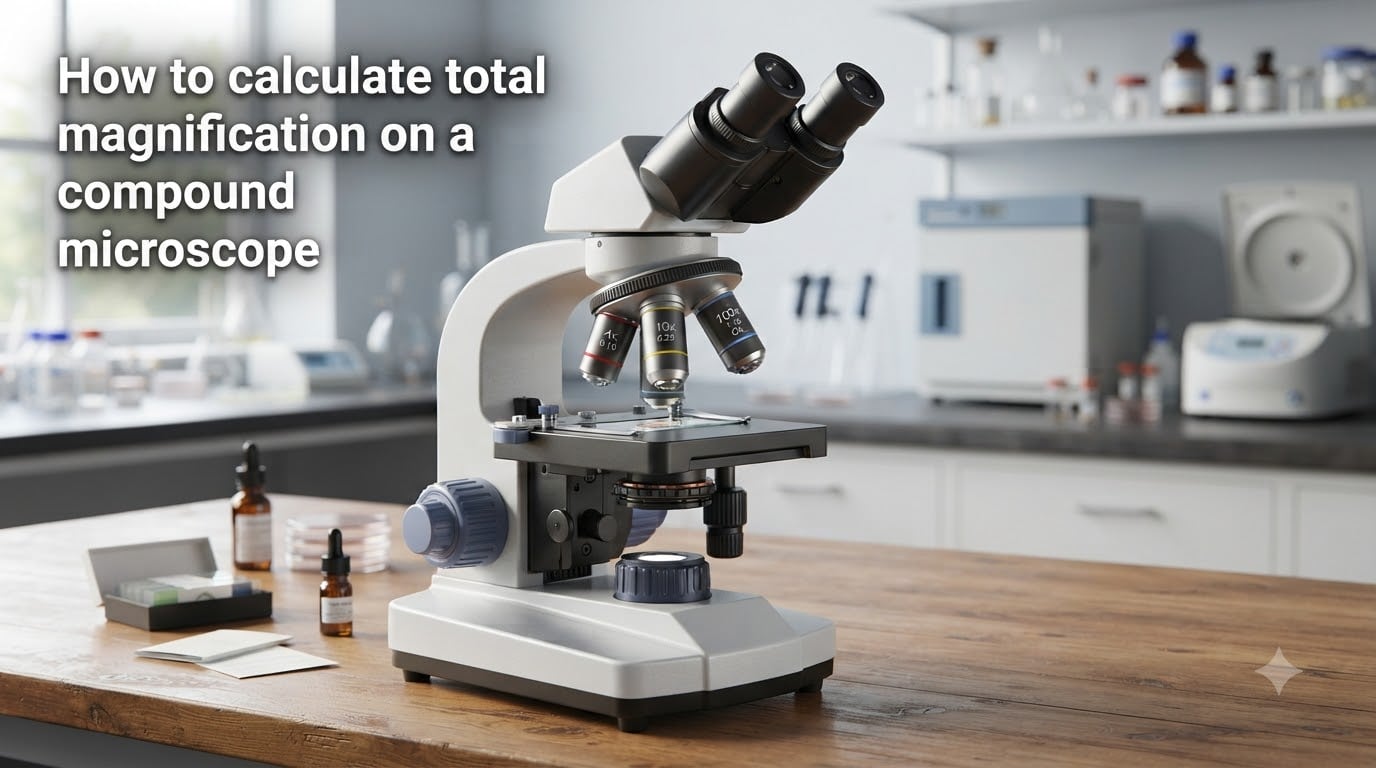
Learning how to calculate total magnification on a compound microscope is one of the first skills every biology student and lab technician needs. The process is simple once you know the formula, but the details around objective lenses, oil immersion, and practical limits can trip people up.
Total Magnification = Eyepiece (Ocular) Magnification x Objective Lens Magnification
That single multiplication is all it takes. If you are using a standard 10x eyepiece with a 40x objective lens, your total magnification is 400x. In this guide, I will walk you through the formula, every common objective lens combination, the mistakes to avoid, and why cranking up magnification does not always give you a clearer image.
Our team put this guide together because we noticed that most online resources give you the formula and stop there. They skip the practical questions that come up in real lab settings. What happens when you switch objectives? Why does a 1000x image sometimes look worse than a 400x one? When do you actually need oil immersion? Let us answer all of that.
Table of Contents
The Total Magnification Formula Explained
The total magnification formula is straightforward multiplication. You multiply the magnification power stamped on your eyepiece by the magnification power printed on your current objective lens.
Formula: Total Magnification = Ocular Lens Power x Objective Lens Power
Most compound microscopes come with a 10x eyepiece, also called an ocular lens. Some models use 15x or 20x eyepieces, so it is always worth checking. The eyepiece magnification is usually printed on the side of the eyepiece tube.
The objective lenses sit on the rotating nosepiece at the bottom of the body tube. A typical compound microscope has three to four objectives: 4x, 10x, 40x, and 100x. Each objective is labeled with its magnification power.
Here is a quick example. If your eyepiece reads 10x and you swing the nosepiece to the 40x objective, the math is: 10 x 40 = 400x total magnification. Your specimen now appears 400 times larger than it actually is.
Understanding Objective Lens Magnification Levels
Objective lenses are where the real magnification work happens on a compound microscope. Each lens serves a specific purpose, and knowing when to use each one makes a big difference in what you can actually see.
The 4x Scanning Objective
The 4x objective is called the scanning lens. With a standard 10x eyepiece, it gives you 40x total magnification. This is your starting point for any slide.
Use the 4x lens to locate your specimen, get it centered, and establish rough focus. The field of view at 40x is wide, so you see a large area of the slide. This makes it easy to find what you are looking for before moving to higher powers.
At 40x total magnification, you can see large structures like plant cells, insect parts, and tissue sections clearly enough to orient yourself.
The 10x Low Power Objective
The 10x objective gives you 100x total magnification with a 10x eyepiece. This is often called the low power lens.
Once your specimen is centered and focused at 40x, switch to the 10x objective. Because most compound microscopes are parfocal, your image should stay nearly in focus when you change objectives. You will only need a small fine-focus adjustment.
At 100x total magnification, you can make out individual cells, cell arrangements, and larger organelles. This is a great working magnification for many biology lab exercises.
The 40x High Power Objective
The 40x objective delivers 400x total magnification with a standard 10x eyepiece. This is the high power lens and is where things get interesting for detailed observation.
At 400x, you can see cell nuclei, protozoa, and detailed internal structures of cells. The field of view narrows significantly compared to lower powers, so your specimen must be properly centered before switching.
One thing to watch: the working distance at 40x is short. The objective lens sits very close to the slide. If you focus carelessly with the coarse adjustment knob, you can crack the slide or damage the lens. Always start focusing from the side and use the fine adjustment once you are close.
The 100x Oil Immersion Objective
The 100x oil immersion objective gives you 1000x total magnification with a 10x eyepiece. This is the highest magnification on most standard compound light microscopes.
The 100x lens requires immersion oil between the lens and the coverslip. Without oil, light scatters at the glass-air interface, and your image becomes dim and blurry. The oil has the same refractive index as glass, so it keeps the light path clean.
At 1000x total magnification, you can see bacteria, blood cell details, and fine structures within larger cells. This is where careful slide preparation and lighting become essential.
Never use the 100x objective without immersion oil. You will damage the lens and get a worthless image. Also, clean the lens thoroughly with lens paper after each use to prevent oil residue buildup.
Step-by-Step: How to Calculate Total Magnification on a Compound Microscope
Here is the calculation process broken into clear steps. Follow these every time you switch objectives, and you will always know your exact magnification.
Step 1: Check your eyepiece magnification. Look at the number printed on the side of the eyepiece. On most educational microscopes, this is 10x. Write it down if you are working through a lab exercise.
Step 2: Identify your current objective lens. The magnification is printed on the side of each objective on the revolving nosepiece. The lens clicked into position is the one you are currently using.
Step 3: Multiply the two numbers. Take your eyepiece power and multiply it by your objective lens power. The result is your total magnification.
Step 4: Verify by checking your field of view. As total magnification increases, your field of view decreases. If the image looks the same size when you switch from 10x to 40x objective, something is wrong with your calculation or your lens.
Let us run through all four standard combinations with a 10x eyepiece. The 4x objective gives 10 x 4 = 40x. The 10x objective gives 10 x 10 = 100x. The 40x objective gives 10 x 40 = 400x. The 100x objective gives 10 x 100 = 1000x.
Try this practice problem: you are using a 15x eyepiece with a 40x objective. What is your total magnification? Multiply 15 x 40 = 600x. The same formula works regardless of your eyepiece power.
Total Magnification Reference Table
Here is a quick reference table for the most common eyepiece and objective combinations. Keep this handy during lab work.
| Objective Lens | With 10x Eyepiece | With 15x Eyepiece | With 20x Eyepiece |
|---|---|---|---|
| 4x (scanning) | 40x | 60x | 80x |
| 10x (low power) | 100x | 150x | 200x |
| 40x (high power) | 400x | 600x | 800x |
| 100x (oil immersion) | 1000x | 1500x | 2000x |
Most classroom and laboratory compound microscopes use the 10x eyepiece column. The 40x and 1000x values are the ones you will encounter most frequently in biology courses.
Notice that a 15x eyepiece with the 100x oil immersion objective gives 1500x total magnification. This is where the commonly cited 1500x limit for optical microscopes comes from, and it connects directly to the limitations we will discuss next.
Common Mistakes When Calculating Magnification
Several recurring errors show up in labs and online forums. Avoiding these will save you time and prevent incorrect measurements.
Mistake 1: Adding instead of multiplying. Some students add the eyepiece and objective numbers together. A 10x eyepiece plus a 40x objective does not give 50x. It gives 400x. Always multiply.
Mistake 2: Assuming all eyepieces are 10x. While 10x is the standard, some microscopes have 15x or 20x eyepieces. If your calculations seem off, check the eyepiece first. A 15x eyepiece with a 40x objective gives 600x, not 400x.
Mistake 3: Confusing magnification with resolution. Magnification tells you how much larger something appears. Resolution tells you how much detail you can distinguish. You can magnify an image 1000x and still see nothing useful if the resolution is poor.
Mistake 4: Forgetting oil on the 100x objective. The 100x oil immersion lens produces a dark, fuzzy image without immersion oil. Many new users think their microscope is broken when really they just skipped the oil.
Mistake 5: Not cleaning oil off the lens. Leaving immersion oil on the 100x objective causes it to seep into the lens elements over time. This permanently degrades image quality. Always wipe the lens with clean lens paper after each oil immersion session.
Practical Limits: Why Higher Magnification Is Not Always Better
This is the topic that causes the most confusion in microscopy forums. People buy a microscope rated for 1000x and expect crystal-clear images of bacteria. Then they are disappointed when the view is dim and blurry.
The key concept is that magnification and resolution are different things. Magnification makes things bigger. Resolution determines whether you can actually see more detail. Beyond a certain point, increasing magnification just makes a blurry image larger. This is called empty magnification.
The useful magnification limit of a light microscope is tied to its numerical aperture and the wavelength of visible light. Light microscopes are fundamentally limited by the wavelength of visible light, which averages around 550 nanometers.
The theoretical maximum useful magnification for a compound light microscope is about 1000 to 1500x. This is why the commonly cited limit is 1500x. Beyond that, you are magnifying blur, not detail.
The numerical aperture of the objective lens is what determines actual resolving power. Higher NA means better resolution. A 40x objective with an NA of 0.65 can resolve fine detail that a cheap 100x objective with an NA of 1.25 might struggle to match if the optics are low quality.
One microscopy community member on Reddit put it well: they were confused about why 1500x is cited as the optical limit when microscopes only go to 1000x. The answer is that a 15x eyepiece with a 100x objective gives 1500x, which is the practical ceiling. Beyond that, physics gets in the way.
For seeing structures smaller than about 200 nanometers, such as viruses or the internal details of organelles, you need an electron microscope. Light simply cannot resolve features that small.
Tips for Getting the Best View at Each Magnification
Knowing how to calculate total magnification is just the start. Getting a clear image at each power level requires proper technique.
At 40x total magnification (4x objective): Start here with every slide. Use coarse focus to bring the specimen into view, then fine-tune. Adjust the diaphragm so the image is bright but not washed out. This is your scanning power, so use it to map out the slide.
At 100x total magnification (10x objective): Your field of view shrinks to roughly 1.5 to 2 millimeters. Make sure your specimen is centered before switching from 4x. Adjust the condenser to improve contrast. This is a good power for observing cell arrangement and tissue structure.
At 400x total magnification (40x objective): The working distance becomes very short. Only use the fine focus knob from this point forward. Reduce light intensity slightly, because higher magnifications concentrate light and can wash out details. This power is ideal for seeing cell nuclei and protozoa.
At 1000x total magnification (100x oil immersion): Place a small drop of immersion oil directly on the coverslip before rotating the 100x objective into position. Focus very carefully using only the fine adjustment. Open the diaphragm fully, because oil immersion images are naturally dim. Clean everything thoroughly when finished.
A general rule across all magnifications: start with low power, find your specimen, center it, then work up. Jumping straight to high power is the most common reason beginners cannot find anything on their slides.
Frequently Asked Questions
How do you calculate total magnification on a compound microscope?
To calculate total magnification, multiply the eyepiece (ocular) lens magnification by the objective lens magnification. For example, a 10x eyepiece with a 40x objective gives 400x total magnification.
What is the formula for total magnification?
The formula is: Total Magnification = Ocular Lens Power x Objective Lens Power. Most compound microscopes use a 10x eyepiece, so total magnification is simply 10 multiplied by the objective lens value.
What is the total magnification of 4x, 10x, 40x, and 100x objectives?
With a standard 10x eyepiece, the 4x objective gives 40x total magnification, the 10x gives 100x, the 40x gives 400x, and the 100x gives 1000x.
What is the total magnification of a compound microscope?
The total magnification depends on which objective lens is in use. A standard compound microscope with a 10x eyepiece and four objectives produces 40x, 100x, 400x, and 1000x total magnification.
Why is the compound microscope limited to 1500x magnification?
Light microscopes are limited by the wavelength of visible light, which restricts useful resolution to about 200 nanometers. Beyond 1000 to 1500x, additional magnification only enlarges a blurry image without adding detail. This is called empty magnification.
How much can a compound microscope zoom?
A standard compound light microscope can achieve up to 1000x total magnification with a 10x eyepiece and 100x oil immersion objective. With a 15x eyepiece, it reaches 1500x, which is near the practical limit for optical magnification.
Do you need oil immersion for the 100x objective?
Yes. The 100x objective is an oil immersion lens that requires a drop of immersion oil between the lens and the coverslip. Without oil, light scatters at the glass-air boundary and the image becomes dark and blurry.
Wrapping Up
Calculating total magnification on a compound microscope comes down to one simple multiplication: eyepiece power times objective lens power. With a standard 10x eyepiece and objectives of 4x, 10x, 40x, and 100x, you get total magnifications of 40x, 100x, 400x, and 1000x.
Remember that higher magnification does not automatically mean better images. Resolution and numerical aperture determine what you can actually see, and the practical limit for light microscopes sits around 1000 to 1500x. Start at low power, center your specimen, work your way up, and use oil immersion when the 100x objective calls for it.
Now that you can calculate total magnification confidently, the next step is putting it into practice. Grab a prepared slide, work through each objective, and verify your magnification at every step. That hands-on repetition is what turns the formula into instinct.