
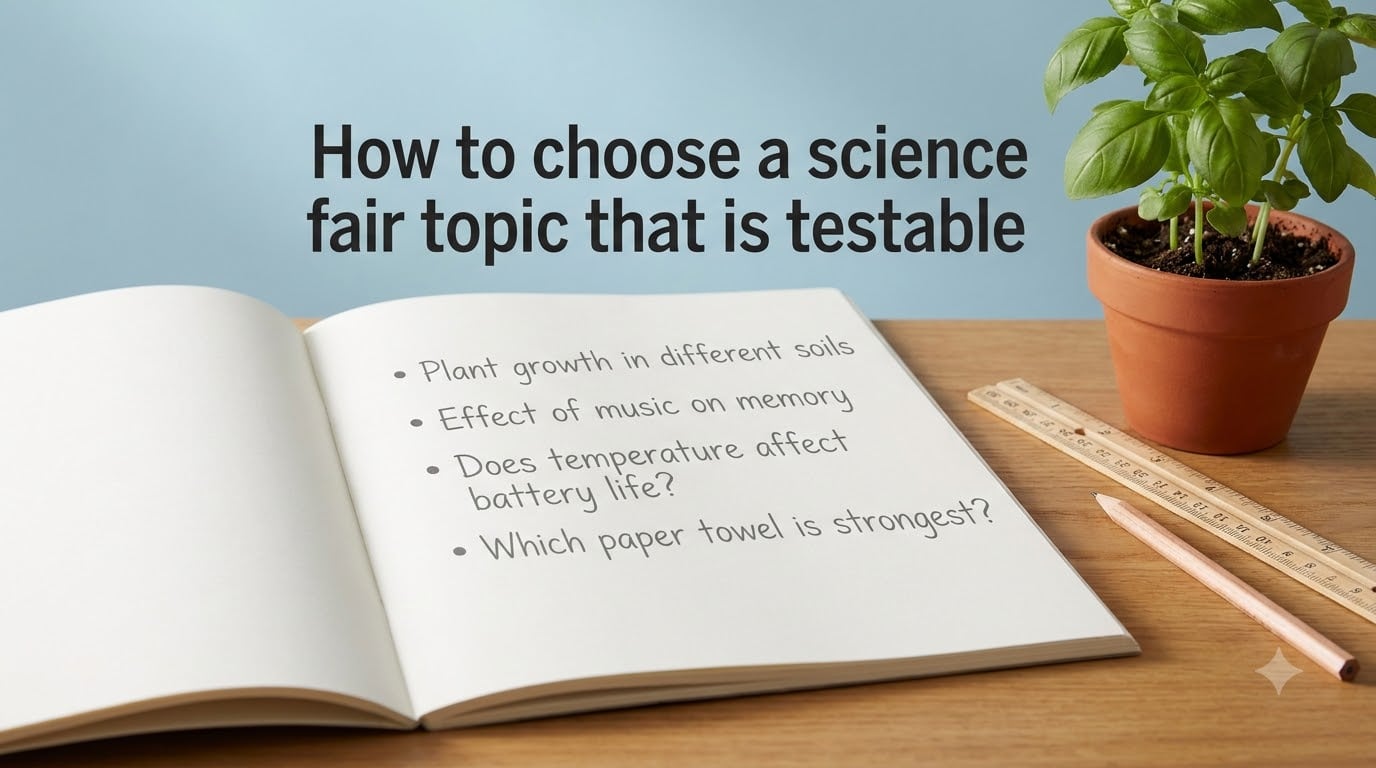
Every year, students and parents ask me the same question: how do you turn a vague interest into a project that actually holds up at a science fair? Most pick a topic that sounds cool, then discover halfway through that they cannot measure anything meaningful. That frustration wastes weeks. The good news is that with a simple process, you can avoid it.
Our team has watched students from elementary through high school struggle with this exact problem. The answer almost always comes down to one word: testable. When you know how to choose a science fair topic that is testable, the rest of the project falls into place — the variables make sense, the data is real, and the conclusion is something judges respect.
This guide walks through what makes a topic testable, a 7-step process to land on one, how to identify variables, how to write a hypothesis that holds up, and a validation checklist you can run before you commit. I have also included testable topic ideas by grade level and tips for students working without a lab or mentor.
Table of Contents
What Is a Testable Science Fair Topic?
A testable science fair topic is a specific question you can investigate by changing one variable and measuring the results. You run trials, collect numbers, and reach a conclusion based on evidence rather than opinion.
The opposite is a research topic. A research project asks “what is” or “how does X work” and answers it with reading. There is nothing wrong with research, but most competitive science fairs reward the scientific method — a clear experiment with measurable outcomes.
Think of it this way: “How do plants grow?” is a research topic. “How does the amount of sunlight affect the height of basil plants after 21 days?” is a testable topic. The second version gives you something to change (sunlight), something to measure (height), and something to control (water, soil, seed type).
A testable topic also has to be repeatable. If a judge or classmate followed your procedure, they should get similar results. That repeatability is what turns a fun demonstration into actual science.
Why Testability Matters for Your Science Fair Project
Judge rubrics at school, regional, and events like ISEF consistently score projects on the strength of the research question. A testable topic gives you measurable results, which means you can show a graph, a chart, and a defensible conclusion.
Without testability, you end up with a display that says “this is interesting” but no data to back it up. That tends to cap your score even when the topic itself is creative. I have seen clever, well-built volcano models lose to simple plant-light experiments because the second student had numbers and the first had a show.
Testability also makes the project easier. Once you know your variables, the experiment runs itself. You set up trials, collect data on a schedule, and analyze. The hard part — choosing the right question — happens before you touch a single material.
Finally, a testable topic teaches real scientific thinking. Students learn cause and effect, controlled comparison, and how to handle results that contradict a hypothesis. Those skills carry far beyond one fair.
Broad Topic vs Testable Question: Key Differences
The fastest way to understand testability is to see it side by side with a broad topic. The difference is not the subject — it is how the question is framed. Here is a comparison you can use as a quick reference.
| Broad Topic | Testable Question | What You Measure |
|---|---|---|
| Volcanoes | How does the ratio of baking soda to vinegar affect eruption height? | Eruption height in cm |
| Plant growth | How does the type of fertilizer affect radish sprout height after 14 days? | Sprout height in cm |
| Memory | Does background music tempo affect short-term recall of a 10-word list? | Number of words recalled |
| Battery life | How does brand affect the runtime of AA batteries in a LED flashlight? | Runtime in hours |
| Solar energy | How does the angle of a solar panel affect voltage output at noon? | Voltage in volts |
Notice the pattern. Every testable question names the thing you change (sunlight amount, fertilizer type, music tempo), the thing you measure (height, recall, runtime), and a timeframe. That structure is what makes a topic testable.
If you cannot fill in all three of those slots, your topic is still too broad. Keep narrowing until you can.
Step-by-Step Process to Choose a Testable Science Fair Topic
This is the core process I use with students. Follow it in order and you will end up with a topic you can actually test.
Step 1: List five interests, not experiments. Write down hobbies, things you wonder about, or stuff that annoys you. Cooking, sports, video games, pets, weather — anything. Do not jump to “the classic baking soda volcano.” Start with what already interests you.
Step 2: Narrow the field. Pick one or two interests from your list. Within each, name a specific angle. If you picked plants, narrow to “how light affects seedlings.” If you picked sports, narrow to “how ball inflation affects bounce height.”
Step 3: Turn the angle into a testable question. Use this template: “How does [one thing I change] affect [one thing I measure] over [time period]?” Fill it in. If you cannot complete the sentence, the angle is too broad.
Step 4: Identify your variables. Write down what you change (independent), what you measure (dependent), and what you keep the same (controlled). If you have two things changing at once, your topic is not yet testable — pick one.
Step 5: Draft a hypothesis. Predict what will happen using an if-then-because structure. Even a wrong prediction is fine; the point is that you committed to one before running the experiment.
Step 6: Run a feasibility check. Can you get the materials? Do you have time for at least three trials? Is anything dangerous or restricted? A topic that fails feasibility is not testable for you, even if it is testable in theory.
Step 7: Validate with the checklist below. Run your topic through the seven-point validation checklist before you commit. If it passes, lock it in and start the experiment. If it fails, return to step 3.
The biggest mistake students make is jumping from step 1 straight to materials. Spending an hour on steps 3 through 7 saves days of redo work later.
How to Identify Variables in Your Science Fair Project
Variables are the heart of a testable topic. There are three types, and you need all three defined before you start.
Independent variable: the one thing you deliberately change. In a plant-light experiment, that might be hours of sunlight per day. You set the levels — for example, 4, 8, and 12 hours.
Dependent variable: what you measure to see the effect. For the plant experiment, that is sprout height in centimeters. The dependent variable depends on the independent one.
Controlled variables: everything you keep the same so they do not interfere. Same soil, same water amount, same seed type, same pot size, same temperature. If you change two things at once, you cannot tell which one caused the result.
Here is a quick trick I use with students. Write three columns on a sticky note: Change, Measure, Keep Same. If your experiment has more than one item in the Change column, you are not yet testable. Pick the variable you care about most and move the others to Keep Same.
Real example: a student tested whether music tempo affected reaction time. Independent variable was tempo (60, 120, 180 BPM). Dependent variable was reaction time in milliseconds. Controlled variables were the device, the test app, time of day, and the same set of test subjects. That is a clean, fully testable setup.
Run at least three trials for each level of your independent variable. One trial is not data — it is an anecdote. Three trials give you an average and let you spot outliers.
Writing a Strong Hypothesis for a Testable Topic
A hypothesis is your prediction written in a way someone can prove or disprove with data. The cleanest format is “If [I change X], then [Y will happen], because [scientific reason].”
Here is what weak and strong hypotheses look like side by side.
Weak: “Plants will grow better in sunlight.” This is vague — what is “better”? How much sunlight? Better compared to what?
Strong: “If basil plants receive 12 hours of light per day compared to 4 hours, then they will grow at least 30% taller after 21 days, because photosynthesis requires light energy to produce glucose for growth.”
The strong version has a measurable prediction (30% taller), a clear comparison (12 vs 4 hours), a timeframe (21 days), and a scientific reason (photosynthesis and glucose). Anyone reading it knows exactly what to test.
Your hypothesis can be wrong. In fact, a disproven hypothesis often makes a stronger project, because you can discuss why the result differed. Judges care about the thinking, not whether you predicted correctly.
One warning: avoid hypotheses that are obviously true. “If I water a plant, it will not die” does not test anything interesting. Aim for a question where the outcome is genuinely uncertain.
Testable Topic Ideas by Grade Level
The right topic depends on age and available equipment. Here are starting points for each level.
Elementary (grades 3-5): How does water temperature affect how fast an Alka-Seltzer tablet dissolves? Does the type of string affect how many drops of water it holds before breaking? How does the slope of a ramp affect how far a toy car rolls? These are simple, safe, and use household materials.
Middle school (grades 6-8): How does salt concentration affect the boiling point of water? Does the color of a container affect how fast ice melts in sunlight? How does the type of ball (tennis, rubber, plastic) affect its rebound height off a fixed surface? These add precision and require more careful measurement.
High school (grades 9-12): How does the concentration of salicylic acid affect the rate of plant seed germination? Does screen color temperature affect melatonin levels measured by a sleep tracking app? How does blade pitch angle affect the power output of a model wind turbine? These are competitive-level questions with clear variables and real-world relevance.
Pick the level that matches your resources, not the level that sounds most impressive. A clean elementary experiment with solid data beats an ambitious high school project with messy results.
Common Mistakes to Avoid When Choosing a Testable Topic
Most failed science fair projects trace back to topic-selection mistakes. Here are the ones I see again and again.
Choosing a demonstration instead of an experiment. Building a model volcano is a demo. It shows what happens but does not test a variable. Add a variable — eruption height based on baking soda ratio — and it becomes testable.
Testing two variables at once. If you change both the fertilizer type and the water amount, you cannot tell which one affected growth. Hold all but one variable constant.
Picking a topic that needs dangerous materials. Open flames, strong chemicals, and high voltage are common in rejected proposals. Flame color experiments using gas burners are a classic example. Choose safer alternatives.
Ignoring the time you actually have. A topic that needs six weeks of growth will fail if the fair is in three weeks. Work backward from the deadline.
Going too broad. “How does pollution affect the ocean” is a book, not an experiment. Narrow until one student can run it on a kitchen table.
Skipping the hypothesis. Without a prediction, your project is a description, not an investigation. Always commit to a hypothesis before you collect data.
Validation Checklist: Is Your Topic Truly Testable?
Before you commit, run your topic through these seven questions. If you can answer “yes” to all of them, you have a testable topic.
Can I name exactly one variable I will change?
Can I name exactly one thing I will measure, in specific units?
Can I list the variables I will keep the same?
Can I complete at least three trials for each level of my independent variable?
Can I get all materials safely and within budget?
Can I finish the experiment within the time I have before the fair?
Could a classmate repeat my procedure and get similar results?
If any answer is “no” or “I’m not sure,” go back and tighten the question. This checklist is the single most useful tool I share with students, and almost no competitor covers it.
Print it, tape it to your notebook, and use it every time. It takes five minutes and saves weeks.
Tips for Choosing a Testable Topic Without a Lab or Mentor
Many students worry they cannot compete without university lab access or a research mentor. Forum discussions on r/ScienceTeachers and Science Buddies’ Ask an Expert confirm this is a top concern. Here is the reality: most winning school and regional projects use materials from a hardware store or grocery store.
Focus on questions where the equipment is simple. Water quality testing kits cost under $20 and support dozens of testable questions. Smartphone sensors — light meters, decibel meters, accelerometers — turn any phone into a measurement device for free.
If you want mentorship, start with free options. Science Buddies has an Ask an Expert forum. Local science fairs often connect students with advisors. A 20-minute conversation with a teacher can sharpen a vague idea into a testable question.
Avoid projects that require equipment you cannot access in the next two weeks. A testable topic you can run today beats a brilliant one stuck waiting on a lab.
Finally, keep a backup topic. If your original experiment fails halfway through, you can pivot to your backup without starting the selection process over.
Frequently Asked Questions
What are some testable science fair projects?
Testable science fair projects include how baking soda-to-vinegar ratio affects eruption height, how fertilizer type affects radish sprout height after 14 days, whether music tempo affects short-term word recall, and how solar panel angle affects voltage output. Each has one changed variable, one measurable outcome, and a clear timeframe.
What is the 5 second rule in science fair?
The 5 second rule is a popular testable science fair topic that asks whether food dropped on the floor for under five seconds picks up fewer bacteria than food left longer. Students test it by dropping food for different durations, then culturing samples on agar plates and counting colonies after 24 to 48 hours.
How to pick a good science fair topic?
Pick a good science fair topic by listing five interests, narrowing to one angle, turning it into a question that names one variable you change and one you measure, checking that materials and time are feasible, and running it through a seven-point validation checklist before committing.
How do I choose a science expo topic?
Choose a science expo topic the same way you choose a fair topic: start from a personal interest, narrow to a specific angle, frame it as a testable question with one independent variable and one measurable dependent variable, and confirm you can complete at least three trials with safe materials before the event.
Conclusion
Learning how to choose a science fair topic that is testable is the single most important step in your project. The 7-step process — list interests, narrow the field, frame a testable question, identify variables, write a hypothesis, run a feasibility check, and validate — gives you a repeatable system you can use for any future competition.
Start with what genuinely interests you, narrow until you can name one variable to change and one to measure, and run the validation checklist before you commit. Do that, and your science fair project will have the measurable results judges reward — and the kind of clear thinking that lasts long after the fair ends.