
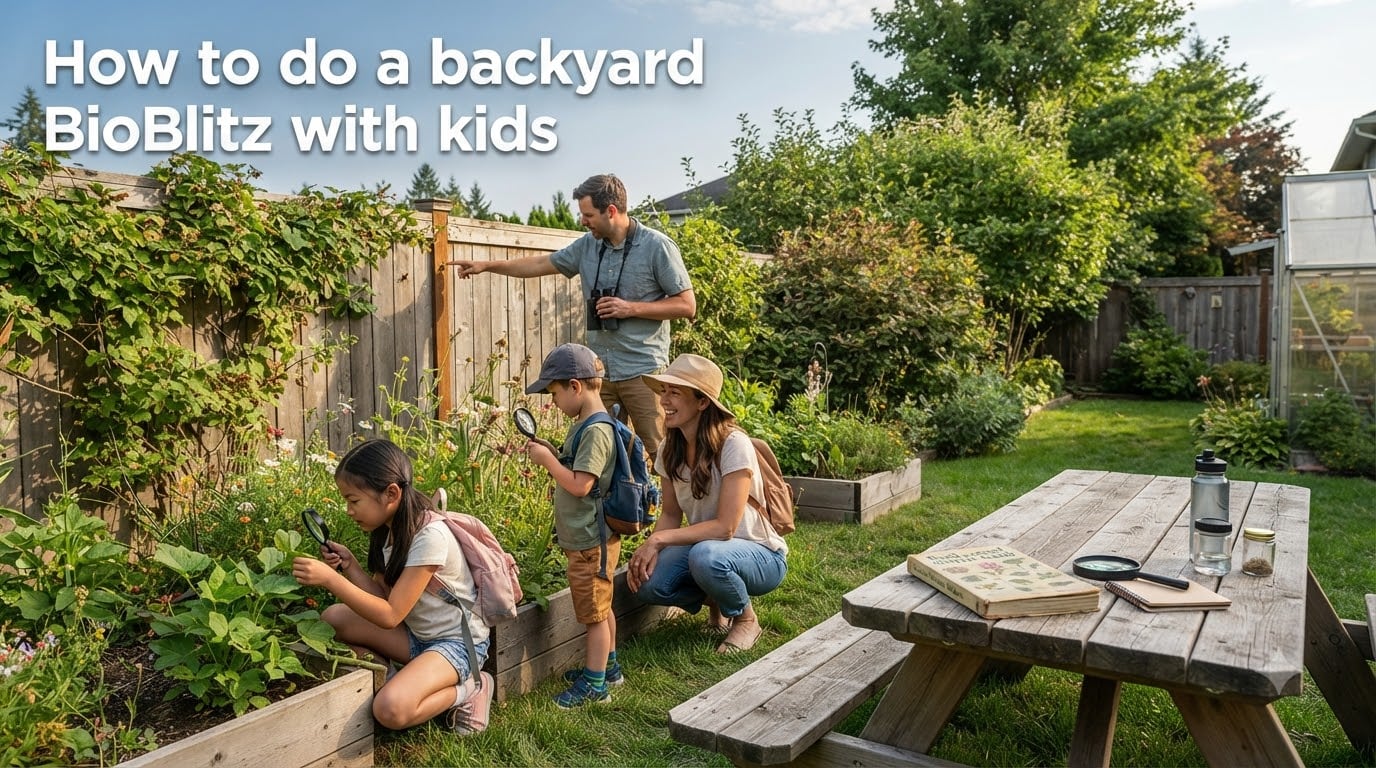
Last spring, my kids and I counted 47 different species in our tiny suburban backyard in a single afternoon. We saw a hawk moth, heard a woodpecker we never knew visited our oak tree, and discovered three types of moss growing between our patio stones. That day changed how our family sees our yard, and it started with one simple idea: a backyard BioBlitz with kids.
A BioBlitz is a nature scavenger hunt for science. You and your family identify and record as many living species as you can in a defined area within a set time. The data you collect becomes real contributions to citizen science projects, and the activity itself teaches kids about biodiversity, observation, and the ecosystems right outside their door.
In this guide, I’ll walk you through everything our team has learned from running BioBlitzes with hundreds of families. You’ll get a clear definition, a step-by-step plan, an iNaturalist tutorial for kids, age-appropriate modifications, safety tips, and fun challenges that keep children engaged from start to finish.
Table of Contents
What Is a Backyard BioBlitz?
A backyard BioBlitz is a focused effort to find, identify, and record every species of plant, animal, fungi, and insect living in your yard over a short period of time, usually one to twenty-four hours. The word “BioBlitz” comes from “biological” and “blitz,” because the goal is to survey biodiversity quickly and thoroughly.
The first official BioBlitz was held in Washington, D.C. in 1996, organized by the National Park Service and the National Geographic Society. Since then, BioBlitzes have spread to parks, schools, and backyards around the world.
Think of a BioBlitz as a scientific census of your outdoor space. Instead of counting people, you’re counting robins, dandelions, pill bugs, and spider webs. Every observation adds a data point to our understanding of local biodiversity.
Biodiversity is the variety of life in an ecosystem, and it includes every living thing from microscopic bacteria in soil to the birds in your trees. Explaining biodiversity to a kid is simple: every different plant and animal makes your yard healthier, like a team where everyone has a job.
The typical objectives of a BioBlitz are to:
Create a species inventory of a specific area
Engage community members in citizen science
Raise awareness about local biodiversity
Contribute observations to scientific databases
Connect families and educators with nature
Why Do a BioBlitz With Kids?
Kids who spend time cataloging species learn to slow down and notice the world. According to research from the University of Michigan, kids who engage in nature-based science activities show measurable improvements in observation skills, scientific reasoning, and environmental stewardship.
A BioBlitz gives children permission to dig, look under leaves, and ask questions. My own kids turned from reluctant hikers into curious naturalists after their first BioBlitz. They started pointing out lichens on rocks and tracking which flowers attracted which bees.
There are three big reasons families love this activity. First, it is free and accessible to anyone with a small outdoor space. Second, it produces real scientific data through apps like iNaturalist. Third, it is genuinely fun, more game than chore, when you frame it right.
Beyond the science, BioBlitzing builds family memories. You will remember the day you found a cicada emerging from its shell or the morning a Cooper’s hawk landed on your fence. Those moments stay with kids for decades.
What You Need: BioBlitz Tools and Supplies
You do not need expensive gear to run a backyard BioBlitz with kids. Here is the basic kit our team recommends after dozens of family BioBlitzes.
A smartphone or tablet with the iNaturalist app installed (free, iOS and Android)
Merlin Bird ID app (free) for identifying birds by sound or photo
PictureThis or Seek app (free) for additional plant and animal identification
A field guide for your region, either a paperback book or downloaded PDF
A magnifying glass or hand lens for examining insects, leaves, and lichens
A notebook and pencils for sketching and recording observations
A camera or phone camera for documenting species you cannot identify in the moment
A small container like a clear jar for temporary up-close viewing (release creatures after)
Sun hats, sunscreen, water bottles and weather-appropriate clothing
Optional: a butterfly net, binoculars, bug vacuum, or a backyard map printed on paper
Pro tip from our team: download and create your iNaturalist account before the day of the BioBlitz. Logging in, setting up your profile, and learning the camera button takes about ten minutes, and you do not want to use precious BioBlitz time wrestling with app setup.
How to Do a Backyard BioBlitz With Kids: Step by Step
This is the core of our guide. Follow these seven steps to run a successful backyard BioBlitz with kids, whether you have a half-acre yard or a small patio garden.
Step 1: Pick a Date and Time Window
Choose a 1 to 4 hour window when your kids are well-rested and fed. Early morning is best for birds and pollinators. Late afternoon works for mammals and butterflies. Weekend mornings are popular with families for good reason.
Pick a time of year when insects are active. Late spring through early fall offers the most species diversity in most temperate regions. Avoid rainy or very windy days, which limit both insect activity and your comfort.
Step 2: Define Your Study Area
Mark the boundaries of your BioBlitz area. It might be your entire backyard, a corner garden, a strip between your house and the fence, or even a balcony with potted plants. Make it small enough to search thoroughly.
For younger children, use a printable grid map of your yard. Give each kid a clipboard and let them draw the location of every species they find. This builds mapping skills and gives them ownership of the data.
Step 3: Set Up Your Apps and Tools
Open iNaturalist, tap “Observe,” and make sure the camera and location services are working. Test your photo quality by snapping a leaf and seeing if the app can suggest a species. Charge your phone fully before starting.
Lay out your magnifying glass, notebook, and jar on a picnic table. If you are using a field guide, flip through it briefly so kids recognize the layout before you start hunting.
Step 4: Assign Roles for Family Teams
Give each family member a specific focus. Common role assignments include:
Bird spotter: listens and watches for feathered visitors
Insect hunter: flips rocks and checks under leaves
Plant surveyor: photographs leaves, flowers, and bark
Sketch artist: draws what they see in a notebook
Photographer: documents everything for later identification
Roles rotate every 30 minutes to keep everyone engaged and learning across all taxonomic groups.
Step 5: Search Systematically
Move through your yard in a planned pattern, not randomly. Walk along the fence first, then around the garden beds, then check the tree canopy, and finally examine ground-level features like mulch, stones, and grass.
Look up, down, and underneath. Many species hide under leaf litter, in soil cracks, on the underside of leaves, or in tree bark crevices. Turn over one log. Lift a flat stone. Peek into a flower. The hidden species are often the most exciting finds.
Step 6: Photograph and Record Every Species
In iNaturalist, take a photo of each species. Try to capture the whole organism plus a clear close-up of identifying features, like a leaf vein, an insect’s antenna, or a flower’s center. The app uses AI to suggest identifications, and human experts then confirm or correct them.
For things you cannot photograph, like bird calls or animal tracks, write them in your notebook with the time and location. Audio recordings from your phone’s voice memo app can be uploaded to iNaturalist later.
Step 7: Review, Share, and Celebrate Findings
When your time is up, gather as a family and look at your observations together. Count the species on iNaturalist’s project page. Compare findings to your expectations. Celebrate rare or unexpected species.
Share your BioBlitz project on social media or with friends. Submit your observations to community science projects like the City Nature Challenge or the Great Backyard Bird Count. Each upload becomes a data point scientists can use to track biodiversity over time.
Using the iNaturalist App With Kids
iNaturalist is the most popular citizen science platform in the world, with over 400 million observations submitted by users. It is also the easiest tool for kids to learn because the app does most of the identification work.
Here is how to do a BioBlitz on iNaturalist in five simple steps:
Download the app from the Apple App Store or Google Play, then create a free account using an email address.
Tap the green “Observe” button at the bottom of the screen when you spot a species.
Take a clear photo of the organism, framing it so leaves, wings, or markings are visible.
Review the AI suggestions that appear, then pick the closest match or choose “Unknown” if unsure.
Tap “Submit” to add the observation to your project and the global iNaturalist database.
The app works offline, so you can record observations without cell service. They upload automatically when you reconnect to wifi.
For younger kids, parents can take the photos while children describe what they see. For older kids, hand them the phone and let them run the camera themselves. They will learn faster by doing.
One feature our team loves is the “Projects” tool. Before your BioBlitz, create a project on iNaturalist’s website and invite family members to join. All observations during your time window automatically filter into the project page, giving you a single dashboard to review your findings.
Age-Appropriate BioBlitz Modifications
Different ages need different approaches to BioBlitzing. Here is how our team adjusts the activity for three age groups.
BioBlitz for Preschoolers (Ages 3 to 5)
Keep the time window to 30 to 45 minutes. Focus on five senses rather than species counts. Ask kids to find something soft, something that flies, something that smells nice, and something sticky.
Use a “touch and release” jar for pill bugs and rolly pollies. Sing songs about the creatures you find. Draw pictures of three favorite species at the end. Skip iNaturalist and just collect memories.
Skip the data collection focus and lean into the discovery. The goal at this age is positive associations with nature, not scientific rigor.
BioBlitz for Elementary Kids (Ages 6 to 10)
Run a 90-minute BioBlitz with parent supervision. Introduce iNaturalist by letting kids photograph and upload at least five species themselves. Add a competitive element, like who can spot the most colors, who finds the smallest insect, or who hears the most bird calls.
This is the prime age for learning the names of plants and animals. Use field guides and let kids teach each other what they have identified. Encourage sketches in notebooks.
Our team’s testing shows kids this age average 25 to 40 species in a typical suburban backyard with active searching.
BioBlitz for Tweens and Teens (Ages 11 to 14)
Give older kids more independence. Let them plan the survey, choose the time window, and run the iNaturalist project themselves. Introduce taxonomy by sorting observations into plants, insects, birds, fungi, and other categories.
Add a research layer. After the BioBlitz, have them research one species in depth using field guides or online resources. Encourage them to write a short report or create a presentation about their findings.
Teens can also join virtual BioBlitz projects, where they identify species from photos uploaded by others around the world. This connects backyard exploration to global citizen science.
Safety Tips for Backyard BioBlitzing
Most BioBlitzes are safe, but a few precautions keep the day worry-free for families with young children.
Teach the “look but don’t touch” rule for unknown insects, spiders, and snakes. A simple guideline: if you cannot identify it, admire it from a safe distance and photograph it for later research.
Watch for poisonous plants like poison ivy, poison oak, or stinging nettle, depending on your region. Before the BioBlitz, walk your yard and point out any plants to avoid.
Check for ticks in areas with tall grass, woods edges, or known tick habitat. Wear long pants tucked into socks, use insect repellent, and do a tick check at the end of the day.
Stay hydrated and sun-safe. Even a 90-minute outdoor activity requires water, hats, and sunscreen. Schedule water breaks every 30 minutes for younger kids.
Be aware of bee and wasp nests. If you know of an active nest, mark it off-limits for the BioBlitz. If a child gets stung, have a plan for handling allergies.
Release everything you collect. Any creature placed in a temporary jar should be returned to where it was found within minutes. BioBlitzing is observation, not collection.
Making It Fun: Games and Challenges
The fastest way to lose a kid’s interest is to turn a BioBlitz into a lecture. Our team has tested dozens of game formats, and these are the most reliable crowd-pleasers.
The Color Rainbow: challenge each kid to photograph a species in every color of the rainbow. The first team to fill all seven colors wins.
Five-Sense Scavenger Hunt: make a list of things to find by sound, smell, touch, sight, and even taste (only with adult-approved edible plants like mint or basil).
Tiny Titans: whoever finds the smallest insect or organism wins the title for the day. Magnifying glasses make this even more fun.
Bird Call Bingo: print a bingo card of common backyard birds. First kid to hear five species across a row wins.
Pollinator Count: set a timer for five minutes and count every bee, butterfly, and hoverfly visiting a single flower. Compare results across different plants.
For repeat BioBlitzers, keep a “life list” of every species your family has ever identified. Watching it grow from 20 to 200 species over a year is one of the most rewarding experiences in family science.
Plan a seasonal BioBlitz series. Run one in spring, summer, fall, and winter. Compare species lists and watch migration patterns, flowering cycles, and insect emergence unfold over time. Phenology, the study of seasonal changes, is a powerful concept kids grasp naturally through repeated BioBlitzes.
After the BioBlitz, turn your observations into a nature journal, a backyard field guide, or a photo book. Our family binds our yearly iNaturalist exports into a printed album the kids treasure.
Frequently Asked Questions
How to make a bioblitz?
To make a BioBlitz, pick a small outdoor area and a set time window, gather basic tools like a magnifying glass, notebook, and smartphone with iNaturalist installed, then systematically search the area and photograph every plant, insect, bird, and fungus you find. Upload your photos to iNaturalist to create a species inventory and contribute to citizen science.
How to explain biodiversity to a kid?
Explain biodiversity to a kid by describing it as the variety of life in a place, like the players on a sports team where every plant, insect, and bird has a different job. Show that a yard with many different species is healthier than one with only a few, because each creature helps the others survive, from bees pollinating flowers to worms enriching soil.
How to do a bioblitz on iNaturalist?
To do a BioBlitz on iNaturalist, download the free app, create an account, tap the green Observe button each time you spot a species, take a clear photo, review the AI-suggested species identification, and tap Submit to upload. Optionally, create a project on the iNaturalist website before your BioBlitz to automatically collect all your family observations into one dashboard.
What is the BioBlitz method?
The BioBlitz method is a structured biodiversity survey where participants search a defined area within a set time, identify and record every species they can find, and submit their data to a scientific database. The method combines field observation, species identification using apps and guides, and citizen science data submission to create a snapshot of biodiversity in a location.
What are the typical objectives of a BioBlitz?
The typical objectives of a BioBlitz are to create a species inventory of a specific area, engage community members in citizen science, raise awareness about local biodiversity, contribute observations to scientific databases, and connect families and educators with nature. BioBlitzes also help scientists track changes in species populations over time.
What does BioBlitz have to do with biodiversity?
BioBlitz has everything to do with biodiversity because the activity is specifically designed to document and measure biodiversity in a particular place. By counting every species in an area, BioBlitzes create a snapshot of biodiversity that scientists can compare across years and locations, helping track which species are thriving, declining, or migrating in response to environmental change.
Plan Your Backyard BioBlitz With Kids Today
A backyard BioBlitz with kids is one of the highest-value, lowest-cost activities a family can share. It combines outdoor play, scientific thinking, technology, and real contributions to global biodiversity research. In a single afternoon, your family can document dozens of species and build memories that last a lifetime.
Our team’s biggest piece of advice: do not overthink it. Pick a Saturday morning, charge your phone, download iNaturalist, and head outside with your kids. The data you collect matters less than the curiosity you spark.
Start with a simple one-hour BioBlitz. See what you find. Compare notes with neighbors. Run a second BioBlitz in a different season and watch your species list grow. Within a year, your family will have hundreds of observations contributing to real science and a deeper connection to the ecosystem right outside your door.
Whether you have a sprawling lawn or a small patio, your outdoor space holds more life than you realize. A backyard BioBlitz with kids is the easiest way to discover it together.