
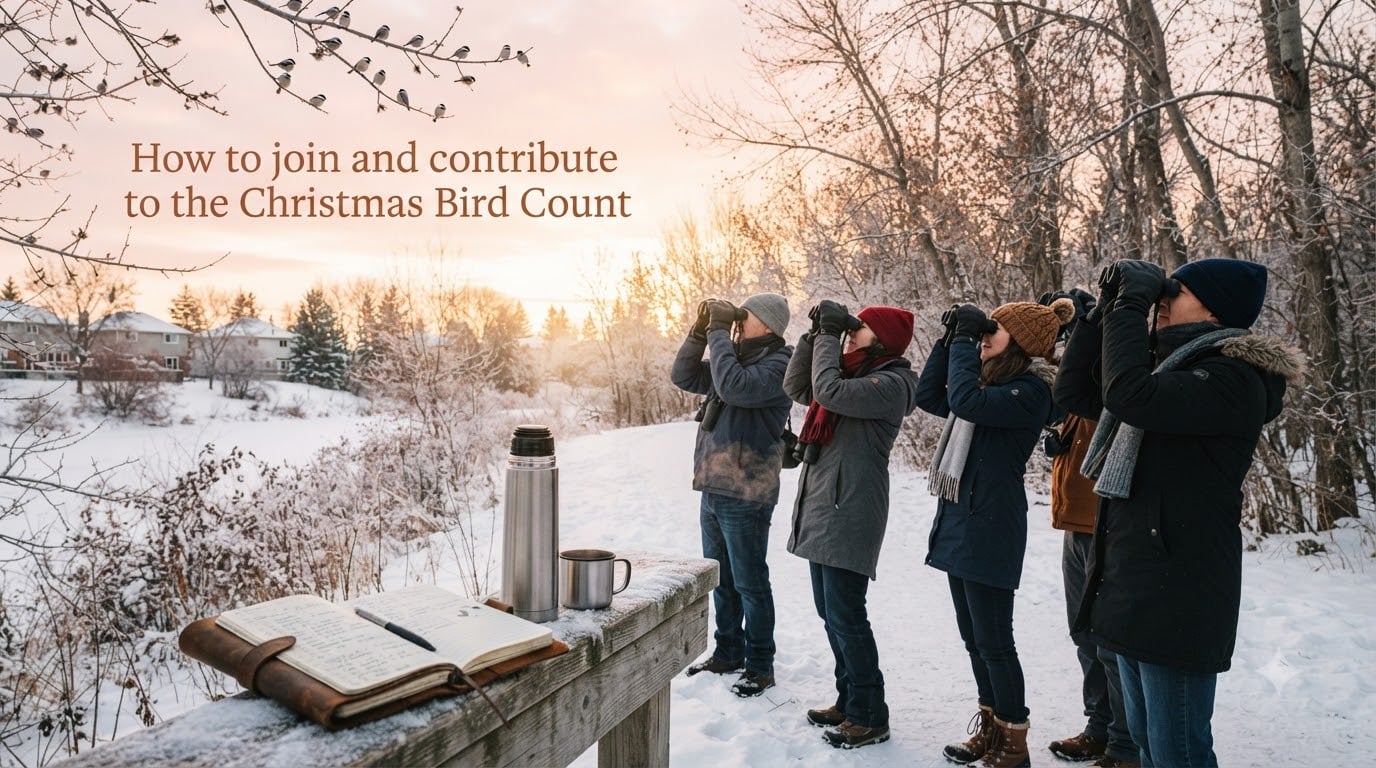
If you have ever wanted to turn a holiday walk into real science, learning how to join and contribute to the Christmas Bird Count is the easiest way to start. Every December, tens of thousands of volunteers head outside across the Western Hemisphere to count birds, and their observations feed one of the longest-running wildlife databases on the planet.
I joined my first CBC three winters ago, mostly by accident after a friend asked me to hold her extra pair of binoculars. By the end of the day, I had counted 27 species, met a dozen local birders, and learned that my “boring” suburban neighborhood actually hosted a wintering flock of cedar waxwings. You do not need a degree in ornithology to take part, and the data you collect has been shaping conservation policy since 1900. In this guide, I will walk you through exactly what the count is, how to sign up, what to expect, and how your sightings travel from your notebook into the hands of researchers.
Table of Contents
What Is the Christmas Bird Count and Why It Matters?
The Christmas Bird Count (CBC) is the longest-running community science bird project in the world, organized every year by the National Audubon Society. It began on Christmas Day in 1900 as a peaceful alternative to a holiday hunting contest called the “side hunt,” and it has run continuously ever since. More than 120 years of unbroken records now make the CBC one of the richest datasets in ecology.
Each year, between December 14 and January 5, volunteers count every bird they see or hear inside a designated circle that is 15 miles (24 km) in diameter. Counts happen simultaneously within each circle, which gives scientists a snapshot of winter bird populations across more than 3,000 locations in the Western Hemisphere. In recent seasons, more than 80,000 people have taken part, tallying tens of millions of individual birds.
The numbers we collect are not just trivia. Audubon and partner scientists use CBC results to track long-term population trends, identify species at risk, flag range shifts driven by climate change, and lobby for protective legislation. When you contribute to the Christmas Bird Count, your observations become a row in a dataset that has helped recover species like the bald eagle and documented declines in once-common birds like the evening grosbeak.
When Does the Christmas Bird Count Happen
The official count window runs from December 14 through January 5 every season. Within that window, each count circle picks one calendar day to conduct its survey. Start times vary, but most circles begin at sunrise and run for about eight hours, with some continuing past dusk for owls and night birds.
If you cannot commit to a full day, you can still participate. Many circles split teams into morning, midday, and owling shifts. Feeder watchers (more on that role below) typically count from their homes for a few hours at any point during the count day. Plan to confirm your exact schedule directly with your compiler once you sign up.
How to Join the Christmas Bird Count in 5 Steps
Joining is simpler than most newcomers expect. Here is the exact path I recommend.
Step 1: Check the Audubon circle map. Go to the Audubon Christmas Bird Count website and open the interactive circle map. Each circle is color-coded: green means it is accepting new participants, yellow is limited, and red is full or not running. Click any circle near you to see its name, count day, and compiler contact info.
Step 2: Pick a circle that fits your schedule. Look for a count day you can attend, or choose one close to home so travel is simple. Beginners often pick circles that include feeder watching, since you can contribute from your backyard or apartment window.
Step 3: Email the compiler in advance. Compilers are volunteers who organize their local count. They assign you to a team, share driving routes, and explain local etiquette. Send a short, friendly email introducing yourself, your birding experience (be honest, even if it is “none”), and your availability.
Step 4: Get matched with a team or feeder route. Most compilers pair new birders with seasoned observers for a sort of on-the-job crash course. You will learn identification, counting protocols, and how to log unusual species, all in one day.
Step 5: Show up, count, and submit your data. Bring binoculars, dress warmly, and follow your team leader’s instructions. After the count, your compiler enters the tally into Audubon’s database. Your sightings are published as part of the circle’s results within a few months.
Finding Your Local Count Circle and Compiler
Every count takes place inside a count circle, a fixed 15-mile (24 km) diameter area that stays the same year after year. Circles were drawn decades ago to give scientists consistent comparison sites. You do not live inside a circle by default; you have to find the one nearest you and contact its compiler to join.
The easiest way to locate a circle is the Audubon Christmas Bird Count map on audubon.org. Click your region, zoom to your town, and click the nearest green circle. A popup will display the compiler’s name, email, phone (in some cases), and the scheduled count day. You can also search by zip code on some regional Audubon chapter websites.
If there is no green circle near you, check the yellow ones. Limited circles still accept newcomers, especially feeder watchers who count birds from home. Red circles either are already full for the season or have no compiler that year, so try the next-closest option.
Once you find a compiler, send a brief email like: “Hi, my name is [Name], I live in [town], and I am interested in joining your Christmas Bird Count on [date]. I am a [beginner/intermediate] birder and can [walk/drive/host a feeder count]. Could you let me know if there is space and what I should bring?” Most compilers respond within a week.
What to Expect on Count Day
Count day is structured but relaxed. Your team leader will gather everyone before sunrise, review the assigned route, and hand out checklists or tally sheets. Expect to drive or walk between several “count stops” (places where you stand quietly and record every bird you see or hear for a set period).
You will log three kinds of data: species names, total counts per species, and effort data (how many people, hours, miles, and weather conditions). Even if you only recognize five birds, your team can usually cover a hundred species or more combined.
There are two main ways to participate, and picking the right one is part of knowing what to expect.
Field Observer vs Feeder Watcher
A field observer travels the count circle with a team, walking or driving between stops and counting birds in the field. Field observers cover the most ground and find the rarest species, but the day can be cold, long, and physically demanding.
A feeder watcher counts birds from a single location, usually their own backyard or apartment balcony, during the count day. This role is ideal for beginners, people with mobility limitations, families with kids, or anyone who wants a low-effort contribution. The compiler provides a feeder-watching form, you fill in species and max-count-at-one-time, and submit it back to the compiler that evening.
Many counts rely on feeder watchers to cover neighborhoods that field teams cannot easily reach, so do not underestimate the value of sitting on your couch with a notebook and binoculars.
What to Bring and How to Prepare
You do not need fancy gear to start. Here is a realistic checklist based on what experienced CBC volunteers actually carry.
Binoculars (any pair, even basic 8×42 models)
Warm layers, waterproof boots, hat, and gloves
Field guide or bird-ID app on your phone (Merlin, Sibley, or Audubon apps all work)
Notebook and pencil, or printed tally sheet from your compiler
Water, snacks, and a thermos with something hot
Headlamp for early starts or owling after dusk
Sunglasses and sunscreen if you will be in open country
Forum regulars on r/birding consistently recommend scouting your route or count area on a free day before the count. Showing up familiar with the territory lets you focus on birds instead of navigation. Other frequently shared tips: stay flexible, dress warmer than you think, and accept that you will miss some birds. Counting is a group effort, so even your “I don’t know” sightings help the team.
How Your Bird Count Data Drives Conservation
Once your compiler submits your circle’s tally, Audubon combines the data with every other circle’s results and releases annual summaries. Researchers then use the dataset to model long-term population trends for hundreds of species. Studies built partly on CBC data have shown shifts in winter ranges, identified species vulnerable to climate change, and tracked recoveries of birds like bald eagles, peregrine falcons, and wood ducks.
Your observations also feed the State of the Birds reports and Audubon climate watch dashboards that policymakers and conservation groups use to prioritize land protection. A single morning of counting in your local park can shape habitat decisions decades from now.
Participation is free and has been since 2012, which removes one more barrier. The only “cost” is your time, and even a few hours as a feeder watcher meaningfully expand the geographic reach of the count.
Frequently Asked Questions
How do I participate in the Christmas Bird Count?
To participate in the Christmas Bird Count, find your nearest count circle on the Audubon circle map, email the compiler listed for that circle well before count day, and ask to join a field team or be assigned as a feeder watcher. The compiler will match you with experienced birders and share the schedule, route, and gear list.
Who runs the Christmas Bird Count?
The National Audubon Society coordinates the Christmas Bird Count nationally, but each count circle is run locally by a volunteer compiler who organizes teams, assigns routes, and submits the final tally to Audubon.
Do I need experience to join the Christmas Bird Count?
No experience is required to join the Christmas Bird Count. Beginners are paired with experienced birders who provide on-the-spot identification help, and feeder-watching roles let you contribute from home with just a notebook and a window.
Is the Christmas Bird Count free?
Yes, participation in the Christmas Bird Count has been free since 2012. The program is funded by Audubon memberships, donations, and partner organizations, so volunteers only need to cover their own travel and gear.
What is a count circle and how big is it?
A count circle is a fixed survey area 15 miles (24 km) in diameter used for the Christmas Bird Count. Circles stay in the same location year after year so that long-term population trends can be compared fairly across decades.
How many people participate in the Christmas Bird Count?
In recent seasons, more than 80,000 volunteers have participated in the Christmas Bird Count across roughly 3,000 count circles in the United States, Canada, Latin America, and the Caribbean.
Can I count birds at my feeder instead?
Yes, feeder watching is an official Christmas Bird Count role. You count birds at your feeder or yard during the assigned count day, record species and the highest number of each seen at one time, and submit the form to your compiler at the end of the day.
Conclusion
Learning how to join and contribute to the Christmas Bird Count is really about three small steps: find a circle on the Audubon map, email the compiler, and show up ready to learn. From there, every bird you identify, every tally mark you make, adds a new data point to a 120-year record of North American birdlife.
The hardest part is sending that first email. Once you do, you will find a welcoming community of birders, a free family-friendly activity for the holidays, and the satisfaction of knowing your sightings will shape bird conservation for decades. Pull up the circle map today, pick the nearest green circle, and send your first message before the 2026 season fills up.