
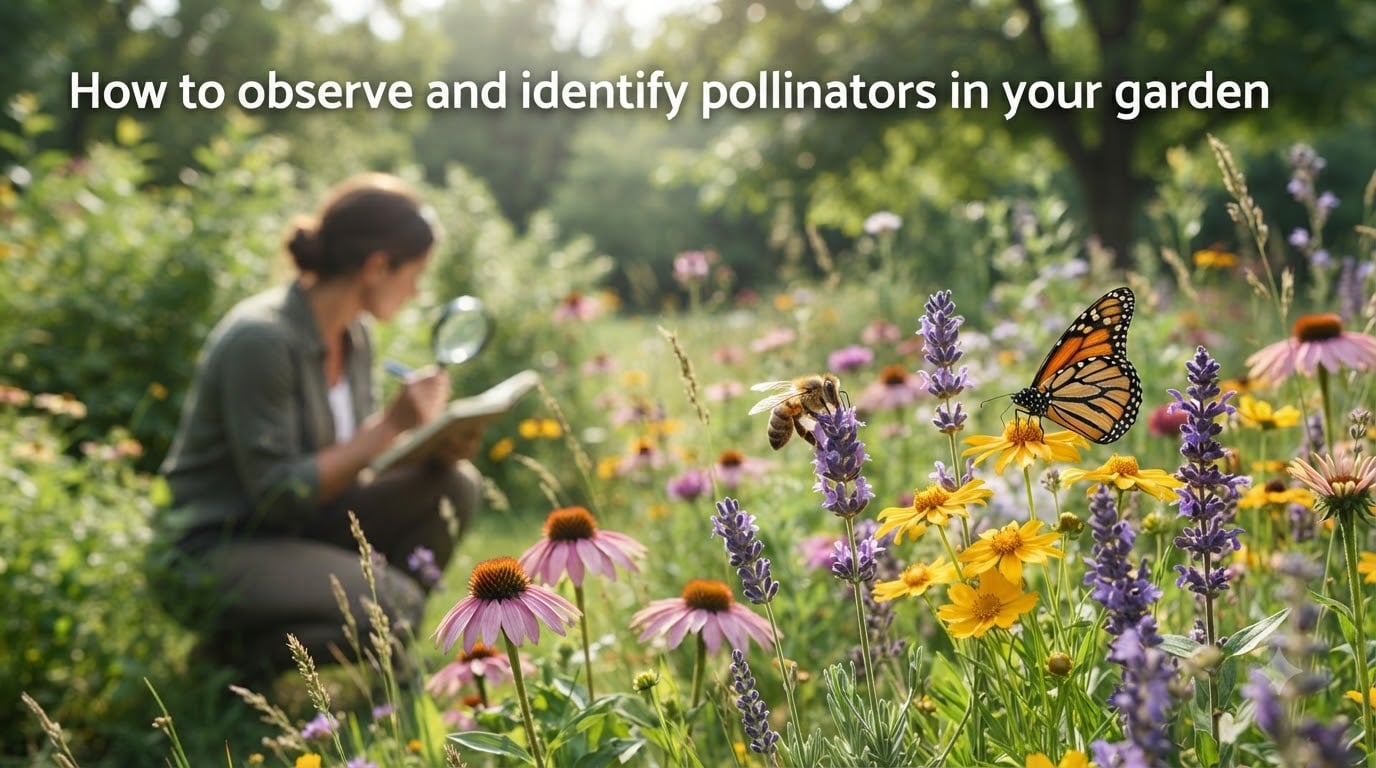
Our team has spent the last three summers sitting quietly in our backyards, watching bumblebees bounce between coneflowers, hovering flies mimic wasps, and butterflies drift past milkweed. If you have ever wondered what is actually visiting your flowers, you are not alone. Learning how to observe and identify pollinators in your garden is one of the most rewarding ways to connect with the natural world right outside your door.
Pollinators are animals that move pollen between flowers so plants can produce seeds and fruit. This group includes bees, butterflies, moths, flies, wasps, beetles, and even some birds like hummingbirds. Without them, most flowering plants and roughly one in three bites of food we eat would not exist. When you can name what is visiting your blooms, you start to understand your garden as a living ecosystem.
In this guide, we walk through everything you need to know to start observing pollinators with confidence. You will learn when to watch, what tools help, how to tell a bee from a hoverfly, and how to contribute your sightings to citizen science. Whether you have a sprawling wildflower meadow or a few containers on a balcony, the methods below will work for you.
Table of Contents
Getting Started with Pollinator Observation
Starting pollinator observation does not require expensive gear or years of training. The most important tools are patience, curiosity, and a notebook. The first step is to pick a spot in your garden where flowers are blooming and insect activity is visible, then sit or stand quietly for ten to fifteen minutes at a time.
Pollinators are sensitive to movement, sudden shadows, and vibrations. Move slowly, avoid waving your arms, and try to position yourself downwind if possible so your scent does not travel toward the flowers. Many seasoned observers find that sitting on the ground or on a low stool keeps you at flower level, where the action actually happens.
Here is a simple step-by-step process we recommend for your first few observation sessions:
Step 1: Choose a sunny day when temperatures are above 60 degrees Fahrenheit, as most pollinating insects are cold-blooded and inactive when it is cool.
Step 2: Pick a flowering plant that is currently in bloom and attracting visible activity, such as lavender, salvia, sunflowers, or native wildflowers.
Step 3: Position yourself about three to six feet away and stay as still as possible. Use a chair or cushion if you plan to observe for a while.
Step 4: Watch individual insects rather than trying to follow everything at once. Track one pollinator for a minute or two and note its behavior.
Step 5: Record what you see in a notebook or on your phone, including time of day, weather, flower type, and a quick sketch or photo.
The biggest mistake beginners make is trying to identify everything immediately instead of observing behavior first. Spend your early sessions just watching how different insects move, feed, and interact with flowers. The identification will come naturally once you start noticing patterns.
Best Times and Conditions for Observation
Timing makes an enormous difference in how many pollinators you will see. Most pollinating insects are most active during warm, calm, sunny weather between mid-morning and late afternoon. We have found that the window from 10 AM to 2 PM is typically the peak activity period in most regions during spring and summer.
Bees prefer temperatures above 55 degrees Fahrenheit and calm winds. Butterflies need even warmer conditions, often above 60 degrees, and they love to bask on sunlit surfaces before taking flight. Hoverflies and many beetles are active across a wider temperature range, but they too favor sunny conditions over cloudy or rainy days.
Seasonal timing matters just as much as daily timing. Here is a quick breakdown of what to expect throughout the year:
Early spring (March to April): Queen bumblebees emerge, early mining bees appear, and the first butterflies like mourning cloaks and sulphurs take flight.
Late spring (May to June): Peak diversity for many solitary bees, the first wave of butterflies, and increasing hoverfly numbers.
Mid-summer (July to August): The busiest period with the highest diversity and abundance of pollinators, including wasps, beetles, and hummingbird moths.
Early fall (September to October): Monarch migration, second generations of butterflies, and bumblebee colonies at their largest.
Late fall and winter: Most pollinators are dormant, but you may spot overwintering queen bumblebees on warm winter days.
Overcast and windy days are generally poor for observation, since pollinators seek shelter. However, right after a summer rain, when the sun returns and flowers are still wet, you can sometimes catch intense bursts of feeding activity as insects make up for lost time.
Common Pollinator Groups You’ll Encounter
When you start observing your garden, you will quickly notice that the pollinators visiting your flowers fall into several recognizable groups. Understanding these categories is the foundation of pollinator identification. Let us walk through the main groups you are likely to encounter.
Bees: The Most Important Pollinators
Bees are the most efficient and diverse group of pollinators in nearly every garden. There are over 20,000 bee species worldwide, and the vast majority are solitary, gentle, and unlikely to sting. The three types you will see most often are honeybees, bumblebees, and solitary bees like mason bees, leafcutter bees, and sweat bees.
Honeybees are slender, golden-brown with faint abdominal stripes, and they collect pollen in neat baskets on their hind legs called corbiculae. Bumblebees are larger, fuzzier, and rounder, with yellow, black, and sometimes orange or red banding patterns. Solitary bees vary enormously in size and color, from tiny metallic green sweat bees to robust leafcutter bees carrying leaf pieces beneath their bodies.
Butterflies: The Flashy Flower Visitors
Butterflies are among the most recognizable garden pollinators. They have broad, colorful wings, a distinctive fluttering flight, and a coiled proboscis they uncurl to sip nectar. Common garden butterflies include swallowtails, monarchs, painted ladies, sulphurs, and skippers, which are small, moth-like butterflies with hooked antennae tips.
Butterflies tend to visit flat, open flowers where they can land and feed comfortably. They are generally less efficient pollinators than bees because they lack specialized pollen-carrying structures, but they travel longer distances between plants, which helps with cross-pollination.
Hoverflies: The Master Mimics
Hoverflies, also called flower flies or syrphid flies, are incredibly common garden visitors that are frequently mistaken for bees or wasps. They can hover motionless in midair, dart sideways, and fly backward, behaviors that bees and wasps cannot replicate. Hoverflies are harmless to humans, with no stinger, and their larvae are excellent aphid predators.
Many hoverflies have yellow and black striped abdomens that mimic wasps or bees as a defense mechanism. The marmalade hoverfly, with its orange and black banded abdomen, is one of the most frequently seen species in gardens. We always tell beginners that if it hovers and has a fast, jerky flight, it is almost certainly a hoverfly.
Wasps: Pollinators and Predators
Wasps are often unfairly maligned, but they are valuable pollinators and important pest controllers. Paper wasps, yellowjackets, and solitary hunting wasps like the golden digger wasp all visit flowers for nectar. Wasps appear smoother and less hairy than bees, with more elongated bodies, narrow waists, and longer legs that dangle during flight.
Solitary wasps are generally non-aggressive and fascinating to observe. Many are specialist pollinators of particular plants, and some, like fig wasps, are the sole pollinators of specific species. If you see a wasp visiting flowers and feeding on nectar rather than investigating your food, it is simply doing its job as a pollinator.
Beetles, Moths, and Other Pollinators
Beetles are among the oldest pollinators on Earth. Soldier beetles, longhorn beetles, and swollen-thighed beetles regularly visit open-faced flowers like daisies, Queen Anne’s lace, and magnolias. Beetles tend to be clumsy feeders, chewing on petals and pollen rather than sipping nectar cleanly.
Moths are the nighttime pollinators most people overlook. Hawk moths, also called hummingbird moths, are large day-flying moths that hover in front of tubular flowers. Smaller moths visit pale, fragrant flowers that bloom at night. Hummingbirds are the primary bird pollinators in the Americas, drawn to red and orange tubular flowers.
Key Identification Features for Major Pollinator Groups
Once you recognize the main pollinator groups, the next step is learning to identify specific features that distinguish one species or type from another. Field identification relies on observing a combination of body characteristics, wing features, and behavior. You do not need to capture or handle any insect to identify it.
When you spot a pollinator, train yourself to scan it systematically. Start with body shape and overall size relative to a familiar reference like a honeybee. Then move to color patterns, wing characteristics, and finally behavior. With practice, this scan takes only a few seconds.
Body Shape and Hair Patterns
Bees are typically stout and very hairy, with feathery body hair designed to catch and hold pollen. Wasps are more elongated with narrow waists and noticeably less hair. Hoverflies have rounder abdomens, shorter antennae, and a body covering of short, sparse hair that looks almost bare compared to a bee.
Bumblebees are large and densely fuzzy with distinct yellow, black, and sometimes orange bands. The exact pattern and location of these bands is the primary way experts identify different bumblebee species. Solitary bees range from tiny, glossy black species to large, robust miners with pale facial hair.
Wing Characteristics and Flight Patterns
Wing shape, number of visible wings, and resting position are excellent identification clues. Bees and wasps have two pairs of wings that often overlap, making them look like one pair at a glance. Flies, including hoverflies, have only one pair of functional wings, with the second pair reduced to tiny knob-like structures called halteres.
Butterflies fold their wings vertically over their backs when at rest, while most moths spread their wings flat or tent them over the abdomen. Skippers hold their wings at a distinctive angle, partly open and partly closed, like a fighter jet.
Flight pattern is one of the fastest ways to narrow down identification. Bees fly in purposeful, relatively straight lines between flowers. Hoverflies hover and dart erratically. Butterflies flutter in a slow, bobbing pattern. Wasps fly quickly and directly with legs trailing behind them.
Antennae, Eyes, and Leg Structure
Antennae shape differs significantly between groups. Bees and wasps have relatively long, elbowed antennae that bend at a clear angle. Flies have short, stubby antennae that are easy to miss. Butterflies have long, club-tipped antennae, while moths can have feathery or tapered antennae.
Eye shape and size also help. Flies typically have large, round eyes that meet in the middle of the face on males. Bees have more oval eyes set on the sides of the head. Leg structure matters for pollen collection. Bees have specialized structures on their legs or underside for carrying pollen, while wasps and flies do not.
Tools and Techniques for Better Observation
You can start observing pollinators with nothing but your eyes and a notebook, but a few simple tools will dramatically improve your ability to identify what you see. The right equipment also makes documentation and learning much more effective over time.
Here is what we recommend for a basic observation kit:
Field notebook and pen: A small, weather-resistant notebook for recording date, time, weather, plant species, insect descriptions, and behavior notes.
Hand lens or loupe: A 10x magnification lens lets you examine captured or still insects closely without needing to handle them roughly.
Camera or smartphone: Even basic phone cameras can capture useful identification photos, especially with macro attachments.
Regional field guide: A printed guide specific to your area helps with species-level identification and is often more reliable than apps alone for confirmation.
Clock or timer: Tracking observation duration allows you to compare activity levels across sessions and contribute standardized data to citizen science projects.
Beyond physical tools, your observation technique matters enormously. We recommend a structured approach called a timed count, where you watch a single flowering plant for a set period, typically five or ten minutes, and count every pollinator that visits. This method gives you comparable data over time and reveals patterns you would miss from casual watching.
Another effective technique is the slow approach. Rather than walking through your garden scanning broadly, pick one plant and study it closely for several minutes. You will be amazed at the small solitary bees, tiny flies, and other pollinators that reveal themselves when you stop moving and start looking carefully at a single flower cluster.
Photography Tips for Documenting Pollinators
Photography has become the most popular way to document and identify pollinators, and for good reason. A clear photo captures details that are impossible to remember accurately, and it allows you to compare your observations against field guides and online resources later. You do not need a professional camera to get started.
Smartphone cameras are remarkably capable for pollinator photography, especially when paired with an inexpensive clip-on macro lens. The key is getting close, staying steady, and waiting for the insect to settle on a flower rather than chasing it in flight.
Here are the photography tips we have found most useful over years of documenting garden pollinators:
Shoot in burst mode to capture multiple frames, since pollinators move quickly and only one shot in a burst may be sharp enough for identification.
Focus on the insect, not the flower by tapping the screen on your phone where the insect appears, ensuring the body and wing patterns are crisp.
Position yourself at the insect’s level rather than shooting downward, as side and back angles show more useful identification features.
Use natural light whenever possible and avoid flash, which startles pollinators and washes out color patterns critical for identification.
Capture multiple angles of the same insect if it stays put, including a top view for body patterns and a side view for body shape.
Wait for feeding behavior rather than approaching immediately, since insects focused on nectar are less likely to fly away and more likely to display identifying features.
For photographers with a DSLR or mirrorless camera, a macro lens in the 90mm to 105mm range is ideal for pollinator work. Set a fast shutter speed, at least 1/500 second, to freeze motion. A wider aperture around f/8 to f/11 gives enough depth of field to keep the entire insect sharp while blurring the background for clarity.
Citizen Science: Contribute Your Observations
One of the most exciting aspects of pollinator observation is that your sightings can directly contribute to scientific research. Citizen science platforms allow amateur observers to upload photos and data that researchers use to track pollinator populations, map species distributions, and monitor changes over time. Your garden observations have real scientific value.
The most widely recommended platform for pollinator identification and citizen science is iNaturalist. This free app uses community verification and AI image recognition to help identify your observations, and verified sightings become part of a global biodiversity database used by scientists worldwide. Forum communities consistently recommend iNaturalist as the first tool for beginners.
Beyond iNaturalist, several targeted citizen science projects focus specifically on pollinators:
The Great Sunflower Project asks participants to count pollinators visiting a single plant for a set time, generating standardized data on pollinator abundance across regions.
Bumble Bee Watch focuses on bumblebee identification and distribution mapping, with experts reviewing submitted photos for confirmation.
Journey North tracks monarch butterfly migration and other seasonal pollinator movements through volunteer-reported sightings.
The Great Southeast Pollinator Census and similar regional counts invite gardeners to count and categorize pollinators on a designated day each year.
eButterfly is a dedicated butterfly reporting platform that feeds data into butterfly conservation and research programs.
Participating in citizen science transforms your observation from a personal hobby into a contribution to conservation. Many users in gardening forums describe how uploading their sightings and getting confirmations from expert naturalists rapidly accelerated their identification skills and deepened their engagement with their local pollinator community.
Creating a Pollinator-Friendly Observation Space
If you want more pollinators to observe, the most effective strategy is to create the habitat they need. A garden designed with pollinators in mind will attract a far greater diversity and abundance of species than a conventional landscape. This is where observation and gardening intersect beautifully.
The foundation of a pollinator-friendly garden is a diversity of native plants that bloom across the full growing season. Native pollinators have evolved alongside native plants, and many species depend on specific plants for food or reproduction. Aim for at least three different plant species blooming at any given time from early spring through late fall.
Here is what attracts pollinators most and will bring them to your observation station:
Native wildflowers like coneflowers, black-eyed Susans, asters, goldenrod, milkweed, and bee balm provide high-quality nectar and pollen that native pollinators recognize and prefer.
Flower diversity in shape and color attracts different pollinator types, since bees favor blue, purple, and yellow flowers, butterflies are drawn to red and orange, and hummingbird moths visit white tubular flowers.
Planting in clumps or drifts rather than single scattered plants makes it easier for pollinators to find and efficiently work a large patch of the same flower.
Water sources like a shallow dish with pebbles or a dripping bird bath give pollinators a place to drink and are excellent observation points.
Nesting habitat such as bare soil patches, hollow stems left standing over winter, and undisturbed leaf litter supports solitary bees and other pollinators that need places to reproduce.
Avoiding pesticides entirely, including so-called organic ones, is essential since even low-toxicity sprays can harm pollinators at the doses they encounter on treated flowers.
If you are not seeing many pollinators despite planting, the most common reasons are pesticide use in your yard or neighboring properties, lawns dominating the landscape with no continuous floral resources, and new plantings that have not yet matured enough to attract established pollinator populations. Patience matters. It can take a full growing season or two for a new pollinator garden to build a reputation among local insect populations.
Common Misidentifications and How to Avoid Them
Even experienced observers make identification mistakes, and certain confusions come up again and again. Knowing the most common misidentifications in advance will save you frustration and help you build accurate observation records. The good news is that a few simple checks resolve most of these errors.
Here are the misidentifications we see most frequently, along with how to tell the look-alikes apart:
Hoverfly or Bee?
This is the single most common identification confusion in any garden. Hoverflies have evolved to mimic bees and wasps so effectively that even experienced gardeners are fooled. The fastest check is the wings. Flies have one pair of visible wings, while bees have two pairs that overlap and look like a single pair. Look closely and you may see the faint outline of the second pair on a bee.
Also check the antennae. Hoverflies have short, barely visible antennae, while bees have long, clearly elbowed antennae. Finally, hoverflies have large round eyes that often meet in the middle, while bee eyes are set on the sides of the head. If it hovers in place and darts sideways, it is a hoverfly, not a bee.
Bee or Wasp?
Bees and wasps are closely related, and telling them apart confuses many beginners. The simplest rule is hair. Bees are hairy, often visibly fuzzy, because they need body hair to collect pollen. Wasps are smooth and shiny with very little visible hair. Wasps also have a more elongated body with a distinctly narrow waist, and their legs hang visibly during flight.
Behavior offers another clue. If you see an insect actively collecting visible pollen on its legs or body, it is a bee. Wasps visit flowers for nectar but do not collect pollen. However, some wasps like pollen wasps do collect pollen, so leg structure and hair remain the most reliable features.
Moth or Butterfly?
The butterfly versus moth distinction is usually straightforward but can trip you up with day-flying moths and dusk-active butterflies. Butterflies generally have club-tipped antennae, rest with wings folded vertically, and are active during the day. Moths typically have feathery or tapered antennae, rest with wings spread flat, and are active at dusk or night.
The exceptions are notable. Hummingbird moths, also called clearwing moths or hawk moths, fly during the day and hover at flowers like tiny hummingbirds. Skippers, which are technically butterflies, look moth-like with their stout, fuzzy bodies and fast, darting flight. When in doubt, check the antennae tips for the club shape that confirms a butterfly.
Frequently Asked Questions
How can I identify pollinators in my garden?
Start by learning the main groups: bees are hairy with stout bodies, butterflies have broad colorful wings, hoverflies have short antennae and hover in place, and wasps are smooth with narrow waists. Observe body shape, wing count, flight pattern, and antennae to narrow down identification. Use a field guide or the iNaturalist app to confirm species from photos.
When is the best time to observe pollinators?
The best time to observe pollinators is on warm, sunny, calm days between 10 AM and 2 PM when temperatures are above 60 degrees Fahrenheit. Mid-summer from July through August typically offers the highest diversity and abundance. Avoid windy, rainy, or overcast days when pollinators seek shelter.
How do I introduce pollinators to my garden?
Attract pollinators by planting a diversity of native flowers that bloom from spring through fall, providing a shallow water source, leaving bare soil and hollow stems for nesting, and avoiding all pesticides. Native plants like coneflowers, milkweed, asters, and bee balm are especially effective at drawing in local pollinator species.
What attracts pollinators the most?
Native flowering plants in clustered drifts attract the most pollinators. Bees favor blue, purple, and yellow flowers with accessible nectar and pollen. Butterflies are drawn to red, orange, and pink flat-topped flowers. Continuous blooms from early spring to late fall, a water source, and pesticide-free habitat create the strongest attraction.
Start Observing Your Garden Pollinators Today
Learning how to observe and identify pollinators in your garden is a skill that grows richer every season. The first time you confidently tell a hoverfly from a honeybee, or recognize a returning bumblebee species on your coneflowers, you will understand why so many gardeners become devoted pollinator watchers. Your garden is already a pollinator habitat. All you need to do is slow down and pay attention.
Start simple. Grab a notebook, pick a sunny morning, and spend ten minutes watching a single flowering plant. Photograph what you see, upload it to iNaturalist, and let the community help you learn. Plant a few native flowers if you have not already, and commit to pesticide-free gardening. Every observation you make contributes to understanding and protecting these essential creatures.
The pollinators in your garden are doing extraordinary work every day, enabling cross-pollination, supporting plant reproduction, and sustaining the food web. By learning to observe and identify them, you become part of a growing community of citizen scientists and garden stewards working to ensure these flower visitors thrive for generations to come.