
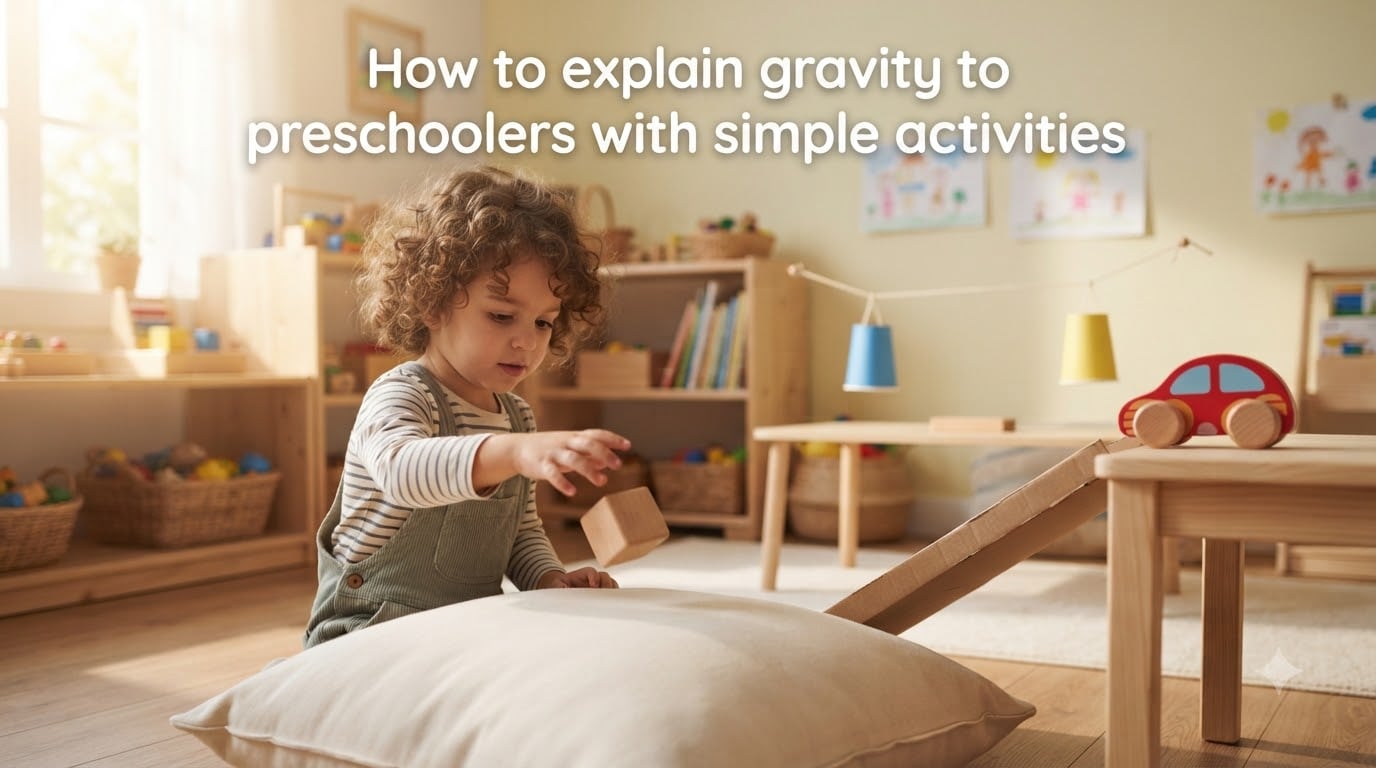
I still remember the day my three-year-old dropped an entire cup of cereal from the high chair and looked at me like he had just performed magic. He had. Every parent of a preschooler watches their child become a tiny scientist, and one of the first big ideas they discover is gravity. If you want to explain gravity to preschoolers in a way that actually sticks, hands-on activities work far better than lectures. After running these experiments with my own kids and a classroom full of curious four-year-olds, I have seen what sparks the “aha” moment, and what just confuses them. This guide gives you a simple definition, seven tested activities, and the words to use when your child asks the questions you are not ready for.
Table of Contents
What Is Gravity? A Simple Definition for Preschoolers
Gravity is an invisible force that pulls everything toward the ground. It is why things fall down when you drop them, and why you stay on the floor instead of floating away into the sky. The Earth acts like a giant magnet that gently tugs on you, on your toys, on water, and on everything else, even though you cannot see it.
I like to tell kids that gravity is a “hugging force” from the Earth. The Earth gives everything a hug that pulls it down, and that is why balls bounce back to the floor and why your spoon hits the ground when you knock it off the table. This simple picture helps young children grasp the idea without needing to learn about mass or physics formulas.
Why Gravity Matters: Keeping Us Safe on Earth
Most gravity activities for preschoolers stop at “things fall down.” That is a fine start, but I think it misses something important. Gravity is actually the reason we can live on Earth at all. It holds the air around us so we have oxygen to breathe. It keeps the oceans from floating off into space. It keeps our feet planted on the ground so we can walk, run, and jump without drifting away like balloons.
When my daughter asked me once, “What would happen without gravity?” I told her that we would all float up, up, up like soap bubbles, and the water in her bath would turn into shiny blobs floating around the room. She laughed, then quietly said, “I like gravity.” That is when I knew the concept had really landed. Helping children connect gravity to safety and stability turns an abstract idea into something they can feel grateful for.
Age-Appropriate Vocabulary for Teaching Gravity
One gap I noticed in many guides is that they jump straight into activities without giving parents the right words. Here is a short vocabulary list you can use while you play. Keep it simple and repeat the words often so they become familiar.
- Force: A push or pull that makes things move. Gravity is a pull.
- Pull: When something tugs another thing toward it. Gravity pulls things down.
- Down: The direction things fall because of gravity.
- Fall: What happens when gravity pulls something toward the ground.
- Earth: The planet we live on, which has gravity that keeps us here.
- Heavy vs. light: A way to talk about how much something weighs, and how gravity acts on it.
You do not need to use every word every time. Pick two or three and weave them into your play. Repetition is your friend at this age.
7 Simple Gravity Activities for Preschoolers
These are the activities I return to again and again. They use household items, take less than five minutes to set up, and have produced the most excited “whoa” moments in my house. Pick one or two to start, and save the rest for another day.
Activity 1: The Drop and Watch Game
Materials: a few small toys, a soft blanket or pillow.
- Hold a toy up high and ask your child what they think will happen if you let go.
- Let go and watch the toy land on the pillow.
- Try again with a heavier toy, then a lighter one. Ask which one fell faster.
- Drop the same toy from higher up (still safely) to show that gravity always pulls it down.
This is the simplest way to introduce gravity experiments for kids. The pillow keeps things quiet and prevents breakage, which means you can run the experiment 20 times in a row without stress.
Activity 2: Toy Car Ramp
Materials: a flat board or large book, a few toy cars or balls, a small stack of books.
- Prop one end of the board on a stack of books to make a ramp.
- Let your child place a car at the top and let it go.
- Ask them to describe what happened. The car rolled down because gravity pulled it.
- Raise the ramp higher and repeat. The car goes faster because gravity has more space to pull.
This is a classic gravity activities for preschoolers experiment, and it works because kids love watching wheels move. They naturally want to try every ramp height, which means you get dozens of teachable moments in one play session.
Activity 3: Paper Drop Race
Materials: two sheets of paper.
- Crumple one sheet into a tight ball. Leave the other sheet flat.
- Hold both pieces at the same height and drop them at the same time.
- Watch what happens. The crumpled paper hits the ground first.
- Explain that air slowed the flat paper down, but gravity still pulled both pieces down.
This is the easiest way to teach preschoolers about air resistance without using the words “air resistance.” Just say “the air pushed on the flat paper and slowed it down.”
Activity 4: Balance Scale Exploration
Materials: a clothes hanger, two paper cups, string, and small items like crayons, blocks, or snacks.
- Tie a paper cup to each end of the hanger so it balances evenly.
- Hang the hanger from a hook or hold it steady.
- Place a crayon in one cup. Watch the heavier side drop.
- Add items to the lighter cup until it balances. Talk about how gravity pulls heavier things down.
This activity takes about ten minutes to set up, but it lasts for days because kids keep wanting to weigh new things. A banana, a sock, a Lego brick. Each one becomes a tiny science experiment.
Activity 5: Playground Slide Gravity Hunt
Materials: just a playground slide.
- Before sliding, ask your child to feel how the slide slopes downward.
- Slide down together and talk about how gravity pulled you.
- Try a small toy on the slide. Did it slide too?
- Place the toy at the bottom of the slide. Does it slide back up on its own? Why not?
Outdoors is where gravity activities for 4 year olds really shine. The playground turns an abstract force into something your child can feel in their stomach as they swoosh down.
Activity 6: Bouncing Ball Comparison
Materials: a tennis ball, a bouncy rubber ball, and a soft foam ball.
- Drop each ball from the same height and watch what happens.
- Talk about how gravity pulls each ball down at the same speed, but the balls feel different when they land.
- Drop a ball onto a hard floor versus a carpet. The carpet absorbs more of the bounce, but gravity still pulls the ball down the same way.
This is one of those gravity experiments for kids that turns into a whole afternoon of play. Once they notice differences in bounce, they will start testing every ball in the toy bin.
Activity 7: Sink or Float with a Gravity Twist
Materials: a tub of water, a few small waterproof toys, a piece of cork, a small rock.
- Ask your child which items will sink and which will float.
- Drop each one into the water and watch what gravity does.
- Explain that gravity pulls everything down, but water pushes back up on some objects.
- Try a sponge. First it floats, then it sinks when full of water because gravity is pulling the heavier sponge down.
This blends gravity with another favorite kid topic. It is one of the best hands-on gravity experiments for preschoolers because the answer is not always what they expect.
How to Handle Tricky Follow-Up Questions
The moment your preschooler understands a basic idea, they will ask a question that stumps you. I have been there. Here is how I answer the most common ones without breaking into a sweat.
“Why don’t I float away?” Because gravity is hugging you to the Earth. Even though you cannot feel it, gravity is always pulling you down, which keeps your feet on the ground.
“Why do heavier things fall faster?” Honestly, in preschool this is not quite true. Without air, everything falls at the same speed. But for young kids, I usually say, “Gravity pulls everything down the same way. Heavier things just seem faster because they have more for gravity to pull.” That keeps the door open for a deeper answer later.
“What’s the difference between gravity and magnets?” Both are pulls, but gravity pulls everything toward the Earth all the time. Magnets only pull certain metal things, and only when they are close enough. Gravity is bigger, magnets are pickier.
“Is there gravity on the moon?” Yes, but the moon is smaller than Earth, so its gravity is weaker. That is why astronauts can hop around like kangaroos when they visit.
You do not need a perfect answer. You just need to keep the conversation going. Saying “I am not sure, let me find out” is also a wonderful lesson in curiosity.
Troubleshooting Common Gravity Experiment Problems
Even good experiments go sideways sometimes. Here is what to do when things do not work the way you planned.
The paper drop race looks the same. If the flat and crumpled paper seem to fall at the same speed, try dropping them from higher up, like off a chair (safely). The flat paper will flutter more visibly from a greater height.
The balance scale will not balance. Check that your cups are empty and tied at equal lengths. A piece of tape on the hanger hook can stop it from sliding.
Your child loses interest. Move on. Two minutes of focused play is worth more than ten minutes of distraction. Come back to the experiment another day.
The toy breaks. Switch to softer items. Stuffed socks or foam balls work just as well as fancy toys for teaching gravity for kids.
Safety Tips for Gravity Activities with Young Kids
Most gravity activities are safe, but a few small precautions make them smoother.
- Always drop toys onto a soft surface like a carpet, blanket, or pillow.
- Supervise every drop, especially with heavier objects.
- For ramps, make sure the bottom of the ramp lands on a soft area or carpet.
- For outdoor experiments, watch for sharp edges, slippery surfaces, and steps.
- Wash hands after any activity that uses food or outdoor items.
These tips let you focus on the fun instead of worrying about spills or falls.
Frequently Asked Questions About Teaching Gravity to Preschoolers
How to explain gravity to preschool?
Start with a simple definition: gravity is an invisible force that pulls everything toward the ground. Then let your child feel it through short activities like dropping toys, rolling balls down ramps, and watching paper fall. Keep your language short, repeat the words often, and follow your child’s curiosity instead of sticking to a script.
What is gravity in simple words for kids?
Gravity is an invisible force that pulls everything toward the ground. It is the reason balls fall down, why your feet stay on the floor, and why we do not float into the sky. You can describe it as a hugging force from the Earth that never stops pulling.
What is the simplest way to explain gravity?
The simplest way to explain gravity is to use the words ‘pull down.’ Tell your preschooler that the Earth pulls everything down, even though we cannot see it. Then drop a toy and a piece of paper so they can see gravity in action.
At what age do children understand gravity?
Most children begin to grasp the basic idea of gravity between ages 3 and 5, with deeper understanding developing around age 6 or 7. By age 3, toddlers already experiment with gravity by dropping objects repeatedly, even if they cannot yet explain it in words.
How do you teach gravity to a 3 year old?
Use short, hands-on activities instead of explanations. Drop toys onto a pillow, roll balls down a board, and use the words ‘pull down’ and ‘fall down’ often. Keep sessions short, repeat favorite experiments, and answer follow-up questions with simple, honest language.
Final Thoughts on Teaching Gravity to Preschoolers
Explaining gravity to preschoolers is less about getting the science right and more about sparking curiosity. Every dropped toy, every rolled ball, every slide at the playground is a chance to point out the invisible force that shapes our world. Start with one simple activity, use words like pull, down, and fall, and let your child’s questions guide what comes next.
If you remember nothing else from this guide, remember this: gravity is the reason we are all here, on the ground, together. That is a pretty amazing idea for a three-year-old to discover. So grab a toy, find a pillow, and let the experiments begin.