
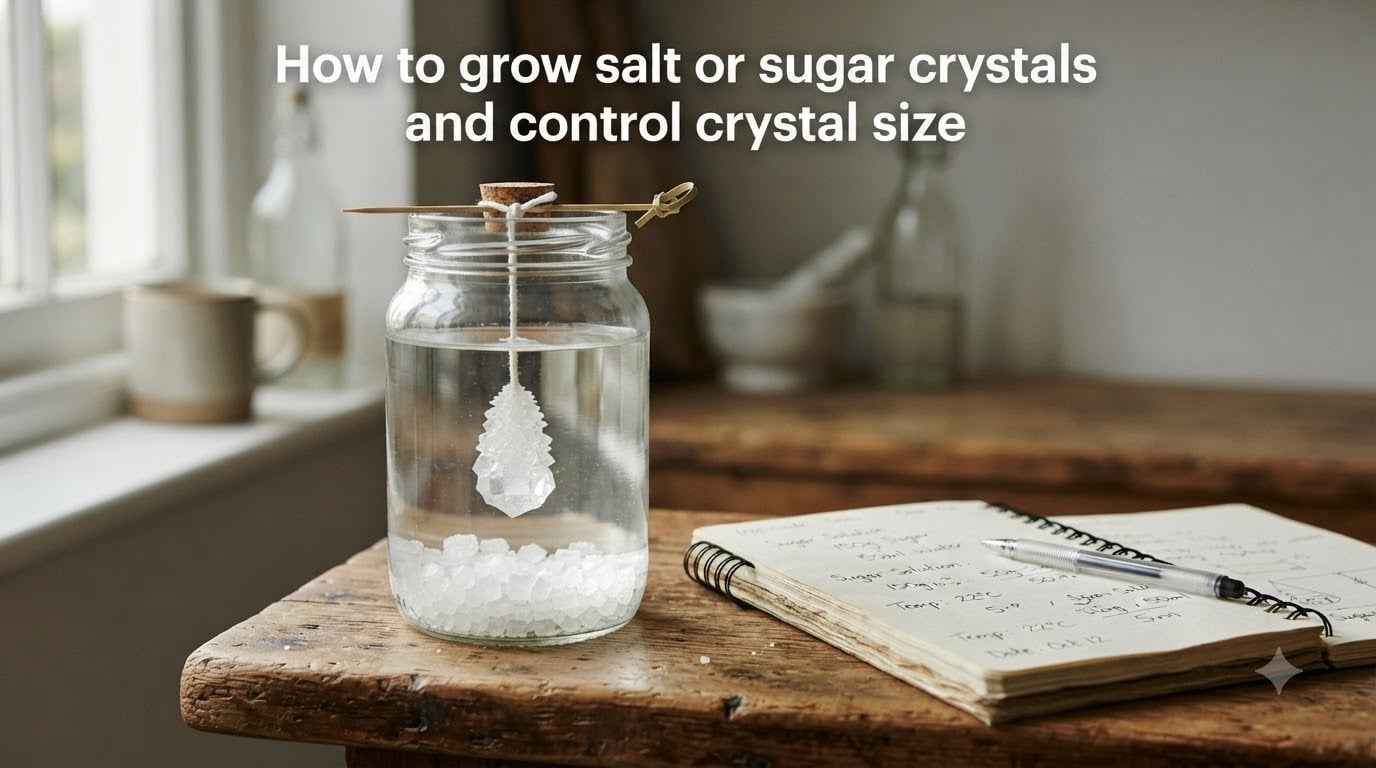
I grew my first crystal on a kitchen counter when I was nine, and I remember being shocked when it came out smaller than the seed I had dropped into the jar. That single frustration sent me down a rabbit hole of research, and what I learned is this: anyone can learn how to grow salt or sugar crystals and control crystal size with a few reliable variables. Our team has run dozens of these experiments over the past year, comparing temperatures, evaporation rates, and seeding techniques so you do not have to repeat my early mistakes.
Crystal growing is one of the cheapest, most rewarding science projects you can run at home. Salt and sugar both dissolve in water, both form visible crystals, and both teach the same underlying chemistry. The big difference is that sugar crystals grow visibly larger and slower, which makes them perfect for studying growth over days. Salt crystals form in hours, which makes them perfect for impatient experiments.
In this guide I will walk you through the science of supersaturation, the exact measurements that work, and the key levers you can pull to deliberately control crystal size rather than leave it to chance.
Table of Contents
What Are Crystals and Why Size Control Matters?
A crystal is a solid in which molecules line up in a repeating, geometric pattern called a lattice. Table salt (sodium chloride) forms cubic crystals because each sodium ion bonds with six chloride ions in a perfect cube. Table sugar (sucrose) forms longer, monoclinic crystals because its molecules stack at an angle.
I think of crystal size control as the difference between letting nature do whatever it wants and gently steering the process. In an industrial lab, chemists tune temperature, evaporation, and seeding to grow crystals of a specific size because size changes how the crystal dissolves, how it flows, and how it looks. In the kitchen, you can use the same levers to grow a single chunky sugar crystal the size of your thumb instead of a thin crust of sandy grains.
Why does size matter beyond aesthetics? Larger crystals have fewer surface defects and store more internal structure, which is why gem-quality silicon and quartz are grown slowly in careful conditions. For a science fair, growing one big crystal demonstrates more understanding than growing a thin layer of small ones. For edible rock candy, larger crystals feel smoother on the tongue and look more impressive.
The Science Behind Crystal Formation: Supersaturation Explained
Crystal growth depends on a simple idea: hot water holds more dissolved solute than cold water. When you heat water, you create space between molecules so more sugar or salt can squeeze in. As the solution cools or evaporates, the water can no longer hold all that solute, so the extra molecules are forced to leave the solution and lock into a solid.
Three terms describe how loaded the solution is. A saturated solution holds the maximum amount of solute at a given temperature. An undersaturated solution could dissolve more if you added it. A supersaturated solution holds more solute than it should be able to, which means it is unstable and ready to dump crystals at the slightest nudge.
Supersaturation is the engine behind every crystal you will ever grow. To make one, you heat water, stir in solute until no more dissolves, then cool or evaporate slowly. The solution is now supersaturated, and any seed crystal, dust speck, or scratch on the glass provides a nucleation site where molecules can start building.
Nucleation is the moment the first tiny cluster of molecules organizes into a stable pattern. Once a stable nucleus exists, additional molecules latch on in the same orientation. That is why a single seed crystal can grow into a big crystal while a clean solution will sometimes wait days before anything starts.
The opposite of nucleation is dissolution, which happens when a crystal sits in an undersaturated solution. If your seed crystal starts shrinking instead of growing, your solution is too weak and you need to add more solute and reheat.
Materials You Need to Grow Salt or Sugar Crystals
You probably own everything you need already. Here is the kit I use for both salt and sugar experiments.
A clean glass jar or heat-safe cup (clear glass lets you watch growth)
Distilled water (tap water works but minerals can add cloudiness)
Granulated table sugar for sugar crystals
Table salt or rock salt for salt crystals
A saucepan for heating
A wooden spoon or popsicle stick for stirring
Cotton string, a wooden skewer, or a paperclip for suspending a seed
A pencil or clothespin to hold the string across the jar opening
A coffee filter or paper towel to filter impurities
Optional: food coloring for sugar crystals, vanilla extract for flavor
For salt crystal experiments, you can swap table salt for rock salt, kosher salt, or even alum from the spice aisle. Alum produces clearer, larger crystals and is what most science kits use. For sugar, plain granulated sugar works, but pure cane sugar often yields clearer results than beet sugar.
How to Grow Salt Crystals Step by Step
Salt crystals grow fastest because sodium chloride has very high solubility in water and a cubic lattice that snaps together quickly. You can grow visible salt crystals in a single afternoon.
Heat 1 cup of distilled water until it just starts to simmer.
Stir in salt one tablespoon at a time until no more dissolves. You will need roughly 6 to 7 tablespoons of table salt per cup.
Remove from heat and let the solution cool for 10 minutes.
Pour the solution through a coffee filter into a clean glass jar to remove undissolved grains.
Tie a small seed crystal (a single grain of salt works) to a piece of cotton string.
Suspend the string in the solution with a pencil across the jar mouth.
Cover loosely with a paper towel to keep dust out while allowing evaporation.
Set the jar in a calm, room-temperature spot away from vibrations.
Check after 24 hours. You should see small cubic crystals beginning to form on the string and the jar walls.
Let it grow for 3 to 7 days for medium crystals, or 2 weeks for larger specimens.
Salt crystals usually appear within hours and reach pea-size within a few days. They look like tiny glass cubes clustered on the string.
How to Grow Sugar Crystals Step by Step
Sugar crystals grow more slowly than salt because sucrose molecules are larger and stack in a more complex pattern. That slowness is exactly what makes sugar ideal for controlled, large-crystal experiments. I use the 3-to-1 ratio that university chemistry programs rely on.
Combine 1 cup of distilled water and 3 cups of granulated sugar in a saucepan.
Heat slowly while stirring. Keep the temperature just below boiling so you do not caramelize the sugar.
Stir constantly for 5 to 10 minutes until all the sugar dissolves and the liquid looks clear.
Remove from heat and let the solution cool for 15 minutes.
Pour through a coffee filter into a clean glass jar to remove any undissolved grains or impurities.
Tie a seed crystal (a small sugar crystal or a rock candy chunk) to a cotton string.
Suspend the seed in the solution using a pencil laid across the jar opening.
Cover loosely with a paper towel and place the jar in a spot where the temperature stays steady.
Wait 3 to 5 days for small crystals, 7 to 10 days for medium crystals, and 2 to 4 weeks for chunky single crystals.
When you are happy with the size, remove the crystal, let it dry on a paper towel for 1 hour, and eat it or display it.
This recipe produces rock candy if you let it crust around the string, or chunky crystals if you control evaporation carefully. For transparent single crystals, see the advanced technique section below.
How to Control Crystal Size: The Key Variables
Crystal size is controlled by four levers, and once you understand them you can stop hoping for big crystals and start engineering them.
1. Cooling rate. Slow cooling produces fewer, larger crystals because molecules have time to find existing nuclei instead of forming new ones. Rapid cooling produces many small crystals because new nucleation sites keep appearing. If you want a single big crystal, let your solution cool for 30 minutes before adding the seed.
2. Evaporation rate. Faster evaporation forces more solute out of the solution per hour, which sounds good but actually causes nucleation storms. Slow evaporation, with the jar loosely covered and placed away from drafts, lets molecules deposit onto the existing seed instead of starting new crystals. For maximum size, cover the jar with a cloth that slows but does not stop airflow.
3. Seed crystal quality. A clean, well-formed seed gives molecules a perfect template to follow. A scratched or rough seed encourages branching. The largest single crystals in the world started from carefully selected seeds.
4. Disturbance. Vibration, temperature swings, and jostling all cause defects and competing nucleation sites. Reddit users in r/crystalgrowing report that a single bump can split a growing crystal. Pick a quiet shelf, leave it alone, and resist the urge to peek every hour.
If your crystals are coming out small and sandy, slow everything down. Cool the solution longer, cover the jar more, and reduce airflow. If your crystals are growing too slowly or the seed is dissolving, your solution is undersaturated. Add more solute and reheat.
Salt Crystals vs Sugar Crystals: Side-by-Side Comparison
Salt and sugar crystals look and behave differently because their molecules are different sizes and shapes. Here is a quick side-by-side.
Solubility at 20 C: Salt dissolves up to about 36 grams per 100 mL of water. Sugar dissolves up to about 204 grams per 100 mL of water.
Crystal shape: Salt forms sharp cubes. Sugar forms elongated, slanted prisms.
Typical size at home: Salt crystals reach 1 to 5 mm. Sugar crystals regularly reach 1 to 3 cm with patience.
Growth time: Salt shows visible crystals in 24 hours. Sugar takes 3 to 7 days for first visible growth.
Clarity potential: Salt crystals are usually opaque white. Sugar crystals can be glass-clear when grown slowly.
Edible? Salt is edible in small amounts. Sugar is fully edible. Avoid alum, Borax, and Epsom salts for taste testing.
Best for: Salt is best for quick demonstrations. Sugar is best for showcasing controlled size and clarity.
Sugar crystals are larger than salt crystals at home because sucrose molecules are bigger and stack in longer chains, which encourages visible growth on a single seed. Salt crystals stay small because sodium and chloride ions are tiny and bond in every direction, so they tend to fill in many small grains instead of one big cube.
Seed Crystal Technique for Large Single Crystals
If you want one impressive crystal instead of a fuzzy crust, you need a seed crystal. A seed is a small, well-formed crystal of the same substance that gives molecules a head start.
To make a seed for sugar crystals, let a small jar of sugar solution evaporate until tiny crystals form on the bottom. Pick the cleanest one with the best shape and tie it to a thin cotton thread using a simple overhand knot. Soak the thread in the solution first so it does not wick crystals up the line.
For salt, a single grain of table salt or a small alum crystal works perfectly. Tie it loosely so the knot does not crush the seed.
Lower the seed into your filtered, room-temperature supersaturated solution. Make sure the seed hangs in the middle of the jar and does not touch the walls or bottom. If the seed is not getting larger after 48 hours, your solution is not supersaturated enough. Reheat, add more solute, filter, and try again.
I have had the best results when I leave the jar completely alone for the first week. Each time I have moved it to show someone, the crystal has grown a defect on that side.
Troubleshooting Common Crystal Growing Problems
Even with perfect materials, things go wrong. Here are the problems I see most often and how I fix them.
Crystals forming on the bottom instead of the string. Your seed is not suspended correctly or the solution is too saturated. Lower the temperature, add a tablespoon of water, and re-filter the solution.
Seed crystal dissolving. Your solution is undersaturated. Add more solute, reheat until dissolved, cool, and re-submerge the seed.
Cloudy or sandy crystals. You cooled too fast or there is dust in the solution. Filter through a coffee filter, slow the cooling, and cover the jar to keep dust out.
Crystals growing too fast. Reduce evaporation by covering the jar with a tighter lid, but crack it open slightly so water can still leave. Move the jar to a cooler spot.
No crystals after a week. Check that your solution was actually supersaturated. If undissolved sugar or salt sat at the bottom after heating, the solution was probably saturated but not supersaturated. Add more solute, reheat, and try again.
Crystal falling off the string. Rough up the seed with sandpaper so the knot has more grip, or use a thin wire instead of cotton thread.
Advanced Technique: Growing Transparent Single Crystals
Transparent single crystals are the holy grail of home crystal growing because they show internal structure and look like gemstones. They require patience and very stable conditions.
The trick is to grow the crystal in a covered container that allows just enough evaporation over weeks, not days. I use a jar with a plastic lid that has three small holes drilled in it. This slows evaporation so the seed grows steadily without competing nucleation.
Keep the temperature constant. A closet away from heating vents works well. Room temperature around 20 C is ideal. Avoid direct sunlight because warming the jar during the day and cooling it at night causes expansion defects.
Re-filter the solution every 7 to 10 days and transfer the crystal to fresh solution. The growing crystal will reject impurities into the liquid, and a fresh batch keeps growth clean. Expect 4 to 8 weeks for a crystal the size of a peanut, longer for anything larger.
Reddit users in r/crystalgrowing and r/chemistry report that alum grown this way can reach 2 inches across in a month. Sugar crystals grow slower but can become perfectly clear with this method.
Safety and Storage Tips for Edible vs Non-Edible Crystals
Only eat crystals you grew from food-grade sugar or salt. Borax, alum, and Epsom salt crystals are not food and should be labeled clearly and stored away from children and pets. Even edible crystals should be stored in a dry container because humidity will dissolve them over time.
Always use clean jars and utensils. Wash everything with hot soapy water and rinse well before starting. Sugar solutions are magnets for bacteria if left at warm temperatures for too long, so keep edible crystals refrigerated if you plan to store them for more than a few days.
Never heat sugar solutions above the soft-crack stage (around 140 C). Molten sugar is far hotter than boiling water and can cause severe burns. Adult supervision is a must for younger scientists.
Frequently Asked Questions
How to increase crystal size?
Slow down every stage of the process. Cool your supersaturated solution slowly so only one seed crystal forms instead of many. Cover the jar loosely to slow evaporation, which lets molecules deposit onto the existing crystal rather than forming new nuclei. Keep the jar in a vibration-free spot at a steady temperature, and leave it alone for at least a week. Reddit users regularly report 1 to 4 weeks of undisturbed growth for crystals 1 to 3 cm in size.
Are sugar crystals bigger than salt crystals?
Yes. Sugar crystals grown at home regularly reach 1 to 3 cm, while salt crystals usually stop at 1 to 5 mm. Sucrose molecules are larger and stack in longer chains, which encourages visible growth on a single seed. Sodium chloride ions are small and bond in every direction, so they tend to fill in many small grains instead of one big cube.
How to make a crystal grow bigger?
Use a clean seed crystal suspended in the middle of a filtered, supersaturated solution. Cover the jar loosely to slow evaporation. Keep the temperature steady at around 20 C and place the jar on a vibration-free shelf. Refilter the solution and transfer the crystal to fresh liquid every 7 to 10 days to remove impurities. Expect 2 to 4 weeks for chunky crystals and 4 to 8 weeks for transparent single crystals.
How to grow sugar crystals quickly?
The fastest method is the classic rock candy approach: boil 1 cup of water, dissolve 3 cups of sugar, cool for 10 minutes, then suspend a seeded string in the jar. You will see small crystals within 24 to 48 hours and rock candy within a week. Note that fast growth produces many small crystals rather than one large one, so quick sugar crystals look like a sandy crust instead of a clear chunk.
Conclusion
Learning how to grow salt or sugar crystals and control crystal size comes down to four habits: start with a supersaturated solution, use a clean seed, slow down every variable, and leave the jar alone. Salt is the right choice if you want quick results in a single afternoon. Sugar is the right choice if you want to grow an impressive, edible crystal over several weeks. Both teach the same chemistry, and both reward patience more than speed.
Pick a method, gather your materials, and start your first jar this weekend. Track your crystal every day with a photo and a note about temperature and humidity. Within a month you will have a hands-on understanding of nucleation, supersaturation, and growth that no textbook can match.