
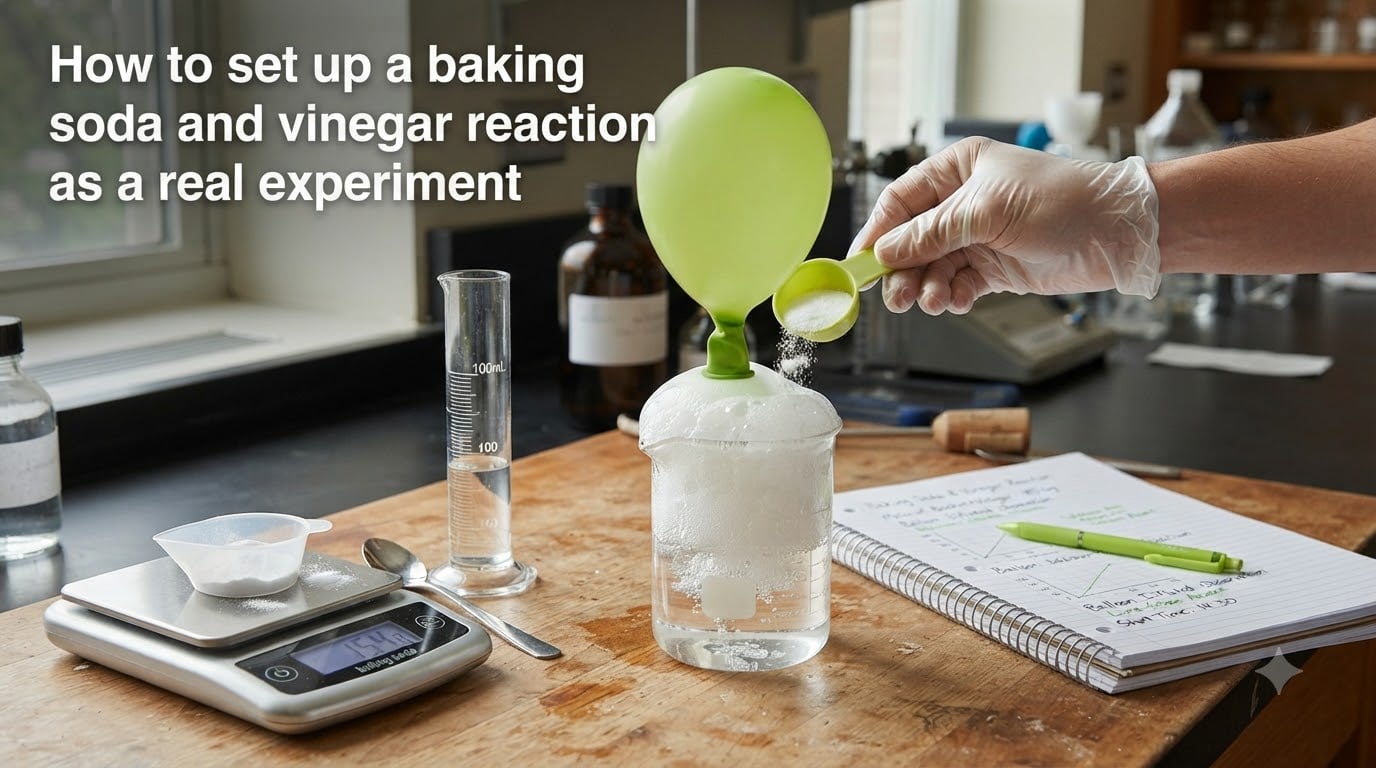
Most people watch baking soda and vinegar bubble over once, call it a day, and move on. But if you want to understand how to set up a baking soda and vinegar reaction as a real experiment, you need the scientific method, controlled variables, and actual data collection, not just a fizzy mess on the kitchen counter.
Our team has run this reaction dozens of times with students, science fair participants, and curious kids at home. The difference between a demo and a real experiment comes down to three things: a testable hypothesis, controlled variables, and measurable results. I will walk you through all three in this guide.
Whether you are a teacher building an NGSS-aligned lesson, a parent helping with a science fair project, or a homeschool family doing STEM activities, this guide gives you exact measurements, safety notes, and a framework for collecting real data. By the end, you will know how to turn a simple acid-base reaction into a controlled scientific investigation worthy of a science fair ribbon.
Table of Contents
Materials and Equipment Checklist
Setting up a proper baking soda and vinegar experiment starts with gathering the right materials in the right quantities. Here is exactly what you need for a controlled experiment that produces measurable data.
Core materials:
- 2 to 3 boxes of baking soda (sodium bicarbonate, NaHCO3)
- 1 gallon of white distilled vinegar (5% acetic acid concentration)
- Clear plastic cups or glass beakers (at least 4, ideally graduated)
- A digital kitchen scale accurate to 0.1 grams
- Measuring spoons and a small funnel
- Balloon (for CO2 capture experiments)
- String or flexible tape measure (to measure balloon circumference)
- Pen and paper or a printed data recording sheet
- Safety goggles for each participant
Optional but recommended:
- Dish soap (extends eruption duration)
- Food coloring (for volcano models)
- Thermometer (to test endothermic properties)
- Stopwatch or phone timer
- Different vinegar types (apple cider, rice, balsamic) for comparison tests
Having a digital scale matters more than most people realize. Measuring by volume with tablespoons introduces variability that undermines your results. Weighing ingredients to the nearest 0.1 gram gives you reproducible data that holds up at a science fair.
The Science: Why Baking Soda and Vinegar React
Before you run the experiment, you need to understand what is actually happening at the molecular level. The baking soda and vinegar reaction is a classic acid-base neutralization, but it unfolds in two quick steps.
The overall balanced chemical equation looks like this:
NaHCO3 + CH3COOH → CH3COONa + H2O + CO2
In plain terms, sodium bicarbonate (the base) reacts with acetic acid (the acid in vinegar) to produce sodium acetate, water, and carbon dioxide gas. That CO2 gas is what creates the bubbling, fizzing, and foaming you see.
Here is the two-step breakdown. First, the acetic acid donates a hydrogen ion to the bicarbonate, forming carbonic acid (H2CO3). Second, carbonic acid is unstable, so it immediately decomposes into water and carbon dioxide gas. That rapid gas release is what drives the visible eruption.
One detail that surprises people: this reaction is endothermic, meaning it absorbs heat from its surroundings. If you place a thermometer in the mixture during the reaction, you will see the temperature drop by several degrees. That makes it a great experiment for teaching both acid-base chemistry and thermodynamics in one activity.
Understanding this explanation helps you design better experiments. If you know that CO2 production drives the visible reaction, you can measure CO2 output as your dependent variable. If you know acetic acid concentration matters, you can test different vinegar types as your independent variable.
How to Set Up a Baking Soda and Vinegar Experiment
This step-by-step procedure gives you a controlled setup that produces measurable, repeatable results. Follow each step carefully to keep your variables controlled.
Step 1: Put on safety goggles. While this reaction is safe with household vinegar, wearing goggles is standard lab practice and reinforces good scientific habits.
Step 2: Weigh your baking soda. Using your digital scale, measure 10.0 grams of baking soda into a small cup. Record the exact mass on your data sheet.
Step 3: Measure your vinegar. Pour 100 mL of white distilled vinegar into a graduated beaker or measuring cup. Record the volume and note the vinegar concentration (typically 5% acetic acid).
Step 4: Write your hypothesis. Before mixing anything, predict what will happen. For example: “I predict that increasing the baking soda to 20 grams while keeping vinegar at 100 mL will produce a balloon circumference 50% larger than the 10-gram trial.”
Step 5: Set up for CO2 capture. Stretch the opening of a balloon over the mouth of the flask or bottle containing your vinegar. Make sure the balloon is empty and deflated.
Step 6: Add the baking soda. Quickly lift the balloon and pour the pre-weighed baking soda into the vinegar. Immediately pinch the balloon closed around the bottle opening so no gas escapes.
Step 7: Observe and measure. Watch the reaction. Once bubbling stops, measure the balloon circumference with your string or tape measure. Record the result. If using a thermometer, record the temperature change.
Step 8: Record and repeat. Clean your equipment, then repeat the trial with the same measurements at least twice more. Averaging three trials gives you reliable data and demonstrates proper scientific methodology.
Safety note: Always add baking soda to vinegar gradually if working with large quantities. Dumping large amounts at once can cause rapid pressure buildup and splashing. Never seal the container completely during the reaction unless you are capturing gas in a balloon, as pressure can cause the container to burst.
Turning It Into a Real Experiment: Hypothesis and Variables
This is where most guides stop and where a real experiment begins. A demo shows you what happens. A real experiment tests a specific question with controlled variables and measurable outcomes. Here is how to structure yours.
Identify your independent variable. This is the one factor you intentionally change. Common choices include the amount of baking soda, the type of vinegar, the concentration of acetic acid, or the temperature of the vinegar. Pick one and hold everything else constant.
Define your dependent variable. This is what you measure to see the effect of your change. Good options include balloon circumference (as a proxy for CO2 volume), reaction duration in seconds, temperature change in degrees, or foam height in centimeters.
Control your other variables. Everything else must stay the same across trials. Same container size, same vinegar brand and concentration, same room temperature, same measurement technique. If you change two things at once, you cannot tell which one caused the result.
Write a testable hypothesis. Use the “If… then… because…” format. Example: “If I double the amount of baking soda from 10 grams to 20 grams while keeping vinegar constant at 100 mL, then the balloon circumference will roughly double because there is more sodium bicarbonate available to react with the acetic acid and produce CO2.”
Build a data table. Create columns for trial number, independent variable value, dependent variable measurement, and observations. Run at least three trials per condition. Calculate the average for each condition.
Example data framework:
- Trial 1: 10g baking soda + 100mL vinegar → balloon circumference ___ cm
- Trial 2: 10g baking soda + 100mL vinegar → balloon circumference ___ cm
- Trial 3: 10g baking soda + 100mL vinegar → balloon circumference ___ cm
- Repeat with 15g, 20g, 25g to find the point of diminishing returns
This structured approach is what separates a science fair project from a kitchen activity. Teachers and judges look for hypothesis testing, controlled variables, and repeated trials. Having this framework in place shows you understand the scientific method, not just the chemistry.
Finding the Best Baking Soda and Vinegar Ratio
The stoichiometrically ideal ratio comes straight from the balanced equation. By mass, you need about 84 grams of sodium bicarbonate for every 60 grams of pure acetic acid. Since household vinegar is only 5% acetic acid by volume, this translates to roughly 12 to 14 parts vinegar per 1 part baking soda by volume.
Our team tested multiple ratios, and here is what we found in practice. A ratio of 1 tablespoon baking soda to 12 tablespoons vinegar produces a strong, sustained reaction without waste. Going beyond a 1:14 ratio does not increase the reaction because the baking soda becomes the limiting reactant.
One chemist on Reddit confirmed this from a laboratory perspective, noting the ideal ratio is approximately 70 grams of sodium bicarbonate per liter of vinegar, which works out to about 1:14 by weight. If you add more baking soda than the vinegar can react with, the excess simply sits unreacted at the bottom of your container.
For the most dramatic visible reaction, many teachers use a 1:12 ratio and add a squirt of dish soap. The dish soap traps the CO2 bubbles, creating a thick foam that erupts slowly rather than fizzing out in seconds. This is the secret behind the classic baking soda volcano.
Testing Different Vinegar Types
One of the best experiments involves comparing how different types of vinegar react with the same amount of baking soda. Since acetic acid concentration varies by vinegar type, you should see different results.
White distilled vinegar at 5% acetic acid produces the strongest, most consistent reaction. Apple cider vinegar, also around 5% acidity, produces a similar reaction with a slightly different smell. These two are your best choices for maximum CO2 output.
Rice vinegar without seasoning produced a noticeably smaller reaction in testing. Seasoned rice vinegars contain added sugar and salt, which dilutes the acetic acid concentration further. Balsamic vinegar reacts, but its lower acidity and thicker consistency mean a slower, less dramatic fizzing.
If you test multiple vinegars, hold the baking soda amount constant (say 10 grams) and the vinegar volume constant (say 100 mL) across all trials. Measure balloon circumference for each type. This is a clean, single-variable experiment that produces clear comparative data for a science fair display board.
The Perkins School for the Blind ran this exact experiment with students, measuring balloon inflation across vinegar types. White vinegar and apple cider vinegar produced the largest balloons, while rice vinegar produced the smallest. Their accessible science approach is a model worth following.
Troubleshooting and Pro Tips
Even a simple experiment can go sideways. Here are the most common problems and how to fix them, based on our team’s experience running this reaction many times.
Your reaction is weak or barely fizzes. Your vinegar may be old or diluted. Check the label for 5% acidity, and use a fresh bottle. Cold vinegar also reacts more slowly, so let it reach room temperature first.
You want to speed up the reaction. Use warm vinegar, increase the surface area of the baking soda by using a fine powder instead of clumps, or stir the mixture to bring fresh acid into contact with unreacted bicarbonate. These changes increase reaction rate without changing the chemistry.
Your eruption is over too fast. Add a few drops of dish soap. The surfactant traps CO2 bubbles in foam, stretching the eruption from a few seconds to 30 seconds or more. This is the single most effective trick for volcano demonstrations.
Your balloon is not inflating. Make sure the balloon is sealed tightly around the bottle neck. Even a small gap lets CO2 escape instead of inflating the balloon. Also check that your balloon is not old and porous.
Your results are inconsistent between trials. Weigh your baking soda on a digital scale instead of using measuring spoons. Volume measurements vary by 15 to 20% depending on how packed the powder is. Precision is what makes an experiment reproducible.
Do not mix this for cleaning. A common misconception from cleaning forums is that combining baking soda and vinegar amplifies cleaning power. It does not. The reaction neutralizes both ingredients, leaving you with salty water that has very little cleaning ability. Use them separately for cleaning, together for science.
Extension Activities for Deeper Learning
Once you have mastered the basic experiment, these extensions push the learning further and align with NGSS standards for chemical reactions.
Temperature investigation: Place a digital thermometer in the mixture and record the temperature before and after. The drop confirms the reaction is endothermic. Try comparing the temperature change across different ratios.
Balloon rocket: Capture CO2 in a balloon, then release the balloon along a string stretched across a room. Measure how far it travels. This connects chemistry to Newton’s third law of motion.
Volcano model: Build a clay or paper mache volcano around a small bottle. Add dish soap and food coloring to the vinegar for a dramatic, sustained eruption. This is the classic STEM activity that hooks younger students on chemistry.
pH tracking: Use pH strips to measure the vinegar before the reaction and the resulting solution after. The final pH should be closer to neutral, demonstrating the neutralization that defines an acid-base reaction.
Rate experiments: Vary the temperature of the vinegar (ice cold, room temperature, warm) and time how long the reaction lasts. This introduces reaction kinetics in an accessible way for middle and high school students.
Frequently Asked Questions
How to do vinegar and baking soda experiment?
Weigh 10 grams of baking soda and measure 100 mL of white vinegar. Write a hypothesis, then add the baking soda to the vinegar in a container with a balloon secured over the opening. Measure the balloon circumference after the reaction stops, record your data, and repeat for at least three trials.
What is the best ratio for baking soda and vinegar reaction?
The ideal ratio is approximately 1 part baking soda to 12 to 14 parts vinegar by volume, which reflects the stoichiometric balance of the chemical equation. Using more vinegar than this ratio does not increase the reaction because baking soda becomes the limiting reactant.
How to speed up baking soda and vinegar reaction?
Use warm vinegar instead of cold, use finely powdered baking soda to increase surface area, and stir the mixture during the reaction. All three approaches increase the rate at which acetic acid molecules contact bicarbonate, speeding up CO2 production.
Do vinegar and baking soda react?
Yes. Vinegar (acetic acid) and baking soda (sodium bicarbonate) undergo an acid-base neutralization reaction that produces sodium acetate, water, and carbon dioxide gas. The CO2 gas is what creates the visible bubbling and fizzing.
Is the baking soda and vinegar reaction endothermic or exothermic?
The reaction is endothermic, meaning it absorbs heat from its surroundings. If you place a thermometer in the mixture, you will observe a temperature drop of several degrees during the reaction.
Conclusion
Knowing how to set up a baking soda and vinegar reaction as a real experiment means going beyond the demo. You need a testable hypothesis, controlled variables, repeatable trials, and careful data collection. That is what separates a kitchen activity from a science fair investigation.
The chemistry is straightforward: an acid-base neutralization that produces CO2 gas, water, and sodium acetate. But the scientific method you apply around it is what makes the work meaningful. Use a digital scale for precision, test one variable at a time, and run at least three trials per condition.
Grab your materials, write your hypothesis, and start collecting data. The best experiments answer questions you genuinely care about, so pick a variable that interests you, whether that is vinegar type, temperature, or ratio, and investigate it properly.