
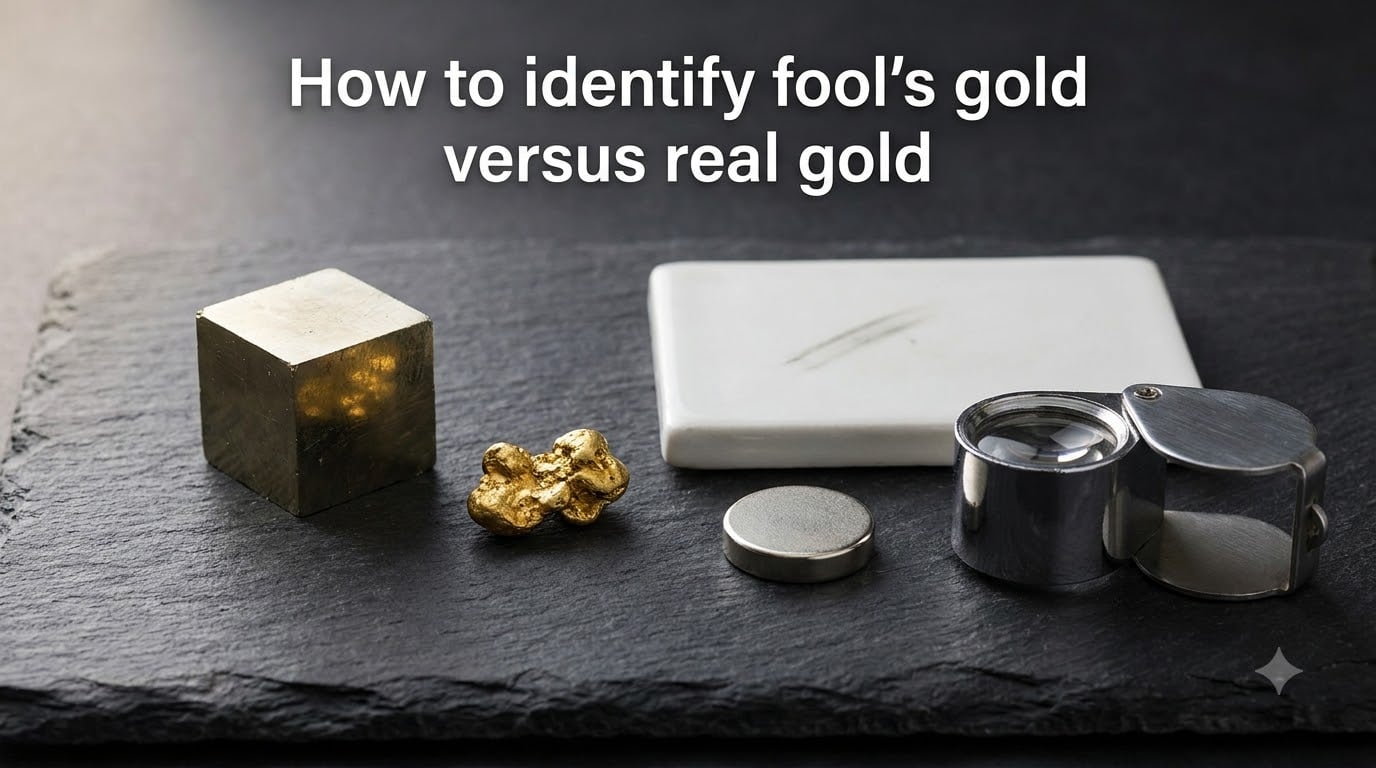
I still remember the first time I cracked open a quartz vein in a creek bed and saw what looked like a small fortune staring back at me. The metallic glint was bright, the color was unmistakably yellow, and my heart nearly stopped. That “gold” turned out to be pyrite, and my disappointment taught me more about mineral identification than any textbook ever could.
If you have ever held a shiny, gold-colored rock and wondered whether to start celebrating or to keep walking, this guide is for you. In it, our team walks through how to identify fool’s gold versus real gold using tests you can run at home with a pocket knife, a streak plate, and a strong magnet. We will cover color, streak, hardness, crystal form, density, magnetism, and even the destructive tests that experienced prospectors use. By the end, you will have a clear, repeatable workflow so the next time you find a golden-looking specimen, you will know exactly what you are holding.
Table of Contents
What Is Fool’s Gold?
Fool’s gold is the common name for pyrite, an iron sulfide mineral with the chemical formula FeS2. Pyrite forms brassy-yellow, metallic crystals that have tricked hopeful prospectors for centuries, which is exactly how it earned its nickname.
Real gold, on the other hand, is a native element with the symbol Au. It almost always appears as a soft, deep golden yellow and rarely forms sharp geometric crystals in nature. The confusion between the two comes down to three things: color, metallic luster, and weight. Both can look heavy and shiny in the pan, and both can show up in the same kind of quartz-rich stream gravel. The differences only become obvious once you start running a few simple tests.
One quick note before we begin. Pyrite is not worthless. Collectors prize well-formed pyrite cubes and pyritohedrons, and pyrite has real industrial uses in sulfuric acid production. It is just not gold, and treating it like gold leads to bad decisions in the field.
Color Comparison: Brassy Yellow vs Golden Yellow
The fastest free test is color, and once you have seen both minerals side by side, you will rarely confuse them again.
Pyrite has a brassy, pale yellow color, often described as “sulfur yellow” or even slightly greenish in some lights. It looks a touch cold, like polished brass on a doorknob. Real gold has a warmer, deeper, buttery yellow that stays the same under any light source, because gold does not tarnish or oxidize.
Here is what to look for when you hold the specimen up:
- Does the color lean brassy or pale? Lean pyrite.
- Does it have a uniform warm yellow, even in the shadowed parts of the rock? Lean gold.
- Is there any rainbow tarnish, purple sheen, or dark patina on the surface? That points to pyrite or to another sulfide, not gold.
Color alone is not enough to confirm gold, because chalcopyrite (another sulfide) has an even yellower color that fools many beginners. Use color as your first filter, then move on to the streak test to confirm.
The Streak Test: Greenish-Black vs Yellow
The streak test is one of the oldest tricks in mineralogy, and it is one of the most reliable ways to tell fool’s gold from real gold. The streak is the color of a mineral when it is powdered, and you get it by dragging the specimen across an unglazed porcelain tile called a streak plate.
Here is how to run the test in three steps:
- Find an unglazed porcelain tile. The back of a ceramic bathroom tile works in a pinch.
- Press the specimen firmly and drag it across the plate with enough force to leave a mark.
- Look at the color of the streak left behind, ideally in natural daylight.
Real gold leaves a yellow streak that looks exactly like the gold you started with. Pyrite leaves a greenish-black or brownish-black streak that looks nothing like the bright specimen. If your streak is dark, you are holding fool’s gold or another sulfide. If your streak is bright yellow, you are most likely holding real gold.
Safety note. Pyrite dust is not acutely toxic, but you should still avoid breathing it in or getting it in your eyes. Do the test outdoors if you can, wash your hands afterward, and never lick the streak plate.
Hardness and Crystal Form Differences
If you want a second non-destructive confirmation, check hardness and crystal shape. Geologists measure hardness on the Mohs scale, where talc is 1 and diamond is 10.
Real gold is soft, registering only about 2.5 to 3 on the Mohs scale. A copper coin sits at 3.5, so a copper penny will actually scratch gold. Pyrite is much harder, sitting at 6 to 6.5. A steel knife blade (around 5.5) will not scratch pyrite. A piece of quartz (7) will scratch pyrite but never real gold, because quartz is far harder than gold.
You can test hardness with everyday items in this order, from softest to hardest:
- Fingernail (2.5): scratches gold, not pyrite.
- Copper penny (3.5): scratches gold, still not pyrite.
- Steel knife or glass plate (5.5): does not scratch gold, does not scratch pyrite.
- Quartz crystal or a piece of granite (7): scratches pyrite easily.
Crystal form is just as telling. Pyrite loves to form sharp geometric shapes, including cubes, pyritohedrons (12-sided forms), and octahedrons. You will often see fine parallel striations on pyrite faces, which look like tiny score marks across the cube. Real gold almost never forms these geometric shapes in nature. When you find it in the wild, it tends to look like rounded flakes, wires, or nuggets. If your specimen has clean flat faces or striations, you are almost certainly looking at pyrite.
Specific Gravity and the Density Test
Specific gravity is just a fancy way of saying “how heavy something feels for its size.” Gold has a specific gravity of about 19.3, meaning it is more than 19 times heavier than an equal volume of water. Pyrite has a specific gravity of about 4.9 to 5.2. That is a huge gap, and you can feel it.
Pick up two pieces of similar size, one a suspected gold nugget and one a piece of pyrite. The real gold will feel dramatically heavier in your hand. Most prospectors describe it as feeling “wrong,” almost like the rock is glued to your palm.
You can also try the water float test that prospectors use in the field. Drop your specimen into a glass of still water and watch how it behaves:
- If it sinks rapidly and lands with a dead thud at the bottom, it is consistent with real gold.
- If it sinks slowly, floats briefly, or tumbles around in the water changing brightness as it flips, it is most likely mica or pyrite. As one experienced Reddit user put it, “If it’s flip-flopping in water and changing its shine from bright to dark, it isn’t gold.”
- If it floats entirely, you are looking at mica flakes or a piece of weathered sulfide.
For a more precise reading, weigh your dry specimen, then weigh it suspended in water on a kitchen scale using a string. Divide dry weight by the difference, and you have specific gravity. Anything above 15 is almost certainly native gold.
Magnet Test and Other Foolers
The magnet test answers one of the most popular questions online: will fool’s gold stick to a magnet? In most cases, no. Pure pyrite is not magnetic. Real gold is also not magnetic. So a magnet alone will not tell pyrite from gold.
However, magnetism becomes very useful when you need to rule out other gold-look-alikes that prospectors commonly mistake for both pyrite and gold.
- Pyrrhotite is an iron sulfide that is weakly magnetic and brass-colored. If your specimen snaps to a strong neodymium magnet, it is pyrrhotite, not gold and not pyrite.
- Magnetite is black and strongly magnetic, but it never looks yellow, so it rarely causes real confusion.
- Chalcopyrite (sometimes called “copper pyrite”) has a deeper yellow color and a greenish or iridescent tarnish. It is not magnetic and has a greenish-black streak.
- Mica flakes are flat, shiny, and flexible. They look like gold at first glance but bend and peel apart into thin sheets, which gold never does.
The hammer test is the field version of all this. As prospectors on Reddit like to say, “If it shatters, it is pyrite. If it bends and flattens, it is gold.” Real gold is so soft and ductile that it deforms instead of breaking. Pyrite is brittle and will crumble, powder, or shatter under a tap from a hammer. Always wear safety glasses when you try this, and do not crush a specimen you cannot replace, because well-formed pyrite crystals have real collector value.
Destructive Tests You Can Perform Safely
Destructive tests are tests where you alter the specimen, usually by scratching, crushing, or cutting. They are the most decisive, but they cost you the sample, so save them for pieces you are willing to sacrifice or pieces that are clearly embedded in waste rock.
Before you run any destructive test, follow these safety steps:
- Put on safety glasses or goggles. Pyrite fragments can fly sharp and fast.
- Work over a tray or a piece of cardboard so you can recover any small pieces.
- Do the test outside or in a well-ventilated area.
- Wash your hands and any tools afterward, and never eat or drink while you are testing.
With safety handled, here are the three destructive tests our team uses most often.
Sectility Test
Try to shave a thin slice off your specimen with a sharp knife. Gold is sectile, meaning the knife will cut curling yellow shavings off it. Pyrite is not sectile. The knife will just skate across the surface or chip off a powdery fragment.
Ductility Test
Pinch a small corner of your suspected gold between two coins and press down. Real gold will flatten and spread out without cracking. Pyrite will crack or shatter because it is brittle.
Acid Test
Vinegar, lemon juice, or a drop of nitric acid on the specimen can give you one more data point. Real gold does not react to any of these. Pyrite can fizz slightly and may produce a faint sulfur smell when acid is applied. If you choose to use nitric acid, treat it with respect. Wear gloves, work outside, and never use it on a specimen you might want to keep.
Quick Comparison: Gold vs Pyrite at a Glance
Here is a compact summary you can save to your phone for the next time you are out in the field. It pulls together every test in this guide so you can run through them quickly in order.
- Color: gold is warm, buttery yellow. Pyrite is brassy, paler, sometimes greenish.
- Streak: gold leaves a yellow streak. Pyrite leaves a greenish-black streak.
- Hardness: gold is 2.5 to 3 Mohs, scratched by a copper penny. Pyrite is 6 to 6.5, scratched only by quartz.
- Crystal form: gold forms rounded flakes, wires, and nuggets. Pyrite forms sharp cubes, pyritohedrons, and striated faces.
- Specific gravity: gold is about 19.3, pyrite about 5. Real gold feels shockingly heavy.
- Magnetism: both gold and most pyrite are non-magnetic. If it sticks to a strong magnet, suspect pyrrhotite.
- Hammer response: gold bends and flattens. Pyrite crumbles or shatters.
- Acid response: gold does not react. Pyrite may fizz slightly with nitric acid.
What to Do If You Think You Found Real Gold
If all the tests point to real gold, do not start spending money yet. Take a few smart next steps to confirm what you have.
Start by rechecking your streak test on a clean streak plate, because a contaminated sample can give a false result. Weigh the specimen dry and in water so you can confirm a specific gravity above 15. Photograph the find in good daylight next to a ruler, a coin, or another known reference object. That documentation is useful if you decide to consult an expert.
If the result still looks like real gold, take it to a certified assayer, a geology professor at a nearby university, or a reputable coin and bullion dealer. Many will look at your specimen for free, especially if you tell them where you found it. Avoid “we buy gold” roadside signs, which usually pay scrap-metal prices and rarely account for specimen or nugget value.
Frequently Asked Questions
What is the easiest way to tell if gold is real?
The easiest at-home check is the streak test. Drag the specimen firmly across an unglazed porcelain tile. Real gold leaves a yellow streak that matches the color of the metal, while pyrite leaves a greenish-black streak. Combine the streak test with a weight check, because real gold feels surprisingly heavy for its size.
Is fool’s gold worth anything?
Fool’s gold, or pyrite, has real value but it is not gold. Well-formed pyrite crystals are popular with mineral collectors, and pyrite is used industrially to make sulfuric acid. Its price is a small fraction of the price of real gold, so it should never be valued like gold.
Will fool’s gold stick to a magnet?
Pure pyrite is not magnetic and will not stick to a magnet. Real gold is also not magnetic. A magnet test is most useful for ruling out pyrrhotite, a brass-colored iron sulfide that does respond to strong neodymium magnets and is often confused with both pyrite and gold.
What are three ways to test gold at home with water?
1. Drop the specimen in a glass of still water. Real gold sinks quickly and settles with a heavy thud. 2. Weigh the specimen dry, then weigh it suspended in water and divide to find specific gravity. Values above 15 confirm native gold. 3. Swirl the specimen in a black gold pan with water. Real gold stays at the bottom because of its weight, while mica, pyrite, and black sand wash over the edge.
Can fool’s gold be valuable?
Pyrite can be valuable to mineral collectors when it forms sharp cubes, pyritohedrons, or unusually large crystal groups, especially when paired with quartz, galena, or calcite. Specimen-quality pyrite from classic localities has sold for hundreds of dollars per piece. As a metal source, pyrite has essentially no monetary value compared with gold.
Final Thoughts
Learning how to identify fool’s gold versus real gold is less about memorizing one magic trick and more about building a quick decision routine. Color first, then streak, then hardness, then weight. By the time you have run those four checks, you will be right about 95% of the specimens you pick up.
The other 5% is where the magnet, water, and destructive tests come in. Use them when the first round is inconclusive, always wear safety glasses when you crush a sample, and never destroy a beautiful crystal just to confirm what a streak plate could have told you in five seconds. If your tests all point to real gold, take the specimen to a certified assayer for a final professional opinion. Good luck out there, and may your next pan be heavy.