
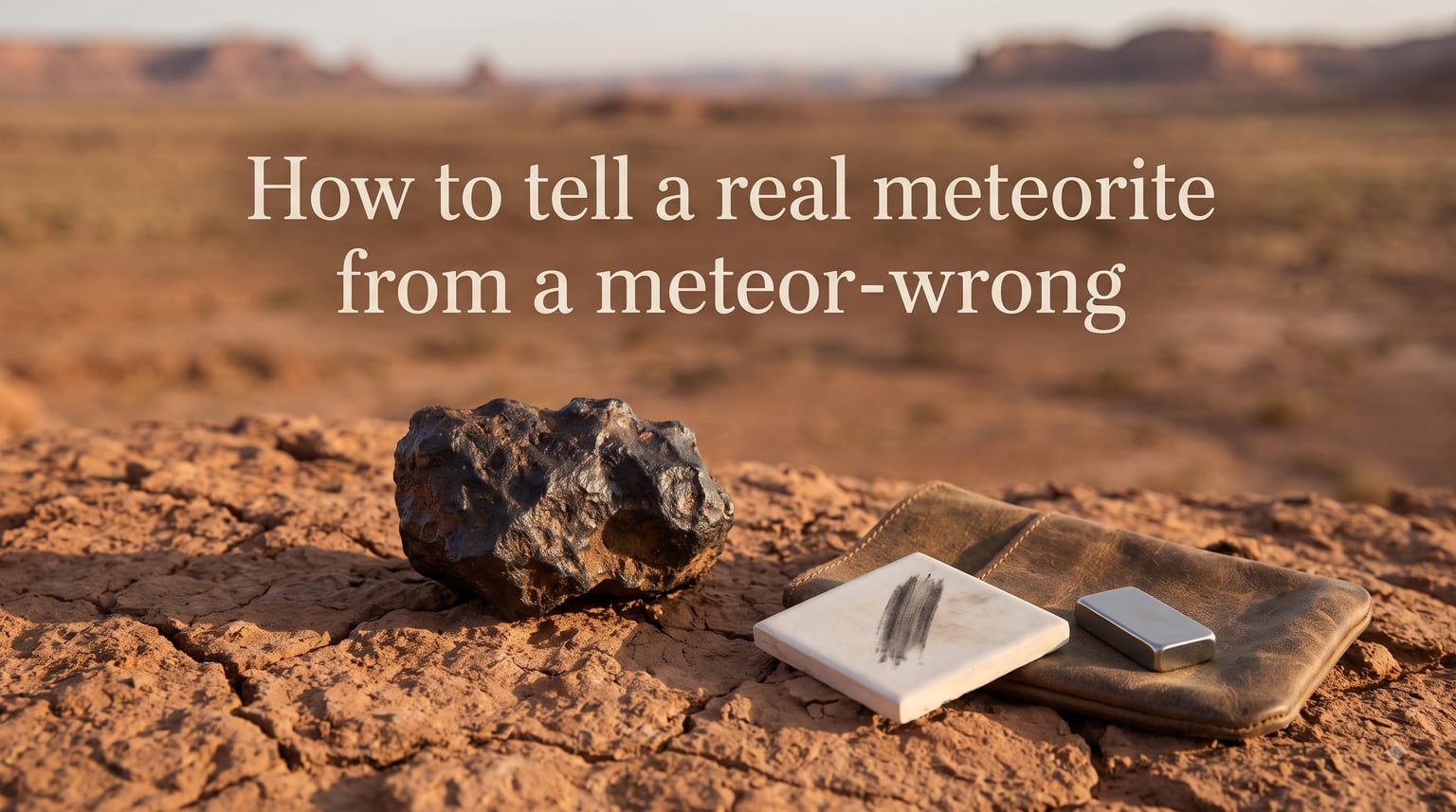
You found a strange, heavy, dark rock in the desert or a freshly plowed field. It pulls a magnet. Your heart races. Could it be a genuine space rock?
Most of the time, the answer is no. Geologists and meteorite collectors have a name for these lookalikes: meteor-wrongs. Out of every hundred rocks that get submitted to universities and museums for testing, fewer than one turns out to be a real meteorite.
Learning how to tell a real meteorite from a meteor-wrong is part science and part pattern recognition. You do not need a laboratory or expensive tools to run the initial screening. A strong magnet, a piece of unglazed ceramic tile, and a metal file can eliminate the vast majority of imposters right at your kitchen table.
In this guide, our team walks through every visual check and hands-on test that experienced collectors use in the field. By the end, you will know exactly what features point to a genuine meteorite and which red flags tell you to set the rock down and move on.
Table of Contents
What Is a Meteorite? (And What Is a Meteor-Wrong?)
A meteorite is a natural solid object that originated in space, survived passage through Earth’s atmosphere, and landed on the ground. Most come from the asteroid belt between Mars and Jupiter, though a small number originated on the Moon or Mars.
The terminology matters. A meteoroid is the object while it is still floating in space. A meteor is the visible streak of light (the “shooting star”) created as that object burns through the atmosphere. Only if a piece survives to hit the ground does it earn the name meteorite.
A meteor-wrong is simply any Earth rock or man-made object that someone mistakes for a meteorite. The term is lighthearted but accurate. Common meteor-wrongs include hematite, magnetite, industrial slag, basalt, lava rock, and rusted iron artifacts.
There are three main types of genuine meteorites, and knowing them helps you understand what to look for:
Iron meteorites — Made almost entirely of nickel-iron metal. These are the densest and most magnetic. They make up roughly 5% of all finds.
Stony meteorites — Composed primarily of silicate minerals. These look the most like ordinary Earth rocks. They account for about 94% of all meteorites, with the largest subgroup being chondrites that contain tiny spherical structures called chondrules.
Stony-iron meteorites — A rare mix of metal and silicate crystals. Pallasites, with their embedded crystals of olivine, are the most visually stunning. They represent less than 1% of all meteorites found.
The reason meteor-wrongs are so common is simple. Earth has billions of heavy, dark, magnetic rocks. Space rocks are extremely rare by comparison. Your baseline assumption should always be that a suspicious rock is terrestrial until proven otherwise.
How to Tell a Real Meteorite from a Meteor-Wrong: Step by Step
Here is the sequence our team recommends for screening any suspected meteorite. Run through these checks in order, and if your rock fails any one of them, it is almost certainly a meteor-wrong.
Quick checklist:
Step 1: Inspect the surface for a dark, thin fusion crust
Step 2: Look for regmaglypts (thumbprint-like depressions)
Step 3: Check the shape, surface texture, and density
Step 4: Hold a strong magnet near the rock
Step 5: Perform a streak test on unglazed ceramic
Step 6: File a corner and look for metal grains inside
Step 7: Compare against known meteor-wrongs
If your rock passes all seven checks, it is worth pursuing professional confirmation. Most rocks fail at steps one through four.
Visual Test 1: Look for a Fusion Crust
The single most reliable visual feature of a freshly fallen meteorite is a fusion crust. This is a thin, dark layer that forms on the surface as the rock burns during atmospheric entry.
As a meteoroid plows through the atmosphere at tens of thousands of miles per hour, friction heats its exterior to thousands of degrees. The outer millimeter or so melts and flows, then solidifies into a dark glassy coating once the object slows down. The interior stays cold and unchanged.
A fusion crust typically appears black or very dark brown. On stony meteorites it looks matte and slightly textured, almost like charcoal. On iron meteorites it can appear blue-black or dark gray with a bluish tint.
Look for flow lines on the surface. These are delicate ridges and grooves that formed when the molten surface layer streamed backward as the meteorite flew through the air. They look like tiny ripples or streaks frozen in place. Flow lines are a strong indicator of a genuine meteorite because no Earth process recreates them.
One important note: fusion crust weathers over time. A meteorite that has been sitting in the dirt for decades or centuries may have a rusted, brown, or weathered crust. Iron meteorites especially turn rusty and orange on the surface. If the crust is gone entirely, identification becomes much harder.
Most meteor-wrongs have no fusion crust at all. Slag and volcanic rocks may look dark and rough, but they lack that distinct thin, smooth coating. Earth rocks are not exposed to atmospheric entry, so nothing on their surface mimics fusion crust precisely.
Visual Test 2: Check for Regmaglypts (Thumbprints)
Regmaglypts are shallow, thumbprint-like indentations on the surface of a meteorite. They are sometimes called “thumbprints” because they look like someone pressed a finger into wet clay.
These features form during atmospheric entry. As different areas of the meteorite’s surface ablate unevenly, small depressions get carved into the exterior. The result is a surface covered with smooth, shallow pits that often have a slightly elongated shape pointing in the direction of flight.
Regmaglypts are most common and most visible on iron meteorites. They range from the size of a dime to the size of a golf ball. The edges are smooth and rounded, not sharp or angular.
Here is the key test: press your thumb into one of the depressions. If it fits comfortably and feels like it was molded to match a thumb, you may be looking at a regmaglypt. Earth rocks can have weathered pits and holes, but they tend to be irregular, rough-edged, and randomly shaped rather than smooth and thumb-sized.
Not every meteorite has regmaglypts. Small meteorites or fragments may have broken surfaces instead. But if you see thumbprints combined with a dark fusion crust and a magnetic pull, you have a strong candidate.
Visual Test 3: Examine the Shape and Surface
Meteorites come in unusual but recognizable shapes. During atmospheric flight, the surface melts and flows, which tends to round off sharp edges and create a somewhat aerodynamic form.
Most meteorites are roughly angular or blocky with rounded corners. They are not perfectly spherical, and they are not flat or blade-like. If your rock is a perfect sphere, it is almost certainly not a meteorite. River rocks and concretions are the usual culprits for round shapes.
Here is a critical red flag: meteorites do not have holes, bubbles, or vesicles. If your rock has gas bubbles on its surface or throughout its interior, it is a meteor-wrong. Volcanic rocks like pumice, basalt, and scoria are full of vesicles. Industrial slag is also riddled with gas bubbles from the smelting process.
Meteorites are also denser than typical Earth rocks. Pick up your suspected meteorite and compare it to a similarly sized rock nearby. A genuine iron meteorite feels surprisingly heavy for its size, sometimes 30 to 50% heavier than an equal volume of ordinary stone. Stony meteorites are denser than most terrestrial rocks of similar appearance.
If the rock feels light, porous, or hollow, cross it off your list. No real meteorite is porous or lightweight.
The Magnet Test: Does It Attract?
The magnet test is one of the simplest and most informative checks you can perform. Almost all meteorites contain some amount of nickel-iron metal, which means almost all meteorites will attract a magnet.
Here is how to do it properly. Use a strong neodymium magnet, not a weak refrigerator magnet. Hold the magnet close to the rock without touching it. A genuine iron meteorite will pull the magnet strongly enough to feel it yanking toward the surface. Stony meteorites produce a weaker but still noticeable attraction.
Some collectors hang the magnet on a string and watch whether the rock pulls it. Others use a compass and see if the needle swings when the rock is brought near. Both methods work for detecting even small amounts of metal.
Now for the most important caveat: a magnet sticking to your rock does not prove it is a meteorite. Many Earth minerals are magnetic. Magnetite is strongly magnetic. Hematite can be weakly magnetic. Certain industrial slags contain enough iron to attract a magnet fiercely. Man-made iron objects obviously attract magnets too.
The magnet test is better at ruling things out than confirming them. If your rock does NOT attract a magnet at all, it is very unlikely to be a meteorite. The only exceptions are rare achondrite meteorites (like lunar and Martian samples) that contain little to no metal, but these are extraordinarily uncommon finds.
Think of the magnet test as a gate. If the rock passes, you move on to the streak and file tests. If it fails, you can stop here with confidence.
The Streak Test: What Color Does It Leave?
The streak test is one of the most effective ways to separate meteorites from their closest lookalikes. It takes 30 seconds and requires only a piece of unglazed ceramic tile, which you can find at any hardware store.
Here is the procedure. Take the underside (the rough, unglazed side) of a white ceramic tile, or the unglazed ring on the bottom of a coffee mug. Rub your suspected meteorite firmly across the surface. Look at the color of the powder streak left behind.
A genuine meteorite leaves little to no streak. Most meteorites produce a faint light gray or colorless mark because their minerals do not create colored powder. Iron meteorites may leave a faint gray streak.
Compare this to the common meteor-wrongs:
Hematite leaves a distinctive red-brown or rust-colored streak. This is the single fastest way to identify hematite and rule out a meteorite.
Magnetite leaves a black or dark gray streak. Since magnetite is magnetic, it fools many people. The streak test reveals it instantly.
Industrial slag can leave various colored streaks depending on its composition.
If your rock leaves a red, brown, or black streak on the ceramic tile, it is not a meteorite. Period. The streak test alone eliminates the vast majority of suspected meteorites that collectors submit for identification.
The File Test: Look for Metal Grains
If your rock passed the magnet and streak tests, it is time to look inside. The file test exposes the interior of the rock so you can check for the metal grains that distinguish genuine meteorites from terrestrial lookalikes.
Take a metal file or coarse sandpaper and grind a small spot on a corner or edge of the rock. You only need to expose a patch roughly the size of a dime. Once you have a fresh interior surface, examine it closely under good lighting. A magnifying glass or jeweler’s loupe helps enormously.
In a stony-iron or iron meteorite, you will see shiny metal flecks scattered through the matrix. These are grains of nickel-iron alloy. In stony chondrite meteorites, you may also spot chondrules, which are tiny spherical structures about the size of a pinhead or peppercorn. No Earth rock contains chondrules.
Iron meteorites, when cut, polished, and etched with acid, reveal a geometric crosshatch pattern called the Widmanstatten pattern. You will not see this with a simple file test, but the presence of abundant shiny metal throughout the interior is a strong sign.
Here is the catch: man-made iron and steel also contain metal. To distinguish a meteorite from an iron artifact, look for the presence of nickel. Genuine iron meteorites typically contain 5 to 20% nickel, while man-made iron rarely contains more than trace amounts. Definitive nickel detection requires a chemical test or professional XRF analysis, which we cover later.
If you file the rock and see no metal grains at all, just uniform mineral grains or glassy material, it is likely a meteor-wrong. The only exception would be a rare achondrite, which requires professional identification.
Common Meteor-Wrongs: What Gets Mistaken for Meteorites
Understanding the most common imposters is just as important as knowing meteorite characteristics. Forum communities like r/meteorites and r/whatsthisrock on Reddit see the same types of meteor-wrongs posted day after day. Here are the top culprits and how to tell them apart from genuine space rocks.
Hematite
Hematite is the number one meteor-wrong worldwide. It is heavy, often dark gray or reddish-brown on the surface, and sometimes weakly magnetic. People find it and immediately think “meteorite.” The streak test gives it away every time: hematite leaves a distinctive red-brown streak on unglazed ceramic. No real meteorite produces that color.
Magnetite
Magnetite is the second most common lookalike. It is strongly magnetic, dark gray to black, and dense. In fact, magnetite is so magnetic that pieces can attract each other and even magnetize nails. This makes it a very convincing meteor-wrong. But magnetite leaves a black streak on ceramic, while meteorites do not. Run the streak test first.
Industrial Slag
Slag is the waste product of metal smelting and industrial processes. It gets dumped in fields, along railroad tracks, and near old factories. Slag is often heavy, dark, metallic-looking, and magnetic. The telltale sign is vesicles — gas bubbles frozen into the surface. Slag typically has smooth areas on one face (where it cooled against a surface) and bubbly, rough areas on others. No real meteorite has gas bubbles.
Volcanic Rocks (Basalt, Scoria, Obsidian)
Volcanic rocks can look dark and unusual, especially in areas where they are not native. Basalt is dark and dense. Scoria and pumice are full of holes. Obsidian is glassy and black. None of these have fusion crust, metal grains, or chondrules. The vesicles in scoria and pumice are an instant disqualification.
Man-Made Iron and Steel
Rusted iron objects, old tools, cannonball fragments, and ship ballast are frequently found in fields and mistaken for iron meteorites. They are magnetic, heavy, and rusty. The file test exposes them: industrial iron has a uniform structure without the Widmanstatten pattern or nickel content of a true meteorite. A professional nickel test provides certainty.
Concretions and Other Earth Rocks
Concretions are rounded mineral masses formed in sedimentary rock. They can look perfectly spherical or oddly shaped, and some have dark surface coatings. They are never magnetic and never have fusion crust. River cobbles with desert varnish also fool people in dry regions where dark, polished rocks are common.
If you want to know what can be mistaken for a meteorite, the short answer is: almost any dense, dark, or magnetic Earth material. That is why the multi-step testing process matters so much. No single test is definitive, but together they separate the real space rocks from the pretenders.
Where to Get a Meteorite Tested Professionally
If your rock passed every home test and you still believe it might be genuine, the next step is professional analysis. At-home tests can only take you so far. Definitive identification requires equipment that measures the precise elemental composition of the specimen.
The gold standard is X-ray fluorescence (XRF) analysis. An XRF gun bombards the sample with X-rays and reads the resulting fluorescence to determine its exact chemical makeup. This test detects nickel content instantly, which is the single most reliable marker separating iron meteorites from man-made iron. Many universities and commercial labs offer XRF testing.
Start by contacting the geology department at a nearby university. Many are happy to examine suspected meteorites, especially smaller schools that welcome public engagement. State geological surveys, like the Utah Geological Survey and the USGS, also provide guidance and referrals.
The Meteoritical Society maintains the official registry of all known meteorites, called the Meteoritical Bulletin. If your specimen is confirmed as genuine, it can be officially classified and named, which adds to its scientific and monetary value. Classification requires a polished section, chemical analysis, and submission to the Bulletin.
Reddit forum users consistently recommend XRF analysis over guesswork. The community values professional confirmation because the vast majority of submitted specimens turn out to be meteor-wrongs. The cost of professional testing is modest compared to the value of a genuine classified meteorite, and it saves collectors from embarrassment.
Be realistic about the odds. Even among rocks that pass home screening, only a small fraction turn out to be real. But confirming a genuine meteorite is an extraordinary experience, and proper testing is the only way to know for certain.
The Vinegar Myth and Other Meteorite Testing Mistakes
The internet is full of questionable meteorite identification advice. Some of these home remedies are useless, and others can actually damage a genuine specimen. Let’s address the most common myths.
The vinegar test: Some online sources claim that dripping vinegar (a weak acid) on a meteorite will cause a visible reaction. This is misleading. Meteorites do not react with vinegar in any meaningful way. Vinegar will fizz on carbonate rocks like limestone because the acid dissolves calcium carbonate. If your rock fizzes with vinegar, it is a terrestrial carbonate, not a meteorite. The test is only useful as a negative indicator.
The weight-to-size ratio myth: While meteorites are dense, plenty of Earth rocks are equally heavy. Density alone proves nothing. Magnetite and hematite are both extremely dense. Use density as a supporting clue, not a standalone test.
Breaking the rock open: Some guides suggest smashing your suspected meteorite to examine the interior. Do not do this. If the rock is a genuine meteorite, breaking it can destroy scientifically valuable features like the fusion crust and reduce its value significantly. Use the file test on a small corner instead.
Relying on a single test: The biggest mistake people make is latching onto one positive result and ignoring everything else. A magnet sticking to a rock does not make it a meteorite. A dark surface does not make it a meteorite. You need to run the full battery of tests and look for multiple confirming features.
Forum members in r/meteorites repeatedly emphasize this point. The community has seen thousands of confident “meteorite” discoveries that failed basic testing. Approach identification with healthy skepticism, run every test, and let the evidence guide you rather than your initial excitement.
Frequently Asked Questions
Why shouldn’t you pick up a meteorite?
In most cases it is perfectly fine to pick up a meteorite. However, if you witnessed a fresh fall, handling the rock with bare hands can contaminate it with oils and salts from your skin, which interferes with scientific analysis of organic compounds and cosmogenic isotopes. Freshly fallen meteorites are scientifically most valuable when collected with clean tools and stored in sterile conditions. Additionally, in some countries and on public lands, meteorites may be protected by law, so removing them could be illegal.
What does vinegar do to a meteorite?
Vinegar does nothing meaningful to a genuine meteorite. Vinegar is a weak acid that reacts with carbonate minerals, so if you drip vinegar on a rock and it fizzes, that rock contains calcium carbonate and is not a meteorite. Real meteorites are essentially inert in vinegar. The vinegar test only works as a negative indicator to rule out terrestrial carbonate rocks.
Will a magnet stick to all meteorites?
No, a magnet will not stick to all meteorites, but it will stick to the vast majority. About 95% of meteorites contain enough nickel-iron metal to attract a magnet. The main exceptions are achondrites, including lunar and Martian meteorites, which contain little or no metal and will not attract a magnet. These are extremely rare finds. If your rock does not attract a strong magnet at all, it is very unlikely to be a meteorite.
What can be mistaken for a meteorite?
The most common meteor-wrongs are hematite (heavy, dark, leaves a red-brown streak), magnetite (strongly magnetic, leaves a black streak), industrial slag (dark, magnetic, full of gas bubbles), volcanic rocks like basalt and scoria (dark, porous), rusted man-made iron objects, and rounded concretions. These materials account for the overwhelming majority of rocks submitted for meteorite identification.
How can I tell if I found a meteorite?
Run a series of home tests: check for a thin dark fusion crust, look for thumbprint-like regmaglypts, confirm the rock has no holes or bubbles, test with a strong magnet, perform a streak test on unglazed ceramic (a real meteorite leaves little or no streak), and file a corner to look for shiny metal grains. If your rock passes all these tests, seek professional XRF analysis from a university geology department for definitive confirmation.
Conclusion
Learning how to tell a real meteorite from a meteor-wrong comes down to a disciplined, multi-step process. Start with the visual cues: a dark fusion crust, thumbprint regmaglypts, no holes or vesicles, and a shape that looks weathered by atmospheric flight rather than river tumbling.
Then move to the physical tests. Check for magnetism, run the streak test on unglazed ceramic, and file a corner to look for metal grains and chondrules. Each test eliminates another category of imposters until only genuine candidates remain.
Most rocks fail at the first or second check. That is normal and expected. The reward comes from the rare specimen that passes every test and earns professional confirmation, connecting you to a piece of the solar system older than Earth itself.