
I still remember the afternoon my daughter asked me why the sky was blue. I had a dozen things on my mind and almost brushed past it. Then I watched her face and realized the question mattered more than my to-do list. That single pause changed how I parent her curiosity.
Learning how to nurture a curious child’s science questions at home does not require a lab coat, a degree, or fancy equipment. It starts with how you respond when your child looks up and asks “why?” This guide shares what our team at March for Science SV has learned from educators, parents, and child development researchers. You will find practical strategies, age-specific tips, and easy experiments you can try with items already in your kitchen.
Table of Contents
Value your child’s science questions
The first step in nurturing scientific curiosity is treating every question as worthy of attention. When your child asks “why do leaves change color?” or “where does rain come from?” they are doing exactly what scientists do. They are observing the world and asking testable questions.
Stop what you are doing and make eye contact. You do not need to have the perfect answer. You just need to show that the question landed. Try responding with “That is a great question. What do you think?” before offering any explanation. This simple habit tells your child their curiosity has value.
Keep a running list of questions your child asks. I taped one inside a kitchen cabinet, and we review it together on Sunday mornings. My daughter loves seeing her questions preserved, and it gives us a roadmap for the week ahead.
Explore and find answers together
You will not always have an answer ready, and that is okay. One of the biggest pain points parents share with us is the dread of hearing a question they cannot explain. The good news: science is not about having answers. It is about pursuing them.
When a question stumps you, say so. Then model the next step. Pull up a child-friendly website, check a library book, or call a relative who might know. Our team has found that children as young as four can follow along with a simple search when you narrate your thinking aloud.
Try phrases like “I am not sure, let us find out together” or “What would happen if we tested that?” These turns an uncomfortable gap in knowledge into a shared adventure. For deeper biological topics like how plants drink water or why some animals hibernate, a kid-friendly encyclopedia becomes your best friend.
Give children time and space to explore
Curiosity needs room to breathe. When your child stops to stare at ants on the sidewalk or watch ice melt in a glass, resist the urge to hurry them along. Those quiet minutes of observation are where scientific thinking begins.
Build small pockets of unstructured time into your week. A 20-minute backyard visit with no agenda, a slow bath with floating objects, or a rainy afternoon spent watching puddles can become a rich discovery session. Let your child lead. Ask “What do you notice?” rather than directing the activity.
One easy routine our family adopted is the “wonder window.” Every day after dinner, my daughter tells me one thing she noticed that surprised her. It takes two minutes and keeps her observation skills sharp.
Accept that explorations are often messy
If you wait for the perfect moment to do science, you will never start. Baking soda volcanoes overflow. Water beads bounce across the kitchen floor. Paint ends up on the dog. This is normal, and it is part of the learning.
Set up the space before the experiment, not after. Lay down a tarp, clear the table, move anything you cannot wash. Then give yourself permission to relax about the mess. Children who are afraid of making a mess often stop experimenting altogether.
I have started framing messes as data. “Look how far the baking soda flew, that means the reaction was really strong!” When mess becomes information, parents stress less and children learn more.
Learn from mistakes together
A failed experiment is not a problem. It is a finding. When your bridge collapses, your plant wilts, or your baking soda volcano refuses to erupt, you have a perfect chance to model problem-solving.
Ask “What did we learn?” instead of “What went wrong?” Children who hear the first question learn to see setbacks as information. They develop the kind of growth mindset that helps them through science class, friendships, and life.
Share your own mistakes openly. “I burned the toast because I set the timer wrong. What should I try next time?” When children see adults treat errors as feedback, they copy that approach. This is one of the most powerful things you can teach, and it costs nothing.
Hands-on science experiments with household items
You do not need a kit to do real science at home. Your pantry, recycling bin, and backyard contain everything you need. Here are five experiments our team has tested with children ages 3 to 8. Each one uses materials you likely already own.
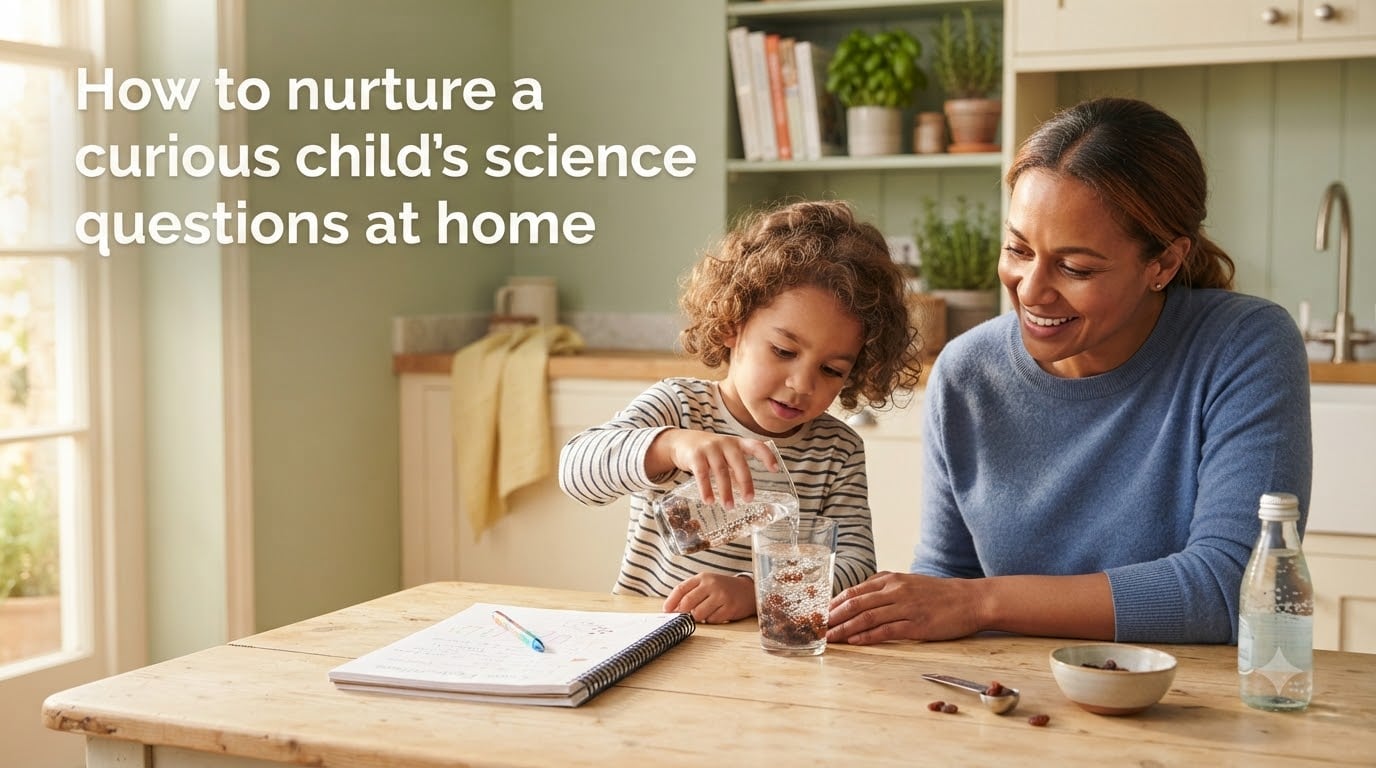
1. Dancing raisins. Fill a clear glass with sparkling water and drop in a handful of raisins. The bubbles attach to the raisins and lift them to the surface, where they pop and sink again. Children love the rhythm. You can talk about buoyancy, gas, and density.
2. Cloud in a jar. Fill a jar with warm water, add a match to create smoke, then place a plastic bag of ice on top. A small cloud forms inside the jar. This is a wonderful way to talk about how real clouds form high in the sky.
3. Shadow drawing. On a sunny morning, set up toys or blocks and trace their shadows every hour. Children see how shadows shift with the sun and learn that the sun moves even when we cannot feel it.
4. Ramp races. Lean a cutting board against a stack of books. Predict which object will reach the bottom first, then test with a toy car, a sock, and a banana. Talk about friction, slope, and prediction.
5. Kitchen sink density. Layer honey, dish soap, water, and oil in a tall glass. Drop in small items like a grape, a plastic bead, and a cherry tomato. Watch where each one floats. You have just built a hands-on density column.
Age-appropriate ways to nurture curiosity at every stage
How you nurture a curious child’s science questions depends on where they are developmentally. Here is a breakdown by stage, based on what educators at Bright Horizons and NAEYC recommend.
Infants (0 to 12 months)
Infants learn through their senses. Offer treasure baskets filled with safe objects of different textures, weights, and sounds. A wooden spoon, a soft scarf, a metal bowl, and a crinkly toy give your baby plenty to compare. Narrate what they touch: “Smooth, bumpy, cold.” You are building the foundation for scientific vocabulary.
Toddlers (1 to 3 years)
Toddlers thrive on cause and effect. Fill a table with containers, funnels, and water. Provide ramps for toy cars. Ask “What will happen if we drop this?” and celebrate whatever happens. Toddlers also love sorting objects by color or size, which is a real scientific skill.
Preschoolers (3 to 5 years)
Preschoolers ask endless “why” questions and want real answers. Follow their interests. If your child is fascinated by bugs, plan a backyard bug hunt with a magnifying glass. If they love water, build rivers in the sandbox. This is the age when simple experiments like dancing raisins create lifelong memories.
Pre-K and early elementary (5 to 8 years)
Children in this age range can plan and record simple investigations. Give them a notebook and encourage them to draw what they see. Help them make predictions before each experiment and compare results afterward. They are ready for the scientific method in its simplest form.
Model curiosity by being curious yourself
Children learn more from what you do than what you say. If they see you wondering aloud, looking things up, and asking questions, they will copy that behavior. Our team spoke with parents on Reddit and Facebook who shared the same insight: the most powerful thing a parent can do is be visibly curious.
Try narrating your own discoveries. “I have always wondered why bread rises. Let us look it up.” Take your child to a museum and ask what catches your eye. Admit when something surprises you. Children who grow up with curious adults become curious adults themselves.
This applies to screen time too. When you use a phone or tablet, treat it as a tool for finding answers, not a pacifier. Look up a question your child asked and read the answer together. You are teaching them how to find information responsibly.
Use simple science vocabulary to build understanding
Children absorb vocabulary faster than adults expect. Sprinkle scientific terms into everyday talk. Use words like “observe,” “predict,” “compare,” and “hypothesis” in ways that fit the moment.
“What do you predict will happen if we add more water?” feels natural and teaches a real scientific concept. “Let us observe the ice cube for ten minutes” sounds more interesting than “watch the ice.” Children who learn these words early find science class easier and more fun.
You do not need to teach the formal definitions. Just use the words often enough that they become part of your child’s everyday vocabulary. By the time they reach school, they will already sound like young scientists.
Frequently Asked Questions
How do you nurture curiosity in children?
Nurture curiosity by valuing every question your child asks, exploring answers together when you do not know them, giving your child time and space to observe the world, accepting that real exploration is often messy, modeling curiosity in your own behavior, and using simple scientific vocabulary like observe, predict, and compare during everyday moments.
What are some easy science questions for kids?
Easy science questions include Why is the sky blue?, Where does rain come from?, Why do leaves change color?, What makes ice melt?, Why do some objects float and others sink?, How do plants drink water?, Why is the moon sometimes visible during the day?, and What happens to bread when we bake it?. These questions open up hands-on experiments with household items.
Which questions can you ask to cultivate curiosity?
Ask open-ended questions like What do you notice?, What do you think will happen if we try?, Why do you think that worked?, What could we change next time?, How are these two things the same or different?, What surprised you today?, and What is one thing you want to find out tomorrow?. These questions invite thinking rather than yes or no answers.
What type of curiosity should children have in the field of science?
Children benefit from curiosity that drives them to observe carefully, ask why, form predictions, and test their ideas through hands-on exploration. This kind of curiosity is sometimes called diversive curiosity (wonder about everything) and epistemic curiosity (the deep desire to learn how things work). Both types matter and complement each other across developmental stages.
How do I handle science questions I cannot answer?
Say honestly that you do not know and turn it into a shared investigation. Look up the answer together using a child-friendly website, library book, or local expert. Narrate your search process so your child sees how adults find information. This teaches them that not knowing is the starting point for learning, not a failure.
Final thoughts on raising a young scientist at home
Learning how to nurture a curious child’s science questions at home is less about knowing facts and more about showing up. Pause when the questions come. Explore answers together. Give your child time and permission to get messy. Model curiosity yourself. Use words that make science sound exciting.
You do not have to do all of this at once. Pick one strategy from this guide and try it for a week. Maybe it is the wonder window at dinner, or a Sunday afternoon of dancing raisins. Small habits repeated often create children who think clearly, ask boldly, and never stop wondering why.
That is the heart of what March for Science SV stands for. Curiosity is a practice we can share with our kids, one question at a time.