
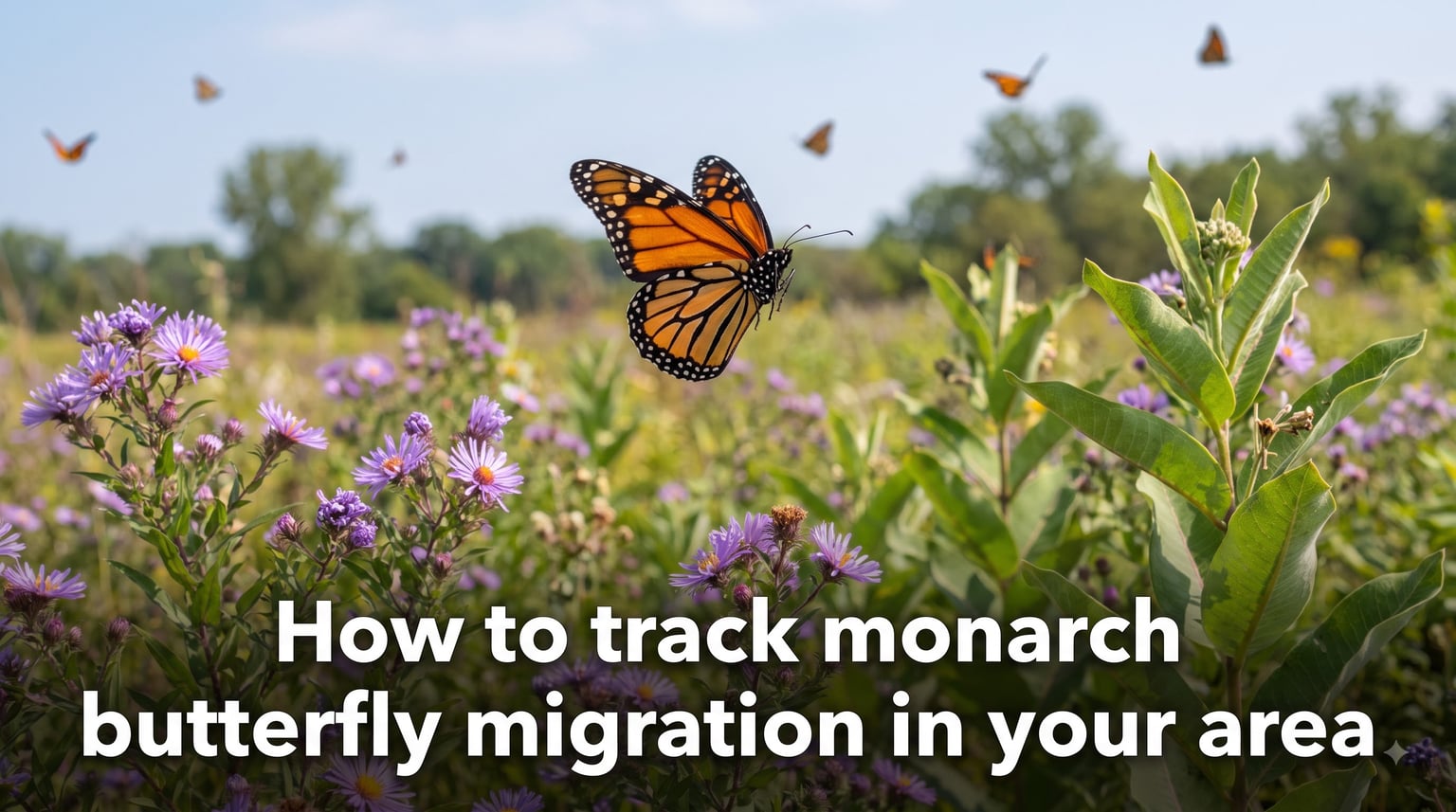
Every fall, I watch the sky above my neighborhood and wonder whether today’s the day the monarchs pass through. If you’ve ever stopped mid-walk to follow a drifting orange wing, you’ve already started the journey of learning how to track monarch butterfly migration in your area. Citizen science has turned what used to be a passing curiosity into real conservation data, and your sightings matter.
This guide covers everything I’ve learned from three seasons of contributing to community tracking programs. I’ll walk you through which apps to use, when to expect monarchs in your region, how to tell them apart from lookalikes, and what to do if you find one wearing a tiny tag. By the end, you’ll have a complete system for turning every backyard encounter into useful data.
Table of Contents
Why Tracking Monarch Migration Matters for Conservation?
Tracking monarch migration matters because these butterflies are in trouble. Eastern monarchs have declined by roughly 80% since the 1990s, and western monarchs hit a record low of under 2,000 individuals in 2026. Each sighting you report becomes a data point in continent-wide studies that help scientists understand where monarchs succeed, where they struggle, and how climate shifts are reshaping their routes.
Researchers cannot be everywhere at once. The eastern migration stretches from southern Canada to the oyamel fir forests of central Mexico, and the western population spans the Pacific coast. That’s why community science programs exist. When you report a first sighting, a roost, or a tagged butterfly, you fill in gaps that no satellite or field team could cover alone. Journey North, Monarch Watch, and the Monarch Joint Venture all depend on everyday observers like you.
Beyond the science, tracking is also a personal gateway into conservation. Once you start noticing monarchs in your yard, you’ll start noticing milkweed, nectar plants, weather patterns, and migration timing. The data becomes a mirror that reflects back how your local landscape supports (or fails to support) one of the most spectacular migrations on Earth.
How to Track Monarch Butterfly Migration in Your Area: A Step-by-Step Guide
You can track monarch butterfly migration in your area in five steps: pick a community science program, download its app or bookmark its website, learn the basic identification markers, watch for monarchs during peak hours, and submit your observations with location and date details. Each step takes only minutes to set up, but the data you generate contributes to decades of research.
Choose your primary tracking program. Journey North is best for casual first-sighting reports across North America. Monarch Watch is best if you want to participate in tagging. Project Monarch (Monarch Joint Venture) is best if you want to scan Bluetooth-tagged butterflies using the world’s smallest tracking devices.
Download the app or open the reporting form. Journey North and Monarch Watch both have free iOS and Android apps. Project Monarch uses Bluetooth on compatible phones. A web-based reporting form works just as well if you prefer desktop entry.
Set up your profile and location. Most apps let you save a default location (your home, a regular park, a schoolyard) so each report takes seconds instead of minutes. Set notifications for migration alerts in your region.
Watch during peak hours. Mid-morning to early afternoon on warm, sunny days with light winds is prime monarch activity time. Fall brings the famous southbound flights; spring brings the slower breeding dispersal north.
Submit what you see. Include date, time, location, number of monarchs, behavior (nectaring, flying, roosting), and any tags you spotted. Even “zero sightings” reports matter because they help track phenology shifts.
After a few weeks of reporting, you’ll start to see your own sightings appear on real-time migration maps. There’s a particular satisfaction in watching your data points join thousands of others to trace the seasonal pulse of an entire species.
Eastern vs. Western Monarch Populations
There are two distinct monarch populations in North America, and they do not mix. The eastern population breeds east of the Rockies and overwinters in the oyamel fir forests of central Mexico, a journey of up to 3,000 miles. The western population breeds west of the Rockies and overwinters in coastal California groves from Santa Cruz to San Diego.
Tracking the eastern migration means watching for a continental flyway that funnels south through Texas and funneling back north through the central U.S. in spring. The western migration is shorter and more coastal, with monarchs clustering in eucalyptus and Monterey pine groves within a few miles of the Pacific.
If you live in the central Rockies, you may actually see both. Monarchs from the eastern population sometimes drift west across the mountains, while western monarchs occasionally show up in unexpected inland locations. Most tracking apps will ask which population your sighting belongs to so the data routes to the right researchers.
Population status differs sharply between the two. Eastern monarchs number in the tens of millions during peak summer breeding, while western monarchs remain critically low. Reporting a western monarch sighting carries extra scientific weight because every individual helps researchers track the slow recovery of that population.
Best Apps for Tracking Monarch Butterflies
The three best apps for tracking monarch butterflies are Journey North, Monarch Watch, and the Monarch Joint Venture’s Project Monarch app. Each serves a different purpose, and most experienced trackers use at least two of them depending on the season and their goals.
Journey North
Journey North is the simplest entry point. The free app and website let you submit first sightings, fall roost counts, milkweed phenology, and even mass migration events. The real-time map updates within minutes of submission, so you can watch the migration front move across the continent in spring and fall. I open this app every morning during peak season just to see what others are reporting.
Monarch Watch
Monarch Watch is the gold standard for monarch tagging. If you want to apply tiny numbered tags to monarchs and report recoveries, this is your program. Their app includes training modules, a tagging calendar by latitude, and a tag-recovery map. The app also tracks milkweed planting, waystation registration, and seasonal observations. If you’re serious about contributing mark-and-recapture data, Monarch Watch is essential.
Project Monarch (Monarch Joint Venture)
Project Monarch uses Bluetooth-enabled mobile devices to detect rice-sized radio transmitters attached to individual monarchs. It’s a newer technology, and not every phone supports the required Bluetooth Low Energy scanning. When it works, it gives researchers detailed movement data no citizen has ever collected before. Download it, check compatibility, and contribute when you can.
If you only have time for one app, pick Journey North for general sighting reports, Monarch Watch for tagging, and Project Monarch when you’re near active research sites or want to try the cutting-edge Bluetooth scanning.
Understanding Regional Migration Timing
Monarch migration timing depends on latitude, elevation, and seasonal weather patterns. In general, the fall southbound migration begins in late August in Canada and progresses through the U.S. over roughly eight weeks, arriving in Mexico by early November. The spring recolonization moves north between March and June.
Northeast and Midwest
Spring arrivals show up from late April through mid-May. Fall flights build through August and peak in mid-September. By late September, most monarchs have pushed south of your area. Roosts of hundreds or thousands of monarchs are common along the Gulf Coast and in the lower Midwest during late September.
Southeast and Gulf Coast
Spring arrivals appear as early as late February in Florida and march progressively north through March and April. Fall migration brings waves of monarchs from the north between late September and early November, with major roost concentrations in Louisiana, Mississippi, and Alabama.
Great Plains and Mountain West
Spring sightings typically begin in April at lower elevations. The migration narrows into a tighter flyway through Texas as monarchs head north. Fall movements start in mid-August at northern latitudes and pass through the southern Plains by mid-October. Tracking programs flag these areas heavily because the flyway is concentrated and easy to monitor.
Pacific Coast and California
Western monarchs have a different rhythm. Breeding monarchs disperse inland in spring and concentrate along the coast in fall. Overwintering clusters begin forming in October and persist through February. Peak cluster sizes occur in December and January. If you live near the coast, fall and winter are your prime reporting seasons.
For real-time timing in your specific county, the Journey North map is the best reference. Check it weekly during migration season and you’ll quickly see when the front is approaching your area.
How to Identify Monarch Butterflies vs. Lookalikes?
You can identify a monarch butterfly by its orange wings with thick black veins and white-spotted black borders. Males have a distinct black scent patch on each hindwing; females have thicker black veining and no scent patch. Monarchs also fly with a slow, floating wingbeat that distinguishes them from the faster, more erratic viceroy.
Viceroys are the most common lookalike and confuse many beginners. Viceroys are slightly smaller with a horizontal black line crossing the veins on each hindwing. Monarchs lack this line. Telling them apart matters because range data for the two species serves different research purposes.
Queen butterflies overlap with monarchs in the southern U.S. and look similar but are darker brown with fewer, smaller white spots. If you’re uncertain, take a photo and submit it through Journey North; their regional reviewers verify submissions and can confirm the species.
What to Do When You Find a Tagged Monarch?
If you find a tagged monarch, record the tag number, location, date, and circumstances, then report it through the Monarch Watch Tag Recovery form. Each recovered tag provides a real data point about an individual butterfly’s lifespan, route, and survival. Even partial tag numbers are useful.
Handle the butterfly gently if you need to read the tag. The tags are adhesive paper discs applied to the wing’s underside and rarely harm the butterfly. Photograph the tag clearly before release so you can zoom in on the number later. Most tags include a contact email and the issuing program, which helps route your report.
Recoveries are rare and precious. Of the hundreds of thousands of monarchs tagged each year, only a small percentage are recovered, especially in Mexico. Your recovery data may fill in a missing link in a multi-year research chain.
How Monarch Butterflies Navigate: The Science Behind the Journey
Monarchs navigate using a sun compass and a magnetic compass, both tied to an internal circadian clock. Their antennae contain the light-sensitive proteins that detect the sun’s position, and their brain integrates that information with magnetic cues to maintain a consistent heading even on cloudy days. This is what allows a butterfly with a brain the size of a pinhead to travel thousands of miles to a forest it has never visited.
In fall, monarchs enter a reproductive state called diapause. They stop mating and egg-laying, shift their metabolism to fat storage, and live up to eight months instead of the typical five-week summer lifespan. This physiological shift is what makes the long journey possible.
Recent GPS tracking research using rice-sized transmitters has confirmed what scientists long suspected: individual monarchs take different routes and adjust for wind, weather, and terrain. Some fly at altitudes over 1,000 feet, using tailwinds to conserve energy. Others hug the surface and weave around obstacles. The variation is part of what makes the migration resilient.
Joining the International Monarch Monitoring Blitz
The International Monarch Monitoring Blitz is an annual three-day citizen science event held in late summer when monarchs are at peak density across North America. Volunteers count monarchs and milkweed in their local areas on the same days, creating a synchronized snapshot of the population. The data helps researchers estimate total numbers and identify regional trends.
Participation is simple: register on the Blitz website, choose a monitoring location, count for a set time window on the designated days, and submit your numbers. Schools, nature centers, and individual homeowners all contribute equally. In 2026, the Blitz will likely fall in late July or early August.
Even one hour of counting during the Blitz produces usable data. If you’ve never tracked monarchs before, the Blitz is the perfect on-ramp because the community of counters, regional coordinators, and online resources makes the process easy and rewarding.
Frequently Asked Questions
Where is the monarch migration right now?
You can see where the monarch migration is right now on the Journey North real-time map, which updates within minutes of new sighting reports. During fall, the migration front moves south from Canada through the central U.S. into Mexico. During spring, it moves north from Mexico and the Gulf Coast into the northern U.S. and Canada.
Can you track monarch butterfly migration?
Yes, you can track monarch butterfly migration in real time through citizen science programs like Journey North, Monarch Watch, and the Monarch Joint Venture. Researchers also use Bluetooth-enabled transmitters, GPS tags, and satellite data to track individual butterflies. Anyone can submit sightings through free apps or websites.
Is there an app for tracking monarch butterflies?
Three major apps track monarch butterflies. Journey North handles first sightings, roosts, and milkweed reports. Monarch Watch focuses on tagging, tag recovery, and waystation registration. Project Monarch from the Monarch Joint Venture uses Bluetooth to scan for rice-sized transmitters on individual butterflies.
How are monarch butterflies doing in 2026?
Eastern monarchs remain significantly below historical averages, with annual surveys showing roughly 80 percent declines since the 1990s. Western monarchs continue to face critical risk, though recent overwintering counts have shown modest improvement. Conservation action and milkweed planting are essential to support both populations in 2026 and beyond.
What month do monarchs migrate through my area?
Monarch migration timing varies by region. In the northern U.S. and Canada, fall migrations peak from late August through September. In the central U.S., peak flights occur from mid-September through mid-October. In the Gulf Coast, monarchs pass through from late September into November. Coastal California sees overwintering clusters from October through February. Check the Journey North map for your county’s current status.
Conclusion
Learning to track monarch butterfly migration in your area is one of the most accessible ways to contribute to real conservation science. Pick one program, set up the app, and start noticing. After a few weeks, you’ll have data points on a continental map and a deeper understanding of how your local landscape fits into one of Earth’s great migrations.
Your next step is simple. Download Journey North or Monarch Watch today, set your location, and watch for your first monarch sighting. Even one report matters, and the more you contribute, the richer your view of the season becomes.