
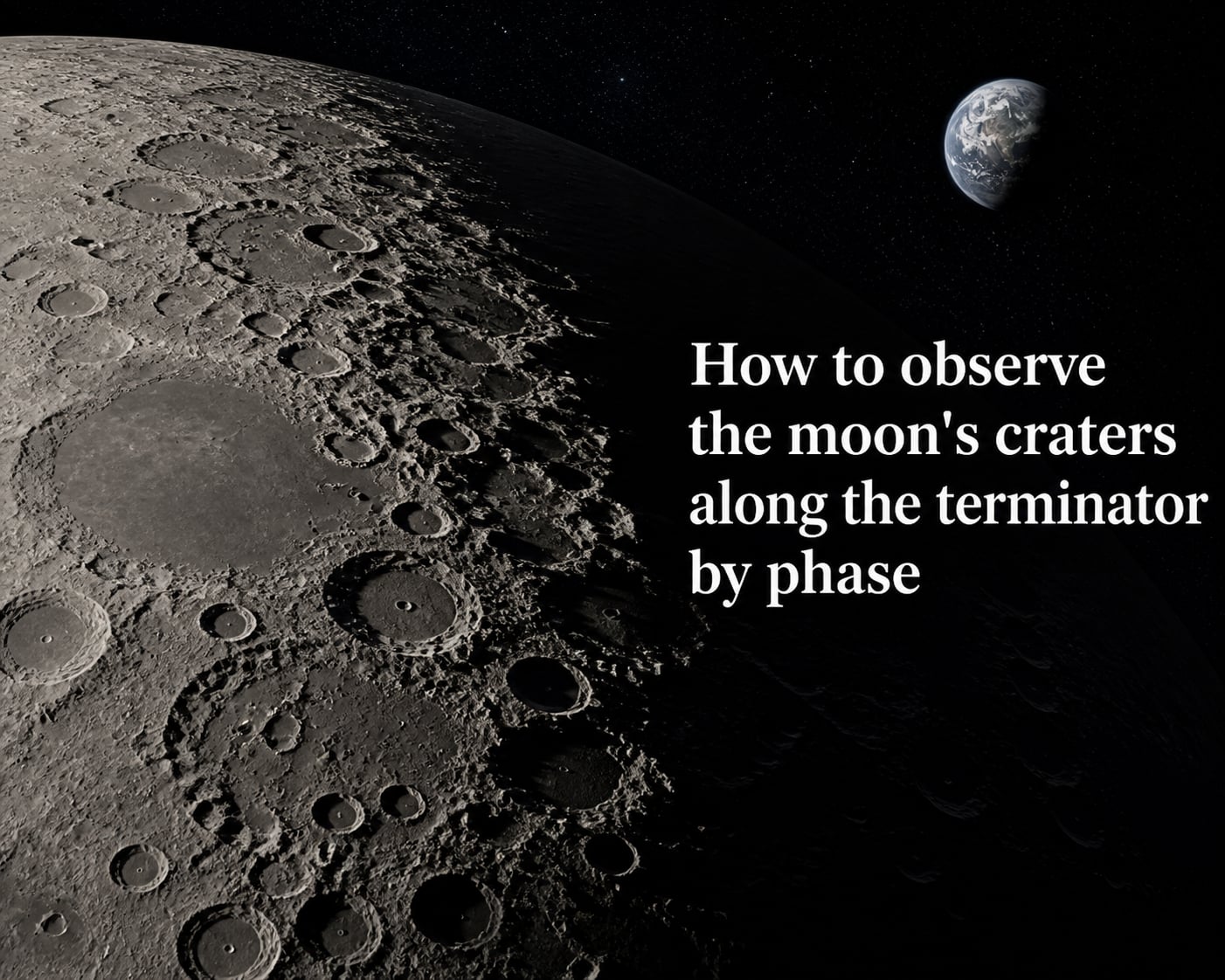
Watching the moon’s craters appear in sharp relief along the terminator is one of the most rewarding experiences for any backyard observer. I’ve spent dozens of nights tracking the terminator line as it sweeps across the lunar surface, and the difference between a flat-looking full moon and a dramatically shadowed first quarter view is genuinely shocking.
In this guide, you’ll learn exactly what the lunar terminator is, why craters look sharper there, and how to plan your observations by lunar phase. I’ll share the specific craters I look for at each phase, plus the equipment that gives you the best results. By the end, you’ll have a clear system for observing moon craters along the terminator like an experienced amateur astronomer.
Table of Contents
What is the Lunar Terminator and Why It Matters?
The lunar terminator is the moving boundary between the illuminated and dark hemispheres of the moon. It’s the line where, at any given moment, sunrise or sunset is occurring on the lunar surface. EarthSky calls this zone the “twilight zone,” and the name fits perfectly because the sun sits right at the horizon for anyone standing there.
The terminator matters because low-angle sunlight creates long shadows. A crater wall or mountain peak casts a shadow that stretches many miles across the surface, exaggerating its height and texture. The same crater at full moon looks like a flat ring because the sun shines straight down on it. At the terminator, the same crater looks like a deep, sculpted pit with a prominent rim.
For anyone who wants to observe moon craters with real depth and detail, the terminator is where the action is. Every lunar feature looks better there, every single time.
Why Craters Appear Sharper Along the Terminator?
Long shadows are the reason craters look sharper near the terminator, and the physics are simple. When sunlight strikes a crater rim at a low angle, the rim blocks light from reaching the crater floor, casting a shadow that may be several times taller than the rim itself. NASA confirms that craters and mountains look most dramatic during phases other than full moon for exactly this reason.
This low-angle illumination also reveals subtle features that disappear under direct light. Tiny ridges, central peaks inside large craters, and wrinkle ridges in the maria all throw shadows at the terminator. During a full moon, those same features blend into the surrounding terrain.
I tested this myself by observing Copernicus crater at first quarter and again at full moon. At first quarter, the crater’s central peaks were clearly visible as bright dots inside a shadowed bowl. At full moon, Copernicus looked like a thin bright ring with no visible depth. Same crater, same telescope, completely different impression.
How the Terminator Moves Across the Lunar Phases?
The terminator moves because the moon orbits Earth every 29.5 days. As the geometry between the sun, Earth, and moon shifts, the terminator creeps across the lunar surface at roughly 10 miles per hour. Over a single observing night, you’ll see noticeable shadow changes in craters you’ve been watching.
Two terminators exist at any time. The sunrise terminator marks where the lunar day is beginning, while the sunset terminator marks where night is falling. During the waxing phases (new moon through full), the sunrise terminator is on the side facing us, lighting up western features. During waning phases, the sunset terminator takes over and shifts to the eastern side.
This is why a phase-by-phase plan works so well. Each night, the terminator reveals a fresh batch of craters, mountains, and rilles under fresh lighting conditions. Tracking the terminator across the lunar cycle gives you 29 days of constantly changing views.
Phase-by-Phase Viewing Guide: What to See and When
The key to consistent success is matching your target features to the phase. Here’s the breakdown I use on every lunation.
New Moon and Waxing Crescent (Days 0 to 7)
During the waxing crescent phase, the terminator is on the western limb of the moon. This is your chance to see craters in dramatic sunrise light. Look for the crater Grimaldi on the western edge, which appears as a dark oval early in the phase.
Around day 3 to 4, the terminator sweeps across Mare Crisium, a circular dark plain that looks stunning under low-angle light. By day 5 to 6, you’ll see the crater Langrenus and the highlands around it emerge from shadow. By day 7, you’re approaching first quarter.
First Quarter Moon (Day 7)
First quarter is the best single night for most observers. The terminator runs roughly north-south down the middle of the lunar disk, and roughly half the moon’s surface is dramatically shadowed. This is when the Apennine Mountains, the crater Copernicus, and the crater Tycho all show distinct shadows.
I usually spend the entire night at first quarter tracking shadow movement in one feature at a time. Pick a crater, watch the terminator edge approach it, and watch the shadow shrink as lunar noon approaches.
Waxing Gibbous (Days 8 to 14)
During the waxing gibbous phase, the terminator shifts eastward. This is the ideal window for observing craters in the eastern half of the lunar disk, including the spectacular crater Aristoteles and the highlands around Plato.
Around day 10, the terminator crosses Mare Serenitatis. The crater Posidonius on its western edge shows fantastic detail at this point, including its fractured floor. By day 13, the terminator approaches the eastern limb and you get your last clear views of craters before full moon washes everything out.
Full Moon (Day 14)
Full moon is the worst phase for terminator viewing because there is no terminator on the near side. Shadows vanish, and craters look flat. Skip detailed crater observation on this night, or focus on bright ray systems like those around Tycho and Copernicus instead.
Waning Gibbous (Days 15 to 21)
After full moon, the sunset terminator appears on the eastern limb. This is mirror-image territory to the waxing gibbous, but the lighting is different. Sunset shadows fall in the opposite direction, so familiar craters look new again.
Day 17 to 18 is prime time for the crater Plato and the Alpine Valley. By day 20, you’re approaching last quarter and the terminator sweeps across the western features once more.
Last Quarter Moon (Day 22)
Last quarter is the second-best night for most observers. The terminator runs north-south again, but the eastern half is shadowed this time. Features you watched emerge at first quarter now fall into darkness, with the sun setting over them instead of rising.
The crater Gassendi at the northern edge of Mare Humorum is one of my favorite last quarter targets. Its central peak and fractured floor throw dramatic sunset shadows.
Waning Crescent (Days 22 to 29)
During the waning crescent, the terminator is on the eastern limb. Craters like Langrenus, Petavius, and Furnerius appear under sunset illumination. By day 26, you’re back to a thin crescent with the terminator near the western edge, completing the cycle.
Equipment for Observing Moon Craters Along the Terminator
The good news is that the moon rewards every level of equipment. You can start with your eyes and graduate as you want more detail.
Naked eye: The lunar maria are visible without any equipment, and you can easily track the terminator’s general position. This is how I started, just noting the phase each night and watching how the bright portion changed.
Binoculars (10×50 recommended): A basic pair of binoculars reveals the major maria and the largest craters. Crater Copernicus and Tycho are easy binocular targets near the terminator. Binoculars are also great for tracking the moon’s libration, which slightly tilts the surface and reveals features beyond the standard near-side view.
Small telescope (60mm to 90mm refractor or 4-inch reflector): This is where terminator viewing becomes serious. A small telescope at 50x to 100x resolves craters 5 to 10 miles across and shows clear shadow detail. Most amateur astronomers start here.
Larger telescope (6 inches and up): Larger apertures handle the moon’s brightness better and resolve smaller craters. At 200x and above, central peaks inside large craters become easy targets. The Sky at Night Magazine team recommends a polar-aligned mount for serious lunar observing, which keeps the moon steady in your eyepiece.
Key Craters and Features to Spot at the Terminator
Some features stand out at the terminator more than others. Here are the targets I return to most often.
Copernicus: A 58-mile-wide crater with prominent terraced walls and central peaks. Looks best two to three days after first quarter when the sunrise terminator is crossing it.
Tycho: A 53-mile crater best known for its extensive ray system. The crater itself is dramatic at the terminator, with deep shadow on its western wall during sunrise.
Plato: A 68-mile crater with a dark, smooth floor. Shadows from its eastern rim spill dramatically across the floor during the waning gibbous phase.
The Straight Wall (Rupes Recta): A 70-mile-long fault line in Mare Nubium. Best viewed around day 8 when the sunrise terminator crosses it, casting a long black shadow that looks exactly like a wall.
Lunar X and Lunar V: Clair-obscur effects that look like letters X and V near the terminator. The Lunar X appears around first quarter, and the Lunar V appears around last quarter. These are short-lived illusions that depend on exactly the right lighting angle.
Viewing Tips and Common Beginner Mistakes
After years of lunar observing, I’ve learned a few things that save time and frustration.
Plan around the phase. Decide what you want to see, then check a moon phase calendar and a lunar feature atlas to find when the terminator will be in the right spot. Random observing works, but planned observing works much better.
Use a moon filter on bright nights. The full moon and gibbous phases can be uncomfortably bright in a telescope. A simple neutral density moon filter reduces glare and lets your eye pick up subtle shadow detail.
Let your eyes dark-adapt. Even though the moon is bright, spending 15 minutes outside before observing helps your eyes pick up finer details. Avoid looking at your phone screen during this time.
Watch libration. The moon’s slight wobble means features near the limb can be seen better on certain nights. Sites like the Virtual Moon Atlas show libration angles for any date.
Be patient. The terminator moves slowly, so a 30-minute observing session at the eyepiece often shows noticeable shadow change. Astrophotographers capture this movement by taking images at intervals and stacking them.
Frequently Asked Questions
Why do astronomers prefer observing the Moon near the terminator?
Astronomers prefer observing near the terminator because the low-angle sunlight casts long shadows across craters, mountains, and rilles. These shadows exaggerate surface relief and reveal subtle features that disappear under direct lighting at full moon. The terminator essentially turns the flat-looking moon into a dramatic, three-dimensional landscape.
How do you observe moon phases?
To observe moon phases, use a moon phase calendar to plan your session, then pick a viewing target based on where the terminator will be. New moon through first quarter shows waxing phases with sunrise light on western features. First quarter is the best single night for crater detail. Full moon is poor for shadow detail. Last quarter through waning crescent shows sunset light on eastern features. Binoculars or a small telescope will show major craters and maria clearly.
Where is the terminator line on the Moon?
The terminator line is wherever the boundary between light and dark falls on the moon’s visible surface at any given moment. During waxing phases (new to full), it runs along the western edge of the illuminated area. During waning phases (full to new), it runs along the eastern edge. At first quarter and last quarter, it runs roughly north-south down the middle of the lunar disk. You can find the exact terminator position for any date using a moon map or app.
What is the best moon phase for viewing craters?
The best moon phase for viewing craters is roughly two to three days on either side of first quarter or last quarter. At these phases, the terminator sits over the most crater-rich regions and throws long shadows that exaggerate crater depth and central peaks. The day of first quarter itself is excellent, and the three nights before and after are equally productive. Avoid full moon for crater detail since the direct lighting flattens everything.
Conclusion
Learning to observe moon craters along the terminator transforms the way you see our nearest neighbor. The terminator line is the secret to seeing the moon as a real landscape rather than a flat disk, and tracking it by phase gives you fresh targets every night of the lunation. Grab a moon phase calendar, pick first quarter as your first target, and start with Copernicus. Once you see that terminator shadow sweep across the crater walls, you’ll understand why amateur astronomers spend entire nights at the eyepiece waiting for the next dramatic moment.