
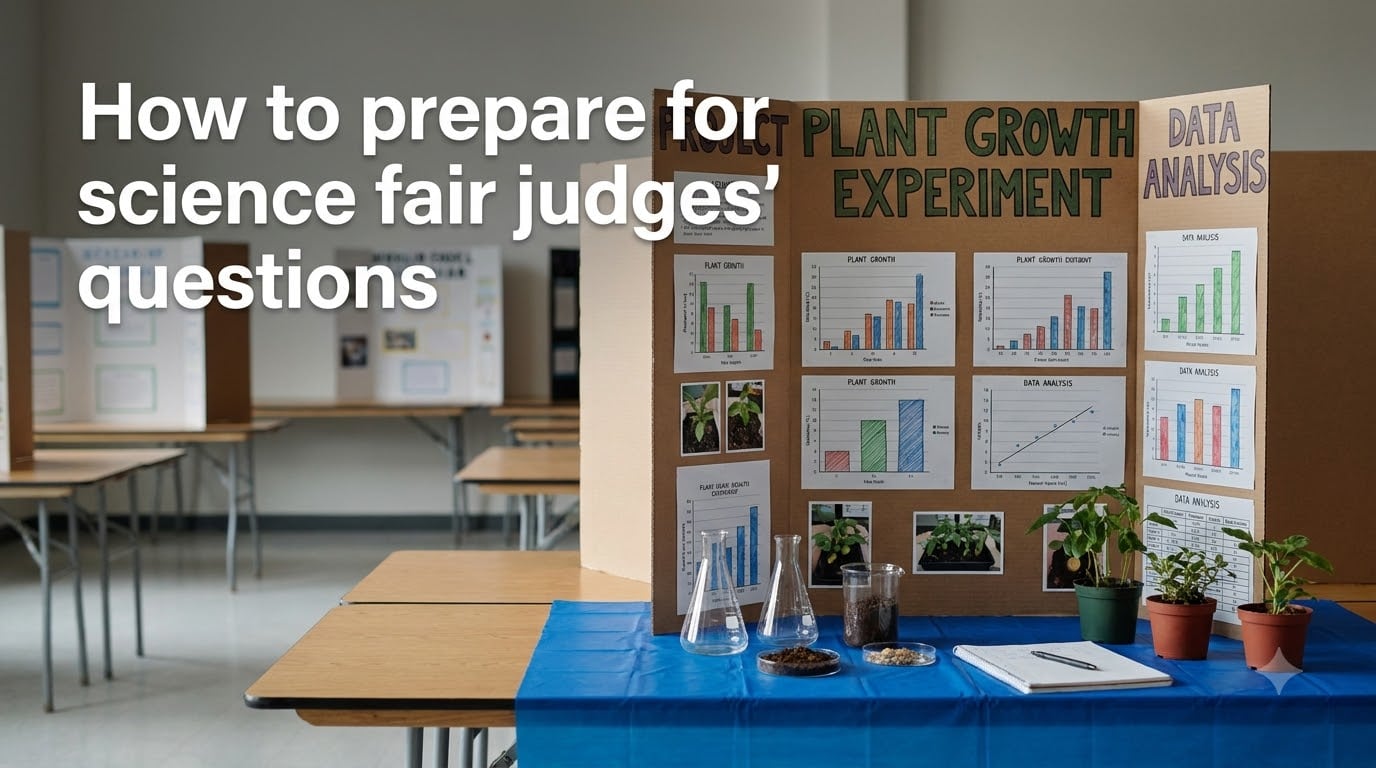
Standing in front of your project board, palms sweating, waiting for a judge to fire off questions — if you have ever been there, you know the feeling. I have judged and coached science fairs at multiple levels, and the same pattern shows up every time: students who nail the Q&A round move up, and those who freeze drop down, regardless of how impressive their board looks. Learning how to prepare for science fair judges’ questions is the single most overlooked skill in competition preparation.
Most students spend weeks on their experiment and minutes on their presentation practice. That is backwards. Judges at events like ISEF and regional fairs routinely tell me the interview round carries as much weight as the project itself. A 2026 survey of science fair coordinators found that over 70% of final scores come down to the Q&A interaction, not the display board.
This guide walks you through exactly what to expect, how to practice, and what to say when a judge asks something you never saw coming. Whether you are presenting at an elementary school fair or competing at ISEF, the strategies here will help you walk in confident and walk out proud.
One note from my own experience: the students who impress judges most are not the ones with the perfect answers. They are the ones who clearly understand their project and can talk about it honestly. Science fair judging is not about catching you in a mistake — it is about seeing whether the work is genuinely yours and whether you can think scientifically under pressure.
Table of Contents
What Questions Do Judges Ask at a Science Fair?
Judges almost always start with broad, open-ended questions and then narrow down to probe how deeply you understand your work. The first question you hear will likely be “Tell me about your project” — and your answer sets the tone for everything that follows.
Here are the 10 questions judges ask most frequently across all competition levels, from elementary school fairs to ISEF:
Tell me about your project — what did you investigate and why?
What was your hypothesis, and how did you arrive at it?
What variables did you control, and why do those matter?
What does your data tell you?
How much help did you receive from others?
What would you do differently if you repeated this project?
Why is this research important or relevant?
What was the hardest part of your project, and how did you handle it?
How would you explain your project to someone with no science background?
What surprised you most about your results?
Notice that none of these are trick questions. They are designed to reveal whether you actually did the work and understand the science behind it. If you can answer these ten confidently, you are ahead of most competitors.
Judges at higher-level competitions like ISEF will follow up with layered questions. For example, after “What does your data tell you?” they might ask, “How confident are you in that conclusion given your sample size?” These follow-up questions test your depth of understanding — they want to see if you can think on your feet, not just recite prepared answers.
What Science Fair Judges Really Look For in a Project?
Judges evaluate your project on four core dimensions during the Q&A: clarity of thinking, depth of understanding, scientific honesty, and enthusiasm. Your score on each of these is largely determined by how you answer questions, not by what is on your board.
Clarity of thinking means you can explain your project logically, from hypothesis to conclusion, without jumping around. Judges want to see a clear thread connecting your research question, your method, your data, and your conclusion.
Depth of understanding goes beyond surface-level answers. If a judge asks why you chose a particular sample size, “Because that is what I read online” is a weak answer. “I chose 30 trials because that gave me enough data points to calculate a meaningful average while staying within my time constraints” shows real understanding.
Scientific honesty is about acknowledging limitations and errors openly. Judges I have spoken with consistently rank this as one of the most important traits they look for. A student who says “My results were inconclusive, and here is what I think went wrong” often scores higher than one who claims everything worked perfectly.
Enthusiasm matters more than students think. Judges are scientists who love science, and they respond to genuine curiosity. If your eyes light up when you talk about what surprised you in your data, that engagement registers.
Most regional and state fairs use a judging rubric that weights creative ability, scientific thought, thoroughness, skill, and clarity roughly equally. At ISEF, the rubric is more detailed but follows the same logic. Understanding the rubric at your specific competition helps you anticipate which questions will come up.
How to Prepare for Science Fair Judges’ Questions Step-by-Step
Preparation is where winners are made. The students who place at the top are not necessarily the smartest — they are the most prepared. Here is a step-by-step method I recommend based on coaching students through multiple competition levels.
Step 1: Master Your One-Minute Pitch
Judges form their first impression within the first 60 seconds. Craft a one-minute explanation of your project that covers your research question, hypothesis, method, key finding, and why it matters. Practice it until it sounds natural, not rehearsed.
Step 2: Write Out Answers to the Top 10 Questions
Take the list of common questions above and write bullet-point answers for each one. Do not write scripts — bullet points force you to speak naturally rather than recite memorized text. Memorized answers sound robotic and fall apart when judges ask follow-up questions.
Step 3: Do Mock Interviews With Real People
This is the single most effective preparation technique. Ask a teacher, parent, mentor, or classmate to play judge. Have them ask you the common questions plus a few unexpected ones. The stress of a live mock interview builds the same mental muscles you need on fair day.
I have seen students transform after just three mock interviews. The first one is always rough. By the third, they are thinking on their feet, handling curveball questions, and sounding like they own their research.
Step 4: Practice Explaining Technical Terms Simply
Judges at regional fairs often come from different scientific specialties. Your judge might be a biologist evaluating a chemistry project. Practice explaining every technical term in your project as if you were talking to a smart 12-year-old. If you cannot explain your control group in plain language, you do not understand it well enough yet.
Step 5: Identify Your Weak Spots and Prepare for Them
Think hard about what a judge might question in your project. Did your sample size feel small? Was your control group imperfect? Did you run into equipment failures? Identify these weak spots and prepare honest, thoughtful answers. Acknowledging a limitation before a judge points it out shows maturity and scientific thinking.
Step 6: Record Yourself and Watch It Back
Film yourself answering questions, then watch the recording. You will catch habits you never noticed — talking too fast, filler words, looking away when uncertain. This is uncomfortable but incredibly effective. Most students improve dramatically after just one recording session.
Weak vs Strong Answers: Side-by-Side Examples
Seeing the difference between a weak answer and a strong one is the fastest way to understand what judges want. Here are direct comparisons for five common questions.
Question: What was your hypothesis?
Weak answer: “I thought the plants would grow better with fertilizer.” This tells the judge nothing about your reasoning.
Strong answer: “My hypothesis was that tomato plants given organic fertilizer would grow 20% taller than those given synthetic fertilizer, based on research showing organic fertilizer releases nitrogen more slowly, which supports sustained root development.” This answer shows reasoning, a specific prediction, and connection to prior research.
Question: What would you do differently?
Weak answer: “I do not know, I think it went pretty well.” This signals a lack of reflection.
Strong answer: “I would increase my sample size from 10 to 30 plants. With only 10 plants, the natural variation between individual plants could mask the effect of the fertilizer. A larger sample would give me more confidence in the results.” This shows critical thinking and self-awareness.
Question: How much help did you receive?
Weak answer: “I did it all myself.” Judges can usually tell when this is not true, and it damages your credibility.
Strong answer: “My science teacher helped me calibrate the pH meter and reviewed my experimental design. My mom drove me to buy supplies. But I designed the experiment, collected all the data, and did the analysis myself.” This shows ownership while being honest about support.
Question: What does your data tell you?
Weak answer: “The data shows fertilizer works.” Vague and unscientific.
Strong answer: “The organic fertilizer group grew an average of 14.2 centimeters, compared to 11.8 centimeters for the synthetic group. That is a 20% difference, which supports my hypothesis. However, the standard deviation was 3.1 centimeters, so I would want to replicate this with a larger sample before drawing firm conclusions.” This demonstrates data literacy and honest interpretation.
Question: Why does this matter?
Weak answer: “It is interesting.” No real justification.
Strong answer: “Organic farming is growing 10% annually in the United States, but we still do not fully understand how organic fertilizers compare to synthetic ones for different crops. My project contributes a small piece of data to that larger question, and it helped me personally understand how to design and run a controlled experiment.” This connects the project to a bigger picture while staying grounded.
How to Handle Difficult or Unexpected Judge Questions?
No matter how much you prepare, a judge will eventually ask something you did not anticipate. This is intentional — judges use unexpected questions to test your real-time thinking. The good news is that you do not need to know every answer. You just need to handle the moment gracefully.
The most important sentence you can learn is this: “That is a great question. I am not sure of the exact answer, but here is what I think based on what I observed.” Judges I have interviewed consistently say this type of response is respected, not penalized. It shows honesty, humility, and the ability to reason through uncertainty.
What never works is pretending to know something you do not. Judges are experts in their fields. They can spot a fabricated answer within seconds, and the damage to your credibility is far worse than admitting you do not know.
Here is a simple framework for handling any tough question:
Pause for two seconds. Do not rush. A brief pause shows you are thinking, not stalling.
Acknowledge the question. “That is something I thought about during my project” or “I have not considered that specifically.”
Reason aloud. Walk the judge through your thinking, even if you are unsure of the final answer. The reasoning process is what they are evaluating.
Be honest if you truly do not know. “I do not have enough data to answer that confidently, but it would be a great next step for my research.”
Another scenario students fear is the ownership question. Judges sometimes ask, “Did you actually do this yourself?” or “Who helped you with the statistics?” Do not get defensive. Answer calmly and specifically. Break down exactly what you did versus what others helped with. Judges ask this at every level, from elementary school fairs to ISEF, because project ownership is a core judging criterion.
If a judge asks a question that seems to challenge your conclusion, do not panic. They are not attacking you — they are testing whether you can defend your work with evidence. Refer back to your data, acknowledge any caveats, and stand behind what your results actually show.
Team Project Q&A Tips: Sharing the Floor Without Sinking
Team projects add a layer of complexity to the judging round. Judges notice when one person dominates the conversation and the other stands silently. They also notice when team members contradict each other or clearly have unequal understanding of the project.
Before the fair, sit down with your teammate and decide who will answer which types of questions. A simple split works well: whoever led a particular part of the project — the experimental design, the data collection, or the analysis — takes the lead on questions about that part.
Practice the handoff. When your teammate finishes answering, add a brief supporting point rather than repeating what they said. “To add to what Maria said, we also noticed…” is a natural way to show collaboration without talking over each other.
Both team members need to understand the entire project, not just their portion. Judges will ask each person questions about the whole project. If one teammate cannot explain the statistical analysis, that reflects poorly on the team, even if the other teammate did that work.
One Reddit thread from ISEF finalists emphasized this exact point: judges at high-level competitions deliberately ask each team member the same question separately to check for consistent understanding. Prepare accordingly.
Managing Nerves and Building Confidence Before Judging
Nerves are normal. Even seasoned competitors feel anxious before judging rounds. The goal is not to eliminate anxiety but to manage it so it does not interfere with your performance. Confidence comes from genuine understanding and preparation — not from trying to act calm.
Breathing techniques work. Try the 4-7-8 method before your judging round: inhale for four seconds, hold for seven, exhale for eight. Repeat three times. This activates your parasympathetic nervous system and lowers your heart rate. It sounds simple, but I have watched students transform from shaky to steady with this one technique.
Reframe the situation in your mind. Judges are not enemies trying to trip you up. They are scientists who genuinely want to learn about your work. Most judges volunteer their time because they love seeing young people engage with science. Reminding yourself of this shifts the dynamic from interrogation to conversation.
Arrive early and get comfortable with your space. Stand at your board, look at your materials, and take a few minutes to settle in before judges arrive. Familiarity with your environment reduces anxiety. If possible, walk through your one-minute pitch aloud once or twice while you wait.
Physical grounding helps too. Plant both feet firmly on the floor. Keep your hands relaxed at your sides or resting lightly on your board. Avoid fidgeting with pens or papers — it signals nervousness and distracts from your words.
The most powerful confidence builder is simply knowing your project inside and out. When you have done mock interviews, identified your weak spots, and practiced explaining your work in plain language, nerves fade naturally because you trust your own preparation.
Competition-Specific Tips: Elementary, Regional, and ISEF
Judging styles differ significantly across competition levels. What works at an elementary school fair will not be enough at ISEF, and ISEF-level preparation would be overkill for a third grader. Here is how to tailor your approach.
Elementary School Fairs
At this level, judges are looking for basic understanding of the scientific method and genuine enthusiasm. Expect simple questions: “What did you learn?” “What was your favorite part?” “Would you do this project again?” Keep answers short and energetic. Judges at this level want to see that you had fun and learned something.
Regional and State Fairs
Judging at regional and state competitions is more rigorous. Judges expect you to understand variables, controls, and data interpretation. They will ask about your experimental design and may probe for weaknesses. Prepare for layered follow-up questions and be ready to discuss your methodology in detail. The judging rubric at this level typically evaluates creative ability, scientific thought, and thoroughness.
ISEF and International Competitions
At ISEF, you will face multiple judging rounds with judges who are leading experts in their fields. Expect deep technical questions, probes into your statistical methods, and questions about how your work connects to broader scientific problems. Judges at this level look for originality, research-grade methodology, and the ability to discuss your work at a professional level. Prepare for questions about future research directions and how your findings could be applied.
At every level, one thing stays constant: judges reward ownership and honest scientific thinking over polished but shallow answers.
Key Mistakes to Avoid During Judge Q&A
A few common mistakes sink otherwise strong projects. Avoid these and you will already be ahead of most competitors.
Memorizing scripted answers. Memorized responses sound robotic and collapse when a judge asks a follow-up question you did not rehearse. Use bullet points instead of scripts.
Talking too fast. Nerves make people speed up. Slow down deliberately. Judges need time to process your answers, and a measured pace projects confidence.
Pretending everything went perfectly. This is the fastest way to lose credibility. Every project has limitations. Acknowledging them honestly shows scientific maturity.
Ignoring the judge’s body language. If a judge looks confused, pause and ask if they would like you to clarify. If they are nodding and engaged, keep going. Reading the room is a real skill.
Reading from your board. Your board is a visual aid, not a script. Know your material well enough to speak directly to the judge and refer to the board only to point out specific data or images.
Giving one-word answers. Yes or no answers kill the conversation. Always follow up with a brief explanation. “Yes, and the reason I chose that method is…” turns a dead end into a discussion.
Frequently Asked Questions
What questions do judges ask at a science fair?
Judges most commonly ask students to explain their project, describe their hypothesis, discuss their variables and controls, interpret their data, explain what they would do differently, and discuss how much help they received. They start broad and narrow down to test depth of understanding.
How to impress science fair judges?
Impress judges by showing genuine understanding of your project, speaking in plain language about complex concepts, honestly acknowledging limitations and errors, connecting your findings to real-world relevance, and displaying enthusiasm for your research. Honest, thoughtful answers consistently outscore polished but shallow responses.
What do I say when I do not know the answer to a judge’s question?
Say something like, u0022That is a great question. I am not certain, but based on what I observed, here is what I think.u0022 Reason through your answer aloud. Judges respect honest thinking far more than fabricated answers, and being caught guessing dishonestly damages your credibility permanently.
How to practice for science fair judging alone?
Write bullet-point answers to the 10 most common judge questions, record yourself answering them on video, and watch the playback to catch nervous habits. Practice explaining every technical term in plain language. When possible, do mock interviews with a teacher or parent asking unexpected questions.
What are 5 testable questions for science fair?
Good testable questions compare one specific variable against a control. Examples: How does water temperature affect the rate of sugar dissolving? Does the type of fertilizer affect plant height? How does the angle of a ramp affect the distance a ball rolls? Does saltwater freeze at a different temperature than freshwater? How does the amount of baking soda affect the volume of a volcano eruption?
Final Thoughts
Knowing how to prepare for science fair judges’ questions comes down to three things: understand your project deeply, practice with real people asking real questions, and be honest when you do not know something. The students who win are not the ones with perfect answers. They are the ones who clearly own their work, think scientifically under pressure, and treat the judging round as a conversation rather than a test.
Start preparing at least two weeks before your fair. Master your one-minute pitch, write bullet-point answers to the top 10 questions, and do at least three mock interviews. Record yourself once and watch it back. Identify your weak spots and prepare honest responses. Walk in on fair day knowing you have done the work, and let your genuine curiosity shine through.
You have already done the hardest part — the research itself. Now go talk about it like the scientist you are.