
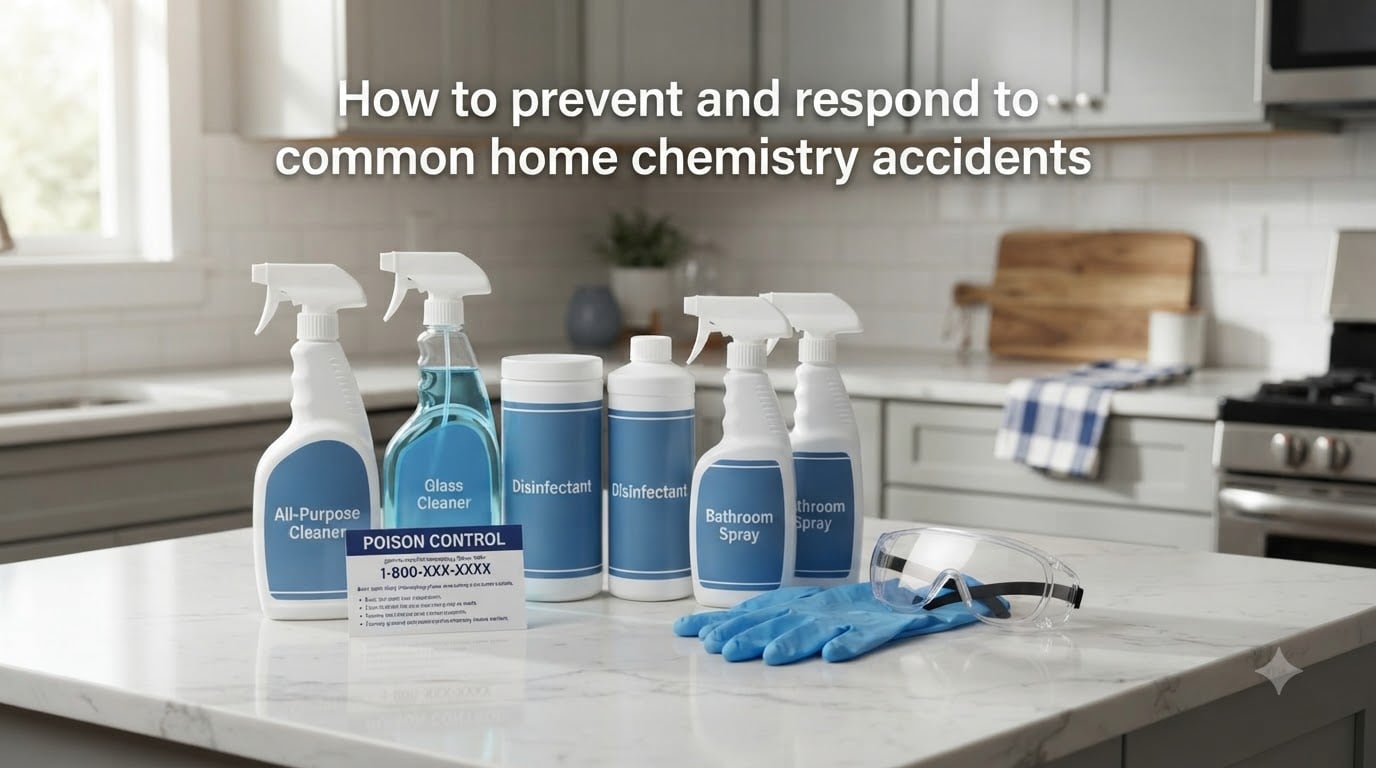
Every year, thousands of home chemistry accidents send people to emergency rooms, and most of them are preventable. The products sitting under your kitchen sink, in the garage, or on a laundry room shelf, things like bleach, ammonia, drain cleaners, and pool chemicals, can cause serious harm when they are mixed, stored, or used incorrectly. I have spent years reviewing chemical safety guidance from the Red Cross, Poison Control, and local emergency management agencies, and the patterns are remarkably consistent. People get hurt because they did not read a label, stored two incompatible products side by side, or tried to clean up a spill without knowing what was in it.
This guide covers how to prevent and respond to common home chemistry accidents, from dangerous mixing combinations to emergency first aid. Here is a quick summary of the most important prevention tips before we go deeper.
Never mix chemicals, especially bleach and ammonia, bleach and acids, or different drain cleaners together.
Read every label before use and follow the directions for application, ventilation, and storage.
Keep products in original containers so warning labels and instructions stay with the product.
Store chemicals locked up, away from children and pets, in a cool, dry, well-ventilated area.
Post the Poison Control number, 1-800-222-1222, near every phone and save it in your mobile contacts.
If you take only one thing from this article, let it be this: almost every home chemistry accident I have ever read about traces back to one of those five points being ignored.
Table of Contents
Most Common Types of Home Chemistry Accidents
Home chemistry accidents happen in a few predictable ways. Understanding the patterns helps you spot risks before they become emergencies. The four main categories are chemical mixing incidents, improper storage failures, accidental exposure, and unsafe disposal.
Chemical Mixing Incidents
Mixing accidents are the most dangerous and the most common type of home chemistry accident. Someone tries to make a stronger cleaner by combining two products, or rinses a bucket that still contains residue from a different chemical. The result can be toxic gas, intense heat, splashing, or even a small explosion. Bleach mixed with ammonia releases chloramine gas, which can cause severe respiratory damage within minutes. Bleach mixed with an acid, like toilet bowl cleaner or vinegar, releases chlorine gas, which is even more dangerous.
Improper Storage Failures
Storing chemicals in the wrong place or in the wrong container causes accidents that often go unnoticed until someone gets hurt. A corroded container leaks onto a shelf. A flammable product sits next to a water heater. A child opens a cabinet because the latch was broken. Forum discussions I reviewed from chemistry communities repeatedly highlighted unlabeled and improperly stored chemicals as a top source of dangerous incidents, even among experienced professionals.
Accidental Exposure
Exposure happens through three main routes: breathing in fumes, skin or eye contact, and swallowing. Inhalation is the most common route in home accidents because toxic gases spread invisibly through a room. Skin contact causes chemical burns that may not appear immediately. Accidental swallowing happens most often with children, who are drawn to colorful liquids in unmarked containers.
Unsafe Cleanup and Disposal
Pouring incompatible chemicals down the same drain, tossing reactive products into the trash, or cleaning up a spill without protective gear all count as disposal accidents. These incidents can injure you, contaminate your home, or harm sanitation workers downstream.
Dangerous Chemical Combinations to Never Mix
Some chemical combinations produce reactions you cannot undo. Once the gas is in the air or the burn is on your skin, the damage is done. These are the specific combinations that cause the most home emergencies, and I want you to recognize each one.
Bleach and Ammonia
Mixing bleach (sodium hypochlorite) with ammonia produces chloramine gas. Symptoms start with coughing, shortness of breath, and chest tightness. At higher concentrations, exposure can cause fluid buildup in the lungs and respiratory failure. This combination is frequently responsible for emergency room visits because ammonia appears in many glass cleaners, some paint strippers, and certain floor cleaners.
Bleach and Acids
Combining bleach with an acid releases chlorine gas. Acids are found in toilet bowl cleaners, rust removers, calcium and lime removers, and of course vinegar. Chlorine gas attacks the respiratory system immediately. Even a small amount produced in a poorly ventilated bathroom can send a person to the hospital. If you have ever read a news story about someone collapsing while cleaning a bathroom, this is almost always the cause.
Hydrogen Peroxide and Vinegar
People sometimes mix hydrogen peroxide and vinegar thinking they are creating a powerful natural cleaner. Combined in the same container, they form peracetic acid, which is corrosive, can burn skin and eyes, and irritates the respiratory system. Using them separately on the same surface in sequence is generally fine, but never combine them in one bottle.
Different Drain Cleaners Together
Drain cleaners rely on harsh chemistry, either strongly alkaline (sodium hydroxide) or strongly acidic (sulfuric acid). Mixing two different drain cleaners can produce violent exothermic reactions, sometimes enough to crack a pipe or launch caustic liquid upward into your face. If one product did not clear the drain, do not pour a second one down after it. Call a plumber instead.
The General Rule
Treat every household chemical as if it should never touch another chemical. The safest approach is to use one product at a time, rinse thoroughly with water between products, and ventilate the area. When in doubt, do not mix.
How to Prevent Home Chemistry Accidents?
Prevention comes down to habits. The people who avoid accidents are the ones who follow the same simple routine every single time they handle a chemical product. Here is the prevention framework I recommend, based on guidance from the Red Cross, the EPA, and local hazardous materials agencies.
Read and Follow Every Label
Labels tell you what the product contains, what it should never touch, how to ventilate, what protective equipment to wear, and what to do in an emergency. Read the label before you open the container, not after something goes wrong. Pay special attention to warning words like Danger, Warning, and Caution, which indicate increasing levels of hazard.
Look for the GHS hazard symbols, the red diamond pictograms on the label. These standardized symbols communicate specific dangers: corrosive, flammable, toxic, oxidizing, and environmental hazard. Learning to recognize them takes five minutes and they appear on products worldwide.
Use Products Only as Directed
Do not use a product for a purpose the label does not mention. Do not use more than the recommended amount. Do not leave a chemical sitting on a surface longer than the directions allow. More is not better with chemicals, it is more dangerous.
Ventilate the Area
Open windows and run exhaust fans whenever you use cleaning products, solvents, paints, or pesticides. Good ventilation dilutes fumes before they reach dangerous concentrations. If you can smell a chemical strongly, the ventilation is not adequate.
Wear Protective Equipment
Gloves protect your skin from corrosive and absorbing chemicals. Safety glasses protect against splashes, which is how most eye injuries happen. Long sleeves and closed shoes add another barrier. Professional chemists on community forums were unanimous on this point: protective equipment is non-negotiable, even for quick tasks.
Keep Children and Pets Away
Set up a physical barrier or work during times when children and pets are not present. A curious toddler can reach a cleaning bucket faster than most adults expect. Pets may lick spilled liquids or walk through wet product and then ingest it while grooming.
Safe Chemical Storage at Home
How you store chemicals matters as much as how you use them. A well-organized storage setup prevents the majority of accidental exposure incidents. The key principles are segregation, containment, and access control.
Keep Products in Original Containers
Original containers are designed to hold that specific chemical safely. They carry the warning label, the ingredients list, and the emergency instructions. Transferring products to food containers, water bottles, or unmarked spray bottles removes all that information and creates a serious poisoning risk.
Segregate Incompatible Chemicals
Store acids away from bases. Store flammables away from oxidizers. Store bleach away from ammonia-based products. A simple way to do this is to group products by function, cleaning, laundry, automotive, pool, and keep those groups on separate shelves or in separate cabinets. If two products should never be mixed, they should not be stored side by side.
Store Locked and Out of Reach
Use cabinets with child-resistant latches or store chemicals on high shelves that children cannot reach. Garage and basement storage should be secured the same way as kitchen and bathroom storage. Poison Control data consistently shows that the majority of childhood poisoning cases involve products that were left within reach.
Avoid Extreme Conditions
Keep chemicals away from heat sources, open flames, direct sunlight, and freezing temperatures. Heat can cause containers to expand, leak, or ignite flammable contents. A shelf next to the water heater, furnace, or dryer is not a safe place for flammable or volatile products.
What to Do Before a Chemical Emergency?
Preparation takes an hour and can save a life. Before any incident happens, set up the following in your home.
Post Emergency Numbers
Save the Poison Control number, 1-800-222-1222, in your phone and post it where household members can find it. Poison Control is free, available 24 hours a day, and staffed by experts who can tell you exactly what to do for a specific exposure. In a fire, explosion, or large spill, call 911.
Assemble a Basic Emergency Kit
Keep the following in an accessible location: chemical-resistant gloves, safety glasses, a face mask rated for fumes (N95 at minimum, though it will not protect against all gases), paper towels and absorbent material for small spills, a sealed container for contaminated materials, and a bottle of fresh water for eye flushing. This is not a substitute for professional response, but it covers the first critical minutes.
Read Labels Now, Not Later
Go through your home and read the labels on every chemical product you own. Note which ones are flammable, which are corrosive, and which should never be mixed. Move incompatible products apart. This single exercise eliminates a large percentage of preventable accidents.
What to Do During a Chemical Emergency?
If an accident happens, your response in the first few minutes determines the outcome. Follow these steps in order.
Step 1: Stop and Assess
Stop what you are doing. Do not try to clean anything up yet. Look at what happened: which products are involved, how much spilled, and whether anyone was exposed. If anyone is unconscious, having trouble breathing, or in severe pain, call 911 immediately.
Step 2: Ventilate and Evacuate if Needed
If toxic fumes are present, open windows and leave the room. Close the door behind you to contain the gas. If the smell is strong or widespread, evacuate the entire home and call 911 from outside. Do not re-enter until emergency responders tell you it is safe.
Step 3: Protect Yourself Before Helping Others
Before you help a person who has been exposed, make sure you will not become the next victim. Put on gloves and eye protection. Do not walk into a contaminated area barefoot or without protection. Responders sometimes become patients because they rushed in unprotected.
Step 4: Address Exposure
For skin contact, remove contaminated clothing and rinse the affected area with cool running water for at least 15 minutes. For eye contact, flush the eye with lukewarm water for 15 minutes, holding the eyelid open. For inhalation, move the person to fresh air immediately. For suspected swallowing, do not induce vomiting unless Poison Control specifically tells you to.
Step 5: Call Poison Control or 911
Call Poison Control at 1-800-222-1222 for any exposure, even if the person seems fine. Have the product container with you so you can read the label to the specialist. For severe symptoms, fire, explosion, or a large spill you cannot contain, call 911.
Step 6: Contain the Spill if Safe
If the spill is small, you know what the chemical is, and you have protective equipment, you can absorb it with paper towels or an absorbent material. Place contaminated materials in a sealed bag or container. Do not use a vacuum or a fan, which can spread fumes or fine particles. If you are unsure, leave it and call for help.
First Aid for Chemical Burns and Exposure
First aid for chemical injuries differs from other injuries because the chemical keeps causing damage until it is removed. Speed matters more than anything else.
Chemical Burns on Skin
Remove any clothing or jewelry that touched the chemical, because residue continues to burn. Rinse the skin with cool, gently running water for at least 15 to 20 minutes. Do not apply creams, ointments, butter, or home remedies, they trap the chemical against the skin. Cover the burn loosely with a clean, dry cloth and seek medical attention for anything beyond a minor irritation.
Chemical Exposure to Eyes
Eye exposure is an emergency. Flush the affected eye with lukewarm water for a full 15 minutes, holding the eyelids open so water reaches all surfaces. If the person wears contacts, remove them after the first minute or two of flushing. Seek medical attention immediately after flushing, and bring the product container to the hospital.
Inhalation of Chemical Fumes
Move the person to fresh air right away. Loosen tight clothing. If they are having trouble breathing, are coughing violently, or feel chest pain, call 911. Even if symptoms seem mild, call Poison Control, because some gases cause delayed lung injury that appears hours later.
Swallowed Chemicals
Do not induce vomiting. Vomiting can bring the chemical back up through the esophagus and cause a second round of damage, and some chemicals are more dangerous coming back up. Do not give the person anything to eat or drink unless Poison Control tells you to. Call Poison Control immediately with the product container in hand.
Know When It Is Beyond First Aid
First aid buys time. It does not replace medical treatment. If a burn is larger than three inches, if it involves the face, hands, feet, groin, or a major joint, or if the chemical was a strong acid or base, go to the emergency room. When in doubt, always seek professional care.
How to Dispose of Household Chemicals Safely?
Improper disposal harms people and the environment. Pouring chemicals down the drain, into the storm sewer, or into the trash can cause reactions in plumbing, contaminate drinking water, and injure sanitation workers.
Use Hazardous Waste Collection
Most cities and counties operate household hazardous waste collection programs. They accept paint, solvents, pesticides, motor oil, pool chemicals, batteries, and other hazardous products at no charge. Search for household hazardous waste collection plus your city name to find dates and locations.
Never Mix Waste for Disposal
Just as you should never mix chemicals while cleaning, you should never combine leftover chemicals for disposal. Mixing wastes in a single container can cause reactions during transport or processing. Keep products in their original containers and bring them separately.
Follow Label Disposal Instructions
Some labels include specific disposal guidance. If the label says do not discard in trash, follow that instruction. If a container is empty and the label allows it, you may be able to rinse and recycle it. When the label is unclear, contact your local waste authority.
Frequently Asked Questions
How do you prevent a household chemical emergency?
Prevent household chemical emergencies by reading every label before use, never mixing chemicals together, storing products in original containers locked away from children, ventilating areas during use, wearing gloves and eye protection, and posting the Poison Control number (1-800-222-1222) where everyone can find it.
What should you do first if a chemical spill occurs?
Stop and assess the situation first. Do not try to clean up the spill immediately. Check whether anyone was exposed, identify the chemical involved, ventilate the area, and evacuate if fumes are strong. Call 911 for large spills, fire, or severe exposure, and call Poison Control at 1-800-222-1222 for guidance.
What are 5 things you can do to ensure safe handling of chemicals?
1) Read the label and follow all directions. 2) Wear protective equipment such as gloves and safety glasses. 3) Ventilate the area by opening windows or running fans. 4) Never mix different chemical products together. 5) Store chemicals in original containers, locked and out of reach of children.
What household chemicals should never be mixed?
Never mix bleach and ammonia (produces toxic chloramine gas), bleach and acids such as toilet bowl cleaner or vinegar (produces chlorine gas), hydrogen peroxide and vinegar (produces corrosive peracetic acid), and different brands of drain cleaner (can cause violent reactions).
When should you call Poison Control?
Call Poison Control at 1-800-222-1222 any time a chemical product is swallowed, inhaled, splashed on skin, or gets into eyes, even if no symptoms are present. The service is free, confidential, and available 24 hours a day. Call 911 instead if someone is unconscious, having seizures, or struggling to breathe.
What are the four types of chemical hazards?
The four main types of chemical hazards are corrosive (burns skin and tissue), flammable (ignites easily), toxic (causes poisoning through inhalation, ingestion, or absorption), and reactive (undergoes dangerous reactions when mixed, heated, or pressurized). GHS labels use standardized pictograms to identify each hazard type.
Conclusion
Preventing home chemistry accidents is not complicated, but it does require consistent habits. Read every label, never mix products, store chemicals properly, ventilate your work area, and keep the Poison Control number within reach. These five practices prevent the vast majority of household chemical emergencies.
When an accident does happen, your response matters more than the accident itself. Stop, assess, ventilate, protect yourself, address the exposure, and call for help. Quick, informed action limits harm and gives professionals the information they need to take over.
Now that you know how to prevent and respond to common home chemistry accidents, take fifteen minutes today to walk through your home. Read the labels on your cleaning products, separate anything incompatible, and save the Poison Control number in your phone. A few minutes of preparation can prevent an emergency room visit.