
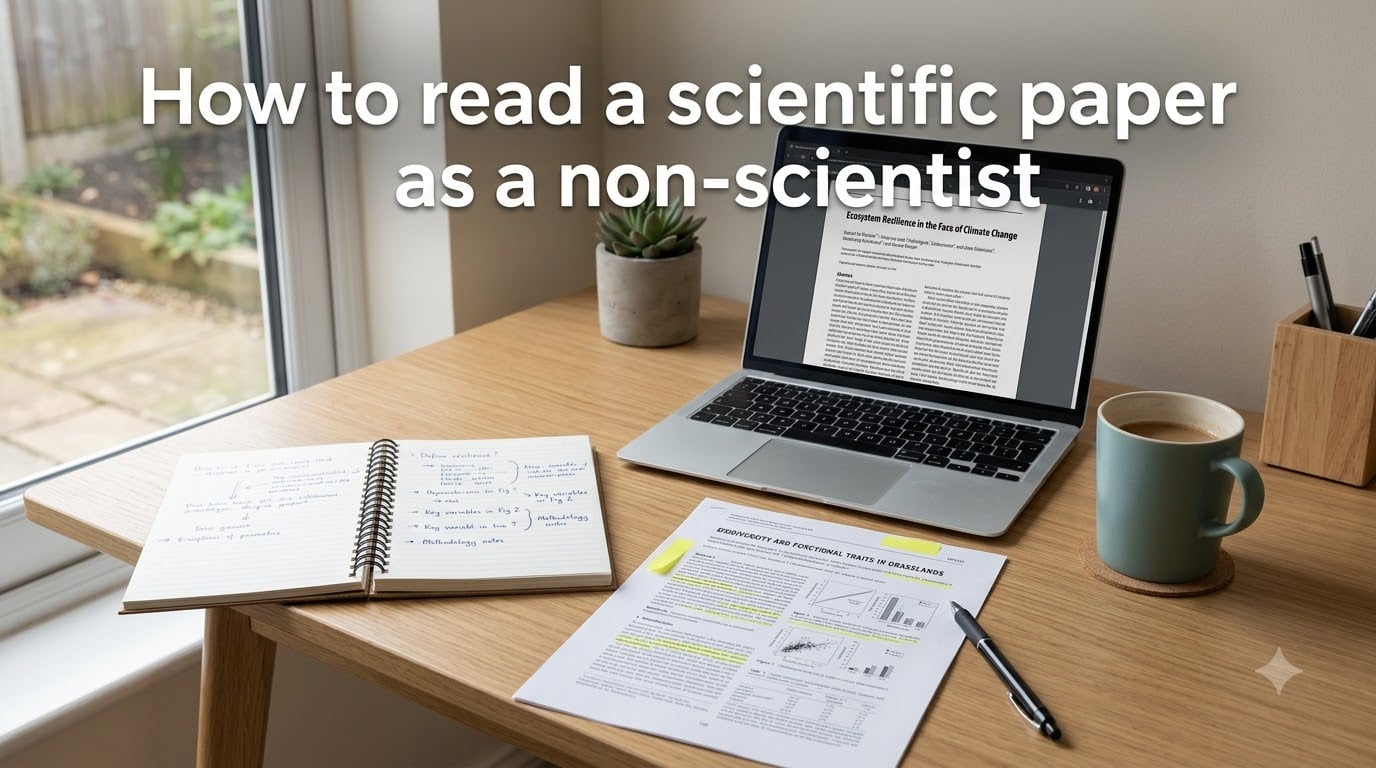
When I first opened a peer-reviewed paper on sleep and memory, I froze at the methods section. The vocabulary felt like a foreign language, and the dense figures looked like works of art I had no training to interpret. If that sounds familiar, this guide on how to read a scientific paper as a non-scientist will give you a clear, repeatable strategy you can use tonight.
Scientific papers are not written to be impenetrable. They follow a predictable structure designed to help reviewers evaluate evidence. Once you understand that structure, the reading process becomes far less intimidating. Our team put together this walkthrough after spending weeks comparing guidance from working scientists, university librarians, and science journalists who teach reading skills to general audiences.
By the end of this article, you will know the exact order in which to read each section, how to spot trustworthy figures, where to find papers worth your time, and how to handle unfamiliar technical terms without giving up.
Table of Contents
Why Non-Scientists Should Learn How to Read a Scientific Paper?
Reading primary research gives you direct access to evidence before it gets filtered through headlines, press releases, or social media posts. Journalists, policy makers, patients facing treatment decisions, and curious citizens all benefit from being able to read the source material themselves.
Here is what changed for me once I built this habit. I stopped arguing from headlines and started evaluating claims with the actual data behind them. I caught a news story that overstated a clinical trial result. I also discovered a fascinating study on urban bird cognition that I now reference in conversations about animal intelligence.
You do not need a graduate degree. You do need a method. Reading scientific papers efficiently is a learned skill, and it is one of the highest-leverage habits a non-scientist can develop.
The Anatomy of a Scientific Paper: Sections You Will Encounter
Most scientific papers follow a standard format called IMRaD: Introduction, Methods, Results, and Discussion. Recognizing each section’s purpose is the first step toward confident reading.
Abstract
The abstract is a short summary (usually under 300 words) of the entire study. It previews the question, the methods, the main findings, and the conclusion. Treat it as a trailer, not the movie itself.
Introduction
The introduction explains the background, what is already known, and the gap the study fills. It usually ends with a stated hypothesis or research question. This is where context lives.
Methods
The methods section describes how the study was conducted: participants, materials, procedures, and analysis. As a non-scientist, you only need to grasp the broad approach, not every reagent or equation.
Results
The results section reports what the data showed, often paired with figures and tables. Look here for the actual numbers behind any bold claim you may have read in the news.
Discussion and Conclusion
The discussion interprets the results, acknowledges limitations, and proposes next steps. This is where authors tell you what they think their findings mean.
References and Supplementary Material
The references list the studies the authors built on. Supplementary materials contain extra figures, datasets, or detailed protocols. They are useful for deeper dives but optional for first-pass reading.
How to Read a Scientific Paper: A Step-by-Step Strategy
This seven-step strategy is what experienced researchers actually use. It is faster than reading cover-to-cover and dramatically improves comprehension.
Read the introduction first, not the abstract. The introduction gives you the conceptual map you need to understand everything else. The abstract compresses too much into too little space and often reads as jargon without context.
Identify the BIG QUESTION. In one sentence, write down what the study is trying to answer. If you cannot, the paper may not have a clear question, which is a warning sign.
Summarize the background in five sentences or less. What did prior research show, and what gap does this paper fill? This step anchors the rest of your reading.
Read the methods section for the big picture only. Skip the fine procedural detail. Focus on study design, sample size, and whether the experiment seems appropriate to the question.
Examine the figures and tables. Each chart should have a clear title, labeled axes, and a caption explaining what is shown. Figures often communicate the main finding more clearly than the text.
Read the discussion. Here the authors explain what their results mean, compare them with prior work, and acknowledge limitations. This is where interpretation lives, and where healthy skepticism pays off.
Reread the abstract. Only now will the abstract make sense. Use it to test whether you actually understood the study. If the abstract still confuses you, repeat steps 2 through 6.
Pro tip from our research: set a 25-minute timer for your first pass. Reading a paper feels less overwhelming when you commit to short, focused sessions.
How to Evaluate Figures, Tables, and Statistical Claims
Figures and tables are the heart of any scientific paper. They show the actual evidence. Reading them well separates casual readers from critical thinkers.
Start with the axis labels and units. A graph labeled “Effect size (Cohen’s d)” without units means nothing until you know what counts as small, medium, or large. Most disciplines have agreed-upon conventions, and the caption will usually explain.
Look for error bars, confidence intervals, and sample sizes. A bar chart without these tells you less than it appears to. A wide error bar means the result is uncertain. A small sample size (under 30, for example) often signals preliminary findings worth treating cautiously.
Watch for the phrase “statistically significant” and the related “p-value.” Statistical significance means the result is unlikely to be due to chance alone, but it does not mean the result is large or important in real-world terms. Treat significance as a minimum bar, not the finish line.
Where to Find Scientific Papers and How to Spot Trustworthy Sources?
Knowing where to look matters as much as knowing how to read. Start with these beginner-friendly tools.
Google Scholar (scholar.google.com) indexes most peer-reviewed literature and often links to free full-text versions. PubMed is the standard for biomedical and life sciences research. arXiv and bioRxiv host preprints, which are papers shared before formal peer review.
Preprints versus peer-reviewed papers is an important distinction. Preprints appear faster and let you track emerging findings, but they have not yet been vetted by other scientists. Peer-reviewed papers have been checked by anonymous experts, though peer review is imperfect and not a guarantee of correctness.
To gauge credibility, check the authors’ institutional affiliations, look at how often the paper has been cited, and verify the journal is indexed in reputable databases. Be wary of journals with unclear editorial boards, very fast turnaround times, or unsolicited email invitations to submit, which are classic signs of predatory publishers.
Common Mistakes Non-Scientists Make When Reading Papers
Even motivated readers fall into predictable traps. Knowing them ahead of time saves hours of confusion.
The most common mistake is skipping the methods section entirely. Without methods, you cannot judge whether the findings are valid. A second pitfall is confusing correlation with causation: just because two variables move together does not mean one caused the other.
Many readers also trust university press releases as if they were the study itself. Press releases tend to oversimplify and oversell. Finally, reading without taking notes leaves you unable to recall what you learned two weeks later. A short margin note or a digital annotation tool makes a huge difference.
Tips for Building Reading Endurance and a Sustainable Habit
Your first paper may take two to three hours. That is normal. The goal is not speed; it is comprehension. Each paper you finish makes the next one easier.
Start with review articles. These papers summarize dozens of primary studies and give you a friendly on-ramp to a new field. Once you understand the landscape, dive into the original research that interests you most.
Use the 20-minute rule. Commit to reading for 20 focused minutes, then take a break. Most beginners can sustain attention for about that long before mental fatigue sets in. Over time, your endurance will grow.
Keep a reading journal. Jot down the citation, the big question, the main finding, and one thing you still find confusing. A simple spreadsheet works perfectly. Joining a journal club or an online reading group adds accountability and exposes you to interpretations you would have missed alone.
Frequently Asked Questions
How do I start reading papers if I’m not a scientist?
Start with a review article on a topic you find interesting. Skim the introduction to understand context, identify the big question, and use the seven-step strategy in this guide. Your first paper will take time, and that is normal.
What is the best way to read a scientific paper efficiently?
Read the introduction first, identify the main research question, then examine figures and tables before reading the discussion. Reread the abstract last. This order front-loads context and saves you from rereading sections.
Should I read the abstract or introduction first?
Read the introduction first. It contains the background and motivation that make the abstract meaningful. Coming back to the abstract at the end lets you verify you understood the study correctly.
How long does it take to read a scientific paper?
For a beginner, a single paper can take two to three hours. With practice, you can complete a first-pass reading in 30 to 60 minutes. Focused 25-minute sessions work well for sustained attention.
What should I do when I hit technical terms I do not understand?
Look up terms one at a time using a scientific dictionary or a quick search. Focus on the concepts you need to follow the argument and skip highly specialized jargon. Many papers also define key terms in their introduction.
Start Reading Your First Scientific Paper This Week
Knowing how to read a scientific paper as a non-scientist is a skill you build by doing. Pick one topic you care about, search Google Scholar for a review article, and apply the seven-step strategy from this guide. Expect to feel slow at first. By your third paper, you will notice the rhythm.
The reward is real. You will move from consuming science headlines to actually evaluating the evidence behind them, and that shift changes how you make decisions about health, policy, technology, and the natural world. Start small, stay patient, and trust the process.