
I remember the moment a coworker forwarded me a headline claiming that chocolate cures cancer. The article looked legitimate. It cited researchers. It quoted statistics. Yet the entire study had been conducted on five mice, in a journal that accepted payment for publication, with no replication.
That headline is one example of bad science in the news, and there are thousands more circulating every day. From miracle diet claims to manipulated health studies, science misinformation shapes what we eat, how we vote, and which treatments we trust.
Our team put together this guide on how to spot bad science and misleading data in the news because critical thinking is one of the most practical skills a citizen can develop. We will walk you through the red flags, the statistical traps, and the step-by-step process our researchers use to evaluate any science claim. You will finish this article with a working mental checklist you can apply to the next headline you read.
Table of Contents
What Counts as Bad Science (And How It Differs From Pseudoscience)
Bad science is flawed research that follows the scientific method, but contains errors, biases, or misinterpreted data. It is often unintentional. A researcher might use too small a sample size, cherry-pick results, or overstate what the data actually shows.
Pseudoscience is something different entirely. Pseudoscience rejects the scientific method or applies it selectively. It often relies on anecdote, untestable claims, or appeals to tradition rather than evidence. Homeopathy, climate denial, and certain diet fads fall into this category.
Misinformation is the third category. It happens when accurate science is twisted, exaggerated, or stripped of context in news coverage. A study might be sound, but a misleading headline turns it into something the researchers never claimed.
Knowing which category you are dealing with matters. Bad science can sometimes be corrected through replication and peer review. Pseudoscience rarely engages with evidence at all. Misinformation lives in the gap between what researchers said and what the public hears.
Quick Warning Signs: 7 Red Flags in Science News Headlines
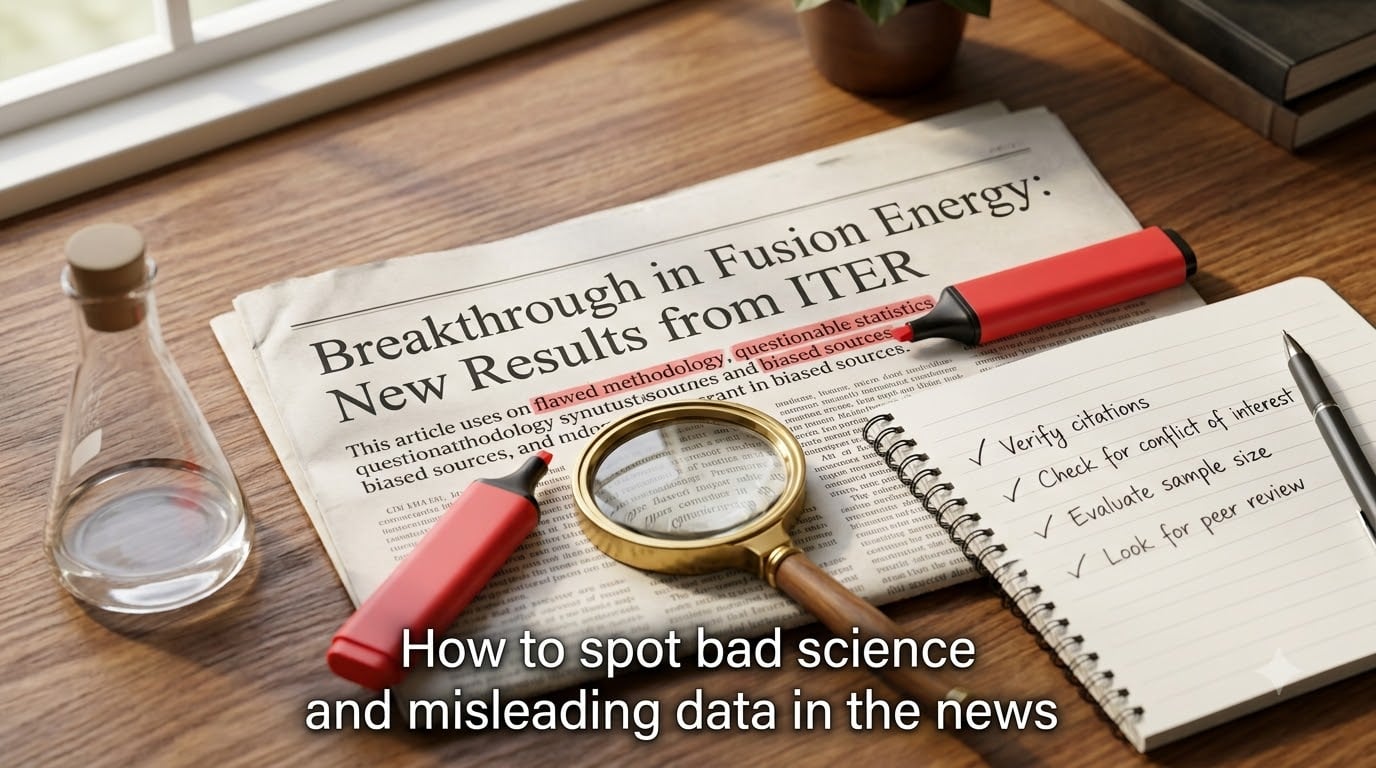
You can catch most misleading science stories in under 30 seconds by scanning for these red flags. I use this mental checklist every time a sensational claim crosses my feed.
- Miracle cure language: Words like “breakthrough,” “cure,” “revolutionary,” or “game-changer” usually signal hype rather than substance.
- Single study, sweeping claim: Real science builds slowly. One study never proves anything definitive on its own.
- No sample size mentioned: If the article does not say how many people (or mice, or cells) were studied, that is a warning sign.
- Correlation dressed as causation: Headlines saying “X causes Y” when the underlying study only showed a link are misleading.
- Vague sourcing: “Scientists say” or “a new study shows” without naming the journal or lead researcher is a tell.
- Conflicts of interest hidden: If funding sources are not mentioned, ask why. Industry-funded studies tend to favor the funder.
- No opposing view cited: Legitimate science reporting includes expert voices outside the study team.
If two or more of these appear in a single article, treat the claim with serious skepticism.
Peer Review, Journal Reputations, and Why Publication Matters
Peer review is the process where independent experts in the same field evaluate a study before it is published. It is the gatekeeper that keeps sloppy work out of reputable journals. When you see a study cited in the news, the first thing our team checks is whether it appeared in a peer-reviewed journal.
Not all journals are equal. Top-tier publications like Nature, Science, The Lancet, and JAMA have rigorous review processes and high rejection rates. Predatory journals are the opposite. They publish anything for a fee, often within days, with little to no real peer review. Beall’s List and the Committee on Publication Ethics track known predators.
How do you tell the difference? Check whether the journal is indexed in PubMed or Web of Science. Look for a clear editorial board with named researchers. Search for the journal’s impact factor. If you cannot verify any of these, assume the worst.
News articles often obscure this distinction. A reporter might say “a study published in the International Journal of…” without checking whether that journal is credible. As a reader, your job is to verify before you trust.
Sample Size, Statistical Significance, and P-Values Explained
Sample size is one of the easiest things to check, and one of the most overlooked. A study of 12 people cannot reliably tell you anything about millions. A study of 10,000 participants can. Generally, larger samples produce more reliable results because they reduce the role of random chance.
Statistical significance is a related concept. Researchers use a p-value to measure whether a result could have happened by chance. A p-value below 0.05 is the conventional threshold for significance. It means there is less than a 5% probability that the observed result is random.
But statistical significance is not the same as importance. A tiny effect can be statistically significant in a massive sample. A large effect can be statistically insignificant in a tiny one. This is where many news articles go wrong. They report “significant results” without explaining whether the effect size actually matters in real life.
Our team once reviewed a study claiming a new supplement “significantly improved mood.” The p-value was 0.04, which sounds impressive. The actual effect? A 2-point change on a 100-point mood scale. Statistically significant, practically meaningless.
When reading science news, ask three questions. How many participants were involved? What was the p-value? And how big was the actual effect?
Correlation vs Causation: The Most Common Mistake in Science News
Correlation means two things happen together. Causation means one thing actually causes the other. This distinction trips up more science reporting than any other concept.
Ice cream sales and drowning deaths both rise in summer. They are correlated. Ice cream does not cause drowning. The shared cause is hot weather, which leads to more swimming and more ice cream eating.
News headlines frequently blur this line. A study finds that people who drink coffee live longer. The headline reads “Coffee Extends Your Life.” The truth is more nuanced. Coffee drinkers might also have higher incomes, better healthcare access, or different work schedules. The coffee might have nothing to do with it.
Randomized controlled trials are the gold standard for proving causation. In these studies, participants are randomly assigned to receive a treatment or a placebo. Randomization controls for the hidden variables that observational studies cannot.
If a news article does not mention randomization, assume the underlying study is observational. Treat any causal claim with healthy skepticism until you see the study design.
Conflict of Interest, Funding Sources, and Hidden Biases
Researchers are human. They have careers, financial incentives, and ideological commitments. Acknowledging this is not cynicism. It is good science.
Conflict of interest disclosures are required by reputable journals. They tell you who funded the research, whether the authors have consulting relationships, and whether any commercial entity stood to benefit from the results. When these disclosures are missing or vague, that itself is a red flag.
Industry-funded studies are not automatically invalid, but they tend to produce results favorable to the funder. A review of beverage industry research found that studies funded by soda companies were far more likely to report that sugary drinks do not contribute to obesity. Independent studies reached the opposite conclusion.
Beyond money, ideological bias shapes research too. Climate science, vaccine research, and nutrition studies all attract advocates with strong priors. The best science addresses this by including diverse research teams and preregistering hypotheses before data collection.
When you read a science story, search for the original study and read the conflict of interest section. If it is missing, that is information in itself.
Real-World Examples of Flawed Studies That Went Viral
Looking at past failures is the fastest way to train your eye. Here are three studies that shaped public opinion despite serious flaws.
The power posing study claimed that holding “power poses” for two minutes raises testosterone and lowers cortisol. The result was a bestselling book and thousands of executives striking Wonder Woman stances before meetings. Replications failed. The original data was questioned. The lead researcher admitted statistical errors. The effect, if it exists at all, is tiny.
The green coffee bean study claimed that green coffee extract caused significant weight loss. It was retracted by its authors after the FDA found methodological flaws. The retraction came years after the study drove a major diet pill marketing campaign.
The “vaccines cause autism” study was published in The Lancet in 1998. It was retracted after investigators found that the lead author had undisclosed conflicts of interest and had manipulated data. The damage to public health continues two decades later, as measles outbreaks in undervaccinated communities show.
Each of these stories follows the same arc. A small, flawed study produces a dramatic claim. The media amplifies it. Replication and correction move much more slowly. By the time the truth arrives, the misinformation has shaped public opinion for years.
How to Evaluate a Science News Article: A Step-by-Step Walkthrough
Here is the exact process our team uses when we see a science claim we want to verify. You can run through it in under five minutes.
Step 1: Identify the original study. The news article should link to or name the published research. If it does not, search Google Scholar or PubMed using the keywords from the article. If you cannot find the original, treat the claim as unverified.
Step 2: Check the journal. Is the journal peer-reviewed and reputable? Look for impact factor, editorial board, and indexing in major databases. Cross-reference with Beall’s List if you suspect a predator.
Step 3: Read the abstract and methods section. The abstract gives you the headline finding. The methods section tells you how the researchers got there. Look for sample size, study design, and statistical approach.
Step 4: Scan for conflicts of interest. Who funded the study? Do the authors have financial stakes in the outcome? Are these disclosed?
Step 5: Look for replication. Has the result been reproduced by independent teams? A single unreplicated finding is a hypothesis, not a fact. Replication is how science separates signal from noise.
Step 6: Compare the headline to the conclusion. Read the article’s headline, then read the study’s actual conclusion. If they do not match, the reporting is misleading.
Step 7: Seek expert commentary. Has an independent expert weighed in on the study? Reputable science journalism includes outside voices. If none are quoted, that is a gap.
Run any claim through these seven steps and you will catch the vast majority of misleading science in the news.
Frequently Asked Questions About Spotting Bad Science
What are 5 ways to spot fake news?
Check the original source and verify the study exists. Look for peer review and reputable journal publication. Confirm sample size and statistical significance. Identify conflicts of interest and funding sources. Compare the headline to the actual conclusion of the research.
What are some indicators to determine if a science news report is good or bad?
Good science news names the journal, cites peer-reviewed sources, includes sample size, discloses funding, quotes independent experts, and matches the headline to the study conclusion. Bad science uses miracle language, omits key details, hides conflicts of interest, and makes sweeping claims from a single study.
What are some examples of bad science?
The power posing study that claimed body language changes hormone levels, the retracted green coffee bean weight loss study, and the discredited vaccine-autism study. Each combined small samples, methodological flaws, or undisclosed conflicts to produce claims that did not survive replication.
How do you usually check if news is true?
Start by identifying the original source rather than trusting the summary. Cross-check the claim against multiple reputable outlets. Look for primary documents, official data, or peer-reviewed studies. Use fact-checking sites for viral claims, and apply critical thinking to emotional or sensational framing.
How to tell science from pseudoscience?
Science relies on the scientific method with testable hypotheses, peer review, and reproducibility. Pseudoscience rejects these standards, relies on anecdote or tradition, makes unfalsifiable claims, and resists revision when evidence contradicts it. Look for transparency, replication, and willingness to update conclusions.
What scientific facts have been proven wrong?
Examples include the claim that stomach ulcers are caused by stress rather than H. pylori bacteria, the belief that beta-carotene supplements prevent cancer (they may increase risk), and the once-common claim that dietary fat causes heart disease. Science updates as new evidence emerges.
What are the four examples of pseudoscience?
Common examples include astrology, homeopathy, flat earth theories, and climate change denial. Each lacks peer-reviewed support, makes unfalsifiable claims, and continues to circulate despite contradicting evidence from established scientific disciplines.
Why Science Literacy Protects Democracy and Public Health
Knowing how to spot bad science and misleading data in the news is more than an academic exercise. It affects which treatments patients pursue, which policies voters support, and which risks communities prepare for.
When citizens can critically evaluate science claims, they make better personal and civic decisions. They push back on misinformation. They reward accurate reporting. They hold institutions accountable.
That is why we built this guide. The next time a headline makes a claim that sounds too good to be true, slow down. Run it through the seven steps. Verify the source. Check the sample size. Read the conflicts of interest.
Our mission at March for Science SV is to defend the role of science in public life. Critical thinking is part of that mission. Share this guide with a friend, a student, or a family member. The more readers who can tell good science from bad, the stronger our shared understanding becomes.
1 thought on “How to Spot Bad Science in the News (October 2026) Complete Reviews”