
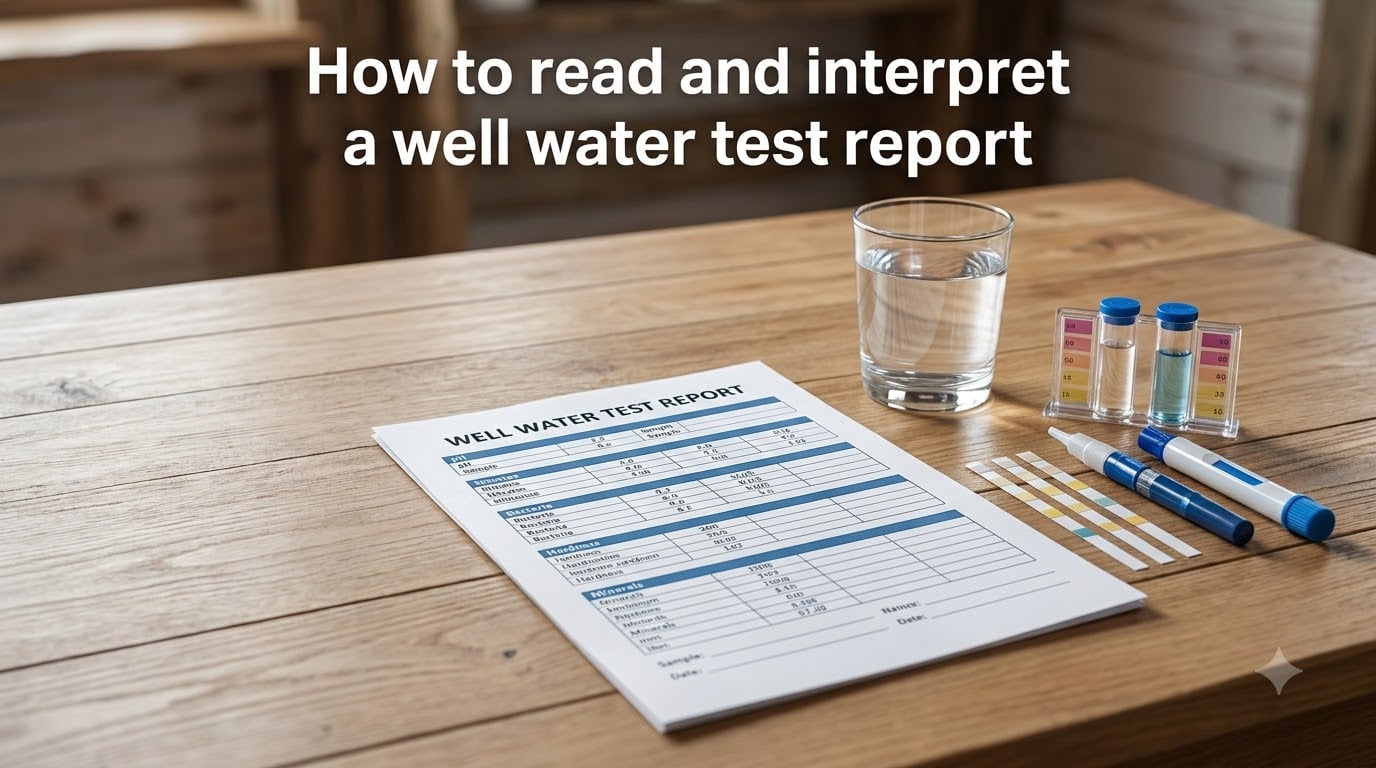
If you rely on a private well for drinking water, learning how to read and interpret a well water test report is one of the most practical skills you can build. I have helped neighbors decode lab results for years, and I have seen the same confusion show up again and again. People hold a stack of paperwork with strange numbers, abbreviations like “MCL” and “ppm,” and they cannot tell if the water is safe, marginal, or dangerous.
This guide walks you through what a typical lab report contains, what each parameter means, and how to decide on your next steps. By the end, you will be able to read your own well water test report with confidence.
Table of Contents
How to Read Your Well Water Test Report: The Basic Layout
Most certified laboratories follow a similar layout for well water test reports. Knowing the basic structure of a water quality report saves you from feeling overwhelmed when you flip open the envelope or download the PDF.
Every well water test report begins with a header section that identifies the lab, your sample ID, the date the sample was received, and the date testing was completed. Look here first to confirm the report actually belongs to your well and that the testing happened recently. Lab reports are time-sensitive documents, and most state agencies recommend your sample be analyzed within 48 hours of collection for accurate bacteria results.
Below the header, most reports contain a sample information block with details you provided at submission: the well depth, sample collection date and time, the type of well (drilled, dug, or driven), and whether the tap was a kitchen sink, outdoor spigot, or pressure tank. These details matter because interpretation depends on context. A high iron reading from an outdoor hose bib tells a different story than the same reading from your kitchen tap.
After the sample block comes the main results table. Each row represents a single parameter such as pH, total coliform, nitrate, or lead. Columns typically include the parameter name, your result, the unit of measurement, the EPA maximum contaminant level (MCL) or secondary MCL, and a pass or fail indicator. Some labs add a fourth column for the method detection limit, the lowest concentration the lab can reliably measure.
Understanding Units of Measurement on Your Report
The numbers on your report are meaningless without understanding units. Two units appear most often in private well testing: milligrams per liter (mg/L) and parts per million (ppm). For water testing, these two units are essentially interchangeable. A reading of 5 mg/L equals 5 ppm. Some reports, especially those for trace contaminants like PFAS or lead, use micrograms per liter (µg/L) or parts per billion (ppb). One ppm equals 1,000 ppb.
You will also see “NTU” for turbidity (a measure of water cloudiness) and “CFU/100 mL” for bacteria, which stands for colony-forming units per 100 milliliters of water. When you see “<" before a number, such as "<0.5 mg/L," the lab is telling you the contaminant was below their detection limit. That is good news. "ND" means non-detect, and it is the cleanest result you can get.
Key Abbreviations and What They Mean
Water quality reports are loaded with acronyms that look intimidating at first. Here is a quick glossary of the abbreviations you will encounter most often.
MCL (Maximum Contaminant Level) is the highest amount of a contaminant allowed in public drinking water under EPA rules. While private wells are not legally bound by MCLs, these values remain the best reference standard for safe drinking water.
MCLG (Maximum Contaminant Level Goal) is the level below which there is no known or expected health risk. MCLGs are set at zero for known carcinogens.
SMCL (Secondary Maximum Contaminant Level) covers contaminants that affect how water looks, tastes, or smells, but do not pose direct health risks at typical levels. Iron, manganese, and chloride often fall under SMCLs.
AL (Action Level) applies to lead and copper. If more than 10 percent of tap samples exceed the AL, the water system must take action.
pH Levels Explained: What the Number on Your Report Means
The pH reading measures how acidic or basic your water is on a scale from 0 to 14. A pH of 7 is neutral, below 7 is acidic, and above 7 is basic. For private wells, the EPA secondary standard recommends a pH between 6.5 and 8.5. Most well water falls in this range naturally, but values outside it are common.
If your pH is below 6.5, your water is acidic and may corrode metal pipes, fixtures, and solder joints. Corrosive water can leach lead and copper from plumbing, creating a secondary health hazard even if the source water is clean. Signs of corrosive water include blue-green stains in sinks, pinhole leaks in copper piping, and a metallic taste.
A pH above 8.5 means your water is alkaline. Alkaline water often has a slippery feel, may taste bitter, and tends to deposit scale on fixtures and inside water heaters. While not directly harmful, high pH reduces the effectiveness of chlorine disinfection if you use it.
For most well owners, pH itself is not a health emergency. It is more of an indicator that points to other problems. If your pH is outside the 6.5 to 8.5 range, ask your lab or local extension office about follow-up testing for lead, copper, and corrosion indicators.
Bacteria Testing: Coliform, E. coli, and What Positive Results Mean
Bacteria testing is the single most important part of any well water analysis. The presence of certain bacteria can make your water unsafe to drink, even if every chemical test comes back clean.
Most routine bacteria panels test for total coliform bacteria first. Coliforms are a broad group of organisms that live in soil, vegetation, and the digestive tracts of warm-blooded animals. Their presence does not automatically mean your water is dangerous, but it does indicate that pathogens could potentially survive in your well. A positive coliform result is a warning to investigate further.
If total coliform is detected, the lab typically retests for fecal coliform and Escherichia coli (E. coli). E. coli lives in the intestines of humans and animals and is the most reliable indicator of recent fecal contamination. Finding E. coli in your well water is a serious red flag. Drinking water with E. coli can cause gastrointestinal illness, especially in young children, older adults, pregnant women, and anyone with a compromised immune system.
If your well water tested positive for coliform but negative for E. coli, the result is still meaningful. It tells you that bacteria are entering your system from somewhere, even if the contamination is not recent fecal matter. Common causes include a cracked well cap, a shallow well near surface contamination, flooding, or nearby agricultural runoff. I recommend retesting after shock chlorination and addressing any structural issues with your well.
The standard safe reading for total coliform and E. coli is zero, or “ND” (non-detect). Anything above zero means you should not drink the water untreated until the source is identified and resolved.
Nitrates and Nitrites: Health Effects and Action Thresholds
Nitrates and nitrites are nitrogen-based compounds that leach into groundwater from agricultural fertilizer, septic systems, animal waste, and decaying plant matter. Both are tested separately because they have different toxicity profiles.
The EPA maximum contaminant level for nitrate-nitrogen (NO3-N) is 10 mg/L, and for nitrite-nitrogen (NO2-N) it is 1 mg/L. The combined total of both should not exceed 10 mg/L. If your report lists results as nitrate (NO3) rather than nitrate-nitrogen, the safe limit is 45 mg/L. Labs and reports vary, so always check which form is being reported.
Nitrates are particularly dangerous for infants under six months old. High nitrate levels can cause methemoglobinemia, also called “blue baby syndrome,” where the blood cannot carry oxygen effectively. Pregnant women and adults with certain enzyme deficiencies are also at elevated risk.
If your well shows nitrate levels above 5 mg/L, the EPA recommends retesting every six months because agricultural contamination often fluctuates seasonally. A single elevated result above 10 mg/L means you should switch to bottled water for drinking and cooking until the source is identified and treated. Reverse osmosis systems are highly effective at removing nitrates.
Heavy Metals: Lead, Arsenic, and Copper Limits
Heavy metals are among the most serious contaminants you can find in a water test report because they cause long-term health damage even at low concentrations.
Lead has an EPA action level of 0.015 mg/L (15 ppb) and an MCLG of zero. Lead is rarely present in source groundwater at dangerous levels. Most lead contamination comes from plumbing inside the home, including lead service lines, lead solder on copper pipes (used before 1986), and brass fixtures. If you have lead readings above the action level, run your tap for several minutes before using water for drinking or cooking, and consider replacing any lead-containing plumbing.
Arsenic has an MCL of 0.010 mg/L (10 ppb). Arsenic occurs naturally in some bedrock formations, especially in the western United States, and can also enter groundwater from industrial sites and certain pesticides. Long-term exposure is linked to skin damage, cardiovascular disease, and increased cancer risk. There is no safe level of arsenic, so any detection above 10 ppb requires immediate treatment or an alternative water source.
Copper has an action level of 1.3 mg/L. Copper typically leaches from household plumbing rather than from source water. High copper levels can cause stomach upset with short-term exposure and liver or kidney damage over many years.
Iron, Manganese, and Other Common Well Water Issues
Iron and manganese are two of the most common complaints among private well owners. They are not usually health hazards at the levels found in residential wells, but they create serious quality-of-life problems.
The EPA secondary standard for iron is 0.3 mg/L and for manganese is 0.05 mg/L. Even readings below these limits can stain laundry, plumbing fixtures, and dishes. Iron staining produces reddish-brown marks, while manganese staining tends to be dark brown or black. If your report shows iron above 0.3 mg/L or manganese above 0.05 mg/L, a water softener or dedicated iron filter can usually solve the problem.
Hardness measures calcium and magnesium in your water. It is reported in mg/L as CaCO3 or in grains per gallon (gpg). Readings under 60 mg/L (3.5 gpg) are considered soft, 60 to 120 mg/L is moderately hard, and above 180 mg/L is very hard. Hard water is not a health concern, but it causes scale buildup in water heaters and pipes, reduces soap effectiveness, and shortens appliance life.
Total dissolved solids (TDS) measures everything dissolved in your water, including minerals, salts, and small amounts of organic matter. The secondary standard is 500 mg/L. High TDS often correlates with hard water and can give water a flat or salty taste.
How to Interpret Your Results: Reading the Numbers Correctly
Once you understand what each parameter means, the next step is comparing your result to the appropriate standard. Most reports do this for you with a “Pass” or “Fail” column, but you should still verify.
For each parameter, identify whether it has a health-based standard (MCL, MCLG, AL) or an aesthetic standard (SMCL). If your reading exceeds a health-based standard, treat it as a priority. If it exceeds only an aesthetic standard, the water is generally safe to drink but may need treatment to address taste, staining, or scale.
Pay attention to detection limits and method references. A result listed as “<0.001 mg/L" is functionally the same as "ND" for most practical purposes. Always check the lab's detection limit before assuming a low result means the contaminant is truly absent.
Consider seasonal variation when reviewing results. Shallow wells often show higher nitrate and bacteria readings after spring rains or fall fertilizer application. If you test in a single season and get a clean result, retest at least once during a different time of year before assuming your water is consistently safe.
What to Do When Results Are Dangerous: Action Thresholds and Next Steps
If your water test report shows any contaminant exceeding its MCL or AL, take these steps in order. First, stop using the water for drinking and cooking immediately. Switch to bottled water or a known-safe source.
Second, identify the likely source. For bacteria, inspect your well cap, casing, and surrounding area for damage or surface runoff. For nitrates, check the proximity of septic systems, agricultural fields, and feedlots. For metals, test both your source water and your tap water separately to isolate whether contamination comes from the well or your plumbing.
Third, retest to confirm the result. Single elevated readings can be caused by sampling errors, recent weather events, or lab mistakes. Most agencies recommend a confirmation test before investing in treatment.
Fourth, choose appropriate treatment. Common residential treatment options include shock chlorination for bacteria, reverse osmosis for nitrates and most metals, water softeners for hardness and iron, and manganese greensand filters for manganese. Always match the treatment to the contaminant.
Fifth, contact your state laboratory or county health department. Most states offer free or low-cost well water testing, public health guidance, and lists of certified treatment professionals.
Frequently Asked Questions About Well Water Test Reports
How do I read my well water test results?
Start with the header to confirm the sample is yours and recent. Then read the results table row by row, comparing each value to the MCL or action level listed. Anything at or above the limit needs follow-up, while ‘ND’ or non-detect results mean the contaminant was below the lab’s detection limit.
How to read a water quality report for hard water?
Look at the hardness row, which is reported in mg/L as CaCO3 or in grains per gallon. Under 60 mg/L is soft, 60 to 120 mg/L is moderately hard, and above 180 mg/L is very hard. Hardness is an aesthetic issue, not a health one, but high hardness can damage water heaters and plumbing.
What if my well water tested positive for coliform but negative for E. coli?
A positive coliform result with negative E. coli means bacteria are entering your system from somewhere, but the contamination is not necessarily recent fecal matter. Common causes include a damaged well cap, shallow construction, flooding, or nearby runoff. Retest after addressing any structural issues, and consider shock chlorination.
How to read a water quality tester?
Most home test kits display results in ppm or mg/L. Match the unit on the tester to the unit on the standard you are comparing against. Home testers are less precise than lab tests but useful for routine checks between lab analyses.
How many times a year should well water be tested?
The EPA recommends annual testing for coliform bacteria, nitrates, and total dissolved solids. Test more often after flooding, well repairs, land-use changes nearby, or if anyone in the household is pregnant, very young, or immunocompromised.
What is a good well water test?
A good well water test covers coliform bacteria, E. coli, nitrate, nitrite, lead, arsenic, copper, iron, manganese, hardness, pH, and total dissolved solids. State-certified labs produce the most reliable results, and a comprehensive basic panel typically costs between $20 and $150.
Conclusion: Putting Your Well Water Test Report to Work
Learning how to read and interpret a well water test report puts you in control of your household water safety. Once you understand the layout, the units, the abbreviations, and the safe ranges for each parameter, the document becomes a roadmap rather than a mystery. Compare every reading to its MCL or secondary standard, distinguish health concerns from aesthetic ones, and act quickly when something exceeds a health-based limit.
If you remember nothing else, remember these three points. Test your well water annually through a state-certified lab. Treat any positive bacteria or E. coli result as an immediate health concern. Match your treatment to the specific contaminant you have, and confirm elevated results with a retest before investing in equipment. With these habits in place, your well water test report becomes one of the most useful tools in caring for your home.