
Learning how to record and interpret your home’s frost dates changes gardening from a guessing game into a science. I started tracking frost dates in my own backyard three years ago, and my tomato harvest has gone from spotty to consistently heavy. The reason is simple: when you know your local frost patterns, you plant at the right time every time.
Frost dates matter because they mark the boundaries of your growing season. The last spring frost date tells you when it’s generally safe to plant tender crops outdoors. The first fall frost date tells you when your warm-weather plants are at risk. Together, these two dates define how long your garden can grow.
In this guide, I’ll walk you through what frost dates actually mean, where to find them, how to interpret the numbers, and how to keep your own records. You’ll also learn how to adjust for your yard’s microclimate and extend your season when the weather cooperates.
Table of Contents
What Are Frost Dates?
Frost dates are the average calendar dates when your area typically experiences its last spring frost and first fall frost. These dates are calculated from at least 30 years of historical weather station data, so they reflect long-term patterns rather than any single year’s weather.
The last spring frost date marks the average end of freezing overnight temperatures in spring. After this date, your risk of a damaging frost drops significantly, though it never reaches zero. The first fall frost date marks the average beginning of freezing temperatures in autumn, signaling the end of the growing season for warm-weather crops.
Between these two dates lies your growing season. The length of that window determines which crops you can grow to maturity. In zone 3, the season might be 90 days. In zone 9, it’s closer to 300 days. That single number shapes everything from seed selection to harvest timing.
How to Record and Interpret Your Home’s Frost Dates: The Basics
How to record and interpret your home’s frost dates comes down to two tasks: collecting observations and reading them with the right context. Recording means writing down the actual dates frost occurs in your specific location. Interpreting means comparing those observations to regional averages and adjusting your planting schedule accordingly.
Think of regional frost dates as a starting point. They tell you what the climate usually does. Your job as a gardener is to learn what your specific yard actually does, because temperature varies block by block, slope by slope, even side-yard by side-yard.
When you record frost dates for several years, you build a personal climate dataset. After five years of consistent observation, you’ll know your yard better than any national database can. I keep a simple spreadsheet with dates, low temperatures, and notes about which plants survived. That spreadsheet has saved me hundreds of dollars in lost plants.
How to Find Your Frost Dates
Finding your official frost dates takes about ten minutes. Here’s the process I recommend.
Step 1: Look up your USDA Hardiness Zone. Visit the USDA Plant Hardiness Zone Map at planthardiness.ars.usda.gov and enter your ZIP code. This gives you your zone, which is the foundation for everything else.
Step 2: Use a frost date calculator. The Old Farmer’s Almanac, the National Gardening Association, and NOAA all offer free frost date calculators online. Enter your ZIP code and you’ll get the average last spring frost and first fall frost dates for your area.
Step 3: Cross-reference at least three sources. Different sources use different probability thresholds and weather stations. The almanac might say May 10 while the extension office says May 18. This is normal. Average them or take the later date to be safe.
Step 4: Call your local extension office. University cooperative extension offices have region-specific data and advice. They often know about local patterns that national databases miss. My extension office told me about a frost pocket two miles east of town that regularly runs 7 days later than the official date.
Step 5: Check with a local nursery. Independent nurseries stock plants timed for your actual conditions. Ask them when they put out tomatoes and peppers. They’ll tell you what really works, not just what the data says.
Understanding Frost Date Probability
Frost dates are probabilities, not promises. Most sources report dates with a 50% probability threshold, meaning there’s a 50% chance of frost before that date and a 50% chance after. Some sources use a 30% threshold or a 70/30 rule, which is more conservative.
The 70/30 rule in gardening means you pick a date where there’s only a 30% chance of frost occurring after it. This gives you a buffer against late cold snaps. I use 70/30 dates for tomatoes, peppers, and basil, which are frost-sensitive. For cool-season crops like lettuce and kale, I use the 50% date because they tolerate light frost.
How accurate are last frost date predictions? Honestly, they’re decent but not perfect. A 30-year average smooths out extremes, but recent climate shifts have pushed many regions earlier or later than the historical baseline. That’s why your own recordings matter so much. They capture your current reality, not a 30-year-old snapshot.
How to Record Your Own Frost Observations
National databases tell you about your region. Personal observations tell you about your yard. Here’s how I keep records that actually improve my garden results.
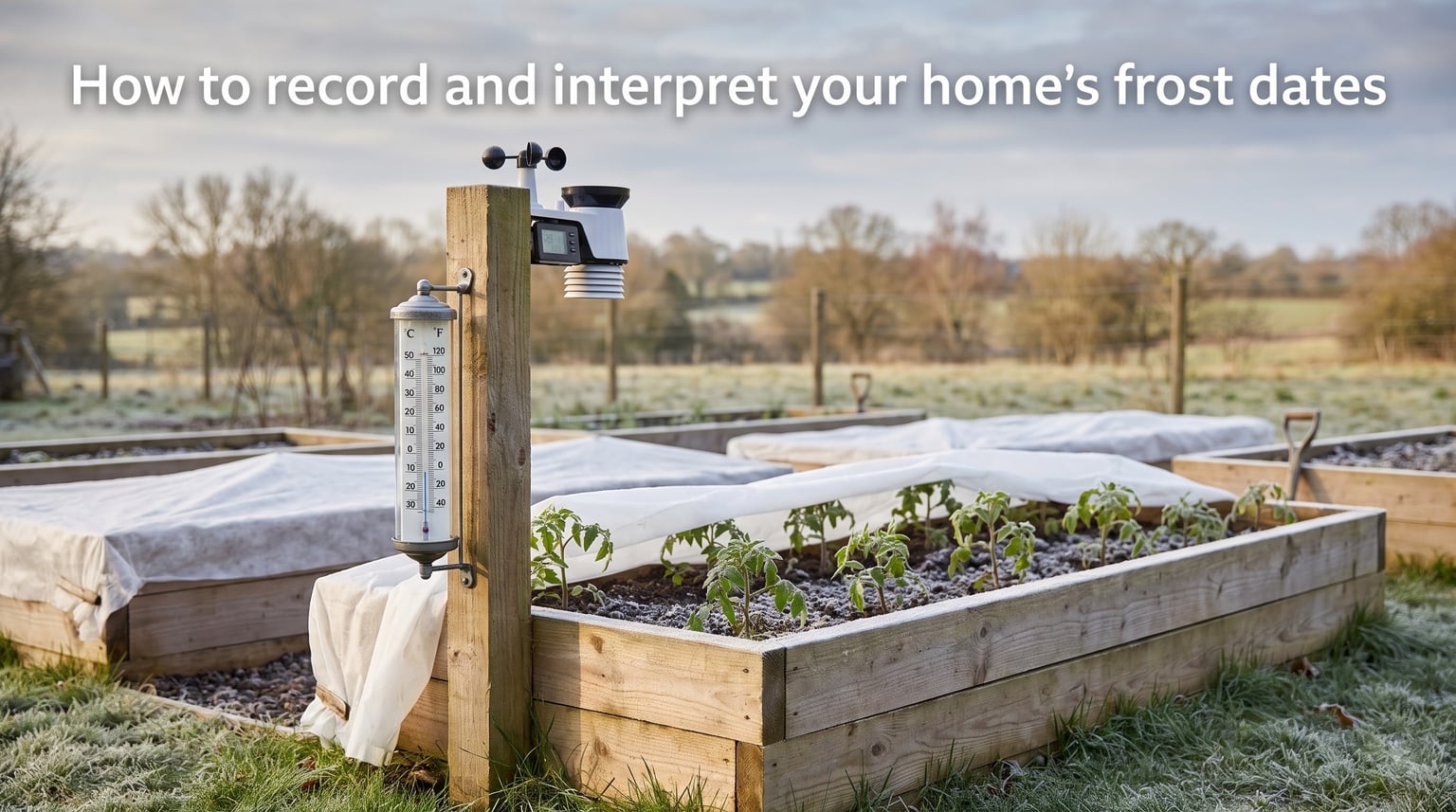
Choose your thermometer wisely. A wireless weather station with an outdoor sensor gives you the most reliable data. Mount the sensor 4 to 6 feet above ground, away from buildings, pavement, and direct morning sun. I’ve used AcuRite and Davis stations and both work well for under $100.
Record the date and minimum temperature. Every time temperatures drop to 32 degrees Fahrenheit or below, log the date and the lowest temperature reached. Include whether the frost was a light frost, hard frost, or killing frost (more on that below).
Note the conditions. Clear skies, calm winds, and low humidity all increase frost risk. Capturing these details helps you predict future events. A still, clear night in late April is far more dangerous than a cloudy, breezy one.
Track plant damage. Did your tomato seedlings survive? Did the apple blossoms get hit? This connects weather data to actual outcomes, which is what really matters for planning.
Use a simple recording system. I keep a notebook in the garden shed and a spreadsheet backup. Some gardeners use apps like SeedTime or Garden Planner. Whatever works for you will work. The key is consistency. After 3 years of records, you’ll see patterns NOAA never captured.
Mine your data each year. Compare your records to regional averages. If your last spring frost is consistently 10 days later than the official date, adjust your planting schedule accordingly. That personalization is the whole point of recording.
Frost Types and Their Effects on Plants
Not all frost is equal. Understanding the difference helps you protect the right plants at the right time.
A light frost occurs when temperatures drop to 32 to 35 degrees Fahrenheit briefly. Tender plants may show minor damage, but most hardy crops survive. Lettuce, spinach, kale, and peas handle light frost without issue.
A hard frost happens when temperatures fall between 28 and 32 degrees Fahrenheit for several hours. Ice forms inside plant cells, causing visible damage. Tomatoes, peppers, and basil are usually destroyed at these temperatures.
A killing frost is when temperatures drop below 28 degrees Fahrenheit, often for several hours. This kills most tender vegetation, often down to the roots. It signals the definitive end of the growing season for warm-weather crops.
Will frost form at 40 degrees? Yes, sometimes. Frost forms on surfaces that radiatively cool below 32 degrees, even when the official air temperature is 40. Clear nights, calm winds, and low humidity create perfect conditions. This is why your roof can have frost while the weather station reports 38 degrees.
How to Interpret Frost Date Data for Garden Planning
Once you have your frost dates, you can build a planting calendar. The math is straightforward. Count backward from your last spring frost to find seed starting dates. Count forward from your first fall frost to find harvest deadlines.
For warm-season crops like tomatoes, start seeds indoors 6 to 8 weeks before your last spring frost date. Transplant outdoors 1 to 2 weeks after that date, when soil has warmed. I always wait until night temperatures stay above 50 degrees Fahrenheit consistently.
For cool-season crops, you have two windows. Plant in early spring, 4 to 6 weeks before the last frost, for harvest before summer heat. Plant again in late summer, 10 to 12 weeks before the first fall frost, for fall and early winter harvest.
Use the days-to-maturity on your seed packets to calculate your planting deadlines. Add 14 days as a buffer for unexpected weather. If your first fall frost is October 15 and your variety needs 70 days, plant by July 25 at the latest.
Keep a planting journal with actual planting dates, germination dates, and harvest dates. After a few seasons, this becomes your personal planting calendar, often more useful than any online calculator.
Microclimate Variations in Your Yard
Your yard is not your zone. Slopes, pavement, water features, and tree cover all create microclimates that differ from the regional average. A south-facing wall might be zone 7 while a shaded low spot in the same yard is zone 5.
Cold air sinks, so low spots and valleys are frost pockets. Hilltops and south-facing slopes are warmer and drain cold air away. I have a 5-degree difference between my front yard and back yard on the same night.
Buildings, fences, and large rocks absorb heat during the day and release it at night. Planting near these features gives tender plants a buffer. I keep basil against the south wall of my house for exactly this reason.
Record your frost observations by location. Note which parts of your yard frost first and which frost last. After a few years, you’ll know exactly where to plant your most frost-sensitive crops and where to push the season earliest.
How to Extend Your Growing Season?
Frost dates are averages, not laws. With season extension tools, you can plant earlier and harvest later than your zone suggests.
Cold frames are bottomless boxes with clear lids that trap solar heat. They let you plant 4 to 6 weeks before your last spring frost and harvest 4 to 6 weeks after your first fall frost. You can build a basic cold frame from old windows and lumber for under $50.
Row covers and frost cloth protect plants down to about 28 degrees Fahrenheit. Drape them over seedlings on cold nights and remove them in the morning. They’re cheap, reusable, and effective.
Hoop houses are larger structures, essentially unheated greenhouses. They add 2 to 3 weeks on each end of the season. Serious gardeners use them to grow greens all winter in zones 6 and warmer.
Mulch is an underrated season extender. A thick layer of straw or shredded leaves insulates soil and roots, protecting perennials through winter and allowing earlier spring growth.
Frequently Asked Questions
How do I determine my frost date?
Enter your ZIP code into a frost date calculator from the Old Farmer’s Almanac, NOAA, or your local university extension office. Cross-reference at least three sources, then choose the latest date for safety. Your local extension office will give you the most accurate regional data.
What is the 70/30 rule in gardening?
The 70/30 rule means using a frost date where there’s only a 30% chance of frost occurring after it. This gives you a safety buffer for tender crops like tomatoes and peppers. Use the 50% date for hardy crops that tolerate light frost.
What temperature is considered a killing frost?
A killing frost occurs when temperatures drop below 28 degrees Fahrenheit for several hours. This freezes plant cells and destroys most tender vegetation. A light frost at 32 to 35 degrees damages only the most sensitive plants.
How long after the first frost does the ground freeze?
Ground freeze typically occurs 2 to 4 weeks after the first hard frost, depending on soil moisture, snow cover, and tillage. Snow actually insulates the ground and delays freeze. Bare, wet soil freezes faster than dry, mulched soil.
Will frost form at 40 degrees?
Yes, frost can form at 40 degrees Fahrenheit on surfaces that radiatively cool below freezing. Clear skies, calm winds, and low humidity create perfect conditions. This is why your car windshield can have frost even when the official temperature reads 38 degrees.
How accurate are last frost date predictions?
Frost date predictions are based on 30 years of historical data and are accurate within 7 to 14 days for most regions. Recent climate shifts have made them less reliable than they used to be. Personal observation records improve accuracy for your specific location.
Start Tracking Your Frost Dates Today
Knowing how to record and interpret your home’s frost dates gives you a real advantage in the garden. Start by looking up your regional dates, then begin tracking what actually happens in your yard. After three years of records, you’ll have insights no national database can give you.
Pick a recording system you’ll actually use, whether that’s a notebook, a spreadsheet, or a garden app. Note the date, the minimum temperature, and any plant damage. Cross-reference with regional averages each spring and fall, and adjust your planting calendar accordingly. Your garden will thank you with stronger harvests and fewer lost plants.