
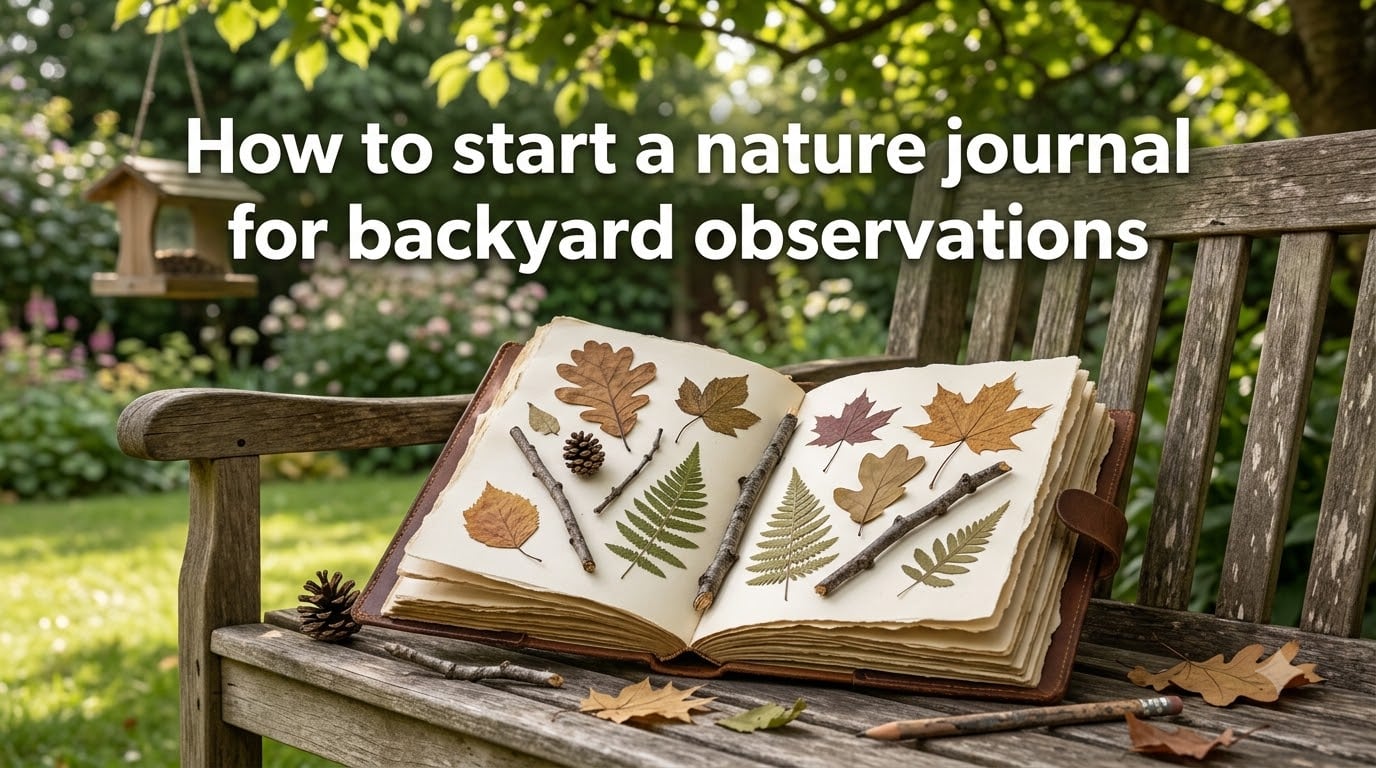
Nature journaling is the practice of recording what you notice in the natural world through words, sketches, numbers, or collected specimens. When you focus on your own backyard, you turn an ordinary outdoor space into a long-term laboratory for observation.
I started keeping a backyard nature journal three summers ago, and the habit has changed how I see the patch of grass behind my house. I notice more birds now. I track when the first bumblebee shows up each spring. I have records of oak leaves in three different colors during the same week in October.
In this guide, I’ll walk you through how to start a nature journal for backyard observations from scratch. You’ll learn what to record, how to choose a sit spot in your yard, what supplies actually matter, and how to keep going when the first enthusiasm wears off.
Table of Contents
What Is Nature Journaling and Why Start in Your Backyard?
Nature journaling is a structured way to slow down and pay attention to the living things around you, then record those observations in a dedicated notebook. It combines elements of field science, sketching, and personal reflection into one practice.
The Real Definition of Nature Journaling
At its core, nature journaling is about training your attention, not producing art. You write down what you see, hear, smell, and count. You sketch quick shapes. You ask questions about what you do not understand.
The journal itself can take many forms. Some people draw detailed botanical illustrations. Others write paragraphs about the weather and the birds they spotted. A few tape leaves inside the pages or press flowers between sheets. None of these approaches is more correct than the others.
What matters is the act of looking carefully and recording what you noticed. That single act is the foundation of every nature journal, from a child’s first scribble to a working biologist’s field notebook.
Backyard-Specific Advantages You Might Overlook
Your backyard offers something no park or trail can match: repeated access to the exact same location. You can return to the same oak tree every week for a year and document how it changes. You can count the birds at the same feeder across seasons.
Backyard observation also removes a common barrier. You do not need to drive anywhere, pack a bag, or commit to a long hike. You step outside your door, sit down, and start noticing. That low-friction access makes it far easier to build a consistent habit.
I have watched a single maple tree in my yard go from bare branches to bud break to full leaf to first color in one season, all from the same kitchen chair. That kind of continuity is gold for building observation skills.
Choosing Your Journal and Basic Supplies
You do not need much to start a nature journal for backyard observations. A notebook and a pencil will get you further than you might think. Here is what actually matters when you gather supplies.
Picking the Right Journal
Any bound notebook with blank or lightly lined pages works as a nature journal. The best choice is one you will actually carry outside and use without worrying about ruining it.
Sketchbooks with cream-colored paper handle colored pencil and light watercolor well. Composition notebooks are cheap and tough enough for outdoor use. Spiral-bound field notebooks lay flat when you open them, which makes writing easier.
Avoid anything too precious at the start. You want a journal that feels low-pressure, so you do not hesitate to scribble a quick note or sketch a rough shape when something catches your eye.
Writing and Drawing Tools
A few pencils cover most of what you need. A regular graphite pencil works for notes and quick sketches. A mechanical pencil gives you a consistent line for detailed work. Colored pencils let you capture the actual color of a leaf or bird.
A black fine-tip pen is useful for labeling and adding text to sketches. A soft eraser helps when you want to adjust a drawing without damaging the paper.
If you plan to add watercolors later, a small water brush and a pocket-sized paint set can join your kit. Most beginners, including me, skipped this for the first six months and added it only after the habit was solid.
Optional Extras Worth Considering
A magnifying glass or hand lens turns ordinary observations into discoveries. The veins on a leaf, the segments of an insect wing, the texture of bark all become much more interesting under magnification.
A small ruler helps you record the size of plants, mushrooms, or animal tracks. A field guide for your region makes identification faster, though you can also photograph unknowns and look them up later.
A simple pouch or tote to carry your supplies keeps everything together. The goal is to make it easy to grab your kit and head outside without thinking about it.
Selecting Your Backyard Sit Spot
A sit spot is a specific place you return to repeatedly to observe nature. Choosing the right one in your backyard makes the difference between a journal full of generic entries and one full of rich, specific observations.
What Makes a Good Sit Spot
The best sit spot in your backyard is somewhere you can see a small slice of habitat without too much distraction. A corner of the yard near shrubs and a bird feeder works well. A spot under a tree where shadows shift through the day is even better.
Look for a place that combines several layers of life. Trees, shrubs, ground plants, bare soil, and water features all attract different creatures at different times. The more variety you can see from one spot, the richer your observations will be.
Comfort matters too. You will sit here often, so a place with a chair, a bench, or even a flat rock you can perch on will help you stay longer. I picked a spot near a window so I could also observe on rainy days without getting wet.
Visiting Your Sit Spot for the First Time
Spend your first visit doing nothing but looking and listening for at least 15 minutes. Do not write yet. Just notice what lives there, what moves, what sounds you hear.
After that quiet observation, write down three things: the most noticeable sound, the most noticeable movement, and the most noticeable color or pattern. These become your baseline, the first reference point you can compare future visits against.
Return to the same spot at different times of day and in different weather. Morning visits often show different birds than evening ones. After-rain visits reveal snails, worms, and mushroom activity you would miss in dry conditions.
What to Observe and Record During Each Visit
The hardest part for most beginners is knowing what to actually write down. Here is a simple system that takes the guesswork out of every entry.
The 3-3-3 Observation Method
The 3-3-3 method is a quick structure that works for any visit. Each time you sit down at your backyard spot, notice 3 things you see, 3 things you hear, and 3 things you wonder about.
For example, on a May morning in my yard, I saw a robin, a dandelion, and a beetle on the fence. I heard a woodpecker, traffic in the distance, and a dripping hose. I wondered why the dandelions clustered along the south edge, where the woodpecker was working, and whether the beetle was eating the fence.
This method takes about 5 minutes and produces a complete entry every time. It also trains you to use multiple senses, which strengthens your observation skills far more than relying on sight alone.
Recording Context: Date, Time, Weather, and Place
Every nature journal entry should include the basics: the date, the time of day, the weather, and your exact location in the yard. Context is what turns a list of facts into a record you can learn from later.
Date and time tell you when something happened. Weather tells you why a plant might be blooming early or a bird might be acting unusually. Your exact spot tells you what kind of habitat you were watching.
After a year of entries, you can look back and see patterns. The robin first sang on March 14 at 6:42 a.m. The maple dropped its first leaves on October 3. The ladybugs appeared on the south wall every sunny afternoon in November. None of these patterns would be visible without the context.
Wildlife, Plants, and Seasonal Changes
Wildlife observations are the most popular entry in most backyard journals. Note the species you see, how many, what they were doing, and where they went. Even common birds like robins and sparrows deserve notes when you see them doing something interesting.
Plants deserve attention too. Sketch a leaf, count the petals on a flower, note when a tree first leafs out or first drops its leaves. A pressed leaf taped into your journal next to a written description creates a permanent record you can reference years later.
Seasonal changes are easiest to track when you compare entries across months. Did the same shrub bloom earlier this year than last year? Are different birds visiting the feeder in winter than in summer? These comparisons turn your backyard journal into a long-term study.
Simple Techniques That Don’t Require Artistic Skill
The single biggest worry I hear from people starting a nature journal is that they cannot draw. Here is the truth: drawing skill is optional, and you can produce a rich, useful journal without any artistic training at all.
I Notice, I Wonder, It Reminds Me Of Framework
This three-part framework, often called “I Notice, I Wonder, It Reminds Me Of,” gives you a complete entry structure using only words. You write what you noticed, what you wondered about it, and what it reminded you of.
For example: “I notice the oak leaves are half-size today. I wonder if the late frost slowed their growth. It reminds me of how the same tree looked three weeks ago in early spring.” That entry took about a minute and captures real observation.
This framework works because it pushes you past simply listing what you see. The “I Wonder” part turns you into a question-asker, which is the heart of scientific thinking. The “It Reminds Me Of” part connects this moment to your past experiences and knowledge.
Word-Based Entries That Still Work
Some of my most valuable entries contain no drawings at all. A paragraph describing the sound of a woodpecker, the smell of soil after rain, or the way light falls through leaves at dusk captures observation just as well as any sketch.
Try writing a sensory description using all five senses: what you see, hear, smell, touch, and (carefully) taste. A line like “the air smells like wet pine needles and cold earth” records information you would otherwise forget within hours.
You can also list things by category. Birds today: 4 robins, 1 cardinal, 2 chickadees. Insects: 1 bumblebee, 3 ants on the path, no spiders. These simple lists become powerful data when you keep them across months.
Simple Shapes and Symbols Anyone Can Draw
If you want to add visuals but feel intimidated, start with basic shapes. Circles, ovals, and lines can represent leaves, eggs, clouds, or stones. You do not need realistic art; you need enough visual information to remember what you were looking at.
Arrows showing movement are useful. A bird flying left, a worm moving into soil, a cloud drifting across the sky. Tiny maps of your sit spot with an X marking where something happened add clarity without requiring any drawing skill.
I keep a small symbol key in the back of my journal. A dot means I saw a new species. A star means I have a question to research. A circle means I returned to a familiar subject. These marks turn each page into a quick-glance summary.
Building a Consistent Nature Journaling Habit
Starting a nature journal is easy. Sticking with one for months and years is the actual challenge. Here is what worked for me and what forum users repeatedly recommend.
Starting With 10-Minute Sessions
Most beginners who quit do so because they tried to write long entries from day one. Short sessions beat long ones every time. Ten minutes a day, three days a week, builds a habit that lasts. Sixty minutes once a month does not.
I started with five minutes at the same kitchen chair every morning with coffee. That was enough time for one 3-3-3 entry plus a quick sketch of whatever caught my eye. After two months, the habit felt automatic and I naturally extended the time.
Forum users in nature journaling communities consistently report the same thing. Short, regular entries produce better journals than occasional marathon sessions. The reason is simple: repetition builds skill faster than intensity.
Using Triggers and Routines
A trigger is something that reminds you to journal. Pouring your morning coffee, finishing lunch, or unlocking the back door can all become triggers if you pair them with your journaling habit.
Keep your journal in plain sight. Mine sits on the kitchen counter next to my coffee mug. I see it before I open my laptop, which cues me to step outside first. Out of sight is out of mind, even for good habits.
Decide on a default time and place. If your answer to “when do I journal” is always “whenever I feel like it,” you will skip most days. Pick a trigger time and stick with it for at least three weeks before deciding whether to adjust.
What to Do When You Skip a Day
You will skip days. That is normal and expected. The mistake is treating a missed day as a failure and letting it spiral into a missed week, then a missed month.
When you skip a day, leave the page blank or write one sentence about why you skipped. Do not skip two days in a row if you can help it. One missed day is a rest. Two missed days starts breaking the habit loop.
I have gaps in my journal from sick days, travel, and bad weather. I do not go back and fill them in. I just write the next entry when I can. The journal records what actually happened, including the gaps, and that honesty is part of what makes it valuable.
Seasonal Observation Tips for Backyard Journals
One of the biggest rewards of backyard journaling is watching the same space change across seasons. A few focused strategies make those changes easier to track.
Tracking Phenology Through the Year
Phenology is the study of seasonal timing in nature, and your backyard is a perfect place to practice it. Note when the first crocus blooms, when the migrating warblers pass through, when the first frost hits, and when the last leaves fall.
Year after year, these records reveal shifts. The first robin might arrive earlier in 2026 than it did five years ago. The maple might leaf out a week sooner than the long-term average. Your personal backyard data becomes part of a much bigger story.
You can contribute your observations to citizen science projects. Platforms like iNaturalist and Journey North accept backyard phenology records from any observer. Your humble journal entries become real data used by scientists.
What Changes When in Your Backyard
Spring is the busiest season for change. Buds break, flowers open, migrants arrive, and insects emerge. Try to write a short entry every few days during these weeks. The pace of change is so fast you will miss things if you only check weekly.
Summer rewards patient observers. Birds are quieter once nesting ends. Butterflies visit specific flowers. Bats emerge at dusk. The light changes through the day in ways that affect what you see and where animals are active.
Fall brings visible color changes and migration. Track which trees turn first and which hold their leaves longest. Watch the bird feeder become more crowded as winter approaches. Note the last day you see a hummingbird, a swallow, or a monarch.
Winter reveals what summer hides. Bark textures, evergreen shapes, bird flocks, and animal tracks in snow all become visible when leaves are gone. Many backyard naturalists say winter is when they learn the most about their sit spot.
Nature Journaling With Kids and Family
Backyard nature journaling works especially well as a family activity. Kids notice different things than adults, and combining observations makes every entry richer.
Give younger children their own simple journal and let them draw or scribble freely. The point is not a beautiful page but a record of what they noticed. Ask them to tell you about their drawing and write their words underneath.
Older kids can use the same frameworks adults do, including the 3-3-3 method and I Notice, I Wonder. Many children who hate writing assignments love nature journaling because it has no rules and no wrong answers.
Schedule a weekly family sit spot visit. Sit together for 15 minutes, then share what each of you noticed. The conversation that follows becomes part of your learning, and the shared memories last far longer than any single entry.
Frequently Asked Questions
What are some ideas for starting a nature journal?
Start with a dedicated notebook and a pencil, choose a quiet spot in your yard, and record the date, time, and weather. Use the 3-3-3 method: note 3 things you see, 3 things you hear, and 3 things you wonder about. Add quick sketches, leaf rubbings, or pressed flowers as you get more comfortable.
What is the 3-3-3 journaling method?
The 3-3-3 method is a simple observation structure where you notice 3 things you see, 3 things you hear, and 3 things you wonder about during each visit to your backyard sit spot. It takes about 5 minutes and produces a complete entry every time, training you to use multiple senses.
How do I start a nature journal?
Pick any bound notebook with blank or lightly lined pages and pair it with a pencil. Choose one spot in your backyard, visit it for 10 to 15 minutes, and write down what you see, hear, and wonder about. Return to the same spot regularly, even just three times a week, and add sketches or lists as your confidence grows.
Can you give me an example of a nature observation?
A simple backyard nature observation might read: ‘May 12, 7:15 a.m., partly cloudy, 58 degrees. Saw a robin pulling a worm from the lawn near the maple tree. Heard a woodpecker drumming on the oak. Wondered if the robins are nesting in the shrub by the fence because I saw two carrying twigs yesterday.’ This entry includes context, sensory detail, and a question to follow up on.
Your Next Steps With a Backyard Nature Journal
Starting a nature journal for backyard observations does not require special talent, expensive gear, or large blocks of free time. It requires a notebook, a pencil, one spot in your yard, and a willingness to slow down and notice.
Pick up a cheap notebook today and step outside for ten minutes. Write what you see, what you hear, and what you wonder about. Do the same thing tomorrow. By the end of the week, you will have a real journal, and by the end of the month, you will have the beginnings of a real practice.
The backyard you have right now, with all its weeds, insects, weather, and quiet moments, is more than enough material. You do not need a perfect yard or a perfect plan. You just need to start.