
Every year, U.S. poison control centers receive over 2 million calls about potential poisonings. Children under 6 account for nearly half of those calls. Most of these emergencies happen at home, with everyday products sitting in cabinets just feet from where kids play.
Learning how to store home chemistry chemicals safely away from children is the single most effective step you can take to reduce that risk. The good news is that proper storage is straightforward once you know the core principles.
I have spent years researching home safety as a parent and science advocate. What I have found is that most families get the basics right but miss critical details that make a real difference. This guide walks through every room, every chemical type, and every age group so nothing slips through the cracks.
You will find the “High and Locked” principle, a room-by-room breakdown, exact height recommendations, age-specific strategies, and a clear emergency action plan. Let us start with the foundational rule that every expert agrees on.
Table of Contents
The “High and Locked” Principle Explained
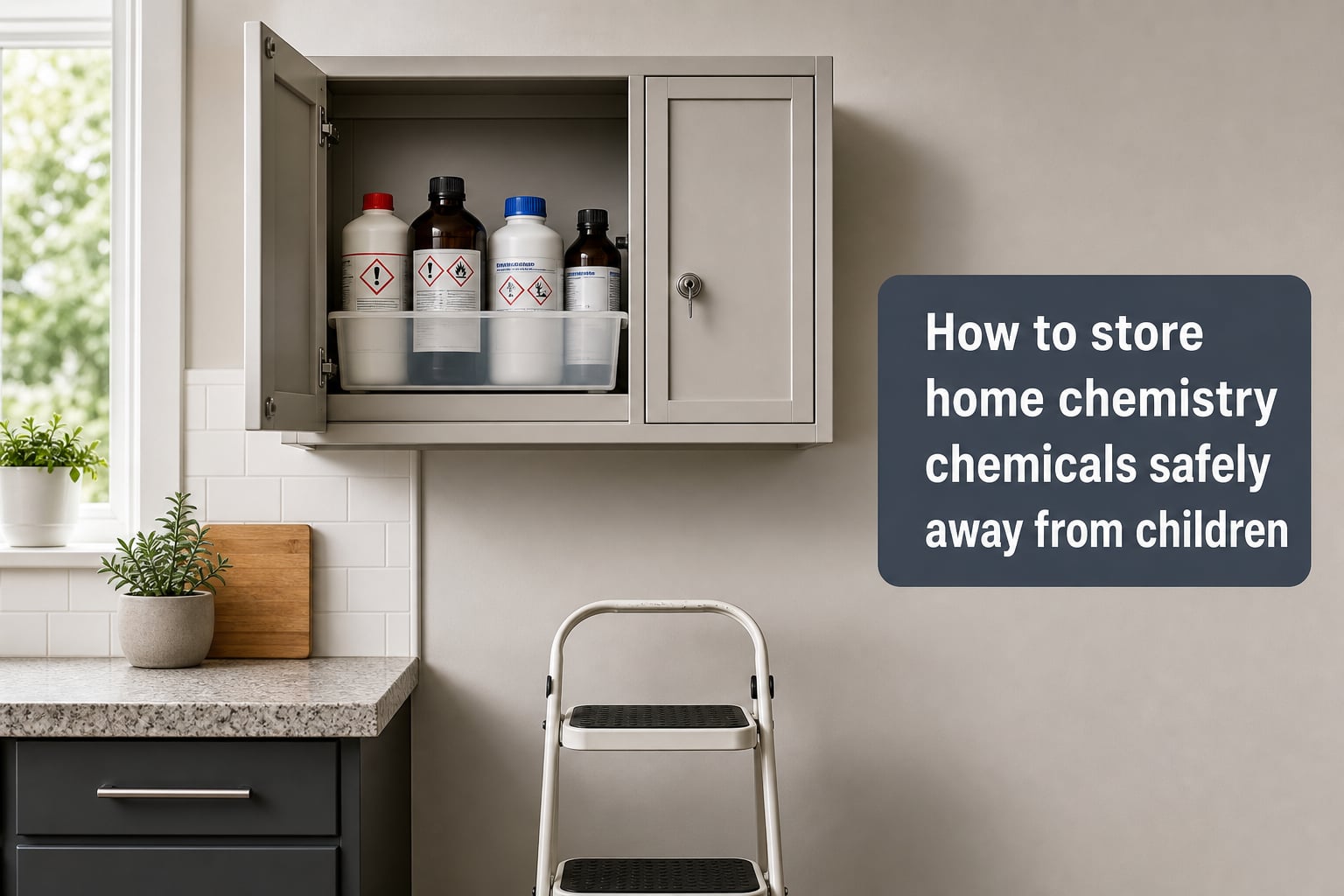
The “High and Locked” principle is the single most effective rule for keeping children safe from household chemicals. It means storing every hazardous substance both out of reach and behind a barrier a child cannot open.
“High” means at least 5 feet off the ground. At that height, most children under 7 simply cannot physically reach the shelf, even with a stool. “Locked” means a physical barrier — a child-safety latch, padlock, or automatic-locking mechanism on the cabinet door.
Neither measure alone is enough. Toddlers are surprisingly resourceful and will push a chair, climb a counter, or use a broom handle to knock items off high shelves. A lock on a low cabinet stops them from opening the door, but if a child eventually figures out the latch, the chemicals are right at their eye level. You need both height and a lock together.
Here is a quick numbered summary you can follow:
Store all chemicals at least 5 feet off the ground.
Place them in a cabinet with a working child-safety lock or padlock.
Keep the cabinet out of sight — behind a closed door if possible.
Use secondary containment (a plastic bin or tray) inside the cabinet to catch leaks.
Recheck the lock every month to make sure it still engages properly.
This principle applies to every room in your home. Whether it is bathroom cleaners, kitchen supplies, garage solvents, or garden pesticides, “High and Locked” is your starting point.
What Household Chemicals Pose a Risk to Children
Many parents underestimate how many dangerous chemicals are sitting around their home. The list extends far beyond obvious hazards like bleach and pesticides. Here is a breakdown by category of the products you need to secure.
Cleaning Products
Cleaning products cause more childhood poisonings than any other chemical category. Drain cleaners, toilet bowl cleaners, oven cleaners, and bleach are all highly corrosive and can cause severe throat and stomach burns. Dishwasher pods and laundry detergent pods are especially dangerous because their bright colors and squishy texture look like candy to young children.
Medications
Both prescription and over-the-counter medications are a leading cause of accidental poisoning. Iron supplements, pain relievers, cold medicines, and heart medications can all be fatal in small doses. Never refer to medicine as candy — this confuses children into thinking all pills are safe to eat.
Automotive and Garage Chemicals
Antifreeze has a sweet taste that children and pets find appealing, and even a small amount can cause kidney failure. Motor oil, brake fluid, windshield washer fluid, and car cleaning products all belong in locked garage storage, never in the house.
Pesticides and Garden Chemicals
Weed killers, insecticides, rat poison, and fertilizers are extremely toxic and often stored carelessly in garden sheds or garages. Slug bait and rodent poison are particularly dangerous because they are designed to be left on the ground where children can find them.
Less Obvious Hazards
Button batteries (found in remotes, hearing aids, and toys) can burn through a child’s esophagus in under two hours. Essential oils like eucalyptus and tea tree oil can cause seizures if ingested. Vape liquids contain concentrated nicotine that is toxic in tiny amounts. Alcohol-based hand sanitizers and rubbing alcohol are also frequent offenders.
Walk through every room of your home and collect these items. If you would not want your child touching or tasting it, it needs safe storage.
Best Storage Locations by Chemical Type
Different chemical types have different storage requirements. Temperature, ventilation, and proximity to living spaces all matter. Here is a room-by-room guide to where each category belongs.
Kitchen Storage
The kitchen is tricky because it is where families spend the most time. Avoid the classic “under the sink” spot for cleaning products — it is exactly where a crawling toddler looks first. Instead, move dish soap and surface cleaners to a high cabinet above the counter, secured with a safety latch. Keep dishwasher pods in their original child-resistant container on a top shelf.
Bathroom Storage
Bathrooms house medications, toiletries, and cleaning products in a small, humid space. Store all medications in a locked medicine box on a high shelf — not in a low vanity drawer. Toilet bowl cleaner, drain unblocker, and mold remover should go in a high linen closet with a lock, not on the edge of the tub.
Garage Storage
Garages hold the most dangerous chemicals: antifreeze, motor oil, pesticides, paint thinner, and pool chemicals. Store these on a high shelf inside a locked metal or heavy-duty plastic cabinet. Garages should be cool and well-ventilated, but avoid storing chemicals near water heaters or furnaces where heat could cause containers to degrade or ignite flammable contents.
Laundry Room Storage
Laundry detergent pods are one of the most frequently ingested household products by children under 5. Keep all laundry products — pods, liquid detergent, bleach, and fabric softeners — in a high, locked cabinet. Never leave pods in an open decorative jar on top of the machine, no matter how convenient it seems.
Secondary Containment Technique
One technique most guides miss is secondary containment. Place a plastic storage bin or shallow tray under your chemical bottles inside the cabinet. If a bottle leaks, cracks, or tips over, the bin catches the spill before it drips down to where a child might touch it or where incompatible chemicals could mix. This is standard practice in professional labs and works just as well at home.
Why Original Containers and Labels Matter
Always store chemicals in their original labeled containers — never transfer them to food containers, water bottles, or jars. This single rule prevents a significant number of accidental poisonings every year.
The label on a commercial product contains three critical pieces of information: the active ingredients, the hazard warnings, and the emergency instructions. If a child does ingest a product, Poison Control will ask you to read the label. Without it, identifying the right treatment becomes much harder and more dangerous.
Transferring chemicals to food containers is especially risky. A sports drink bottle filled with antifreeze looks identical to the real thing. A margarine tub of laundry powder looks like food. Children cannot tell the difference, and even adults have accidentally consumed chemicals stored in food packaging.
If an original container is cracked or leaking, transfer the chemical to a clearly marked container with a written label that includes the product name, active ingredient, and hazard warning. Use a permanent marker, not a sticky note that can fall off.
Keep the original child-resistant cap on at all times. Remember that “child-resistant” does not mean “child-proof.” It only means it takes a child longer to open — usually enough time for an adult to notice. That is why locks and height still matter even with child-resistant caps.
Choosing Safe Cabinets and Child-Proof Locks
Not all cabinets and locks are equally effective. Choosing the right combination makes a real difference in how well your chemical storage holds up against a determined toddler.
Cabinet Types
Solid wood or metal cabinets are best for chemical storage. Avoid flimsy particleboard cabinets with push-latch doors — toddlers can pull these open with a firm yank. A cabinet with a door that closes flush and has a frame for mounting a lock is ideal. If you rent and cannot install permanent hardware, choose a freestanding lockable storage cabinet.
Lock Types
There are three main categories of child safety locks for cabinets. Each has strengths and weaknesses:
Automatic-locking latches: These engage every time the door closes. You never have to remember to lock up. They are the most reliable option for busy parents. Look for models that require a magnet to open.
Magnetic locks: Installed inside the cabinet door and opened with a magnetic key you keep separate. Completely invisible from the outside, which is nice for kitchens. Just do not lose the key.
Padlocks and combination locks: Best for garages, sheds, and outdoor storage. A keyed padlock on a metal cabinet is nearly impossible for a young child to defeat.
Whichever lock you choose, test it yourself. Close the cabinet, wait three seconds, then pull the door hard. If it pops open, the lock is not strong enough. Replace it immediately.
Install locks on every cabinet and drawer that contains chemicals — not just the ones you think your child can reach. Children grow quickly, and a cabinet that was out of reach last month may now be accessible with a step stool.
Age-Specific Childproofing Strategies
Children face different risks at different developmental stages. Your storage strategy needs to adapt as your child grows. Here is what to focus on at each age.
Infants (0 to 12 Months)
Infants cannot walk or reach high places, so the risk is relatively lower. However, they can grab items placed near them on the floor, in low baskets, or on changing tables. Focus on keeping chemicals off the floor and out of diaper bags. If you carry hand sanitizer or essential oils in your bag, store them in a sealed inner pocket.
Toddlers (1 to 3 Years)
Toddlers are the highest-risk group. They are mobile, curious, and put everything in their mouths. They also climb — onto chairs, counters, and shelves. At this stage, “High and Locked” is non-negotiable. Every chemical in your home needs to be at least 5 feet up and behind a tested lock.
Get down on your hands and knees and crawl through every room. This eye-level perspective reveals hazards you miss when standing: the cleaner bottle behind the toilet, the detergent pod that fell behind the machine, the bag of fertilizer leaning against the garage wall. Fix everything you find.
Preschoolers (3 to 5 Years)
Preschoolers have better motor skills and can open some child-resistant caps. They are also old enough to start learning about danger. Continue using locks, but begin teaching them what the warning labels mean. Show them the skull-and-crossbones or “Keep Out” symbols and explain, in simple terms, that these products can make them very sick.
School-Age Children (5 to 7 Years)
By school age, children can open most safety locks and reach most shelves. Physical barriers alone are no longer enough. Education becomes your primary tool. Teach them never to touch chemicals without an adult present, what to do if a bottle spills, and how to call for help. Keep Poison Control’s number posted on the refrigerator.
Talking to Children About Chemical Dangers
Physical barriers only work until your child figures out the lock. Long-term safety depends on teaching children to respect chemicals from an early age. The conversation looks different depending on how old your child is.
Start Young with Simple Language
Begin around age 2 or 3. Use words like “yucky,” “ouch,” and “danger” rather than complex explanations. Point to a bottle of cleaner and say, “This is yucky. Only Mommy and Daddy touch it.” Repeat this every time you use a cleaning product. Consistency builds the habit of asking before touching.
Never Call Medicine Candy
This cannot be emphasized enough. Telling a child that medicine is candy makes every pill bottle in the house a target. If a child believes gummy vitamins are treats, they will seek them out when you are not looking. Always call medicine “medicine” and explain that it is only for when a grown-up says so.
Use Visual Teaching Tools
One parent on a parenting forum described turning chemical safety into a simple science experiment. They put a penny in a cup of vinegar and let their child watch it change color. Then they explained that the same thing could happen inside a body if someone drank a chemical. Visual demonstrations make abstract dangers concrete for young minds.
Practice Emergency Skills
By age 4 or 5, teach your child to find you immediately if they see a spilled bottle, an open cabinet, or something that looks wrong. Practice the phrase, “I found something, come look.” Reward them for reporting rather than handling the situation themselves. Make sure older children know how to dial 911 and that Poison Control’s number is posted visibly.
Emergency Response: What to Do If a Child Ingests a Chemical
Even with the best precautions, accidents happen. Knowing what to do in the first minutes after a child ingests a chemical can mean the difference between a mild incident and a medical emergency.
Step 1: Call Poison Control Immediately
Call Poison Control at 1-800-222-1222 right away. This is a free, 24-hour hotline staffed by medical experts. They will ask for the child’s age, weight, what they ingested, and how much. Have the original container nearby so you can read the label. Do not wait for symptoms to appear before calling.
Step 2: Follow Their Instructions Exactly
Poison Control will tell you whether to go to the emergency room, monitor at home, or take a specific action. Follow their guidance to the letter. They deal with thousands of cases and know exactly what each chemical exposure requires.
Step 3: What NOT to Do
Do not induce vomiting unless Poison Control specifically tells you to. For corrosive chemicals like drain cleaner or bleach, vomiting can cause a second round of damage to the esophagus. Do not give the child milk or water unless instructed — some chemicals react dangerously with liquids.
Do not wait to “see what happens.” Some symptoms take hours to appear, and by then the damage may be severe. When in doubt, call.
Step 4: If Chemicals Get on Skin or in Eyes
For skin exposure, remove contaminated clothing and rinse the area with cool running water for at least 15 minutes. For eye exposure, hold the eye open and flush with lukewarm water for 15 minutes. Call Poison Control after starting the rinse to get further instructions.
Keep This Number Visible
Post the Poison Control number — 1-800-222-1222 — on your refrigerator, inside a kitchen cabinet door, and in your phone contacts. Make sure babysitters, grandparents, and older siblings know where to find it. You can also text POISON to 484848 to save the contact to your phone automatically.
Common Mistakes to Avoid
Even safety-conscious parents make mistakes. Here are the most common ones and how to fix them.
Storing chemicals under the kitchen sink: This is the most accessible cabinet in the house for a crawling child. Move cleaning products to a high, locked cabinet.
Keeping chemicals in food containers: Never pour antifreeze into a juice bottle or paint thinner into a water bottle. The risk of accidental ingestion is too high.
Forgetting about secondary homes and vehicles: Grandparents’ houses, vacation rentals, and even the trunk of your car may have unsecured chemicals. Check every environment your child spends time in.
Ignoring social media trends: Some online challenges encourage teens to ingest or misuse household chemicals. Talk to older children about the real dangers of these dares and keep quantities of ingestible products (hand sanitizer, cough medicine) monitored.
Relying on child-resistant caps alone: These caps slow children down, but they do not stop them. Always pair them with height and a cabinet lock.
Safe Disposal of Old Chemicals
Old, expired, or unwanted chemicals are a safety risk just sitting on your shelf. Leaking containers, degraded labels, and forgotten products create hidden dangers. Here is how to get rid of them properly.
Never pour chemicals down the drain, into the yard, or into storm drains. Many chemicals contaminate water supplies or poison wildlife. Never throw liquid chemicals in the regular trash — sanitation workers can be exposed if containers break.
Instead, take your old chemicals to a household hazardous waste collection facility. Most counties run free drop-off days several times a year. Check your local government website for dates and accepted items. Hardware stores like Home Depot and Lowe’s also accept some items like paint and batteries for recycling.
Before disposing of a chemical, check the label. Many products include specific disposal instructions. If the label is unreadable and you cannot identify the product, treat it as hazardous and take it to a facility rather than guessing.
Frequently Asked Questions
How do you keep chemicals away from children?
Keep all chemicals at least 5 feet off the ground in a locked cabinet with a child-safety latch or padlock. Use secondary containment like a plastic bin to catch leaks. Store everything in original containers and check locks monthly.
How to safely store household chemicals?
Store household chemicals in a cool, dry, well-ventilated area in their original labeled containers. Place them in a locked cabinet at least 5 feet high. Never transfer chemicals to food containers, and keep Poison Control’s number (1-800-222-1222) visible.
What household chemicals pose a risk to children?
Cleaning products (bleach, drain cleaner, detergent pods), medications, antifreeze, pesticides, button batteries, essential oils, vape liquids, and alcohol-based hand sanitizers all pose serious risks. Laundry detergent pods alone cause thousands of poisoning incidents each year.
What type of cabinet should chemicals be stored in?
Store chemicals in a solid wood or metal cabinet with a door that closes flush and can support a child-safety lock. Avoid particleboard cabinets with push-latch doors. For garages and sheds, use a lockable metal cabinet with a padlock.
Where should you never store chemicals?
Never store chemicals under the kitchen sink, in low unlocked bathroom cabinets, in food containers, on low open shelves, near heat sources like water heaters, or anywhere a toddler can reach them by climbing. Also avoid humid areas that degrade containers over time.
What do you do if a child drinks a chemical?
Call Poison Control immediately at 1-800-222-1222. Have the product container ready to read the label. Do not induce vomiting or give the child anything to drink unless Poison Control tells you to. Follow their instructions exactly and go to the emergency room if directed.
Conclusion: Your Chemical Safety Action Plan
Knowing how to store home chemistry chemicals safely away from children comes down to a few core principles: store everything High and Locked, keep products in original containers, use secondary containment to catch leaks, and adapt your strategy as your child grows.
Take one hour this week to walk through every room with fresh eyes. Get on the floor, open every low cabinet, and move every chemical to a high, locked space. Post the Poison Control number — 1-800-222-1222 — on your refrigerator today.
Accidental poisoning is preventable. With the right storage practices and a clear emergency plan, you can make your home safe for the curious, growing children who live there. Start now — do not wait for a close call to take action.