
If you’ve ever been cornered by a four-year-old asking why the sky is blue and felt your brain scramble for an answer, you are not alone. I’ve been there, fumbling through half-remembered high school physics while a small human stares at me expecting revelation.
The good news is that learning how to talk to kids about how science actually works is less about having the right answers and more about showing them how to find answers themselves. In this guide, I’ll share what our team has learned from working with parents, teachers, and curious kids across hundreds of conversations. You’ll get practical scripts, age-specific strategies, and a clear way to handle those terrifying “I don’t know” moments.
Table of Contents
What Is Science and Why It Matters for Kids?
Science is the process of learning about the natural world through observation, asking questions, and testing ideas with experiments. That definition fits on a napkin, and it’s the one most scientists would actually agree with.
When we talk to kids about how science actually works, we’re not just transmitting facts about planets or chemicals. We’re teaching them a method for figuring things out, which is a skill that transfers to every part of life. Kids who learn to think like scientists tend to ask better questions, solve problems more creatively, and hold their ground against misinformation as they grow up.
From my own work with families, I have noticed that children who are encouraged to test their own ideas (even silly ones) develop more confidence than children who only memorize definitions. One mom I worked with told me her seven-year-old son now corrects TV commercials with “where’s the evidence for that?” She swears she never taught him that phrase, just the habit of asking for it.
The Scientific Method Simplified for Children
The scientific method is a step-by-step process for answering questions about how the world works. You don’t need a lab coat or a microscope to use it. You need curiosity, patience, and a willingness to be wrong.
Here are the five steps, written in language a curious kid can follow:
Ask a question. Start with something specific you want to know, like “Why does ice melt faster on the porch than in the freezer?”
Make a guess (a hypothesis). A hypothesis is just a smart guess you can test. “I think it melts faster outside because it’s warmer there.”
Try it out. Run a small experiment, change one thing at a time, and watch what happens.
Record what you see. Draw it, write it down, or take photos. Scientists call this data.
Talk about what you learned. Did your guess hold up? Why or why not? What would you try next?
Many science educators also use the “5 E’s” framework: Engage, Explore, Explain, Elaborate, and Evaluate. If that feels like too much jargon, think of it this way: hook their interest, let them play with the idea, name what just happened, try something harder, and check what stuck. Both approaches land on the same truth: science is a cycle, not a straight line.
Asking Questions: The Foundation of How Science Actually Works
Asking questions is the engine of science, and kids are born with it already running. The trick is keeping it alive.
When your child asks why leaves change color, you have three options. You can lecture for ten minutes. You can brush it off with “I don’t know.” Or you can turn it back into a question. Try: “That’s a great question. What do you think?” That single response does more for scientific thinking than any textbook paragraph.
I tested this approach with my own niece over a long weekend, and within two days she was hypothesizing about why the dog liked one toy over another. We never did a formal experiment, but she was practicing the habit of testing her guesses against reality. That’s what science actually looks like at its core.
Valuing Curiosity and Exploration Every Day
Curiosity is the spark; exploration is the engine. Both need room to run.
Science doesn’t only happen in classrooms. It happens when you notice that bread rises faster on a warm day, when you wonder why your shadow disappears under a flashlight, or when you argue about whether the bath water level rises when you step in. Those moments are gold.
Here are three quick ways to invite curiosity into an ordinary day:
Slow down. When a child points at something, pause before answering. Give them a beat to observe on their own.
Name what you see. Say, “I’m noticing the steam is curling to the left today.” Naming patterns trains the brain to look for them.
Follow their lead. If they’re obsessed with snails, lean in. Snail science covers chemistry, biology, and physics without anyone noticing.
The families I have worked with who do this best aren’t science experts. They’re just consistent about treating the child’s wonder as something worth taking seriously.
Hands-On Learning: Turning Play Into Science
Hands-on learning is where abstract ideas become real. Children remember what they touch, smell, and squish far longer than what they hear.
You don’t need fancy equipment. Here are five experiments using items you probably already own, each one tied to a basic scientific idea.
Sink or float in the bathtub. Gather five small toys, predict which will sink, and test them. Children learn about density without a single textbook.
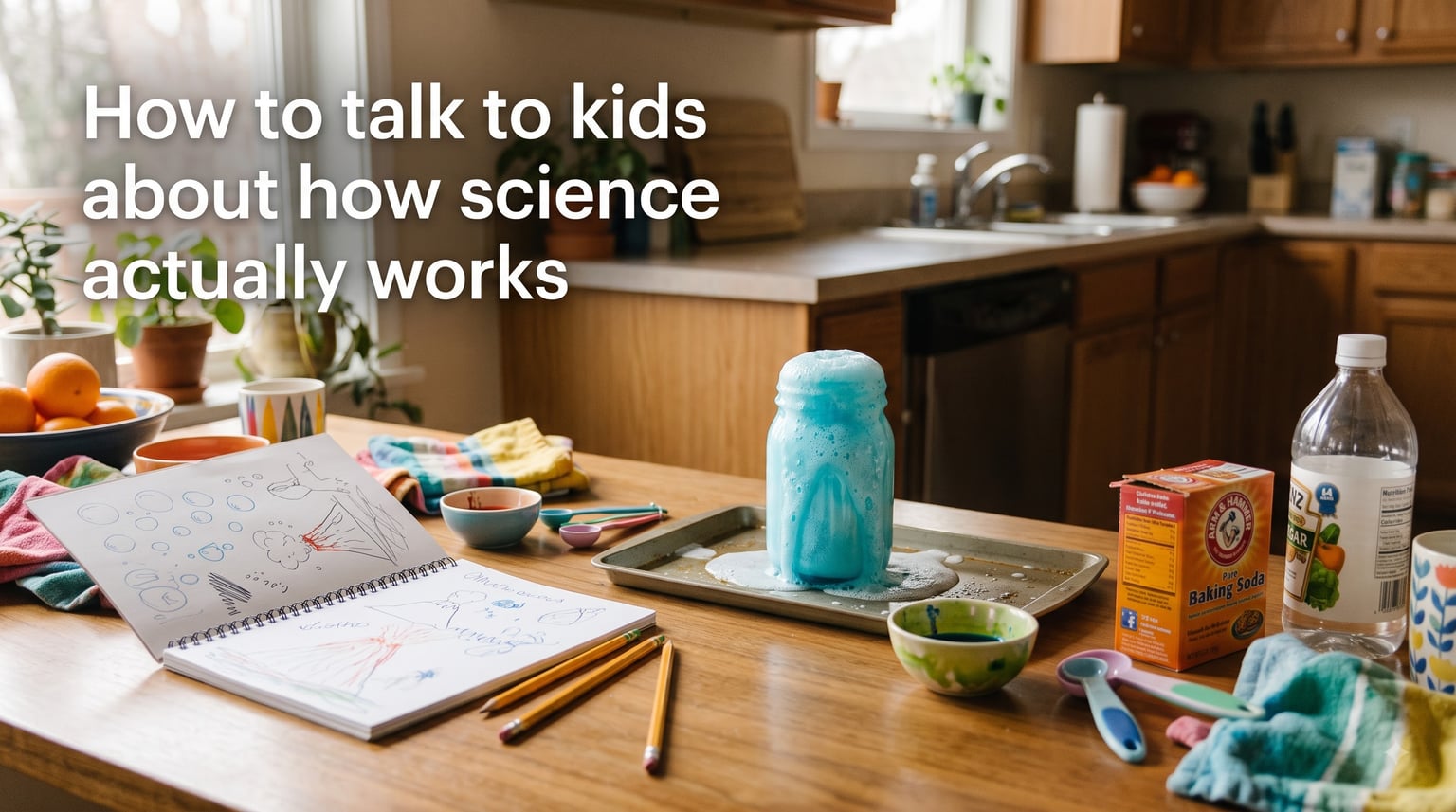
Baking soda volcanoes in the kitchen. Combine baking soda, vinegar, and a drop of dish soap. The fizz is a chemical reaction in action.
Shadow tracking on the porch. Trace your shadow’s outline at three different times of day. Kids see the Earth rotating before their eyes.
Ice melting race. Put ice cubes on different surfaces (metal, wood, plastic) and time how fast they melt. Now you’re testing variables.
Crystal growing with sugar. Mix sugar water, pour it over a string, and wait. Days later, real crystals appear. Patience is part of the data.
Each of these activities follows the same pattern: predict, test, observe, talk. That’s how science actually works, regardless of age.
Recording Observations and Learning From Mistakes
Recording observations turns a fun moment into a real scientific one. Kids can draw what they see, dictate a sentence to you, or take a photo with your phone.
A simple notebook, or even a stack of sticky notes, gives the experiment a record. Over time, your child builds a portfolio of “I figured this out myself,” which is priceless for confidence.
Equally important: learning from mistakes. If the baking soda volcano doesn’t erupt, that’s not a failure. That’s a finding. Ask, “What could we change next time?” This small shift in language reframes mistakes as data, which is exactly how working scientists think about them.
What to Do When You Don’t Know the Answer
You will not know the answer. That is guaranteed, and it is also an opportunity.
When I don’t know something, I say so, and then I say, “Let’s find out together.” We open a browser, check a library book, or call a relative who might know. The lesson here is bigger than the topic: science is a community effort, and saying “I don’t know” is the first honest step in any investigation.
Parents on forums echo this exact approach. One parent put it simply: “I stopped pretending I had all the answers, and my kids got more curious, not less.” That captures the spirit of how science actually works more than any textbook ever could.
Age-Appropriate Strategies for Different Stages
How you explain science depends on where your child is developmentally. Here’s a quick breakdown by age that I’ve refined over years of working with families.
Ages 3 to 5 (Preschool): Focus on the senses. Let them touch, smell, and taste (safe) things. Use big words occasionally, like “evaporation” when you watch a puddle dry, but don’t worry if they just say “it’s gone.” The point is exposure.
Ages 6 to 8 (Early Elementary): Start introducing cause and effect. Ask “what do you think will happen if…” before trying things. They can begin drawing simple charts or recording results with pictures.
Ages 9 to 12 (Upper Elementary): They can handle more abstract ideas, like the difference between observation and inference. Encourage them to design their own experiments and explain results to the family.
Across all ages, the same principle applies: meet them where their curiosity lives, and don’t push past it.
Frequently Asked Questions
How do you explain what science is to a child?
Science is the process of learning about the natural world through observation, asking questions, and testing ideas with experiments. Tell your child that scientists are detectives who use experiments instead of magnifying glasses, and they can be one too.
What are the 5 E’s of teaching science?
The 5 E’s are Engage, Explore, Explain, Elaborate, and Evaluate. Start by hooking their interest, let them play with the idea, name what just happened, try something harder, and finally check what they learned.
How to explain science to a 7 year old?
Use simple language, hands-on activities, and lots of questions. Try experiments like sink or float, shadow tracking, or growing crystals. Always ask what they think will happen before you test it together.
How do you introduce science to a child?
Start with their own questions. When they ask why something happens, pause and ask what they think. Then explore the answer together through observation, a quick experiment, or a book. This shows them that science is something they do, not just something they memorize.
What do you teach a 3 year old about science?
At age 3, focus on the senses and simple cause and effect. Let them explore water, sand, leaves, and kitchen tools safely. Use rich vocabulary like melt, float, and grow, and follow their curiosity wherever it leads.
Final Thoughts on Talking to Kids About Science
Talking to kids about how science actually works is really about teaching them to think. You don’t need to be a scientist. You need to ask good questions, follow their curiosity, and treat mistakes as data.
Start small. Pick one moment today, maybe a puddle, a shadow, or a melting ice cube, and turn it into a question. Watch what happens when you ask, “What do you think?” That single habit, practiced often, is how science actually works, and it’s how the next generation of curious thinkers gets built.