
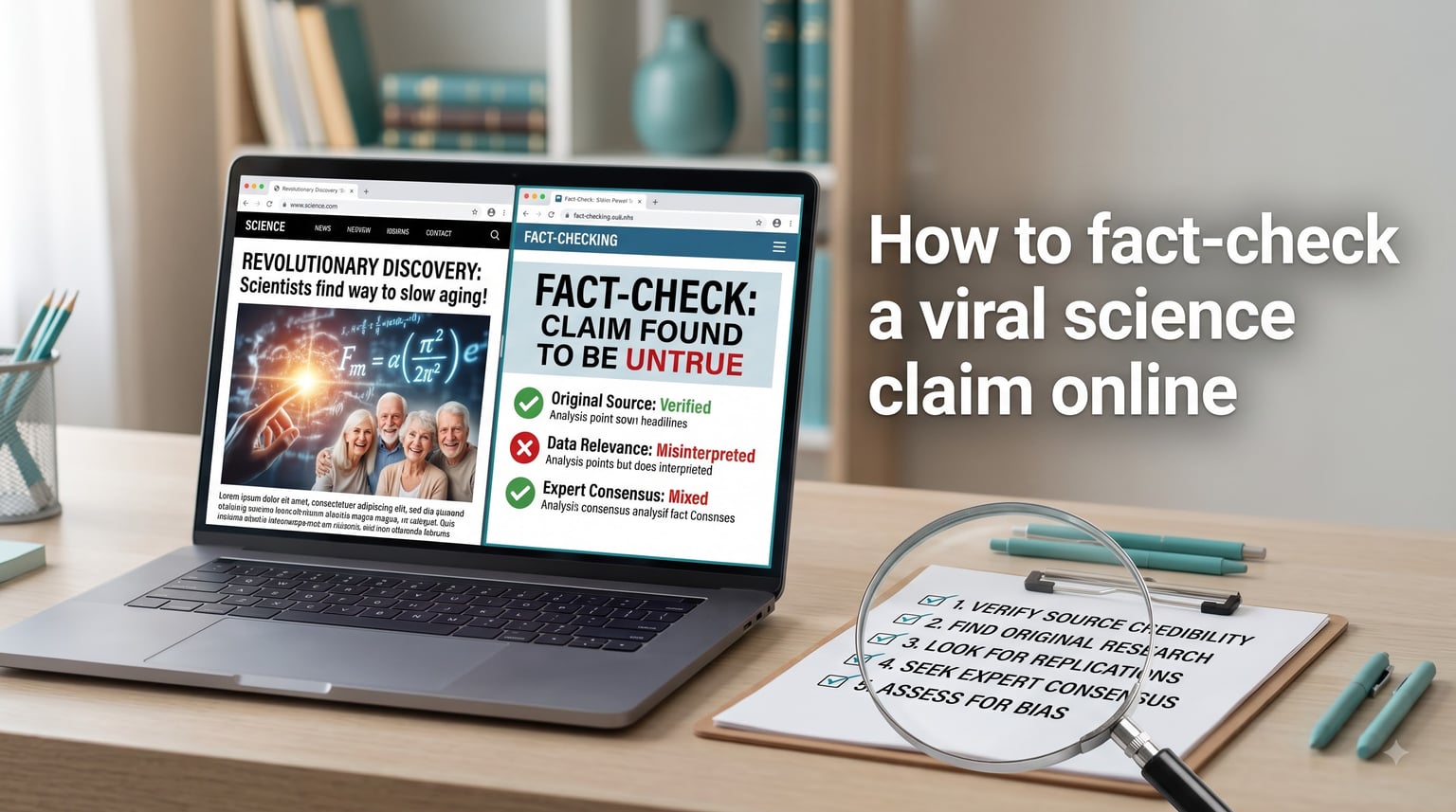
Learning how to fact-check a viral science claim online is now a basic skill for anyone who scrolls social media. A 2018 MIT study found that false news spreads roughly six times faster than the truth on platforms like Twitter, and science claims sit right at the center of the worst viral hoaxes. I have spent the last several months collecting and verifying viral science claims from my own feeds, testing which tools actually catch fakes, and which ones create more confusion than they solve. This guide is the system I landed on.
Below I will walk you through a four-move framework, the science-specific statistical traps that catch even careful readers, and the tools I now keep open in a tab every time I see something that makes me stop scrolling.
Table of Contents
Why Fact-Checking Viral Science Claims Matters in 2026?
Viral science misinformation leads to real harm. During the COVID-19 pandemic, false claims about bleach, ivermectin, and vaccine DNA cost lives and damaged trust in public health. In 2026, the pattern has not slowed. Instead, it has spread into climate science, nutrition research, and AI safety claims.
Misinformation experts point to two forces that make science claims uniquely viral. First, scientific language gives claims an air of authority even when the underlying study is weak or nonexistent. Second, science topics trigger strong emotional responses, and emotions are the single biggest predictor that a person will share a post without reading it.
Fact-checking protects you from making decisions you would not have made with accurate information. It also protects the people who trust what you share. Every viral claim you pause to verify is one fewer misleading message reaching an uncle, a coworker, or a new parent who is tired and looking for answers.
How to Fact-Check a Viral Science Claim Online: The 4-Move Framework
The most reliable beginner system is the 4 Moves method, developed by Mike Caulfield at the University of Washington’s Center for an Informed Public and used in the Web Literacy for Student Fact-Checkers curriculum. I have used it on roughly 80 viral claims this year. It works because it does not require subject expertise, only a few minutes and a willingness to leave your original post.
Here are the four moves in order.
Move 1: Check Previous Work With Fact-Checkers
Before you do anything else, search for an existing fact-check. Someone, somewhere, has probably already verified the claim. Open a new tab and search the exact phrase of the claim along with the word “fact check.” Visit two or three of these sites and look for matching entries:
FactCheck.org and its SciCheck vertical for science claims
Snopes.com for viral stories and image claims
AFP Fact Check for international coverage
Google Fact Check Tools, which aggregates thousands of fact-checks
If you find a recent rating, you can usually stop here. A high-quality fact-check will cite its own sources and explain its reasoning.
Move 2: Go Upstream to the Original Source
If no fact-check exists, find what the post is actually claiming. Click through to any linked article, study, or press release. Identify the underlying claim and search for the original source. Often a viral post cites a real study but misstates its findings.
Ask yourself three questions when you find the source. Was the study published in a peer-reviewed journal or on a preprint server? How big was the sample? Does the conclusion in the news article match what the paper actually says? A common pattern I see is that the paper found a correlation in mice, and the headline claims a cure for humans.
Move 3: Read Laterally About the Source
Lateral reading means you stop reading the article or post you are checking and start reading about the source. Open new tabs and search for the outlet, author, or journal that produced the claim. Look for what other trusted outlets and fact-checkers say about them.
This is the opposite of vertical reading, which is reading down through the article itself. Research from Stanford History Education Group showed that professional fact-checkers almost universally use lateral reading because a polished-looking website is one of the weakest signals of credibility.
Move 4: Circle Back When You Get Lost
If at any point you hit a dead end, go back to the original claim and rethink. Maybe the claim is poorly worded. Maybe the source has a different agenda than you realized. Maybe you need a fresh search query.
I use this move more than any other. Most of my failed fact-check attempts were not because the moves were wrong, but because I tried to push through a step when circling back would have saved time.
Red Flags That Signal Science Misinformation
Some red flags show up over and over. When I see three or more in the same post, I treat it as high-risk and skip straight to the fact-check sites.
The first red flag is sensational language. Words like “breakthrough,” “miracle,” “cure,” or “shocking” almost never appear in careful science writing. The second is missing context. A claim that says “a new study shows coffee prevents cancer” without naming the journal, sample size, or authors is hiding something.
The third is single-study syndrome. Real science is a body of evidence, not a single paper. The fourth is a predatory journal. Be wary of publishers you have never heard of, especially if the press release is the only place the study is being covered. The fifth is a mismatch between the headline and the study. Headlines often oversell what the data actually show.
The sixth is an appeal to nature or to ancient wisdom. “Natural” does not mean safe or effective. The seventh is false balance. Watch for stories that present two viewpoints as equally supported when the evidence strongly favors one. The eighth is hype in the abstract. If the study authors themselves use dramatic language, read the paper carefully.
Science-Specific Pitfalls: Statistics Most People Misread
Most viral science claims are wrong not because the science is wrong, but because a statistic was misread in translation. These are the traps I check every time I see a number in a headline.
Correlation Does Not Mean Causation
This is the oldest trap in science journalism and it still catches new readers every week. Ice cream sales correlate with drowning deaths. That does not mean ice cream causes drowning. Both go up in summer when more people swim.
Whenever you see a correlation, ask whether a third variable could explain the link. If the article does not address that question, treat the causal claim as unproven.
P-Values and Statistical Significance
A p-value below 0.05 means the result is unlikely under the assumption that there is no effect. It does not mean the effect is large, important, or likely to repeat. Many viral studies report p-values without effect sizes, which makes weak results look strong.
The American Statistical Association has warned against treating p-values as a binary truth test. A result with p=0.049 is not suddenly “real science” while p=0.051 is fake news. The effect size and replication record matter far more.
Absolute Risk vs Relative Risk
This is where most health misinformation is born. If a drug cuts your risk of a disease by 50 percent, that sounds huge. But if the baseline risk is two in 10,000, your absolute risk only drops from two in 10,000 to one in 10,000.
Whenever you see a percentage change in risk, ask for the baseline. Real public health communication uses absolute numbers whenever possible. Sensational coverage leans on relative risk because the numbers look more dramatic.
Sample Size and Effect Size
A study of 12 people can find an effect that disappears the moment a larger study is run. If the viral claim is based on a small sample, treat it as preliminary. Conversely, a large sample can find statistically significant effects that are too small to matter in daily life.
Both sample size and effect size need to be reasonable before you accept a claim. A 1 percent reduction in something rare is real, but it is rarely worth changing your behavior over.
Trusted Fact-Checking Tools and Websites for 2026
I keep a short list of trusted resources open in bookmarks. Here are the ones I use most often and what each one is best for.
FactCheck.org SciCheck is the single best resource specifically for science claims. Run by the Annenberg Public Policy Center, it focuses on false and misleading scientific claims that spread through politics and social media.
Google Fact Check Tools lets you search across thousands of fact-checks at once. It is my first stop when I want to know whether a claim has been verified anywhere in the world. You can filter by language, topic, and rating.
Snopes is the original internet fact-check site and remains excellent for viral photos, videos, and historical claims. The methodology has improved a lot over the years and most stories now link to primary sources.
AFP Fact Check covers global claims that other sites miss, especially images and quotes from politicians around the world. The Reuters Fact Check unit and AP Fact Check play a similar role.
For research itself, PubMed and Google Scholar let you check whether a study was actually published and what other researchers have said about it. If a viral claim cites “a Harvard study” but you cannot find the study in PubMed, that is a major red flag.
AI Tools and Apps That Help Detect Fake Science News
AI fact-checking tools have improved a lot in 2026, though none are perfect. I treat them as a first pass, not a final answer.
Humma is a browser extension that scans articles as you load them and shows you fact-check signals next to the page. It is fast and unobtrusive, and I now run it by default on news sites I have not seen before.
ClaimBuster is a research project from the University of Texas that scores sentences for checkability. It is best for academics and journalists, but anyone can paste text into the demo and get back a list of claims worth verifying.
Google’s Gemini and Anthropic’s Claude can both help you read laterally. I paste an article into a chat window and ask for what is missing, what the sources are, and what counter-evidence exists. They make mistakes, so I always verify their citations against primary sources.
For images, TinEye and Google Lens do a reverse image search in seconds. They are essential for checking whether a “shocking photo from a recent event” is actually from a different year, a different country, or a completely different event.
Even with great AI tools, you still need to apply the 4 Moves. AI gets you to Move 3 quickly, but Move 1 and Move 4 still belong to you.
Frequently Asked Questions
How reliable is Snopes for science claims?
Snopes is reliable for general viral claims including photos, videos, and historical quotes. For science-specific claims, FactCheck.org SciCheck and Google Fact Check Tools are stronger because they apply statistical literacy to the underlying research. Use Snopes as a starting point, then verify the primary source.
What is the fastest way to fact-check online info?
Open a new tab, search the exact claim plus the words fact check, and check Snopes, FactCheck.org, and Google Fact Check Tools. If those sites do not have an entry, find the original source by clicking through links and search for the study in PubMed or Google Scholar. This 4-step process usually takes under five minutes.
Is there any fake news detection app?
Yes. Browser extensions like Humma and reverse image search tools like TinEye and Google Lens help detect misinformation in real time. ClaimBuster is a free tool for spotting claims worth fact-checking. None of these apps replace human judgment, but they cut the time needed for a basic check by half.
How do I detect misinformation online before sharing it?
Pause and check your emotional response first, then run the 4 Moves. Look for red flags like sensational headlines, single-study claims, or missing context. Search for the claim on three fact-checking sites. If the claim cites a study, find the paper in PubMed and confirm the actual finding. A two-minute pause prevents the vast majority of accidental misinformation sharing.
Your Fact-Check Action Plan
Knowing how to fact-check a viral science claim online is less about being an expert and more about slowing down before you share. The 4 Moves framework works because it does not require a science degree, just a few minutes and a willingness to leave the original post.
Start by saving the trusted fact-checking sites listed above in your bookmarks bar. Next time you see a viral science claim, pause for ten seconds, notice your emotional response, and run through the four moves. Most claims you check will not need a full investigation, only a quick scan against an existing fact-check.
Share the framework with one person in your life who tends to forward viral posts without checking. The greatest leverage any of us has against misinformation is teaching the people around us to pause and verify too.