
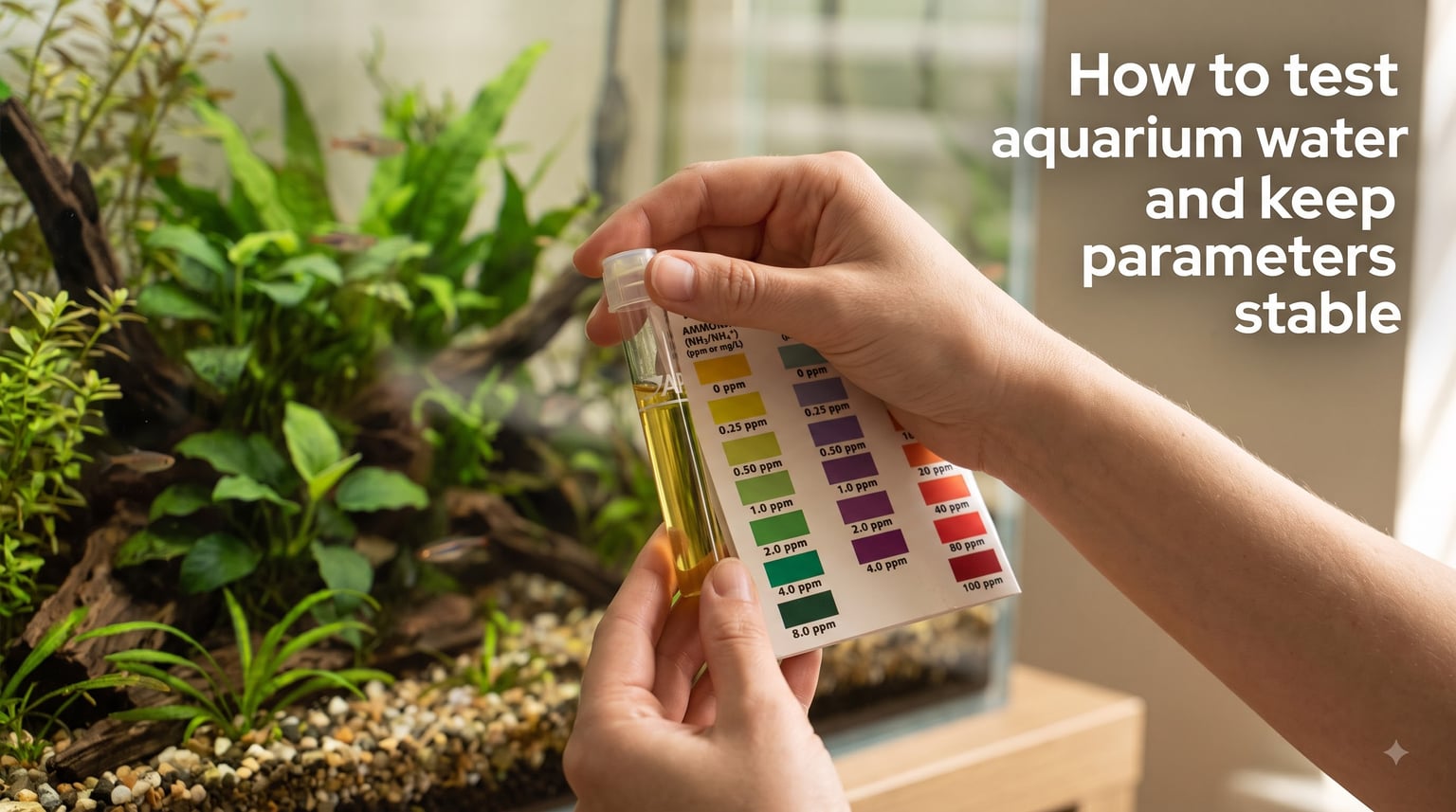
Keeping fish healthy starts with the water they live in. I learned this the hard way when I lost a batch of neon tetras early in my fishkeeping journey because I never tested for ammonia. That mistake pushed me to build a reliable routine around monitoring aquarium water parameters, and I want to share what actually works.
In this guide, I will walk you through how to test aquarium water and keep parameters stable at home, regardless of whether you run a simple freshwater tank or a coral-filled reef. You’ll learn which parameters matter most, how to test them accurately, how often to check each one, and the practical habits that keep your water chemistry from drifting into trouble.
Table of Contents
What Are Aquarium Water Parameters and Why Do They Matter?
Aquarium water parameters are the chemical and physical measurements that define water quality in your tank. They include pH, ammonia, nitrite, nitrate, temperature, and for saltwater setups, salinity, alkalinity, calcium, and magnesium. Each parameter tells you something specific about the environment your fish and plants live in.
These measurements matter because fish, corals, and plants evolved in stable conditions. Even small swings can stress their immune systems, suppress appetite, and trigger disease. In my experience, the vast majority of unexplained fish losses trace back to water chemistry problems rather than pathogens.
The science behind stability is the nitrogen cycle. Fish excrete ammonia through their gills and waste. Beneficial bacteria colonize your filter media and convert that toxic ammonia into nitrite, then a second bacterial group converts nitrite into the less harmful nitrate. Nitrate is removed through water changes and, in planted tanks, absorbed as a nutrient.
Until that bacterial colony is established, ammonia and nitrite accumulate to lethal levels. This is why new tanks demand far more frequent testing than mature systems.
Essential Aquarium Water Parameters to Test
You don’t need to test every possible measurement on day one. I focus on five core parameters for freshwater tanks and add three more for saltwater. Here is the framework I use.
pH (Potential of Hydrogen)
pH measures how acidic or basic your water is on a scale of 0 to 14, with 7 being neutral. Most freshwater community fish thrive between 6.5 and 7.5. African cichlids prefer 7.8 to 8.6, while discus and many South American species do best in soft, slightly acidic water around 6.0 to 7.0.
Saltwater tanks typically run 8.1 to 8.4. Reef tanks especially demand stability in this narrow band, since corals and other invertebrates struggle when pH swings more than 0.2 in a day.
Ammonia (NH3/NH4)
Ammonia is the first waste product in the nitrogen cycle and the most dangerous. Any detectable ammonia above 0 ppm is a red flag. Ideally, your test reads 0 ppm at all times. Even 0.25 ppm causes gill damage and stress in most species.
Ammonia exists in two forms: NH3 (more toxic) and NH4 (less toxic). The ratio shifts with pH and temperature, which is why high pH and warm water make ammonia more dangerous.
Nitrite (NO2)
Nitrite is the intermediate stage between ammonia and nitrate. Like ammonia, it should always read 0 ppm in a healthy tank. Nitrite interferes with fish’s ability to absorb oxygen, a condition called brown blood disease.
Nitrate (NO3)
Nitrate is the end product of the nitrogen cycle and far less toxic than ammonia or nitrite. Freshwater tanks generally stay safe below 40 ppm, though planted tanks use it as fertilizer. Reef keepers aim for much lower levels, ideally under 10 ppm, since high nitrate stunts coral growth and fuels algae.
Temperature
Temperature affects metabolism, oxygen levels, and the toxicity of ammonia. Most tropical freshwater fish do well between 75°F and 80°F (24°C to 27°C). Coldwater species like goldfish prefer 65°F to 72°F (18°C to 22°C). Reef tanks usually sit between 76°F and 78°F (24.5°C to 25.5°C).
I always keep two thermometers in my tanks, one digital probe and one stick-on glass unit, since either can drift or fail without warning.
Salinity (Saltwater Only)
Salinity measures the dissolved salt content, usually expressed as specific gravity (sg) or parts per thousand (ppt). Fish-only saltwater tanks run 1.018 to 1.023 sg. Reef tanks do best at 1.024 to 1.026 sg. Anything outside this range stresses marine life and corals.
A refractometer gives the most accurate reading. Swing-arm hydrometers are cheaper but lose calibration and read high in tanks with a lot of organic matter.
Alkalinity (KH/dKH) – Saltwater and Some Freshwater
Alkalinity, measured in degrees of KH or dKH, is your water’s buffering capacity, meaning its resistance to pH swings. Marine tanks typically run 7 to 11 dKH. Reef keepers often target 8 to 9 dKH for coral growth. African cichlid tanks benefit from high alkalinity as well.
Ideal Parameter Ranges: Freshwater vs Saltwater
Having a quick reference helps you know instantly whether your reading is in the safe zone. Here is the table I use when I test.
| Parameter | Freshwater Community | Saltwater Fish-Only | Reef Tank |
|---|---|---|---|
| pH | 6.5 to 7.5 | 8.1 to 8.4 | 8.1 to 8.4 |
| Ammonia (ppm) | 0 | 0 | 0 |
| Nitrite (ppm) | 0 | 0 | 0 |
| Nitrate (ppm) | under 40 | under 20 | under 10 |
| Temperature | 75 to 80°F | 75 to 80°F | 76 to 78°F |
| Salinity (sg) | N/A | 1.018 to 1.023 | 1.024 to 1.026 |
| Alkalinity (dKH) | 3 to 8 | 7 to 11 | 8 to 9 |
Keep in mind that consistency matters more than chasing a perfect number. A tank stable at pH 7.0 is healthier than a tank that swings between 6.8 and 7.4 every day, even though both averages fall in the “correct” range.
How to Test Aquarium Water Step by Step
When I walk new hobbyists through the testing process, I always start with a liquid test kit. They are more accurate than strips and far cheaper than digital meters for most parameters. Here is the procedure I follow.
Step 1: Gather your supplies. You will need the test kit, a clean test tube (most kits include one), a measuring dropper, and a piece of white paper or the color chart that comes with the kit.
Step 2: Rinse the test tube. Use tank water to rinse, not tap water. Tap water can contaminate the sample with chlorine or chloramine that skews the readings.
Step 3: Collect the sample. Draw water from mid-tank, away from the filter outflow and surface agitation. Surface water tends to be lower in CO2, which can artificially raise pH readings.
Step 4: Add the reagent. Liquid test kits work by adding drops of chemical reagents that react with the target parameter. Hold the bottle vertically and squeeze gently so the drops are the same size. Too little reagent gives a false low reading.
Step 5: Cap and shake. Seal the tube and shake for the time specified in the kit instructions, usually 5 seconds to 1 minute depending on the test.
Step 6: Wait for color development. Most tests need a few minutes for the color reaction to finish. Nitrate tests often take up to 5 minutes.
Step 7: Compare against the color chart. Hold the tube against the white background of the chart in natural daylight. Indoor lighting can distort color perception, especially the difference between yellow-green shades in nitrate tests.
Step 8: Record the result. Write down the parameter, the reading, the date, and any action you took. A simple notebook or spreadsheet works fine. Tracking trends over weeks is far more useful than any single reading.
Step 9: Rinse and store. Empty the tube, rinse with clean water, and store the kit somewhere cool and dry. Heat and sunlight degrade the reagents.
Test Kit Types Compared: Liquid vs Strips vs Digital
Each testing method has tradeoffs in cost, accuracy, and ease of use. Here is how I think about them.
Liquid test kits are the gold standard for ammonia, nitrite, nitrate, pH, and alkalinity in freshwater tanks. They cost more upfront than strips but last for hundreds of tests. The API Freshwater Master Test Kit is what I recommend to every beginner. It covers ammonia, nitrite, nitrate, and pH in one box.
Test strips are quick and convenient. You dip a strip, wait 30 to 60 seconds, and compare the pads against a color chart. They are useful for spot checks and for parameters where exact numbers don’t matter, like general hardness. They struggle with low nitrate readings and are easy to misread because of how similar the color shades are.
Digital meters excel for pH, salinity, and temperature. A calibrated pH probe gives readings accurate to within 0.01, much better than the 0.2 resolution of liquid pH tests. A refractometer is essential for serious saltwater keepers since hydrometers drift and lose accuracy.
My recommendation for a beginner is a liquid master kit plus a refractometer if you run saltwater. Add a digital pH pen only if you keep delicate species or breed fish. Strips are fine as a backup but should not be your primary tool.
How Often Should You Test Aquarium Water
Testing frequency depends entirely on tank age and stocking. Here is the schedule I follow, and it matches what most experienced reefers recommend on forums like r/Aquariums.
| Tank Stage | Frequency | What to Test |
|---|---|---|
| Fishless cycling (weeks 1 to 6) | Every 2 to 3 days | Ammonia, nitrite, nitrate |
| New tank with fish (first 3 months) | Twice weekly | Ammonia, nitrite, nitrate, pH |
| Established freshwater (3+ months) | Weekly | Nitrate, pH |
| Established reef (6+ months) | Weekly | Alkalinity, calcium, nitrate, phosphate, salinity |
| After any issue (fish death, algae bloom) | Daily for one week | Full panel |
Once your tank is established and stable, you can scale back, but never stop entirely. Problems creep up slowly, and a quick weekly nitrate test catches most issues before they become catastrophic.
How to Keep Aquarium Water Parameters Stable
Stability is the goal, and it comes down to a handful of consistent habits. I have ranked these by how much impact they had on my own tanks.
1. Do regular water changes. A 10% to 25% weekly water change is the single most powerful tool for keeping aquarium water parameters stable. It dilutes nitrate, replenishes minerals, and resets pH drift. I do 20% weekly on most of my freshwater tanks and 10% twice a week on my reef tank.
2. Match new water to tank parameters. Freshwater tanks benefit from dechlorinated water at the same temperature as the tank. Saltwater tanks require mixed salt at the same salinity and temperature. I always check the new water’s pH and salinity before adding it.
3. Don’t overfeed. Uneaten food is the most common cause of ammonia spikes. I feed only what fish consume in 2 to 3 minutes, once or twice a day. In planted and reef tanks, I use an automatic feeder when I travel to prevent overfeeding.
4. Stock appropriately. The classic “one inch of fish per gallon” rule is too simplistic, but the underlying idea is right. Overstocking overwhelms the nitrogen cycle. Choose fish that match your tank size and filtration capacity.
5. Maintain your filter. Beneficial bacteria live on filter media. Rinse media in tank water (never tap water) during water changes to preserve the colony. Replace media gradually, never all at once, or you crash your cycle.
6. Keep up with substrate vacuuming. Detritus trapped in gravel or sand breaks down into ammonia. A weekly gravel vacuum during water changes removes waste before it pollutes the water column.
7. Buffer alkalinity in freshwater. If your tap water has low KH, add crushed coral or a buffer to your filter. This prevents the pH crashes that beginners often see months after setup, once the natural buffers in the tank are used up.
8. Use a timer and thermometer for temperature. Heaters fail silently. A heater controller with an alarm catches failures before they cook your fish. I also unplug the heater during water changes to prevent it from running dry and cracking.
9. Quarantine new additions. New fish, corals, and live rock can introduce diseases and parameter swings. Quarantine them in a separate tank for 2 to 4 weeks before adding to your display.
10. Log your readings. A simple log, paper or digital, lets you spot trends before they become problems. I track pH, ammonia, nitrite, nitrate, temperature, and salinity in a spreadsheet. The first time I caught a slow nitrate climb because of a clogged filter, I was sold on logging forever.
Troubleshooting Common Parameter Problems
Even with good habits, things go wrong. Here are the three problems I see most often and what actually fixes them.
Ammonia spike in an established tank. The usual culprit is a dead fish, overfeeding, or a recent filter disturbance. I do an immediate 50% water change, test again in 6 hours, and add a bacteria supplement like Seachem Stability to reseed the filter. Avoid using chemical ammonia removers long-term because they mask the underlying problem.
pH crash in freshwater. This happens when KH drops below 2 dKH and the water loses its buffering capacity. The fix is to add a KH booster or crushed coral to the filter, then do small daily water changes to bring pH back up gradually. Never raise pH by more than 0.3 per day, or you shock the fish.
Nitrate creeping up in a reef tank. High nitrate in a mature reef usually means your export methods are not keeping pace. Adding a refugium with macroalgae, increasing water change frequency, or adding a carbon source like vodka dosing all help. Many reefers also use nitrate-removing resins like Seachem Purigen or a dedicated algae reactor.
Forum users on r/Aquariums and r/reeftank often emphasize the same lessons: act fast, do small water changes rather than one giant one, and figure out the root cause before adding chemicals.
Frequently Asked Questions
How to maintain water parameters in an aquarium?
Maintain water parameters by doing regular 10 to 25 percent weekly water changes, not overfeeding, stocking appropriately, and testing weekly. Match new water to tank temperature and pH. Keep filter media healthy by rinsing it in tank water during changes. Log all readings to spot trends before they become problems.
What is the most accurate way to test aquarium water?
Liquid test kits from brands like API and Salifert are the most accurate option for most parameters. Digital pH meters calibrated with reference solution offer even better pH precision. Salt refractometers give more reliable salinity than hydrometers. Avoid relying on test strips as your primary tool since their color differences are hard to read.
How to keep aquarium water stable?
Keep aquarium water stable by using a consistent water change schedule, keeping stocking levels moderate, avoiding overfeeding, and buffering alkalinity to maintain pH. Use a heater controller to prevent temperature swings and test parameters weekly once the tank is established. Stability matters more than hitting an exact target number.
How often should I check my aquarium water parameters?
Test every 2 to 3 days during fishless cycling. For new tanks with fish, test twice weekly for the first 3 months. Established freshwater tanks need a weekly check of nitrate and pH. Reef tanks require weekly alkalinity, calcium, nitrate, phosphate, and salinity testing. Test daily for a week after any problem like a fish death or algae bloom.
Final Thoughts on Stable Aquarium Water
Learning how to test aquarium water and keep parameters stable is the single biggest upgrade you can make as a fishkeeper. Once you build a routine around testing and small, regular water changes, fishkeeping becomes far less stressful, and your animals thrive.
Start with a liquid master test kit, set a weekly testing schedule, and log your readings. Within a few months you will know your tank’s patterns so well that you can spot a problem before it costs you livestock. That is the real goal, not perfection, but consistent, healthy aquarium water parameters.