
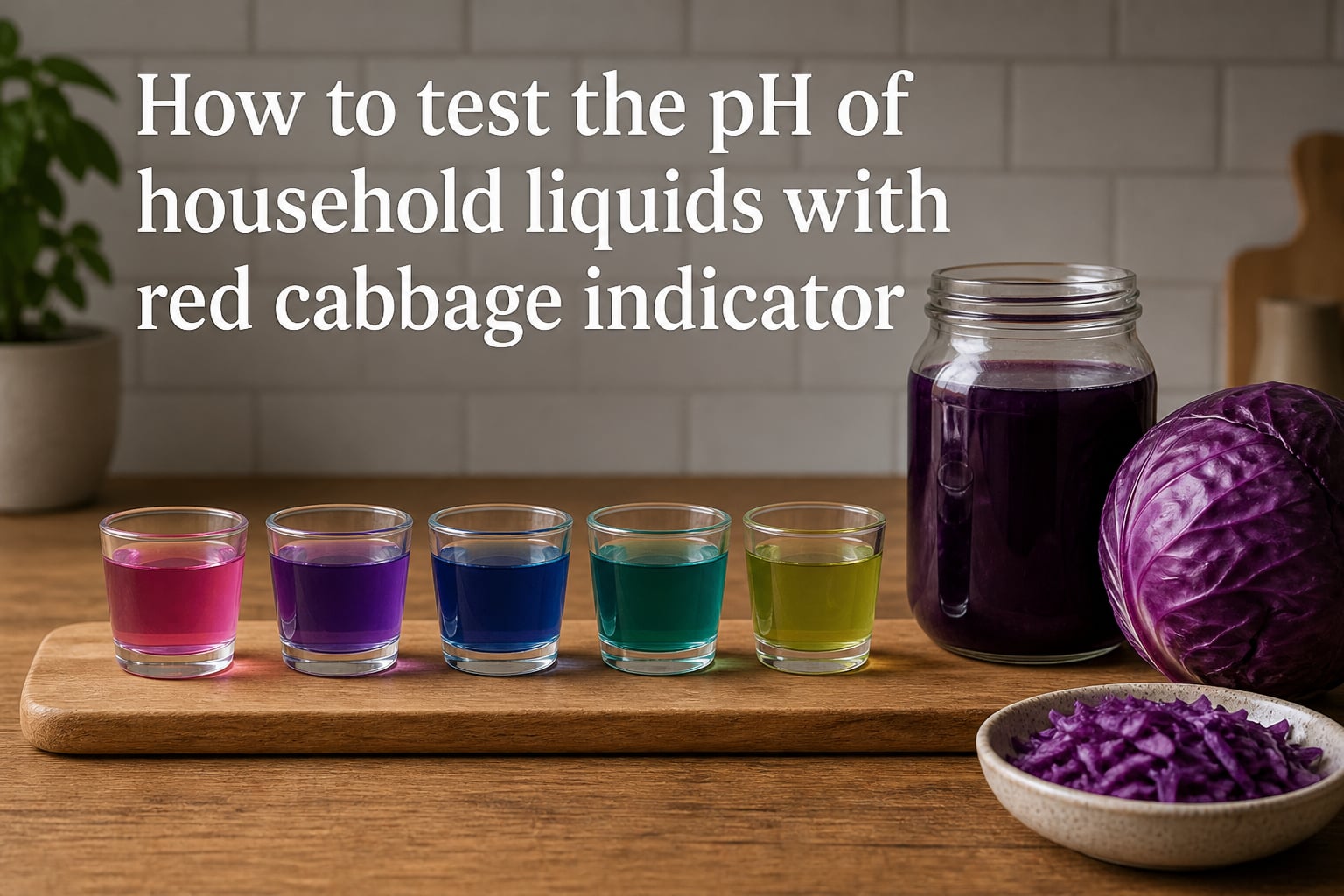
I’ve been running kitchen chemistry experiments with my niece for years, and the red cabbage pH indicator is still the one that gets the biggest reaction. When a clear lemon juice turns hot pink in front of her eyes, or a clear ammonia solution suddenly flashes green, something clicks about chemistry being real. In this guide, I’ll show you how to test the pH of household liquids with red cabbage indicator, exactly the way I run the experiment in my own kitchen and classroom demos.
You’ll learn how red cabbage detects pH, what materials you need, the two best methods for making the indicator, a step-by-step procedure for testing household liquids, and a complete color-to-pH reference chart. I’ll also cover the chemistry behind why it works, how accurate the test really is, and what to do when the colors don’t behave as expected.
Table of Contents
What Is a Red Cabbage pH Indicator?
A red cabbage pH indicator is a natural, non-toxic dye extracted from red cabbage leaves that changes color when mixed with acids or bases. The purple juice contains pigments called anthocyanins, which act as built-in pH sensors. Drop the indicator into a household liquid and watch it shift to pink, red, purple, blue, green, or yellow depending on the liquid’s pH.
Red cabbage works as a pH indicator because it is sensitive across a wide range of roughly pH 1 through 14, unlike litmus paper which only signals acid or base. That broad range makes it one of the best natural indicators you can buy or grow yourself.
You’ll find this experiment recommended by the Royal Society of Chemistry, Science Buddies, and most chemistry teachers because it is safe, cheap, and visually dramatic. The whole project costs less than a few dollars and uses items already in your kitchen.
How Red Cabbage Detects pH: The Science Behind the Color Change
The magic ingredient inside red cabbage is a family of pigments called anthocyanins. These molecules are also what give blueberries, red grapes, and purple sweet potatoes their colors. Anthocyanins are remarkable because they rearrange their molecular structure in response to hydrogen ion concentration, which is what pH actually measures.
When anthocyanin sits in a strongly acidic solution (lots of hydrogen ions), the molecule holds onto a form that absorbs green and yellow light, so we see red and pink. In a neutral solution, the molecule settles into a different shape that reflects purple and violet. In a basic solution (low hydrogen, high hydroxide), the molecule rearranges again and reflects blue, green, or yellow light.
That’s why a single drop of lemon juice turns the indicator hot pink, while a drop of ammonia turns it yellow-green. The same pigment, different molecular shape, totally different visible color. This is also why pH testing with red cabbage is more informative than litmus paper: it gives you a continuous color spectrum rather than just two answers.
Materials You Need to Test pH With Red Cabbage Indicator
Here’s the full checklist I use when running this test at home. You probably have most of it already.
For making the indicator
- 1 small head of red cabbage (about 2 cups chopped)
- 4 cups of water (distilled is best, but tap water works)
- A large pot
- A strainer or colander
- A large bowl or jug to catch the liquid
- Optional: a blender for the cold method
For testing liquids
- Clear plastic cups or small glass containers (one per liquid)
- A plastic dropper or small spoon
- White paper or a white tray to view colors more clearly
- A pen and notepad to record results
Household liquids worth testing
I recommend grabbing 8 to 12 liquids so you can really see the color spectrum. Good options include lemon juice, vinegar, soda, milk, baking soda dissolved in water, dish soap, ammonia (diluted), window cleaner, antacid tablets crushed in water, and plain water as your control.
Step 1: Make Your Red Cabbage pH Indicator
There are two reliable ways to extract the indicator. I usually use the boiling method because it gives the strongest, most concentrated dye. If you want a faster option, the blender method works fine.
Boiling method (recommended)
- Chop the red cabbage into small pieces, roughly 1-inch squares.
- Place the chopped cabbage into a large pot and add 4 cups of water.
- Bring the water to a boil, then reduce heat and simmer for 10 to 15 minutes.
- Turn off the heat and let the liquid cool until you can handle it safely.
- Strain the deep purple liquid into a bowl or jug and discard the cabbage pieces.
- Use the indicator immediately or store it in the fridge.
Blender method (faster)
- Tear a few large cabbage leaves into chunks.
- Add the leaves and 2 cups of warm water to a blender.
- Blend on high for 1 to 2 minutes until the water turns deep purple.
- Strain through a fine sieve or cheesecloth.
- Dilute with more water if the color is too intense to see color shifts clearly.
Storage tips
Pour your cooled indicator into a sealed jar and refrigerate. It keeps for about one week before it starts to oxidize and lose vibrancy. If it turns brownish or smells sour, throw it out and make a fresh batch.
Step 2: Test the pH of Household Liquids With Your Red Cabbage Indicator
Now for the fun part. Set up your station with cups of each liquid in a row, then add the indicator and watch the colors appear.
- Pour a small amount (about 2 tablespoons) of each household liquid into its own clear cup.
- Label each cup so you can match it back to the liquid later.
- Place the cups on a sheet of white paper to make color changes easier to see.
- Add 1 to 2 teaspoons of red cabbage indicator to each cup and stir gently.
- Wait 10 to 15 seconds for the color to fully develop.
- Record the color you observe and compare it to the chart below.
Tip from experience: do this in a clear area with good natural light. I learned the hard way that warm yellow bulbs in the kitchen make it hard to tell the difference between blue and green. Also, pour the indicator into the liquids rather than the other way around. Some household liquids will foam up or splash if you pour them into the dye.
Red Cabbage pH Color Chart: What Each Color Means
This is the chart you’ll keep coming back to. The colors below are the ones I observe consistently across batches. Your results may vary slightly depending on the concentration of your indicator and the strength of the household liquids, but the general pattern holds.
| Color Observed | Approximate pH | Classification |
|---|---|---|
| Red | 1 – 2 | Strong acid |
| Pink | 3 – 4 | Weak acid |
| Purple / Violet | 5 – 7 | Near neutral |
| Blue | 8 – 10 | Weak base |
| Blue-Green | 11 – 12 | Moderate base |
| Yellow-Green | 13 – 14 | Strong base |
Note: red cabbage indicator is most accurate between pH 2 and pH 12. Outside that range, the colors start to blur or fade because the pigment itself begins to break down in very strong acids or bases.
Best Household Liquids to Test for Each pH Range
Here’s a quick guide to which liquids you can expect to land in which color range. Use these to predict before you test, then compare your prediction to the actual color change.
- Acidic (red/pink): lemon juice, vinegar, cola, orange juice, tomato juice
- Near neutral (purple): milk, plain water, rainwater, black coffee (diluted)
- Weakly basic (blue): baking soda solution, egg whites, antacid tablet dissolved in water
- Strongly basic (green/yellow): diluted ammonia, bleach (diluted), drain cleaner (very diluted), soapy water
For my niece’s class, we usually test 10 liquids and then graph the results on a piece of paper. Students quickly notice that things they thought were mild (like cola) are actually strongly acidic, while things they assumed were dangerous (like ammonia diluted down) read as expected.
How Accurate Is the Red Cabbage pH Test?
Red cabbage indicator is accurate to within about half a pH unit, which is plenty precise for home experiments and classroom demos. It cannot match the precision of a digital pH meter or commercial pH strips, but it is far more informative than litmus paper, which only tells you acid versus base.
For best accuracy, use distilled water to dilute liquids that are too concentrated, and use a fresh batch of indicator if your current batch is more than a week old. If you want to verify your results, you can drop a pH strip into the same liquid and compare. I often do this as a follow-up experiment because students love seeing whether their color guesses match the strip’s number.
The biggest limitation is color interpretation. Two people looking at the same shade of purple-blue might call it different things. That is why a quick pH strip comparison is so valuable as a control.
Troubleshooting Common Red Cabbage Indicator Problems
After running this experiment dozens of times, I have hit most of the common problems. Here is what to watch for and how to fix it.
The indicator came out brown instead of purple
This usually means your water was not acidic enough or your cabbage was old. Try adding a small splash of lemon juice to the finished indicator. If it turns pink, you are back on track. If it stays brown, make a fresh batch with a new cabbage.
The colors are not changing enough to read
You probably diluted the indicator too much. Use less water when you boil the cabbage, or add more indicator to each cup. Aim for a deep, vibrant purple dye at the start.
Strong acids or strong bases turn the indicator clear or pale
Very high concentrations of acid or base can bleach the pigment. Dilute the household liquid with distilled water before testing if you notice this happening.
Results vary from cup to cup for the same liquid
Make sure you are using the same amount of indicator in every cup and stirring gently. Inconsistent results usually come from inconsistent measurements.
Extension Experiments to Try Next
If you want to keep going after the basic test, here are three follow-up experiments my students always enjoy.
- Make pH paper: Soak coffee filters or thick paper towels in your cabbage indicator, then let them dry. Cut into strips and dip into liquids. You now have homemade pH paper.
- Test soil pH: Mix a spoonful of garden soil with distilled water, stir, and let the solids settle. Test the liquid with your indicator. Different plants prefer different pH levels, so this becomes a real-world gardening project.
- Test your own body chemistry: Test saliva, sweat, and urine (with adult supervision). pH values shift with diet and exercise, which opens a great discussion about how the body regulates its chemistry.
FAQ
How can I test the pH of a solution using a red cabbage indicator?
To test the pH of a solution using a red cabbage indicator, first extract the purple juice by boiling chopped red cabbage in water for 10-15 minutes, then strain and cool the liquid. Pour about 2 tablespoons of each household solution into a clear cup, add 1-2 teaspoons of the cabbage indicator, and observe the color change. Match the resulting color to a reference chart: red or pink means acidic (pH 1-4), purple means near neutral (pH 5-7), and blue, green, or yellow means basic (pH 8-14).
Can red cabbage juice be used as a pH indicator?
Yes, red cabbage juice works very well as a pH indicator. It contains anthocyanin pigments that change color across a broad pH range, from roughly pH 1 (red) through pH 14 (yellow). It is safe, non-toxic, easy to make at home, and more informative than litmus paper because it shows a continuous color spectrum rather than just two outcomes.
How can I make a practical pH indicator using red cabbage?
To make a practical pH indicator using red cabbage, chop about 2 cups of red cabbage into small pieces and simmer in 4 cups of water for 10-15 minutes. Strain out the cabbage and let the deep purple liquid cool. Store the indicator in a sealed container in the refrigerator for up to one week. To use it, add 1-2 teaspoons to each solution you want to test and compare the color to a pH reference chart.
How accurate is the red cabbage pH test?
The red cabbage pH test is accurate to within about half a pH unit, which is more than enough for home experiments, classroom demos, and science fair projects. It cannot match the precision of a digital pH meter, but it is far more informative than litmus paper. For best accuracy, use distilled water, fresh indicator, and consistent measurements across all samples.
Conclusion
Learning how to test the pH of household liquids with red cabbage indicator turns a head of cabbage into one of the best chemistry tools in your kitchen. The whole process takes about 20 minutes, costs almost nothing, and produces a color spectrum that reliably tells you which household liquids are acids, which are bases, and which are neutral.
Start with the boiling method, test 8 to 12 liquids, and keep the color chart nearby for the first few runs. Once you are comfortable, branch out into the extension experiments: homemade pH paper, soil testing, or your own body chemistry. Each one opens a different doorway into the same core idea that pH is a measurable, visible part of everyday life.
Try the experiment this weekend with your kids, your students, or just yourself, and you will see why red cabbage has been a favorite classroom demonstration for decades.