
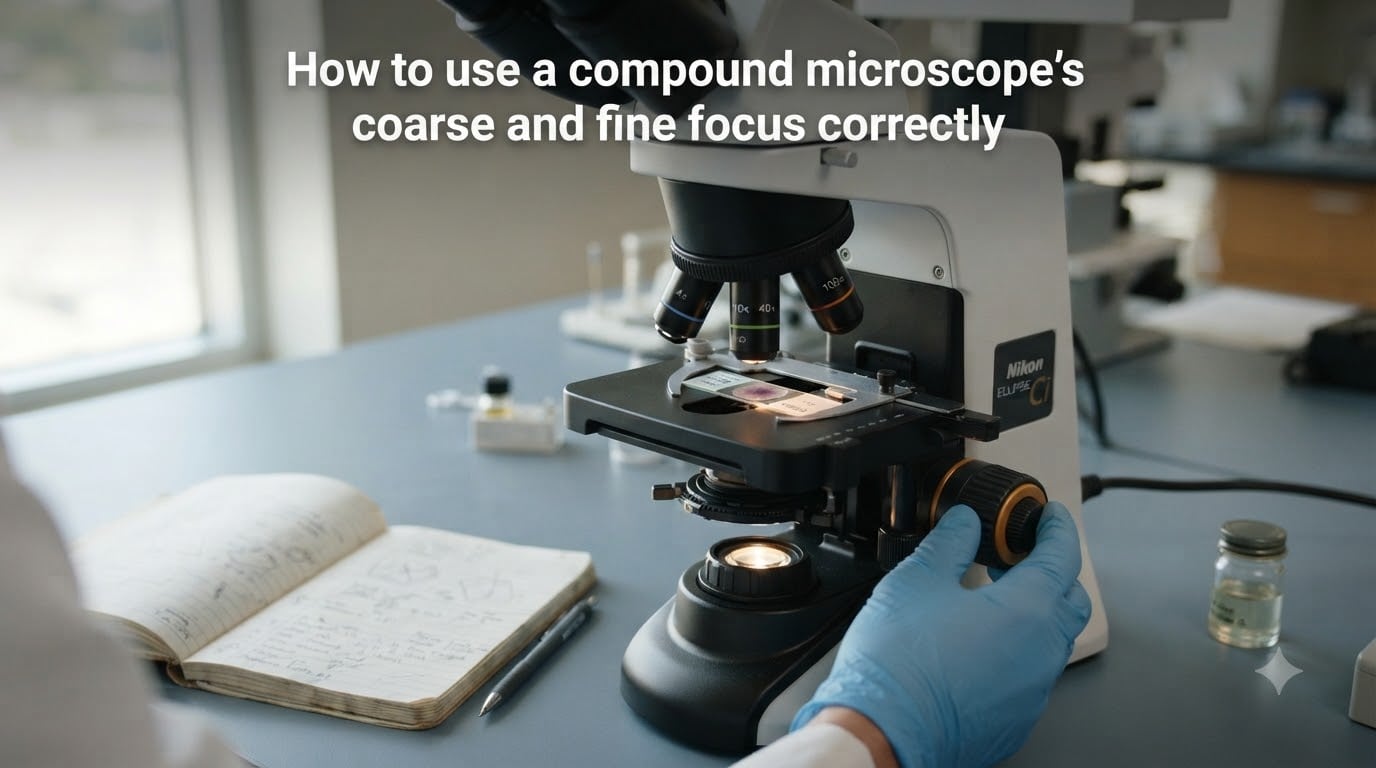
Learning how to use a compound microscope’s coarse and fine focus correctly is the single skill that separates a blurry slide from a sharp, usable image. I remember my first biology lab session – I spent ten minutes cranking the wrong knob and ended up with a cracked slide. After teaching microscopy to first-year students for the past several years, I can tell you that almost every focusing mistake comes down to using the coarse focus at the wrong magnification. In this guide, I’ll walk you through the exact procedure our team uses in lab, including the safety rules that protect both your slide and the objective lens.
Table of Contents
Understanding Coarse Focus vs Fine Focus on a Compound Microscope
The coarse focus and fine focus are two separate knobs (often coaxial, meaning nested on the same axis) that move the microscope stage in very different ways. The coarse focus knob moves the stage rapidly through a large vertical range, while the fine focus knob moves it in tiny, precise increments.
Think of the coarse focus as the “zoom out to find the building” tool and the fine focus as the “tweak the camera lens until the windows are sharp” tool. You need both, but at different stages of the process.
On most modern compound microscopes these knobs are stacked: the larger outer knob is coarse focus, and the smaller inner knob is fine focus. Turning either one moves the stage up or down, but each does so at very different speeds.
Anatomy of the Focusing System: Parts You Need to Know
Before you start turning knobs, locate three parts on your microscope. First, the stage – the flat platform where your slide sits. Second, the coaxial focus knobs on the side of the stand (sometimes there are two pairs – one on each side for ergonomic use). Third, the rack stop – a small screw or lockable collar near the stage that prevents it from being raised too far and crashing into the objective lens.
You will also see the revolving nosepiece, which holds the objective lenses (commonly 4x, 10x, 40x, and sometimes 100x). Each objective has a different working distance – the space between the tip of the lens and your cover slip when the specimen is in focus.
If your microscope has a mechanical stage, you’ll see two knobs that move the slide forward/backward and left/right. These are different from the focus knobs, but you’ll use them together.
Step-by-Step: How to Use the Coarse and Fine Focus Correctly
Follow this procedure exactly every time you bring a new slide into focus. I have watched dozens of students use this method, and it works consistently.
Step 1: Start with the lowest power objective (4x scanning). Rotate the revolving nosepiece until the 4x objective clicks into place. Make sure the stage is in its lowest position before you begin.
Step 2: Position your slide. Place the prepared slide on the stage and secure it with the stage clips, or use the mechanical stage controls to center the cover slip directly over the light coming from below.
Step 3: Raise the stage using only the coarse focus. Look at the slide from the side (not through the eyepiece) and turn the coarse focus knob to bring the stage up until the slide nearly touches the 4x objective. This is the critical safety step – never look through the eyepiece while turning coarse focus downward.
Step 4: Look through the eyepiece and use coarse focus to find the image. With your eye at the eyepiece, slowly turn the coarse focus knob to lower the stage until a blurry image appears. Stop as soon as you see something.
Step 5: Switch to fine focus to sharpen the image. Turn the small fine focus knob slowly in either direction until the specimen is crisp. At 4x you may only need a small adjustment.
Step 6: Center your area of interest. Use the mechanical stage knobs to move the slide so the feature you want to study is in the center of the field of view.
Step 7: Switch to 10x objective, fine focus only. Rotate the nosepiece to bring the 10x objective into place. You will likely need only a small turn of the fine focus knob – this is because most microscopes are parfocal. Do not touch the coarse focus.
Step 8: Switch to 40x objective, fine focus only. Repeat the same process. Refine with fine focus. The image will be much dimmer, so you may need to raise the light intensity using the illuminator dial.
Step 9: For 100x oil immersion (if available). Add a drop of immersion oil, rotate to the 100x objective, and use fine focus only. Never use coarse focus with oil immersion.
When to Use Coarse Focus vs Fine Focus by Magnification
The rule is simple and based on working distance: use coarse focus only when there is enough physical space between the slide and the objective for a large movement to be safe.
- 4x objective (scanning): Coarse focus allowed, then fine focus for sharpness. Working distance is large, so there is no risk of crashing.
- 10x objective (low power): Some microscopes still allow coarse focus, but use only fine focus if you can find the image with fine focus alone. Working distance is moderate.
- 40x objective (high power): Fine focus only. Working distance is so small that coarse focus will slam the objective into the slide.
- 100x objective (oil immersion): Fine focus only. Working distance is essentially zero – coarse focus will damage the lens and the slide.
Safety and Common Mistakes When Focusing
Here are the three mistakes I see most often in lab. Each one can break a slide or scratch an objective lens, and objective lenses are expensive to replace.
Mistake 1: Using coarse focus at 40x. The working distance of a 40x objective is less than a millimeter. One turn of the coarse focus knob at this magnification moves the stage fast enough to crash the lens into the slide. Always fine-focus only at 40x and above.
Mistake 2: Lowering the stage while looking through the eyepiece. This is how slides get cracked. Lower the stage by watching from the side, not through the eyepiece, until the slide nearly touches the objective. Then look through the eyepiece and bring the stage back up.
Mistake 3: Not engaging the rack stop. The rack stop is a small adjustment that limits how high the stage can travel. Set it the first time you use a microscope by bringing the slide close to the 4x objective (without touching), then tightening the rack stop screw. This prevents future crashes even if you turn the wrong knob.
If you ever smell cedar oil or feel resistance, stop immediately. You are likely making contact with the slide. Back the stage down with the coarse focus and inspect.
What Is Parfocality and Why It Makes Focusing Easier
Parfocal means that when you switch between objectives, the specimen stays nearly in focus. A properly aligned compound microscope is parfocal – meaning a tiny turn of fine focus is usually all you need when changing from 4x to 10x to 40x.
If you find yourself needing large adjustments every time you change objectives, your microscope may not be properly parfocal. This usually means the objectives are not all screwed into the nosepiece to the same depth, or the lenses are of different standards. A lab technician can realign a non-parfocal microscope.
Parfocality is why the focusing procedure works so smoothly once you get the slide sharp at 4x. It is also why most of your focusing work happens at the lowest magnification – you only need to refine at higher powers.
Troubleshooting Focus Problems (Forum-Tested Fixes)
These are the most common focus problems reported on microscopy forums and in lab troubleshooting sessions, along with what actually works.
Problem: The fine focus knob has no effect. On some budget microscopes, the fine focus is mechanically linked to the coarse focus and will only move the stage after the coarse focus has been engaged. Try a quarter turn of coarse focus, then test fine focus.
Problem: I cannot reach focus at 40x. This usually means the slide is upside down (cover slip facing down instead of up). Flip the slide. Other causes: cover slip is too thick (older slides often exceed the 0.17 mm standard), or your working distance is too short because the stage is already too close.
Problem: The coarse focus feels locked. Some microscopes have a focus tension screw on the coarse knob itself. Check for a small setscrew – usually on the inside of the knob – and loosen it slightly. Never force a knob that is locked.
Problem: Image is unevenly focused across the field. This suggests a problem with the condenser alignment or a dirty objective lens. Clean the objective with lens paper (never tissue), and check that the condenser is racked up to its working height.
Problem: Fine focus knob is too tight or too loose. Most microscopes have a tension adjustment. Ask your lab manager or consult the manufacturer manual. Do not attempt to disassemble the focusing mechanism without training.
Frequently Asked Questions About Microscope Focus
What is the difference between coarse focus and fine focus on a compound microscope?
The coarse focus knob moves the stage quickly through a large vertical distance and is used to find the specimen at low magnification. The fine focus knob moves the stage in very small increments and is used to sharpen the image at any magnification.
What is the correct order of focusing a compound microscope?
Start with the 4x objective and the stage in its lowest position. Raise the stage using the coarse focus while watching from the side, then look through the eyepiece and bring the stage up slowly with coarse focus until the image appears, then sharpen it with fine focus. Switch to higher objectives (10x, 40x) using only fine focus.
When should you never use the coarse focus?
Never use the coarse focus at 40x, 100x, or any oil immersion objective. The working distance is so small that coarse focus movement will crash the objective lens into the slide and damage both.
What happens if you use coarse focus at 40x?
At 40x magnification, the objective lens sits less than a millimeter above the slide. A turn of the coarse focus knob moves the stage so rapidly that the lens will strike the slide, cracking it and potentially scoring the lens surface – which is expensive to replace.
At what magnification is it okay to use the coarse focus?
Coarse focus is safe to use only at the lowest magnifications – typically the 4x scanning objective and sometimes the 10x low-power objective. From 10x upward, especially at 40x and 100x, use fine focus only.
Why is my microscope blurry at 40x even after focusing?
Common causes are the slide being upside down, cover slip being too thick, or the objective lens being dirty. Flip the slide so the cover slip faces up, switch to a standard 0.17 mm cover slip, and clean the objective with lens paper.
Final Thoughts: Building Good Focusing Habits
Mastering how to use a compound microscope’s coarse and fine focus correctly comes down to muscle memory and one iron rule: coarse focus at low power, fine focus from low to high power, never coarse at 40x or above. Set the rack stop on every microscope you use, watch from the side when raising the stage, and always start at the 4x objective.
Practice on prepared slides until the procedure feels automatic – you’ll find that switching between magnifications becomes nearly effortless thanks to parfocality. The first few sessions may feel slow, but soon you’ll be moving between 4x, 10x, and 40x with the confidence of someone who has done it hundreds of times.