
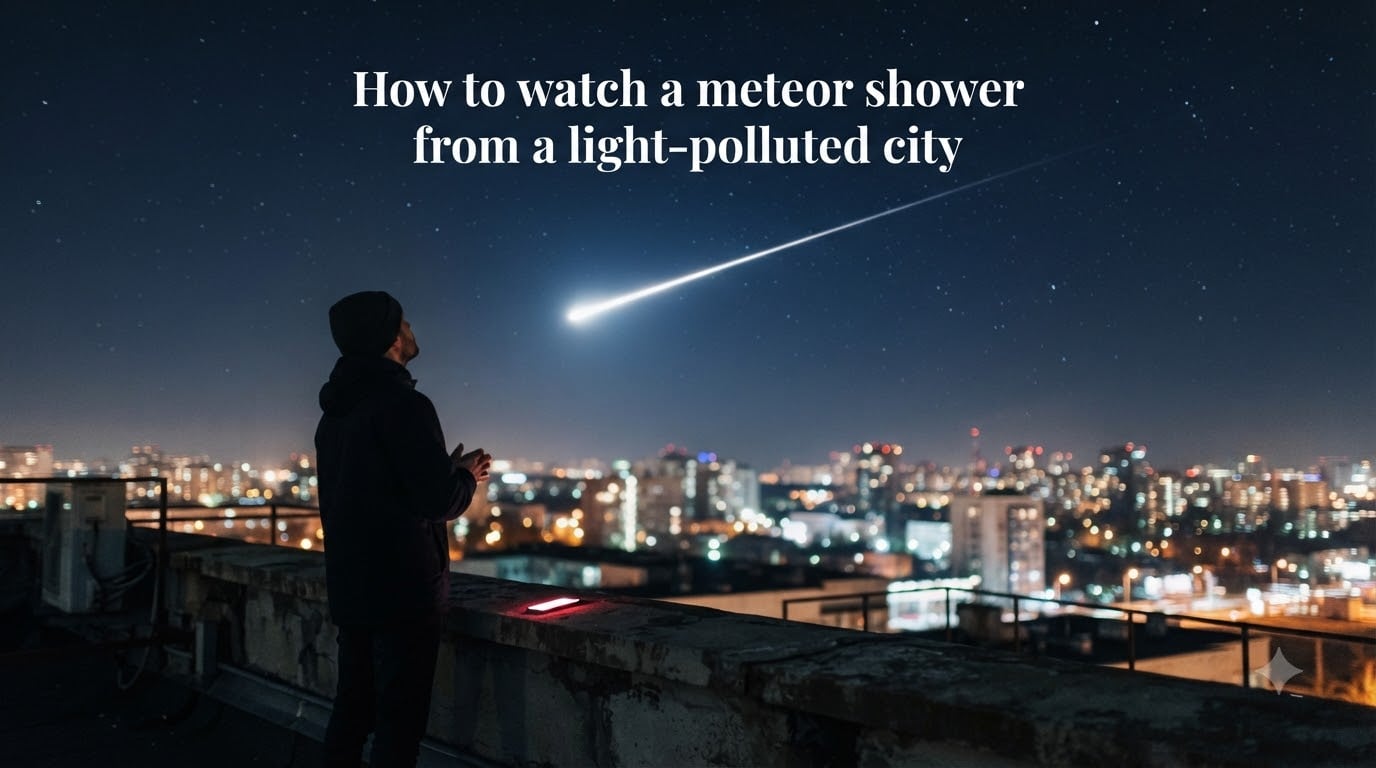
You do not need to drive three hours into the desert to see shooting stars. Learning how to watch a meteor shower from a light-polluted city means adjusting your timing, your location within the urban grid, and your expectations — but the bright fireballs that power major showers like the Perseids and Geminids are still visible overhead even when the skyglow is intense.
I have spent years testing city stargazing from rooftops, parks, and beaches in some of the worst Bortle 7 and 8 zones in the country. The truth is you will miss the faint meteors, but the bright ones, especially during peak nights, cut right through urban light pollution if you position yourself correctly.
This guide walks through every step I use: finding the darkest accessible spot near you, adapting your eyes properly, picking the right night, and knowing exactly where to look.
Table of Contents
What Is Light Pollution and Why It Matters for Meteor Viewing?
Light pollution is the artificial brightness that cities cast upward into the night sky. Streetlights, billboards, parking lots, and buildings create a luminous haze called skyglow that drowns out faint celestial objects. For meteor watching, this means anything dimmer than about magnitude 2 becomes invisible.
The good news is that the brightest meteors, called fireballs, can reach magnitude -4 or brighter. That is as luminous as Venus, and even the most light-drenched city cannot hide them. You will see fewer meteors overall, but the ones you do catch will be memorable.
Astronomers use the Bortle scale to rate sky darkness, from Class 1 (pristine wilderness) to Class 9 (inner-city skylight). Most downtown areas sit at Class 7 or 8. A local park or a rooftop a few miles from the city center might drop to Class 5 or 6 — enough to double or triple your meteor count.
Finding the Best Viewing Spot in a Light-Polluted City
Your location within the city matters more than any equipment you bring. The goal is to maximize darkness while keeping a wide view of the open sky, because meteors can streak across any part of it.
Use a Light Pollution Map First
Before you leave home, pull up a light pollution map like lightpollutionmap.info or Dark Sky Finder. These interactive tools show Bortle-scale color overlays so you can identify the darkest accessible pockets within a short drive. I always check the map and pick two or three candidate spots before committing.
Rooftops and Balconies
A tall rooftop or upper-floor balcony gets you above street-level lighting and gives you a wider horizon. Face away from the brightest cluster of downtown buildings and shield yourself from any direct light sources with a wall, chimney, or stairwell. Even standing behind a vent structure can create a shadow pocket that noticeably improves your view.
Parks and Open Fields
Large parks with athletic fields or open meadows reduce nearby light sources. The key is finding a spot where trees or structures block nearby streetlights while still leaving you a clear overhead view. Golf courses at night (with permission) and school fields are popular among urban stargazers.
Beaches and Shorelines
If you live near a coast, a beach facing away from the city can be one of your best options. Reddit users in city forums consistently report that beaches where the light pollution is behind you offer surprisingly dark horizons over the water. The ocean reflects very little light upward compared to concrete and glass.
The 20-Minute Escape Drive
Driving just 15 to 20 minutes beyond the suburban ring often drops you two full Bortle classes. Look for reservoirs, rural roads, or hilltops on the map. You do not need to reach true dark-sky territory — even a Class 4 sky can deliver dozens of meteors per hour during a strong shower peak.
How to Adapt Your Eyes for Meteor Watching
Dark adaptation is the single most overlooked step for city viewers. Your eyes need 15 to 20 minutes of darkness to switch from daylight (cone) vision to low-light (rod) vision, and during that window your sensitivity improves by a factor of thousands.
The problem is that almost every modern habit fights this process. A single glance at your phone screen, a car headlight sweeping across you, or a porch light clicking on can reset the clock and cost you another 15 minutes.
Here is the adaptation routine I follow every time:
1. Arrive at your spot and turn off all screens.
2. Switch your phone to a red light filter or put it fully away in a pocket.
3. Avoid looking at any white or blue light source for the full 15-20 minutes.
4. Use only red-tinted flashlights if you need to move around.
5. Once adapted, keep your phone face-down or in airplane mode to avoid notification flashes.
Rod cells are also concentrated in your peripheral vision rather than at the center of your gaze. This is why experienced meteor watchers use averted vision — looking slightly to the side of where you expect a meteor, which lets your more sensitive peripheral rods pick up faint streaks.
What Direction to Look for the Meteor Shower
Each meteor shower has a radiant point — the spot in the sky where the meteors appear to originate. For the Perseids it is the constellation Perseus, for the Geminids it is Gemini, and for the Leonids it is Leo. You can find the radiant for any active shower using a free app like Stellarium, SkyView, or Star Walk.
However, you should not stare directly at the radiant. Meteors near the radiant have very short trails, and the best displays appear 40 to 60 degrees away, where the streaks are longest and most dramatic. A good rule of thumb is to look about halfway between the radiant and the zenith (straight overhead), which also tends to be the darkest part of the sky.
In a light-polluted city, prioritize the area directly overhead and slightly toward the darkest horizon. This is where the atmosphere is thinnest and where light pollution is least concentrated.
Best Time to Watch Meteors From the City
Timing is your secret weapon against light pollution. Three factors determine a great viewing window: moon phase, time of night, and peak dates.
Wait for a Moonless Night
The Moon is effectively a giant light pollution source. A full Moon can cut your visible meteor count by 50% or more. Check the Moon phase before you plan your outing — a new Moon or a Moon that sets before midnight gives you the darkest possible background.
Watch After Midnight, Preferably 2 AM to Dawn
Meteor rates climb sharply after local midnight because that is when your side of Earth rotates into the oncoming debris stream. The hours between 2 AM and dawn are typically the most productive. In a city, this is also when traffic, commercial lighting, and overall light output are at their lowest.
Hit the Peak Dates
Every meteor shower has a 1-2 night peak when rates are highest. For 2026, the major showers to target are the Quadrantids in early January, the Lyrids in late April, the Perseids in mid-August, the Orionids in late October, the Leonids in mid-November, and the Geminids in mid-December. The Perseids and Geminids are the strongest and your best bet for city viewing, often producing 50-100 meteors per hour under ideal dark-sky conditions.
Red Light Phone Filters and Night Vision Tips
Preserving your night vision in the city is a constant battle against light sources. Red light does not trigger the breakdown of rhodopsin in your rod cells, so you can use red-tinted illumination without resetting your dark adaptation.
Most phones have a built-in red light or accessibility filter. On iPhone, go to Accessibility settings, enable Color Filters, and set the tint to deep red with intensity near maximum. On Android, apps like Twilight or Night Screen apply a red overlay across your entire display. Turn brightness to its lowest setting as well.
Beyond your phone, a simple red cellophane sheet wrapped over a small flashlight works perfectly and costs almost nothing. Some dedicated red LED astronomy flashlights are available for a few dollars if you want something purpose-built.
Avoid binoculars for meteor watching — they narrow your field of view and you will miss most streaks. Meteors move fast and appear unpredictably across wide areas of sky, so naked-eye viewing with a wide, relaxed gaze is always the most effective approach.
When to Give Up and Watch the Livestream Instead
Sometimes the city wins. If it is overcast, if the Moon is full, or if light pollution at your location is simply too intense, there is no shame in watching a meteor shower livestream. NASA and the Virtual Telescope Project regularly broadcast major shower peaks, and the Slooh online observatory offers live coverage with expert commentary.
I keep a backup plan ready for every outing. Check cloud forecasts at a site like Clear Outside or Astrospheric before you leave, and have the livestream bookmarked so a washed-out night does not end in total disappointment.
Frequently Asked Questions
What way should I look to see the meteor shower tonight?
Look 40 to 60 degrees away from the shower’s radiant point, not directly at it. Meteores near the radiant have short trails, while those farther away produce longer, more visible streaks. Find the radiant using an app like Stellarium or SkyView, then focus on the area between the radiant and straight overhead.
Can you do astrophotography with light pollution?
Yes, but you need short exposures and fast lenses. Use a wide-angle lens at f/2.8 or wider, keep exposures under 15 seconds to avoid washing out the sky, and raise your ISO to 3200 or higher. Meteors are bright enough to capture even from a city, especially fireballs during peak nights. A light pollution suppression filter can also help reduce skyglow.
Do telescopes work with light pollution?
Telescopes are not ideal for meteor showers because meteors move too fast and appear across a wide area of sky that a telescope cannot cover. For meteor watching, your naked eyes are the best tool. Telescopes are better suited for stationary objects like planets and star clusters, and they can still work in light-polluted areas for those targets.
Conclusion
Knowing how to watch a meteor shower from a light-polluted city comes down to four things: finding the darkest accessible spot, adapting your eyes for 20 minutes, timing your session for moonless post-midnight hours, and looking about 45 degrees from the radiant rather than staring at it.
You will not see as many meteors as someone in a dark-sky park. But the fireballs — the ones people actually remember — are bright enough to punch through almost any urban skyglow. Pick the next peak night from the 2026 shower calendar, grab a red light filter for your phone, and give it a real attempt. The first bright streak you catch above your city skyline will surprise you.