
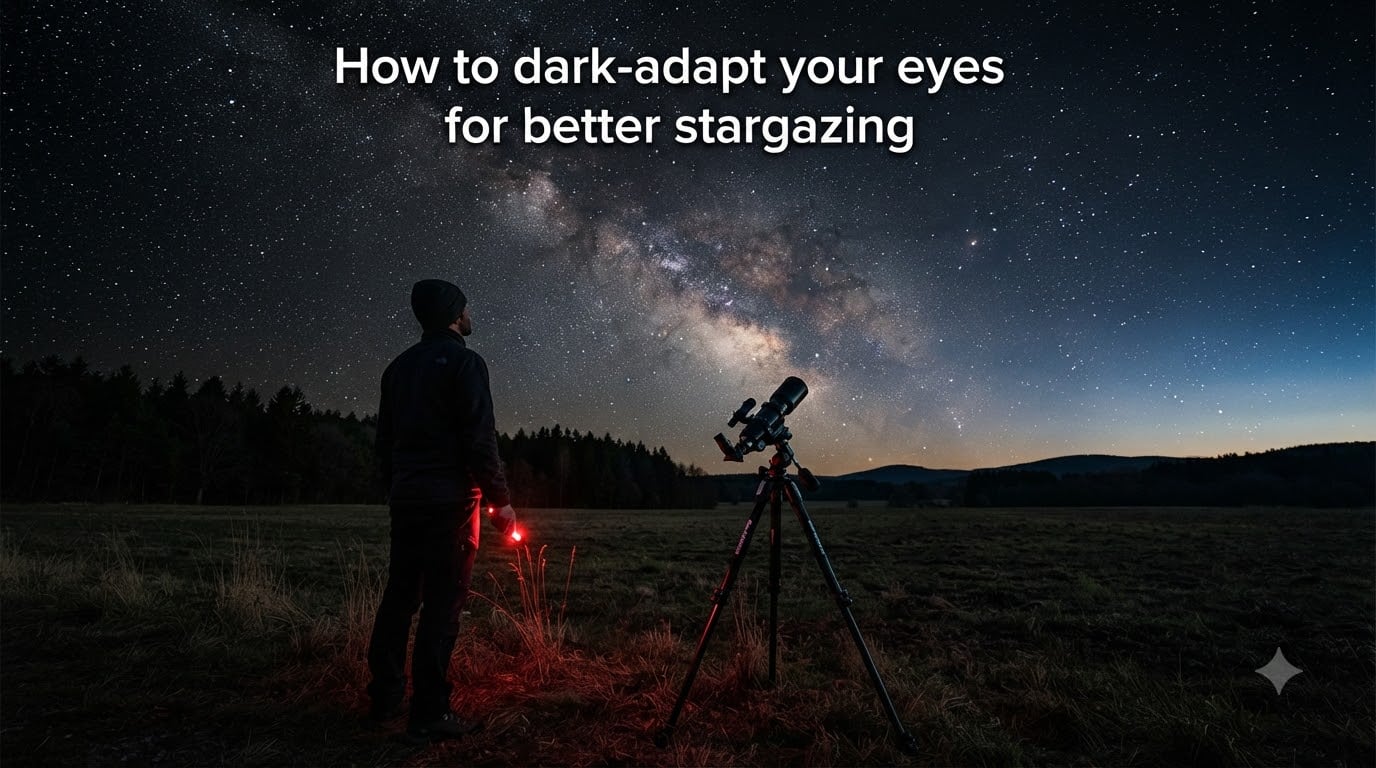
You step out into the backyard, ready to see the Milky Way, and all you get is a blur of gray smudges. Your buddy next to you points at a galaxy you’d swear wasn’t there a second ago. The difference isn’t the sky. It’s their eyes. They spent the last half hour preparing, and you didn’t.
That preparation has a name: dark adaptation. It’s the quiet, mostly invisible process that turns your eyes into a stargazing instrument, and it’s the single biggest upgrade most amateur astronomers never bother with. In this guide I’ll show you exactly how to dark-adapt your eyes for better stargazing, what happens inside your retina while you wait, and the small habits that keep your night vision intact once you’ve earned it.
Table of Contents
What Is Dark Adaptation?
Dark adaptation is the process by which your eyes adjust from bright light to darkness, becoming progressively more sensitive to faint light over roughly 20 to 40 minutes. During this window, the photoreceptor cells in your retina physically remodel themselves so you can detect stars, nebulae, and other dim targets that were completely invisible seconds earlier.
Eye doctors describe it as the shift from photopic vision (cone-driven, bright-light, color vision) to scotopic vision (rod-driven, dim-light, black-and-white vision). When fully dark-adapted, your eyes can become 1,000 to 10,000 times more sensitive than they were under normal indoor lighting. That range is the difference between seeing a third-magnitude star and a fourteenth-magnitude galaxy hanging millions of light-years away.
The Two Systems Working Inside Your Eyes
You have roughly 6 to 7 million cones, concentrated in the fovea at the center of your retina. They handle color, fine detail, and bright light.
You have about 90 to 120 million rods, packed mostly in the outer retina. They ignore color and detail but are staggeringly sensitive to small amounts of light. Rods are what make stargazing possible at all.
The challenge for stargazers: bright light, including sunlight, indoor LEDs, or a phone screen, leaves your rods effectively useless. They need time and darkness to recover.
How Dark Adaptation Works: The Science of Rhodopsin
Dark adaptation works through the regeneration of a light-sensitive pigment called rhodopsin (sometimes called “visual purple”) inside your rod cells. When light hits rhodopsin, the pigment chemically breaks down. That breakdown triggers an electrical signal to your brain, which is how you “see” anything at all.
The catch: a broken-down rhodopsin molecule can’t detect anything. To see faint light, you have to rebuild the molecule first. This rebuilding takes time, and chemistry is the reason dark adaptation feels slow.
Cones, by the way, rebuild their photopigments quickly, often in 5 to 10 minutes. Rods take much longer because the chemistry is more involved. This is why your color vision bounces back fast after stepping out of a lit room, but your deep-sky vision still isn’t ready 20 minutes later.
Why This Matters for Stargazers
Every photon from a distant galaxy has to be caught by a working rhodopsin molecule in your retina. If you’ve been staring at a white flashlight or scrolling Instagram, almost none of your rhodopsin is available to do that catching. Wait it out, and the photons that were always arriving suddenly have something to land on.
How Long Does Dark Adaptation Take?
Full dark adaptation takes 20 to 40 minutes in complete darkness, with most observers hitting near-maximum sensitivity by minute 30. Younger eyes typically adapt faster. If you’re over 50, plan for 35 to 45 minutes. Pupil dilation contributes a little, but the bulk of the timeline is rhodopsin chemistry.
Here’s the rough breakdown of what to expect:
- 0 to 5 minutes: Cones recover. You start seeing large, bright objects clearly again.
- 5 to 10 minutes: Color vision improves. You notice more stars and brighter deep-sky targets.
- 10 to 20 minutes: Rod sensitivity climbs sharply. Faint stars begin popping out.
- 20 to 40 minutes: Rod sensitivity peaks. You can now see faint galaxies, nebulae, and detail in the Milky Way.
One bright flash from a phone or passing car headlight, and your adaptation resets. A single smartphone glance at full brightness can cost you 10 minutes of rebuild time. Some observers report even worse.
How to Dark-Adapt Your Eyes for Better Stargazing
The full process starts well before you step outside and continues through the night. Here’s the workflow our team has settled on after years of star parties and backyard sessions.
Step 1: Start Adaptation Hours Earlier
About two to three hours before observing, dim the lights in your home and avoid bright screens. If you’re heading somewhere with very dark skies, wear sunglasses in the car to start the process early. This is one of the most overlooked parts of learning how to dark-adapt your eyes for better stargazing.
Step 2: Arrive at Your Site Before Full Dark
Set up your telescope or observing chair in the last 20 minutes of twilight, not after astronomical darkness has fully settled. This gives your eyes a head start. Settling gear in dim light is far kinder to your rods than flipping a white headlamp on at 10 p.m.
Step 3: Avoid White Light Completely
Put your phone in airplane mode or stash it. Cover any dashboard lights, porch lights, or neighbor’s security lights that you can’t control. Any white-light exposure sets the timer back.
Step 4: Use Only Dim Red Light
Switch your flashlight to red, or build a quick red flashlight with a piece of red plastic or a red balloon stretched over the lens. Cover the flashlight’s lens with extra layers of film until it’s barely bright enough to read a star chart.
Step 5: Wait, Then Observe
Spend the first 20 to 30 minutes looking up without expectations. Stargaze with just your eyes, sketch the sky, or train your telescope on easy targets like the Moon’s edge. Let time do the work.
Why Red Light Preserves Night Vision
Red light preserves night vision because wavelengths at the long end of the visible spectrum barely trigger rhodopsin breakdown in your rod cells. Your cones can still detect red light so you can read charts and pack gear, but your rods stay mostly intact.
The keyword here is dim. A bright red flashlight works against you; a barely-glowing red light is the goal. If you can see your hand clearly in front of your face under the light, it’s too strong.
Quick DIY tip: rubber-band a couple of layers of red theatrical gel over a small LED flashlight. Astronomers have been doing this for decades, and it’s a 60-second fix that costs under $5.
Tips for Preserving and Improving Night Vision
Once you’ve built up that sensitivity, the goal shifts to keeping it. These habits separate casual skygazers from people who actually start pulling out faint structure in nebulae.
Use the Averted Vision Technique
Averted vision means looking slightly off to the side of a faint target instead of directly at it. Your fovea is packed with cones, so dead-center vision is actually weaker in dim conditions. Look 8 to 15 degrees off, and the target often pops in.
Cover One Eye When You Need Light
Your eyes adapt independently. Astrophotographer and amateur astronomers alike use an eye patch over their dominant eye to preserve the other eye’s full adaptation whenever they need to check a chart or a piece of gear.
Avoid Any Light Pollution Where Possible
Even with full adaptation, a severe light dome on the horizon will drown out faint details. Move to a darker site when you can, and use a towel over your head and eyepiece when you can’t.
Eat for Your Eyes (Optional but Helpful)
Rhodopsin is built from vitamin A, and a steady supply helps your eyes regenerate the pigment efficiently. Carrots, sweet potatoes, spinach, and eggs are all good sources. It’s not a magic boost, but it isn’t nothing either.
Common Mistakes That Ruin Night Vision
Even experienced observers slip on these. Watch out for the big ones.
- Checking your phone. Even at lowest brightness and night-mode color, the screen is far too bright and far too blue.
- Looking at car headlights. A passing car can reset 20 minutes of adaptation in one second.
- White-light headlamps “just for a second.” That one second costs you another 20 minutes.
- Skipping the wait. Pulling out the telescope immediately and expecting faint galaxies is a common beginner trap.
- Using the wrong brightness of red light. If you can see colors clearly, the light is too bright.
Do You Need Dark Adaptation for Bright Objects?
You don’t need full dark adaptation to enjoy the Moon, Jupiter, Saturn, or Venus. They’re bright enough that even slightly adapted eyes see them well. Dark adaptation becomes essential when you chase deep sky objects, faint comets, or the Milky Way’s dust lanes.
FAQ
How long does it take your eyes to adjust to the dark for stargazing?
Full dark adaptation takes 20 to 40 minutes in complete darkness, with most observers hitting near-maximum sensitivity by about 30 minutes. Younger eyes usually adapt faster, while observers over 50 typically need 35 to 45 minutes.
How can night vision be improved for stargazing?
Avoid all white and blue light for at least 30 minutes before observing, use a dim red flashlight for charts and gear, and stay in a dark location away from streetlights and phone screens. Wearing sunglasses for a few hours before observing also gives you a head start.
Can you train your eyes to see better in the dark?
You can’t really train your rods, but consistent stargazing builds habits that protect your night vision. Practicing averted vision and avoiding bright light sources makes your sessions more productive over time, even though the underlying chemistry stays the same.
What is it called when your eyes adapt to the dark?
It is called dark adaptation, the process by which your eyes shift from cone-driven photopic vision to rod-driven scotopic vision as rhodopsin regenerates in the retina.
What diseases affect dark adaptation?
Vitamin A deficiency, retinitis pigmentosa, and congenital stationary night blindness all impair dark adaptation. Age-related changes and cataracts also slow the process noticeably.
Do you need dark adaptation for the Moon and planets?
Not for the Moon, Jupiter, Saturn, or Venus. They are bright enough to see clearly with light-adapted eyes. Dark adaptation only becomes essential for deep sky objects like galaxies and nebulae.
Final Thoughts
Learning how to dark-adapt your eyes for better stargazing is mostly about patience and discipline. The chemistry takes 20 to 40 minutes, and almost anything bright resets the clock. Plan ahead, dim your world in the hours beforehand, keep a red flashlight with extra layers of tape over the lens, and resist the phone.
Once you’ve done it a few times, dark adaptation becomes automatic. You stop reaching for white light without thinking, you build the pre-session routine into your habits, and your star charts start showing you things you couldn’t see before. The sky hasn’t changed. Your eyes have.