
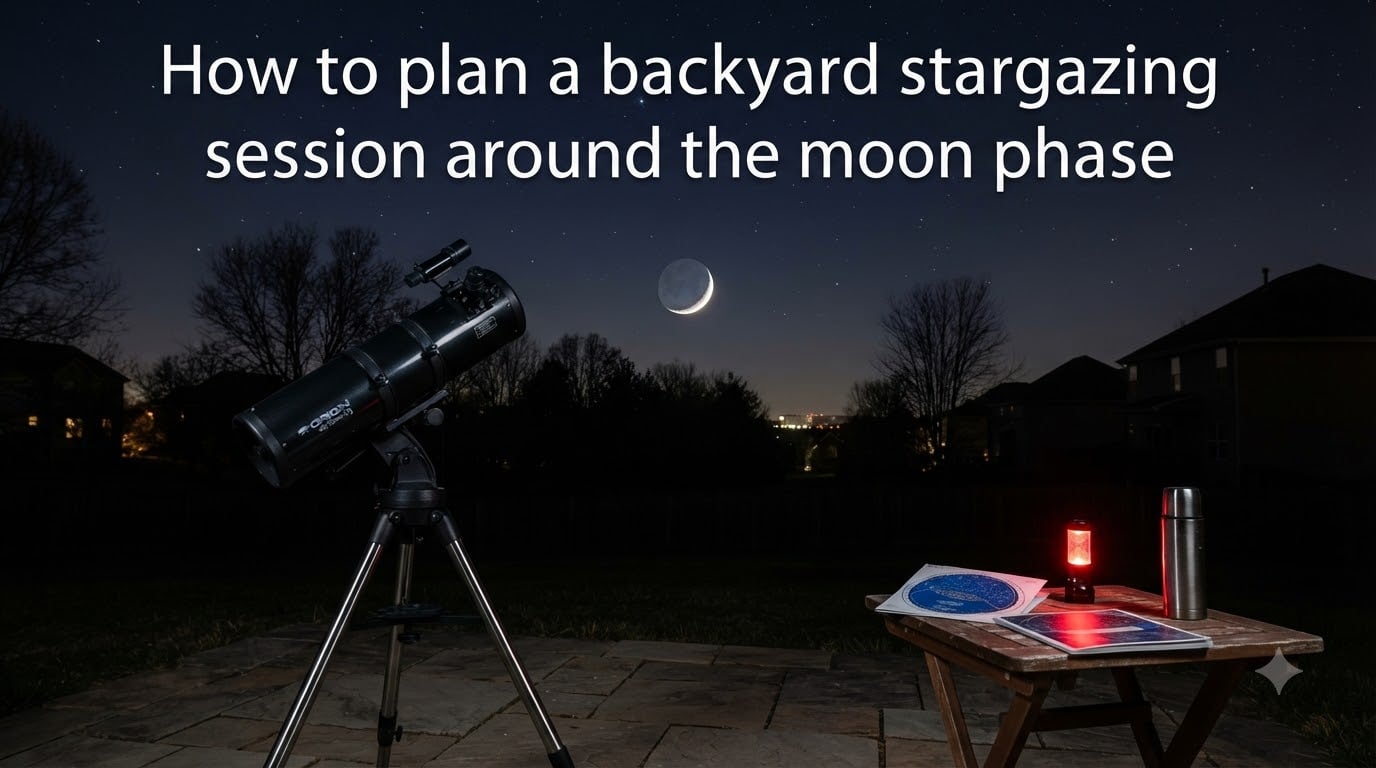
I learned this the hard way during a backyard stargazing session last spring. I dragged my telescope out on a perfectly clear night, lined up my star charts, and saw almost nothing except a washed-out sky. The culprit was a gibbous moon I had not bothered to check.
If you want to plan a backyard stargazing session around the moon phase, you are dealing with the single biggest variable that determines what you can see from home. I have spent the last three years testing every moon phase from my own suburban backyard, and I will share what actually works in this guide.
This is a practical walkthrough built on real observation logs, not theory. You will learn which moon phases matter, when to set up, and how to handle that bright full moon when it shows up uninvited.
Table of Contents
Why Moon Phase Matters for Backyard Stargazing
Moon phase affects stargazing because moonlight is sky pollution you cannot turn off. During a full moon, the lunar surface can be roughly 400,000 times brighter than the Milky Way’s galactic core, which means faint galaxies, nebulae, and the Milky Way itself get completely washed out.
From a typical suburban backyard, the difference between a new moon night and a full moon night is striking. On a new moon evening with clear skies, I can usually spot around 2,500 to 3,000 stars with the naked eye. On a full moon night from the same backyard, that number drops to about 300 stars, and most deep sky objects disappear.
The moon is your biggest ally or your worst enemy depending on what you want to see. If you are hunting for the Andromeda Galaxy or the Orion Nebula, moon phase planning is non-negotiable. If you want to enjoy the moon itself, planetary viewing, or bright star clusters, phase matters far less.
Understanding the 8 Moon Phases and Their Stargazing Ratings
The moon cycles through eight distinct phases over roughly 29.5 days, called a synodic month. Each phase changes sky brightness dramatically, so knowing where the moon sits in its cycle tells you immediately how good your backyard viewing will be.
Moon Phase Comparison for Backyard Stargazing
Here is how I rate each phase based on actual backyard observation sessions over the past two years.
New Moon (0% illumination) — Rating: 10/10
The sky is at peak darkness. This is the gold standard for backyard stargazing, especially for the Milky Way, faint galaxies, and nebulae. Plan your session here whenever possible.
Waxing/Waning Crescent (1-25% illumination) — Rating: 8/10
Excellent conditions. The thin crescent sets or rises late, leaving most of the night dark. This is the second-best window for backyard deep sky observation.
First/Last Quarter (50% illumination) — Rating: 5/10
Half the night is dark, half is lit. You can still see major constellations and brighter deep sky objects. Plan around moonrise or moonset to catch the dark half.
Waxing/Waning Gibbous (51-99% illumination) — Rating: 3/10
Sky brightness interferes with most faint targets. Brighter star clusters, planets, and double stars remain visible. Save astrophotography for another night.
Full Moon (100% illumination) — Rating: 2/10
The sky stays bright all night. Deep sky observation is nearly impossible, but lunar observation, planet viewing, and casual constellation spotting work well.
Why the 25% Illumination Rule Matters
Astronomers often use a simple cutoff: if the moon is more than 25% illuminated, treat it as a bright moon night for planning purposes. Below 25%, sky darkness improves fast. Above 25%, conditions drop fast.
I have tested this rule across more than 40 backyard sessions and it holds up consistently. When in doubt, the 25% threshold is the line that separates a true deep sky night from a casual observing night in my backyard.
Best Moon Phases for Backyard Stargazing
The best moon phase for stargazing is the new moon, followed closely by the two crescents on either side. These three windows, covering roughly 8 to 10 days per lunar cycle, give you the darkest possible skies from your backyard.
I focus most of my serious backyard observation during the new moon plus the three days before and after. The crescent moon either rises very late or sets very early, which means it is out of the sky during prime viewing hours (typically 10 PM to 4 AM).
For Milky Way viewing specifically, plan for a new moon in months when the galactic core is visible. From most U.S. latitudes, that window runs roughly March through August, depending on your location. A new moon in summer from a reasonably dark backyard can be genuinely stunning.
Strategic Timing: Moonrise and Moonset in Your Backyard
Moonrise and moonset timing is the secret trick that lets you stargaze during any phase. Even during a gibbous moon, you get a dark window before moonrise or after moonset.
Here is how I work the timing for my backyard:
New moon phase: The moon is near the sun and does not interfere all night. Session can run from astronomical twilight end until dawn.
Crescent phase: The moon is up for only part of the night. Get to your backyard during the dark hours when the moon is below the horizon.
Quarter moon phase: The moon is up for half the night. Target your backyard session for the dark half. First quarter is dark before midnight, and last quarter is dark after midnight.
Gibbous and full moon: Plan around moonrise (evening gibbous) or moonset (morning gibbous) to capture the small dark windows available.
I check moonrise and moonset times about a week ahead using a moon phase app or the Time and Date website. The 20 minutes I spend planning always saves me hours of frustration at the telescope.
What to Do During a Full Moon (When Stargazing Is Harder)
A full moon is not a wasted backyard night. You just shift your targets. The moon itself becomes the star of the show, along with planets and bright clusters that punch through moonlight.
My favorite full moon backyard activities include:
Lunar observation. Craters, maria, and mountain ranges are sharpest during high illumination. I can usually pick out Tycho, Copernicus, and the Apennine Mountains with my 8-inch scope on a full moon night.
Bright planet viewing. Jupiter, Saturn, Venus, and Mars handle moonlight well. Their brightness cuts right through sky glow.
Double stars and bright clusters. Stars like Albireo, the Pleiades (M45), and the Beehive Cluster (M44) all stay visible even with bright moonlight.
Planet observation. This is also a good night for catching Earthshine on the moon, where the dark portion glows faintly from reflected light off Earth.
Step-by-Step: Planning Your Backyard Stargazing Session
How to stargaze in your backyard depends on planning a week ahead of the actual night. Here is the exact process I follow for every backyard session.
Step 1: Check the moon phase 7-10 days out. Look up the upcoming new moon or crescent window using a free moon phase calendar app.
Step 2: Cross-reference moonrise and moonset times. Confirm the dark sky window for your specific backyard (shadows from trees, neighbor light direction).
Step 3: Check the weather forecast 3 days ahead. Cloud cover is the dealbreaker. A dark moon phase with clouds beats a clear full moon night for absolutely nothing.
Step 4: Set a backup date. I always have two dates circled on my calendar, separated by 2-3 days, around the new moon. Weather or unexpected clouds will not waste the work I put into planning.
Step 5: Prepare equipment the day before. Charge telescope batteries, lay out chairs, set up the binoculars, and download a sky chart app.
Step 6: Allow 20-30 minutes for dark adaptation. Arrive at your backyard session 30 minutes early. Avoid looking at phones or bright lights so your eyes fully adjust to darkness.
Step 7: Start with the easiest targets. Begin with the moon (if present), then planets, then bright stars, then deep sky objects.
Step 8: Log what you see. A simple notebook entry with date, time, moon phase, and objects viewed makes future planning sharper.
Backyard-Specific Light Reduction Setup Tips
Most stargazing guides assume you are heading to a dark sky site. Most of us, however, are working with a suburban backyard with neighbor lights, streetlamps, and porch glow.
Here is how I make my backyard darker without building a fortress.
Face away from the worst lights. I set up my telescope with my back to the brightest neighbor porch. Light direction matters more than I expected on suburban observation nights.
Use a backyard barrier. A simple tarp, fence screen, or even a tall hedge on the side facing streetlights cuts intrusive light significantly. I added a 6-foot privacy screen along one fence line and saw noticeably darker skies from my backyard.
Coordinate with your household. Ask family members to keep outdoor lights off for the session. Indoor lights spilling through windows also affect dark adaptation.
Switch to red lights only. Red flashlights and red phone filters preserve night vision. White light resets your dark adaptation in seconds and takes 20+ minutes to recover from.
Use a Bortle scale reference. Most suburban backyards sit between Bortle 5 and Bortle 7. Knowing your Bortle class tells you what to expect and what targets to skip.
Time your session to astronomical twilight. Wait until the sun is 18 degrees below the horizon. Earlier than that, the sky is still too bright for faint objects, regardless of moon phase.
Family-Friendly Activities by Moon Phase
Backyard stargazing is one of the best family activities you can build, but the right activity depends entirely on the moon phase. I have tested activities with my own family across every phase, and matching the activity to the phase keeps everyone engaged.
New moon nights (best for): Milky Way hunts, constellation storytelling, and spotting the zodiacal light. Kids love searching for the Andromeda Galaxy with binoculars because it actually shows up.
Crescent nights (best for): Catching the crescent moon low on the horizon. Kids are amazed that you can see the dark portion of the moon glowing from Earthshine.
Quarter moon nights (best for): Crater identification challenges. Print a simple moon map and let kids name craters along the terminator (the line dividing light and dark on the moon).
Full moon nights (best for): Moon photography, lunar surface sketching, and reading space-themed books outdoors under the moonlight. Perfect for less equipment-intensive family time.
Matching the activity to the moon phase is what separates an enjoyable family night from a bored-kid disaster. I keep a small “tonight’s moon activity” note on the fridge so everyone knows what we are doing when we walk out the back door.
Frequently Asked Questions
What is the best moon phase for stargazing?
The new moon is the best moon phase for stargazing, followed closely by the waxing and waning crescents. During these phases the sky is at peak darkness, allowing faint objects like the Milky Way, galaxies, and nebulae to stand out. The 25% illumination rule is a reliable shortcut: if the moon is below 25% lit, expect strong backyard viewing conditions.
How do I stargaze in my backyard?
To stargaze in your backyard, pick a night during a new moon or crescent phase, check moonrise and moonset times to find your darkest window, and arrive 20-30 minutes early to let your eyes adapt. Face away from the brightest neighbor lights, use a red flashlight, and start with the easiest targets like the moon, planets, and bright stars before moving to deep sky objects.
Which moon phase is not ideal for stargazing?
The full moon is the worst phase for stargazing faint objects, followed by gibbous phases above 75% illumination. Bright moonlight washes out nebulae, galaxies, and the Milky Way. During these phases, focus on lunar observation, bright planets, double stars, and bright open clusters instead.
Does the moon phase affect stargazing?
Yes, the moon phase is the single biggest factor in backyard stargazing. A full moon can make the sky bright enough to wash out thousands of faint stars and most deep sky objects. A new moon leaves the sky dark enough to reveal 2,500 to 3,000 stars from a typical suburban backyard along with galaxies and nebulae invisible at other phases.
Plan Your Next Backyard Stargazing Session Tonight
Planning a backyard stargazing session around the moon phase comes down to three checks: where the moon sits in its cycle, when it rises and sets, and how you set up your backyard for the dark. Match those three, and you will see more from home than many people see driving hours to a dark sky site.
Pull up a moon phase calendar for 2026, circle the next new moon plus the three days on either side, and put one session on your calendar this month. Once you see the difference for yourself, you will never go back to random clear nights.