
If you have ever heard someone say “correlation does not imply causation” and wondered what that actually means, you are in the right place. In this guide, I will walk you through exactly how to explain correlation versus causation with everyday examples that anyone can understand, no statistics degree required.
Correlation is when two variables change together in a measurable way, while causation means one variable directly causes the change in another. The distinction matters because confusing the two leads to bad decisions, wasted money, and misleading headlines.
Our team has spent years breaking down statistical concepts for students, parents, and professionals. The everyday examples in this guide come from real research, real news stories, and real conversations we have had with readers who wanted clarity.
By the end, you will be able to explain correlation versus causation to a coworker, a student, or even a child, and you will know how to spot faulty cause-and-effect claims in the news.
Table of Contents
What Is Correlation?
Correlation is a statistical measure that describes how two variables move in relation to each other. When one goes up and the other goes up too, that is a positive correlation. When one goes up and the other goes down, that is a negative correlation.
A simple everyday example: shoe size and reading ability in children. Older kids tend to have bigger feet and better reading skills, so the two variables move together. That is correlation, plain and simple.
Researchers measure the strength of a correlation using the correlation coefficient, which ranges from negative 1 to positive 1. A value near 1 means a strong positive relationship, a value near negative 1 means a strong negative relationship, and a value near 0 means there is basically no linear relationship at all.
Notice I said nothing about one thing causing the other. That is the whole point. Correlation only tells you that two things are associated, not that one drives the other.
What Is Causation?
Causation means that a change in one variable directly produces a change in another variable. If I flip a light switch, the room gets brighter because the switch controls the electricity flowing to the bulb. That is a direct cause-and-effect relationship.
In scientific research, establishing causation requires much more work than simply spotting a correlation. You need to rule out alternative explanations and demonstrate that the relationship holds up under controlled conditions.
One classic example of real causation: smoking causes lung cancer. This was not assumed from a single correlational study. Decades of controlled research, biological plausibility, and replicated findings all confirmed that smoking directly increases cancer risk.
Causation is what most people actually want to know when they look at data. They want to know what will happen if they change something. But correlation alone can never answer that question.
Correlation vs Causation: The Key Differences
The fastest way to explain correlation vs causation is a side-by-side comparison. Here are the differences that matter most.
Direction of influence. Causation flows one way, from cause to effect. Correlation has no direction at all, it just describes a pattern.
Predictive power. Causation lets you predict what happens when you intervene. Correlation only lets you predict what happens when you observe.
Evidence required. Causation requires controlled experiments, ruling out confounding variables, and replication. Correlation only requires a statistical calculation.
Everyday shortcut. Ask yourself: “If I stopped doing X, would Y still happen?” If yes, you are probably looking at correlation, not causation.
This simple question, which logicians call the counterfactual test, is one of the most practical tools for separating real cause-and-effect from mere association in daily life.
Why Correlation Does Not Imply Causation?
Three main reasons explain why a correlation can exist without any causal link between the two variables involved. Understanding these three traps will make you a sharper critical thinker.
The Third Variable Problem
The most common reason correlation is not causation is the third variable, also called a confounding variable. This is a hidden factor that influences both of the variables you are looking at, making them appear connected when they are not.
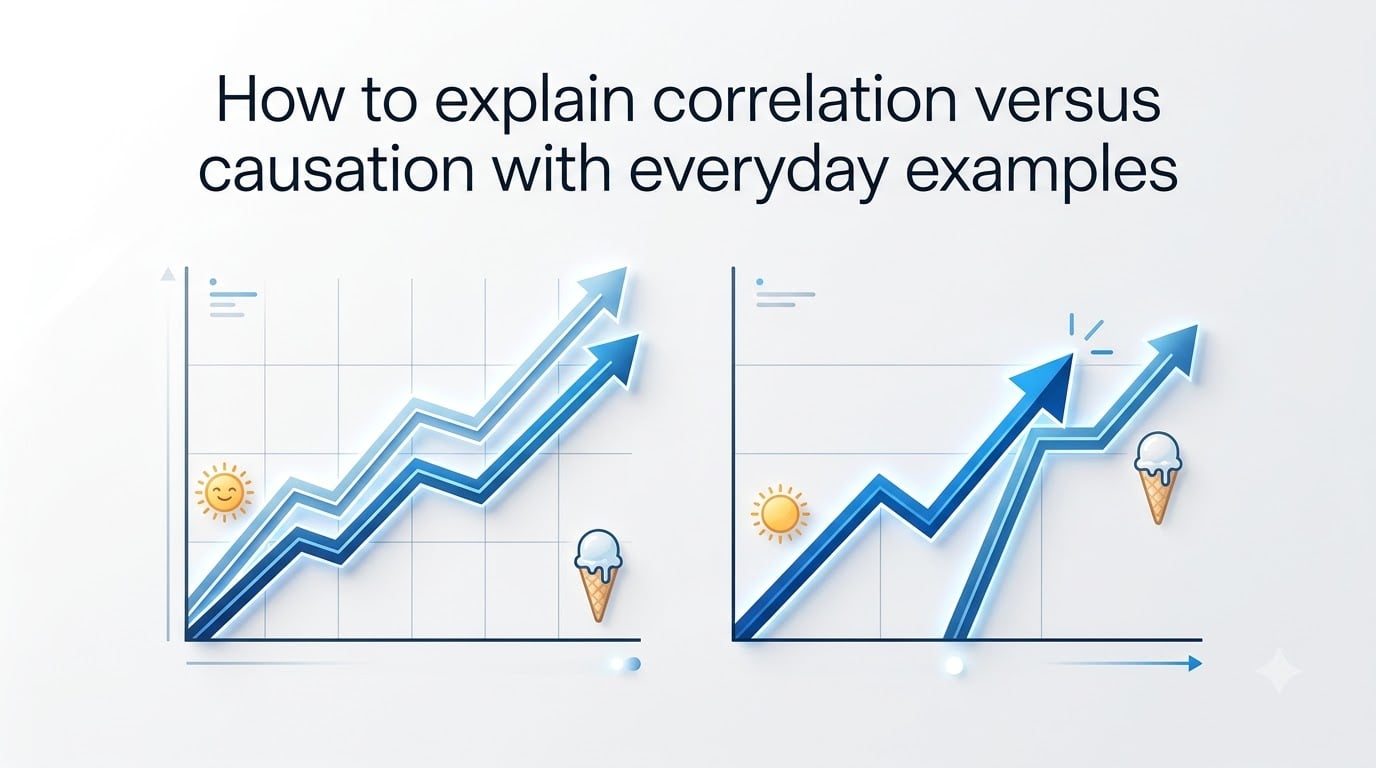
The famous example: ice cream sales and crime rates both rise during summer months. Looking at the data, you would see a strong positive correlation. But ice cream does not cause crime, and crime does not cause ice cream sales. The hidden third variable is temperature. Hot weather makes people buy more ice cream and also creates conditions where more crime occurs.
The Directionality Problem
Sometimes two variables are correlated but you cannot tell which one is causing the other. This is the directionality problem, and it shows up constantly in observational research.
For example, studies show that children who read more tend to have larger vocabularies. Does reading build vocabulary, or do kids with bigger vocabularies enjoy reading more? Without a controlled experiment, you cannot say for certain which direction the causation runs.
Pure Coincidence
Sometimes two things move together purely by chance. These are called spurious correlations, and they are more common than most people realize.
There is an entire website dedicated to hilarious spurious correlations, like the fact that Nicholas Cage movie releases correlate with swimming pool drownings. Nobody believes one causes the other. The pattern exists only because if you compare enough datasets, some will line up by random chance.
Everyday Examples of Correlation Without Causation
The best way to explain correlation vs causation is through relatable examples. Here are five everyday scenarios that illustrate the concept clearly.
1. Sunglasses and ice cream. On sunny days, more people wear sunglasses and more people buy ice cream. The two are correlated, but sunglasses do not cause ice cream purchases. The common cause is hot, sunny weather.
2. Coffee drinkers and heart disease. Early studies found a correlation between coffee consumption and heart disease. Later research revealed the real culprit: coffee drinkers in those studies were also more likely to smoke. Once researchers controlled for smoking, the link between coffee and heart disease largely disappeared.
3. Stork populations and birth rates. In some European countries, regions with more storks have higher birth rates. This is a real statistical correlation. But storks do not deliver babies. Rural areas tend to have both more storks and more families having children, while cities have fewer of both.
4. Education and income. People with more education tend to earn more money. While education likely contributes to higher earnings, the relationship is not purely causal. Factors like family background, intelligence, motivation, and social connections all influence both education and income simultaneously.
5. Phone use and sleep problems. Studies link heavy smartphone use to poor sleep quality. But does the phone cause the sleep issue, or do people who sleep poorly spend more time on their phones at night? Anxiety, stress, and lifestyle could be driving both.
Each of these examples shows why you should pause before assuming that a connected pattern means one thing is causing the other. Always ask what hidden variables might be at play.
How to Tell if Correlation Means Causation
Scientists use a specific set of criteria to move from correlation toward causation. Here is the practical process they follow, simplified for everyday use.
Step 1: Rule out chance. Use statistical significance testing to check whether the correlation is strong enough that it is unlikely to be random. A p-value below 0.05 is the common threshold, though it is not a magic number.
Step 2: Control for confounding variables. Use techniques like regression analysis or matching to account for third variables that could be driving the apparent relationship. The coffee and heart disease example shows why this step matters.
Step 3: Check the timeline. The supposed cause must come before the effect. If you cannot establish that X happened before Y, you cannot claim causation.
Step 4: Run a controlled experiment. The gold standard for establishing causation is a randomized controlled experiment. Randomly assign participants to groups, change one variable, and measure the outcome. Randomization helps distribute confounding variables evenly across groups.
Step 5: Look for a plausible mechanism. There should be a logical, biologically or physically plausible explanation for how the cause produces the effect. This is why the smoking and cancer link was convincing: researchers identified actual biological mechanisms in lung tissue.
Step 6: Replicate the finding. A single study is never enough. Causation becomes more convincing when independent researchers replicate the result in different populations and settings.
How to Explain Correlation vs Causation to a Child
Explaining this concept to kids works best with a concrete, silly example that makes them laugh. The stork and babies story works well for children because the image is memorable and obviously wrong.
Tell the child: “Imagine someone noticed that towns with more storks have more babies born. They might say storks bring babies! But what if those towns are just out in the country, where there are more birds AND more families with kids?”
Then give them a question to think through: “Does wearing your lucky socks make your team win, or do you just remember wearing them on the days you won?” This teaches them to look for hidden variables in their own life.
Keep it playful and let them come up with their own examples. Kids who invent their own silly correlations understand the concept far better than kids who just hear a definition.
Why Our Brains Confuse Correlation With Causation?
The human brain is wired to find patterns and assign causes to them. This tendency, called causal reasoning, helped our ancestors survive. If eating a certain berry was followed by getting sick, it was safer to assume the berry caused the illness.
The problem is that this same instinct fires even when there is no real causal link. Psychologists call this apophenia, the tendency to perceive meaningful connections between unrelated things. It is why we see faces in clouds and believe in lucky charms.
Confirmation bias makes things worse. Once we believe X causes Y, we notice every example that fits and ignore the ones that do not. This is why personal anecdotes are such unreliable evidence for causation.
Recognizing these built-in mental shortcuts is the first step toward thinking more clearly about data and avoiding common reasoning errors.
How to Spot Faulty Causation Claims in the Media?
News headlines are notorious for implying causation from correlational data. Once you know what to look for, you will see it everywhere.
Watch for verbs like “causes,” “prevents,” “boosts,” or “lowers” in headlines about observational studies. If the study did not run a controlled experiment, those verbs are misleading. A more honest headline would say “linked to” or “associated with.”
Check whether the article mentions confounding variables. If a study finds that people who eat a certain food live longer, but never accounts for the fact that health-conscious people also exercise more and smoke less, the conclusion is shaky.
Look for the sample size and who funded the study. Small samples produce more false positives, and industry funding introduces subtle biases that can distort findings over time.
Finally, look for replication. One dramatic study means little. A body of consistent evidence from independent researchers means a lot. This single habit will protect you from most misleading health and science headlines.
Frequently Asked Questions
How to explain correlation vs causation?
Correlation means two variables change together, while causation means one variable directly causes the change in the other. The clearest way to explain it is with an everyday example like ice cream sales and crime rates, which both rise in summer because of hot weather, not because one causes the other.
What is a real life example of correlation without causation?
A classic real life example is ice cream sales and crime rates. Both increase during summer months, creating a strong correlation. But neither one causes the other. The hidden third variable is temperature, since hot weather drives both ice cream purchases and higher crime rates.
How to explain correlation vs causation to a child?
Use a silly, memorable example like the stork and babies story. Tell them that towns with more storks have more babies, but that is because those are country towns with more families and more birds. Then ask them whether wearing lucky socks really helps a team win, or if they just remember the wins. Letting kids invent their own examples works best.
What is a real life example of a correlation?
A simple real life correlation is shoe size and reading ability in children. Older kids tend to have both bigger feet and stronger reading skills, so the two variables move together. This is a positive correlation, but shoe size does not cause reading ability. Age is the common factor driving both.
Conclusion
Learning how to explain correlation versus causation with everyday examples is a skill that pays off every single day. The next time you see a headline claiming that something “causes” something else, you will know to ask about confounding variables, controlled experiments, and replication.
Remember the core distinction: correlation means two things move together, causation means one directly produces the other. Use the counterfactual test, watch for third variables, and never assume causation from a single observational study.
Teach it to a child with the stork example, apply it to your own decisions with the lucky socks question, and read news headlines with a sharper eye. That is the entire concept, and now you can explain it to anyone.