
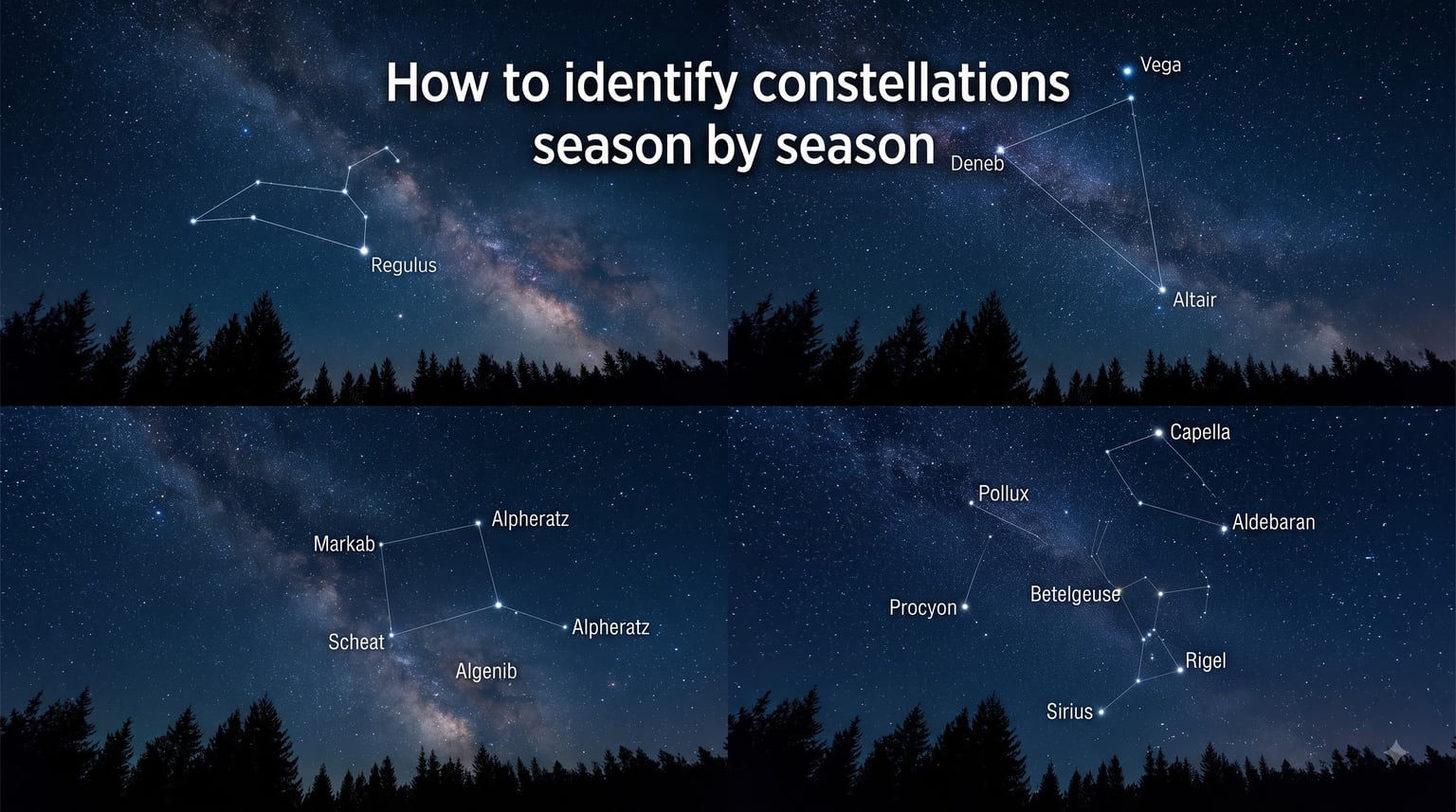
Learning how to identify constellations season by season is one of the most rewarding hobbies you can pick up. I still remember my first clear winter night, tracing Orion’s Belt across the sky and feeling like I had unlocked a secret the universe had been waiting to share.
This guide walks you through every season of the Northern Hemisphere night sky. By the end, you’ll know which constellations rise in each season, why they shift throughout the year, and how to spot deep-sky objects hiding inside them. We’ll cover spring, summer, autumn, and winter skies one at a time, so you can build your knowledge one season at a time.
Here’s what you’ll learn: the astronomy behind seasonal star patterns, the easiest constellations to find in each season, naked-eye and binocular targets, plus practical tips for light-polluted skies. Let’s get started.
Table of Contents
Why Constellations Change With the Seasons?
Constellations change with the seasons because Earth orbits the Sun. As our planet travels around our star over the course of a year, the night side of Earth faces different regions of space. The constellations you see at 10 PM in March are not the same ones you’ll see at 10 PM in September.
Think of it like standing in the middle of a room and slowly turning around. As you rotate, different paintings on the walls come into view. Earth’s yearly orbit works the same way, except we move around the Sun instead of spinning in place.
Earth’s Orbit and the Night Sky
The night side of Earth always points away from the Sun. When Earth is on one side of its orbit in July, the night side faces the constellation Sagittarius. Six months later in January, Earth has moved to the opposite side of the Sun, and the night side now faces Taurus and Gemini instead.
This is why the constellations visible in summer are completely different from those visible in winter. Spring and autumn serve as transition periods when the sky mixes constellations from both adjacent seasons.
Right Ascension and Declination Basics
Astronomers map the sky using two coordinates: right ascension (like longitude on Earth) and declination (like latitude). A constellation’s declination determines whether it rises above your horizon at all. Constellations near the celestial equator rise and set for most observers, while those near the north celestial pole stay visible year-round.
For Northern Hemisphere stargazers, constellations with high northern declination are always above the horizon. We call these circumpolar constellations because they appear to circle the North Star, Polaris, without ever setting.
Circumpolar Constellations You Can See Every Night
From mid-northern latitudes (around 40°N), seven constellations never set below the horizon. Ursa Major, Ursa Minor, Draco, Cepheus, Cassiopeia, Camelopardalis, and Lynx rotate around Polaris all year long.
The Big Dipper, part of Ursa Major, is the easiest circumpolar asterism to find. Use its pointer stars, Dubhe and Merak, to find Polaris, then drop down to Polaris’s brightness to gauge sky conditions. A dim Polaris means poor transparency; a bright one means excellent viewing.
How to Identify Constellations in Spring (March to May)
Spring skies offer a clean transition between winter’s bright stars and summer’s Milky Way. The Big Dipper rides high in the north, and Leo dominates the southern sky. Spring is also galaxy season, when we look out of our galaxy’s disk and into deep space.
Leo the Lion
Leo is the easiest spring constellation to identify once you know the trick. Look for a backwards question mark, called the Sickle, forming Leo’s mane and head. The bright star Regulus marks the bottom of the question mark and is Leo’s heart.
A triangle of stars to the east of the Sickle forms Leo’s hindquarters. Together, the Sickle and triangle outline a lion crouching in the sky. The famous Leonid meteor shower radiates from this constellation every November.
Ursa Major and the Big Dipper
Ursa Major contains the Big Dipper, the most recognizable asterism in the Northern Hemisphere. Seven bright stars form the dipper’s bowl and handle, which looks like a ladle in the sky. The Dipper is part of the larger Great Bear constellation.
Use the Dipper’s pointer stars to find Polaris and the north celestial pole. Then follow the handle’s curve to arc across the sky toward Arcturus in Boötes, a bright orange star that anchors spring evenings. This handle-arc trick works every spring night.
Virgo the Maiden
Virgo sprawls across the southern sky in spring, with brilliant blue-white Spica marking the ear of grain in her hand. Virgo covers a large region of sky and contains the Virgo Cluster, a massive grouping of galaxies about 54 million light-years away.
Spica sits low in the south during spring evenings. To find it, follow the arc of the Big Dipper’s handle past Arcturus and continue the same curve, a memory trick astronomers call “arc to Arcturus, then speed on to Spica.”
Spring Deep-Sky Targets
Spring skies offer dozens of bright galaxies. The Virgo Cluster alone contains Messier 87, Messier 49, and the Markarian Chain. The Leo Triplet, three spiral galaxies near Leo’s hindquarters, fits inside a single binocular field of view.
Look for the Beehive Cluster in Cancer, which lies between Leo and Gemini. It appears as a faint smudge to the naked eye in dark skies and resolves into dozens of stars through binoculars.
How to Identify Constellations in Summer (June to August)
Summer nights deliver the Milky Way at its best. The galaxy’s densest star clouds arc across the sky from Sagittarius in the south through Cygnus overhead. This is prime time for stargazing because the nights are warm and the sky stays dark late.
The Summer Triangle (Cygnus, Lyra, Aquila)
The Summer Triangle is the dominant asterism of summer evenings, made of three bright stars from three different constellations. Deneb in Cygnus the Swan, Vega in Lyra the Harp, and Altair in Aquila the Eagle form a giant triangle crossing the Milky Way.
Vega is the brightest of the three and sits high overhead on summer evenings. Deneb marks the tail of Cygnus, whose body forms the Northern Cross asterism stretching down the Milky Way. Altair is flanked by two fainter stars that hint at Aquila’s wings.
Scorpius and Sagittarius
Scorpius the Scorpion rises in the southeast on summer evenings. Look for the bright red supergiant Antares, whose name means “rival of Mars” because of its reddish color. The constellation curves through the sky like a fishhook or scorpion’s tail.
Sagittarius follows Scorpius and points the way to the center of our Milky Way galaxy. The constellation’s stars form a teapot shape, with the Milky Way appearing as steam rising from its spout. Through binoculars, this region explodes with star clusters and nebulae.
Summer Milky Way Highlights
The summer Milky Way is the densest part of our galaxy visible from Earth. Look along the band of light stretching from Sagittarius through Cygnus. You’ll see dark rifts where interstellar dust blocks distant starlight, and bright clouds where millions of stars crowd together.
The Cygnus Rift, a dark lane splitting the Milky Way through Cygnus, is visible even from suburban skies. It is a region of cold gas and dust where new stars are forming inside our galaxy.
Best Deep-Sky Objects for Summer Nights
Three spectacular nebulae wait inside the Summer Triangle. The Veil Nebula in Cygnus is a supernova remnant 2,400 light-years away. The Ring Nebula in Lyra looks like a smoke ring through a telescope. The North America Nebula in Cygnus resembles the continent’s shape and is wide enough to fill binoculars.
The Hercules Globular Cluster, Messier 13, sits between Vega and the two northern stars of the Hercules keystone asterism. It contains hundreds of thousands of stars and is one of the brightest globular clusters in the Northern Hemisphere.
How to Identify Constellations in Autumn (September to November)
Autumn skies are dimmer than summer or winter, but they hold some of the most famous patterns. The Milky Way fades as we look away from the galactic center, and the Great Square of Pegasus becomes the dominant feature in the south.
Pegasus and the Great Square
The Great Square of Pegasus is the autumn sky’s anchor. Four nearly equal-bright stars form a giant square, with each side spanning roughly 15 degrees, about three times the width of your fist held at arm’s length.
Look for the square standing on one corner in the south during autumn evenings. The constellation Andromeda extends from the square’s northeastern star, and that extension is your stepping stone to our nearest galactic neighbor.
Cassiopeia the Queen
Cassiopeia is a circumpolar constellation that shines high in the northeast on autumn evenings. Five bright stars form a distinctive W or M shape, depending on the time of night. It never sets below the horizon from mid-northern latitudes.
Cassiopeia sits opposite the Big Dipper around Polaris. When the Dipper is low in the north, Cassiopeia is high overhead, and vice versa. Use it as a reference point to find Andromeda, Perseus, and Cepheus.
Andromeda and the Andromeda Galaxy
Andromeda stretches east of the Great Square of Pegasus. Find the second star from the corner star Alpheratz, then hop two stars north to Mirach. Continue two more stars to find the Andromeda Galaxy, Messier 31.
M31 is the closest large galaxy to the Milky Way, about 2.5 million light-years away. It appears as a faint smudge to the naked eye in dark skies and grows into a glowing oval through binoculars. On a clear, moonless night, you are seeing light that left that galaxy when early humans first walked the Earth.
Autumn Stargazing Targets
Autumn is the best season to observe the Andromeda Galaxy and the Triangulum Galaxy. Both are part of our Local Group of galaxies. The Double Cluster in Perseus, two open star clusters side by side, fits inside a binocular field and is one of autumn’s most rewarding sights.
Look for the Pleiades, also called the Seven Sisters, rising in the east by late autumn. This open cluster will become a winter highlight, but you can spot its delicate pattern as early as October.
How to Identify Constellations in Winter (December to February)
Winter brings the brightest, most recognizable constellations of the year. Orion the Hunter dominates the southern sky, surrounded by a circle of brilliant first-magnitude stars that astronomers call the Winter Hexagon.
Orion the Hunter and Orion’s Belt
Orion is the easiest constellation to find, period. Three bright stars in a row form Orion’s Belt, and they point northeast toward Aldebaran in Taurus and southeast toward Sirius in Canis Major.
Look for the red supergiant Betelgeuse marking Orion’s shoulder and the blue-white Rigel at his foot. The three stars of Orion’s Belt, Alnitak, Alnilam, and Mintaka, line up perfectly and are visible from almost any location with even moderate light pollution.
Taurus and the Pleiades
Taurus the Bull charges Orion in the sky. The orange star Aldebaran marks the bull’s eye, and a V-shaped cluster of stars called the Hyades forms his face. Past Taurus, look for the Pleiades cluster riding on the bull’s shoulder.
The Pleiades, also known as the Seven Sisters, contains hundreds of stars about 444 light-years away. Most people see six or seven stars with the naked eye, but binoculars reveal dozens more embedded in delicate blue nebulosity.
Canis Major and Sirius
Canis Major, Orion’s hunting dog, follows Orion across the winter sky. Sirius, the brightest star in the night sky, marks the dog’s nose and is impossible to miss. It twinkles fiercely near the horizon because we see it through a thick layer of atmosphere.
Sirius is only 8.6 light-years away, making it one of our nearest stellar neighbors. Its name comes from the Greek word for “scorching,” and ancient stargazers blamed its brightness for the heat of summer when it rose with the Sun.
The Winter Hexagon
Six first-magnitude stars form a giant hexagon spanning the winter sky. Start at Sirius in Canis Major, then move clockwise through Procyon in Canis Minor, Pollux in Gemini, Capella in Auriga, Aldebaran in Taurus, and Rigel in Orion.
This Winter Hexagon is the largest and brightest asterism in any season. Once you identify these six stars, you have found the core of the winter sky. The Milky Way runs through one side of the hexagon, splitting the region between Gemini and Auriga.
Essential Tips for Beginner Stargazers
You don’t need expensive equipment to start identifying constellations. Our team has helped hundreds of beginners over the years, and these tips come straight from what works in the field.
Best Viewing Times and Conditions
The best stargazing happens on clear, moonless nights when the sky is fully dark. Wait at least an hour after sunset for astronomical twilight to end. Avoid nights near the full Moon, when moonlight washes out faint stars. Plan around new Moon phases for the darkest skies.
Give your eyes 20 to 30 minutes to adapt to darkness. Avoid looking at your phone screen during this time, or use a red-light filter to preserve your night vision. Once dark-adapted, you’ll see roughly three times more stars than you could at first glance.
Light Pollution Considerations
Light pollution is the biggest obstacle for city stargazers. The Bortle Scale ranks sky darkness from Class 1 (excellent dark site) to Class 9 (inner city). Most suburban skies fall in Class 5 to 6, where the Milky Way is faint or invisible.
You can still identify bright constellations from light-polluted areas. Focus on first-magnitude stars like Sirius, Vega, Arcturus, and Capella, which shine through urban glow. The Big Dipper, Orion, and Cassiopeia remain visible even from city centers. Drive 30 minutes outside town for noticeably darker skies.
Star Charts and Apps That Help
Free smartphone apps like Stellarium, Sky Map, and Sky Tonight turn your phone into a real-time planetarium. Hold your phone up to the sky and the app overlays constellation lines, star names, and deep-sky objects.
A traditional planisphere, a rotating star chart, is also valuable. It works without batteries, teaches you the sky’s mechanics, and forces you to learn star positions by actually finding them. Our team recommends using both: apps for quick identification and planispheres for deep learning.
Naked-Eye vs Binoculars vs Telescopes
Your naked eye is the best tool for learning constellations. It gives you the widest field of view and helps you see patterns. Start with naked-eye observation until you feel confident with the seasonal layout.
Binoculars, especially 10×50 models, are the next step. They reveal star clusters, nebulae, and double stars too faint for the naked eye. They are also forgiving and easy to aim, unlike telescopes.
Save telescopes for after you know the constellations well. A telescope shows a tiny patch of sky, so you need to know exactly where to point it. Beginners often give up on telescopes because they don’t know where to look first.
How to Read a Seasonal Sky Map
Seasonal sky maps show the sky as it appears at a specific time and date. Hold the map overhead and face the direction marked at the bottom. The map’s edge represents your horizon, and the center represents the sky directly above you.
Start at the horizon and work your way up. Find the brightest stars first, then connect them into constellations using the lines on the map. Practice with one season at a time so the patterns become second nature.
Frequently Asked Questions
Is there a standard way to divide constellations by season?
Yes. Most stargazers divide the Northern Hemisphere sky into four seasons: spring (March-May), summer (June-August), autumn (September-November), and winter (December-February). Each season features a different set of prominent constellations visible during evening hours. Spring highlights Leo and Virgo, summer brings the Summer Triangle and Scorpius, autumn showcases Pegasus and Andromeda, and winter features Orion and Taurus.
Why are different constellations visible in different seasons?
Constellations shift with the seasons because Earth orbits the Sun. As Earth moves around our star over the year, the night side of our planet faces different regions of space. The constellations you see at midnight in January are on the opposite side of the Sun from those you see at midnight in July, which is why summer and winter skies look completely different.
What is the easiest constellation to find in the Northern Hemisphere?
Orion is the easiest constellation to find in the Northern Hemisphere. Look for three bright stars in a straight line, Orion’s Belt, on winter evenings in the southern sky. Once you spot the Belt, the surrounding constellation outline is easy to trace. The Big Dipper is a close second and is visible year-round from mid-northern latitudes.
How can I tell what time of year it is by looking at the stars?
You can tell the time of year by identifying which constellations are visible. Orion and Taurus mean winter. Leo and Virgo mean spring. The Summer Triangle and Scorpius mean summer. Pegasus and Cassiopeia mean autumn. Ancient cultures used star positions to mark seasons long before calendars existed, and you can use the same sky landmarks today.
What constellations are visible all year from the Northern Hemisphere?
Seven constellations are circumpolar from mid-northern latitudes and never set below the horizon: Ursa Major, Ursa Minor, Draco, Cepheus, Cassiopeia, Camelopardalis, and Lynx. They rotate around Polaris, the North Star, throughout the night and across all seasons, making them reliable landmarks for any time of year.
Do constellations ever change position over time?
Yes, but very slowly. Due to a wobble in Earth’s axis called precession, the celestial pole traces a circle over roughly 26,000 years. This means the North Star changes over millennia, and constellation positions shift gradually. The constellations we recognize today looked different to ancient Sumerians and will look different to stargazers 10,000 years from now.
Final Thoughts on Seasonal Constellation Identification
Learning how to identify constellations season by season is a skill that grows with practice. Start with one season’s brightest patterns, master them over a few weeks, then expand to the next season. Within a year, you’ll know the major constellations of every season and feel at home under the night sky.
Pick a clear night this week and step outside. Find Orion’s Belt if it’s winter, the Summer Triangle if it’s summer, or the Big Dipper in any season. The night sky has been waiting for you, and now you have a complete roadmap to start exploring it.
1 thought on “How to Identify Constellations Season by Season (October 2026) Guide”