
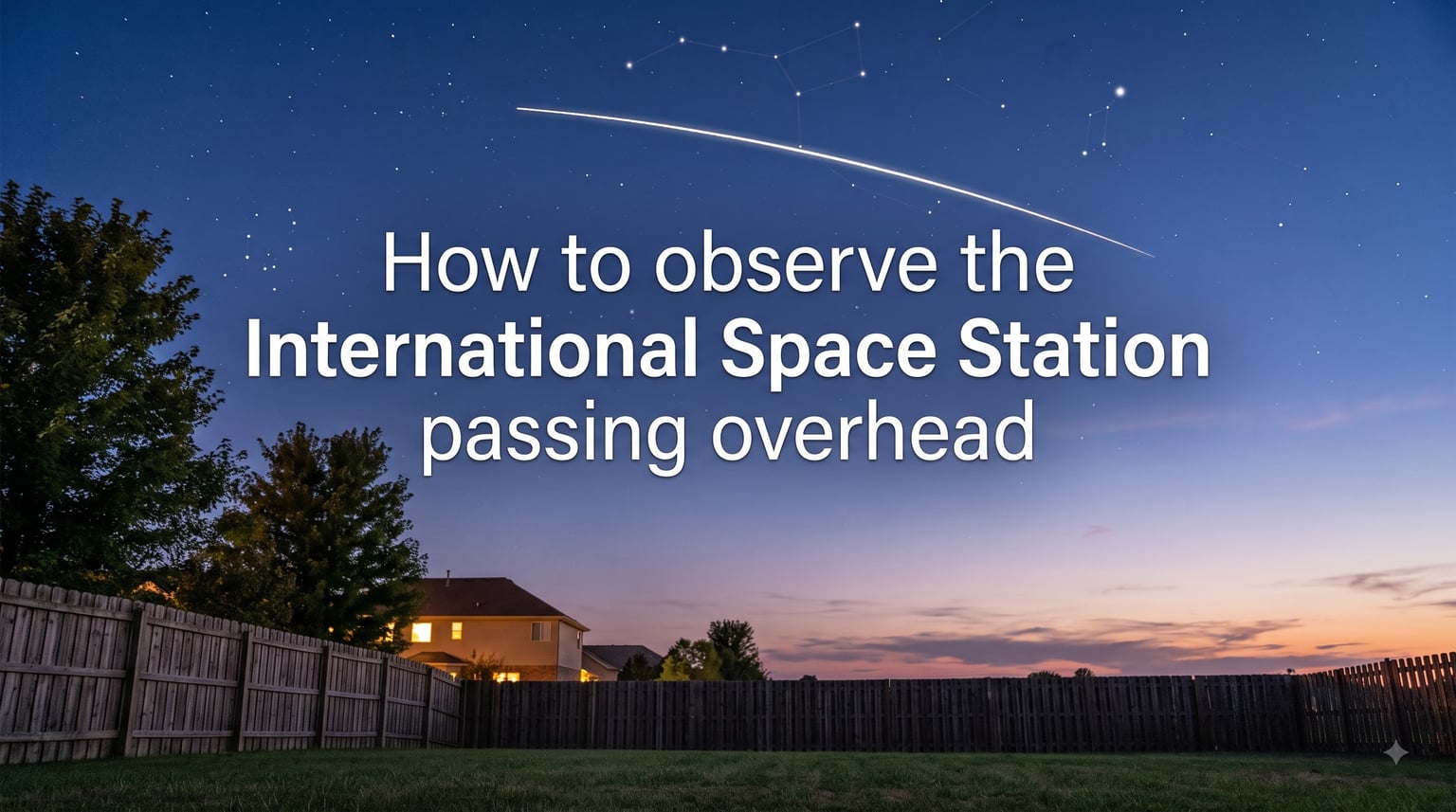
I still remember the first time I watched the International Space Station glide silently over my neighborhood. There were no flashing lights, no roar of an engine, just a steady white point moving faster than any airplane I had ever seen. Within three minutes it vanished over the rooftops, and I was hooked. If you have ever wanted to know how to observe the International Space Station passing overhead, this guide will get you outside and watching in a single evening.
The good news is that the ISS is the brightest man-made object in the night sky, and you do not need a telescope, binoculars, or even any experience. You just need clear skies, a little patience, and the right information about when and where to look.
Table of Contents
What the ISS Is and Why You Can See It Without a Telescope?
The International Space Station is a permanently crewed spacecraft orbiting about 250 miles above Earth. It travels at roughly 17,500 miles per hour and circles the planet every 90 minutes. Despite being so far away, the station is huge. Its solar arrays stretch about 240 feet from end to end, which is wider than a football field.
That massive surface area catches sunlight and reflects it back down to observers on the ground. The reflected light is intense enough to make the ISS shine as bright as the planet Venus, reaching a magnitude of negative 4 or so at its best passes. For comparison, the brightest stars hover around magnitude 0, so the ISS can outshine them by a wide margin.
This combination of large reflective surface, low orbit, and high speed is exactly why you can observe the International Space Station passing overhead using nothing but your eyes.
Why the ISS Is Only Visible at Dawn and Dusk?
Here is the part that trips up most beginners. The ISS does not generate its own visible light. It only shines because it reflects the Sun. For you to see it, three things have to happen at the same time.
The ISS must be above your horizon.
The Sun must be below your horizon so the sky is dark enough that a faint moving dot stands out.
The ISS must still be in sunlight, which means it needs to be high enough that the Sun has not set on it yet.
Those three conditions only line up in the window between sunset and full night, or between full night and sunrise. That is why NASA and most tracking apps only list ISS passes during twilight hours. Once the station flies deep into Earth’s shadow, it disappears from view.
Summer months often give the best evening opportunities because the Sun stays low on the horizon long after sunset, keeping the ISS bathed in sunlight while your sky remains dark.
What the ISS Looks Like Passing Overhead?
When you observe the International Space Station passing overhead, it looks like a bright, steady white star moving smoothly across the sky. There are no flashing lights, no colored strobes, and no sound.
A typical visible pass lasts between 1 and 6 minutes depending on the geometry. It usually enters from the western horizon, climbs to a peak elevation, then fades into Earth’s shadow or sinks below the eastern horizon. Because the ISS moves at orbital speed, it crosses the sky much faster than a commercial airplane, which typically moves at around 500 miles per hour.
Sometimes you will notice a smaller, dimmer object following the ISS by a few seconds or a few minutes. These are often visiting cargo ships, like the Russian Progress or SpaceX Dragon, or satellites released during a station maneuver.
How to Know When the ISS Will Pass Over Your Location?
Once you know what to look for, the next step is finding out when the station is going to appear above your town. Here is the workflow I use.
Go to NASA’s Spot the Station page at nasa.gov/spot-the-station and enter your city or coordinates.
Look for passes with a maximum height of 40 degrees or higher. Those are the easiest to see because the station flies directly overhead.
Note the compass directions where it appears and disappears, and how long the pass lasts.
Sign up for email or text alerts if you do not want to check the site every day.
Download the free Spot the Station mobile app for iOS or Android for push notifications.
For real-time confirmation, check a live tracker like Heavens-Above or ISS Live Now before you head outside.
The app will tell you the exact moment the ISS becomes visible, the highest point of the pass in degrees above the horizon, and the direction it will enter and exit your sky. Treat those minutes as sacred and step outside a few minutes early so your eyes adapt to the dark.
Understanding Elevation Angles and the Fist Method
Tracking alerts use a few specific numbers that can be confusing at first. Here is what they mean.
Maximum height is the peak elevation of the pass in degrees above the horizon. 90 degrees is straight up. 45 degrees is halfway up the sky.
Appears is the compass direction where the ISS first becomes visible above the horizon.
Disappears is where it either enters Earth’s shadow or drops below the opposite horizon.
To estimate degrees without any equipment, hold your fist out at arm’s length with the knuckles facing up. The height of your fist covers about 10 degrees of sky. Three fists stacked is roughly 30 degrees, four fists is about 40 degrees, and so on. This trick is great when an alert tells you to look 50 degrees up and you have no idea what that means.
Passes under 20 degrees are tougher because buildings, trees, and hills block the view. Passes above 40 degrees feel dramatic because the station goes almost directly overhead.
Best Viewing Conditions and Where to Watch From
You do not need a dark-sky preserve to enjoy an ISS flyover. The station is bright enough to spot from city centers, suburbs, and rural farms alike. Still, a few conditions improve the experience.
Clear skies matter most. Even thin cirrus clouds can dim the ISS to invisibility.
Low light pollution helps you see the fainter passes, especially those at lower elevations.
An open view of the compass direction listed in the alert removes a lot of frustration.
No direct sunlight in your eyes keeps your pupils dilated, so dimmer passes are easier to follow.
Backyards work great. So do rooftops, soccer fields, parking lots, and beaches. If you have kids, lay out a blanket, hand them a pair of binoculars to look at the stars while they wait, and let them shout when the ISS appears. It turns a 3-minute flyover into a memory they talk about for years.
How to Tell the ISS Apart from Airplanes and Starlink?
This was the number one confusion I saw across stargazing forums when I researched this article. People watch a bright light cross the sky and are not sure what they saw. Here is the simple breakdown.
ISS moves at a steady pace, does not blink, has a soft white glow, and follows a great arc that often crosses more than half the sky in minutes.
Airplanes have red and white blinking strobes, are usually much slower, and you can typically hear them if they are anywhere near you.
Starlink satellites appear as a tight train of dim lights moving in a straight line, often shortly after a launch. They are fainter than the ISS and travel in formation.
Meteors flash across a small patch of sky in under a second. The ISS is visible for one to six minutes.
If the light is steady, fast, and high, you are almost certainly watching the space station. If you want to double-check, open your tracking app live and compare the path on the screen to what you see above.
Photographing the ISS With a Smartphone or Camera
Once you have a few naked-eye sightings under your belt, photographing the station becomes the natural next step. You can absolutely capture an ISS streak with a phone.
Mount your phone on a tripod or steady it against a wall.
Open your camera app, switch to night mode or manual mode, and lock focus to infinity.
Use a 3 to 10 second exposure if your phone allows it.
Frame the path you expect the ISS to follow and start the exposure as it enters your field of view.
The result is a glowing arc across the sky that captures the motion of the station in a single still image. With a DSLR or mirrorless camera, use ISO 800 to 1600, an exposure of 8 to 15 seconds, and a wide-angle lens. Astrophotographers chasing even more ambitious shots sometimes capture the ISS transiting the Moon or Sun, which requires a telescope, a precise transit prediction, and a very steady hand.
Frequently Asked Questions About Observing the ISS
How do I know when the ISS is overhead?
Use NASA’s Spot the Station website or app and enter your city. It lists upcoming visible passes with exact times, compass directions, and maximum elevation. You can sign up for email or text alerts so you never miss a flyover.
What does the space station look like when it passes over?
It looks like a bright, steady white star moving smoothly across the sky without blinking. It moves faster than an airplane and usually takes 1 to 6 minutes to cross your field of view.
When can I see the ISS from my location?
Most locations get several visible passes per week. The best windows are in the hour after sunset or the hour before sunrise, when the sky is dark but the station is still in sunlight.
How often does the International Space Station pass overhead?
The ISS orbits Earth every 90 minutes, but only a few of those passes line up with your location and twilight viewing conditions. On average, expect 2 to 4 good viewing opportunities per week from any given spot.
Can I see the ISS without a telescope?
Yes. The ISS is the brightest man-made object in the night sky and is designed to be observed with the naked eye. Binoculars and telescopes can show structural detail but are not required.
Your First ISS Sighting Is Closer Than You Think
Learning how to observe the International Space Station passing overhead is one of the easiest and most rewarding stargazing skills you can pick up. There is no equipment to buy, no setup to master, and no weather worries beyond cloud cover.
Pick a clear evening this week, open Spot the Station, and step outside a few minutes before the listed flyover time. Within minutes you will see one of humanity’s most extraordinary outposts glide silently across your sky, and you will understand why so many first-time viewers describe the experience as unforgettable.